 Korea Immigration Regional Dashboard
SpotlightSeptember 2026Nationality profilesDownload PDF
Kazakh Immigrants in South Korea
Highlights
- In 2024, Kazakhstan was the 17th-largest nationality among registered foreigners in South Korea (20,482 people) and the 14th-largest among all resident foreigners (44,549 people), up from 25th and 30th place in 2014.
- In 2024, 42.9 percent of Kazakh residents held an overseas Korean status (F-4 or H-2), compared with 24.5 percent of all resident foreigners, and F-4 holders rose from 5,215 in 2019 to 14,501 in 2024.
- The Ministry of Justice counted 11,306 unauthorized Kazakh residents in 2024, equal to 25.4 percent of Kazakh resident foreigners and the seventh-largest count of any nationality.
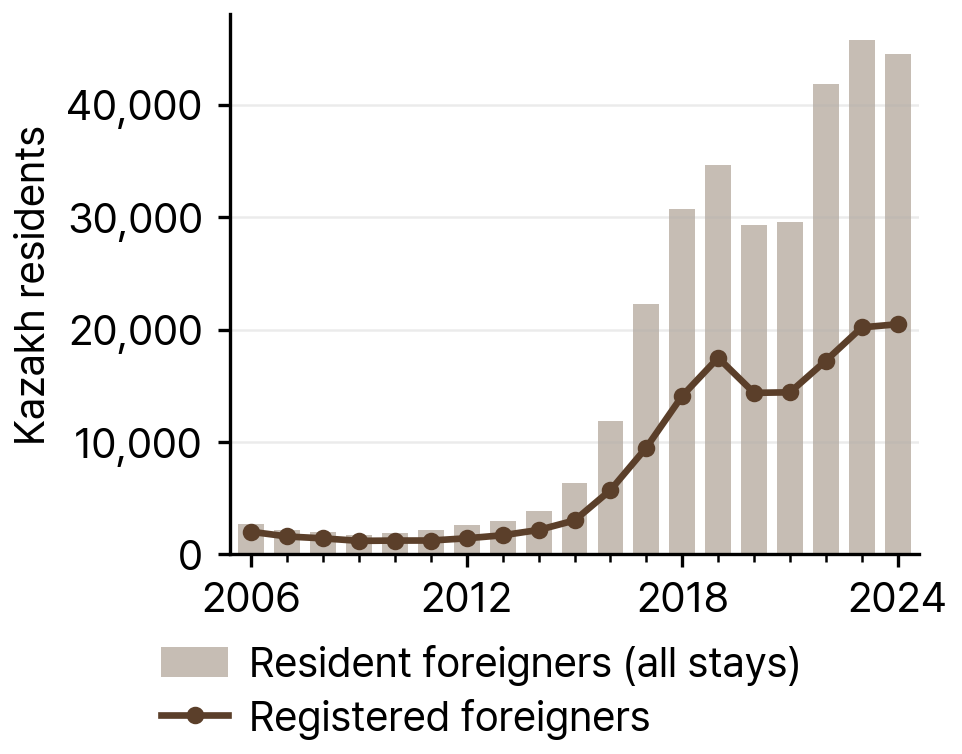
In 2024, 44,549 Kazakh nationals were resident in South Korea on 31 December, 1.7 percent of all resident foreigners. Kazakhstan was the 17th-largest nationality among registered foreigners, the long-term residents (20,482 people, 1.4 percent), and the 14th-largest among all resident foreigners, a count that also includes short-term visitors and F-4 holders. The population was small until the mid-2010s: 2,705 in 2006, 1,878 in 2010, and 3,865 in 2014, when Kazakhstan ranked 25th among registered foreigners and 30th among all resident foreigners. By 2019 the count had risen to 34,638, roughly nine times the 2014 figure. After falling to 29,278 in 2020, it rose again to a peak of 45,764 in 2023.
Many Kazakh nationals in Korea are Koryo-saram, ethnic Koreans whose families were deported from the Soviet Far East to Central Asia in 1937; about 100,000 ethnic Koreans live in Kazakhstan today (Korean Embassy in Kazakhstan, 2026). They have entered Korea mainly through the overseas Korean visas, H-2 (visiting employment) and F-4 (overseas Korean) (Ministry of Government Legislation, 2026). In February 2026 the Ministry of Justice merged these two statuses into F-4 (Ministry of Justice, 2026), and in August 2026 Kazakhstan became the 18th sending country under the Employment Permit System (E-9), with the first workers expected from 2028 (Herald Corp, 2026).
Compared with all resident foreigners in 2024, Kazakh residents were more likely to be children (12.8 percent aged 0-14, against 5.7 percent) and to hold overseas Korean or family statuses. They were much less likely to hold work visas (0.7 percent in the employment group, against 19.2 percent) or permanent residence (1.3 percent, against 7.7 percent). This Spotlight describes the size, location, age and sex, visa status, naturalization, and unauthorized residence of Kazakh nationals in South Korea, drawing on the KIRD dataset (KIRD, 2026) and published sources.
Size of the Population over Time
The number of Kazakh resident foreigners remained below 4,000 between 2006 and 2014 (2,705 in 2006, 1,878 in 2010, and 3,865 in 2014). It grew to 34,638 by 2019. After a drop to 29,278 in 2020 and 29,616 in 2021, the population rose to 41,840 in 2022 and peaked at 45,764 in 2023, then declined slightly to 44,549 in 2024.
Registered foreigners made up a falling share of the total. In 2006, 2,015 of 2,705 Kazakh residents (74 percent) were registered; by 2024 the figure was 20,482 of 44,549 (46.0 percent). Those outside the registered count are F-4 holders, who report residence instead of registering, and short-term visitors. Kazakhstan therefore ranked lower among registered foreigners than among all resident foreigners in 2024 (17th against 14th), while in 2014 it ranked higher on the registered basis (25th against 30th).
Source: KIRD dataset, from Ministry of Justice immigration yearbooks, 2006-2024.
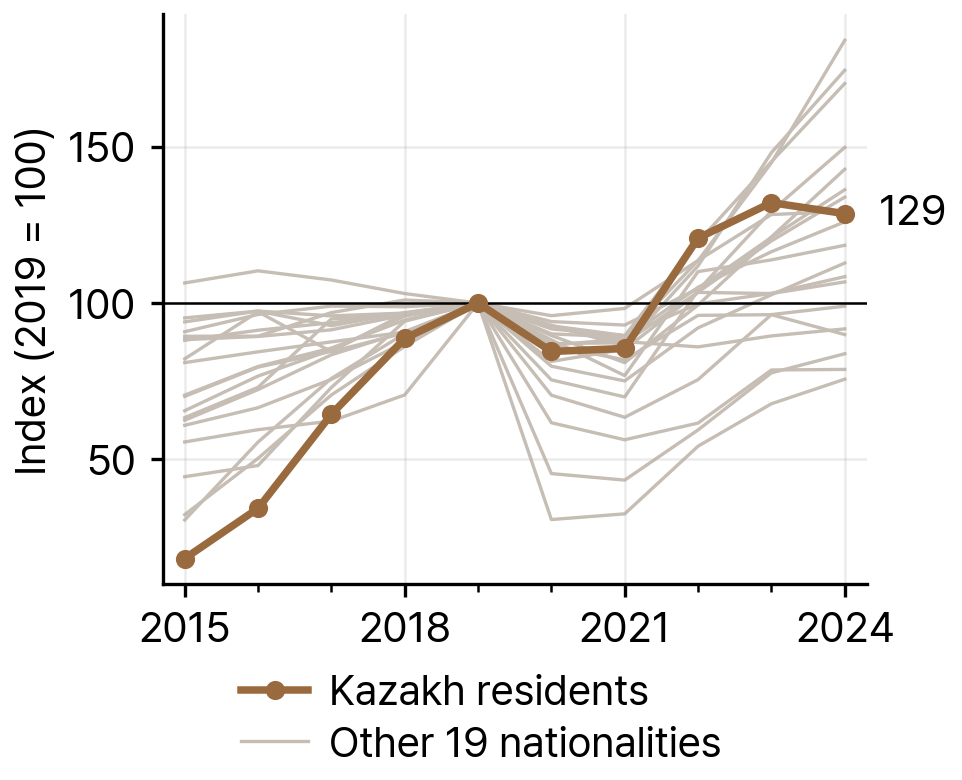
Measured against 2019, the Kazakh population stood at an index of 128.6 in 2024 (a 28.6 percent increase). This placed Kazakhstan ninth in growth among the 20 largest nationalities over 2019-24.
Source: KIRD dataset, from Ministry of Justice immigration yearbooks, 2006-2024.
Table 1Kazakh Resident and Registered Foreigners in South Korea, Selected Years
| Year | Resident foreigners | Registered foreigners | Rank among resident foreigners | Rank among registered foreigners | Share of all resident foreigners (%) | Share of all registered foreigners (%) |
|---|---|---|---|---|---|---|
| 2006 | 2,705 | 2,015 | 24 | 22 | 0.3 | 0.3 |
| 2014 | 3,865 | 2,176 | 30 | 25 | 0.2 | 0.2 |
| 2019 | 34,638 | 17,499 | 14 | 16 | 1.4 | 1.4 |
| 2024 | 44,549 | 20,482 | 14 | 17 | 1.7 | 1.4 |
Note: Resident foreigners include short-term visitors and F-4 holders who report their residence; registered foreigners are long-term residents who register with immigration authorities. Ranks are among all nationalities on each basis.
Source: KIRD dataset, from Ministry of Justice immigration yearbooks, 2006-2024.
Distribution by Province and District
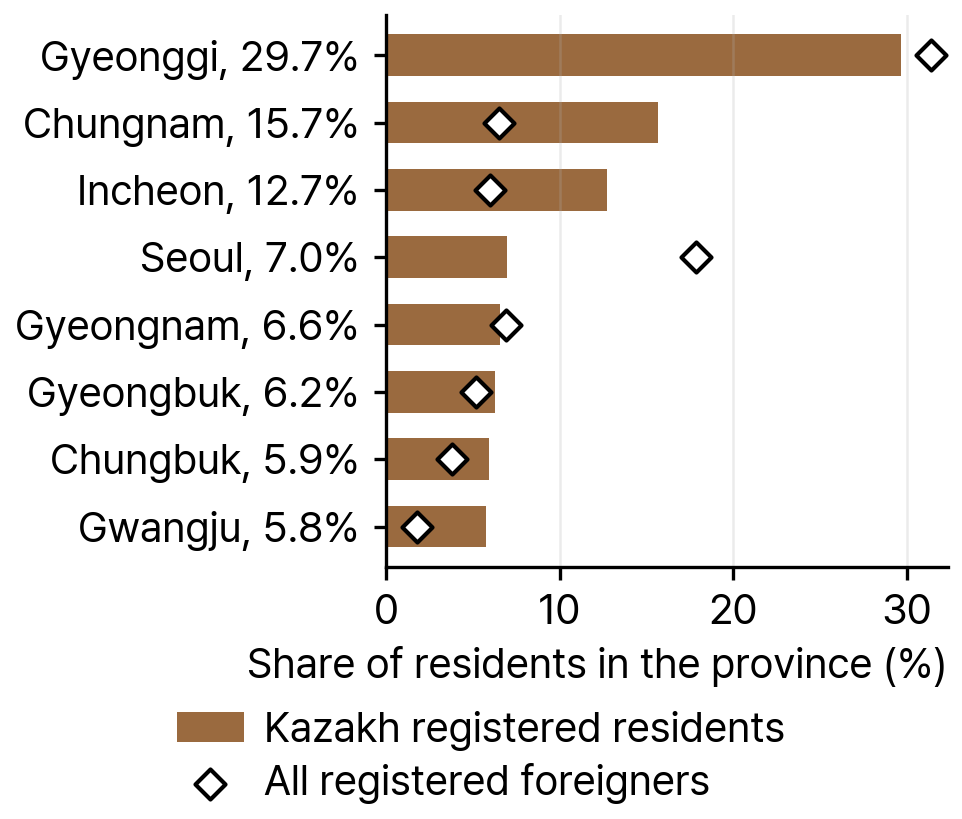
District-level data cover the 20,482 Kazakh registered foreigners in 2024. The Incheon and Gyeonggi area accounted for 42.4 percent of them and Seoul for 7.0 percent, so 49.4 percent lived in the capital region, compared with 55.2 percent of all foreign residents. The Chungcheong provinces accounted for 23.9 percent, Yeongnam 17.8 percent, Honam 7.9 percent, and Gangwon and Jeju 1.1 percent. Some 7.7 percent lived in rural counties (gun), compared with 10.6 percent of all foreign residents.
Source: KIRD dataset, from Ministry of Justice district statistics on registered foreigners, 2024.
The ten largest districts accounted for 53.3 percent of Kazakh registered foreigners in 2024, and 41 districts had at least 100. Incheon Yeonsu-gu had the most (2,126), followed by Asan-si in South Chungcheong (1,813). The two districts of Ansan together had 2,028 (1,188 in Danwon-gu and 840 in Sangnok-gu). Kazakh nationals made up 11.7 percent of all registered foreigners in Yeonsu-gu, 8.5 percent in Gyeongju-si, and 7.7 percent in Asan-si.
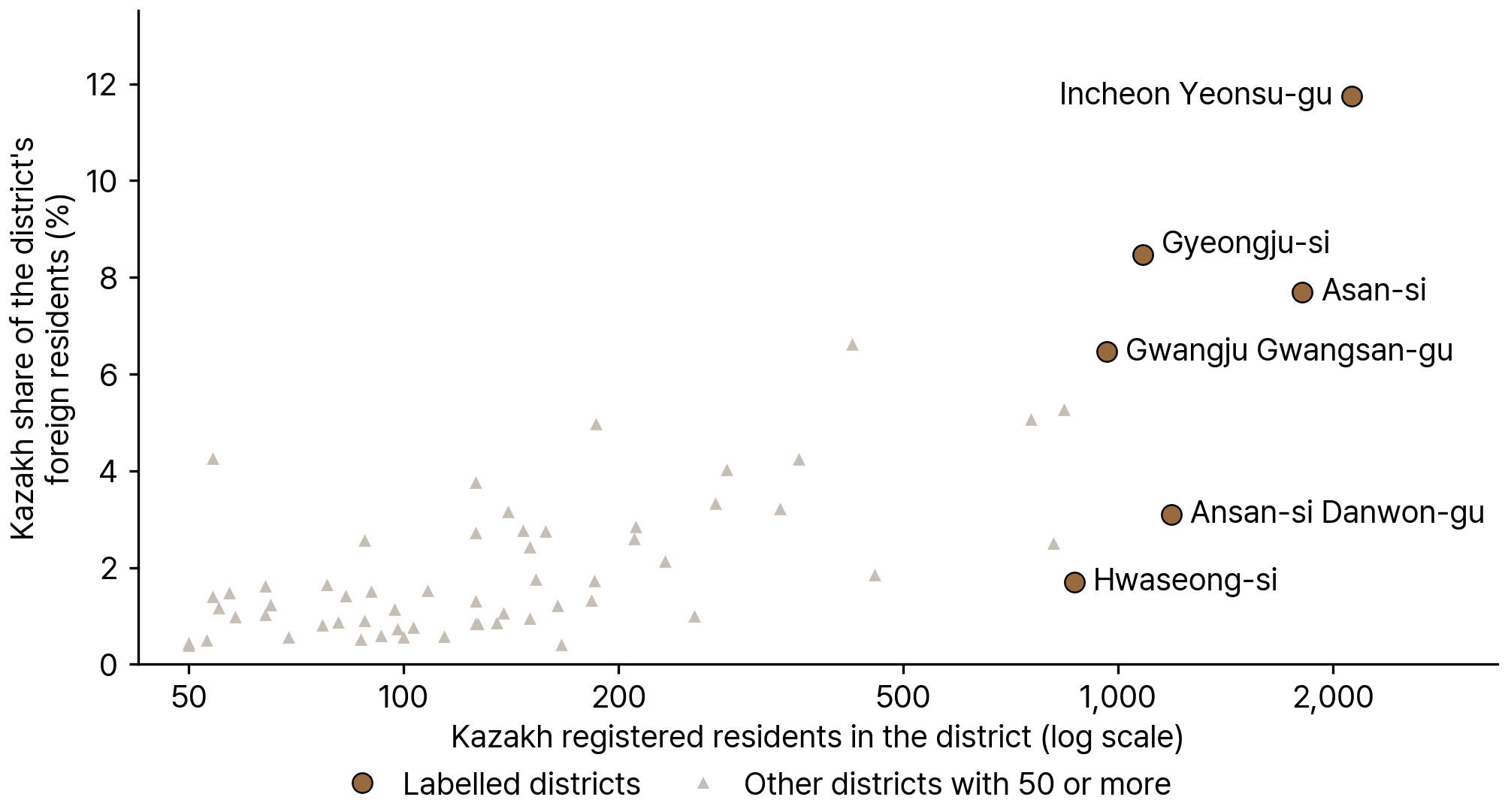
Source: KIRD dataset, from Ministry of Justice district statistics on registered foreigners, 2024.
Table 2Ten Districts with the Most Kazakh Registered Foreigners, 2024
| District | Province | Kazakh residents | Share of district's foreign residents (%) |
|---|---|---|---|
| Incheon Yeonsu-gu | Incheon | 2,126 | 11.7 |
| Asan-si | Chungcheongnam-do | 1,813 | 7.7 |
| Ansan-si Danwon-gu | Gyeonggi-do | 1,188 | 3.1 |
| Gyeongju-si | Gyeongsangbuk-do | 1,085 | 8.5 |
| Gwangju Gwangsan-gu | Gwangju | 966 | 6.5 |
| Hwaseong-si | Gyeonggi-do | 869 | 1.7 |
| Ansan-si Sangnok-gu | Gyeonggi-do | 840 | 5.3 |
| Pyeongtaek-si | Gyeonggi-do | 813 | 2.5 |
| Anseong-si | Gyeonggi-do | 755 | 5.1 |
| Gimhae-si | Gyeongsangnam-do | 457 | 1.8 |
Note: Registered foreigners only; F-4 holders are not included.
Source: KIRD dataset, from Ministry of Justice district statistics on registered foreigners, 2024.
The index of dissimilarity (D) between Kazakh registered foreigners and all other registered foreigners across districts rose from 0.507 in 2014 to 0.586 in 2024, so in 2024, 58.6 percent of Kazakh residents would have had to move to match the distribution of other foreigners. No district met the KIRD definition of an ethnic enclave in 2024 (a location quotient of at least 2 and the group making up at least 30 percent of the district's foreign residents); the highest share was 11.7 percent, in Yeonsu-gu.
Age and Sex
Women made up 45.3 percent of Kazakh residents in 2024 (20,185 of 44,549), up from 42.0 percent in 2019 and close to the 45.1 percent among all resident foreigners. The largest five-year age group in 2024 was 25-29, and the median fell in the 30-34 group.
Children were more common than among foreigners overall. In 2024, 5,703 Kazakh residents (12.8 percent) were aged 0-14, compared with 5.7 percent of all resident foreigners; in 2019 the figure was 2,649 (7.6 percent). Children under 5 numbered 1,775 in 2024, up from 1,081 in 2019. Adults aged 20-39 made up 48.7 percent in 2024 (49.7 percent for all resident foreigners), and people aged 60 and older 4.8 percent (12.9 percent for all resident foreigners).
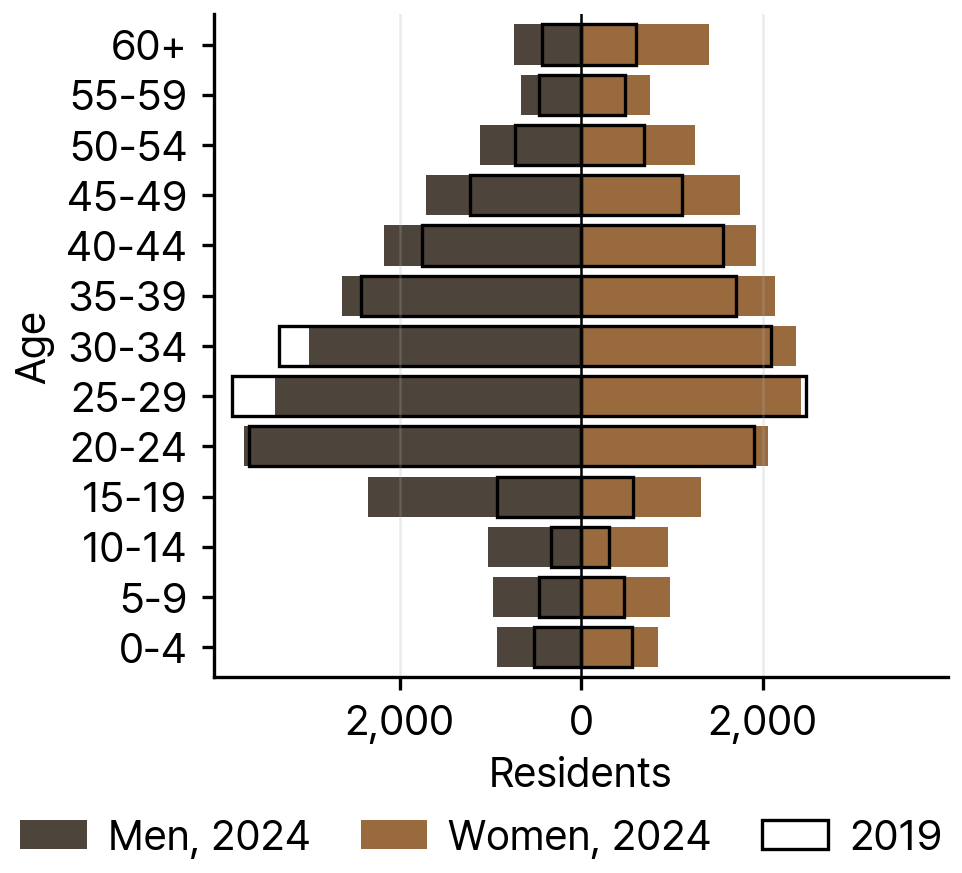
Source: KIRD dataset, from Ministry of Justice immigration yearbooks, 2006-2024.
Visa Status
In 2024, 42.9 percent of Kazakh residents held one of the two overseas Korean statuses (F-4 or H-2), compared with 24.5 percent of all resident foreigners. Another 20.9 percent were short-term visitors (19.7 percent overall), 17.5 percent held marriage or family statuses (13.6 percent overall), and 13.2 percent held other statuses (5.2 percent overall). Only 0.7 percent held employment visas, against 19.2 percent of all resident foreigners, and 1.3 percent held permanent residence (F-5), against 7.7 percent.
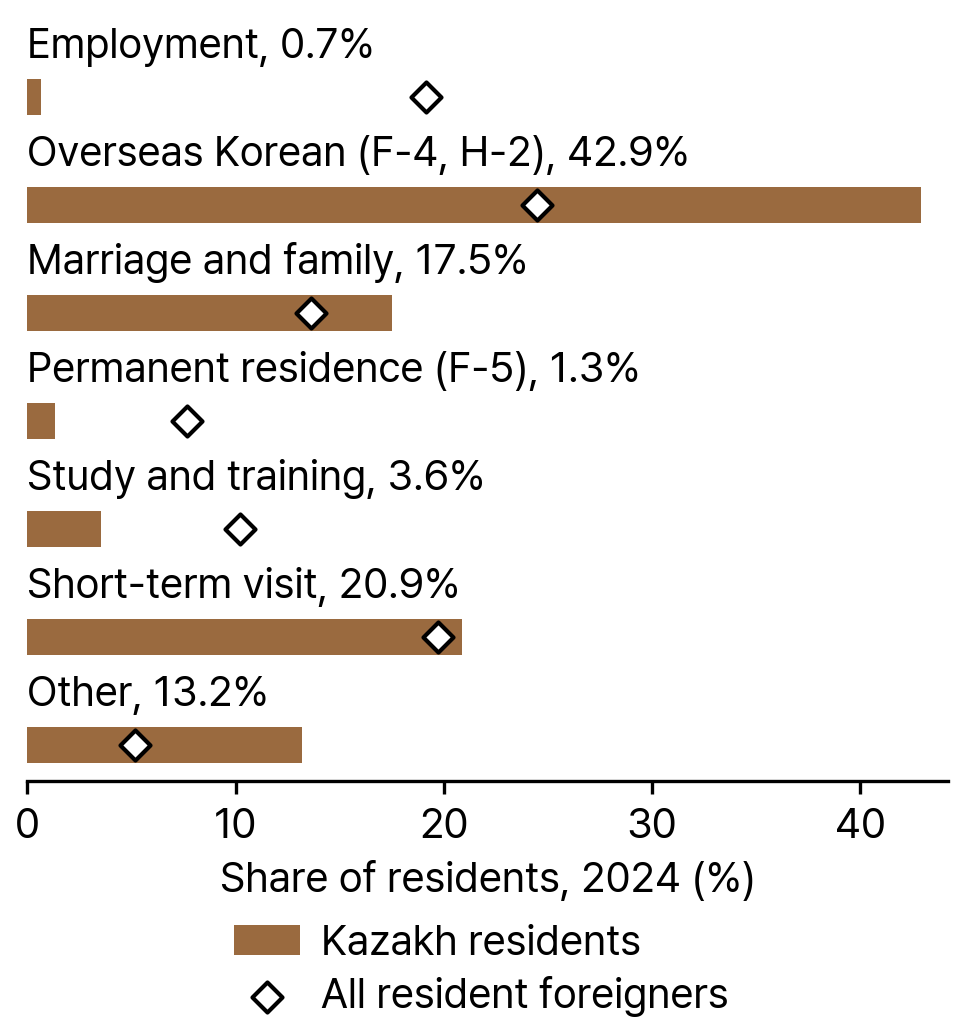
Source: KIRD dataset, from Ministry of Justice immigration yearbooks, 2006-2024.
F-4 was the most common single status in 2024, held by 14,501 Kazakh nationals (32.6 percent), up from 5,215 in 2019 and 782 in 2014. Kazakhstan had the sixth-largest number of F-4 holders of any nationality in 2024. Between 2019 and 2024, H-2 holders fell from 7,762 to 4,615 and visa-exempt visitors (B-1) from 11,541 to 9,066. Dependent family (F-3) holders grew from 151 to 1,547, and visiting cohabitation (F-1) holders from 3,739 to 5,147. The 5,511 Kazakh holders of the miscellaneous G-1 status in 2024 made up 9.7 percent of all G-1 holders in Korea.
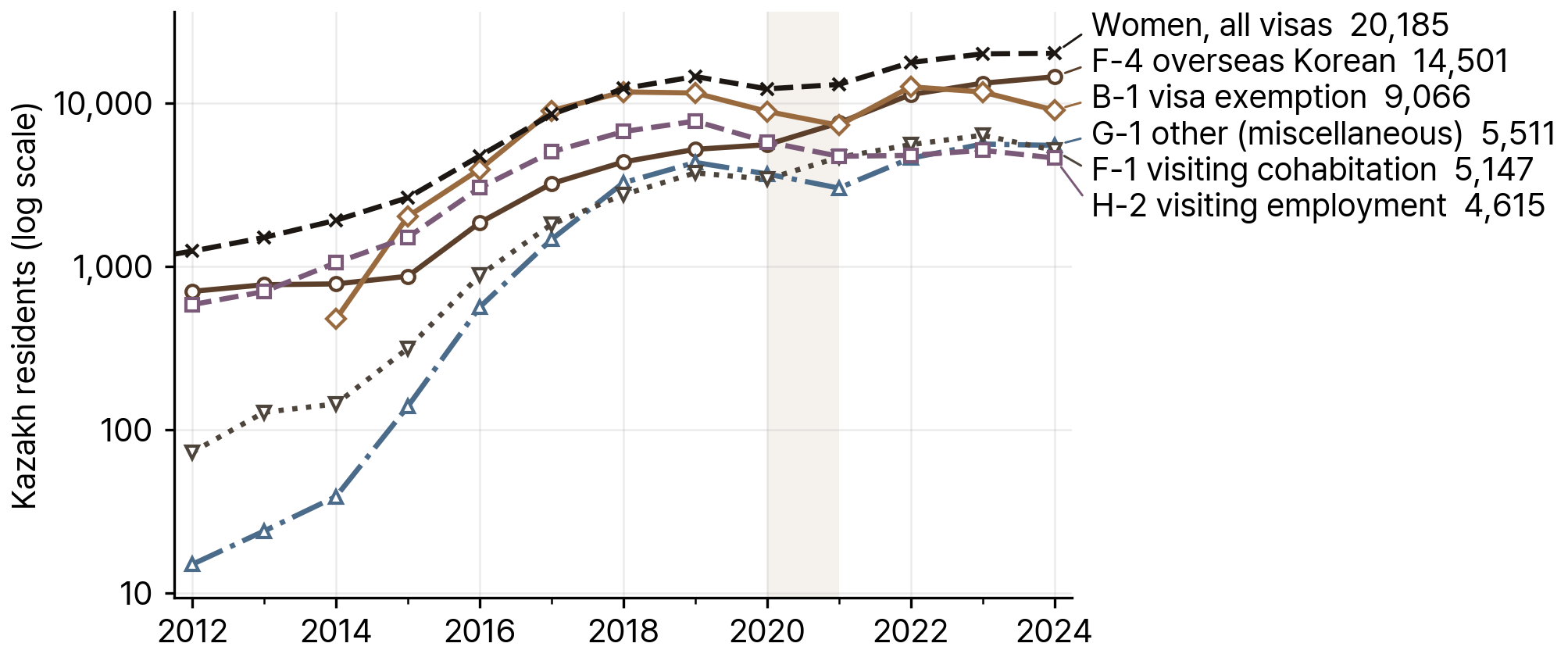
Source: KIRD dataset, from Ministry of Justice immigration yearbooks, 2006-2024.
Table 3Most Common Visa Types among Kazakh Residents in South Korea, 2019 and 2024
| Visa | Meaning | 2019 | 2024 | Share of Kazakh residents, 2024 (%) | Share of all holders of this visa in Korea, 2024 (%) |
|---|---|---|---|---|---|
| F-4 | Overseas Korean | 5,215 | 14,501 | 32.6 | 2.6 |
| B-1 | Visa exemption | 11,541 | 9,066 | 20.4 | 4.4 |
| G-1 | Other (miscellaneous) | 4,334 | 5,511 | 12.4 | 9.7 |
| F-1 | Visiting cohabitation | 3,739 | 5,147 | 11.6 | 5.2 |
| H-2 | Visiting employment | 7,762 | 4,615 | 10.4 | 4.9 |
| F-3 | Dependent family | 151 | 1,547 | 3.5 | 2.9 |
| D-2 | Student | 807 | 1,178 | 2.6 | 0.7 |
Note: Total Kazakh resident foreigners in 2024: 44,549. The H-2 status was merged into F-4 in February 2026.
Source: KIRD dataset, from Ministry of Justice immigration yearbooks, 2006-2024.
Migration Channels and Policy
Ethnic Koreans from Kazakhstan have entered and worked in South Korea mainly through the H-2 visiting employment visa, the route for ethnic Koreans aged 18 and older from China and the former Soviet (CIS) region (Ministry of Government Legislation, 2026). F-4 status is the other overseas Korean route.
On 12 February 2026, the Ministry of Justice merged the H-2 and F-4 statuses into a single F-4 status. New H-2 visas are no longer issued, and existing H-2 holders may change to F-4 before their permitted period ends. The ministry said the change ends disputes over unequal treatment by country of origin and covers about 860,000 overseas Koreans living in Korea (Ministry of Justice, 2026). The KIRD data end in 2024 and so predate this change.
On 14 August 2026, Korea's Foreign Workforce Policy Committee designated Kazakhstan as the 18th sending country under the Employment Permit System (E-9), the fourth in Central Asia after Uzbekistan, Kyrgyzstan, and Tajikistan (Herald Corp, 2026). Kazakhstan qualified because a government agency deals exclusively with worker dispatch and no problems were found with its training facilities; the first workers are expected from 2028 (Korea Times, 2026). The two governments signed a labor-sending memorandum of understanding on 15 September 2026 (Newsis, 2026). In 2024, 0.7 percent of Kazakh residents held employment visas.
Naturalization
Between 2014 and 2024, 181 Kazakh nationals were naturalized as South Korean citizens; the yearbook's by-country naturalization table starts in 2011, but the row covering all naturalization routes for this nationality begins only in 2014. Annual numbers ranged from 4 in 2016 to 33 in 2024, the highest year in the period. Between 2011 and 2024, 12 people from Kazakhstan also had their Korean nationality restored, a route open to those who once held Korean citizenship; none did so in 2024. Against a resident population of 44,549 in 2024, these totals are small, and 1.3 percent of Kazakh residents held permanent residence that year.
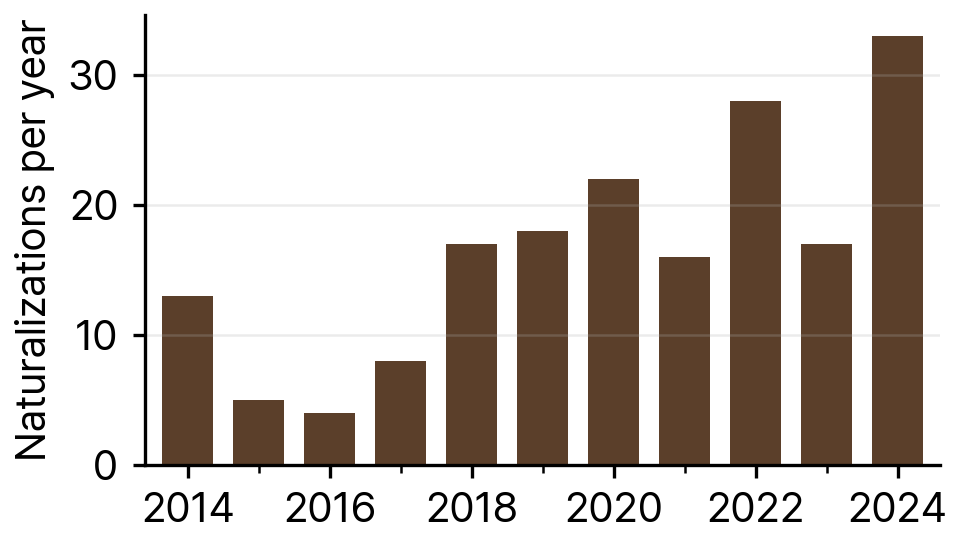
Source: KIRD dataset, from Ministry of Justice immigration yearbooks, 2011-2024.
Unauthorized Residents
Kazakhstan is among the ten nationalities listed separately in table 6-4 of the Ministry of Justice yearbook. The yearbook counted 11,092 unauthorized Kazakh residents in 2019, 9,768 in 2021, 13,788 in 2023, and 11,306 in 2024. The 2024 figure equals 25.4 percent of Kazakh resident foreigners (11,306 of 44,549), ranks seventh among nationalities, and makes up 2.8 percent of all 397,522 unauthorized residents that year (11,306 of 397,522). In 2019 the ratio to the resident population was higher, at 32.0 percent (11,092 of 34,638).
Kazakh nationals can enter South Korea without a visa, and 9,066 were visa-exempt (B-1) visitors at the end of 2024. The yearbook does not break down unauthorized residents by the status on which they entered.
Health and Well-being
To our knowledge, no published study reports health outcomes for Kazakh nationals separately. The closest evidence concerns Koryoin (Koryo-saram) in Gwangju, a group that includes people from Kazakhstan and several other former Soviet states. In a 2022-2024 population-based study, 165 Koryoin participants, 89.7 percent of them born in Central Asia or Russia, had higher odds of high predicted cardiovascular disease risk than age- and sex-matched native Koreans: adjusted odds ratios of 1.77 (95% CI 1.13-2.79) on the Framingham Risk Score and 1.89 (95% CI 1.10-3.23) on the Pooled Cohort Equations (Yang et al., 2025).
In Gwangju's Koryoin Village, a volunteer free clinic opened in March 2018 because many residents had difficulty obtaining care due to health insurance eligibility problems (Hankook Ilbo, 2018).
Migration from Kazakhstan to South Korea
Labor migrants from Kazakhstan have long gone mainly to Russia because of shared language and culture. A 2024 study reports that migration to the United States, Germany, and South Korea has grown in recent years (Chu 2024). We know of no published source that reports the share of all Kazakh emigrants who live in South Korea or Korea's rank among destinations. Within Korea, Kazakh nationals made up about 31 percent of Central Asian nationals in 2023, second to Uzbek nationals at about 60 percent (Chu 2024).
Kazakhstan has no record of Employment Permit System (EPS) deployments to Korea. In 2023, 5,309 Kazakh nationals in Korea held work visas; 5,146 of them held the H-2 visiting employment visa for ethnic Koreans and 30 held the E-9 EPS visa. The same year, 13,239 held F-4 overseas Korean status, about 17 times the 2013 number (Chu 2024). Kazakh officials cited in 2025 put the number of Kazakh nationals working in Korea at about 15,000, of whom about 11,000 lacked legal status (Times of Central Asia 2026).
No EPS Korean-language test (EPS-TOPIK) had been held in Kazakhstan by August 2026, so there are no figures on applicants or places. Before a first round, the two governments had to sign a memorandum of understanding and set up the test, which Kazakh officials said would take place at the National Testing Center in Almaty (Times of Central Asia 2026).
South Korea is a mid-ranked source of remittances to Kazakhstan. In the first three quarters of 2022, Korea ranked third among sending countries with US$35.6 million (10.1 percent of the total), behind Russia and the United States. In the same period of 2023 it ranked fourth with US$27.3 million (11.6 percent), behind Russia, the United States, and Germany, out of total inflows of US$236.2 million (Chu 2024, using IOM data). Remittances are a small part of Kazakhstan's economy. Personal remittances received equaled 0.083 percent of GDP in 2024, down from 0.116 percent in 2023 and 0.213 percent in 2022 (World Bank 2024), against a world average of 4.74 percent across 91 countries (TheGlobalEconomy.com 2026).
About 100,000 ethnic Koreans live in Kazakhstan. In August 1937 the Soviet government decided to move Koreans from the Far East to Central Asia, and the first trains of deported Koreans arrived in Kazakhstan that September (Korean Embassy in Kazakhstan 2026). The first Koryo-saram settlement in Kazakhstan was at Ushtobe, in the Almaty region (Korea.net, 2019). As far as we know, no published source reports the regions of Kazakhstan that Korea-bound migrants come from.
A visa waiver agreement signed by South Korea and Kazakhstan in November 2014 opened the way for direct migration, according to the 2024 study. Kazakh nationals filed 2,094 refugee applications in Korea in 2023, 11.1 percent of the 18,837 total and second after Russian nationals, and in May 2023 Korean authorities arrested two Kazakh brokers and one Tajik broker for arranging fraudulent refugee applications (Chu 2024). In 2024 Kazakhstan was the only Central Asian country still in process for an EPS agreement; Uzbekistan had joined in 2006, Kyrgyzstan in 2007, and Tajikistan in 2024, while Turkmenistan restricts overseas movement (Chu 2024). Kazakhstan had sought EPS admission since 2023, and the large number of undocumented Kazakh workers in Korea was the main obstacle. The government in Astana prepared a roadmap to reduce undocumented workers and to prevent workers recruited under a future legal scheme from overstaying (Times of Central Asia 2026).
Research on Kazakh migrants in Korea is limited and mostly treats Koryo-saram from several former Soviet states together. An and Frigerio (2018) find that ethnic Korean migrants from the Commonwealth of Independent States, although favored by ethnicity-based visa policy, often take jobs outside the sectors their visas permit because of limited Korean and higher wages in the informal market, and face greater vulnerability at work as a result. Song (2019) describes a hierarchy among co-ethnics in which Koryo-saram and Korean-Chinese return migrants are socially alienated and assigned to lower-wage jobs in dirty, difficult, and dangerous sectors. Lee (2023), studying Koryo-saram from Uzbekistan, links their migration to Korea with the compatriot visiting employment system opened in 2007 and to ties to an ancestral homeland, within a community divided into subgroups linked by transnational networks. We are not aware of any study that examines brokers, debt, marriage, or return among Kazakh nationals specifically.
Table 4Migration Indicators, Kazakhstan and South Korea
| Indicator | Value | Source |
|---|---|---|
| Share of Central Asian nationals in Korea, 2023 | About 31% (second after Uzbekistan) | Chu (2024) |
| Kazakh nationals on work visas in Korea, 2023 | 5,309 (5,146 H-2; 30 E-9) | Chu (2024) |
| Kazakh F-4 holders in Korea, 2023 | 13,239 | Chu (2024) |
| Kazakh nationals working in Korea, 2025 (officials' estimate) | About 15,000, of whom about 11,000 without legal status | Times of Central Asia (2026) |
| EPS-TOPIK applicants | No test held by August 2026 | Times of Central Asia (2026) |
| Remittances from Korea, January-September 2022 | US$35.6 million (10.1%, 3rd) | Chu (2024) |
| Remittances from Korea, January-September 2023 | US$27.3 million (11.6%, 4th) | Chu (2024) |
| Personal remittances received, 2024 | 0.083% of GDP | World Bank (2024) |
| Refugee applications by Kazakh nationals in Korea, 2023 | 2,094 (11.1% of total, 2nd) | Chu (2024) |
Note: Remittance shares are of all remittances received by Kazakhstan in the period; ranks are among sending countries.
Source: Chu (2024), using Korea Immigration Service yearbooks and IOM data; Times of Central Asia (2026); World Bank World Development Indicators.
Community Organizations
None of the 1,720 migrant-serving organizations in the KIRD census names Kazakhstan or Kazakh nationals in its name or target group. Most general-purpose organizations, such as multicultural family support centers and foreign worker support centers, also serve Kazakh residents.
Korea has two large Koryo-saram neighborhoods. In September 2022, about 18,000 Koryo-saram lived in Ansan, 6,000 to 7,000 of them in Ttaetgol Village (Namdo Ilbo, 2022). In 2024, about 100 shops in Gwangju's Koryoin Village provided a living for about 500 Koryo-saram (Namdo Ilbo, 2024). These counts include people from several former Soviet countries and are not broken down by nationality.
Sources
KIRD dataset. Nationality-level data from Ministry of Justice immigration yearbooks and district statistics, 2006-2024. https://doi.org/10.3886/E249944V1
Ministry of Government Legislation. 2026. Overseas Koreans: employment (찾기쉬운 생활법령정보). https://easylaw.go.kr/CSP/CnpClsMain.laf?popMenu=ov&csmSeq=1136&ccfNo=3&cciNo=3&cnpClsNo=1
Ministry of Justice. 2026. Unification of overseas Korean residence status (F-4). Press release, 12 February 2026. https://www.moj.go.kr/bbs/moj/182/603456/artclView.do
Herald Corp. 2026. Kazakhstan joins, foreign workforce sending countries expand to 18. 14 August 2026. https://biz.heraldcorp.com/article/10841162
Korea Times. 2026. Kazakhstan designated as workforce-sending country. 14 August 2026. https://www.koreatimes.co.kr/southkorea/globalcommunity/20260814/kazakhstan-designated-as-workforce-sending-country
Yang, Jung-Ho, Yerin Choi, Ran Lee, Seong Eun Kim, Kyung-Hwa Park, Seong-Woo Choi, BongKyu Sun, Kyunghak Kim, and Sun-Seog Kweon. 2025. Cardiovascular disease risk disparities between immigrants and native Koreans: a population-based study in Gwangju, Korea. Epidemiology and Health 47: e2025067. https://pmc.ncbi.nlm.nih.gov/articles/PMC12884040/
Hankook Ilbo. 2018. Gwangju clinic opens in Koryoin Village. 1 March 2018. https://www.hankookilbo.com/news/article/201803011642635294
Embassy of the Republic of Korea in Kazakhstan. Koryo-saram in Kazakhstan (카자흐스탄의 고려인). https://overseas.mofa.go.kr/kz-ko/brd/m_9002/view.do?seq=590221
World Bank. Personal remittances, received (% of GDP), Kazakhstan. World Development Indicators. https://data.worldbank.org/indicator/BX.TRF.PWKR.DT.GD.ZS?locations=KZ
Namdo Ilbo. 2022. Gwangju Koryoin Village Ukrainian refugee report (8): Ansan's Ttaetgol Village, similar to Wolgok-dong's Koryo-saram village. 14 September 2022. http://www.namdonews.com/news/articleView.html?idxno=695223
Namdo Ilbo. 2024. "Long live Koryoin Village": unveiling ceremony for the Koryoin Village Specialty Street. 14 June 2024. http://www.namdonews.com/news/articleView.html?idxno=775188
Chu, Y. (2024). Current status of human exchanges between Korea and Central Asia, and factors contributing to the increase in Kazakhstani migrant workers in South Korea [Working paper]. Hankuk University of Foreign Studies. https://wapor.org/wp-content/uploads/Chu-Current-status-of-Human-Exchanges-between-Korea-and-Central-Asia-and-Factors-Contributing-to-the-Increase-in-Kazakhstani-Migrant-Workers-in-South-Korea.pdf
The Times of Central Asia. 2026. Kazakhstan South Korea working visa route opens under EPS. https://timesca.com/kazakhstan-south-korea-working-visa-route-epssouth-korea-opens-legal-labor-market-to-kazakhstanis/
TheGlobalEconomy.com. 2026. Kazakhstan: Remittances, percent of GDP. https://www.theglobaleconomy.com/Kazakhstan/remittances_percent_GDP/
Oh, H. W., & Lee, J. 2019. Park in Kazakhstan honoring ethnic Koreans to be built. Korea.net, 8 November 2019. https://www.korea.net/NewsFocus/Culture/view?articleId=179004
An, E., & Frigerio, A. (2018). Semi-compliant labor migrants in South Korea: Koryo-saram diaspora and their lessons for global development. Studies in Global Ethics and Global Education, (8), 16-33. https://doi.org/10.5604/01.3001.0012.0385
Song, C. (2019). Joseonjok and Goryeo saram ethnic return migrants in South Korea: Hierarchy among co-ethnics and ethnonational identity. In T. Tsuda & C. Song (Eds.), Diasporic returns to the ethnic homeland: The Korean diaspora in comparative perspective (pp. 57-77). Palgrave Macmillan. https://doi.org/10.1007/978-3-319-90763-5_4
Lee, J. (2023). Why do diasporas re-emigrate to their historical "homelands"? A case study of Koryo Saram's "return" from post-Soviet Uzbekistan to South Korea. Journal of the Asia-Japan Research Institute of Ritsumeikan University, 5, 51. https://doi.org/10.34389/asiajapan.5.0_51
Newsis. 2026. Korea and Kazakhstan sign an MOU on sending and admitting workers under the Employment Permit System (in Korean; photo report). 15 September 2026, via Nate News. https://m.news.nate.com/view/20260915n32757
Suggested citation: Korea Immigration Regional Dashboard (KIRD). 2026. “Kazakh Immigrants in South Korea.” Foreign Residents in South Korea series, September 2026. Data: Korea Immigration Regional Dashboard (KIRD) dataset, https://doi.org/10.3886/E249944V1. Interactive maps and tables: https://immigrantsinkorea.today.