 Korea Immigration Regional Dashboard
SpotlightSeptember 2026Nationality profilesDownload PDF
Myanmar Immigrants in South Korea
Highlights
- At the end of 2024, South Korea had 52,034 registered Myanmar foreigners, making Myanmar the eighth-largest nationality among registered foreigners and the 13th-largest among all resident foreigners (53,914 people), up from 15th and 16th in 2014.
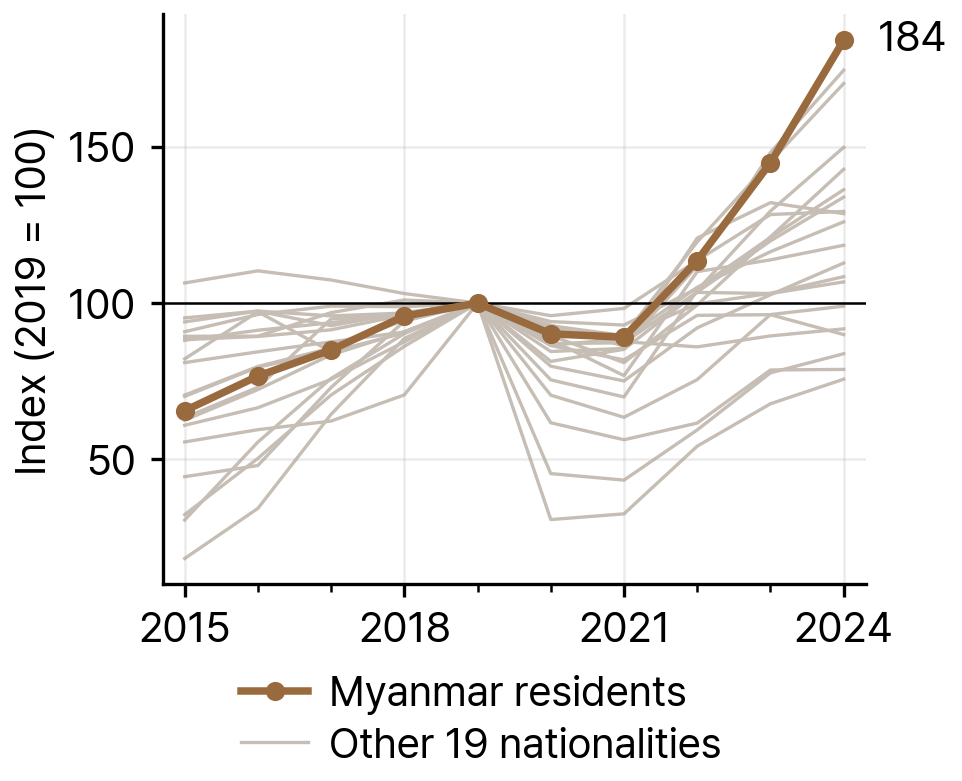
- Between 2019 and 2024 the population grew by 84 percent (index 184, with 2019 = 100), the fastest growth among the 20 largest nationalities.
- In 2024, 60.6 percent of Myanmar residents held an E-9 non-professional employment visa, and women made up 15.2 percent of the group, compared with 45.1 percent of all resident foreigners.
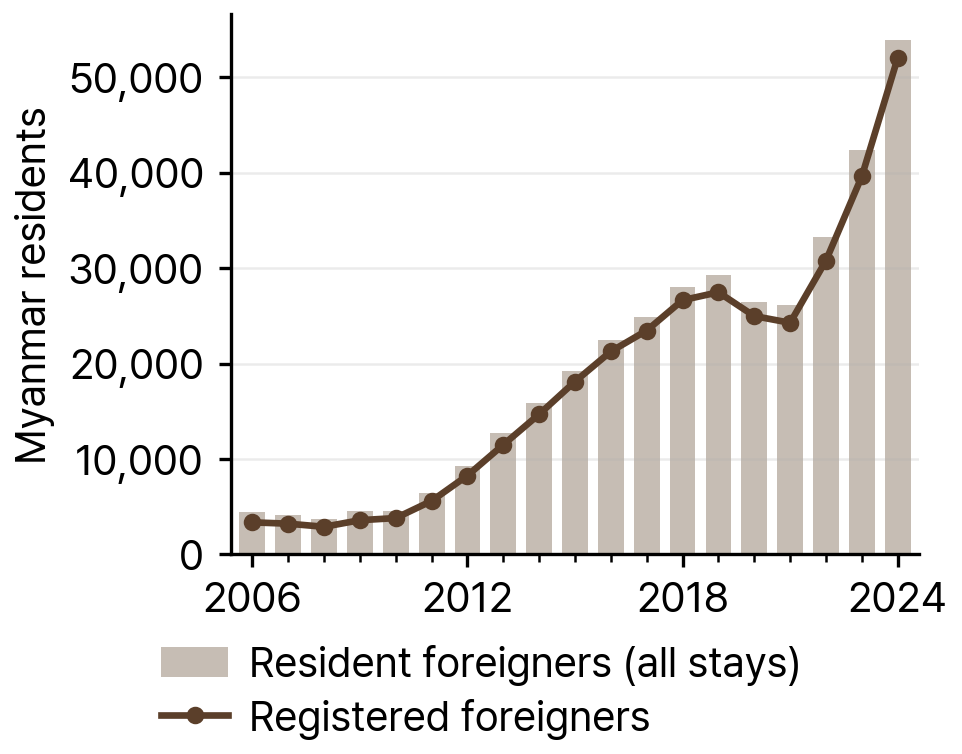
On 31 December 2024, South Korea counted 52,034 registered Myanmar foreigners, the eighth-largest nationality among registered foreigners (3.5 percent of the total), and 53,914 Myanmar resident foreigners, the 13th-largest nationality among all resident foreigners (2.0 percent). The resident count had been 4,484 in 2006 and 29,294 in 2019, so it grew about twelvefold (53,914 / 4,484 = 12.0) between 2006 and 2024.
Most Myanmar residents came as workers under the Employment Permit System (EPS). Korea and Myanmar signed an EPS memorandum of understanding in November 2007, and Myanmar workers were expected to be able to work legally in Korea from May 2008 (Korea.kr, 2007). After the February 2021 military coup in Myanmar, the Ministry of Justice introduced a humanitarian measure that allowed Myanmar nationals already in Korea to switch to a temporary status (Edaily, 2021). The number of Myanmar residents fell from 29,294 in 2019 to 26,096 in 2021 and then rose each year to 53,914 in 2024.
Compared with all resident foreigners, Myanmar residents are younger, far more likely to be men, and far more likely to hold an employment visa. In 2024, 90.4 percent were aged 20 to 39 (49.7 percent of all resident foreigners), and 68.4 percent held an employment visa (19.2 percent of all resident foreigners). Almost all (96.5 percent) were registered foreigners, since few hold the short-term or overseas Korean statuses that do not require registration.
Size of the Population over Time
The Myanmar population in Korea was small until the late 2000s. It stood at 4,484 resident foreigners in 2006 and 4,565 in 2010, then rose to 15,921 in 2014 and 29,294 in 2019 (see Figure 1). The count fell to 26,412 in 2020 and 26,096 in 2021, then grew to 33,275 in 2022, 42,438 in 2023, and 53,914 in 2024, the highest level recorded. Registered foreigners followed the same path, from 3,362 in 2006 to 52,034 in 2024.
Source: KIRD dataset, from Ministry of Justice immigration yearbooks, 2006-2024.
Among the 20 largest nationalities, the Myanmar population grew fastest between 2019 and 2024 (see Figure 2). With 2019 set to 100, its index was 184 in 2024. Among registered foreigners, Myanmar rose from 19th place in 2006 and 15th in 2014 to 10th in 2019 and 8th in 2024. Among all resident foreigners, it ranked 20th in 2006, 16th in 2014 and 2019, and 13th in 2024 (see Table 1).
Source: KIRD dataset, from Ministry of Justice immigration yearbooks, 2006-2024.
Table 1Myanmar Resident Foreigners and Registered Foreigners in South Korea, Selected Years, 2006-24
| Year | Resident foreigners | Registered foreigners | Rank among registered foreigners | Rank among resident foreigners | Share of all registered foreigners (%) | Share of all resident foreigners (%) |
|---|---|---|---|---|---|---|
| 2006 | 4,484 | 3,362 | 19 | 20 | 0.5 | 0.5 |
| 2014 | 15,921 | 14,694 | 15 | 16 | 1.3 | 0.9 |
| 2019 | 29,294 | 27,483 | 10 | 16 | 2.2 | 1.2 |
| 2024 | 53,914 | 52,034 | 8 | 13 | 3.5 | 2.0 |
Note: Registered foreigners are long-term residents who register with immigration authorities. Resident foreigners also include short-term visitors and overseas Koreans (F-4) who report their residence. Ranks and shares are computed separately for each base.
Source: KIRD dataset, from Ministry of Justice immigration yearbooks, 2006-2024.
Distribution by Province and District
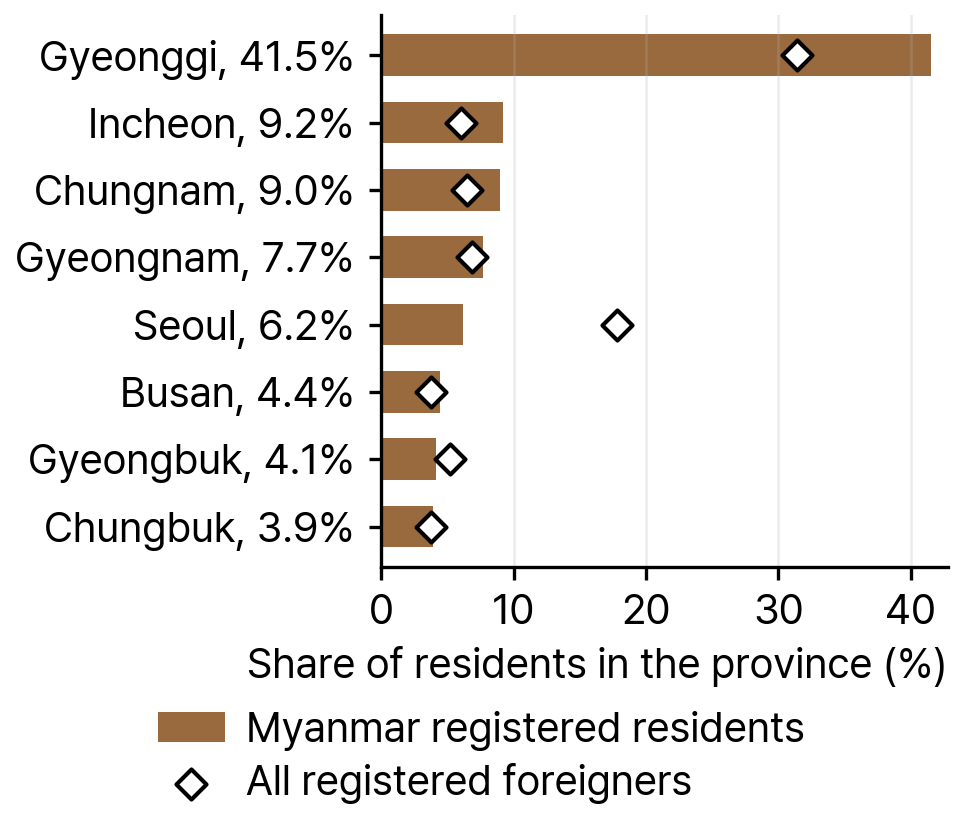
In 2024, half of registered Myanmar foreigners (50.8 percent, or 26,419 people) lived in Incheon and Gyeonggi-do, and another 6.2 percent (3,230) lived in Seoul (see Figure 3). The Seoul capital area as a whole was home to 57.0 percent of the group, close to the 55.2 percent for all resident foreigners. Yeongnam had 20.0 percent (10,384), Chungcheong 14.1 percent (7,350), Honam 7.2 percent (3,722), and Gangwon and Jeju 1.8 percent (929).
Source: KIRD dataset, from Ministry of Justice immigration yearbooks, 2006-2024.
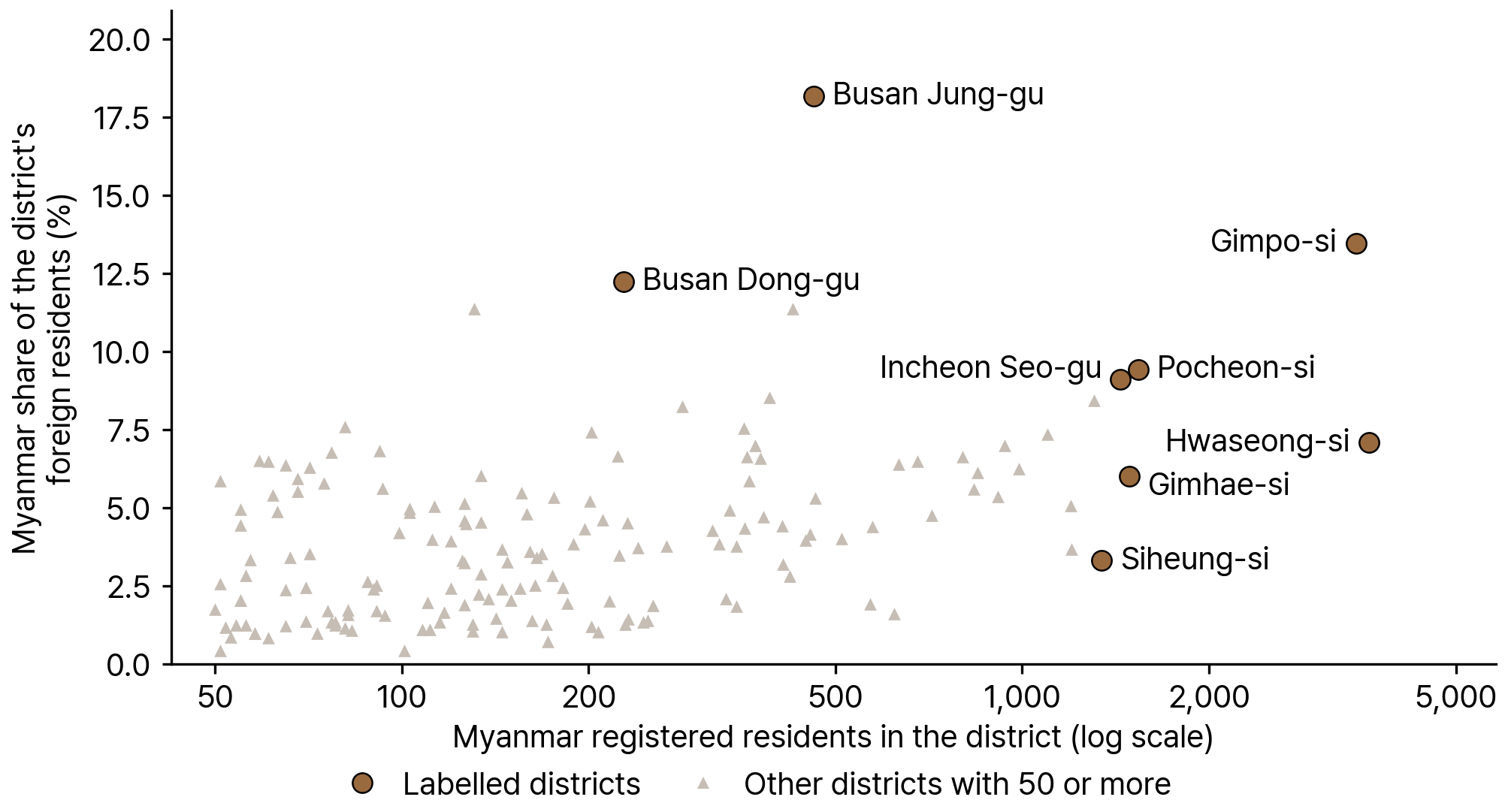
Myanmar residents are spread across many industrial cities. In 2024, 111 districts had at least 100 registered Myanmar foreigners, and the ten largest districts together accounted for 34.0 percent of the group (see Figure 4 and Table 2). Hwaseong-si (3,623) and Gimpo-si (3,449) in Gyeonggi-do were the largest. In Gimpo-si, Myanmar nationals made up 13.5 percent of all registered foreigners. The highest district share was in Busan Jung-gu, where 461 Myanmar residents were 18.2 percent of the district's registered foreigners. Rural counties (gun) accounted for 11.7 percent of the group, compared with 10.6 percent of all resident foreigners.
Source: KIRD dataset, from Ministry of Justice immigration yearbooks, 2006-2024.
Table 2Ten Districts with the Most Registered Myanmar Foreigners, 2024
| District | Province | Myanmar residents | Share of district's registered foreigners (%) |
|---|---|---|---|
| Hwaseong-si | Gyeonggi-do | 3,623 | 7.1 |
| Gimpo-si | Gyeonggi-do | 3,449 | 13.5 |
| Pocheon-si | Gyeonggi-do | 1,537 | 9.4 |
| Gimhae-si | Gyeongsangnam-do | 1,486 | 6.0 |
| Incheon Seo-gu | Incheon | 1,440 | 9.1 |
| Siheung-si | Gyeonggi-do | 1,342 | 3.3 |
| Paju-si | Gyeonggi-do | 1,305 | 8.4 |
| Pyeongtaek-si | Gyeonggi-do | 1,199 | 3.7 |
| Asan-si | Chungcheongnam-do | 1,196 | 5.1 |
| Gwangju-si | Gyeonggi-do | 1,099 | 7.4 |
Note: Counts are registered foreigners (52,034 Myanmar nationals in the 2024 district-level data). The ten districts together accounted for 34.0 percent of the group.
Source: KIRD dataset, from Ministry of Justice immigration yearbooks, 2006-2024.
The group became less residentially concentrated over the decade. The index of dissimilarity (D) between Myanmar residents and all other registered foreigners across districts fell from 0.532 in 2014 to 0.436 in 2024. No district met the KIRD definition of an ethnic enclave in 2024 (a location quotient of at least 2, with the group making up at least 30 percent of the district's foreign residents).
Age and Sex
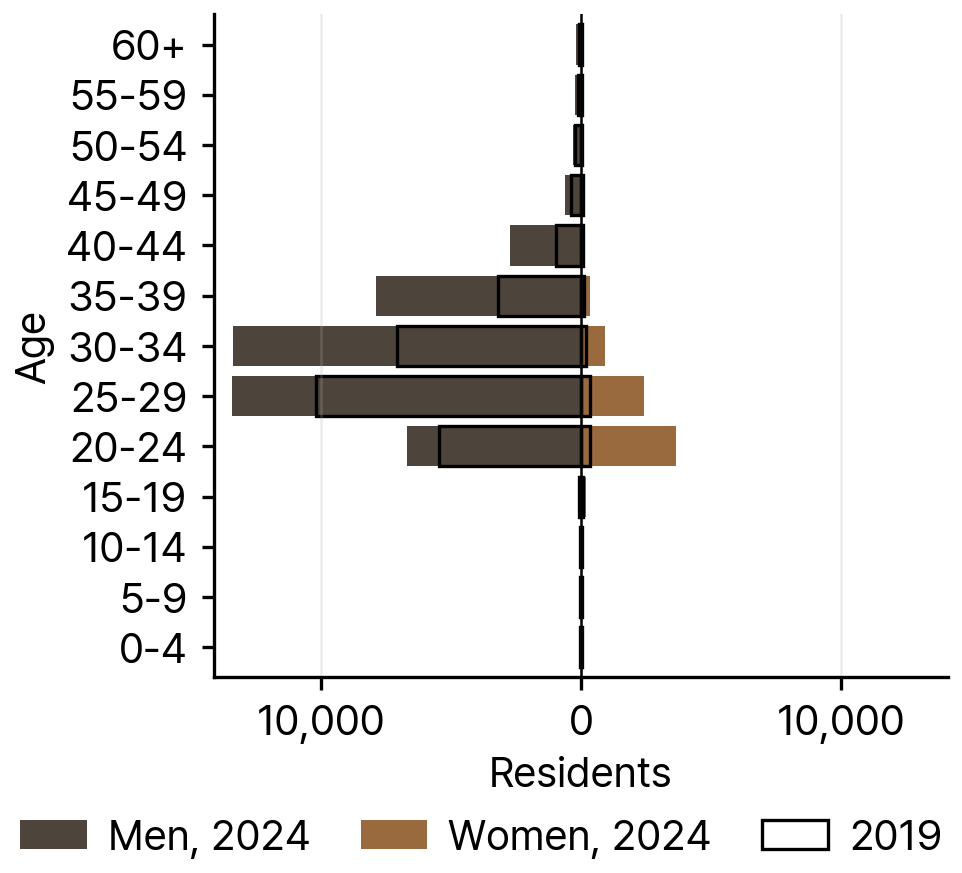
Myanmar residents are concentrated in working ages. In 2024, 48,724 of 53,914 (90.4 percent) were aged 20 to 39, compared with 49.7 percent of all resident foreigners (see Figure 5). The largest five-year age group was 25 to 29, and the median fell in the 30 to 34 group. Children aged 0 to 14 were 0.8 percent of the group (406 people), and those aged 60 and older were 0.5 percent, compared with 5.7 percent and 12.9 percent of all resident foreigners.
Women were a small minority. Their number rose from 1,427 in 2019 (4.9 percent) to 8,190 in 2024 (15.2 percent), still far below the 45.1 percent share of women among all resident foreigners. The number of children under 5 rose from 60 in 2019 to 161 in 2024.
Source: KIRD dataset, from Ministry of Justice immigration yearbooks, 2006-2024.
Visa Status
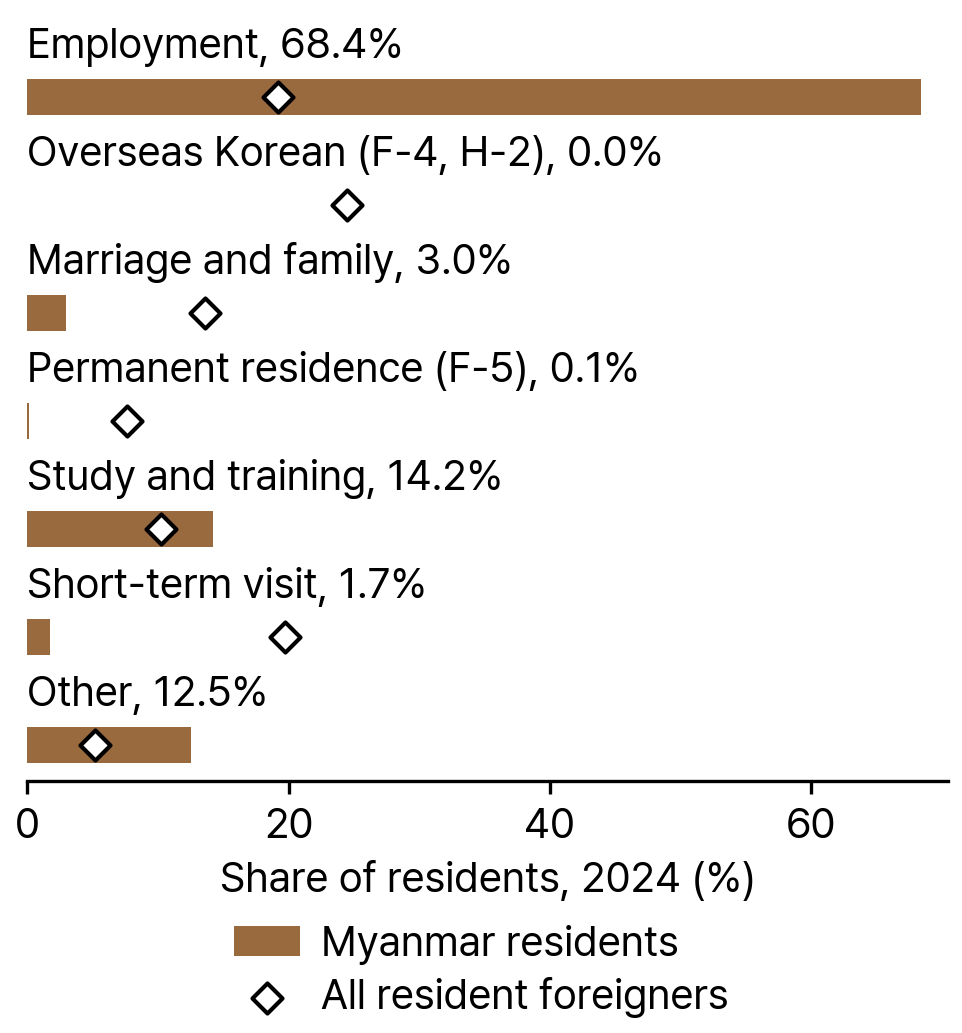
Employment visas account for most Myanmar residents. In 2024, 68.4 percent held an employment visa, compared with 19.2 percent of all resident foreigners (see Figure 6). Study and training visas covered 14.2 percent (10.2 percent of all resident foreigners), and the other category, which includes G-1, covered 12.5 percent (5.2 percent). Marriage and family visas (3.0 percent), permanent residence (0.1 percent), and short-term visits (1.7 percent) were all far less common than among all resident foreigners (13.6, 7.7, and 19.7 percent). No Myanmar residents held overseas Korean visas, which covered 24.5 percent of all resident foreigners.
Source: KIRD dataset, from Ministry of Justice immigration yearbooks, 2006-2024.
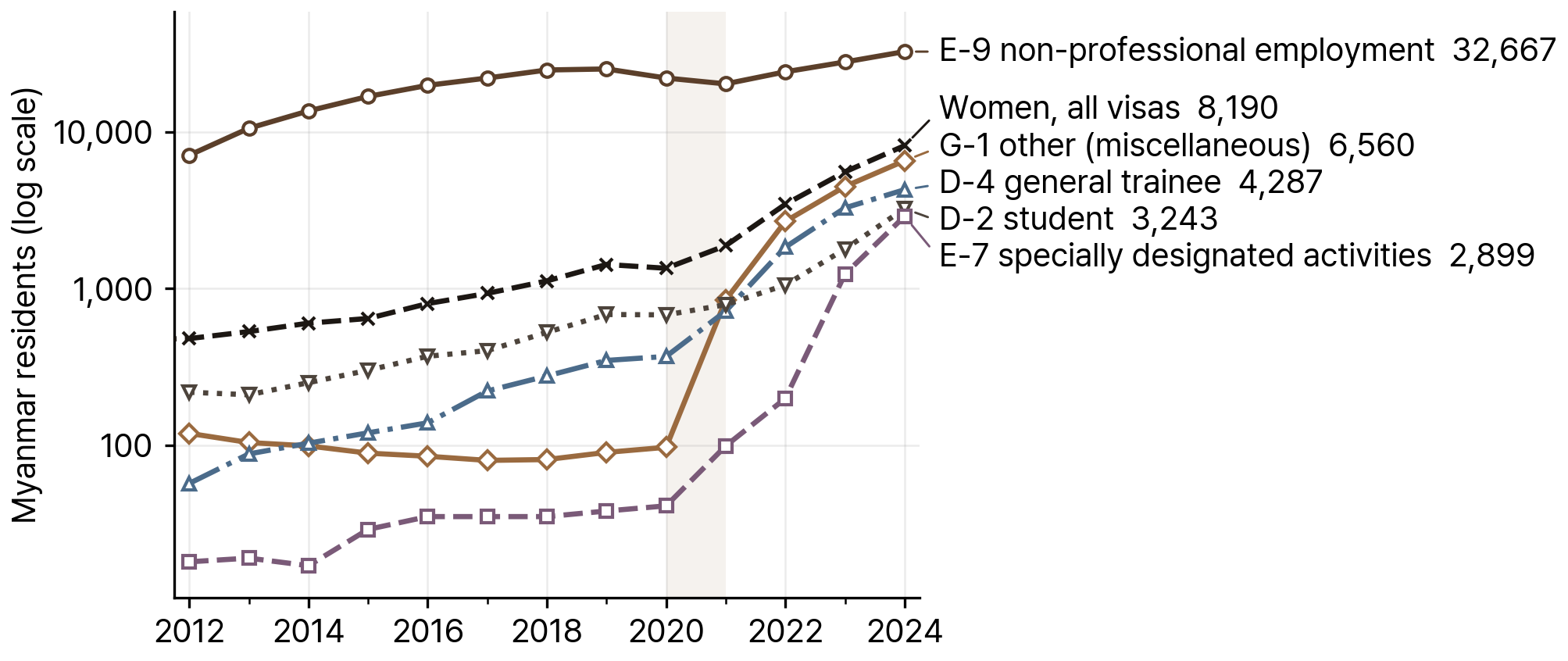
The E-9 non-professional employment visa is the main status. E-9 holders rose from 13,653 in 2014 to 25,311 in 2019 and 32,667 in 2024, when they were 60.6 percent of the group and 9.7 percent of all E-9 holders in Korea; Myanmar ranked fifth among nationalities for E-9 in 2024 (see Figure 7 and Table 3). Other statuses grew faster from a small base between 2019 and 2024. G-1 holders went from 90 to 6,560, D-4 general trainees from 348 to 4,287, D-2 students from 684 to 3,243, and E-7 specially designated workers from 38 to 2,899. The G-1 count includes the humanitarian status (G-1-99) granted to Myanmar workers from March 2021 (OhmyNews, 2023). In 2024, Myanmar nationals were 11.6 percent of all G-1 holders in Korea.
Source: KIRD dataset, from Ministry of Justice immigration yearbooks, 2006-2024.
Table 3Main Visas Held by Myanmar Residents in South Korea, 2019 and 2024
| Visa | Meaning | 2019 | 2024 | Share of Myanmar residents, 2024 (%) | Share of all holders of this visa in Korea, 2024 (%) |
|---|---|---|---|---|---|
| E-9 | Non-professional Employment | 25,311 | 32,667 | 60.6 | 9.7 |
| G-1 | Other (Miscellaneous) | 90 | 6,560 | 12.2 | 11.6 |
| D-4 | General Trainee | 348 | 4,287 | 8.0 | 4.9 |
| D-2 | Student | 684 | 3,243 | 6.0 | 1.8 |
| E-7 | Specially Designated Activities | 38 | 2,899 | 5.4 | 4.6 |
| E-10 | Crew Employment | 769 | 1,000 | 1.9 | 4.6 |
| C-3 | Short-term Visit | 783 | 757 | 1.4 | 0.5 |
Note: Shares of Myanmar residents use the 2024 total of 53,914 resident foreigners.
Source: KIRD dataset, from Ministry of Justice immigration yearbooks, 2006-2024.
Migration Channels and Policy
The EPS is the main entry route. Myanmar was one of five countries (with Bangladesh, Kyrgyzstan, Nepal, and Timor-Leste) added in February 2007 to the ten existing EPS sending countries, and it was the fourth of the five to sign a memorandum of understanding, on 28 November 2007 (Korea.kr, 2007). Recruitment continued after the coup. The Korean embassy in Myanmar reported that 1,040 Myanmar workers were sent to Korea through the EPS in January and February 2023 (Korean Embassy in Myanmar, 2023).
On 12 March 2021, the Ministry of Justice announced a humanitarian special measure, effective 15 March 2021, for about 25,000 Myanmar nationals in Korea. It covered EPS workers whose permitted period in Korea had expired, students who had finished their studies or training, and short-term visitors limited to 90 days, and it suspended forced departure of Myanmar nationals whose status had expired, citing the unstable situation in Myanmar (Edaily, 2021).
Holders of the resulting G-1-99 status faced a further obstacle. In July 2023, OhmyNews reported that the Myanmar embassy in Seoul was not renewing the expired passports of Myanmar workers with G-1-99 visas, which left many unable to complete required procedures (OhmyNews, 2023).
Naturalization
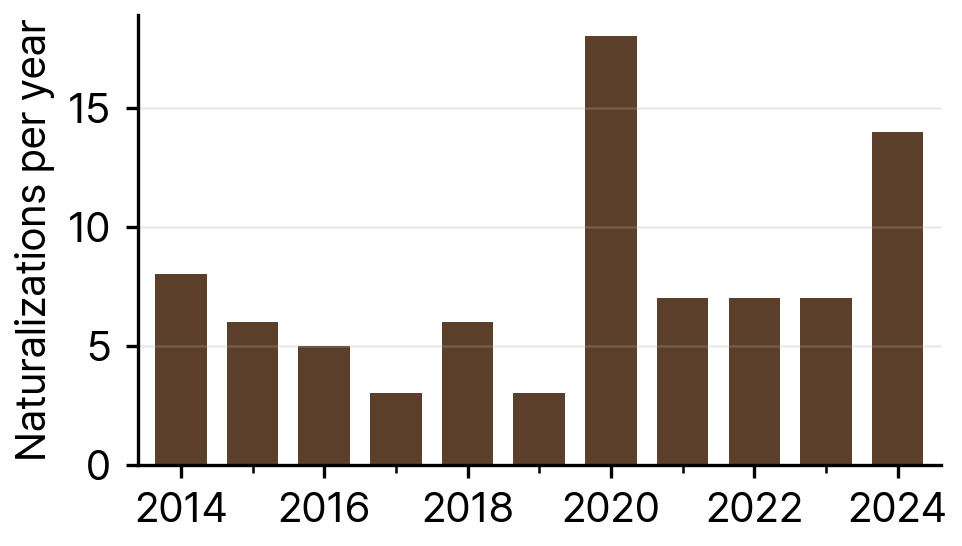
Few Myanmar nationals have become Korean citizens. A total of 84 were naturalized from 2014 to 2024, the period covered by the yearbook's by-country naturalization table (see Figure 8). Annual numbers were in single digits in most years, with the highest counts in 2020 (18) and 2024 (14).
Source: KIRD dataset, from Ministry of Justice immigration yearbooks, 2006-2024.
Unauthorized Residents
Myanmar is not among the ten nationalities that the Ministry of Justice immigration yearbook (table 6-4) reports separately, so no count of unauthorized Myanmar residents is published. The yearbook counted 397,522 unauthorized foreign residents of all nationalities in 2024.
Health and Well-being
Published reports on this group mostly concern workplace injury and death. On 1 July 2026, Aung Min Oo, a 37-year-old subcontracted worker from Myanmar, died after being caught in a conveyor belt at a high-speed rail construction site in Asan, South Chungcheong Province. Women's News reported that the site lacked an emergency shutoff pull cord and a machine guard and did not follow the two-person work rule required for publicly ordered projects (Women's News, 2026).
A 2026 qualitative study of occupational burns among migrant workers in Korea included a Myanmar foundry worker with flame burns over 70 to 75 percent of his body surface. He reported that his treatment visa was extended for only two to three months at a time although he needed about a year of treatment (Lee et al., 2026).
A labor journalism series reported that from May 2024, deaths among Myanmar nationals in Korea rose from one or two a month to one or two a week, with causes including industrial and traffic accidents, cerebral hemorrhage, heart disease, and suicide. The author linked the rise to psychological distress associated with the civil war in Myanmar. The article reports no official death count (Eroun Net, 2024).
Migration from Myanmar to South Korea
In 2022, The Korea Times reported that nearly 27,000 Myanmar nationals lived in South Korea and that most had come through the EPS (Korea Times 2022). The KIRD count for the end of 2022 was 33,275 resident foreigners. To our knowledge, no published source reports what share of Myanmar's emigrants live in Korea or where Korea ranks among their destination countries.
Myanmar's government employment agencies sent 10,611 workers to Korea through the EPS in 2023, to jobs in manufacturing, agriculture, livestock, and construction, and Myanmar's recruitment quota for Korea in 2024 was about 11,000 workers (Global New Light of Myanmar 2024a). Between January and August 2024, 5,850 workers left for Korea, mainly for construction, agriculture, and livestock jobs. The same report stated that 2024 was the first year in which Myanmar would send women to Korea for service-sector work (Global New Light of Myanmar 2024b). We know of no published total of Myanmar's overseas deployments for these years, so Korea's share of all deployments cannot be computed.
Applicants for EPS places far outnumber the places. For the 16th EPS-TOPIK round in 2024, over 100,000 people in Myanmar submitted applications and nearly 90,000 paid the registration fee (Eleven Myanmar 2024a), about nine applications for each of the roughly 11,000 places that year (100,000 / 11,000 = 9.1). In the manufacturing-sector test cycle conducted from 3 June to 15 October 2024, 5,540 of 48,000 candidates passed, and the cutoff score was a record 97.5 out of 100 (Eleven Myanmar 2024b). For the second manufacturing batch, scheduled from February to May 2025, 37,957 applicants were expected to take the exam (Eleven Myanmar 2025).
Remittances to Myanmar from all countries fell 13 percent to US$1.1 billion in 2023, one of the largest declines among East Asia and Pacific recipients that year (World Bank 2024). Personal remittances received were equal to about 1.55 percent of Myanmar's GDP in 2024, according to World Bank data (Trading Economics 2024). The World Bank's bilateral remittance estimates, last produced for 2021, put remittances sent from South Korea to Myanmar at about US$18.5 million that year (World Bank 2021).
As far as we know, no published source identifies the states, regions, or ethnic groups that send the most workers to Korea. In Korea, Myanmar Street in Bupyeong-gu, Incheon, has separate Buddhist temples for Bamar, Karen, Rakhine, and Mon worshippers, so several ethnic groups are present (Hyunbul News 2025).
On 2 May 2024, Myanmar's military government suspended new overseas work permits for men of conscription age in order to enforce military conscription (Radio Free Asia 2024a).
In March 2024, Radio Free Asia reported that a junta-linked Seasonal Worker Training and Care Center had registered and trained over 10,600 people and aimed to recruit about 60,000 workers in 2024 for seasonal work in Korea. The center charged 380,000 kyat (about US$180) for training and registration, and one worker was asked for a down payment of 5 million kyat (about US$2,400) to secure a job. The Korean embassy in Myanmar stated that the Korean government had not announced any guidelines or jobs for seasonal workers, and the director of a Seoul-based civic group warned that a seasonal worker agreement would signal that Korea recognized the junta as a legitimate government (Radio Free Asia 2024b).
We are aware of two studies of Myanmar migrants in Korea, and neither examines migration motives, brokers and debt, marriage, or return. In a phenomenological study of six Myanmar men on the EPS who were active in the Myanmar Association in Korea, Park (2010) found that participation in the association turned them into social and political activists who took on responsibility, maintained a strong political commitment to Myanmar, and gained confidence in Korean society (Park 2010). Kim and Park (2020) found that Myanmar migrant workers arriving from the 1990s built on Vipassana temples that Korean Buddhists had founded after training in Myanmar. The Myanmar Community organization, formed in 1996, was associated with more than 14 Burmese temples in Korea by 2016, and the article reported 18,123 registered Myanmar residents in Korea in 2015 (Kim and Park 2020).
Table 4Migration indicators, Myanmar and South Korea
| Indicator | Value | Source |
|---|---|---|
| Myanmar nationals living in South Korea, 2022 | About 27,000 | Korea Times 2022 |
| EPS workers sent to South Korea, 2023 | 10,611 | Global New Light of Myanmar 2024a |
| EPS recruitment quota for South Korea, 2024 | About 11,000 | Global New Light of Myanmar 2024a |
| EPS workers sent to South Korea, January to August 2024 | 5,850 | Global New Light of Myanmar 2024b |
| Applications for the 16th EPS-TOPIK round, 2024 | Over 100,000 | Eleven Myanmar 2024a |
| Candidates who passed the manufacturing-sector EPS-TOPIK, June to October 2024 | 5,540 of 48,000 | Eleven Myanmar 2024b |
| Applicants expected for the second manufacturing batch, February to May 2025 | 37,957 | Eleven Myanmar 2025 |
| Remittances received from all countries, 2023 | US$1.1 billion | World Bank 2024 |
| Personal remittances received, share of GDP, 2024 | 1.55% | Trading Economics 2024 |
Note: Remittance figures cover all sending countries. No Korea-specific remittance estimate was found.
Source: Sources listed in the table.
Community Organizations
Gwangjang-ro 4-gil in Bupyeong-gu, Incheon, is known as Myanmar Street. Its four Buddhist temples are organized along ethnic lines, with the Myanmar Dharma Propagation Temple serving the Bamar majority and separate Karen, Rakhine, and Mon temples. A 2025 symposium presentation described these temples as places that connect migration, work, and Buddhist practice, with the minority temples also preserving cultural identity and supporting democracy activities in Myanmar (Hyunbul News, 2025).
Danbi News profiled a Myanmar worker whose first jobs were in bed and sofa factories in Gwangju-si, Gyeonggi-do, where workers lived in container dormitories (Danbi News, 2025). Gwangju-si had 1,099 registered Myanmar foreigners in 2024.
Of the 1,720 migrant-serving organizations in the KIRD census, 2 name this community in their name or target group. They are Myanmar Network (Miyanma Network), a community group organized by Myanmar residents in Siheung-si, Gyeonggi-do, and the Myanmar Buddhist Dharma Propagation Temple (Miyanma Bulgyo Jeonbeop Sawon), a religious site in Bupyeong-gu, Incheon. Most general-purpose organizations, such as migrant worker centers and multicultural family support centers, also serve Myanmar residents.
Sources
KIRD dataset, built from Ministry of Justice immigration yearbooks, 2006-2024. openICPSR. https://doi.org/10.3886/E249944V1
Korea.kr Policy Briefing (Ministry of Labor). 2007. Korea-Myanmar EPS MOU Signed. https://m.korea.kr/news/policyNewsView.do?newsId=148643727
Embassy of the Republic of Korea in Myanmar. 2023. Over 1,000 Myanmar Workers Sent to Republic of Korea under EPS within 2 Months. https://overseas.mofa.go.kr/mm-en/brd/m_2096/view.do?seq=759060
Edaily. 2021. Ministry of Justice Implements Humanitarian Special Stay Measure for Myanmar Nationals in Korea. https://edaily.co.kr/News/Read?mediaCodeNo=257&newsId=02571526628982664
OhmyNews. 2023. Myanmar G1-99 Workers Suffer as Embassy Refuses Passport Renewal. https://www.ohmynews.com/NWS_Web/View/at_pg.aspx?CNTN_CD=A0002948687
Women's News. 2026. Family of Aung Min Oo, Who Died at KTX Construction Site, Demands Official Apology. https://www.womennews.co.kr/news/articleView.html?idxno=280044
Lee, Ju-Yeun, Jinjoo Chung, Seung-Sup Kim, and Sung-il Cho. 2026. Occupational Burns among Migrant Workers in South Korea: A Qualitative Study of Challenges and Coping Strategies. BMJ Open 16 (6): e116631. https://pmc.ncbi.nlm.nih.gov/articles/PMC13331201/
Eroun Net. 2024. Migration and Labor, Part 5: The Summer of 2024 for Myanmar Residents in Korea. https://www.eroun.net/news/articleView.html?idxno=49254
Trading Economics, citing World Bank World Development Indicators. 2024. Myanmar: Personal Remittances Received (% of GDP). https://tradingeconomics.com/myanmar/personal-remittances-received-percent-of-gdp-wb-data.html
Hyunbul News. 2025. Myanmar Buddhist Temples in Korea as Spaces Connecting Migration, Labor, and Faith. https://www.hyunbulnews.com/news/articleView.html?idxno=419262
Danbi News. 2025. A Migrant Worker's Struggle for Democracy. https://www.danbinews.com/news/articleView.html?idxno=31060
The Korea Times. 2022. Asylum-Seekers Create Myanmartown from Scratch in Bupyeong. https://www.koreatimes.co.kr/southkorea/globalcommunity/20220527/special-report-asylum-seekers-create-myanmartown-from-scratch-in-bupyeong
Global New Light of Myanmar. 2024a. 11,000 Myanmar Workers to Be Sent to Korea through EPS System. https://www.gnlm.com.mm/11000-myanmar-workers-to-be-sent-to-korea-through-eps-system/
Global New Light of Myanmar. 2024b. Myanmar Sends 5,850 Workers to South Korea under EPS from January to August 2024. https://www.gnlm.com.mm/myanmar-sends-5850-workers-to-south-korea-under-eps-from-january-to-august-2024/
Eleven Myanmar. 2024a. 16th EPS-TOPIK Exam Set to Commence on April 30. https://elevenmyanmar.com/news/16th-eps-topik-exam-set-to-commence-on-april-30
Eleven Myanmar. 2024b. Only 5,540 out of 48,000 Pass Tough EPS TOPIK Exam for South Korea, Setting Record High Score Cutoff. https://elevenmyanmar.com/news/only-5540-out-of-48000-pass-tough-eps-topik-exam-for-south-korea-setting-record-high-score
Eleven Myanmar. 2025. EPS-TOPIK Second Batch Exam Schedule Announced for 37,957 Applicants. https://elevenmyanmar.com/news/eps-topik-second-batch-exam-schedule-announced-for-37957-applicants
World Bank and KNOMAD. 2024. Remittances Slowed in 2023, Expected to Grow Faster in 2024. Migration and Development Brief 40. https://documents1.worldbank.org/curated/en/099714008132436612/pdf/IDU-a9cf73b5-fcad-425a-a0dd-cc8f2f3331ce.pdf
Radio Free Asia. 2024a. Myanmar's Ban on Overseas Male Workers Worsens Thai Labor Shortage. https://www.rfa.org/english/news/myanmar/myanmar-overseas-worker-ban-05152024005024.html
Radio Free Asia. 2024b. Fleeing War and Hardship, Myanmar Youth Seek Jobs in South Korea. https://www.rfa.org/english/news/myanmar/myanmar-jobs-south-korea-03292024152526.html
Kim, K., & Park, C. (2020). Migrant Buddhists and Korean "multiculturalism": A brief survey of the issues surrounding support for South Korea's immigrant Buddhist communities. Religions, 11(12), 628. https://doi.org/10.3390/rel11120628
Park, H. (2010). Exploring the migrant experiences of Myanmarese male social activists in South Korea: A cultural-historical activity theory analysis [Doctoral dissertation, The Pennsylvania State University]. ProQuest Dissertations Publishing. https://eric.ed.gov/?id=ED522597
World Bank. 2021. Bilateral Remittance Estimates (WB_KNOMAD_BRE), Data360. https://data360api.worldbank.org/data360/data?DATABASE_ID=WB_KNOMAD&INDICATOR=WB_KNOMAD_BRE&REF_AREA=KOR
Suggested citation: Korea Immigration Regional Dashboard (KIRD). 2026. “Myanmar Immigrants in South Korea.” Foreign Residents in South Korea series, September 2026. Data: Korea Immigration Regional Dashboard (KIRD) dataset, https://doi.org/10.3886/E249944V1. Interactive maps and tables: https://immigrantsinkorea.today.