 Korea Immigration Regional Dashboard
SpotlightSeptember 2026Nationality profilesDownload PDF
Mongolian Immigrants in South Korea
Highlights
- At the end of 2024, Mongolia was the 11th-largest nationality among registered foreigners in South Korea (37,664 people, 2.5 percent) and the 12th-largest among all resident foreigners (57,093 people, 2.2 percent); in 2014 it ranked 14th on both counts.
- Students and trainees made up 30.5 percent of Mongolian residents in 2024, three times the 10.2 percent among all resident foreigners, and D-2 student visa holders rose from 5,744 in 2019 to 10,471 in 2024.
- The Ministry of Justice counted 16,554 unauthorized Mongolian residents in 2024, equal to 29.0 percent of Mongolian resident foreigners and the fourth-largest unauthorized nationality.
At the end of 2024, 37,664 Mongolian nationals were registered foreigners in South Korea, making Mongolia the 11th-largest nationality among registered foreigners (2.5 percent) and the 12th-largest among all resident foreigners, a wider count that includes short-term visitors and totaled 57,093 Mongolians (2.2 percent). Registered foreigners made up 66.0 percent of Mongolian resident foreigners. The resident count more than doubled from 24,561 in 2014, when Mongolia ranked 14th on both measures.
Mongolians have come to Korea through labor, marriage, and study. Mongolia sends workers under the Employment Permit System (EPS), and a 2007 Korean Embassy report named Korea as the most common destination for Mongolian women marrying abroad. Since 2019 the mix has moved toward study and training: holders of D-2 (student) and D-4 (general trainee) visas together rose from 8,918 in 2019 to 17,330 in 2024, while E-9 (non-professional employment) holders fell from 5,875 to 4,087.
Compared with all resident foreigners in 2024, Mongolian residents were more often women (54.4 percent versus 45.1 percent) and children under 15 (11.5 percent versus 5.7 percent), and less often aged 60 or older (3.1 percent versus 12.9 percent). They were more concentrated in the Seoul capital area (65.3 percent versus 55.2 percent), and almost none held overseas Korean status, which covers 24.5 percent of all resident foreigners.
Size of the Population over Time
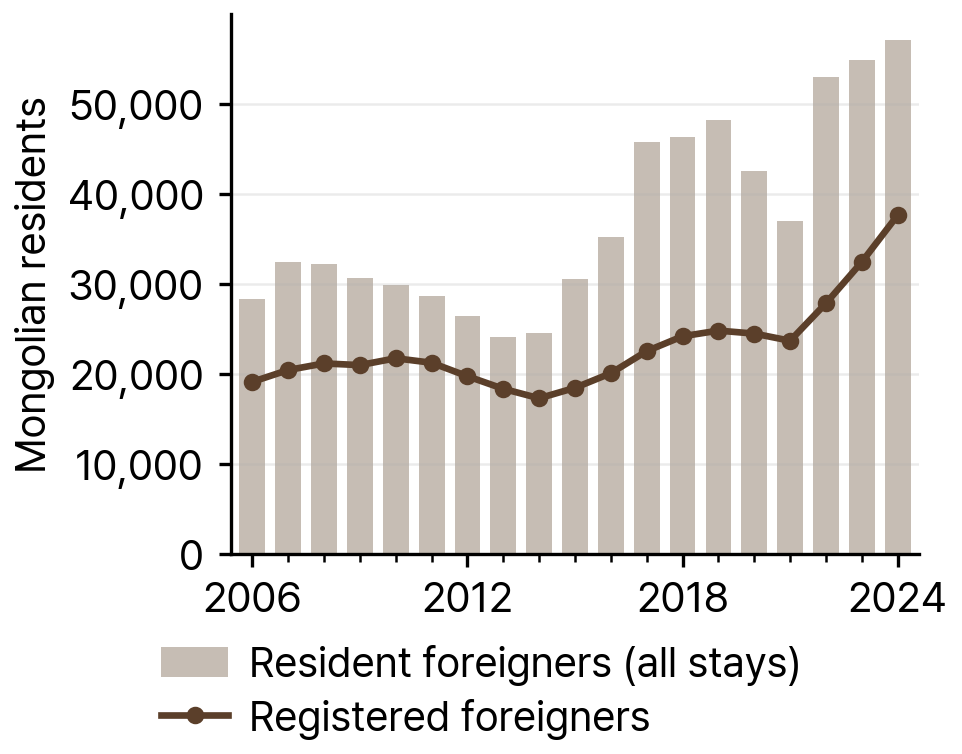
The number of Mongolian resident foreigners fell from 28,392 in 2006 to 24,561 in 2014, then almost doubled to 48,185 by 2019. It dropped during the COVID-19 pandemic years to 37,012 in 2021, recovered to 53,038 in 2022, and rose to 57,093 in 2024, the highest count in the series (see Figure 1).
Source: KIRD dataset, from Ministry of Justice immigration yearbooks, 2006-2024.
Registered foreigners grew from 19,160 in 2006 to 37,664 in 2024. In 2024, 66.0 percent of Mongolian resident foreigners were registered; the other 34.0 percent were in Korea for 90 days or less or did not register.
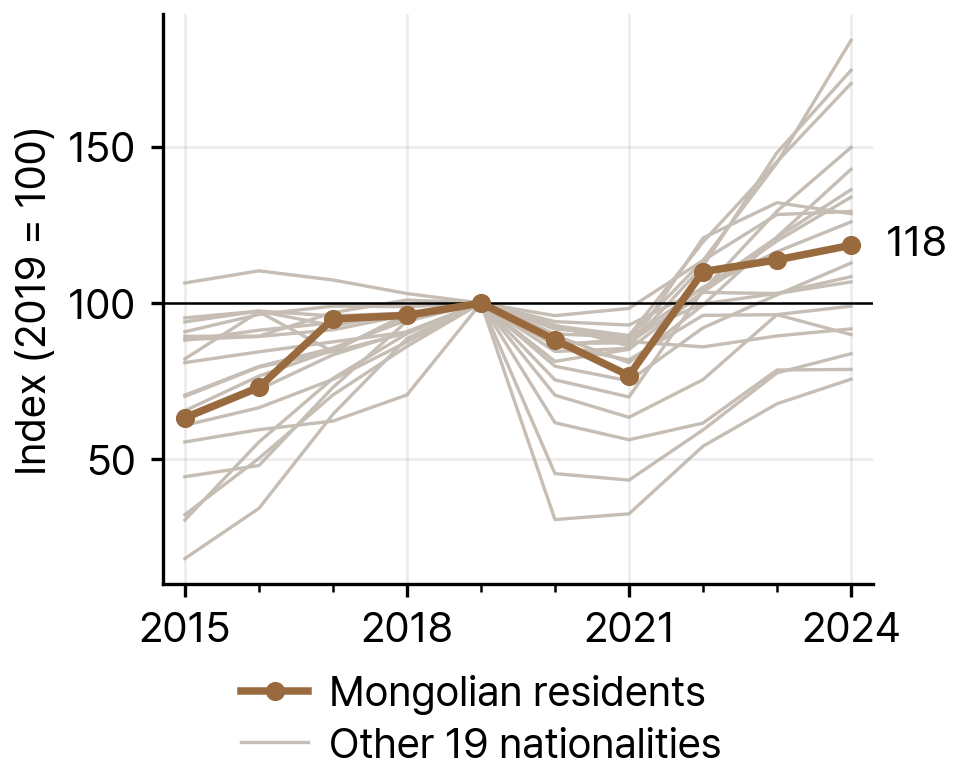
Measured against 2019, the Mongolian population stood at 118.5 in 2024 (2019 = 100). Mongolia ranked 11th in growth over 2019-24 among the 20 largest nationalities (see Figure 2).
Source: KIRD dataset, from Ministry of Justice immigration yearbooks, 2006-2024.
Mongolia's rank differs by measure. Among all resident foreigners it ranked 8th in 2006, 14th in 2014, 10th in 2019, and 12th in 2024. Among registered foreigners it ranked 9th in 2006, 14th in 2014, 12th in 2019, and 11th in 2024. Its share of registered foreigners in 2024 (2.5 percent) was higher than its share of all resident foreigners (2.2 percent), since 34.0 percent of Mongolians in Korea were short-term visitors or otherwise unregistered (see Table 1).
Table 1Mongolian Resident and Registered Foreigners in South Korea, Selected Years
| Year | Resident foreigners | Registered foreigners | Rank among resident foreigners | Rank among registered foreigners | Share of all resident foreigners (%) | Share of all registered foreigners (%) |
|---|---|---|---|---|---|---|
| 2006 | 28,392 | 19,160 | 8 | 9 | 3.1 | 3.0 |
| 2014 | 24,561 | 17,334 | 14 | 14 | 1.4 | 1.6 |
| 2019 | 48,185 | 24,845 | 10 | 12 | 1.9 | 2.0 |
| 2024 | 57,093 | 37,664 | 12 | 11 | 2.2 | 2.5 |
Note: Resident foreigners include short-term visitors and overseas Koreans who report their residence; registered foreigners are long-term residents who register with immigration authorities. Ranks count all nationalities in each series.
Source: KIRD dataset, from Ministry of Justice immigration yearbooks, 2006-2024.
Distribution by Province and District
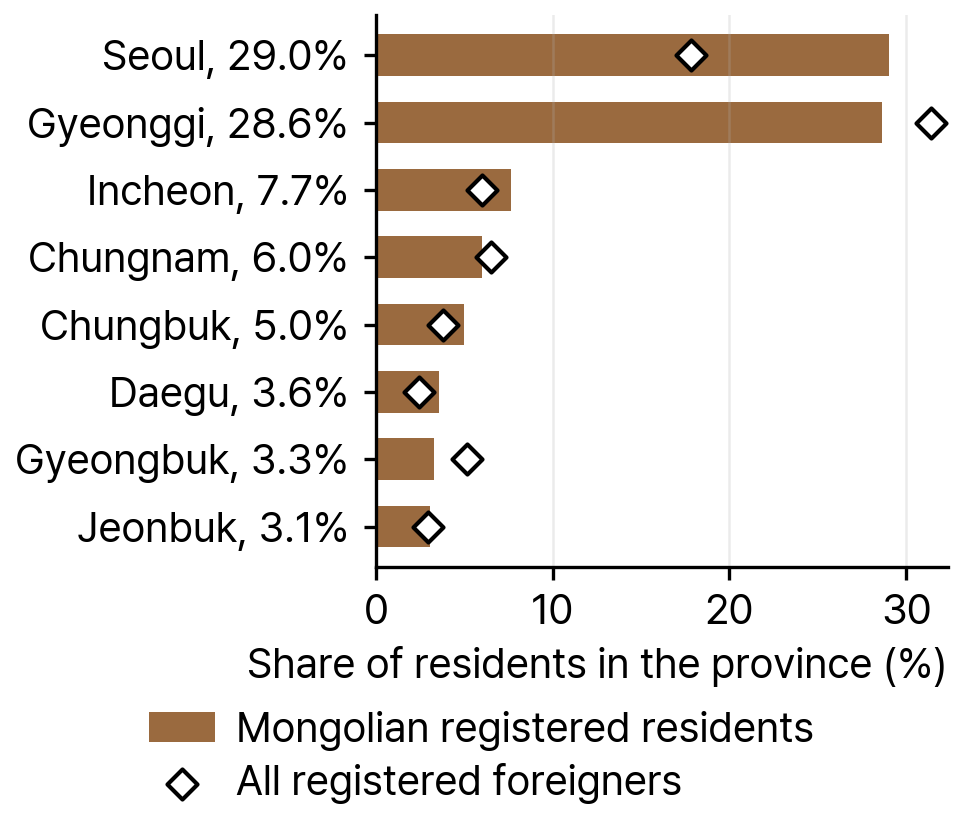
District-level counts cover registered foreigners (37,664 Mongolians in 2024). Incheon and Gyeonggi accounted for 36.3 percent of them and Seoul 29.0 percent, so 65.3 percent lived in the Seoul capital area, compared with 55.2 percent of all foreign residents. Chungcheong followed with 13.6 percent, Yeongnam with 12.2 percent, Honam with 6.6 percent, and Gangwon and Jeju with 2.2 percent (see Figure 3).
Source: KIRD dataset, from Ministry of Justice immigration yearbooks, 2006-2024.
Only 4.6 percent of Mongolian residents lived in rural counties (gun) in 2024, compared with 10.6 percent of all foreign residents. The rural share was highest in Chungcheong, at 18.0 percent of the region's Mongolian residents.
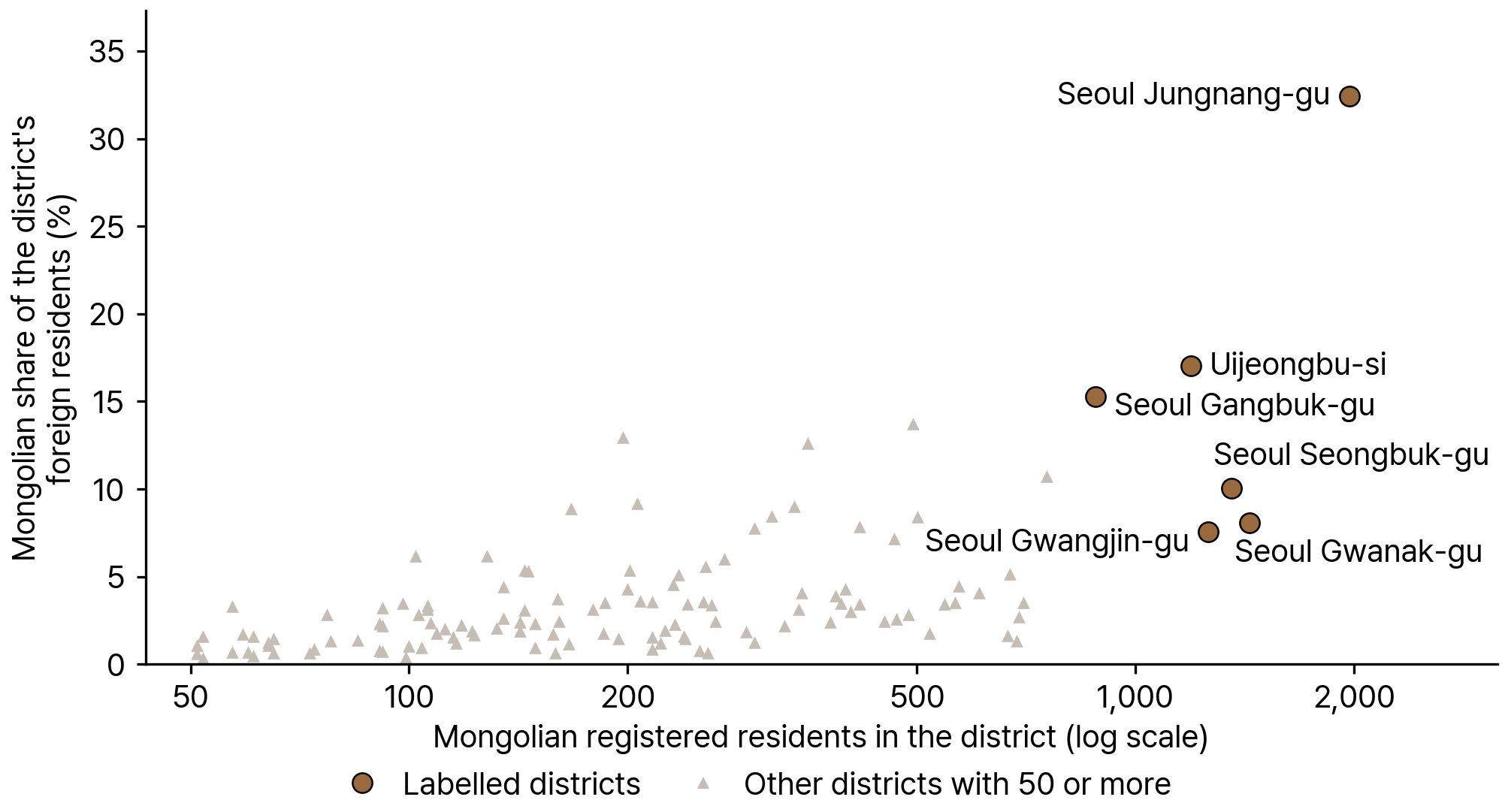
In 2024, 97 districts had at least 100 Mongolian residents, and the ten largest districts accounted for 29.0 percent of the group. Jungnang-gu in Seoul had the most (1,970), followed by Gwanak-gu (1,437), Seongbuk-gu (1,357), and Gwangjin-gu (1,261), also in Seoul, and Uijeongbu-si (1,193) in Gyeonggi-do (see Figure 4 and Table 2).
Source: KIRD dataset, from Ministry of Justice immigration yearbooks, 2006-2024.
Table 2Ten Districts with the Most Mongolian Residents, 2024
| District | Province | Mongolian residents | Share of district's foreign residents (%) |
|---|---|---|---|
| Jungnang-gu | Seoul | 1,970 | 32.4 |
| Gwanak-gu | Seoul | 1,437 | 8.1 |
| Seongbuk-gu | Seoul | 1,357 | 10.1 |
| Gwangjin-gu | Seoul | 1,261 | 7.6 |
| Uijeongbu-si | Gyeonggi-do | 1,193 | 17.0 |
| Gangbuk-gu | Seoul | 882 | 15.3 |
| Cheongju-si Heungdeok-gu | Chungcheongbuk-do | 755 | 10.7 |
| Dongdaemun-gu | Seoul | 701 | 3.5 |
| Gimpo-si | Gyeonggi-do | 692 | 2.7 |
| Hwaseong-si | Gyeonggi-do | 686 | 1.3 |
Note: Registered foreigners. The ten districts together accounted for 29.0 percent of Mongolian registered foreigners.
Source: KIRD dataset, from Ministry of Justice registered foreigner counts by district, 2024.
The index of dissimilarity (D) between Mongolian residents and all other foreign residents across districts was 0.369 in 2014 and 0.378 in 2024. The 2024 value means that about 38 percent of Mongolian residents would have to move to another district for their distribution to match that of other foreigners, a level almost unchanged since 2014.
One district meets the KIRD definition of an ethnic enclave (a location quotient of at least 2 and the group making up at least 30 percent of the district's foreign residents). In Jungnang-gu, Seoul, the 1,970 Mongolian residents made up 32.4 percent of all foreign residents in 2024, with a location quotient of 7.1. Mongolians also made up 17.0 percent of foreign residents in Uijeongbu-si and 15.3 percent in Gangbuk-gu.
Age and Sex
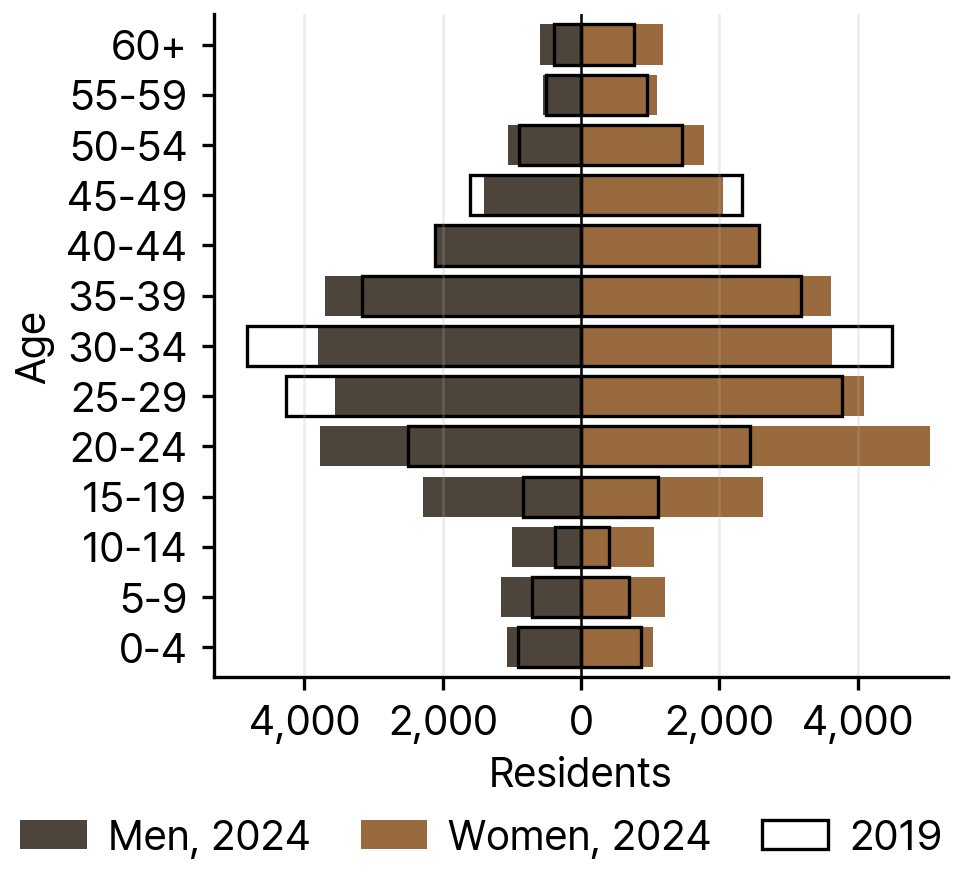
Women made up 54.4 percent of Mongolian resident foreigners in 2024 (31,042 of 57,093), up from 52.0 percent in 2019. Among all resident foreigners, women were 45.1 percent (see Figure 5).
Source: KIRD dataset, from Ministry of Justice immigration yearbooks, 2006-2024.
The largest five-year age group in 2024 was 20-24, and the median resident fell in the 30-34 group. People aged 20-39 accounted for 54.7 percent of Mongolian residents (31,222), compared with 49.7 percent of all resident foreigners.
Children under 15 numbered 6,542 in 2024, or 11.5 percent of the group, twice the 5.7 percent among all resident foreigners; 2,113 were under age 5. People aged 60 or older made up 3.1 percent of Mongolian residents, against 12.9 percent of all resident foreigners.
Visa Status
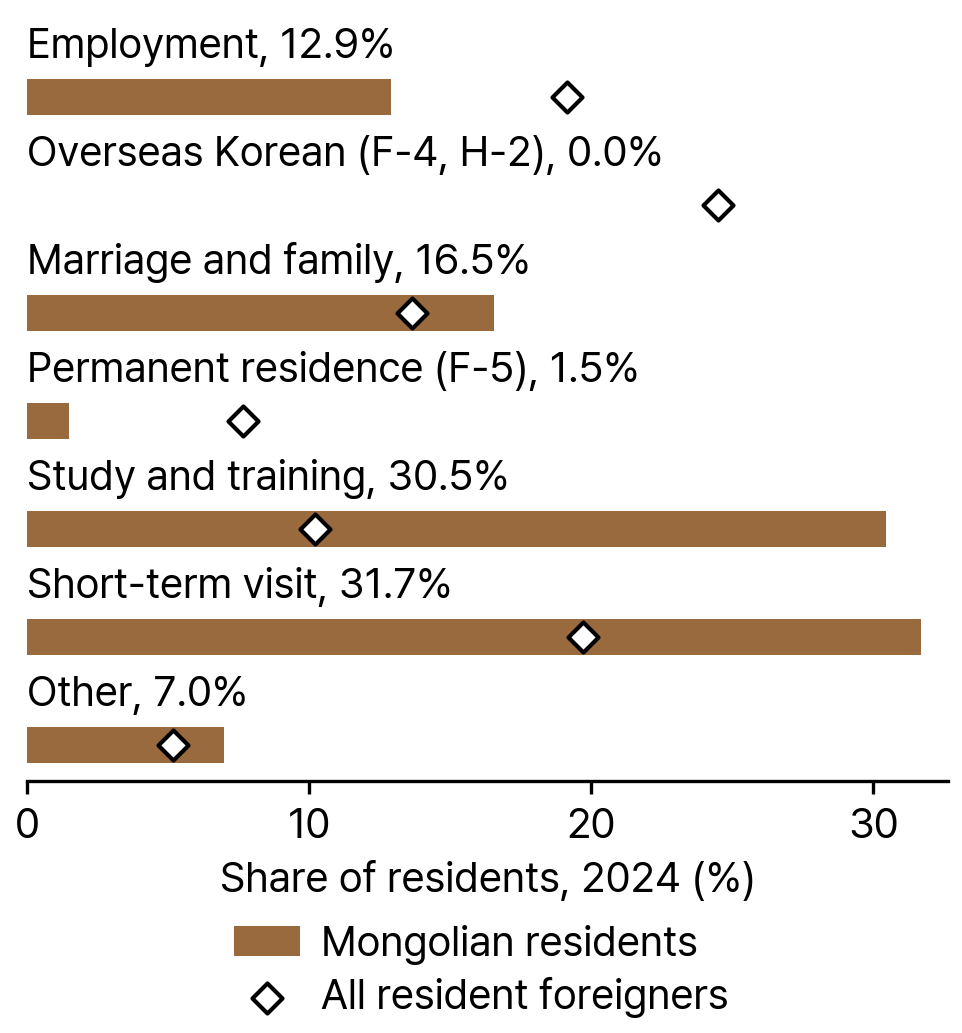
Short-term visits and study were the two largest status groups for Mongolian residents in 2024. Short-term visitors made up 31.7 percent of the group (19.7 percent among all resident foreigners), and study and training visas 30.5 percent (10.2 percent among all). Marriage and family statuses accounted for 16.5 percent (13.6 percent among all), employment for 12.9 percent (19.2 percent among all), and permanent residence (F-5) for 1.5 percent (7.7 percent among all). Almost no Mongolians held overseas Korean statuses (F-4, H-2), which account for 24.5 percent of all resident foreigners (see Figure 6).
Source: KIRD dataset, from Ministry of Justice immigration yearbooks, 2006-2024.
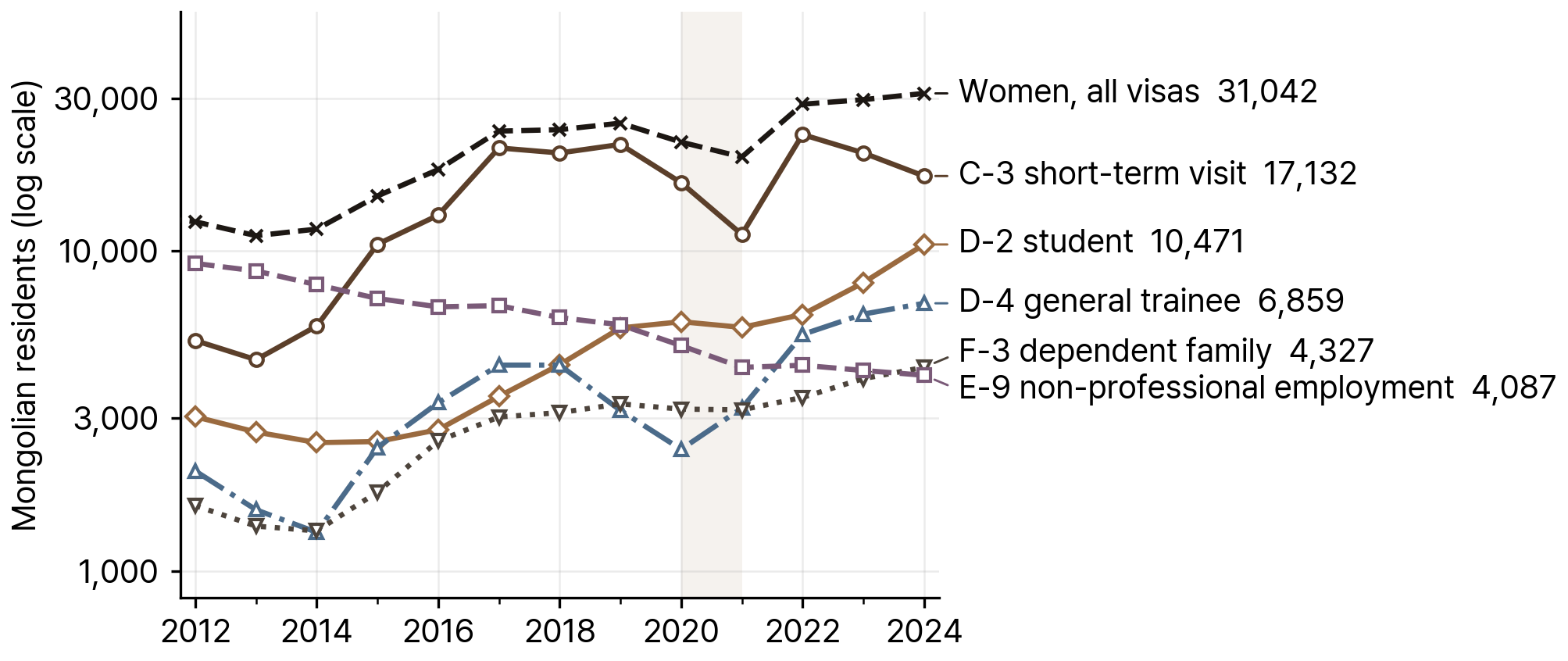
The C-3 short-term visit visa was the most common single status, held by 17,132 Mongolians in 2024 (30.0 percent of the group), down from 21,504 in 2019. Mongolians were 10.5 percent of all C-3 holders in Korea, the third-largest nationality on that visa.
Student and trainee numbers grew fastest. D-2 (student) holders rose from 2,518 in 2014 and 5,744 in 2019 to 10,471 in 2024, and D-4 (general trainee) holders from 1,321 in 2014 and 3,174 in 2019 to 6,859 in 2024. E-9 (non-professional employment) holders fell from 7,839 in 2014 to 5,875 in 2019 and 4,087 in 2024; Mongolians were 1.2 percent of all E-9 holders in 2024 (see Figure 7 and Table 3).
Source: KIRD dataset, from Ministry of Justice immigration yearbooks, 2006-2024.
Table 3Most Common Visa Types among Mongolian Residents, 2019 and 2024
| Visa | Meaning | 2019 | 2024 | Share of Mongolian residents, 2024 (%) | Mongolian share of all holders of this visa, 2024 (%) |
|---|---|---|---|---|---|
| C-3 | Short-term visit | 21,504 | 17,132 | 30.0 | 10.5 |
| D-2 | Student | 5,744 | 10,471 | 18.3 | 5.9 |
| D-4 | General trainee | 3,174 | 6,859 | 12.0 | 7.8 |
| F-3 | Dependent family | 3,327 | 4,327 | 7.6 | 8.2 |
| E-9 | Non-professional employment | 5,875 | 4,087 | 7.2 | 1.2 |
| G-1 | Other (miscellaneous) | 859 | 2,922 | 5.1 | 5.2 |
| F-6 | Marriage migration | 1,846 | 2,140 | 3.7 | 1.4 |
Note: Resident foreigners. Shares of the group use the 2024 total of 57,093.
Source: KIRD dataset, from Ministry of Justice immigration yearbooks, 2006-2024.
Migration Channels and Policy
Mongolia is one of the countries that send workers to Korea under the EPS, the program behind the E-9 visa. As of 2024, Korea had signed worker-exchange memoranda of understanding with 16 countries, and the Human Resources Development Service of Korea oversees the admission process on the Korean side (IDE-JETRO, 2024).
Marriage is another channel. A 2007 post by the Korean Embassy in Mongolia, citing Mongolia's Citizen Registration Office, reported that of 2,551 Mongolian women who had married foreign nationals, 1,673 had married Koreans (the post breaks this down as 1,648 women and 25 men). Far fewer had married nationals of Germany (155), China (137), Japan (119), the United States (89), or Russia (65) (Embassy of the Republic of Korea in Mongolia, 2007). In the KIRD data, 2,140 Mongolians held the F-6 marriage migrant visa in 2024.
Study has become a large channel. Ministry of Justice records cited by K-Study Times counted 18,254 Mongolian international students at Korean universities as of December 31, 2025 (K-Study Times, 2025). This count uses a different date and definition than the D-2 visa totals in the previous section.
In September 2026, the Korea Labor-Foundation sent a four-day delegation led by Secretary-General Park Jong-pil to Ulaanbaatar to launch a program linking pre-departure safety training for Mongolian workers bound for Korea under the EPS with post-arrival orientation in Korea. The stated aim was to reduce workplace injuries (Korea Times, 2026).
Naturalization
From 2014 to 2024, 1,137 Mongolian nationals were naturalized as Korean citizens. Annual counts ranged from 60 (2022) to 145 (2020); 81 Mongolians were naturalized in 2024 (see Figure 8).
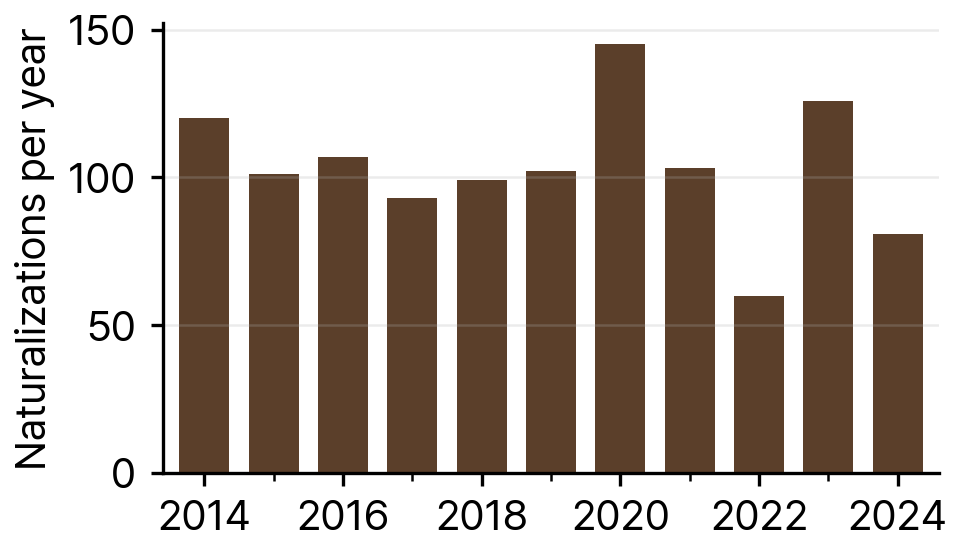
Source: KIRD dataset, from Ministry of Justice immigration yearbooks, 2006-2024.
The Ministry of Justice also recorded 133 restorations of Korean nationality among people of Mongolian nationality between 2011 and 2024, 7 of them in 2024.
Unauthorized Residents
Mongolia is among the ten nationalities for which the Ministry of Justice immigration yearbook (table 6-4) reports unauthorized residents separately. The count was 17,510 in 2019, 15,969 in 2021, 18,524 in 2023, and 16,554 in 2024.
Unauthorized residents equaled 36.3 percent of Mongolian resident foreigners in 2019 (17,510 of 48,185), 43.1 percent in 2021 (15,969 of 37,012), 33.8 percent in 2023 (18,524 of 54,846), and 29.0 percent in 2024 (16,554 of 57,093). In 2024 Mongolians were the fourth-largest unauthorized nationality and accounted for 4.2 percent of the 397,522 unauthorized residents in Korea.
Health and Well-being
To our knowledge, two studies report well-being measures for Mongolians in Korea separately: a 2011 survey of Mongolian migrant workers that measured quality of life and a 2006 study of children of Mongolian migrant workers that measured acculturative stress, self-esteem, and behavior problems (both summarized in the section on migration from Mongolia). The other studies we know of pool Mongolians with other nationalities.
Press reports document workplace deaths of Mongolian workers. On November 8, 2024, a 32-year-old Mongolian worker died at a specialty-vehicle manufacturer in Gimje, North Jeolla Province, after being caught between a parked aerial work platform and roughly 10 tons of newly developed equipment he was moving (Labor Today, 2024). On June 27, 2026, a Mongolian woman in her 40s died at a shipbuilding-component manufacturer in the Daebul industrial area (대불산단) in Yeongam after a pipe being moved by crane struck her in the abdomen (Women's News, 2026).
Migration from Mongolia to South Korea
South Korea is the largest destination for Mongolians abroad. Mongolia's Ministry of Foreign Affairs counted 211,611 Mongolian nationals living overseas in 2023, about 6.1 percent of the country's population, and South Korea had the largest group of any host country (International Organization for Migration, 2023). Among destinations for Mongolians working abroad, China ranks first and South Korea second, followed by Japan, the Czech Republic, and Hungary; in outbound travel statistics Korea ranks third after China and Russia (IDE-JETRO, 2024).
Korea was already a leading destination in the 2000s. An unofficial 2007 estimate attributed to Mongolia's Ministry of Foreign Affairs put about 30,000 of roughly 130,000 Mongolians abroad in Korea, second to Kazakhstan (65,000) and ahead of the United States (about 10,000) (Tsogtsaikhan, 2008).
Workers admitted under the EPS are a small part of the Mongolian population in Korea. For the end of 2023, Fukai estimated about 4,600 Mongolian EPS workers, compared with about 18,500 undocumented workers, 20,200 short-term visitors, 14,300 students and trainees, 2,600 marriage immigrants, and 600 professionals (IDE-JETRO, 2024). Korea admitted 851 Mongolian workers on E-9 visas in 2023, 724 in 2024, and 676 in 2025 (Ministry of Employment and Labor, 2026), and 5,384 Mongolians took the EPS Korean-language test in 2024, of whom 1,814 passed (HRD Korea, 2025). We know of no published source that identifies the aimags (provinces) of Mongolia that Korea-bound migrants come from.
Personal remittances received in Mongolia from all countries equaled about 2.2 percent of GDP in 2024, down from 4.1 percent in 2020 (World Bank, 2024); the share was 2.33 percent in 2022 and 2.24 percent in 2023 (TheGlobalEconomy.com, 2024). The World Bank's bilateral remittance estimates, last produced for 2021, put remittances sent from South Korea to Mongolia at about US$171.1 million that year (World Bank, 2021). In a 2004-05 survey of Mongolian labor migrants in three countries, 87.0 percent of those in Korea sent money home, compared with 76.5 percent in the Czech Republic and 62.8 percent in the United States, and 23.4 percent of the Korea group put remittances toward education and training (Tsogtsaikhan, 2008).
Mongolia's 2001 Law on Receiving Foreign Workers and Sending Labor Abroad set up a system of government-to-government agreements and inter-organizational contracts for employment abroad, with the stated aim of organizing labor migration and protecting migrant workers. Tsogtsaikhan reported in 2008 that many migrants still left through irregular channels with the help of a growing number of private intermediaries (Tsogtsaikhan, 2008). For the EPS, the General Agency for Labor Welfare under the Ministry of Labor and Social Security manages the process in Mongolia, including qualification tests and the deployment of workers. The ministry also operates a Labor and Social Security Service Center in Seoul that assists Mongolian nationals with industrial accident prevention, wage disputes, and access to Korea's pension and social insurance system (IDE-JETRO, 2024).
Research on Mongolians in Korea has focused on marriage, work, and families. A qualitative study of marriage migration found that commercial brokerage, organized around Korean grooms paying the full costs, left Mongolian women exposed to false information and with less say in their own migration (Kim et al., 2008). Interviews with 20 Mongolian marriage migrant women in Gwangju and South Jeolla Province found that they had difficulty turning vocational training at multicultural centers into stable jobs, set work goals around their own economic standing in Korea, and did better when employers recognized credentials earned in Mongolia (Shin, 2024). A 2011 survey of 453 Mongolian migrant workers in 10 Korean cities (333 with legal status and 120 undocumented) found that hope mediated the effect of job satisfaction and social support on quality of life, and that this pathway differed by legal status (Shin & Michiddorj-Otgondulam, 2012). A study of 67 children of Mongolian migrant workers in Seoul and Gyeonggi found moderate acculturative stress, fairly good self-esteem, and few behavior problems (Nho & Hong, 2006). We are not aware of any study of return migration to Mongolia.
Table 4Migration Indicators, Mongolia and South Korea
| Indicator | Value | Source |
|---|---|---|
| Mongolian nationals living abroad, 2023 | 211,611 | International Organization for Migration (2023), citing Mongolia's Ministry of Foreign Affairs |
| South Korea's rank among destinations of Mongolian workers abroad | 2nd, after China | IDE-JETRO (2024) |
| Mongolian EPS workers in South Korea, end of 2023 | About 4,600 | IDE-JETRO (2024) |
| E-9 workers admitted from Mongolia, 2023, 2024, and 2025 | 851; 724; 676 | Ministry of Employment and Labor (2026) |
| EPS-TOPIK test takers in Mongolia, 2024 | 5,384 (1,814 passed) | HRD Korea (2025) |
| Personal remittances received from all countries, 2024 | 2.2 percent of GDP | World Bank (2024) |
| Remittances sent from South Korea, 2021 (World Bank estimate) | US$171.1 million | World Bank (2021) |
| Mongolian migrants in Korea who sent money home, 2004-05 survey | 87.0 percent | Tsogtsaikhan (2008) |
Source: Sources as listed in each row.
Standard Mongolian in Mongolia is based on the northern Khalkha dialects, including the dialect of Ulaanbaatar (Svantesson et al., 2005).
Community Organizations
Seoul's best-known Mongolian commercial area, Mongol Town, lies near Dongdaemun Market. The area drew Russian immigrants from the late 1980s and began to attract Mongolians in the 2000s; the New Kunho Building is its center (IDE-JETRO, 2024). Mobile phone shops are the most common business there, about 80 percent of them operated by Mongolians and 20 percent by Koreans, alongside beauty and nail salons, shipping agents, job-placement offices, and visa agencies (Harper's Bazaar Korea, 2022).
In the KIRD census of 1,720 migrant-serving organizations, 4 have a name or stated target group that names the Mongolian community. They are the Mongolia Ulaanbaatar Culture Promotion Institute (몽골울란바타르 문화진흥원) in Gwangjin-gu, Seoul, a program site designated by the Ministry of Justice; the Mongolia-Korea Language and Culture Center (몽골-한국언어와 문화센터) in Jungnang-gu, Seoul; the Association of Mongolians in Korea (재한몽골인협회) in Jung-gu, Seoul; and Cheonan MOISE (천안 모이세), a nongovernmental organization in Cheonan-si Dongnam-gu, South Chungcheong Province. Most general-purpose organizations in the census, such as multicultural family support centers and migrant worker centers, also serve Mongolian residents.
Sources
Korea Immigration Regional Dashboard (KIRD) dataset. https://doi.org/10.3886/E249944V1
Fukai, H. (2024). Mongolian migrant workers under the Employment Permit System in South Korea: Focusing on sending/receiving policies based on the governments' bilateral agreements. Institute of Developing Economies, Japan External Trade Organization (IDE-JETRO). https://www.ide.go.jp/library/English/Event/Reports/pdf/20240822_Fukai01.pdf
Embassy of the Republic of Korea in Mongolia. 2007. 몽골인들, 한국인과 제일 많이 결혼한다 (Mongolians marry Koreans most of all). https://overseas.mofa.go.kr/mn-ko/brd/m_373/view.do?seq=572721
K-Study Times. 2025. 한국 거주 몽골 유학생 18,254명 (Mongolian international students in Korea), citing Ministry of Justice records. https://kstudytimes.kr/students-by-country/mn
Korea Times. 2026. Under new program, Korea preps Mongolian migrant workers before arrival. https://www.koreatimes.co.kr/southkorea/20260905/under-new-program-korea-preps-mongolian-migrant-workers-before-arrival
Labor Today (매일노동뉴스). 2024. 한국 정착 꿈꿨던 32살 몽골 청년의 죽음 (The death of a 32-year-old Mongolian who dreamed of settling in Korea). https://www.labortoday.co.kr/news/articleView.html?idxno=224645
Women's News (여성신문). 2026. 외국인 노동자 산재사망 369명 (369 foreign workers died in industrial accidents). https://www.womennews.co.kr/news/articleView.html?idxno=282278
World Bank. 2024. World Development Indicators: Personal remittances, received (% of GDP), Mongolia. https://api.worldbank.org/v2/country/MN/indicator/BX.TRF.PWKR.DT.GD.ZS?format=json&date=2018:2024
Svantesson, J.-O., Tsendina, A., Karlsson, A., & Franzén, V. (2005). The phonology of Mongolian. Oxford University Press. https://global.oup.com/academic/product/the-phonology-of-mongolian-9780199554270
Harper's Bazaar Korea. 2022. 동대문에서 만나는 몽골 문화 (Mongolian culture found in Dongdaemun). https://www.harpersbazaar.co.kr/article/70365
International Organization for Migration. (2023). Understanding the situation of the Mongolian diaspora (Discussion paper), citing Mongolia's Ministry of Foreign Affairs (2023). https://mongolia.iom.int/sites/g/files/tmzbdl1611/files/documents/2024-01/understanding-the-situation-of-the-mongolian-diaspora_eng.pdf
Tsogtsaikhan, B. (2008). Demographic changes and labor migration in Mongolia [Conference paper]. PECC-ABAC Conference on Demographic Change and International Labor Mobility in the Asia Pacific Region. https://www.pecc.org/resources/labor/681-demographic-changes-and-labor-migration-in-mongolia/file
TheGlobalEconomy.com. 2024. Mongolia: Remittances, percent of GDP, based on World Bank data. https://www.theglobaleconomy.com/Mongolia/remittances_percent_GDP/
Kim, H., Kim, J., & Kim, M. (2008). '안전한 결혼 이주'?: 몽골 여성들의 한국으로의 이주 과정과 경험 ['Safe marriage migration'? The migration process and experiences of Mongolian women to Korea]. Korean Women's Studies (한국여성학), 24(1), 121-155. https://www.kci.go.kr/kciportal/landing/article.kci?arti_id=ART001236204
Shin, N. (2024). 한국사회 적응 과정에서 나타나는 몽골여성결혼이주민의 노동 문제 [Labor problems of Mongolian female marriage migrants in the process of adaptation to Korean society]. Culture and Society (문화와 사회), 32(1), 171-239. https://www.kci.go.kr/kciportal/landing/article.kci?arti_id=ART003077120
Shin, S., & Michiddorj-Otgondulam. (2012). 재한 몽골 합법·불법 이주노동자들의 직업만족도, 사회적 지지, 희망이 삶의 질에 미치는 영향: 희망의 매개효과와 체류자격의 조절효과를 중심으로 [Effects of job satisfaction, social support and hope on quality of life among legal and illegal Mongolian migrant workers in Korea]. Korean Journal of Psychology: Culture and Social Issues (한국심리학회지: 문화 및 사회문제), 18(4), 435-458. https://accesson.kr/kpacsi/assets/pdf/26330/journal-18-4-435.pdf
Nho, C. R., & Hong, J. J. (2006). 이주노동자 자녀의 한국사회 적응실태 연구: 서울경기지역 몽골출신 이주노동자 자녀를 중심으로 [Adaptation of migrant workers' children to Korean society: Mongolian migrant workers' children in Seoul and Gyeonggi]. Journal of the Korean Society of Child Welfare (한국아동복지학), 22, 127-160. https://www.kci.go.kr/kciportal/ci/sereArticleSearch/ciSereArtiView.kci?sereArticleSearchBean.artiId=ART001147979
World Bank. 2021. Bilateral Remittance Estimates (WB_KNOMAD_BRE), Data360. https://data360api.worldbank.org/data360/data?DATABASE_ID=WB_KNOMAD&INDICATOR=WB_KNOMAD_BRE&REF_AREA=KOR
Human Resources Development Service of Korea (HRD Korea). 2025. 국가별 한국어시험 시행 정보 [EPS-TOPIK test takers and passes by country, 2024]. Archived April 21, 2025. https://web.archive.org/web/20250421163507/https://epstopik.hrdkorea.or.kr/epstopik/pass/candidate/selectChart.do?lang=ko
Ministry of Employment and Labor. 2026. 국가별 일반고용허가제 외국인근로자(E-9) 도입현황 [E-9 workers admitted under the Employment Permit System, by country], 2004-2025. KOSIS. https://kosis.kr/statHtml/statHtml.do?orgId=118&tblId=DT_11827_N001&conn_path=I2
Suggested citation: Korea Immigration Regional Dashboard (KIRD). 2026. “Mongolian Immigrants in South Korea.” Foreign Residents in South Korea series, September 2026. Data: Korea Immigration Regional Dashboard (KIRD) dataset, https://doi.org/10.3886/E249944V1. Interactive maps and tables: https://immigrantsinkorea.today.