 Korea Immigration Regional Dashboard
SpotlightSeptember 2026Nationality profilesDownload PDF
Cambodian Immigrants in South Korea
Highlights
- At the end of 2024, 61,006 Cambodians were registered foreigners in South Korea, the sixth-largest nationality among registered foreigners, and the 63,681 Cambodians among all resident foreigners made them the 11th-largest nationality in that count, 33.9 percent more than the 47,565 recorded in 2019.
- In 2024, 76.9 percent of Cambodian residents (48,998 people) held the E-9 non-professional employment visa, and Cambodians made up 14.5 percent of all E-9 holders in the country.
- In 2024, 22.7 percent of registered Cambodians lived in rural counties (gun), compared with 10.6 percent of all foreign residents.
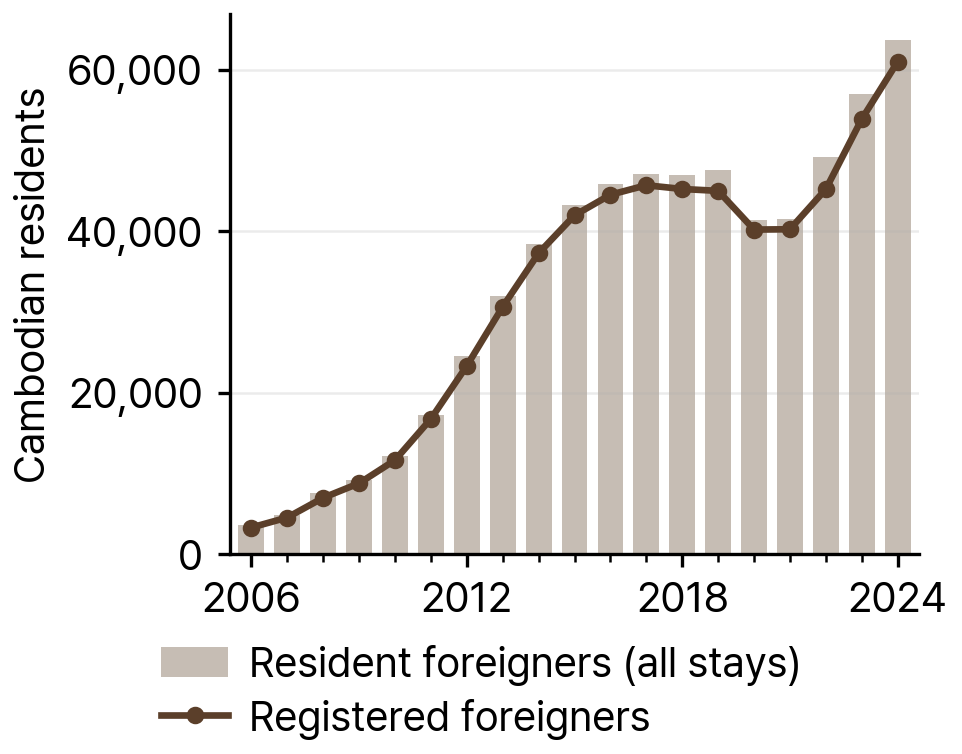
South Korea counted 63,681 Cambodian resident foreigners on December 31, 2024, the largest number on record. In 2024 Cambodians were the sixth-largest nationality among registered foreigners (61,006 people, 4.1 percent of the total) and the 11th-largest among all resident foreigners (2.4 percent). Their rank among registered foreigners was also sixth in 2014 and 2019, while their rank among all resident foreigners moved from 10th in 2014 to 11th in 2019 and 2024. The population grew more than seventeenfold from 3,652 in 2006 (63,681 / 3,652 = 17.4), fell from 47,565 in 2019 to 41,405 in 2020, and has risen every year since 2021.
Most Cambodians came to Korea as workers under the Employment Permit System (EPS), which Korea opened to Cambodia through a labor-sending agreement signed in 2006 (Korea Times, 2025). A smaller group arrived through marriage to Korean citizens, a channel the Cambodian government suspended in 2008 and again in 2010 over trafficking concerns (ABC News, 2010). Since 2019 two newer routes have grown. Cambodian holders of the E-7 specially designated activities visa numbered 55 in 2019 and 2,840 in 2024, and holders of the E-8 seasonal worker visa numbered 1,445 in 2024 after none in 2019.
Compared with all resident foreigners, Cambodians are younger, more often men, and far more concentrated in employment visas: 83.8 percent held an employment visa in 2024, against 19.2 percent of all resident foreigners. They are also less concentrated in the Seoul capital area and more likely to live in rural counties. This Spotlight describes the population's size, location, age and sex, visa status, migration channels, naturalization, unauthorized residence, health, community organizations, and migration from Cambodia to South Korea.
Size of the Population over Time
The number of Cambodian resident foreigners rose from 3,652 in 2006 to 12,192 in 2010 and 38,395 in 2014. Growth slowed after 2014, and the count was 47,565 in 2019. The count fell by 6,160 (13.0 percent) to 41,405 in 2020, changed little in 2021 (41,525), then climbed to 49,240 in 2022, 57,018 in 2023, and 63,681 in 2024.
Nearly all Cambodians in Korea are registered long-term residents. In 2024, 61,006 Cambodians were registered foreigners, 95.8 percent of the resident count. The registered count excludes short-term visitors and holders of the F-4 overseas Korean visa, groups with few Cambodians, so Cambodians rank higher among registered foreigners. They were 20th among registered foreigners and 22nd among all resident foreigners in 2006, and sixth and 10th in 2014.
Source: KIRD dataset, from Ministry of Justice immigration yearbooks, 2006-2024.
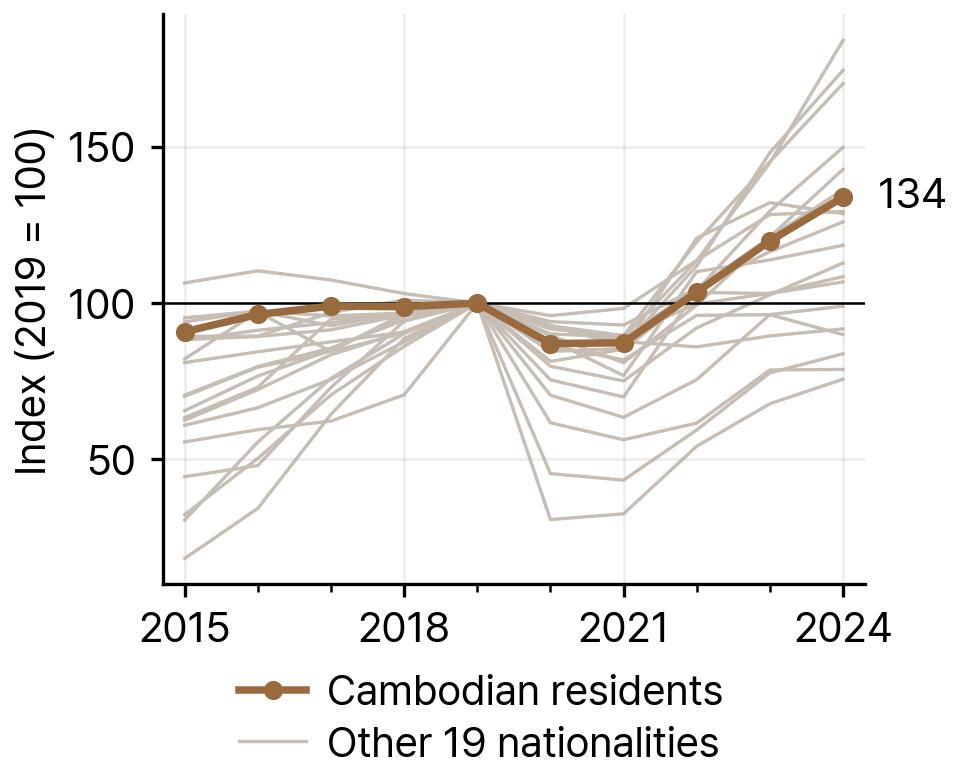
Between 2019 and 2024 the Cambodian population grew by 33.9 percent (index 133.9, with 2019 = 100). This was the 7th-fastest growth among the 20 largest foreign nationalities over that period.
Source: KIRD dataset, from Ministry of Justice immigration yearbooks, 2006-2024.
Table 1Cambodian Resident and Registered Foreigners in South Korea, Selected Years
| Year | Resident foreigners | Registered foreigners | Rank among resident foreigners | Rank among registered foreigners | Share of all resident foreigners (%) | Share of all registered foreigners (%) |
|---|---|---|---|---|---|---|
| 2006 | 3,652 | 3,331 | 22 | 20 | 0.4 | 0.5 |
| 2014 | 38,395 | 37,299 | 10 | 6 | 2.1 | 3.4 |
| 2019 | 47,565 | 45,016 | 11 | 6 | 1.9 | 3.5 |
| 2024 | 63,681 | 61,006 | 11 | 6 | 2.4 | 4.1 |
Note: Resident foreigners (체류외국인) include short-term visitors and F-4 residence reporters; registered foreigners (등록외국인) are long-term residents who register with immigration authorities. Ranks and shares compare Cambodians with all nationalities in the same count.
Source: KIRD dataset, from Ministry of Justice immigration yearbooks, 2006-2024.
Distribution by Province and District
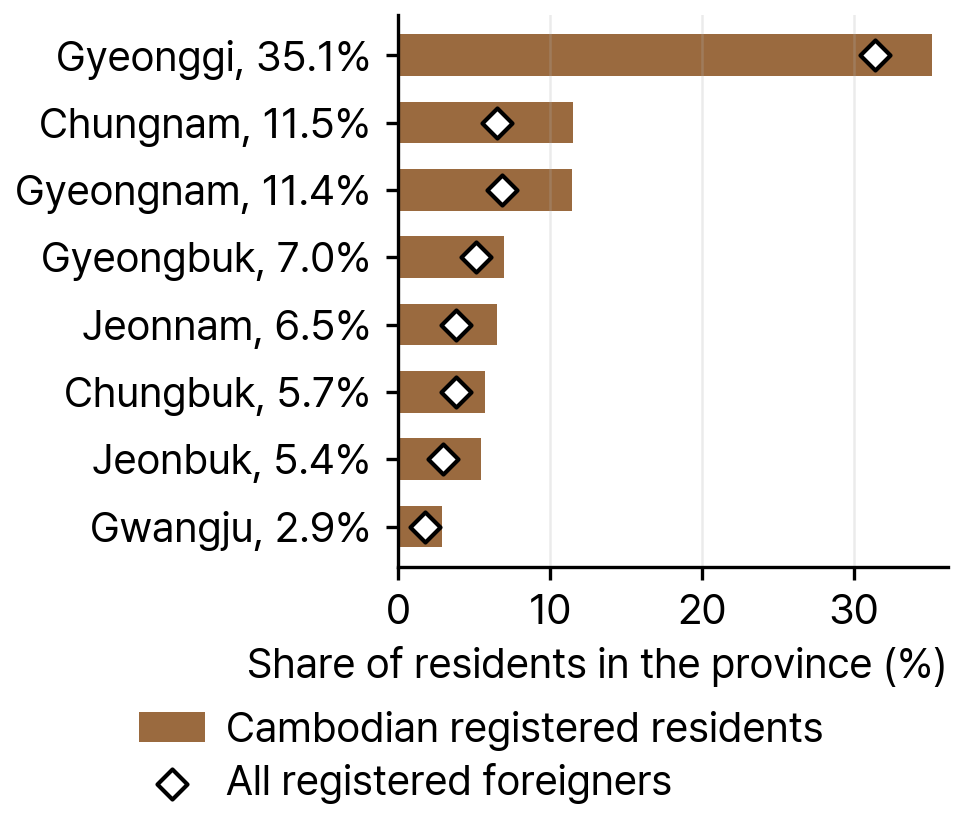
In 2024, 39.1 percent of registered Cambodians lived in the Seoul capital area (Seoul, Incheon, and Gyeonggi), compared with 55.2 percent of all foreign residents. Almost all of that share was outside Seoul itself: 22,753 Cambodians (37.3 percent) lived in Incheon and Gyeonggi, and 1,109 (1.8 percent) in Seoul. The Yeongnam region held 24.8 percent (15,121), Chungcheong 18.4 percent (11,224), Honam 14.8 percent (9,034), and Gangwon and Jeju 2.9 percent (1,765).
In 2024, 22.7 percent of registered Cambodians lived in a rural county (gun), compared with 10.6 percent of all foreign residents. The rural county share was 44.5 percent in Honam, 35.3 percent in Chungcheong, and 31.0 percent in Yeongnam.
Source: KIRD dataset, from Ministry of Justice immigration yearbooks, 2006-2024.
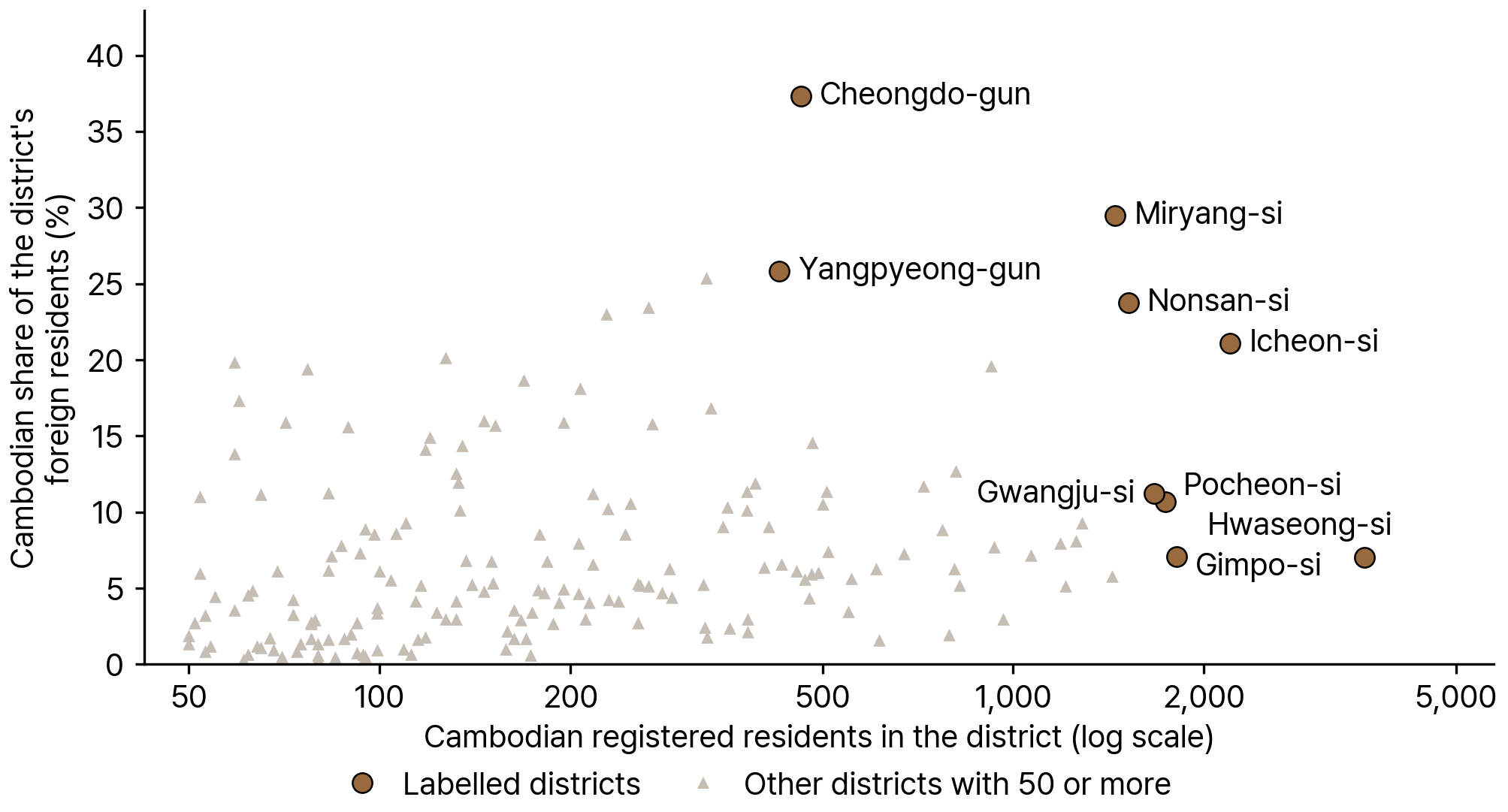
The population is spread across many places. In 2024, 121 districts had at least 100 registered Cambodians, and the ten largest districts together held 29.4 percent of the total. Hwaseong-si in Gyeonggi-do had the most (3,588). In Icheon-si, Nonsan-si, and Miryang-si, Cambodians made up more than one in five foreign residents.
Source: KIRD dataset, from Ministry of Justice immigration yearbooks, 2006-2024.
Table 2Ten Districts with the Most Registered Cambodians, 2024
| District | Province | Registered Cambodians | Share of district's registered foreigners (%) |
|---|---|---|---|
| Hwaseong-si | Gyeonggi-do | 3,588 | 7.0 |
| Icheon-si | Gyeonggi-do | 2,202 | 21.1 |
| Gimpo-si | Gyeonggi-do | 1,813 | 7.1 |
| Pocheon-si | Gyeonggi-do | 1,739 | 10.7 |
| Gwangju-si | Gyeonggi-do | 1,670 | 11.2 |
| Nonsan-si | Chungcheongnam-do | 1,522 | 23.7 |
| Miryang-si | Gyeongsangnam-do | 1,449 | 29.5 |
| Gimhae-si | Gyeongsangnam-do | 1,432 | 5.8 |
| Eumseong-gun | Chungcheongbuk-do | 1,284 | 9.3 |
| Paju-si | Gyeonggi-do | 1,255 | 8.1 |
Note: Gwangju-si is the city in Gyeonggi-do, distinct from Gwangju Metropolitan City. Together these ten districts held 29.4 percent of registered Cambodians.
Source: KIRD dataset, from Ministry of Justice immigration yearbooks, 2006-2024.
The index of dissimilarity between Cambodians and all other foreign residents across districts was 0.494 in 2014 and 0.507 in 2024, a change of 0.013 over the decade.
One district met the enclave definition in 2024. In Cheongdo-gun (Gyeongsangbuk-do), 462 registered Cambodians made up 37.3 percent of foreign residents, a location quotient of 9.6. Other districts with high Cambodian shares in 2024 were Miryang-si (29.5 percent), Yangpyeong-gun (25.8 percent), Damyang-gun (25.4 percent), and Nonsan-si (23.7 percent).
Age and Sex
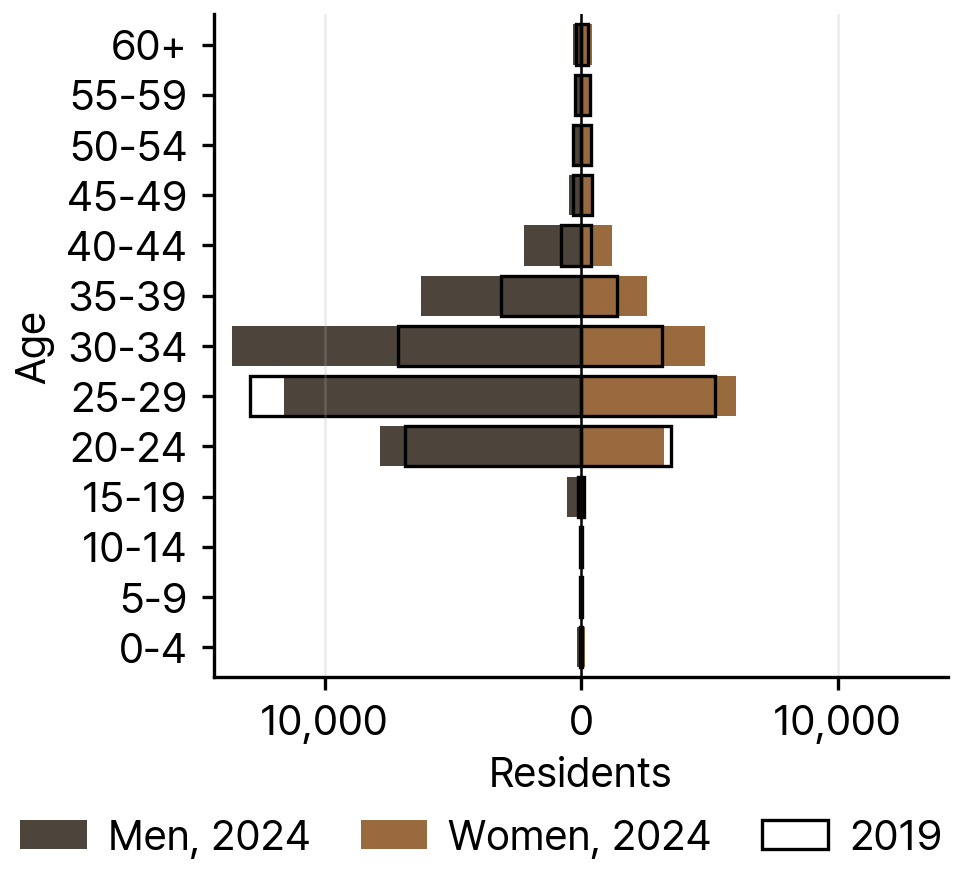
Cambodian residents are concentrated in young working ages. In 2024, 87.8 percent (55,922 people) were ages 20 to 39, compared with 49.7 percent of all resident foreigners. The largest five-year age group was 30 to 34, and the median age also fell in that group.
Few Cambodian residents are children or older adults. In 2024, 0.9 percent (583) were under age 15, against 5.7 percent of all resident foreigners, and 1.2 percent were 60 or older, against 12.9 percent. The number of Cambodian children under 15 rose from 245 in 2019 to 583 in 2024, and children under 5 from 83 to 309.
Women made up 31.4 percent of Cambodian residents in 2024 (19,988 people), down from 32.4 percent (15,406) in 2019. Among all resident foreigners, 45.1 percent were women in 2024.
Source: KIRD dataset, from Ministry of Justice immigration yearbooks, 2006-2024.
Visa Status
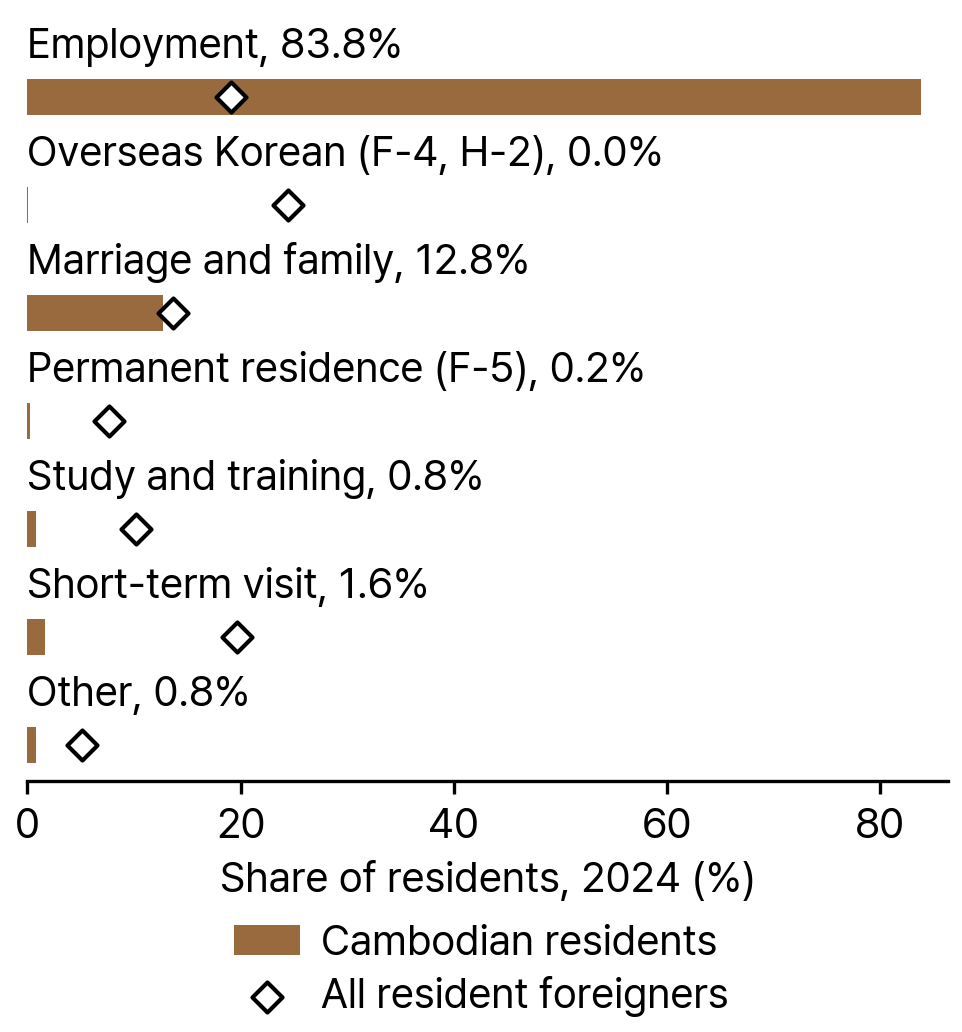
In 2024, 83.8 percent of Cambodian residents held an employment visa, compared with 19.2 percent of all resident foreigners. Marriage and family visas accounted for 12.8 percent (13.6 percent among all resident foreigners). Short-term visits (1.6 percent), study and training (0.8 percent), and permanent residence (0.2 percent) were each much smaller than among all resident foreigners (19.7, 10.2, and 7.7 percent). No Cambodians held overseas Korean visas, the category that covers 24.5 percent of all resident foreigners.
Source: KIRD dataset, from Ministry of Justice immigration yearbooks, 2006-2024.
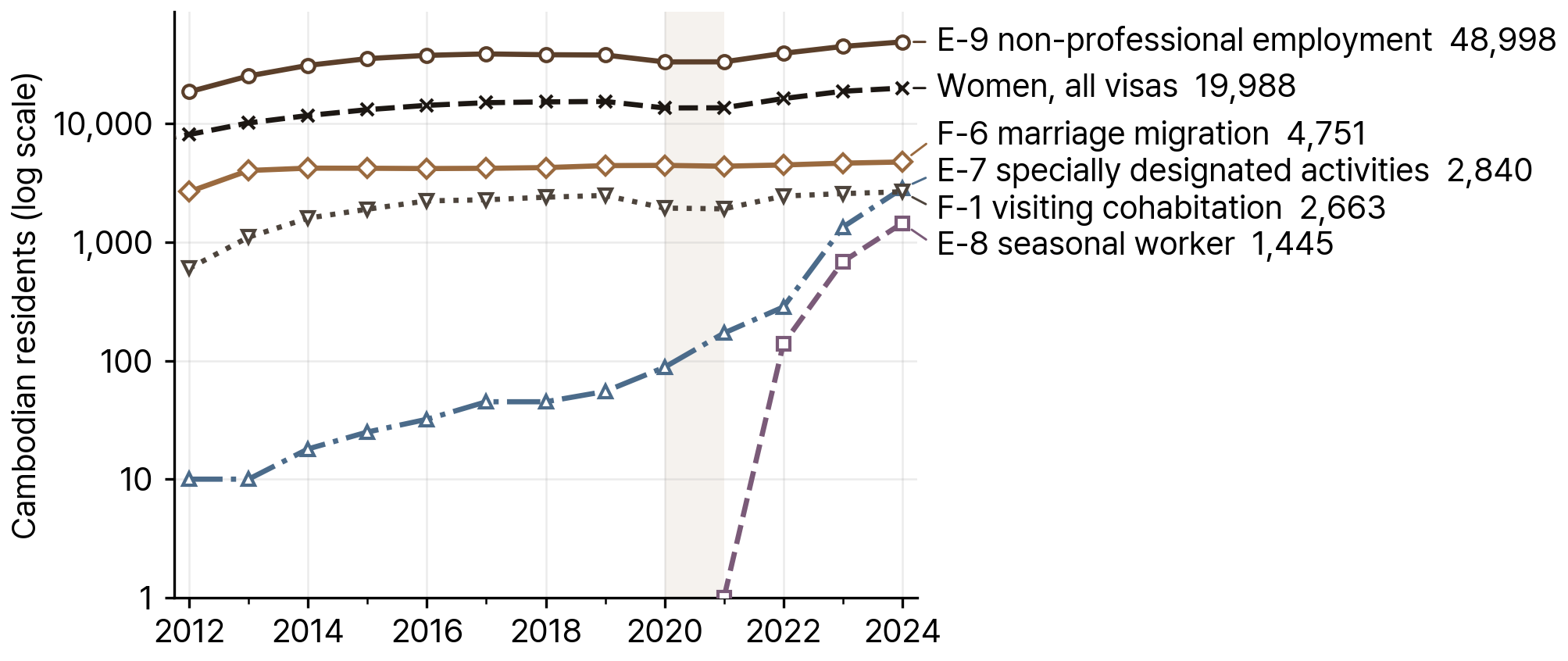
The E-9 non-professional employment visa is the main status. Cambodian E-9 holders grew from 31,056 in 2014 to 37,980 in 2019 and 48,998 in 2024. In the KIRD data for 2024, Cambodians were the largest nationality among E-9 holders, at 14.5 percent of the total. The Korea Times described Cambodia in 2025 as the second-largest source of E-9 workers after Nepal (Korea Times, 2025).
Two smaller statuses grew fast after 2019. E-7 holders increased from 55 in 2019 to 2,840 in 2024, and E-8 seasonal workers from zero to 1,445. Marriage migrants on the F-6 visa numbered 4,751 in 2024, up from 4,428 in 2019, and F-3 dependent family holders rose from 51 to 409.
Source: KIRD dataset, from Ministry of Justice immigration yearbooks, 2006-2024.
Table 3Main Visa Types Held by Cambodian Residents in South Korea, 2019 and 2024
| Visa | Meaning | 2019 | 2024 | Share of Cambodian residents, 2024 (%) | Cambodians' share of all holders of this visa, 2024 (%) |
|---|---|---|---|---|---|
| E-9 | Non-professional employment | 37,980 | 48,998 | 76.9 | 14.5 |
| F-6 | Marriage migration | 4,428 | 4,751 | 7.5 | 3.2 |
| E-7 | Specially designated activities | 55 | 2,840 | 4.5 | 4.5 |
| F-1 | Visiting and cohabitation | 2,480 | 2,663 | 4.2 | 2.7 |
| E-8 | Seasonal worker | 0 | 1,445 | 2.3 | 5.9 |
| C-3 | Short-term visit | 1,130 | 907 | 1.4 | 0.6 |
| F-3 | Dependent family | 51 | 409 | 0.6 | 0.8 |
Note: Shares use the 2024 Cambodian resident total of 63,681.
Source: KIRD dataset, from Ministry of Justice immigration yearbooks, 2006-2024.
Migration Channels and Policy
Labor migration from Cambodia rests on a 2006 labor-sending agreement between the two governments under the Employment Permit System (Korea Times, 2025). The same report described Cambodia in October 2025 as the second-largest source of E-9 workers after Nepal.
Seasonal farm work is a second channel arranged between governments. Korean county governments sign E-8 agreements directly with Cambodia's Ministry of Labour and Vocational Training; Hamyang County signed one in Phnom Penh in August 2026 (Newspim, 2026).
In October 2025, after kidnappings and killings of Korean citizens by Cambodia-based crime groups led to public calls to cut Cambodia's E-9 quota, Labor Minister Kim Young-hoon said the government had no plans to adjust Cambodia's allocation and warned that a cut would unfairly stigmatize Cambodian workers (Korea Times, 2025).
In January 2026, after the Supreme Court ruling on the death of Cambodian worker Nuon Sokkheng (see Health and Well-being), the Ministry of Employment and Labor said it would seek to revise the law so that employers cannot house foreign workers in illegal temporary structures, and would step up inspections of foreign workers' housing (Korea Times, 2026).
Naturalization
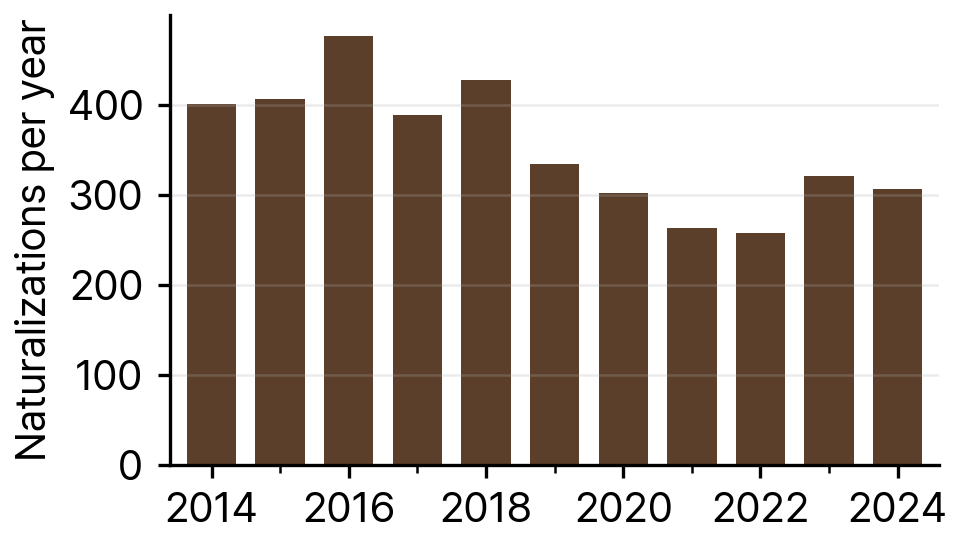
The KIRD dataset records 3,885 naturalizations of Cambodian nationals from 2014 to 2024. The Ministry of Justice yearbook's naturalization table by country of origin is used from the 2011 edition onward, because the 2009 and 2010 editions print cumulative totals dating back to 1991; Cambodia's row covering all naturalization routes in that table begins in 2014. Annual naturalizations peaked at 476 in 2016, fell to 258 in 2022, and stood at 307 in 2024.
A further 83 restorations of Korean nationality were recorded for Cambodian nationals from 2011 to 2024, one of them in 2024. Restoration applies to former Korean nationals and is mainly relevant for ethnic Korean groups.
Source: KIRD dataset, from Ministry of Justice immigration yearbooks, 2006-2024.
Unauthorized Residents
Cambodia is among the ten nationalities that the Ministry of Justice yearbook reports separately in its table of unauthorized residents (table 6-4). The count of Cambodians without valid status was 6,099 in 2019, 8,751 in 2021, 10,920 in 2023, and 10,709 in 2024.
Relative to the resident count, these figures equal 12.8 percent in 2019 (6,099 of 47,565), 21.1 percent in 2021 (8,751 of 41,525), 19.2 percent in 2023 (10,920 of 57,018), and 16.8 percent in 2024 (10,709 of 63,681). Cambodians ranked 8th among nationalities in 2024 and accounted for 2.7 percent of the 397,522 unauthorized residents counted that year.
Health and Well-being
To our knowledge, no published study reports health outcomes for Cambodian residents of Korea separately. News reports describe deaths at work and in worker housing.
Nuon Sokkheng, a 30-year-old Cambodian farm worker, died on December 20, 2020 in an unheated vinyl greenhouse structure used as her dormitory near a vegetable farm in Pocheon, Gyeonggi Province. On January 29, 2026, the Supreme Court upheld a ruling that the government was liable for failing to oversee workplace accommodation and ordered it to pay 10 million won to each of her parents (Korea Times, 2026).
On February 28, 2026, a 35-year-old Cambodian worker died of cardiac arrest after a 1-ton ship block fell on him at a shipyard in Samho-eup, Yeongam, South Jeolla Province (Asia Economy, 2026).
Migration from Cambodia to South Korea
South Korea receives a small part of Cambodia's labor migration. Of about 183,000 returned migrant workers counted in Cambodia's 2019 Labour Force Survey, 95.3 percent had last worked in Thailand and 1.7 percent in South Korea, the second most common country after Thailand (IOM 2024). In January 2024 a spokesperson for Cambodia's Ministry of Labour and Vocational Training said the ministry had documented more than 1.3 million Cambodians working abroad (Phnom Penh Post 2024).
According to a January 2024 ministry report, 9,778 Cambodians, including 2,719 women, were employed in South Korea in 2023 (The Better Cambodia 2024). In April 2023 Labour Minister Ith Samheng said more than 60,000 Cambodians were working in South Korea, more than 40,000 of them on fixed-term migrant worker contracts, and that the Korean government had promised to raise the number of workers by 10,000 or more (Phnom Penh Post 2023). The KIRD data counted 57,018 Cambodian resident foreigners at the end of 2023. In 2024, 35,341 Cambodians took the EPS Korean-language test (EPS-TOPIK) and 11,498 passed (HRD Korea 2025), and Korea admitted 10,445 Cambodian workers on E-9 visas (Ministry of Employment and Labor 2026).
Personal remittances received by Cambodia from all countries totaled about USD 2.83 billion in 2024, or 6.10 percent of GDP, down from 6.57 percent (USD 2.78 billion) in 2023 and 7.43 percent in 2020 (World Bank 2026). For 2021, World Bank bilateral estimates cited by IOM put remittances from South Korea to Cambodia at USD 65 million, the fourth-largest source after Thailand (USD 637 million), the United States (USD 213 million), and France (USD 89 million) (IOM 2024). Cambodian officials report much higher figures. Minister Ith Samheng said in April 2023 that Cambodians in South Korea send home USD 500 million to 600 million a year (Phnom Penh Post 2023).
As far as we know, no published source reports the provinces of origin of Korea-bound workers in aggregate. A 2020 case study of Korea-migrant households was set in Reap and Roka communes of Pea Reang District, Prey Veng Province (Chan & Lak 2020), and workers and families interviewed by the Phnom Penh Post in January 2024 came from Kampong Cham and Kampong Chhnang provinces (Phnom Penh Post 2024).
Cambodian policy has restricted marriage migration to Korea twice. Cambodia banned foreign marriages in March 2008 to prevent trafficking and lifted the ban about eight months later. In March 2010 it suspended marriages between its citizens and South Koreans, after a matchmaker was sentenced to 10 years in prison for bringing 25 women from the countryside to broker marriages with South Korean men. The number of Cambodian women marrying Korean men had risen from 551 in 2008 to 1,372 in 2009, according to Yonhap as reported by ABC News (ABC News 2010). On the labor side, the total cost of the EPS route for Cambodian applicants, including the language test, health check, passport, visa, orientation, and airfare tax, was USD 991 in 2013, according to Ministry of Labour data submitted to the National Assembly for its 2014 audit (Migrant Forum in Asia 2017).
Research on this corridor centers on remittances and return. Sok and Yang (2021), comparing Cambodian workers in Malaysia and South Korea through interviews, found that most workers in Korea sent their salaries home, while those in Malaysia sent limited amounts, and linked the difference to the government-to-government recruitment used for Korea and the government-agency scheme used for Malaysia. Chan and Lak (2020) found an average annual remittance of USD 7,000 among 69 Prey Veng households with a member in Korea, spent mainly on food, health care, home renovation, education, and property, and described remittances as an insecure income source unless invested in longer-term livelihoods. Lay, Lee, and Kim (2025) interviewed five EPS workers preparing to return, who described building a livelihood at home, restoring relationships strained by years abroad, readjusting to hometown life amid concern about Korean cultural influence, and planning an uncertain future. A 2017 policy brief reported that Cambodian workers had been dispatched unlawfully to farms through labor brokers, despite the government-to-government design of the EPS (Migrant Forum in Asia 2017).
Table 4Migration indicators, Cambodia and South Korea
| Indicator | Value | Source |
|---|---|---|
| Returned migrant workers whose last country of work was South Korea, 2019 | 1.7% (Thailand 95.3%) | IOM 2024 |
| Cambodians documented working abroad, all destinations, January 2024 | more than 1.3 million | Phnom Penh Post 2024 |
| Cambodians employed in South Korea, 2023 (ministry report) | 9,778 (2,719 women) | The Better Cambodia 2024 |
| Cambodians working in South Korea, April 2023 (minister's statement) | more than 60,000 | Phnom Penh Post 2023 |
| EPS-TOPIK test takers in Cambodia, 2024 | 35,341 (11,498 passed) | HRD Korea 2025 |
| E-9 workers admitted from Cambodia, 2024 | 10,445 | Ministry of Employment and Labor 2026 |
| Total EPS cost per Cambodian applicant, 2013 | USD 991 | Migrant Forum in Asia 2017 |
| Remittances from South Korea, 2021 (World Bank estimate) | USD 65 million (fourth-largest source) | IOM 2024 |
| Remittances from South Korea per year, 2023 (minister's statement) | USD 500-600 million | Phnom Penh Post 2023 |
| Personal remittances received, all countries, 2024 | USD 2.83 billion (6.10% of GDP) | World Bank 2026 |
| Cambodian women marrying Korean men, 2008 and 2009 | 551 and 1,372 | ABC News 2010 |
Source: Sources as listed in each row.
Community Organizations
The Cambodian embassy opened a shelter in Sangnok-gu, Ansan, on May 28, 2018, with space for about 20 people, to support Cambodian workers who lacked jobs or housing. The press report at the time put the number of Cambodians in Korea at about 60,000 and in Ansan at more than 600 (Kyeonggi Ilbo, 2018).
Of the 1,720 migrant-serving organizations in the KIRD census, 6 name Cambodians in their name or target group. They include the Gwangju-Jeonnam Cambodian Community (Gwangsan-gu, Gwangju), the Gunpo Cambodian Buddhist Center (Gunpo-si, Gyeonggi-do), the Cambodian Cultural Center (Sangnok-gu, Ansan), and Osankam (Miryang-si, Gyeongsangnam-do). Most general-purpose organizations, such as foreign worker support centers and multicultural family centers, also serve Cambodians.
Sources
Korea Immigration Regional Dashboard (KIRD) dataset. Compiled from Ministry of Justice immigration yearbooks, 2006-2024. https://doi.org/10.3886/E249944V1
ABC News (Australia). 2010. Cambodia Bans Marriages to South Koreans. March 19, 2010. https://www.abc.net.au/news/2010-03-19/cambodia-bans-marriages-to-south-koreans/371948
Asia Economy. 2026. Ship Block Topples at Daebul Shipyard, Cambodian Worker Dies [대불산단 조선소서 선박 블록 전도…캄보디아 노동자 숨져]. February 28, 2026. https://view.asiae.co.kr/article/2026022817200587628
The Better Cambodia. 2024. Cambodia and South Korea Enhance Collaborative Efforts in Employment and Vocational Training. https://thebettercambodia.com/cambodia-and-south-korea-enhance-collaborative-efforts-in-employment-and-vocational-training/
Chan, S., & Lak, C. (2020). The impact of international remittances from migrant workers in South Korea on the livelihoods of rural Cambodian households: A case study of Pea Reang District, Prey Veng Province. Insight: Cambodia Journal of Basic and Applied Research, 2(2), 32-66. https://cjbar.rupp.edu.kh/index.php/cjbar/article/download/34/30/57
International Organization for Migration. 2024. Migration in the Kingdom of Cambodia: A Country Profile 2023. Geneva: IOM. https://publications.iom.int/system/files/pdf/pub2024-006-el-cambodia-migration-profile.pdf
The Korea Times. 2025. Labor Minister Rejects Calls to Cut Cambodian Worker Quota after Kidnappings. October 20, 2025. https://www.koreatimes.co.kr/southkorea/globalcommunity/20251020/labor-minister-rejects-calls-to-cut-cambodian-worker-quota-after-kidnappings
The Korea Times. 2026. Labor Ministry Vows to End 'Greenhouse Dorms' after Ruling on Migrant Worker's Death. January 30, 2026. https://www.koreatimes.co.kr/southkorea/globalcommunity/20260130/labor-ministry-vows-to-end-greenhouse-dorms-after-ruling-on-migrant-workers-death
Kyeonggi Ilbo. 2018. Cambodian Embassy in Korea Runs Shelter to Support Its Nationals [주한 캄보디아 대사관, 자국민 지원하기 위한 쉼터 운영]. May 30, 2018. https://www.kyeonggi.com/article/201805300989953
Lay, S., Lee, N., & Kim, S. H. (2025). Experiences in preparing for the repatriation of Cambodian migrant workers from South Korea. Contemporary Society and Multiculture, 15(2), 31-69. https://doi.org/10.35281/cms.2025.05.15.2.31
Migrant Forum in Asia. 2017. South Korea's Employment Permit System: A Successful Government-to-Government Model? Open Working Group on Labour Migration and Recruitment, Policy Brief 2. http://mfasia.org/migrantforumasia/wp-content/uploads/2017/01/2-Policy-Brief-South-Koreas-EPS-A-Successful-G2G-Model.pdf
Newspim. 2026. Hamyang County Signs Seasonal-Worker Agreement in Cambodia [함양군, 일손 찾아 캄보디아까지 갔다…계절근로 협약 체결]. August 8, 2026. https://www.newspim.com/news/view/20260808000071
Phnom Penh Post. 2023. 60K Cambodian Workers in South Korea Remit $500-600M. April 2023. https://www.phnompenhpost.com/business/60k-cambodian-workers-south-korea-remit-500-600m/
Phnom Penh Post. 2024. Prosperity Pipeline: Cambodian Workers Thriving in South Korea. January 10, 2024. https://www.phnompenhpost.com/national/post-in-depth/prosperity-pipeline-cambodian-workers-thriving-in-south-korea
Sok, S., & Yang, C. (2021). Brawn drain from Cambodia: A comparative study of transnational labour migration to Malaysia and South Korea. Bandung: Journal of the Global South, 8(1), 22-44. https://doi.org/10.1163/21983534-08010002
World Bank. 2026. Personal Remittances, Received (% of GDP and current US$), Cambodia. World Development Indicators. https://api.worldbank.org/v2/country/KHM/indicator/BX.TRF.PWKR.DT.GD.ZS?format=json
Human Resources Development Service of Korea (HRD Korea). 2025. 국가별 한국어시험 시행 정보 [EPS-TOPIK test takers and passes by country, 2024]. Archived April 21, 2025. https://web.archive.org/web/20250421163507/https://epstopik.hrdkorea.or.kr/epstopik/pass/candidate/selectChart.do?lang=ko
Ministry of Employment and Labor. 2026. 국가별 일반고용허가제 외국인근로자(E-9) 도입현황 [E-9 workers admitted under the Employment Permit System, by country], 2004-2025. KOSIS. https://kosis.kr/statHtml/statHtml.do?orgId=118&tblId=DT_11827_N001&conn_path=I2
Suggested citation: Korea Immigration Regional Dashboard (KIRD). 2026. “Cambodian Immigrants in South Korea.” Foreign Residents in South Korea series, September 2026. Data: Korea Immigration Regional Dashboard (KIRD) dataset, https://doi.org/10.3886/E249944V1. Interactive maps and tables: https://immigrantsinkorea.today.