 Korea Immigration Regional Dashboard
SpotlightSeptember 2026Nationality profilesDownload PDF
Korean-Russian Immigrants in South Korea
Highlights
- At the end of 2024, Korean-Russians were the 34th-largest nationality among registered foreigners (2,383 people, 0.2 percent) and the 15th-largest among all resident foreigners (35,984 people, 1.4 percent), up from 39th and 26th in 2014.
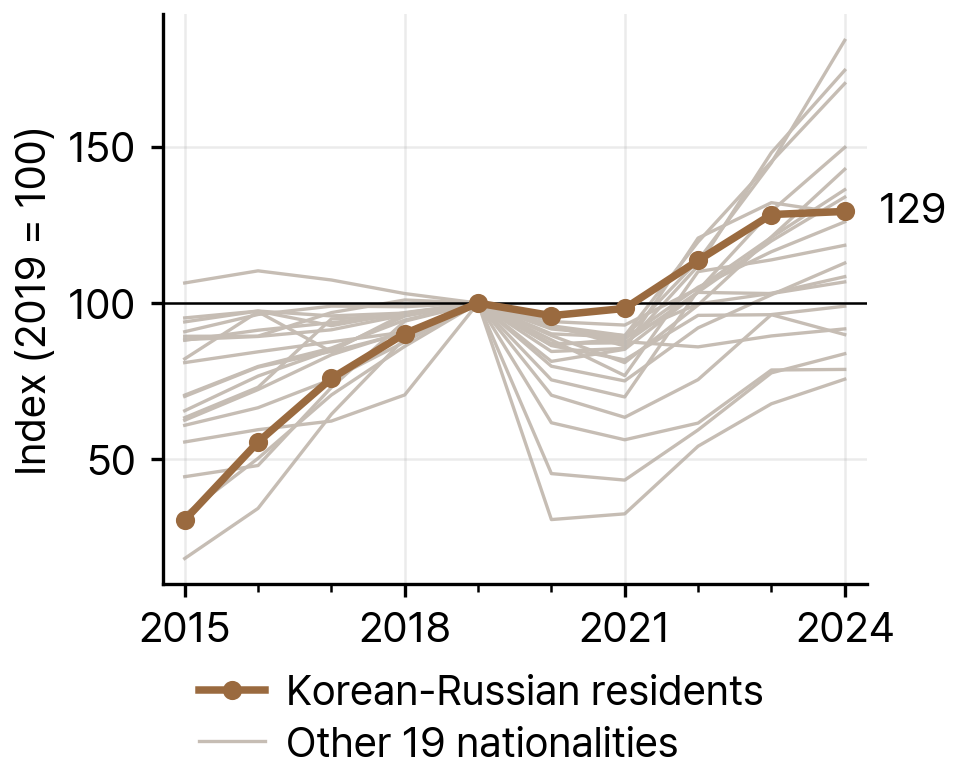
- The group grew from 799 in 2006 to 27,827 in 2019 and 35,984 in 2024, an index of 129.3 (2019 = 100) that ranked eighth among the 20 largest nationalities.
- In 2024, 93.2 percent of Korean-Russian residents (33,555 people) held the F-4 overseas Korean visa, and only 6.6 percent (2,383) were registered foreigners.
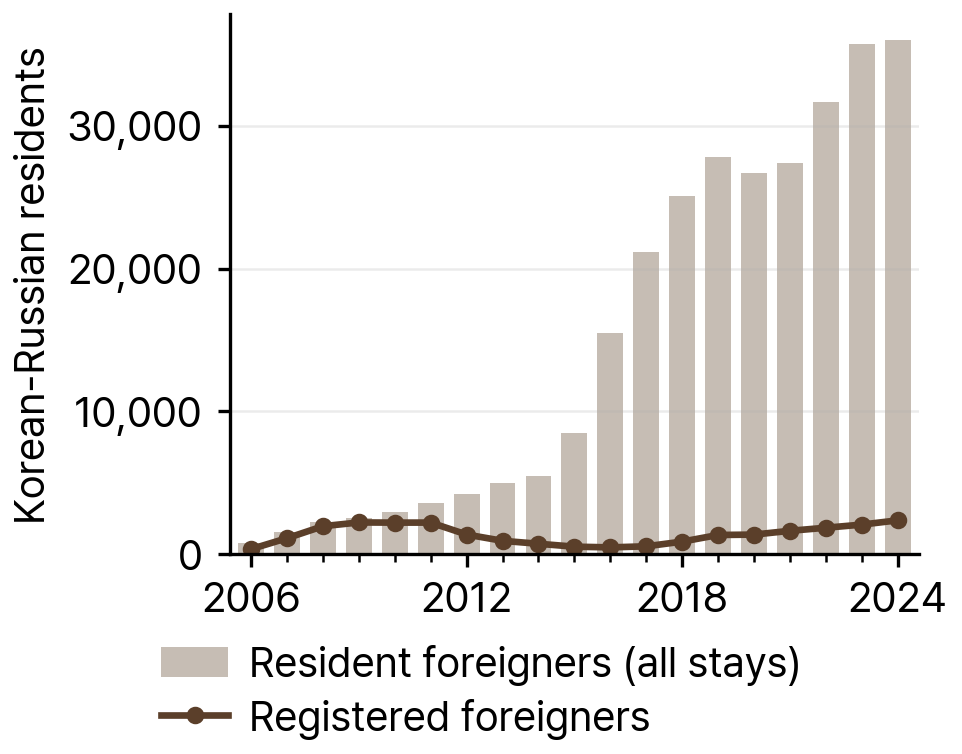
At the end of 2024, 35,984 Korean-Russians (ethnic Koreans of Russian nationality) lived in South Korea as resident foreigners. They were the 34th-largest nationality among registered foreigners (2,383 people, 0.2 percent of the total) and the 15th-largest among all resident foreigners (1.4 percent of the total), up from 39th and 26th in 2014. The two ranks differ because most Korean-Russians hold the F-4 overseas Korean visa and report their residence instead of registering. The population numbered 799 in 2006, 5,452 in 2014, and 27,827 in 2019, and 2024 was its highest recorded year.
Korean-Russians are part of the Koryo-saram, the ethnic Korean population of the former Soviet Union. Russia is not a sending country under Korea's Employment Permit System (E-9), so Korean-Russians do not enter through the general low-skilled labor route (HRD Korea, 2026). They arrive through overseas Korean visas instead: residence in Korea by CIS-origin Koryo-saram increased considerably after the 2007 launch of the H-2 Visit-Employment program (Overseas Koreans Foundation, 2015). In 2019 the Ministry of Justice proposed extending overseas Korean status to the fourth generation of descendants so that young Koryo-saram would not be separated from parents living in Korea (Ministry of Justice, 2019), and on February 12, 2026 it merged the H-2 and F-4 statuses into a single F-4 status (Ministry of Justice, 2026).
The group differs from resident foreigners overall in legal status and age. In 2024, 93.3 percent held overseas Korean statuses (F-4 or H-2), compared with 24.5 percent of all resident foreigners, and almost none held employment or study visas. Because F-4 holders report residence instead of registering, only 6.6 percent were registered foreigners. Children aged 0 to 14 made up 10.2 percent of Korean-Russian residents in 2024, against 5.7 percent of all resident foreigners.
This Spotlight reports on the size and geographic distribution of the Korean-Russian population in South Korea, its age, sex, and visa status, and the migration channels, naturalization, health, migration from the origin countries, and community organizations of its members.
Size of the Population over Time
The number of Korean-Russian resident foreigners rose from 799 in 2006 to 2,973 in 2010 and 5,452 in 2014. Between 2014 and 2019 it grew about fivefold, to 27,827 (27,827 / 5,452 = 5.1).
After a dip to 26,708 in 2020, the population grew each year, to 27,354 in 2021, 31,621 in 2022, 35,709 in 2023, and 35,984 in 2024. The 2024 figure was 8,157 people above the 2019 level, an index of 129.3 (2019 = 100), which placed Korean-Russians eighth of the 20 largest nationalities by change over 2019-24.
Registered foreigners are a small and shrinking share of the total. In 2006, 374 of 799 Korean-Russian residents (46.8 percent) were registered; in 2014 the figure was 745 of 5,452 (13.7 percent), and in 2019 it was 1,360 of 27,827 (4.9 percent). In 2024, 2,383 were registered, 6.6 percent of the total.
The group's rank depends on which count is used. Among all resident foreigners, Korean-Russians ranked 36th in 2006, 26th in 2014, 17th in 2019, and 15th in 2024, and their share of the total rose from 0.1 percent in 2006 to 1.4 percent in 2024. Among registered foreigners they ranked 35th in 2006, 39th in 2014, 36th in 2019, and 34th in 2024, and their share remained between 0.1 and 0.2 percent.
Source: KIRD dataset, from Ministry of Justice immigration yearbooks, 2006-2024.
Source: KIRD dataset, from Ministry of Justice immigration yearbooks, 2019-2024.
Table 1Korean-Russian Residents in South Korea, Selected Years, 2006-24
| Year | Resident foreigners | Registered foreigners | Registered as % of resident | Rank among resident foreigners | Rank among registered foreigners | Share of all resident foreigners (%) | Share of all registered foreigners (%) |
|---|---|---|---|---|---|---|---|
| 2006 | 799 | 374 | 46.8 | 36 | 35 | 0.1 | 0.1 |
| 2014 | 5,452 | 745 | 13.7 | 26 | 39 | 0.3 | 0.1 |
| 2019 | 27,827 | 1,360 | 4.9 | 17 | 36 | 1.1 | 0.1 |
| 2024 | 35,984 | 2,383 | 6.6 | 15 | 34 | 1.4 | 0.2 |
Note: Registered as % of resident is computed as registered foreigners divided by resident foreigners. Resident foreigners include short-term visitors and F-4 holders who report residence; registered foreigners are long-term residents registered with immigration authorities. Ranks are among all nationalities on each count.
Source: KIRD dataset, from Ministry of Justice immigration yearbooks, 2006-2024.
Distribution by Province and District
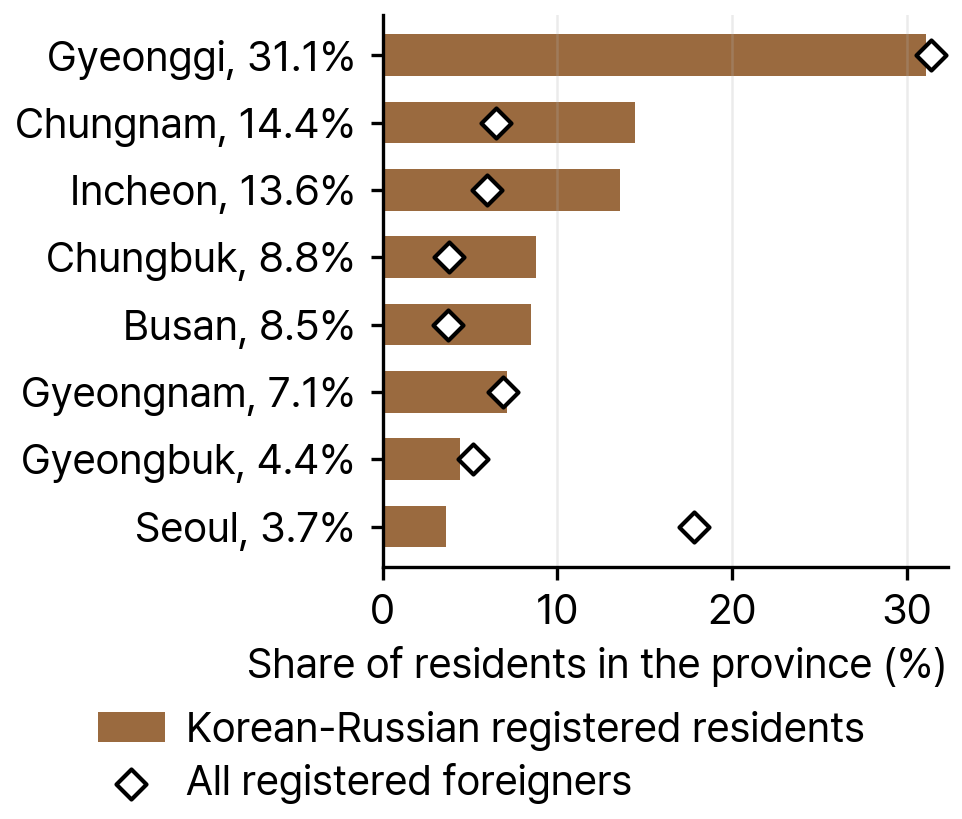
District-level data cover registered foreigners only, so the figures in this section describe 2,383 Korean-Russians in 2024, 6.6 percent of the group. The F-4 holders who make up most of the population are not included.
Of these 2,383 registered residents in 2024, 1,065 (44.7 percent) lived in Incheon and Gyeonggi, 564 (23.7 percent) in the Yeongnam region, and 559 (23.5 percent) in Chungcheong. Only 87 (3.7 percent) lived in Seoul, 87 (3.7 percent) in Honam, and 21 (0.9 percent) in Gangwon and Jeju. Seoul, Incheon, and Gyeonggi together accounted for 48.3 percent of registered Korean-Russians, compared with 55.2 percent of all registered foreigners.
Some 7.9 percent of registered Korean-Russians lived in rural counties (gun), compared with 10.6 percent of all registered foreigners. The rural share was highest in Gangwon and Jeju (23.8 percent) and Chungcheong (17.5 percent).
Source: KIRD dataset, from Ministry of Justice registered foreigner statistics by district, 2024.
In 2024, Ansan-si Danwon-gu (250), Asan-si (211), Incheon Yeonsu-gu (180), Ansan-si Sangnok-gu (134), and Gimhae-si (124) were the five districts with 100 or more registered Korean-Russians. The ten largest districts accounted for 1,296 people, 54.4 percent of the registered total. In none of them did Korean-Russians exceed 1.1 percent of the district's registered foreigners; the highest shares were in Cheongju-si Heungdeok-gu (1.1 percent) and Incheon Yeonsu-gu (1.0 percent).
The index of dissimilarity (D) between registered Korean-Russians and all other registered foreigners across districts was 0.63 in 2014 and 0.66 in 2024, so about two-thirds of the group would have to move to match the distribution of other foreigners. No district met the KIRD definition of an ethnic enclave in 2024 (a location quotient of at least 2 and the group making up at least 30 percent of the district's foreign residents).
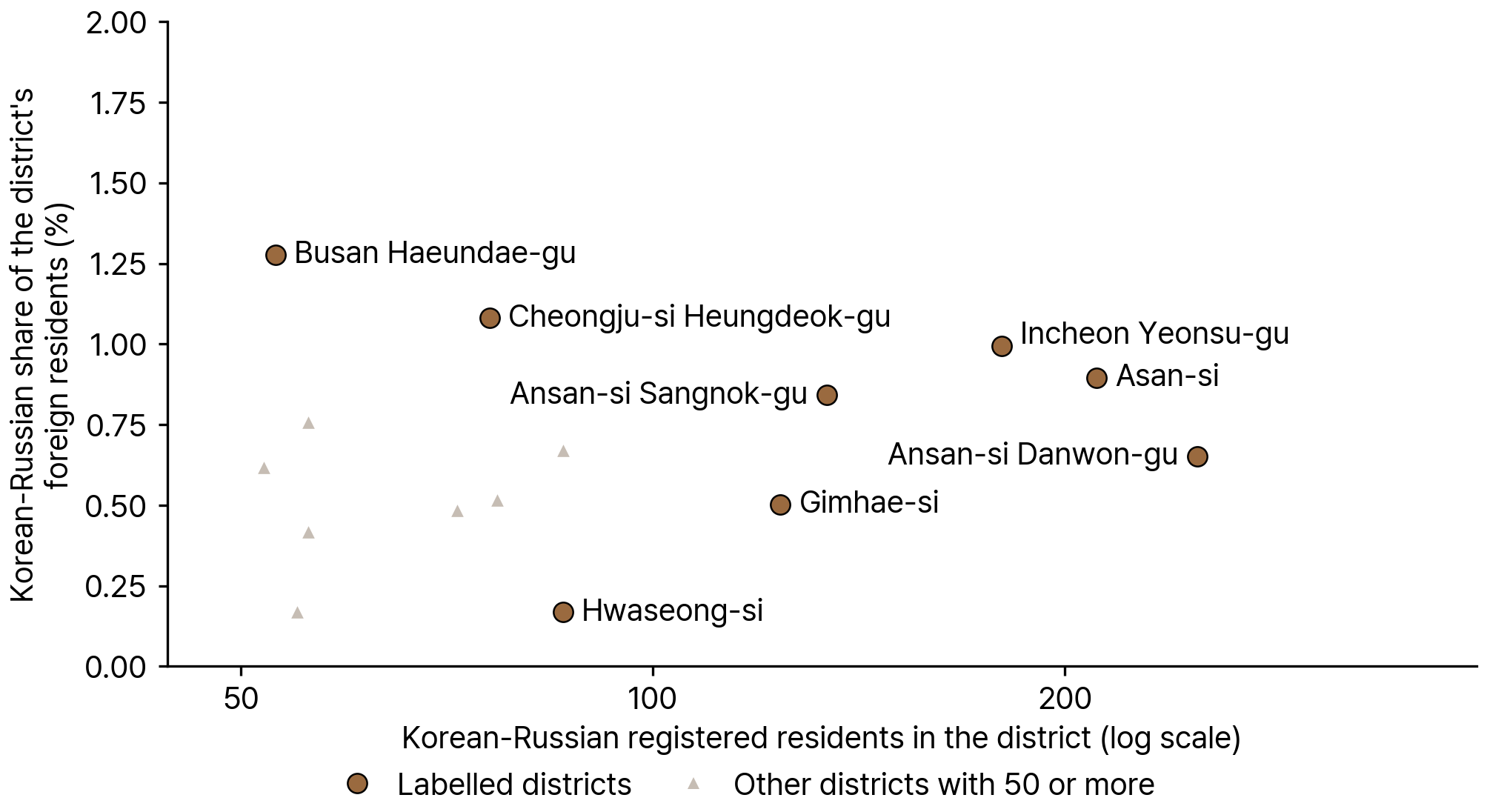
Source: KIRD dataset, from Ministry of Justice registered foreigner statistics by district, 2024. Districts with 50 or more Korean-Russian registered residents.
Table 2Ten Districts with the Most Korean-Russian Registered Residents, 2024
| District | Province | Registered residents | Share of district's registered foreigners (%) |
|---|---|---|---|
| Ansan-si Danwon-gu | Gyeonggi-do | 250 | 0.7 |
| Asan-si | Chungcheongnam-do | 211 | 0.9 |
| Incheon Yeonsu-gu | Incheon | 180 | 1.0 |
| Ansan-si Sangnok-gu | Gyeonggi-do | 134 | 0.8 |
| Gimhae-si | Gyeongsangnam-do | 124 | 0.5 |
| Hwaseong-si | Gyeonggi-do | 86 | 0.2 |
| Gyeongju-si | Gyeongsangbuk-do | 86 | 0.7 |
| Gwangju Gwangsan-gu | Gwangju | 77 | 0.5 |
| Cheongju-si Heungdeok-gu | Chungcheongbuk-do | 76 | 1.1 |
| Anseong-si | Gyeonggi-do | 72 | 0.5 |
Note: Counts are registered foreigners only (2,383 Korean-Russians in 2024). F-4 holders, 93.2 percent of the group, report residence and are not included.
Source: KIRD dataset, from Ministry of Justice registered foreigner statistics by district, 2024.
Age and Sex
Women made up 48.8 percent of Korean-Russian residents in 2024 (17,557 of 35,984), up from 47.1 percent in 2019 (13,109 of 27,827). Among all resident foreigners, 45.1 percent were women.
The group has more children and fewer young adults than resident foreigners as a whole. In 2024, 10.2 percent of Korean-Russians were aged 0 to 14, compared with 5.7 percent of all resident foreigners, and the number of children rose from 1,338 in 2019 to 3,674 in 2024. Adults aged 20 to 39 made up 34.2 percent of the group, against 49.7 percent of all resident foreigners (12,068 in 2019 and 12,323 in 2024).
Older residents are also a large part of the population. In 2024, people aged 60 and older formed the largest age group, and 13.4 percent of Korean-Russians were 60 or older, compared with 12.9 percent of all resident foreigners. The number aged 50 and older grew from 7,131 in 2019 to 10,087 in 2024. The median person fell in the 40-44 age group.
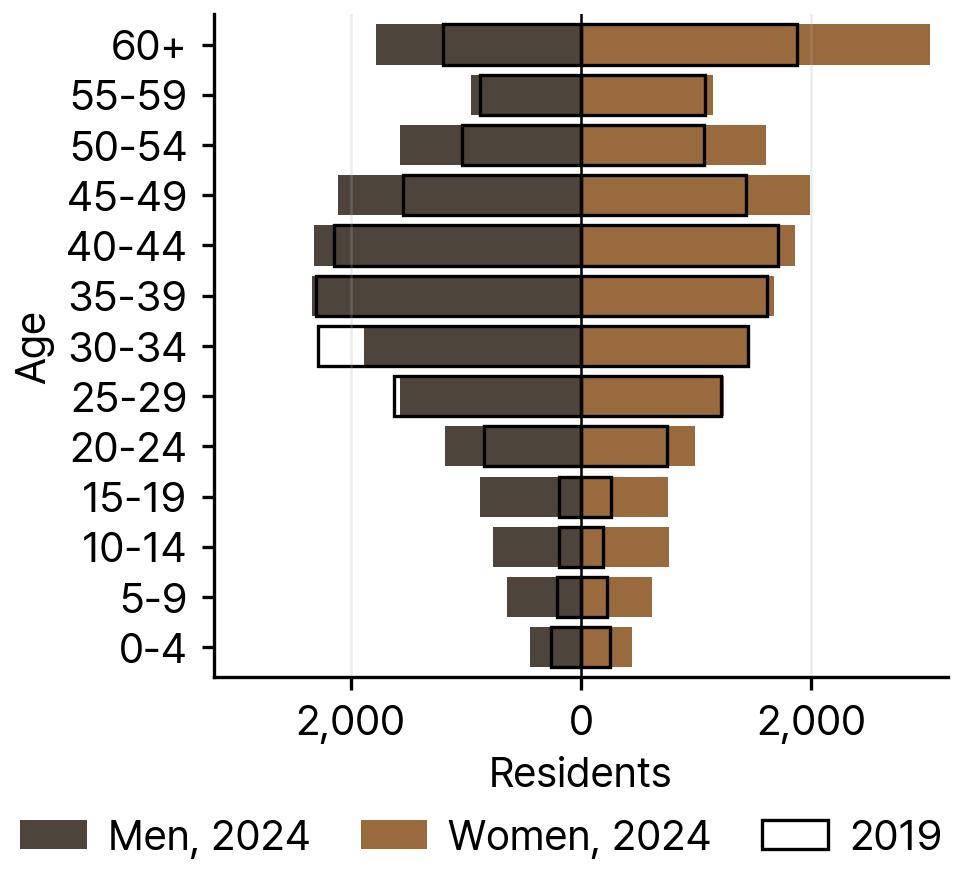
Source: KIRD dataset, from Ministry of Justice immigration yearbooks, 2024.
Visa Status
Nearly all Korean-Russians hold the F-4 overseas Korean visa. In 2024, 33,555 of 35,984 (93.2 percent) were F-4 holders, up from 4,650 in 2014 and 26,395 in 2019. Korean-Russians made up 6.0 percent of all F-4 holders in Korea and were the third-largest nationality on that status.
Permanent residence (F-5) is the second-largest status and the fastest growing. F-5 holders rose from 243 in 2014 and 335 in 2019 to 1,517 in 2024, about 4.5 times the 2019 figure (1,517 / 335). Visiting cohabitation (F-1) holders fell from 887 in 2019 to 594 in 2024, and dependent family (F-3) holders rose from 2 to 99.
By broad visa group, 93.3 percent of Korean-Russians held overseas Korean statuses in 2024, compared with 24.5 percent of all resident foreigners. The group had almost no holders of employment (0.0 percent against 19.2 percent), study and training (0.0 against 10.2 percent), or short-term visit statuses (0.1 against 19.7 percent).
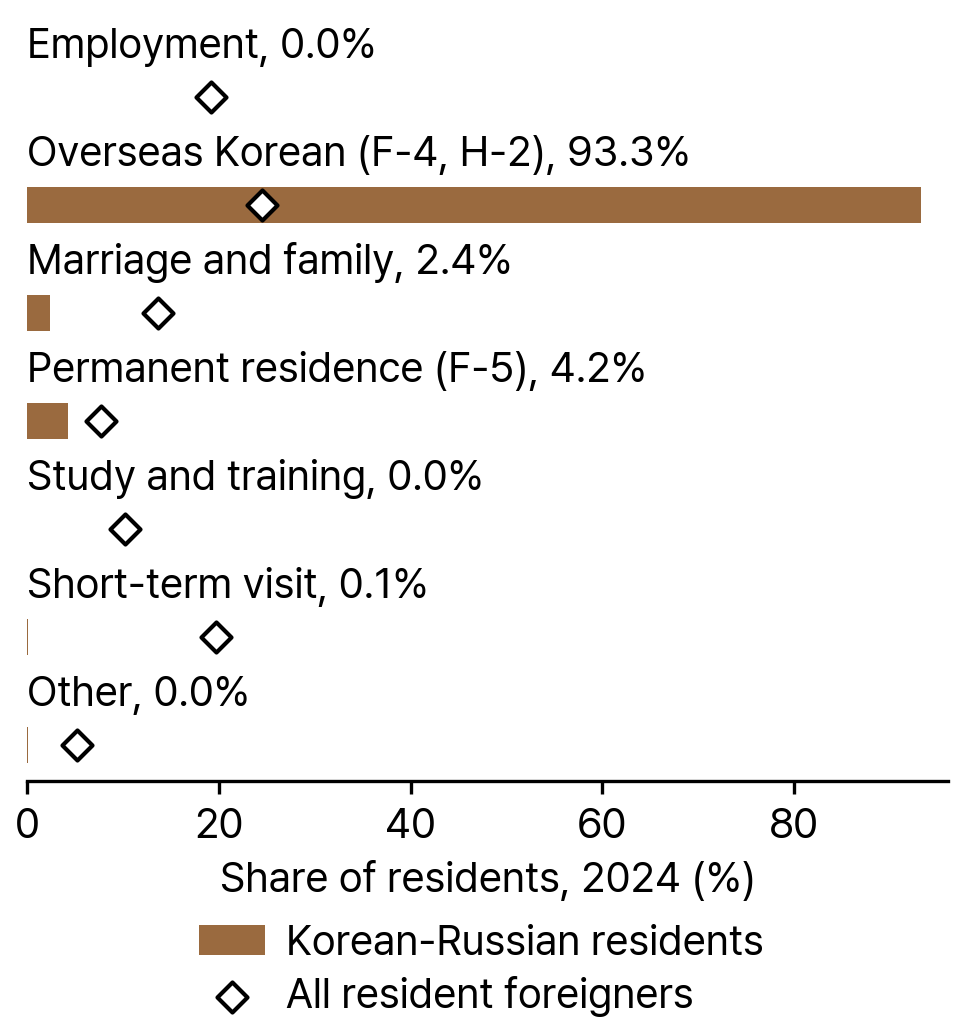
Source: KIRD dataset, from Ministry of Justice immigration yearbooks, 2024.
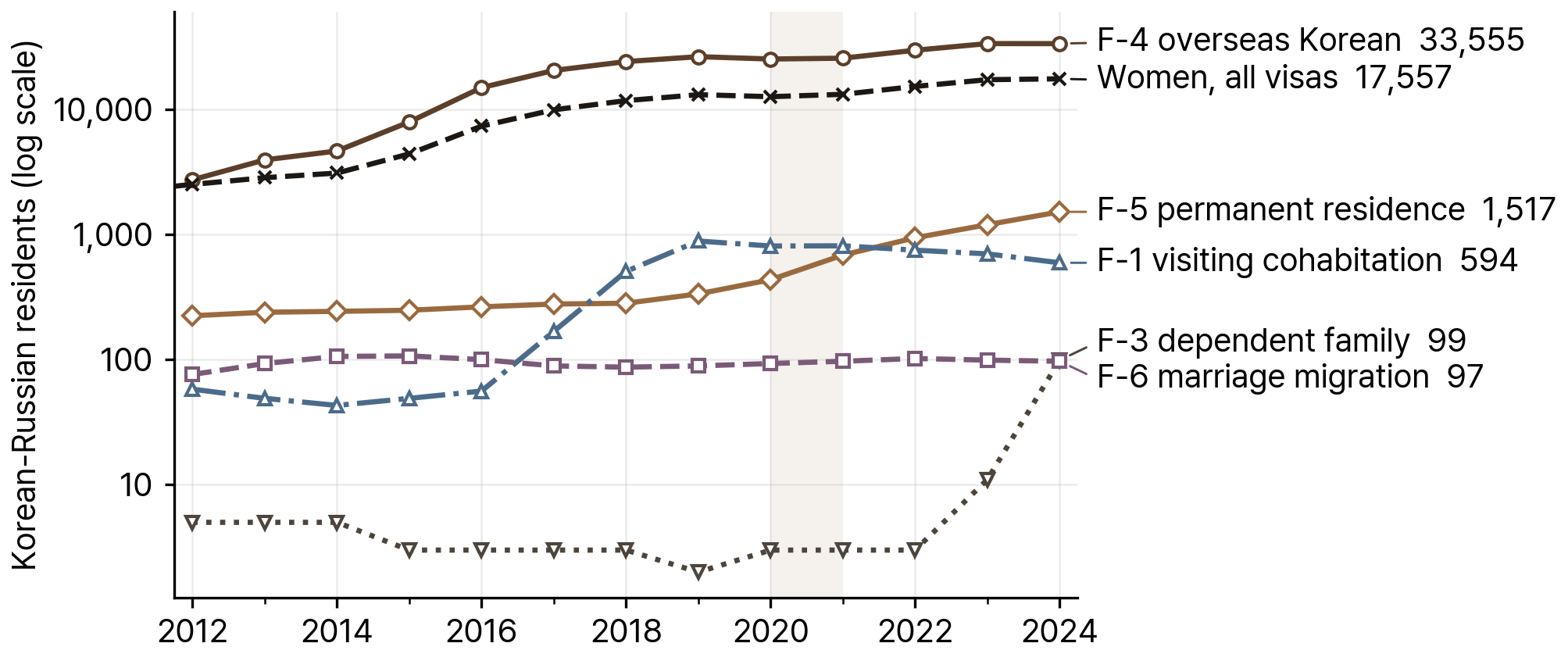
Source: KIRD dataset, from Ministry of Justice immigration yearbooks, 2012-2024.
Table 3Korean-Russian Residents by Visa Status, 2019 and 2024
| Visa | Meaning | 2019 | 2024 | Share of group, 2024 (%) | Share of all holders of this visa in Korea, 2024 (%) |
|---|---|---|---|---|---|
| F-4 | Overseas Korean | 26,395 | 33,555 | 93.2 | 6.0 |
| F-5 | Permanent residence | 335 | 1,517 | 4.2 | 0.7 |
| F-1 | Visiting cohabitation | 887 | 594 | 1.7 | 0.6 |
| F-3 | Dependent family | 2 | 99 | 0.3 | 0.2 |
| F-6 | Marriage migration | 89 | 97 | 0.3 | 0.1 |
| F-2 | Residential | 21 | 63 | 0.2 | 0.1 |
| C-3 | Short-term visit | 54 | 36 | 0.1 | 0.0 |
Note: Shares of the group use the 2024 total of 35,984 Korean-Russian resident foreigners.
Source: KIRD dataset, from Ministry of Justice immigration yearbooks, 2006-2024.
Migration Channels and Policy
Korean-Russians come to Korea on overseas Korean visas. Russia is not a sending country under the Employment Permit System (E-9); HRD Korea's 2026 list of sending countries names China, Thailand, Indonesia, Vietnam, the Philippines, Mongolia, Cambodia, Pakistan, Bangladesh, Nepal, Myanmar, Uzbekistan, Sri Lanka, Timor-Leste, Kyrgyzstan, and Laos (HRD Korea, 2026).
A 2015 study commissioned by the Overseas Koreans Foundation found that residence in Korea by CIS-origin Koryo-saram increased considerably after the H-2 Visit-Employment program began in 2007, and that resident Koryo-saram were unfamiliar with Korean language and culture and faced difficult economic circumstances (Overseas Koreans Foundation, 2015).
On January 25, 2019, the Ministry of Justice issued notice of an amendment to the enforcement decree of the Overseas Koreans Act that would extend overseas Korean status from the third generation to the fourth generation of lineal descendants and beyond. The notice stated that fourth-generation Koryo-saram youth were being separated from parents already living in Korea, and it opened a comment period from January 23 to March 4, 2019 (Ministry of Justice, 2019).
Effective February 12, 2026, the Ministry of Justice merged the H-2 and F-4 statuses into a single F-4 status and ended the issuance of new H-2 visas. Existing H-2 holders may convert to F-4 before their permitted period of residence ends, and any overseas Korean can obtain F-4 without distinction by country of nationality. The same measure added ten occupations to the jobs F-4 holders may take and eased the income requirement for F-5 permanent residence applicants with strong Korean-language ability or volunteer service (Ministry of Justice, 2026).
In a February 11, 2025 press release, the Overseas Koreans Agency announced a survey of stateless Koryo-saram, the first since 2007, to document their settlement conditions and prepare ways for them to obtain legal residence status (Overseas Koreans Agency, 2025).
Naturalization
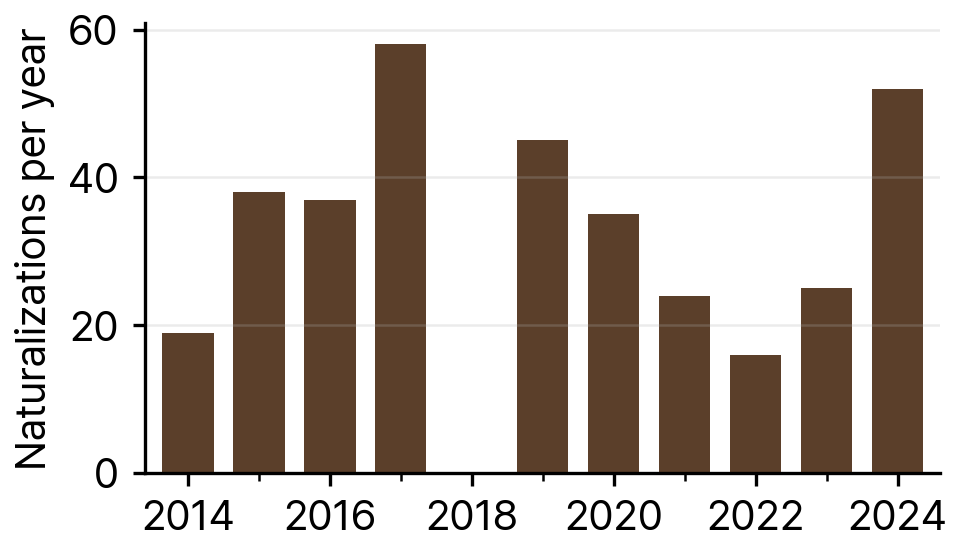
From 2014 to 2024, 349 Korean-Russians acquired South Korean nationality through naturalization. Annual counts were 19 in 2014, 38 in 2015, 37 in 2016, 58 in 2017, 45 in 2019, 35 in 2020, 24 in 2021, 16 in 2022, 25 in 2023, and 52 in 2024. No Korean-Russian count is recorded for 2018 in the KIRD series.
Ethnic Koreans can also regain Korean nationality through restoration of nationality. From 2011 to 2024 (excluding 2018), 68 Korean-Russians did so, including 11 in 2024. Adding the two routes, 63 Korean-Russians acquired or regained Korean nationality in 2024 (52 + 11).
Source: KIRD dataset, from Ministry of Justice immigration yearbooks, 2014-2024.
Unauthorized Residents
Korean-Russians are not among the ten nationalities that the Ministry of Justice yearbook (table 6-4) reports separately for unauthorized residents, so no count is published for this group. The yearbook reported 397,522 unauthorized residents of all nationalities in 2024.
Health and Well-being
To our knowledge, no published study reports the health of Russian-nationality Koryo-saram separately. The two studies below cover Koryo-saram in Korea regardless of nationality.
A 2021 art-therapy study of 17 Koryo-saram adolescents aged 14 to 24 at an alternative school in Korea delivered five 90-minute sessions between October and December 2020. After the program, the share of participants scoring in the no-depression range rose by 41.7 percent and the share with moderate depression fell by 23.5 percent (Z = -3.145, p < .05) (Lee et al., 2021).
A face-to-face survey of 400 Koryo-saram residents of Ansan, conducted from August 25 to September 26, 2025, found that 8.0 percent had been assigned dangerous work that Korean coworkers refused to do, and 25.1 percent had endured a rights violation or discrimination without telling anyone (Seoul Economic Daily, 2026).
Migration of Koryo-saram to South Korea
Korean-Russians belong to the Koryo-saram, whose presence in Central Asia dates to the 1937 Soviet deportation of about 172,000 ethnic Koreans from the Russian Far East, mainly to Kazakhstan and Uzbekistan, where Tashkent and Kyzylorda became centers of settlement. After the Soviet Union dissolved in 1991, Russia, South Korea, Europe, and North America became destinations for Koryo-saram emigrants (Novastan 2024). Russia's 2002 census recorded 148,556 ethnic Koreans (Demoscope Weekly, n.d.).
We know of no published source that reports the share of Russia's emigrants who go to Korea or Korea's rank among their destinations. Most published origin-side figures concern Central Asian countries, whose nationals include most Koryo-saram in Korea but are not counted in this profile. In 2023, 87,698 Uzbek nationals lived in South Korea, about 60 percent of the 147,093 Central Asian nationals in the country (Chu 2024). About 15,000 Kazakhstanis were working in South Korea as of 2025, roughly 11,000 of them without legal status (Times of Central Asia 2026).
Russia sends no workers under the Employment Permit System, so no Russian deployment figure exists (see Migration Channels and Policy). Among Central Asian countries, Uzbekistan joined the system in 2006, Kyrgyzstan in 2007, and Tajikistan in 2024 (Chu 2024), and Kazakhstan was designated the 18th sending country in August 2026, with worker arrivals expected from 2028 (Korea Times 2026). Uzbek workers deployed to Korea on E-9 visas fell from 4,878 in 2023 to 3,080 in 2024, out of 165,000 foreign workers Korea hired that year (Kun.uz 2025). Kazakhstani nationals on work-eligible visas numbered 5,309 in 2023, down from 7,867 in 2019, and 5,146 of the 2023 total held the H-2 Visit-Employment visa for ethnic Koreans (Chu 2024).
In Uzbekistan, nearly 10,000 people took the Test of Proficiency in Korean (TOPIK) in Tashkent in July 2026 and more than 12,000 applied for the October round. The head of the Korean Education Center in Tashkent expected more than 50,000 TOPIK applicants in 2026, up from about 45,000 in 2025, and the same report put E-9 departures from Uzbekistan at about 2,500 a year on average (Yonhap News 2026). TOPIK is the general Korean-language test; EPS applicants take a separate test, EPS-TOPIK. HRD Korea reports that 33,397 people took the EPS-TOPIK in Uzbekistan in 2024 and 13,317 passed (HRD Korea 2025).
Personal remittances received by Russia were 0.66 percent of its gross domestic product (GDP) in 2020, 0.53 percent in 2021, 0.14 percent in 2022, and 0.13 percent in 2023 (World Bank 2023). The World Bank's bilateral remittance estimates, last produced for 2021, put remittances sent from South Korea to Russia at about US$5.0 million that year (World Bank 2021). For Uzbekistan, remittances from Korea totaled $534 million in 2024, up 56 percent from 2023, making Korea the fourth-largest source of the country's $14.8 billion in remittances after Russia ($11.5 billion, 77 percent of the total), Kazakhstan ($795 million), and the United States ($577 million) (Times of Central Asia 2025). Remittances equaled 14.42 percent of Uzbekistan's GDP in 2024 (Trading Economics 2024). Korea sent $35.6 million to Kazakhstan in 2022 (10.1 percent of Kazakhstan's remittance inflows, third after Russia and the United States) and $27.3 million in 2023 (11.6 percent, fourth after Russia, the United States, and Germany) (Chu 2024).
As far as we know, no published source identifies the provinces or oblasts of Russia, Uzbekistan, or Kazakhstan from which Korea-bound Koryo-saram come. Inside Korea, the Seoul National University Asia Center reported about 10,000 registered Koryo-saram in Ansan's Danwon-gu and about 5,000 in Sangnok-gu in the first half of 2024, with smaller communities in Gwangju, formed between 2002 and 2013, and in Jecheon, where a government recruitment program began in 2023 (SNUAC 2024).
We are not aware of any Russian government policy on emigration to Korea. On the Central Asian side, Korean officials said in 2026 that Kazakhstan qualified as an EPS sending country because it has a government agency dealing exclusively with worker dispatch (Korea JoongAng Daily 2026). On the Korean side, the 1999 Overseas Koreans Act excluded Korean-Chinese and Koryo-saram from the entry-visa and employment benefits given to other overseas Koreans; the law was revised in 2004 after it was found to discriminate unconstitutionally, and the government continued to control this group's entry visas and employment rights (Song 2023).
Research on Koryo-saram migration to Korea centers on return and settlement. Lee (2023) studies the increase in migrants from Uzbekistan since 2007, when Koryo-saram began entering Korea as compatriots, as a case of a diaspora moving to an ancestral homeland most members had never lived in. Kim (2015), studying Uzbek Koryo-saram families in Gwangju, finds varied and changing transnational family arrangements, with some families working toward permanent settlement in Korea and reuniting relatives in stages. Song (2023) argues that despite ethnicity-based entry preferences, Koryo-saram returnees are socially alienated, culturally disregarded, and assigned to lower-wage jobs. The literature known to us includes no study of brokers, migration debt, or marriage migration among Russian-nationality Koryo-saram.
Table 4Migration Indicators, Koryo-saram and South Korea
| Indicator | Value | Source |
|---|---|---|
| Ethnic Koreans in Russia, 2002 census | 148,556 | Korean Wikipedia, n.d. |
| Uzbek nationals in South Korea, 2023 | 87,698 (about 60% of 147,093 Central Asian nationals) | Chu 2024 |
| Kazakhstanis working in South Korea, 2025 | About 15,000 (about 11,000 without legal status) | Times of Central Asia 2026 |
| Uzbek E-9 workers deployed to Korea, 2023 and 2024 | 4,878 and 3,080 (of 165,000 total hires in 2024) | Kun.uz 2025 |
| Kazakhstani nationals on work-eligible visas, 2023 | 5,309 (5,146 on H-2) | Chu 2024 |
| TOPIK applicants in Uzbekistan, 2025 | About 45,000 | Yonhap News 2026 |
| EPS-TOPIK test takers in Uzbekistan, 2024 | 33,397 (13,317 passed) | HRD Korea 2025 |
| Remittances from Korea to Uzbekistan, 2024 | $534 million (4th-largest source) | Times of Central Asia 2025 |
| Remittances from Korea to Kazakhstan, 2023 | $27.3 million (11.6% of inflows) | Chu 2024 |
| Remittances from Korea to Russia, 2021 (World Bank estimate) | $5.0 million | World Bank 2021 |
| Remittances, % of GDP, Russia, 2023 | 0.13 | World Bank 2023 |
| Remittances, % of GDP, Uzbekistan, 2024 | 14.42 | Trading Economics 2024 |
Note: Russia is not an EPS sending country, so there are no EPS deployment or applicant figures for Russia. Central Asian figures cover all nationals of those countries, including those who are not Koryo-saram.
Source: Sources as listed in each row; full references appear under Sources.
Community Organizations
Ansan's Koryo-saram population (all nationalities) grew from 6,307 in 2013 to 22,939 in 2025, a 3.6-fold increase (Seoul Economic Daily, 2026). Gwangju's Koryoin Village in Wolgok-dong, Gwangsan-gu, was approved as a nonprofit corporation by the Minister of Justice in April 2014, after Gwangju enacted an ordinance supporting Koryoin residents in October 2013 (Koryoin Village, n.d.). By 2022 the neighborhood's population, including Koryo-saram and other Asian migrants, was about 7,000, and the nonprofit Koryoin Village ran a resident support center, a kindergarten, a school, a clinic, an elder welfare center, a museum, a publishing house, and a radio station (Epoch Times Korea, 2022).
Of the 1,720 migrant-serving organizations in the KIRD census, 28 name Koryo-saram or overseas Koreans from the former Soviet Union in their name or target group. Five are in Gwangju Gwangsan-gu, five in Incheon Yeonsu-gu, and four in Ansan, all districts among the ten with the most registered Korean-Russians. Six are program sites designated and funded by the Ministry of Justice, including Koryoin Village (Gwangju Gwangsan-gu), the Ansan Koryoin Cultural Center (Ansan-si Danwon-gu), the Gyeongsangbuk-do Koryoin Integrated Support Center (Gyeongju-si), and the Neomeo Incheon Koryoin Cultural Center (Incheon Yeonsu-gu). Others are community groups such as the Korean Koryoin Association (Incheon Yeonsu-gu), Koryoin Center Mir (Ansan-si Sangnok-gu), the Chungnam Koryoin Support Association (Asan-si), and Friends from the Former Soviet Union (Gimhae-si).
These organizations serve Koryo-saram of all nationalities. Most general-purpose organizations in the census also serve Korean-Russian residents.
Sources
Korea Immigration Regional Dashboard (KIRD) dataset. Ann Arbor, MI: Inter-university Consortium for Political and Social Research. https://doi.org/10.3886/E249944V1
HRD Korea / Ministry of Employment and Labor. 2026. EPS sending country list. Employment Permit System. https://www.eps.go.kr/eo/slfReturnPsnR_ph.eo?natNm=ph&hiMenuId=1&menuId=14
Overseas Koreans Foundation. 2015. 국내거주 러시아/CIS(고려인) 현황 조사Ⅱ [Survey on Russia/CIS (Koryo-saram) Residents in Korea II]. IOM Migration Research and Training Centre. https://www.mrtc.re.kr/data/08.php?admin_mode=read&no=331
Ministry of Justice. 2019. 고려인 등 재외동포 범위를 4세대 이후까지 확대합니다 [Expanding the scope of overseas Koreans, including Koryo-saram, to the fourth generation and beyond]. Notice, January 25, 2019. https://www.moj.go.kr/bbs/moj/182/487613/artclView.do
Ministry of Justice. 2026. 법무부, 동포 체류자격(F-4) 통합 시행 [Ministry of Justice implements integration of overseas Korean residence status (F-4)]. https://www.moj.go.kr/bbs/moj/182/603456/artclView.do
Overseas Koreans Agency. 2025. Press release, February 11, 2025. https://www.oka.go.kr//web/board/brdDetail.do?menu_cd=000018&num=3215
Lee, Hojung, Hye Jung Kim, Soo-Yeon Kim, and Han Choi. 2021. 미술치료가 고려인 중도입국 청소년의 우울, 불안, 스트레스와 참여자 만족도에 미치는 영향 [The effects of art therapy on depression, anxiety, stress, and satisfaction of Koryo-saram immigrant adolescents]. Korean Journal of Art Therapy 28 (3): 659-672. https://www.kci.go.kr/kciportal/landing/article.kci?arti_id=ART002722611
Seoul Economic Daily. 2026. "One in Four Koryo-saram in Ansan Stays Silent After Discrimination." January 4, 2026. https://en.sedaily.com/society/2026/01/04/one-in-four-koryo-saram-in-ansan-stays-silent-after
World Bank. World Development Indicators: Personal remittances, received (% of GDP), Russian Federation, 2018-2023. https://api.worldbank.org/v2/country/RUS/indicator/BX.TRF.PWKR.DT.GD.ZS?format=json&per_page=10&date=2018:2023
Novastan. 2024. How Central Asia became home for the Koryo-Saram. https://novastan.org/en/uzbekistan/koryo-saram-koreans-central-asia/
Chu, Y.-m. (2024). Current status of human exchanges between Korea and Central Asia, and factors contributing to the increase in Kazakhstani migrant workers in South Korea [Paper]. World Association for Public Opinion Research. https://wapor.org/wp-content/uploads/Chu-Current-status-of-Human-Exchanges-between-Korea-and-Central-Asia-and-Factors-Contributing-to-the-Increase-in-Kazakhstani-Migrant-Workers-in-South-Korea.pdf
The Times of Central Asia. 2026. Kazakhstan South Korea working visa route opens under EPS. https://timesca.com/kazakhstan-south-korea-working-visa-route-epssouth-korea-opens-legal-labor-market-to-kazakhstanis/
The Korea Times. 2026. Kazakhstan designated as workforce-sending country. August 14, 2026. https://www.koreatimes.co.kr/southkorea/globalcommunity/20260814/kazakhstan-designated-as-workforce-sending-country
Kun.uz. 2025. South Korea reduces Uzbek migrant intake amid job abandonment concerns. January 18, 2025. https://kun.uz/en/news/2025/01/18/south-korea-reduces-uzbek-migrant-intake-amid-job-abandonment-concerns
Yonhap News. 2026. [한·중앙아를 잇다]⑧ 우즈베크 '숙련인력'vs키르기스 '신흥송출'…新 코리안드림 [Connecting Korea and Central Asia 8: Uzbekistan's skilled workers and Kyrgyzstan's new sending]. Reported by Park Hyun-soo, September 3, 2026; republished by Supple. https://supple.kr/news/cmtktqcoa008vvh0uuyzfaqgf
The Times of Central Asia. 2025. Uzbekistan receives $14.8 billion in remittances in 2024. https://timesca.com/uzbekistan-receives-14-8-billion-in-remittances-in-2024/
Trading Economics. 2024. Uzbekistan: Workers' remittances and compensation of employees, received (% of GDP), citing World Bank World Development Indicators. https://tradingeconomics.com/uzbekistan/workers-remittances-and-compensation-of-employees-received-percent-of-gdp-wb-data.html
Seoul National University Asia Center. 2024. 한국 내 고려인 밀집거주지의 형성: 안산, 광주, 제천 [Formation of Koryo-saram residential concentrations in Korea: Ansan, Gwangju, Jecheon]. Event description. https://snuac.snu.ac.kr/?u_event=%ED%95%9C%EA%B5%AD-%EB%82%B4-%EA%B3%A0%EB%A0%A4%EC%9D%B8-%EB%B0%80%EC%A7%91%EA%B1%B0%EC%A3%BC%EC%A7%80%EC%9D%98-%ED%98%95%EC%84%B1-%EC%95%88%EC%82%B0-%EA%B4%91%EC%A3%BC-%EC%A0%9C%EC%B2%9C
Korea JoongAng Daily. 2026. South Korea adds Kazakhstan to foreign worker permit system. https://www.koreajoongangdaily.com/korea/kazakh-workers-to-arrive-in-korea-by-2028/12825675
Song, C. (2023, April 14). Joseonjok and Goryeo Saram ethnic return migrants in South Korea: Challenges of co-ethnic hierarchization and ethnonationalism. Georgetown Journal of International Affairs. https://gjia.georgetown.edu/society-culture/joseonjok-and-goryeo-saram-ethnic-return-migrants-in-south-korea-challenges-of-co-ethnic-hierarchization-and-ethnonationalism/
Lee, J. (2023). Why do diasporas re-emigrate to their historical "homelands"? A case study of Koryo Saram's "return" from post-Soviet Uzbekistan to South Korea. Journal of the Asia-Japan Research Institute of Ritsumeikan University, 5, 51. https://doi.org/10.34389/asiajapan.5.0_51
Kim, K.-H. (2015). International migration of Uzbek Koryein to Korea and characteristics of their family types, with particular reference to Koryeins in Gwangju Metropolitan. Journal of Diaspora Studies, 9(2), 37-67. https://www.kci.go.kr/kciportal/ci/sereArticleSearch/ciSereArtiView.kci?sereArticleSearchBean.artiId=ART002055810
World Bank. 2021. Bilateral Remittance Estimates (WB_KNOMAD_BRE), Data360. https://data360api.worldbank.org/data360/data?DATABASE_ID=WB_KNOMAD&INDICATOR=WB_KNOMAD_BRE&REF_AREA=KOR
Human Resources Development Service of Korea (HRD Korea). 2025. 국가별 한국어시험 시행 정보 [EPS-TOPIK test takers and passes by country, 2024]. Archived April 21, 2025. https://web.archive.org/web/20250421163507/https://epstopik.hrdkorea.or.kr/epstopik/pass/candidate/selectChart.do?lang=ko
Demoscope Weekly (Institute of Demography, National Research University Higher School of Economics). n.d. National composition of the population by region of Russia: All-Russian Population Census 2002 (Национальный состав населения по регионам России: Всероссийская перепись населения 2002 года). https://www.demoscope.ru/weekly/ssp/rus_nac_02.php
Koryoin Village (고려인마을). n.d. History (연혁). https://www.koreancoop.com/sub.php?PID=0506
Epoch Times Korea. 2022. Do you know carrot kimchi? The Koryoin Village rooted in the City of Light (in Korean). May 2022. https://www.epochtimes.kr/2022/05/617222.html
Suggested citation: Korea Immigration Regional Dashboard (KIRD). 2026. “Korean-Russian Immigrants in South Korea.” Foreign Residents in South Korea series, September 2026. Data: Korea Immigration Regional Dashboard (KIRD) dataset, https://doi.org/10.3886/E249944V1. Interactive maps and tables: https://immigrantsinkorea.today.