 Korea Immigration Regional Dashboard
SpotlightSeptember 2026Nationality profilesDownload PDF
Taiwanese Immigrants in South Korea
Highlights
- At the end of 2024, 17,384 Taiwanese nationals were registered foreigners in South Korea and 35,838 were resident foreigners, making Taiwan the 18th-largest nationality among registered foreigners and the 16th-largest among all resident foreigners; the resident count was down from a peak of 42,767 in 2019.
- In 2024, 50.6 percent of Taiwanese residents (18,144 people) held the B-2 tourist and transit status and 29.1 percent (10,428) held F-5 permanent residence, compared with 19.7 percent and 7.7 percent of all resident foreigners.
- Only 2.8 percent of Taiwanese residents held an employment visa in 2024, against 19.2 percent of all resident foreigners, and 3,432 Taiwanese nationals naturalized as Korean citizens between 2014 and 2024.
At the end of 2024, the Ministry of Justice counted 17,384 registered Taiwanese foreigners, the 18th-largest nationality among registered foreigners and 1.2 percent of the total, and 35,838 Taiwanese resident foreigners, the 16th-largest nationality among all resident foreigners and 1.4 percent of the total. In 2014 Taiwanese ranked 13th among registered foreigners and 11th among all resident foreigners. The resident count rose from 25,864 at the end of 2006 to a peak of 42,767 in 2019, fell to 18,554 in 2021, and by 2024 had recovered to 83.8 percent of its 2019 level (KIRD dataset).
Taiwanese in Korea include a long-resident ethnic Chinese community (hwagyo) that retained Republic of China passports after Korea cut diplomatic ties with Taiwan in 1992; a 2025 news report put this group at about 15,000 people (Incheon In, 2025). Taiwanese visitors have entered Korea without a visa since January 2003, and for up to 90 days per visit since July 2012 (Maeil Shinmun, 2012). In 2024, 18,144 Taiwanese held B-2 tourist and transit status and 10,428 held F-5 permanent residence, together 79.7 percent of the group.
Compared with all resident foreigners in 2024, Taiwanese residents were more often women (58.8 percent versus 45.1 percent) and aged 60 or older (17.1 percent versus 12.9 percent), and registered Taiwanese were more concentrated in Seoul, Incheon, and Gyeonggi (71.6 percent versus 55.2 percent). This Spotlight describes the number of Taiwanese residents over time, where they live, their age and sex, visa status, migration channels, naturalization, migration from Taiwan to Korea, and community organizations.
Size of the Population over Time
The number of Taiwanese resident foreigners rose from 25,864 in 2006 and 24,760 in 2010 to 31,200 in 2014 and 42,767 in 2019, the highest count in the series. It fell to 19,444 in 2020 and 18,554 in 2021, then rose to 25,417 in 2022, 33,225 in 2023, and 35,838 in 2024 (KIRD dataset).
Registered foreigners declined over the same period, from 22,118 in 2006 to 21,014 in 2014, 19,872 in 2019, and 17,384 in 2024. Registered Taiwanese made up 85.5 percent of Taiwanese resident foreigners in 2006 (22,118 of 25,864) and 48.5 percent in 2024.
Taiwan's rank fell on both bases. Among registered foreigners it was the 8th-largest nationality in 2006, 13th in 2014, 15th in 2019, and 18th in 2024, and its share of all registered foreigners fell from 3.5 percent in 2006 to 1.9 percent in 2014, 1.6 percent in 2019, and 1.2 percent in 2024. Among all resident foreigners it ranked 10th in 2006, 11th in 2014, 13th in 2019, and 16th in 2024, with shares of 2.8, 1.7, 1.7, and 1.4 percent.
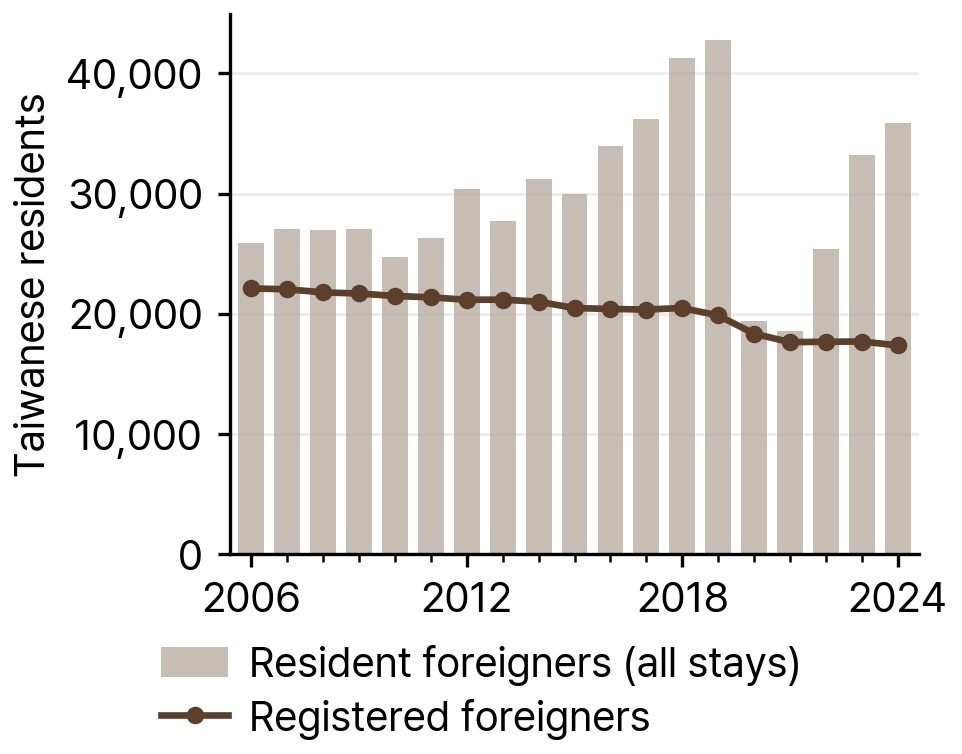
Source: KIRD dataset, from Ministry of Justice immigration yearbooks, 2006-2024.
Measured against 2019, the Taiwanese population stood at an index of 83.8 in 2024 (35,838 divided by 42,767). This ranked 18th in growth among the 20 largest nationalities.
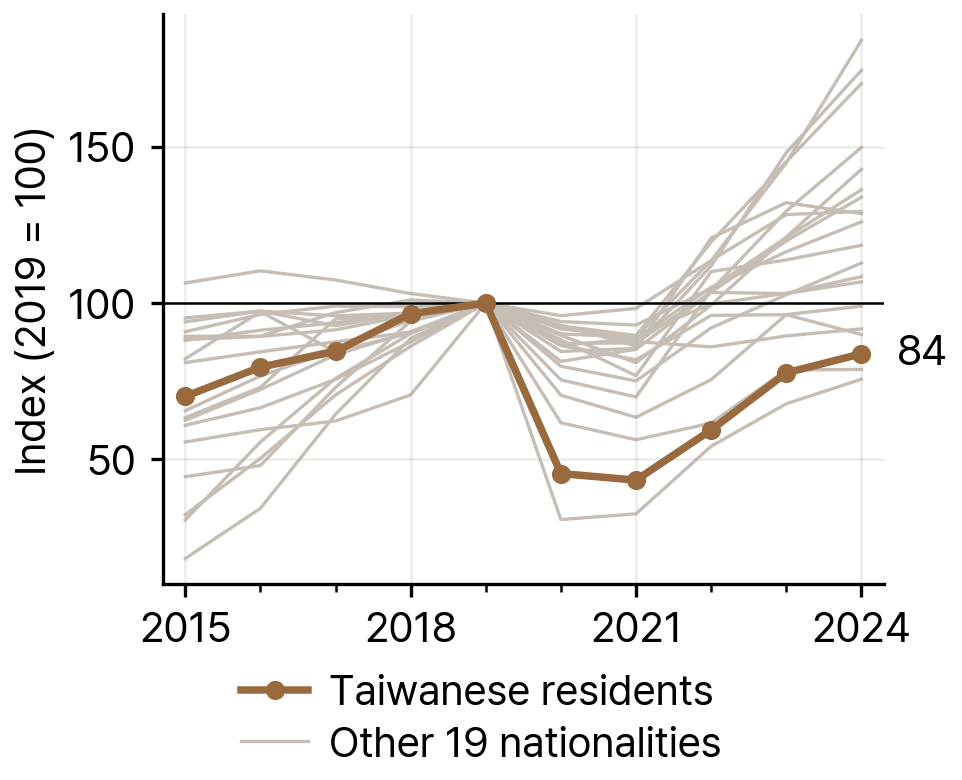
Source: KIRD dataset, from Ministry of Justice immigration yearbooks, 2006-2024.
Table 1Taiwanese Resident Foreigners and Registered Foreigners in South Korea, Selected Years
| Year | Resident foreigners | Registered foreigners | Rank among all resident foreigners | Rank among registered foreigners | Share of all resident foreigners (%) | Share of all registered foreigners (%) |
|---|---|---|---|---|---|---|
| 2006 | 25,864 | 22,118 | 10 | 8 | 2.8 | 3.5 |
| 2014 | 31,200 | 21,014 | 11 | 13 | 1.7 | 1.9 |
| 2019 | 42,767 | 19,872 | 13 | 15 | 1.7 | 1.6 |
| 2024 | 35,838 | 17,384 | 16 | 18 | 1.4 | 1.2 |
Note: Resident foreigners are counted on 31 December and include short-term visitors and F-4 holders who report their residence. Registered foreigners are those in Korea for more than 90 days who completed alien registration. Ranks are among all nationalities on each basis.
Source: KIRD dataset, from Ministry of Justice immigration yearbooks, 2006-2024.
Distribution by Province and District
District data cover the 17,384 registered Taiwanese in 2024. Of these, 7,691 lived in Seoul (44.2 percent) and 4,758 in Incheon and Gyeonggi (27.4 percent), so 71.6 percent lived in the capital region, compared with 55.2 percent of all registered foreigners. A further 2,577 lived in Yeongnam (14.8 percent), Chungcheong 1,077 (6.2 percent), Gangwon and Jeju 656 (3.8 percent), and Honam 625 (3.6 percent). Only 2.3 percent lived in rural counties (gun), against 10.6 percent of all registered foreigners.
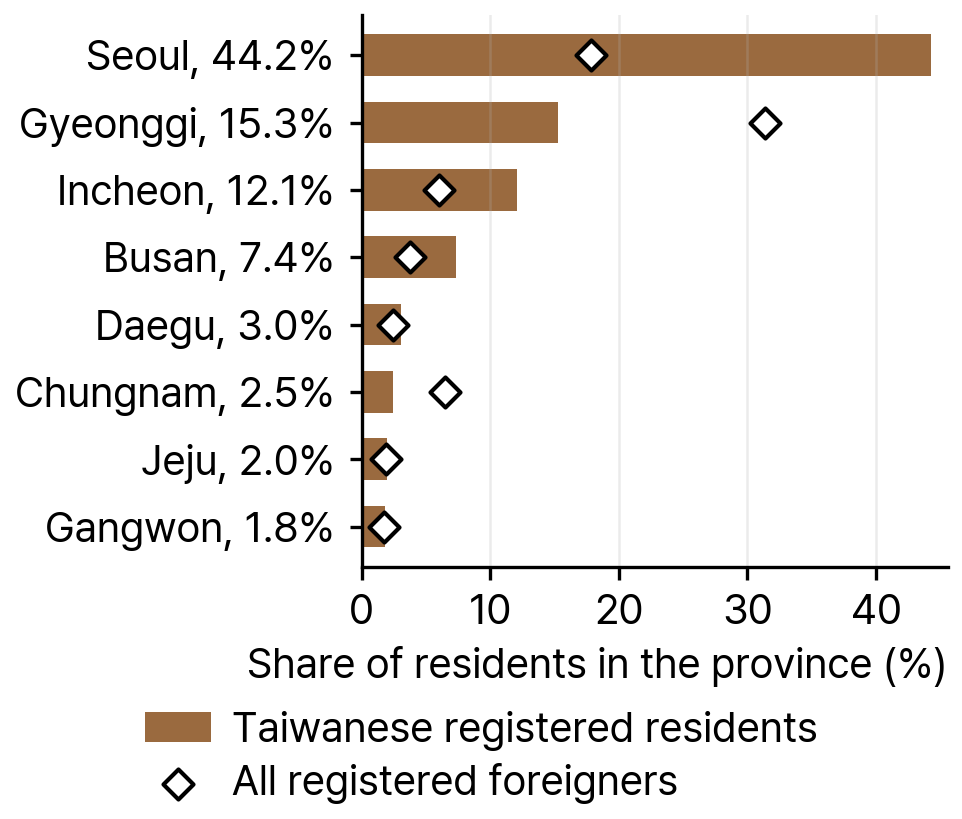
Source: KIRD dataset, from Ministry of Justice registered-foreigner statistics by district, 2024.
Seodaemun-gu in Seoul had the largest number (1,809), followed by Mapo-gu (1,039) and Jung-gu in Incheon (720). The ten largest districts were home to 37.2 percent of registered Taiwanese, and 43 districts had 100 or more. Taiwanese made up the largest shares of registered foreigners in Dong-gu in Busan (13.9 percent, 258 people), Jung-gu in Incheon (13.6 percent), and Jung-gu in Daegu (13.4 percent, 129 people).
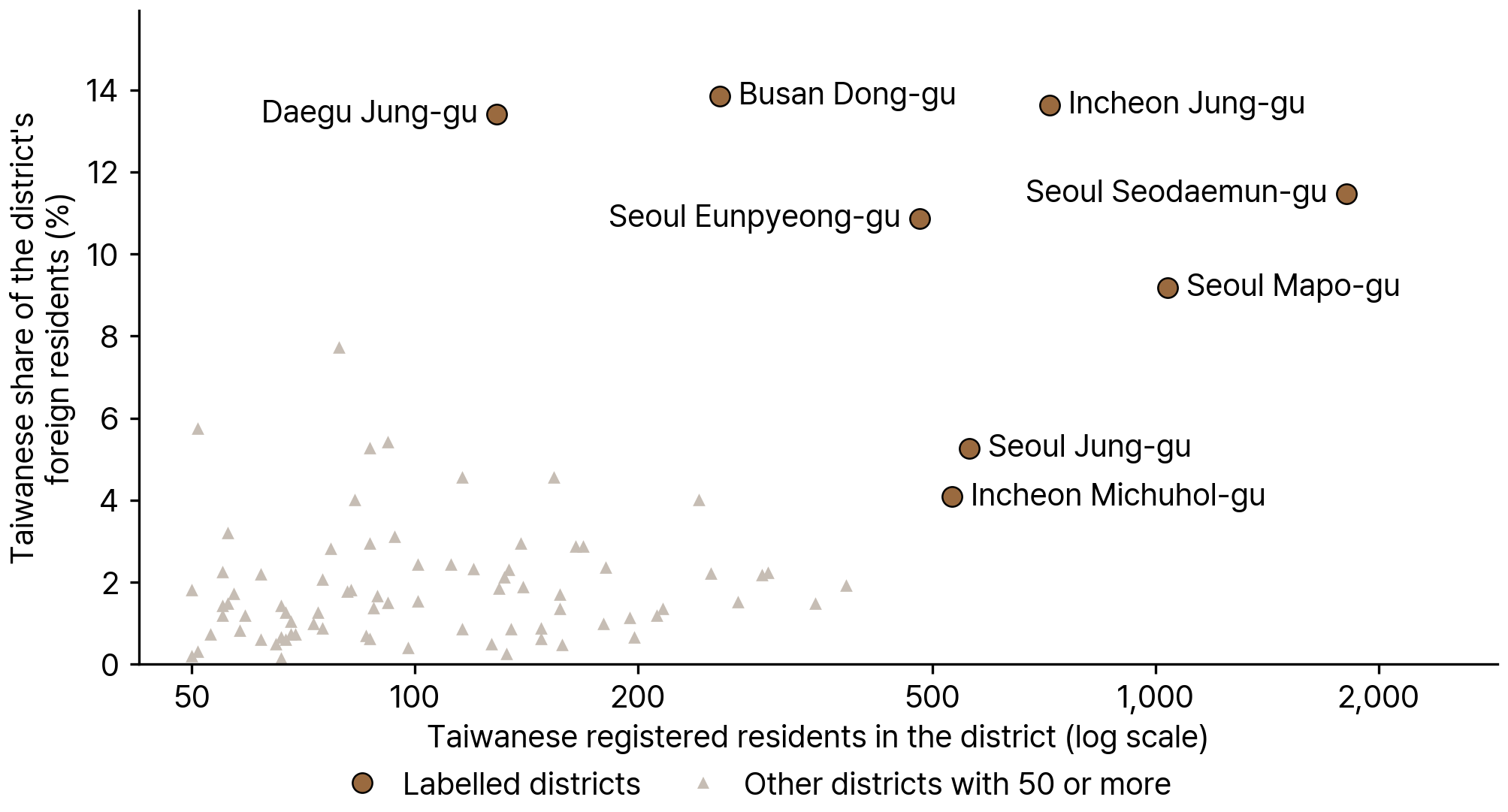
Source: KIRD dataset, from Ministry of Justice registered-foreigner statistics by district, 2024.
Table 2Ten Districts with the Most Registered Taiwanese Foreigners, 2024
| District | Province | Registered Taiwanese | Share of district's registered foreigners (%) |
|---|---|---|---|
| Seoul Seodaemun-gu | Seoul | 1,809 | 11.5 |
| Seoul Mapo-gu | Seoul | 1,039 | 9.2 |
| Incheon Jung-gu | Incheon | 720 | 13.6 |
| Seoul Jung-gu | Seoul | 561 | 5.3 |
| Incheon Michuhol-gu | Incheon | 531 | 4.1 |
| Seoul Eunpyeong-gu | Seoul | 481 | 10.9 |
| Seoul Dongdaemun-gu | Seoul | 382 | 1.9 |
| Seoul Yeongdeungpo-gu | Seoul | 347 | 1.5 |
| Seoul Yongsan-gu | Seoul | 300 | 2.2 |
| Seoul Seongbuk-gu | Seoul | 294 | 2.2 |
Note: Registered foreigners only; F-4 holders who report residence are not included. The ten districts account for 37.2 percent of registered Taiwanese.
Source: KIRD dataset, from Ministry of Justice registered-foreigner statistics by district, 2024.
The index of dissimilarity (D) between registered Taiwanese and all other registered foreigners across districts was 0.423 in 2014 and 0.395 in 2024. A D of 0.395 indicates that about 40 percent of Taiwanese would have had to move to match the distribution of other foreigners in 2024. No district met the ethnic enclave definition used in these Spotlights (a location quotient of at least 2 and Taiwanese making up at least 30 percent of the district's registered foreigners).
Age and Sex
Women made up 58.8 percent of Taiwanese resident foreigners in 2024 (21,065 of 35,838), down from 60.4 percent in 2019, and well above the 45.1 percent share among all resident foreigners.
The age profile is older than that of all resident foreigners. People aged 60 and older were the largest age group in 2024 and made up 17.1 percent of Taiwanese residents, compared with 12.9 percent of all resident foreigners. The median person fell in the 35-39 age group. Adults aged 20-39 made up 48.6 percent (17,412 people), close to the 49.7 percent among all resident foreigners, and children under 15 made up 5.6 percent (2,005), against 5.7 percent overall. A total of 9,962 Taiwanese residents were aged 50 or older in 2024.
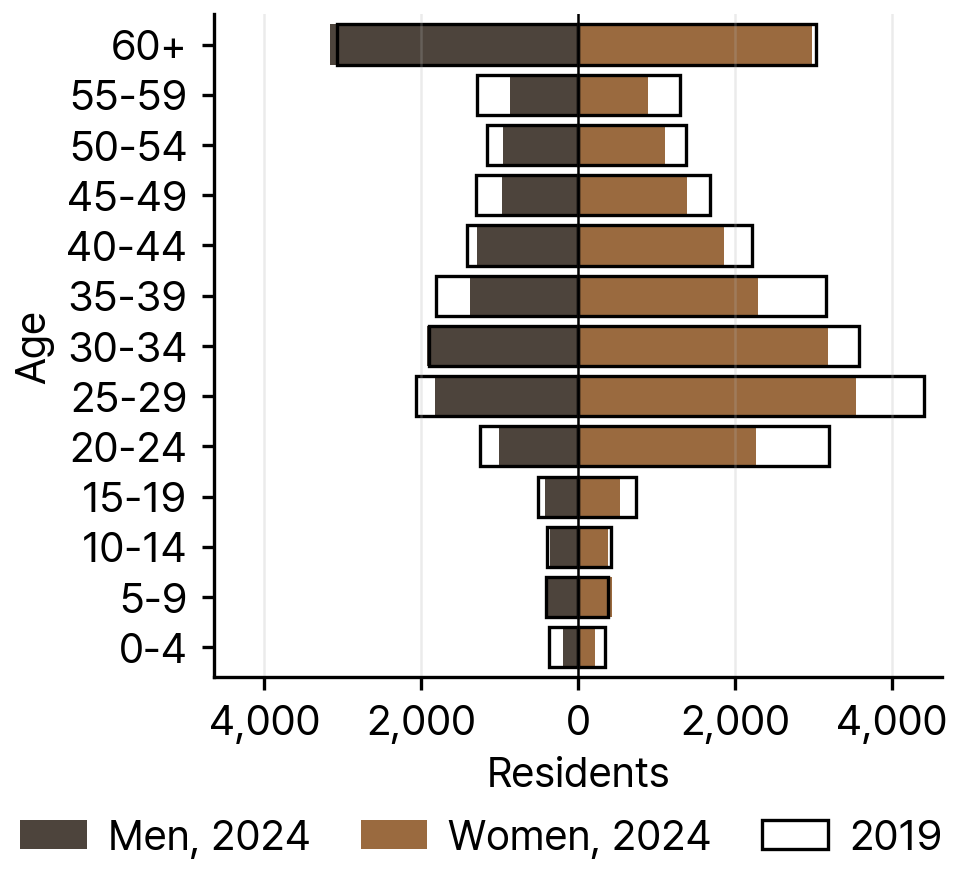
Source: KIRD dataset, from Ministry of Justice immigration yearbooks, 2024.
Visa Status
Half of Taiwanese resident foreigners in 2024 were short-term visitors (50.7 percent), compared with 19.7 percent of all resident foreigners. Permanent residents (F-5) made up 29.1 percent, against 7.7 percent overall. Employment visas accounted for 2.8 percent (19.2 percent overall), study and training for 4.3 percent (10.2 percent overall), and marriage and family statuses for 12.7 percent (13.6 percent overall). Only 0.2 percent held overseas Korean statuses (F-4 or H-2), against 24.5 percent of all resident foreigners.
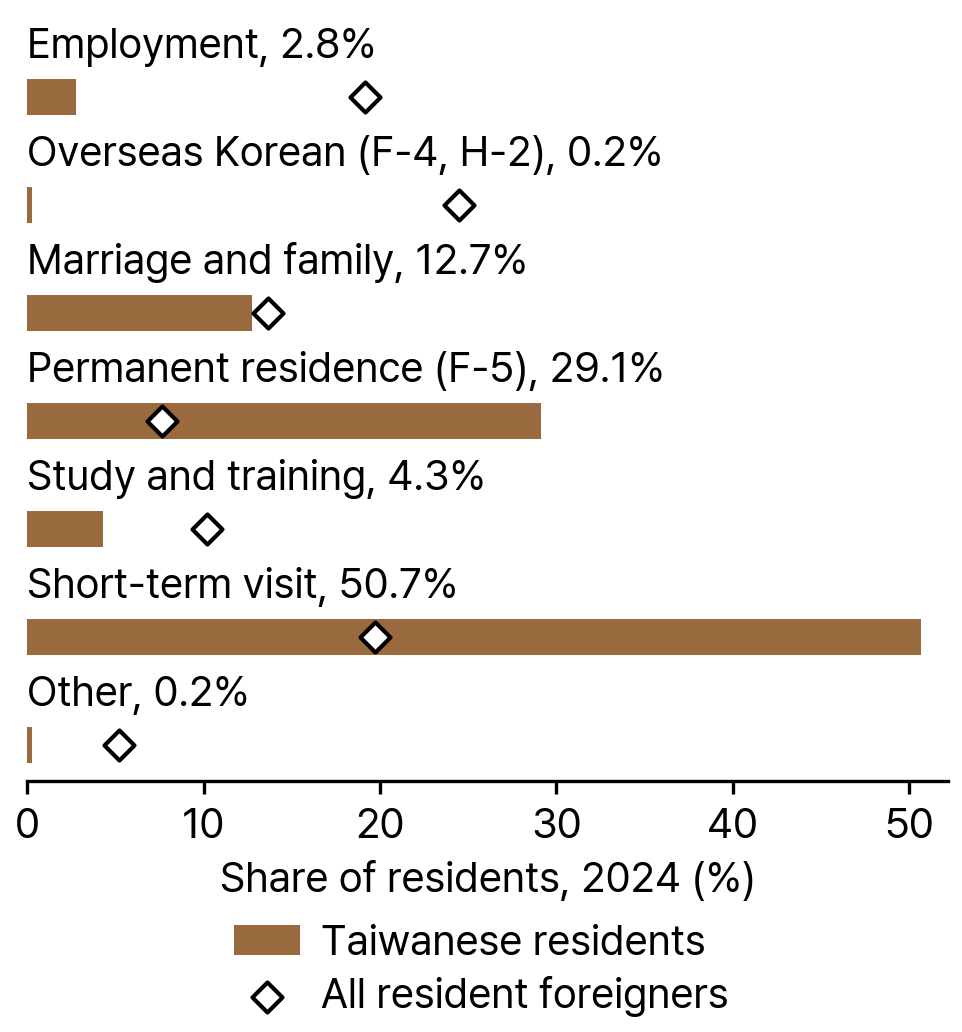
Source: KIRD dataset, from Ministry of Justice immigration yearbooks, 2024.
The B-2 tourist and transit status was the most common, held by 9,958 Taiwanese in 2014, 22,612 in 2019, and 18,144 in 2024. Taiwanese held 11.9 percent of all B-2 statuses in Korea in 2024, the fourth-largest number among nationalities. F-5 permanent residence declined from 13,905 holders in 2014 to 12,488 in 2019 and 10,428 in 2024, and F-2 residential status from 4,422 to 3,465 and 2,449. Holders of F-6 marriage visas rose from 549 in 2014 to 1,623 in 2024, and D-2 students from 544 to 1,032.
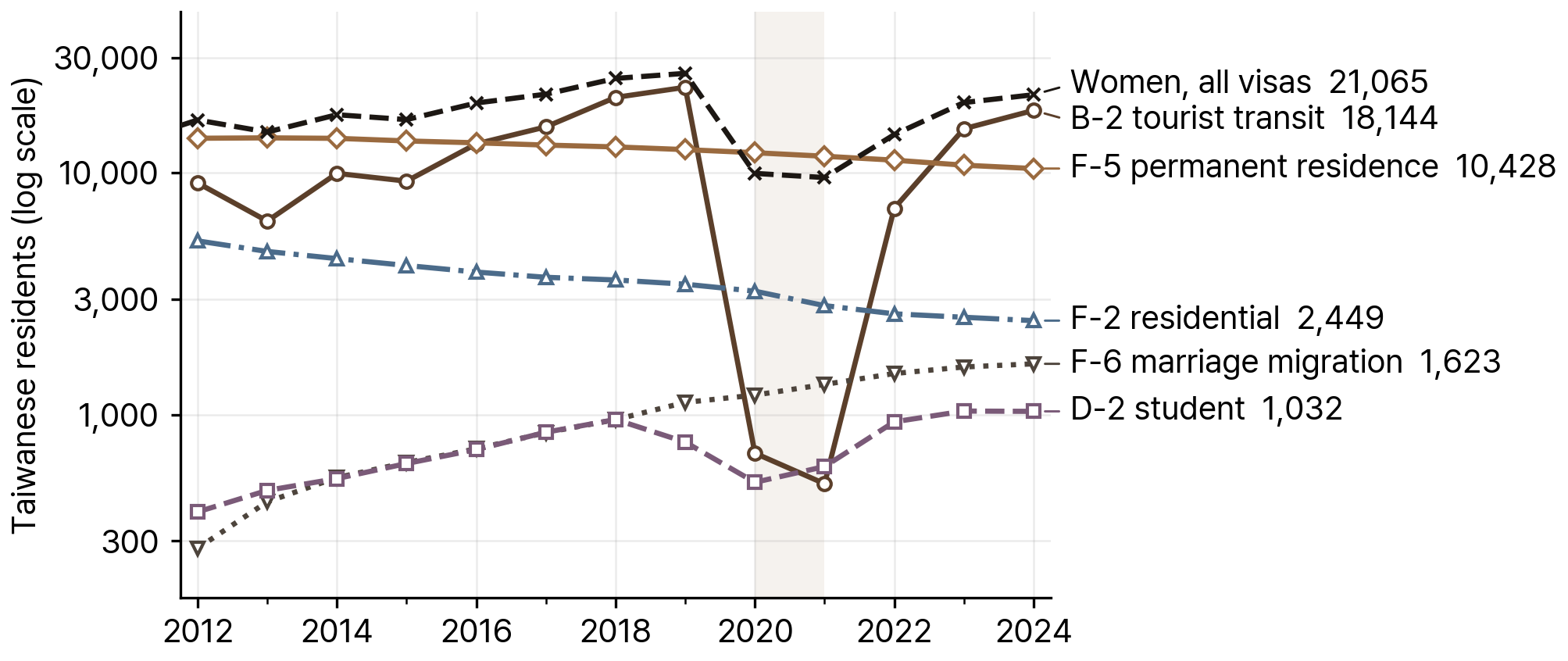
Source: KIRD dataset, from Ministry of Justice immigration yearbooks, 2014-2024.
Table 3Most Common Visas Held by Taiwanese Resident Foreigners, 2019 and 2024
| Visa | Meaning | 2019 | 2024 | Share of Taiwanese, 2024 (%) | Taiwanese share of all holders of the visa, 2024 (%) |
|---|---|---|---|---|---|
| B-2 | Tourist Transit | 22,612 | 18,144 | 50.6 | 11.9 |
| F-5 | Permanent Residence | 12,488 | 10,428 | 29.1 | 5.1 |
| F-2 | Residential | 3,465 | 2,449 | 6.8 | 4.0 |
| F-6 | Marriage Migration | 1,124 | 1,623 | 4.5 | 1.1 |
| D-2 | Student | 770 | 1,032 | 2.9 | 0.6 |
| D-4 | General Trainee | 351 | 475 | 1.3 | 0.5 |
| F-1 | Visiting Cohabitation | 409 | 390 | 1.1 | 0.4 |
Note: Shares of Taiwanese use the 2024 total of 35,838 Taiwanese resident foreigners. The seven visas shown account for 34,541 people (96.4 percent).
Source: KIRD dataset, from Ministry of Justice immigration yearbooks, 2019-2024.
Migration Channels and Policy
Taiwan is not among the countries that send workers to Korea through the Employment Permit System (EPS), which operates through agreements between the Korean government and the governments of 17 countries, including Vietnam, the Philippines, Indonesia, and China; Tajikistan was added as the 17th sending country (Ministry of Employment and Labor, 2024).
Short visits are the main route of entry. Korea and Taiwan have allowed mutual visa-free entry since January 2003, and the visa-free period was extended from 30 to 90 days on July 1, 2012 (Maeil Shinmun, 2012). The two sides began reciprocal automated immigration clearance for pre-registered travelers on June 27, 2018 (National Immigration Agency (Taiwan), 2018).
Because Korea has had no formal diplomatic relations with Taiwan since 1992, a bilateral working holiday program is administered through the Taipei Mission in Korea and the Korean Mission in Taipei. It admits up to 800 participants a year on a first-come basis, and an October 2023 revision of the agreement set the eligible age at 18 to 34 (Ministry of Foreign Affairs, 2026).
Naturalization
Between 2014 and 2024, 3,432 Taiwanese nationals acquired Korean nationality through naturalization. Annual counts ranged from 211 in 2017 to 427 in 2015, and 367 Taiwanese naturalized in 2024 (KIRD dataset).
The Ministry of Justice also recorded 652 restorations of Korean nationality among Taiwanese nationals between 2011 and 2024, including 32 in 2024.
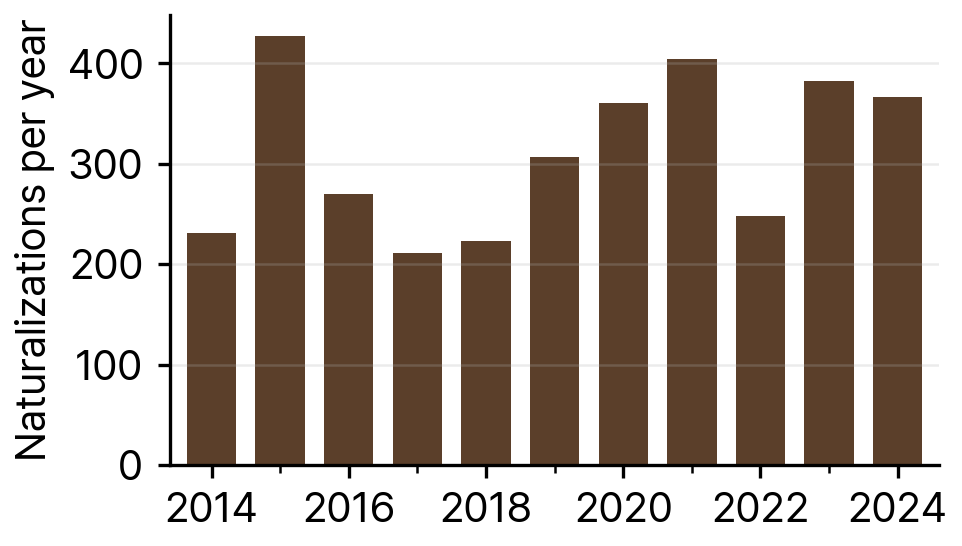
Source: KIRD dataset, from Ministry of Justice immigration yearbooks, 2014-2024.
Unauthorized Residents
Taiwan is not among the ten nationalities that the Ministry of Justice immigration yearbook reports separately in its table of unauthorized residents (table 6-4), so no count of unauthorized Taiwanese residents is published. The yearbook reported 397,522 unauthorized residents of all nationalities in 2024.
Health and Well-being
To our knowledge, no work indexed in OpenAlex, KCI, or DBpia, and no news coverage of migrant occupational deaths, reports health, injury, or care-access outcomes for Taiwanese residents of Korea separately.
Migration from Taiwan to South Korea
The UN counted 832,507 Taiwan-born people living outside Taiwan in 2024, in 16 named destination countries led by the United States (404,256), China (170,422), Canada (64,617), Japan (62,144), and Australia (61,011). South Korea does not appear as a separate destination for Taiwan-born migrants in that table, so no Korean share or rank among destinations can be computed from it. The same table reports 4,824 Korea-born people living in Taiwan in 2024, up from 1,193 in 1990 (UN DESA 2024).
Taiwan's Overseas Community Affairs Council estimated the Taiwanese compatriot community in Korea at around 16,000 people in 2023 (OCAC 2023).
Because Taiwan is not an EPS sending country, there are no deployment counts or EPS applicant figures for Taiwan (Ministry of Employment and Labor 2024). Taiwan is not a World Bank reporting economy, so World Bank series on remittances received, including remittances as a share of GDP, have no Taiwan values, and we know of no published figure for remittances from Korea to Taiwan (Taiwan News 2020).
Most Taiwanese nationals in Korea are members of the long-resident ethnic Chinese (hwagyo) community. A 2004 Samsung Economic Research Institute study found that about 90 percent of this community came from Shandong Province in mainland China. The community holds Republic of China nationality because the Republic of China opened an embassy in Korea in 1949 and Korea had no diplomatic relations with the People's Republic of China until 1992, which left Taiwanese nationality as the only option. In January 2026, the Ministry of Justice counted just over 10,000 Korea-born Taiwanese nationals holding F-1, F-2, or F-5 status; the Hanseong Overseas Chinese Association put the community at about 15,000 and at most 18,000, and academic estimates ranged from 10,000 to 15,000 (Yonhap News 2026).
On the policy side, Korea and Taiwan resumed direct flights in 2005 (Jeju Ilbo 2012). Taiwan's Bureau of Consular Affairs dates the bilateral working holiday program to January 1, 2011, under a memorandum between the Taipei Mission in Korea and the Korea Mission in Taipei (Bureau of Consular Affairs 2024).
As far as we know, published research on Taiwanese nationals in Korea concerns the hwagyo community. An ethnographic study of hwagyo associations in Seoul found that after 1992 most hwagyo retained Taiwanese nationality and formed an independent migrant identity by maintaining a selective distance from both China and Taiwan (Kim 2016). Interviews with third- and fourth-generation hwagyo found that they described themselves as forgotten people outside Korea's multiculturalism policies and were uncertain about their place in Korean society (Kim et al. 2017). A study of hwagyo who moved from Korea to Taiwan or mainland China after facing discrimination since the 1970s found that first-generation returnees treated the move as retirement, while Korea-born second-generation returnees saw business opportunities, needed long periods of adjustment, relied on Korean social networks, and retained a Korea-linked identity (Lee 2012). We are not aware of any study of recent migrants from Taiwan to Korea, such as students or marriage migrants.
Table 4Migration Indicators, Taiwan and South Korea
| Indicator | Value | Source |
|---|---|---|
| Taiwan-born people living abroad, 2024 | 832,507 | UN DESA 2024 |
| South Korea listed as a destination of Taiwan-born migrants, 2024 | Not listed | UN DESA 2024 |
| Korea-born people living in Taiwan, 2024 | 4,824 | UN DESA 2024 |
| Taiwanese compatriot community in Korea (Taiwanese government estimate), 2023 | About 16,000 | OCAC 2023 |
| Korea-born Taiwanese nationals with F-1, F-2, or F-5 status, January 2026 | Just over 10,000 | Yonhap News 2026 |
| Hwagyo originating in Shandong Province (2004 study) | About 90 percent | Yonhap News 2026 |
| EPS sending country | No | Ministry of Employment and Labor 2024 |
| Remittances as a share of GDP (World Bank) | n.a. | Taiwan News 2020 |
Note: n.a. = not published; Taiwan is not a World Bank reporting economy. The UN table records no separate row for South Korea as a destination of Taiwan-born migrants.
Source: UN DESA; Overseas Community Affairs Council (Taiwan); Ministry of Justice; Yonhap News; Ministry of Employment and Labor.
Community Organizations
The Seoul (Hanseong) Overseas Chinese Association originated as a Chinese chamber of commerce founded in 1884 and has used its current name since June 1969. It is a semi-official body that handles part of the Taiwanese government's administrative work for the community, including receiving petitions to the Taipei Mission in Korea, delivering visas the mission issues, mediating disputes between overseas Chinese and Koreans, and registering births, deaths, and marriages (Epoch Times Korea, 2024).
Of the 1,720 migrant-serving organizations in the KIRD census, six name this community in their name or target group. All six are self-operated, privately funded overseas Chinese associations: the Hanseong association in Jung-gu, Seoul; the Incheon association in Jung-gu, Incheon; the Busan association in Dong-gu, Busan; the Daegu association in Jung-gu, Daegu; the Daejeon association in Jung-gu, Daejeon; and the Gwangju association in Seo-gu, Gwangju (KIRD dataset). Most general-purpose migrant organizations in the census also serve Taiwanese residents.
Sources
Korea Immigration Regional Dashboard (KIRD) dataset. openICPSR. https://doi.org/10.3886/E249944V1
Ministry of Employment and Labor / HRD Korea. 2026 (accessed). Employment Permit System, country and language list. https://www.eps.go.kr/eo/langMain.eo?langCD=en
Ministry of Foreign Affairs of Korea, Working Holiday Info Center. 2026 (accessed). Taiwan program page. https://whic.mofa.go.kr/whic/nation/info.jsp?boardNo=100006
Maeil Shinmun. 2012. Korea-Taiwan visa-free visits extended to up to 90 days from July (한국·대만 무비자 방문 7월부터 최장 90일까지). https://www.imaeil.com/page/view/2012062308373970461
National Immigration Agency, Republic of China (Taiwan). 2018. Reciprocal Use of Automated Immigration Clearance (e-Gate). https://www.immigration.gov.tw/5475/5478/141386/141401/234286/
Taiwan News. 2020. World Bank offers almost no data on Taiwan. https://www.taiwannews.com.tw/news/3945916
Incheon In. 2025. 'Taiwanese overseas Chinese': a forgotten name in Korea, 140 years of deep-rooted life ('대만화교'... 한국 속 잊혀진 이름, 140년 뿌리 깊은 삶). https://www.incheonin.com/news/articleView.html?idxno=112048
Epoch Times Korea. 2024. Hanseong Overseas Chinese Association election (서울 한복판서 펼쳐지는 양안 대리전? 과열 혼탁 한성화교협회장 선거). https://www.epochtimes.kr/2024/11/694134.html
United Nations Department of Economic and Social Affairs, Population Division. 2024. International Migrant Stock 2024: Destination and origin, Table 1. https://www.un.org/development/desa/pd/sites/www.un.org.development.desa.pd/files/undesa_pd_2024_ims_stock_by_sex_destination_and_origin.xlsx
Overseas Community Affairs Council, Republic of China (Taiwan). 2023. Expatriate Division, Taipei Mission in Korea: Overview. https://www.ocac.gov.tw/OCAC/SubSites/Pages/Detail.aspx?site=94234775-c0e1-42c5-9e9e-aeef3af6f608&nodeid=1784&pid=13347
Yonhap News, via Korean Center. 2026. Fact check: the size of Korea's 140-year-old overseas Chinese community ([팩트체크] 우리 안의 중국인?…'140년 역사' 한국 화교 규모는). https://www.koreancenter.or.kr/news/articleView.html?idxno=1310026
Ministry of Employment and Labor / HRD Korea. 2024. Employment Permit System: history of the system (제도변천사). https://www.eps.go.kr/eo/EmployPerSystem.eo?tabGb=01
Jeju Ilbo. 2012. Taiwan and Korea extend visa-free stays to 90 days from next month (대만-한국, 내달부터 무비자 체류 90일로 연장). https://jejunews.com/news/articleView.html?idxno=1358618
Bureau of Consular Affairs, Ministry of Foreign Affairs, Republic of China (Taiwan). 2024. Guidelines for Korea (ROK) nationals applying for a visa to join the Republic of China (Taiwan) working holiday scheme. https://www.boca.gov.tw/cp-153-383-76a8a-2.html
Kim, K. (2016). The shifting migrant identity of Korean Huaqiao between China and Taiwan: A case study of Huaqiao associations in Seoul. Journal of Asia-Pacific Studies, 23(3), 157-189. https://doi.org/10.18107/japs.2016.23.3.006
Kim, H., Lee, J. G., Lee, B. C., & Kim, S. (2017). Understanding the life of Chinese immigrants in Korea: Forgotten people in the land of multiculturalism. Asian Social Work and Policy Review, 11(3), 184-192. https://doi.org/10.1111/aswp.12124
Lee, C. (2012). 'Return' migration and new adaptation of Korean 'overseas Chinese' [in Korean]. Korean Cultural Anthropology, 45(3), 153-198. https://www.kci.go.kr/kciportal/ci/sereArticleSearch/ciSereArtiView.kci?sereArticleSearchBean.artiId=ART001702753
Suggested citation: Korea Immigration Regional Dashboard (KIRD). 2026. “Taiwanese Immigrants in South Korea.” Foreign Residents in South Korea series, September 2026. Data: Korea Immigration Regional Dashboard (KIRD) dataset, https://doi.org/10.3886/E249944V1. Interactive maps and tables: https://immigrantsinkorea.today.