 Korea Immigration Regional Dashboard
SpotlightSeptember 2026Province profilesDownload PDF
Foreign Residents in Ulsan
Highlights
- The number of registered foreigners in Ulsan fell from 26,183 in 2015 to 16,827 in 2021 and then rose to 27,642 in 2024, the highest count in the 2006-2024 series, while the number of Korean residents declined every year from 2016 to 2024.
- Skilled statuses (E-1 to E-7) covered 18.6 percent of Ulsan's registered foreigners in 2024, against 5.8 percent nationally, and the city accounted for 7.5 percent of registered E-7 holders in South Korea and 1.9 percent of all registered foreigners.
- Dong-gu accounted for 6,143 of Ulsan's net gain of 7,192 registered foreigners between 2019 and 2024 and had 6.4 registered foreigners per 100 Korean residents in 2024, the highest ratio among the city's five districts.
Ulsan had 27,642 registered foreigners on 31 December 2024, 1.9 percent of the 1,488,353 registered foreigners in South Korea. The city ranked 13th among the 17 provinces and metropolitan cities by the number of registered foreigners and 11th by registered foreigners per Korean resident, with 2.5 per 100 Korean residents against 2.9 nationally. The Ministry of the Interior and Safety (MOIS), whose count adds naturalized citizens and the children of foreign residents, recorded 45,392 foreign residents in Ulsan in 2024.
The registered-foreigner count rose from 10,494 in 2006 to 26,183 in 2015, fell to 16,827 in 2021, and rose again to 27,642 in 2024. Between 2019 and 2024 it grew 35.2 percent (7,192 people), the sixth-fastest growth among the 17 provinces, while the number of Korean residents fell 4.4 percent (49,970 people); the foreign gain equaled 14.4 percent of the Korean loss. The Korean resident count peaked at 1,173,534 in 2015 and declined every year after that, to 1,098,049 in 2024.
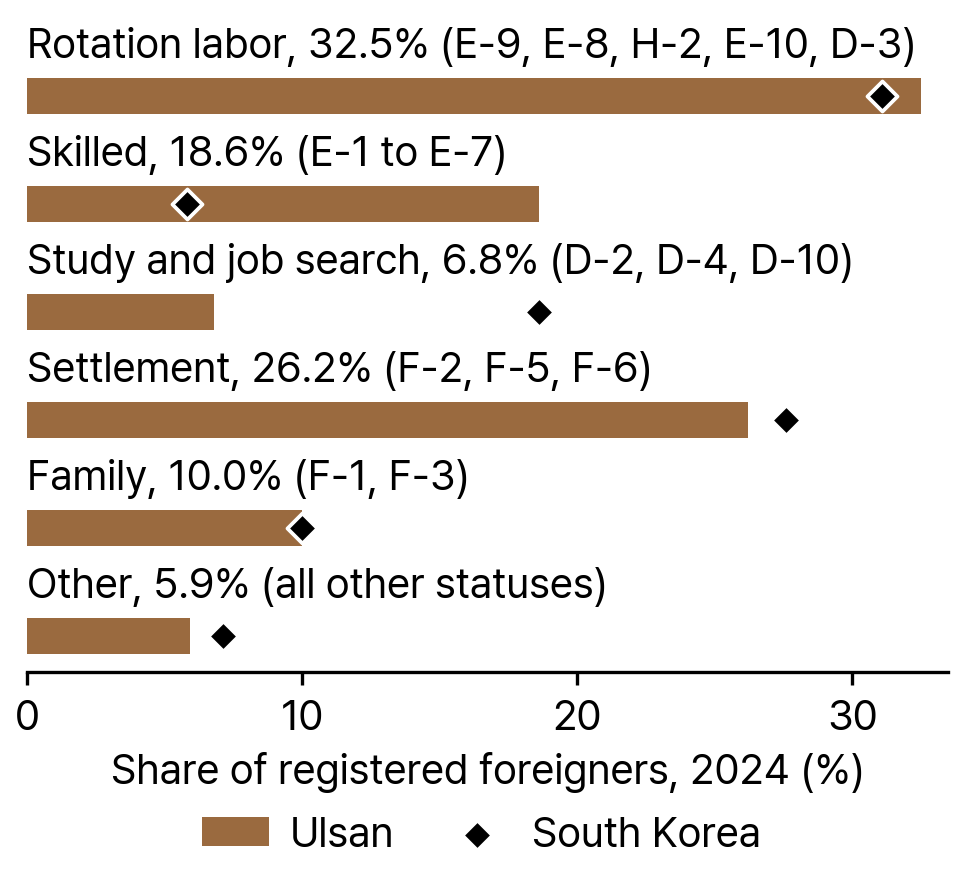
Vietnamese nationals were the largest group of registered foreigners in 2024 (22.7 percent), followed by Korean-Chinese (13.9 percent) and Chinese nationals (8.8 percent). Compared with registered foreigners nationally, those in Ulsan were more likely to have skilled statuses (18.6 percent, against 5.8 percent) and less likely to have study and job-search statuses (6.8 percent, against 18.6 percent). The city was home to 7.5 percent of registered E-7 (specially designated activities) holders and 6.7 percent of registered Sri Lankans in South Korea. Dong-gu and Ulju-gun, two of the city's five districts, together had 18,305 registered foreigners in 2024 (66.2 percent of the city's total), and Dong-gu alone accounted for 6,143 of the 7,192 added between 2019 and 2024.
Size of the Foreign-Resident Population
Ulsan's registered foreigners increased every year from 10,494 in 2006 to 26,183 in 2015 (see Figure 1). The number then declined to 20,002 in 2018 and, after a rise to 20,450 in 2019, fell to 16,827 in 2021, 35.7 percent below the 2015 level. It increased to 18,379 in 2022, 23,620 in 2023, and 27,642 in 2024, the highest count between 2006 and 2024.
The MOIS count of foreign residents, which adds naturalized citizens and children, grew from 14,667 in 2008 to 38,183 in 2015. It ranged from 34,373 to 37,284 between 2016 and 2022 and then rose to 41,698 in 2023 and 45,392 in 2024. From 2015 to 2021 the MOIS count fell 8.9 percent (from 38,183 to 34,800), while the registered count fell 35.7 percent.
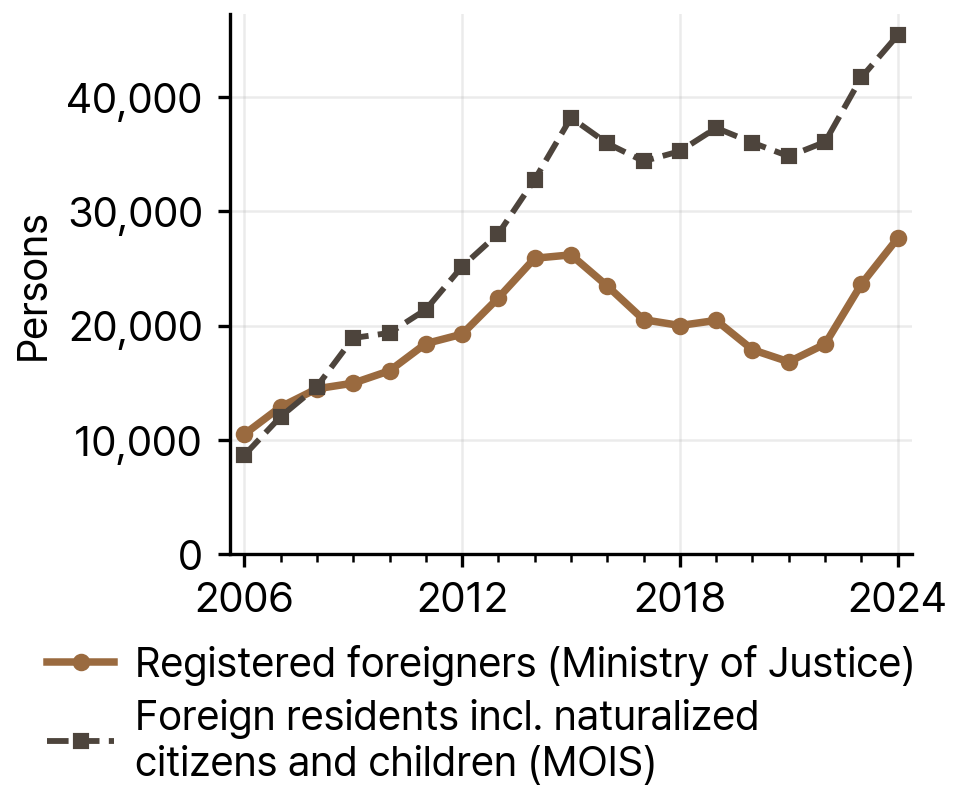
Source: KIRD dataset, from Ministry of Justice immigration yearbooks and Ministry of the Interior and Safety foreign-resident statistics, 2006-2024.
With 2014 set to 100, the index of registered foreigners in Ulsan fell to 65.0 in 2021 and rose to 106.8 in 2024 (see Figure 2, which also shows the indexes for South Korea as a whole). The index of Korean residents in Ulsan was 100.6 in 2015 and declined each year after that, to 94.1 in 2024. Over the ten years from 2014 to 2024, the registered count grew 6.8 percent (1,757 people) and the Korean count fell 5.9 percent (68,328 people).
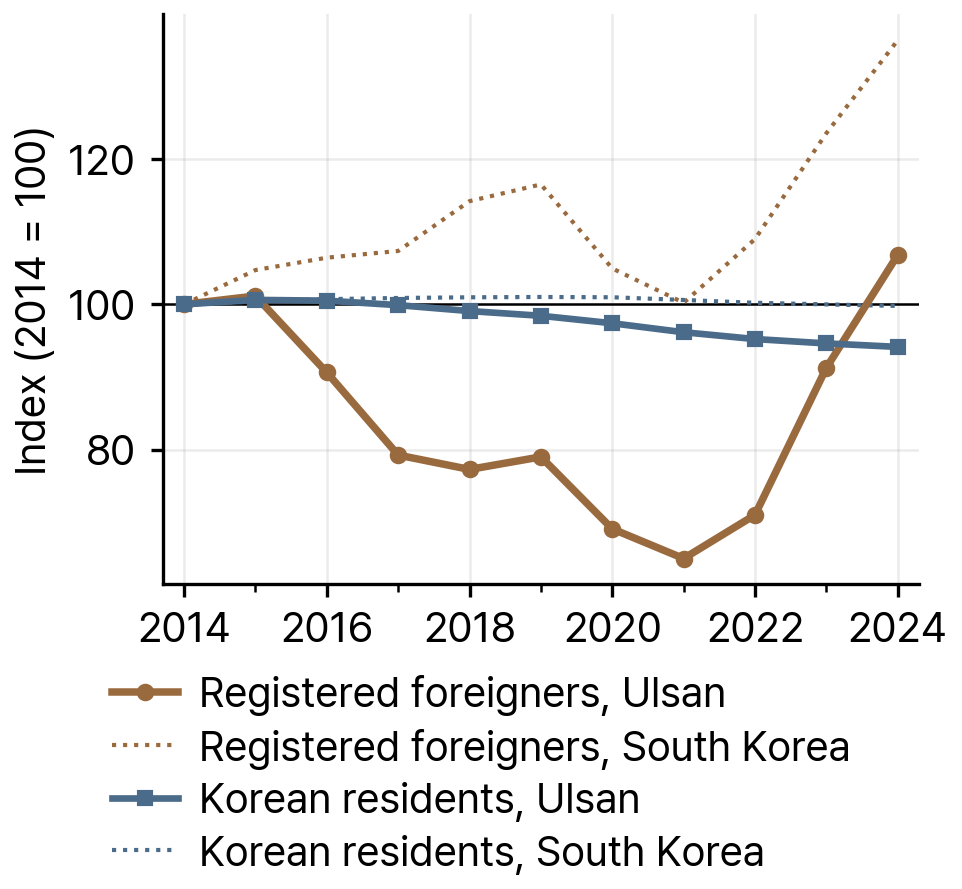
Source: KIRD dataset, from Ministry of Justice immigration yearbooks and Ministry of the Interior and Safety resident registration statistics, 2014-2024.
In 2024 Ulsan ranked 13th among the 17 provinces by the number of registered foreigners and 11th by registered foreigners per Korean resident (2.5 per 100 Korean residents, against 2.9 for South Korea as a whole). Its growth of 35.2 percent in registered foreigners between 2019 and 2024 was the sixth-fastest among the 17 provinces (see Table 1).
Table 1Registered Foreigners, MOIS Foreign Residents, and Korean Residents in Ulsan, Selected Years, 2006-24
| Year | Registered foreigners | MOIS foreign residents | Korean residents | Registered foreigners per 100 Korean residents |
|---|---|---|---|---|
| 2006 | 10,494 | n/a | 1,092,494 | 1.0 |
| 2014 | 25,885 | 32,772 | 1,166,377 | 2.2 |
| 2019 | 20,450 | 37,284 | 1,148,019 | 1.8 |
| 2024 | 27,642 | 45,392 | 1,098,049 | 2.5 |
Note: MOIS counts are shown from 2008, when MOIS counted 14,667 foreign residents in Ulsan; n/a = not shown. The MOIS counts for 2006 (8,664) and 2007 (12,034) were below the registered counts for those years (10,494 and 12,887); in every year from 2008 to 2024, the MOIS count was the larger of the two.
Source: KIRD dataset, from Ministry of Justice immigration yearbooks and Ministry of the Interior and Safety statistics, 2006-2024.
Nationalities
Vietnamese nationals made up 22.7 percent of Ulsan's registered foreigners in 2024 (6,263 people), against 17.6 percent of registered foreigners nationally (see Figure 3 and Table 2). Korean-Chinese followed with 3,851 (13.9 percent), then Chinese nationals with 2,430 (8.8 percent) and Sri Lankan nationals with 2,272 (8.2 percent). The ten largest groups made up 80.7 percent of the city's registered foreigners in 2024.
Between 2019 and 2024 the number of Vietnamese nationals grew from 3,908 to 6,263, while Korean-Chinese fell from 5,041 to 3,851 and Chinese nationals from 2,667 to 2,430; in 2019, Korean-Chinese had outnumbered Vietnamese. The Sri Lankan, Indonesian, Thai, and Nepali groups each more than doubled over the same period, Sri Lankans from 883 to 2,272.
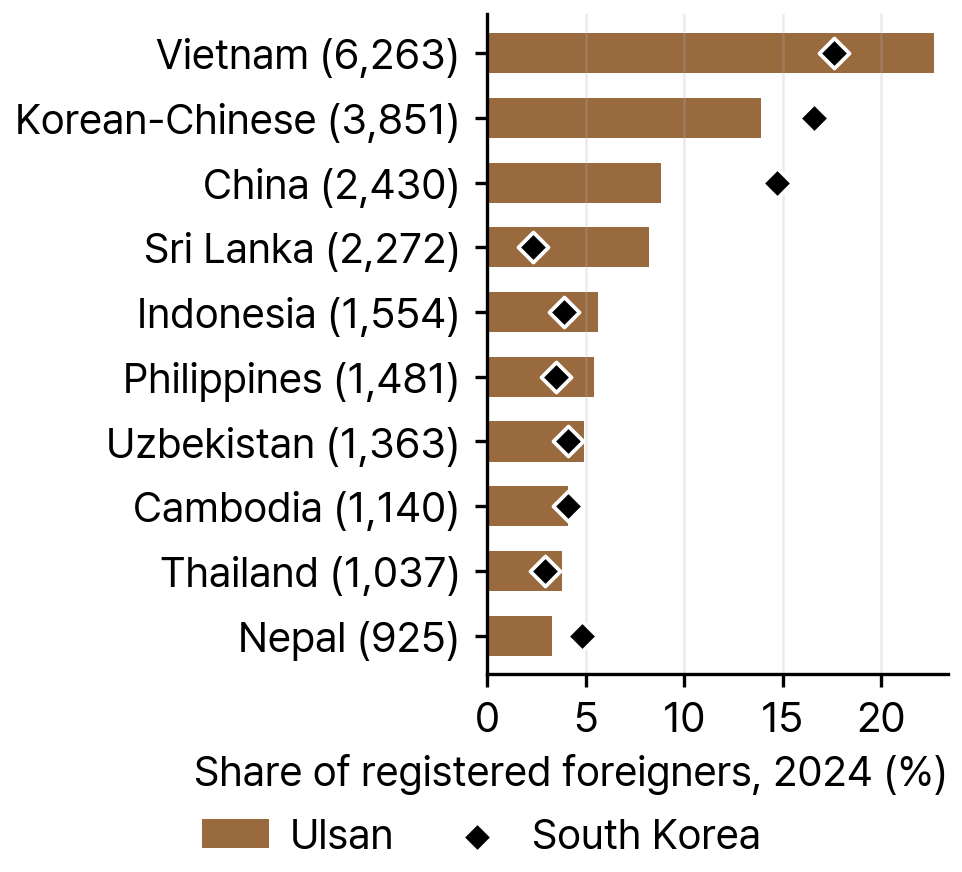
Source: KIRD dataset, from Ministry of Justice immigration yearbooks, 2024.
Table 2Ten Largest Nationalities among Registered Foreigners in Ulsan, 2019 and 2024
| Nationality | 2019 | 2024 | Share of Ulsan's registered foreigners, 2024 (%) | Ulsan's share of this nationality's registered foreigners in South Korea, 2024 (%) |
|---|---|---|---|---|
| Vietnam | 3,908 | 6,263 | 22.7 | 2.4 |
| Korean-Chinese | 5,041 | 3,851 | 13.9 | 1.6 |
| China | 2,667 | 2,430 | 8.8 | 1.1 |
| Sri Lanka | 883 | 2,272 | 8.2 | 6.7 |
| Indonesia | 669 | 1,554 | 5.6 | 2.7 |
| Philippines | 1,121 | 1,481 | 5.4 | 2.8 |
| Uzbekistan | 877 | 1,363 | 4.9 | 2.2 |
| Cambodia | 888 | 1,140 | 4.1 | 1.9 |
| Thailand | 378 | 1,037 | 3.8 | 2.4 |
| Nepal | 423 | 925 | 3.3 | 1.3 |
Note: Korean-Chinese (한국계중국인) are listed separately from other Chinese nationals in the Ministry of Justice data.
Source: KIRD dataset, from Ministry of Justice immigration yearbooks, 2019 and 2024.
Ulsan accounted for 1.9 percent of all registered foreigners in South Korea in 2024 and for larger shares of several national groups. It was home to 6.7 percent of registered Sri Lankans (2,272 of 33,965), 3.1 percent of Russians (695 of 22,450) and of South Africans (142 of 4,641), 2.9 percent of nationals of Türkiye (99 of 3,441), and 2.8 percent of Filipinos (1,481 of 51,991).
The Shannon diversity index of Ulsan's registered foreigners rose from 2.3 in 2014 to 2.6 in 2024, the fifth-highest value among the 17 provinces in 2024. Registered foreigners in the city came from 110 nationalities in 2024.
Overseas Koreans on F-4 status report their residence instead of registering and are not counted among registered foreigners. In 2024, 6,526 F-4 holders reported residence in Ulsan, 1.2 percent of the 553,664 in South Korea. Korean-Chinese made up 5,632 of them, followed by Korean-Russians (221) and holders of U.S. (217), Uzbek (167), and Kazakh (108) nationality. Counting both groups, 9,483 Korean-Chinese residents were recorded in Ulsan in 2024 (5,632 reporting residence on F-4 status and 3,851 registered foreigners).
Residence Statuses
Rotation labor statuses covered 32.5 percent of Ulsan's registered foreigners in 2024 (8,987 people), close to the national share of 31.1 percent, and settlement statuses covered 26.2 percent (7,237), against 27.6 percent nationally (see Figure 4). Skilled statuses covered 18.6 percent (5,147), more than three times the national share of 5.8 percent. Study and job-search statuses covered 6.8 percent (1,891), against 18.6 percent nationally. Family statuses covered 10.0 percent (2,753), equal to the national share, and all other statuses 5.9 percent (1,627), against 7.1 percent nationally.
Source: KIRD dataset, from Ministry of Justice immigration yearbooks, 2024.
E-9 non-professional employment was the most common single status in 2024 (7,223 holders, 26.1 percent), followed by E-7 specially designated activities (4,707, 17.0 percent), F-5 permanent residence (3,254, 11.8 percent), and F-6 marriage migration (2,947, 10.7 percent) (see Table 3). Ulsan accounted for 7.5 percent of registered E-7 holders in South Korea in 2024, about four times its 1.9 percent share of all registered foreigners. Ulsan's share of national holders of the other nine statuses in the table ranged from 0.6 percent (D-2) to 2.2 percent (E-9).
Table 3Ten Most Common Residence Statuses among Registered Foreigners in Ulsan, 2024
| Status | Meaning | Status group | Registered foreigners | Share of Ulsan's registered foreigners (%) | Ulsan's share of all holders in South Korea (%) |
|---|---|---|---|---|---|
| E-9 | Non-professional employment | Rotation labor | 7,223 | 26.1 | 2.2 |
| E-7 | Specially designated activities | Skilled | 4,707 | 17.0 | 7.5 |
| F-5 | Permanent residence | Settlement | 3,254 | 11.8 | 1.6 |
| F-6 | Marriage migration | Settlement | 2,947 | 10.7 | 2.0 |
| F-1 | Visiting cohabitation | Family | 1,777 | 6.4 | 1.8 |
| G-1 | Other (miscellaneous) | Other | 1,175 | 4.3 | 2.1 |
| D-2 | Student | Study and job search | 1,152 | 4.2 | 0.6 |
| H-2 | Visiting employment | Rotation labor | 1,107 | 4.0 | 1.2 |
| F-2 | Residential | Settlement | 1,036 | 3.7 | 1.7 |
| F-3 | Dependent family | Family | 976 | 3.5 | 1.9 |
Note: Shares of Ulsan's registered foreigners are out of 27,642. The ten statuses together covered 25,354 registered foreigners (91.7 percent).
Source: KIRD dataset, from Ministry of Justice immigration yearbooks, 2024.
The MOIS count of 45,392 foreign residents in Ulsan in 2024 comprised 35,193 foreign nationals, 3,992 naturalized citizens, and 6,207 children of foreign residents. MOIS classified the foreign nationals as workers (13,100), marriage migrants (3,503), international students (1,553), ethnic Koreans of foreign nationality (5,239), and other foreign residents (11,798). Workers made up 28.9 percent of the MOIS total in 2024 and children 13.7 percent.
Districts and Population-Decline Areas
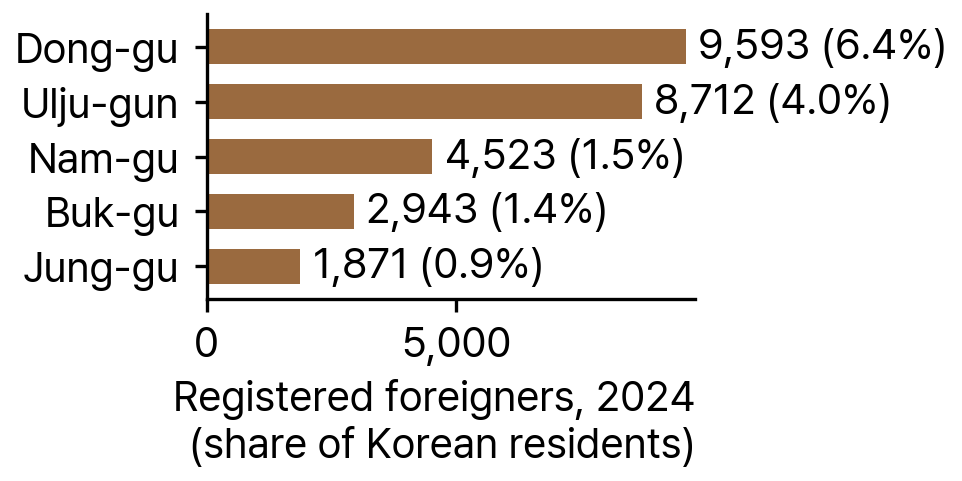
Ulsan has four urban districts (gu), Jung-gu, Nam-gu, Dong-gu, and Buk-gu, and one county (gun), Ulju-gun. Dong-gu had the most registered foreigners in 2024 (9,593, or 34.7 percent of the city's total) and the most per Korean resident (6.4 per 100). Ulju-gun followed with 8,712 (4.0 per 100 Korean residents). Nam-gu (4,523), Buk-gu (2,943), and Jung-gu (1,871) each had fewer than 2 registered foreigners per 100 Korean residents in 2024 (see Figure 5 and Table 4).
Every district lost Korean residents between 2019 and 2024, with losses ranging from 1,274 in Buk-gu to 18,934 in Nam-gu. Registered foreigners increased in Dong-gu (by 6,143, from 3,450 to 9,593), Ulju-gun (by 1,415), and Buk-gu (by 416) and decreased in Nam-gu (by 590) and Jung-gu (by 192). Dong-gu's gain equaled 85.4 percent of the city's net gain of 7,192 registered foreigners and 69.6 percent of the district's loss of 8,820 Korean residents.
Source: KIRD dataset, from Ministry of Justice immigration yearbooks and Ministry of the Interior and Safety resident registration statistics, 2024.
Table 4Registered Foreigners and Korean Residents by District in Ulsan, 2019-24
| District | Registered foreigners, 2024 | Per 100 Korean residents, 2024 | Change in Korean residents, 2019-24 | Change in registered foreigners, 2019-24 | Population-decline area |
|---|---|---|---|---|---|
| Dong-gu | 9,593 | 6.4 | -8,820 | +6,143 | No |
| Ulju-gun | 8,712 | 4.0 | -4,361 | +1,415 | No |
| Nam-gu | 4,523 | 1.5 | -18,934 | -590 | No |
| Buk-gu | 2,943 | 1.4 | -1,274 | +416 | No |
| Jung-gu | 1,871 | 0.9 | -16,581 | -192 | No |
| Ulsan total | 27,642 | 2.5 | -49,970 | +7,192 |
Note: Per 100 Korean residents is the number of registered foreigners divided by the number of Korean residents in the district, times 100.
Source: KIRD dataset, from Ministry of Justice immigration yearbooks and Ministry of the Interior and Safety resident registration statistics, 2019 and 2024; Ministry of the Interior and Safety designation of population-decline areas, 2021.
None of Ulsan's five districts was among the 89 population-decline areas or the 18 areas of interest that the Ministry of the Interior and Safety designated in October 2021. For the city as a whole, the gain of 7,192 registered foreigners between 2019 and 2024 equaled 14.4 percent of the loss of 49,970 Korean residents.
No district in Ulsan met this Spotlight's definition of an ethnic enclave in 2024 (a location quotient of at least 2 for a national group, with the group making up at least 30 percent of the district's registered foreigners).
Population Trends
Ulsan's Korean resident population grew from 1,092,494 in 2006 to a peak of 1,173,534 in 2015 and declined every year from 2016 to 2024, to 1,098,049. It fell 5.9 percent between 2014 and 2024 (68,328 people) and 4.4 percent between 2019 and 2024 (49,970 people). In 2024 it was 0.5 percent (5,555 people) above its 2006 level.
Net internal out-migration from Ulsan declined from 13,674 people in 2021 to 9,536 in 2022, 6,215 in 2023, and 4,854 in 2024, the smallest net outflow in nine years (Ulsan Maeil, 2024). In October 2025 the city's registered domestic population rose by 163 from the previous month to 1,092,797, its first increase after 96 consecutive months of decline, and the total population including foreign residents was 1,122,221 (Financial News, 2025).
Births in Ulsan rose 5.5 percent, from 5,282 in 2024 to 5,574 in 2025, and the total fertility rate rose to 0.92 in 2025, the highest of South Korea's seven special and metropolitan cities (Ulsan Maeil, 2025a). The share of residents aged 65 and older rose from 16.8 percent in 2024 to 18.2 percent in 2025, and the growth rate of the elderly population, 7.8 percent, was the second-highest among the 17 provinces after Incheon's 8.1 percent (Ulsan Maeil, 2025b).
Statistics Korea's 2022-2052 provincial population projection, published on 28 May 2024, projects that Ulsan's population will decline from 1.11 million in 2022 to below 1 million by 2040 and to 830,000 by 2052. Over the same period, the working-age population (ages 15 to 64) is projected to decline from 810,000 to 410,000 (Ulsan Sinmun, 2024).
Industry and Foreign Workers
Registered foreigners on E-9 non-professional employment status, the status of workers admitted through the Employment Permit System (EPS), numbered 6,125 in Ulsan in 2014, 5,006 in 2019, 3,572 in 2021, and 7,223 in 2024. The 2024 count was about twice the 2021 count. E-9 holders made up 26.1 percent of the city's registered foreigners in 2024 and 2.2 percent of all E-9 holders in South Korea.
A local news report counted 6,510 EPS (E-9) migrant workers in Ulsan in 2024, up 28.3 percent (1,434 workers) from the previous year, and reported that 94.8 percent of them (6,172) worked in manufacturing (Ulsan Journal, 2025). The report's count is lower than the KIRD count of 7,223 registered foreigners on E-9 status on 31 December 2024.
The KIRD data record no registered foreigners on E-8 seasonal-worker status in Ulsan on 31 December of any year from 2021 to 2024. A count taken on 31 December misses most seasonal workers, because their contracts end before winter. Ulju-gun operated its first public-type seasonal farm-worker program in 2026, bringing in 20 Laotian nationals to work in pear orchards from May through September, with a local agricultural cooperative handling their hiring and placement on farms (Newsis, 2026).
The city's programs for recruiting foreign shipbuilding workers, a metropolitan-type visa pilot and a training center in Uzbekistan, are described under Provincial Policy.
International Students and Universities
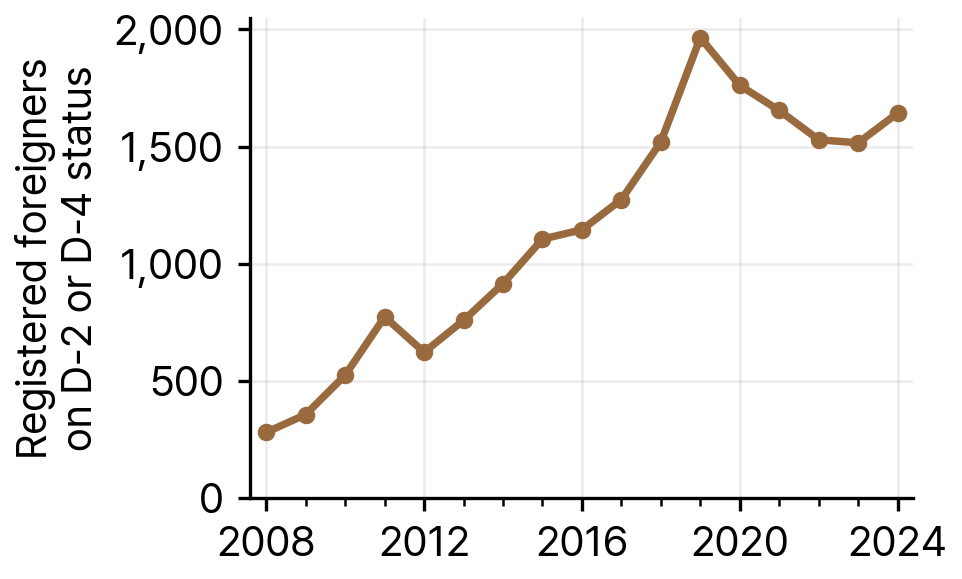
Registered foreigners on student (D-2) and general trainee (D-4) status in Ulsan increased from 280 in 2008 to 915 in 2014 and 1,965 in 2019, the highest count in the series (see Figure 6). The number declined each year to 1,516 in 2023 and rose to 1,643 in 2024, when it equaled 0.6 percent of D-2 and D-4 holders in South Korea, against the city's 1.9 percent share of all registered foreigners. In 2024, 1,152 were D-2 students and 491 were D-4 trainees (1,643 less 1,152).
Source: KIRD dataset, from Ministry of Justice immigration yearbooks, 2008-2024.
The Korean Educational Development Institute (KEDI) counted 1,079 international students at six higher-education institutions headquartered in Ulsan on 1 April 2024. University of Ulsan had 409, UNIST (Ulsan National Institute of Science and Technology) 325, Ulsan College 287, and KEPCO International Nuclear Graduate School 50 (KEDI, 2024). These counts differ from the KIRD count of 1,643, which refers to registered foreigners on D-2 or D-4 status on 31 December 2024.
In October 2024, University of Ulsan and UNIST signed international-student recruitment agreements with Indonesia's Sepuluh Nopember Institute of Technology and Vietnam's Ho Chi Minh City University of Technology and Education, as part of Ulsan's WSU program for a planned Graduate School of Future New Industries (Seoul Sinmun, 2024).
Provincial Policy
Ulsan Metropolitan City's Foreign Resident Support Ordinance (Ulsan Ordinance No. 1897) has been in force since 1 January 2019, following its amendment of 27 December 2018 (National Law Information Center, 2019). The city's Women, Family and Youth Division is the office in charge of foreign-resident and multicultural-family policy (Ulsan Metropolitan City, 2024).
The city's foreign resident support center opened on 17 October 2022 at 60 Dojil-ro, Nam-gu (Sinjeong-dong). The center has four staff members, is managed by an outsourced operator, and provides counseling, education, and cultural programs (Ulsan Metropolitan City, 2022).
Ulsan's metropolitan-type visa pilot, an E-7-3 general skilled-worker visa for shipbuilding welders, electricians, and painters, was planned to bring in 89 foreign workers in its first year, 2025, and 440 in total by the end of 2026 (Seoul Pn, 2025). The first 49 workers admitted under the pilot, Vietnamese nationals with E-7 visas, arrived on 26 November 2025 after at least three months of job and Korean-language training abroad. They were placed with subcontractors of HD Hyundai Heavy Industries and HD Hyundai Mipo in Dong-gu (Ulsan Maeil, 2025c).
Ulsan City and HD Hyundai Heavy Industries jointly built a workforce training center in Uzbekistan, the Ulsan Global Manpower Training Center. By June 2026 they had placed 385 Uzbek workers in Ulsan shipbuilding companies through the center, up from the program's original scale of 280 workers (Herald Corp, 2026).
As of late 2025, Ulju-gun was the only one of Ulsan's five districts rated at the 'risk' stage of the regional-extinction index, and it was excluded from the F-2-R regional specialized visa program that the government has operated nationally since 2023 (krnews21, 2025).
Languages
The KIRD dataset estimates first-language speakers among registered foreigners by applying each country's first-language shares from Ethnologue to the nationality counts. By this estimate, seven languages had at least 1,000 estimated speakers among Ulsan's registered foreigners in 2024. Vietnamese was the most common first language (5,354 speakers), followed by Chinese (2,635), Sinhala (1,565), Tagalog/Filipino (1,287), Khmer (1,181), Indonesian (1,091), and Uzbek (1,013). Thai (930), Russian (911), and Tamil (599) were the next largest.
The estimates exclude Korean. The dataset assigns Korean as the first language of Korean-Chinese residents, so the 3,851 registered Korean-Chinese in Ulsan add nothing to these counts.
Service Organizations and Community Places
The KIRD census of 1,720 migrant-serving organizations in South Korea lists 44 in Ulsan, or 15.9 per 10,000 registered foreigners in 2024, against 11.6 per 10,000 nationally. Forty-three of the 44 provide direct services. By type, they are 13 program sites, 8 nongovernmental organizations, 6 family-support organizations (5 of which are family centers, or gajok senteo), 5 medical providers, 3 community groups, 3 worker centers, 2 resident support centers, 2 youth education providers, 1 school, and 1 administrative office.
The census records the populations each organization serves, and an organization can serve more than one. In Ulsan, 17 organizations list families among the populations they serve, 16 list workers, 10 serve all foreign residents, 7 list refugees, 6 list children, and 4 list women; 2 list undocumented migrants and 2 list youth.
Kkotbawi Foreign Specialized Street (꽃바위외국인특화거리) in Bangeo-dong, Dong-gu, was built around the city's concentration of foreign shipyard workers, and Dong-gu designated it as part of the Namjin-gil specialized-street project promoted since late 2015. The street emptied out during a shipbuilding downturn and has revived with the recent return of Southeast Asian workers (Gyeongsang Ilbo, 2024).
In Nam-gu, Beongae Market hosts a cluster of 'Asia markets' selling ingredients and goods from China, Mongolia, Vietnam, Thailand, the Philippines, and Indonesia, and about half of the market's shoppers are foreign customers (Ulsan Nam-gu, 2024).
At the pilot foreign-worker support center that opened in Ilsan-dong, Dong-gu, Indonesian workers asked staff whether they could rent shared community and exercise space, and the center has been guiding foreign residents to facilities for their own community activities (Kyongsang Ilbo, 2026).
Sources
Korea Immigration Regional Dashboard (KIRD). 2026. Spatiotemporal administrative dataset of nationality, residential diversity, and language demand among immigrants in South Korea, 2006-2024. openICPSR. https://doi.org/10.3886/E249944V1
Ulsan Maeil. 2024. Ulsan's net population outflow last year was 4,854, the lowest in nine years (in Korean). https://www.iusm.co.kr/news/articleView.html?idxno=1048738
Financial News. 2025. Ulsan's population turns to growth for the first time in eight years as people come to Ulsan for jobs (in Korean). https://www.fnnews.com/news/202511251432434893
Ulsan Maeil. 2025a. Ulsan births rise for a second year, with a total fertility rate of 0.92, first among special and metropolitan cities (in Korean). https://www.iusm.co.kr/news/articleView.html?idxno=1067041
Ulsan Maeil. 2025b. Growth of Ulsan's elderly population ranks second in the country as ageing accelerates (in Korean). https://www.iusm.co.kr/news/articleView.html?idxno=1065949
Ulsan Sinmun. 2024. Ulsan's population to fall to 830,000 in 28 years (in Korean). https://www.ulsanpress.net/news/articleView.html?idxno=528747
Ulsan Journal. 2025. Three in 100 Ulsan residents are foreigners; 6,510 Employment Permit System (E-9) migrant workers (in Korean). https://www.usjournal.kr/news/newsview.php?ncode=1065582938386094
Newsis. 2026. Relief for the farming season as Ulju-gun runs its first program for Laotian seasonal workers (in Korean). https://www.newsis.com/view/NISX20260508_0003621509
Korean Educational Development Institute (KEDI). 2024. 2024 statistics on international students in domestic higher education institutions, by institution (in Korean). Via the National Assembly Library CLIK. https://clik.nanet.go.kr/clikr-collection/policyinfo/202/1013/2024/CLIKC4856094490052227_attach_1.xlsx
Seoul Sinmun. 2024. Training global talent: University of Ulsan and UNIST recruit talent in Southeast Asia (in Korean). https://www.seoul.co.kr/news/society/2024/11/05/20241105500079
National Law Information Center (Local Regulations Information System). 2019. Ulsan Metropolitan City Foreign Resident Support Ordinance, in force 1 January 2019 (in Korean). https://www.law.go.kr/LSW/ordinInfoP.do?ordinSeq=1376697&gubun=ELIS
Ulsan Metropolitan City. 2024. Welfare, foreign resident and multicultural support: Foreign resident status (in Korean). https://www.ulsan.go.kr/u/welfare/contents.ulsan?mId=001010001000000000
Ulsan Metropolitan City. 2022. Welfare, foreign resident and multicultural support: Foreign resident support center (in Korean). https://www.ulsan.go.kr/u/welfare/contents.ulsan?mId=001010002000000000
Seoul Pn. 2025. Ulsan and South Gyeongsang start the metropolitan-type visa, with hopes of relief for labor shortages and with concerns (in Korean). https://go.seoul.co.kr/news/newsView.php?id=20251219027006
Ulsan Maeil. 2025c. First 49 foreign workers arrive under the Ulsan metropolitan-type visa and start work next month (in Korean). https://v.daum.net/v/20251126191319034
Herald Corp (Herald Economy). 2026. Forced-labor controversy spreads to the Ulsan-type foreign workforce project: a risk for Korean shipbuilding exports? (in Korean). https://biz.heraldcorp.com/article/10832491
krnews21. 2025. Ulju-gun, in a blind spot of the F-2-R visa system, needs urgent measures against the outflow of foreign workers (in Korean). https://krnews21.co.kr/news/353799
Gyeongsang Ilbo. 2024. Ulsan in the era of 40,000 foreign residents: our neighbors, happy together (in Korean). https://www.ksilbo.co.kr/news/articleView.html?idxno=1012328
Ulsan Nam-gu (Wello blog). 2024. Beongae Market, a traditional market in Nam-gu, Ulsan, where Asia markets cluster (in Korean). https://www.welfarehello.com/community/hometownNews/%EB%B8%94%EB%A1%9C%EA%B7%B8-%EA%B8%B0%EC%9E%90-%EC%95%84%EC%8B%9C%EC%95%84%EB%A7%88%EC%BC%93%EC%9D%B4-%EB%AA%B0%EB%A0%A4-%EC%9E%88%EB%8A%94-%EC%9A%B8%EC%82%B0-%EB%82%A8%EA%B5%AC-%EC%9E%AC%EB%9E%98%EC%8B%9C%EC%9E%A5-%EC%9A%B8%EC%82%B0-%EB%82%A8%EA%B5%AC-%EB%B2%88%EA%B0%9C%EC%8B%9C%EC%9E%A5--1c44c775-ce17-4876-96cd-75c1727687e0
Kyongsang Ilbo. 2026. A visit to the pilot Ulsan Foreign Workers Support Center in Ilsan-dong, where care extends beyond the workplace (in Korean). https://v.daum.net/v/20260508004018967
Suggested citation: Korea Immigration Regional Dashboard (KIRD). 2026. “Foreign Residents in Ulsan.” Foreign Residents in South Korea series, September 2026. Data: Korea Immigration Regional Dashboard (KIRD) dataset, https://doi.org/10.3886/E249944V1. Interactive maps and tables: https://immigrantsinkorea.today.