 Korea Immigration Regional Dashboard
SpotlightSeptember 2026Province profilesDownload PDF
Foreign Residents in Jeju
Highlights
- Jeju had 27,990 registered foreigners at the end of 2024, 97.1 percent more than in 2014, and its ratio of 4.2 registered foreigners per 100 Korean residents was the second-highest among the 17 provinces and metropolitan cities, against 2.9 nationally.
- Chinese nationals made up 34.9 percent of Jeju's registered foreigners in 2024 (9,764 people), against 14.7 percent nationally, and the province had the lowest Shannon diversity index of nationalities among the 17 provinces and metropolitan cities.
- Skilled statuses (E-1 to E-7) covered 16.4 percent of Jeju's registered foreigners in 2024, against 5.8 percent nationally, and the province was home to 15.1 percent of all holders of E-10 crew employment status in South Korea (3,245 people).
Jeju Special Self-Governing Province had 27,990 registered foreigners on 31 December 2024, 1.9 percent of the 1,488,353 registered foreigners in South Korea. Among the 17 provinces and metropolitan cities, it ranked 12th by the number of registered foreigners and second by registered foreigners per Korean resident, with 4.2 per 100 Korean residents against 2.9 nationally. The Ministry of the Interior and Safety (MOIS), whose count adds naturalized citizens and the children of foreign residents, recorded 38,714 foreign residents in the province on 1 November 2024.
The number of registered foreigners rose from 3,199 in 2006 to 14,204 in 2014 and 25,668 in 2019, fell to 20,717 in 2021, and rose again to 27,990 in 2024, the highest count in the series. The number of Korean residents grew every year from 558,496 in 2006 to 678,159 in 2022 and then fell to 670,368 in 2024. Between 2014 and 2024 registered foreigners increased 97.1 percent (13,786 people) and Korean residents 10.4 percent (63,022 people). Between 2019 and 2024 the province gained 2,322 registered foreigners (9.0 percent, which ranked 15th among the 17 provinces and metropolitan cities) and lost 621 Korean residents (0.1 percent).
By the Shannon diversity index, registered foreigners in Jeju were less varied by nationality in 2024 than in any other province or metropolitan city. Chinese nationals made up 34.9 percent of them, against 14.7 percent nationally, and the province was home to 6.5 percent of all Indonesian nationals registered in South Korea, against its 1.9 percent share of all registered foreigners. Skilled statuses (E-1 to E-7) covered 16.4 percent of the province's registered foreigners, against 5.8 percent nationally, and study and job-search statuses 6.6 percent, against 18.6 percent. Jeju was home to 15.1 percent of all holders of E-10 crew employment status in South Korea. The province has two district-level cities, Jeju-si and Seogwipo-si, and neither is a population-decline area.
Size of the Foreign-Resident Population
The number of registered foreigners in Jeju rose from 3,199 in 2006 to 14,204 in 2014, about 4.4 times as many, and to 25,668 in 2019 (see Figure 1). It fell 10.6 percent to 22,943 in 2020 (2,725 fewer people) and to 20,717 in 2021, 19.3 percent below the 2019 level. The count then rose to 21,592 in 2022, 25,456 in 2023 and 27,990 in 2024, 35.1 percent above the 2021 level. In 2024 it was 775.0 percent above the 2006 level (24,791 more people).
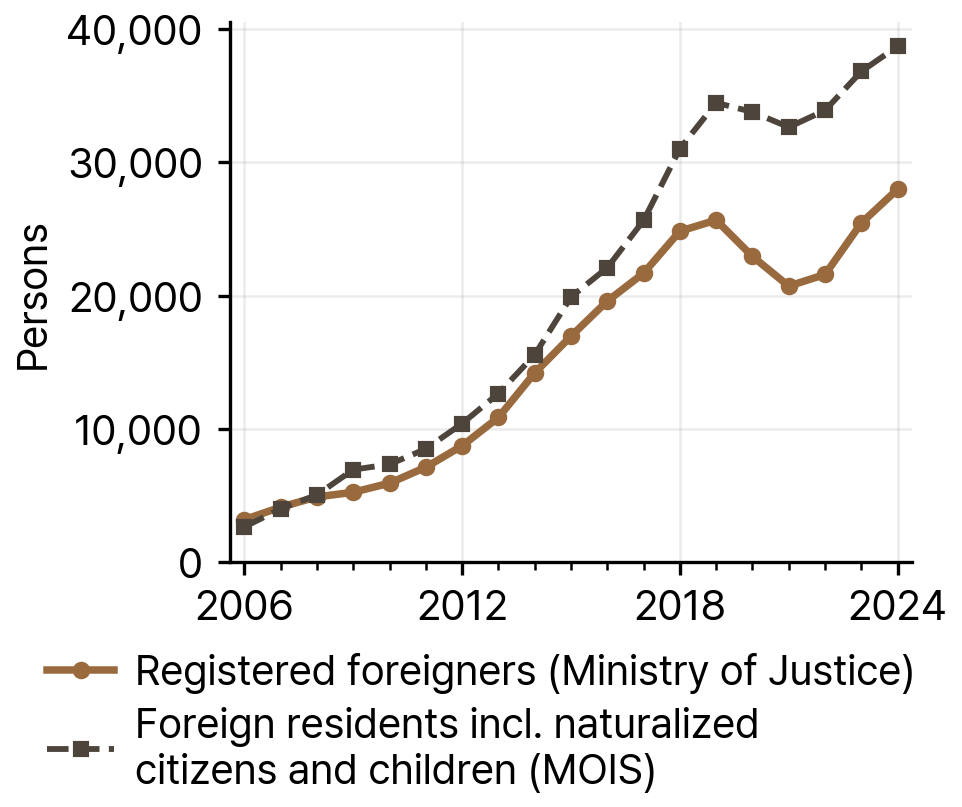
Source: KIRD dataset, from Ministry of Justice immigration yearbooks and Ministry of the Interior and Safety statistics, 2006-2024.
The MOIS count of foreign residents rose from 5,052 in 2008 to 15,568 in 2014 and 34,473 in 2019. It fell to 32,643 in 2021, 5.3 percent below the 2019 level (registered foreigners fell 19.3 percent over the same years), and rose to 38,714 in 2024, 1.4 times the number of registered foreigners. Of the 38,714 people in 2024, 30,511 were foreign nationals, 2,824 were naturalized Korean citizens and 5,379 were children of foreign residents (see Residence Statuses).
Between 2014 and 2024 the number of registered foreigners in Jeju grew 97.1 percent (13,786 people) and the number of Korean residents 10.4 percent (63,022 people), both faster than in South Korea as a whole (see Figure 2). Registered foreigners per 100 Korean residents rose from 0.6 in 2006 and 2.3 in 2014 to 3.8 in 2019 and 4.2 in 2024 (see Table 1).
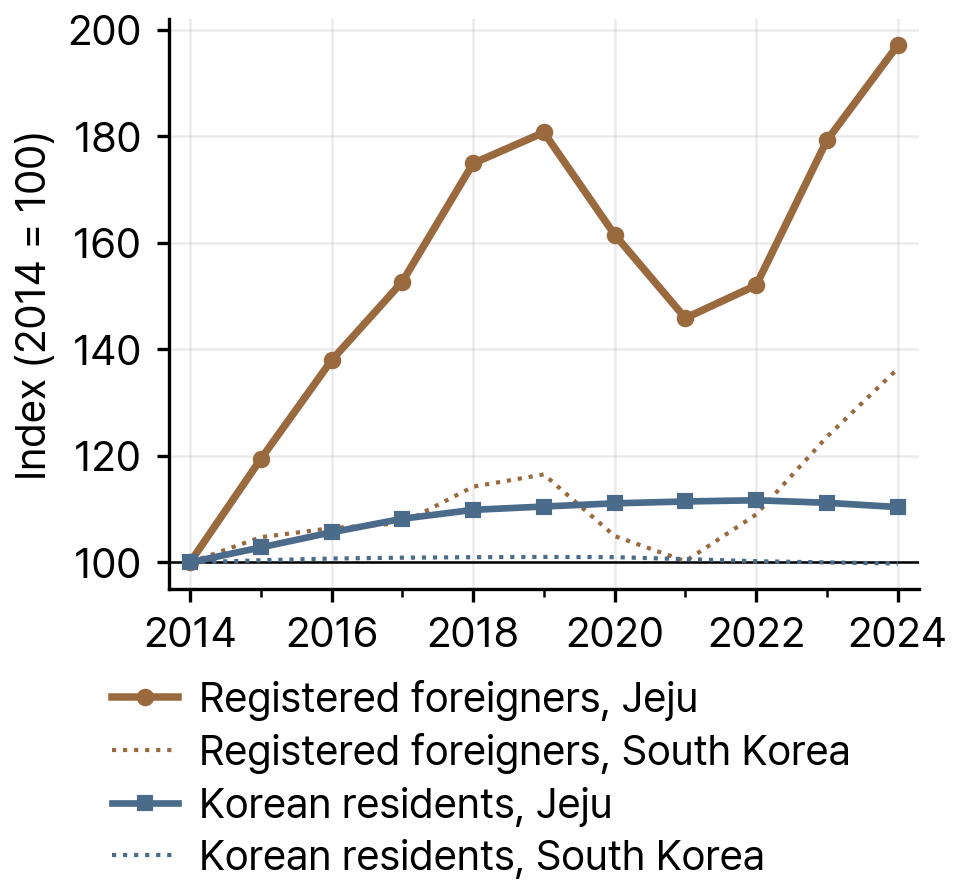
Source: KIRD dataset, from Ministry of Justice immigration yearbooks and Ministry of the Interior and Safety resident registration statistics, 2014-2024.
In 2024 Jeju ranked 12th among the 17 provinces and metropolitan cities by the number of registered foreigners and second by registered foreigners per Korean resident (4.2 per 100 Korean residents, against 2.9 nationally). Its growth of 9.0 percent between 2019 and 2024, from 25,668 to 27,990, ranked 15th among the 17.
Table 1Registered Foreigners, Foreign Residents and Korean Residents in Jeju, Selected Years, 2006-24
| Year | Registered foreigners | MOIS foreign residents | Korean residents | Registered foreigners per 100 Korean residents |
|---|---|---|---|---|
| 2006 | 3,199 | – | 558,496 | 0.6 |
| 2014 | 14,204 | 15,568 | 607,346 | 2.3 |
| 2019 | 25,668 | 34,473 | 670,989 | 3.8 |
| 2024 | 27,990 | 38,714 | 670,368 | 4.2 |
Note: Registered foreigners are counted on 31 December and MOIS foreign residents on 1 November. The table shows MOIS counts from 2008, when the province had 5,052 MOIS foreign residents.
Source: KIRD dataset, from Ministry of Justice immigration yearbooks and Ministry of the Interior and Safety statistics, 2006-2024.
Nationalities
The KIRD data record 109 nationalities among registered foreigners in Jeju in 2024. Chinese nationals were the largest group (9,764, or 34.9 percent), followed by Vietnamese nationals (4,619, or 16.5 percent) and Indonesian nationals (3,803, or 13.6 percent); together these groups made up 65.0 percent of registered foreigners (18,186 of 27,990) (see Figure 3 and Table 2). The ten largest nationalities accounted for 87.0 percent (24,342 of 27,990).
Chinese and Indonesian nationals made up larger shares of registered foreigners in Jeju in 2024 than in South Korea as a whole (34.9 and 13.6 percent, against 14.7 and 3.9 percent). Korean-Chinese made up 5.0 percent, against 16.6 percent nationally, and Cambodian nationals 2.0 percent, against 4.1 percent.
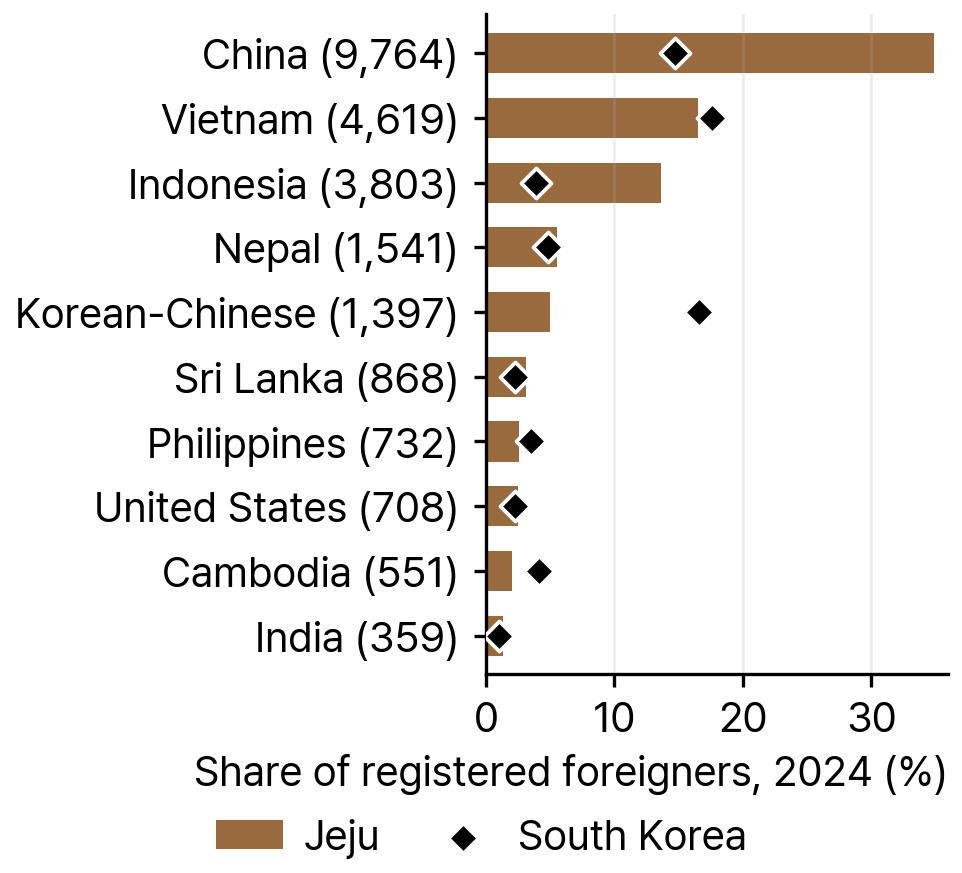
Source: KIRD dataset, from Ministry of Justice immigration yearbooks, 2024.
Between 2019 and 2024 the number of Indonesian nationals in the province more than doubled, from 1,843 to 3,803, and the number of Indian nationals rose from 161 to 359. Vietnamese nationals increased from 3,680 to 4,619 (25.5 percent). Among the ten largest nationalities, three declined: Chinese nationals from 10,844 to 9,764 (10.0 percent), Korean-Chinese from 1,656 to 1,397 (15.6 percent) and Sri Lankan nationals from 882 to 868.
Table 2Ten Largest Nationalities among Registered Foreigners in Jeju, 2019 and 2024
| Nationality | 2019 | 2024 | Share of the province's registered foreigners, 2024 (%) | Share of all registered foreigners of this nationality in South Korea, 2024 (%) |
|---|---|---|---|---|
| China | 10,844 | 9,764 | 34.9 | 4.5 |
| Vietnam | 3,680 | 4,619 | 16.5 | 1.8 |
| Indonesia | 1,843 | 3,803 | 13.6 | 6.5 |
| Nepal | 1,335 | 1,541 | 5.5 | 2.1 |
| Korean-Chinese | 1,656 | 1,397 | 5.0 | 0.6 |
| Sri Lanka | 882 | 868 | 3.1 | 2.6 |
| Philippines | 644 | 732 | 2.6 | 1.4 |
| United States | 679 | 708 | 2.5 | 2.0 |
| Cambodia | 509 | 551 | 2.0 | 0.9 |
| India | 161 | 359 | 1.3 | 2.4 |
Note: Korean-Chinese are Chinese nationals of Korean descent and are reported separately from other Chinese nationals. Jeju was home to 1.9 percent of all registered foreigners in South Korea in 2024.
Source: KIRD dataset, from Ministry of Justice immigration yearbooks, 2019 and 2024.
Jeju was home to 1.9 percent of all registered foreigners in South Korea in 2024 and to larger shares of several national groups: 6.5 percent of Indonesian nationals (3,803 of 58,248), 5.5 percent of British nationals (287 of 5,228), 4.9 percent of registered foreigners from Hong Kong (110 of 2,224), 4.5 percent of Chinese nationals (9,764 of 218,893) and 4.0 percent of Canadian nationals (178 of 4,452).
The Shannon diversity index of registered foreigners' nationalities in Jeju was 2.1 in both 2014 and 2024. In 2024 it was the lowest among the 17 provinces and metropolitan cities.
Overseas Koreans on F-4 status report their residence instead of registering and are not counted among registered foreigners. In 2024, 3,511 of them reported a residence in Jeju, 0.6 percent of the 553,664 nationwide. The largest groups were Korean-Chinese (2,443), nationals of the United States (592), Canada (193) and Australia (92), and Korean-Russians (48).
Residence Statuses
Rotation labor statuses covered 32.9 percent of registered foreigners in Jeju in 2024 (9,203 people), against 31.1 percent nationally, and settlement statuses 31.4 percent (8,799), against 27.6 percent (see Figure 4). Skilled statuses covered 16.4 percent (4,589), about 2.8 times the national share of 5.8 percent. Study and job-search statuses covered 6.6 percent (1,860), against 18.6 percent nationally; family statuses 7.3 percent (2,041), against 10.0 percent; and all other statuses 5.4 percent (1,498), against 7.1 percent.
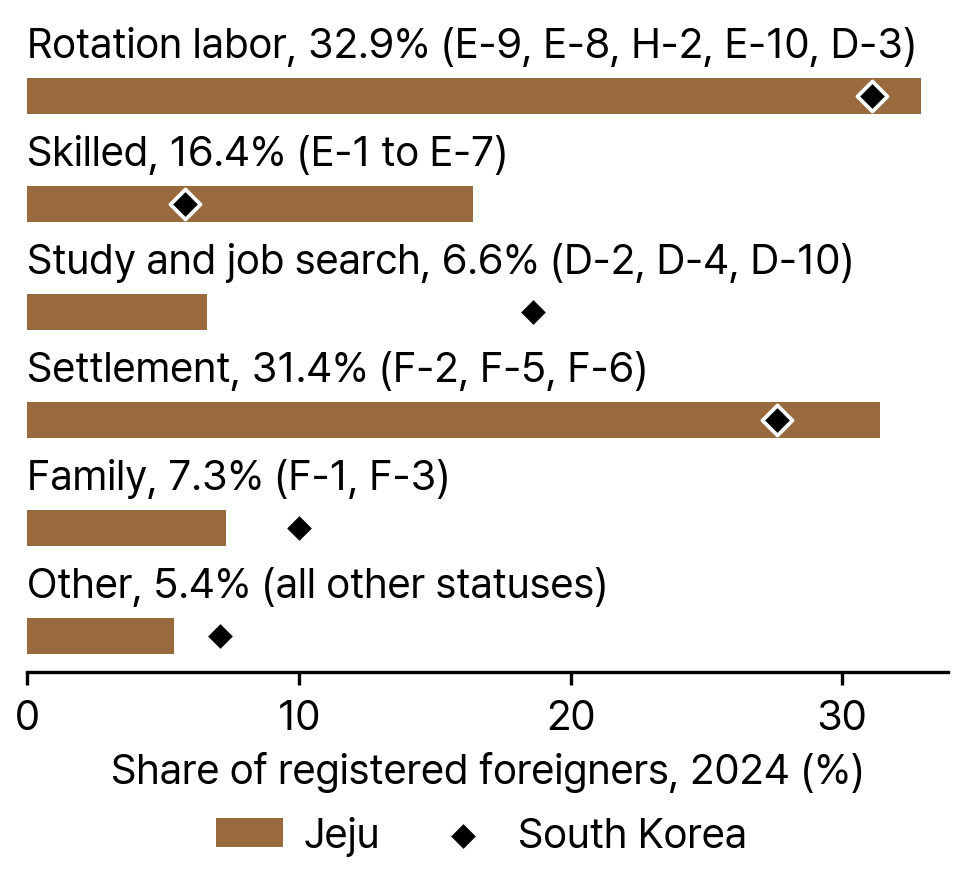
Source: KIRD dataset, from Ministry of Justice immigration yearbooks, 2024.
E-9 non-professional employment was the most common status in 2024, with 4,766 holders (17.0 percent of registered foreigners), followed by E-7 specially designated activities (4,119, or 14.7 percent), F-5 permanent residence (3,639, or 13.0 percent) and E-10 crew employment (3,245, or 11.6 percent) (see Table 3). The province's 3,245 E-10 holders were 15.1 percent of all E-10 holders in South Korea, and its 4,119 E-7 holders 6.5 percent of all E-7 holders, against its 1.9 percent share of all registered foreigners. The province's share of all holders was also above 1.9 percent for F-2 residential status (4.1 percent) and E-8 seasonal work (4.0 percent), and below it for E-9 (1.5 percent) and D-2 student status (0.6 percent).
In 2024, within the rotation labor group, 4,766 people held E-9 status, 3,245 E-10 status and 793 E-8 status, and the remaining 399 held H-2 or D-3 status. The settlement group consisted of 3,639 F-5 holders, 2,641 F-6 holders and 2,519 F-2 holders. E-7 holders accounted for 4,119 of the 4,589 people in the skilled group.
Table 3Ten Most Common Residence Statuses among Registered Foreigners in Jeju, 2024
| Status | Meaning | Registered foreigners | Share of the province's registered foreigners (%) | Share of all holders of this status in South Korea (%) |
|---|---|---|---|---|
| E-9 | Non-professional employment | 4,766 | 17.0 | 1.5 |
| E-7 | Specially designated activities | 4,119 | 14.7 | 6.5 |
| F-5 | Permanent residence | 3,639 | 13.0 | 1.8 |
| E-10 | Crew employment | 3,245 | 11.6 | 15.1 |
| F-6 | Marriage migration | 2,641 | 9.4 | 1.8 |
| F-2 | Residential | 2,519 | 9.0 | 4.1 |
| F-1 | Visiting cohabitation | 1,340 | 4.8 | 1.4 |
| G-1 | Other (miscellaneous) | 1,158 | 4.1 | 2.1 |
| D-2 | Student | 1,048 | 3.7 | 0.6 |
| E-8 | Seasonal worker | 793 | 2.8 | 4.0 |
Note: Shares of the province's registered foreigners use the 2024 total of 27,990. E-8 holders are counted on 31 December, after most seasonal contracts have ended (see Industry and Foreign Workers).
Source: KIRD dataset, from Ministry of Justice immigration yearbooks, 2024.
The MOIS count for 1 November 2024 uses different categories. Of the 38,714 foreign residents it recorded in Jeju, 30,511 (78.8 percent) were foreign nationals: 12,361 foreign workers, 3,201 marriage migrants, 1,524 international students, 2,240 ethnic Koreans of foreign nationality and 11,185 other foreign nationals. The remaining 8,203 (21.2 percent) were 2,824 naturalized Korean citizens and 5,379 children of foreign residents.
Districts and Population-Decline Areas
Jeju has two district-level units, the cities (si) of Jeju-si and Seogwipo-si. In 2024 Jeju-si had 17,976 registered foreigners, 64.2 percent of the province's total, and 3.7 registered foreigners per 100 Korean residents. Seogwipo-si had 10,014 registered foreigners (35.8 percent of the total) and 5.5 per 100 Korean residents, and it was home to 27.2 percent of the province's Korean residents (182,020 of 670,368) (see Figure 5 and Table 4).
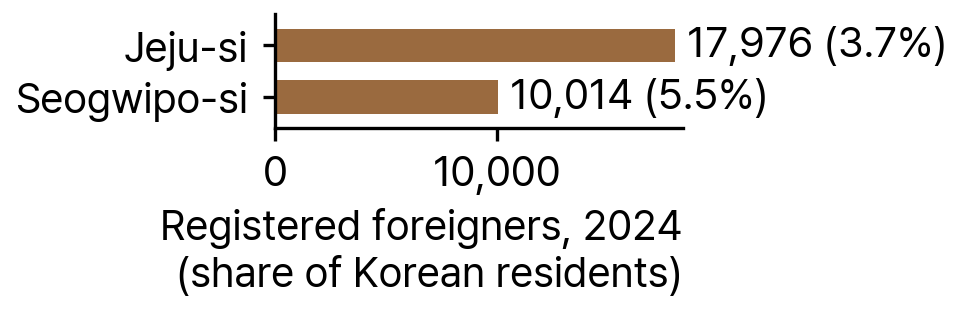
Source: KIRD dataset, from Ministry of Justice immigration yearbooks and Ministry of the Interior and Safety resident registration statistics, 2024.
Between 2019 and 2024 the number of registered foreigners rose by 1,431 in Jeju-si (8.6 percent) and by 891 in Seogwipo-si (9.8 percent). Over the same years Jeju-si lost 1,057 Korean residents and Seogwipo-si gained 436.
Table 4Registered Foreigners and Korean Residents in Jeju-si and Seogwipo-si, 2019-24
| District | Registered foreigners, 2024 | Per 100 Korean residents, 2024 | Change in Korean residents, 2019-24 | Change in registered foreigners, 2019-24 | Population-decline area |
|---|---|---|---|---|---|
| Jeju-si | 17,976 | 3.7 | -1,057 | +1,431 | No |
| Seogwipo-si | 10,014 | 5.5 | +436 | +891 | No |
| Jeju (province total) | 27,990 | 4.2 | -621 | +2,322 | – |
Note: Population-decline areas and areas of interest as designated by the Ministry of the Interior and Safety on 19 October 2021; neither city was designated as either. Registered foreigners per 100 Korean residents use the Korean residents of the same city in 2024.
Source: KIRD dataset, from Ministry of Justice immigration yearbooks and Ministry of the Interior and Safety statistics, 2019 and 2024.
Neither Jeju-si nor Seogwipo-si was among the 89 population-decline areas or the 18 areas of interest that the Ministry of the Interior and Safety designated on 19 October 2021. For the province as a whole, the gain of 2,322 registered foreigners between 2019 and 2024 equaled 373.9 percent of the loss of 621 Korean residents. In Jeju-si the gain of 1,431 registered foreigners equaled 135.4 percent of the loss of 1,057 Korean residents.
By the definition used in this Spotlight, both cities were Chinese enclaves in 2024. Chinese nationals made up 36.0 percent of registered foreigners in Jeju-si (6,479 people), with a location quotient of 3.1, and 32.8 percent in Seogwipo-si (3,285 people), with a location quotient of 4.2.
Population Trends
The number of Korean residents in Jeju rose every year from 558,496 in 2006 to a peak of 678,159 in 2022. The largest annual gains were in 2015 (17,049 people) and 2016 (17,202). The count fell by 2,907 in 2023 and by 4,884 in 2024, to 670,368. In 2024 it was 20.0 percent above the 2006 level (111,872 more people), 10.4 percent above the 2014 level (63,022 more) and 0.1 percent below the 2019 level (621 fewer).
Jeju Sori reported the province's total population as 700,708 in 2023, the first year it exceeded 700,000, and 698,358 in 2024 (Jeju Sori, 2025a). These totals equal the KIRD counts of Korean residents and registered foreigners combined (675,252 and 25,456 in 2023; 670,368 and 27,990 in 2024), so the fall of 2,350 people between the two years combined a loss of 4,884 Korean residents with a gain of 2,534 registered foreigners. Jeju Sori also reported that the total population grew 12.4 percent (76,808 people) over the ten years to 2024 (Jeju Sori, 2025a); by the KIRD counts, registered foreigners accounted for 13,786 of that increase (17.9 percent).
In 2024 Jeju recorded 3,156 births, 2.0 percent fewer than the 3,222 in 2023, and 4,902 deaths, 4.8 percent more than the 4,677 in 2023, according to Statistics Korea's 2024 Honam-Jeju regional population trends release (Jeju Domin Ilbo, 2025). Net migration in 2024 was -3,361, as more people moved out of the province than moved in (Jeju Sori, 2025a).
The total fertility rate was 0.83 in 2024, unchanged from 2023 and above the national rate of 0.75. People aged 80 and older accounted for 52.0 percent of deaths in 2024, and the age-standardized mortality rate rose from 312.0 in 2023 to 317.7, above the national rate of 294.6 (Jeju Domin Ilbo, 2025). People aged 65 and older made up 18.9 percent of the population in 2024, 5.4 percentage points more than ten years earlier (Jeju Sori, 2025a).
Industry and Foreign Workers
The number of registered foreigners on E-9 non-professional employment status, the status issued under the Employment Permit System (EPS), was 2,355 in 2014, 3,929 in 2019, 2,907 in 2021 and 4,766 in 2024. It rose 63.9 percent from 2021 to 2024 and 102.4 percent from 2014 to 2024. E-9 holders made up 17.0 percent of the province's registered foreigners in 2024, and Jeju's share of all E-9 holders in South Korea was 1.5 percent, below its 1.9 percent share of all registered foreigners. E-10 crew employment status was held by 3,245 registered foreigners in Jeju in 2024, 11.6 percent of the province's registered foreigners and 15.1 percent of all E-10 holders in South Korea (see Residence Statuses).
Seoul Shinmun reported 3,778 E-9 workers in Jeju at the end of May 2026, 84.6 percent more than the 2,046 at the end of 2022. Fisheries employed 1,491 of them (39.5 percent), agriculture and livestock 1,205 (31.9 percent), manufacturing 987 (26.1 percent) and services 92 (2.4 percent) (Seoul Shinmun, 2026). These counts differ from the Ministry of Justice count used in the KIRD data, which recorded 4,766 registered foreigners on E-9 status on 31 December 2024.
The province launched a survey of 350 E-9 workers on wages, working hours and industrial accidents, scheduled from August to December 2026 and offered in eight languages: Nepali, Vietnamese, Indonesian, English, Chinese, Cambodian, Filipino and Thai (Seoul Shinmun, 2026).
E-8 seasonal workers counted on 31 December numbered 49 in 2022, 382 in 2023 and 793 in 2024, and on 31 December 2024 the province was home to 4.0 percent of all E-8 holders in South Korea. Because most seasonal workers' contracts end before winter, the 31 December count misses most of the seasonal workers employed during the year. In 2024, citrus farms hiring public-type foreign seasonal workers paid men about 120,000 won per day, including lunch and snacks, against 150,000 won per day for Korean workers (Seoul Shinmun, 2024). The province's public-type seasonal worker program is described under Provincial Policy.
International Students and Universities
Registered foreigners on D-2 student and D-4 general trainee status in Jeju numbered 723 in 2008 and 971 in 2014, then rose to 2,490 in 2019, 2.6 times the 2014 count (see Figure 6). The count fell each year from 2020 to 2023, to 1,540, and was 1,614 in 2024 (1,048 on D-2 and 566 on D-4), 35.2 percent below the 2019 level. Students and trainees made up 5.8 percent of the province's registered foreigners in 2024, down from 9.7 percent in 2019, and the province's share of all D-2 and D-4 holders in South Korea was 0.6 percent, against its 1.9 percent share of all registered foreigners.
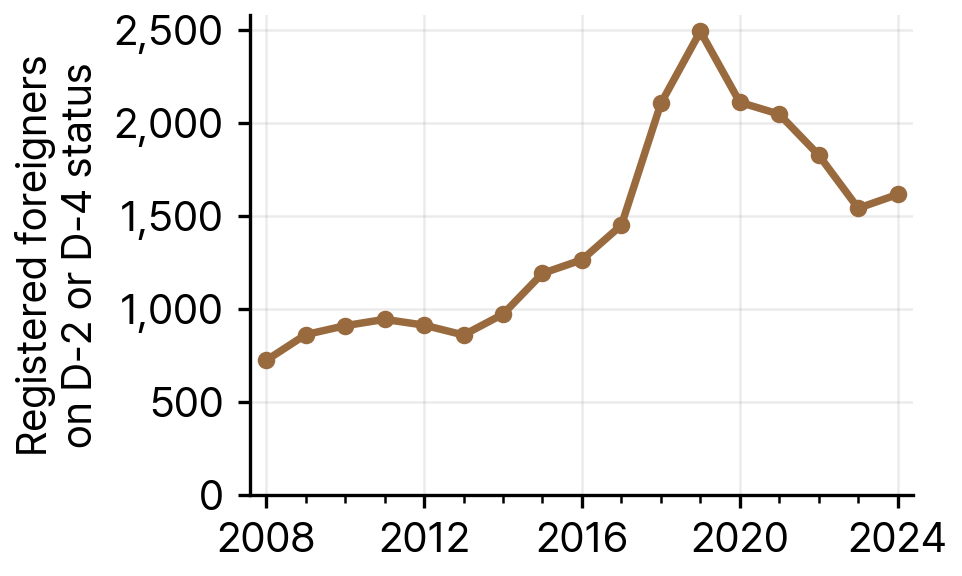
Source: KIRD dataset, from Ministry of Justice immigration yearbooks, 2008-2024.
Jeju National University reported 733 international students, including graduate students, as of 1 September 2026, up from 596 a year earlier. Of these, 477 were undergraduate, language-training and other non-degree students, 32.9 percent more than the 359 counted on 1 October 2025. The students came from 42 countries, led by China (349, or 47.6 percent of the 733), Pakistan (79), Vietnam (63), and Sri Lanka and India (34 each) (Jeju Domin Ilbo, 2026).
Jeju National University and Jeju Tourism University are the two universities in the province's 2025-2026 metropolitan-type visa pilot for international students in tourism-related departments (see Provincial Policy).
Provincial Policy
Jeju Province created a Foreign Residents and Immigration Policy Team (외국인이민정책팀) on 14 January 2025 to lead its work on foreign residents and immigration (Ministry of Justice, 2026). In November 2025 the province submitted a draft Basic Ordinance for Foreign Residents and Immigration Policy Support (외국인주민 및 이민정책 지원 기본 조례안) to the provincial council. The draft would consolidate existing related ordinances, require the governor to set an annual support plan for foreign residents and immigration policy, and create a deliberation committee and a foreign-resident support center (외국인 주민 종합지원센터) (News1, 2025).
As of 2026, the province designates and funds the Jeju Special Self-Governing Province Foreign Workers Support Center (제주특별자치도외국인노동자지원센터). The nonprofit Jeju Foreigners' Peace Community (제주외국인평화공동체), which has operated the center under contracts for 2019-2021, 2022-2024 and 2025-2027, also runs the Jeju Migrant Center, the Seogwipo Migrant Center and the Jeju Migrant Women's Counseling Center (Jeju Foreigners' Peace Community, 2026).
Jeju submitted a plan for the Ministry of Justice's metropolitan-type visa (광역형 비자) pilot on 7 February 2025, and the ministry announced the province's selection on 2 April 2025. The 2025-2026 pilot covers international students on D-2 visas admitted to tourism-related departments at Jeju National University and Jeju Tourism University, with a quota of 250 students. For qualifying students the financial requirement is eased to 10 million won per year, and part-time work is allowed for up to 30 hours per week (Ministry of Justice, 2026).
At a November 2025 immigration-policy forum hosted by Jeju Halla University and the Korea Immigration Policy Society, with Jeju Province and the Jeju Immigration and Foreign Affairs Office as sponsors, a director in Jeju Halla University's RISE Project Group said Jeju had been excluded from the regional specialized visa program. The director also proposed a Jeju-type metropolitan visa that would grant residence status on the governor's recommendation, as part of a wider proposal to allow visa-free entrants to move on to study, employment and settlement (Jeju Sori, 2025b).
Jeju's public-type foreign seasonal worker program began in 2023 under memoranda of understanding with Vietnam's Ninh Binh province (29 March 2023) and Mongolia's Uvurkhangai province (26 July 2023), with 41 workers first placed at the Wimi Agricultural Cooperative (Ministry of Justice, 2026). In November 2024, 109 Vietnamese public-type seasonal workers were working at three citrus-growing agricultural cooperatives (49 at Wimi, 30 at Daejeong and 30 at Gosan). The province planned to add three more cooperatives in 2025 and expected 210 to 220 foreign seasonal workers, more than double the November 2024 number (Seoul Shinmun, 2024).
For 2026 the province has budgeted 621 million won for a multilingual Foreign Resident Portal, led by its Population Policy Officer. The portal is planned to combine information on health care, education, legal matters, jobs and visa procedures with an AI chatbot, and to provide content in English, Chinese, Vietnamese and other languages (Ministry of Justice, 2026).
The public Jeju Free International City Development Center (JDC) has developed Jeju Global Education City since 2008 to reduce spending on study abroad. In 2025, 4,144 students were enrolled at its four international schools, including the Jeju campus of Korea International School, and the JDC estimated the cumulative savings in study-abroad spending at 1.5828 trillion won (JDC, 2025).
Languages
The KIRD dataset estimates the first languages of registered foreigners by applying each nationality's first-language shares from Ethnologue to the number of registered foreigners of that nationality. By this estimate, four languages had 1,000 or more first-language speakers among registered foreigners in Jeju in 2024: Chinese (9,414), Vietnamese (3,953), Indonesian (2,668) and English (1,075) (see Table 5).
Table 5Estimated First-Language Speakers among Registered Foreigners in Jeju, Ten Most Common Languages, 2024
| Language | Estimated speakers | Share of the province's registered foreigners (%) |
|---|---|---|
| Chinese | 9,414 | 33.6 |
| Vietnamese | 3,953 | 14.1 |
| Indonesian | 2,668 | 9.5 |
| English | 1,075 | 3.8 |
| Nepali | 801 | 2.9 |
| Cantonese | 717 | 2.6 |
| Tagalog/Filipino | 648 | 2.3 |
| Sinhala | 598 | 2.1 |
| Khmer | 595 | 2.1 |
| Hindi | 385 | 1.4 |
Note: Estimates apply Ethnologue first-language shares for each nationality to the number of registered foreigners of that nationality on 31 December 2024. Shares use the province total of 27,990 registered foreigners.
Source: KIRD dataset, from Ministry of Justice immigration yearbooks, 2024, with first-language shares from Ethnologue.
Because the estimate divides each nationality among its first languages, the count for a language can differ from the count of the corresponding nationality. In 2024 the estimate for Indonesian (2,668) was 70.2 percent of the number of Indonesian nationals (3,803), and the estimate for Nepali (801) was 52.0 percent of the number of Nepali nationals (1,541). Cantonese is counted separately from Chinese, with an estimated 717 speakers in 2024.
The province's 2026 survey of E-9 workers is offered in Nepali, Vietnamese, Indonesian, English, Chinese, Cambodian, Filipino and Thai (Seoul Shinmun, 2026), and its planned Foreign Resident Portal is to provide content in English, Chinese, Vietnamese and other languages (Ministry of Justice, 2026).
Service Organizations and Community Places
The KIRD census of 1,720 migrant-serving organizations in South Korea lists 27 in Jeju, or 9.6 per 10,000 registered foreigners in 2024, against 11.6 per 10,000 nationally. All 27 provide direct services, and they include two family centers (가족센터). By type, 13 are sites that host programs for foreign residents, 4 are nonprofit organizations, 3 are medical institutions and 2 are community groups; the other five are a legal support organization, a youth education center, a foreign-resident center, a shelter and an administrative office.
By the populations they list, 8 of the 27 organizations serve families, 8 serve all foreign residents, 8 serve workers, 7 serve refugees, 4 serve children and 3 serve undocumented residents. Two each serve youth and women, and one each serves diaspora members and students. An organization can list more than one population.
The nonprofit Jeju Foreigners' Peace Community runs the Jeju Migrant Center in downtown Jeju-si (56 Jungang-ro), where it operates a Korean-culture school. The Migrant Center's own cultural programs are a foreign-family festival, a Chuseok event for migrants, a summer camp for migrant workers and a Korean-speaking contest, and the parent organization organizes the Jeju Multi-ethnic Culture Festival (제주다민족문화제) (Jeju Foreigners' Peace Community, 2026).
The same organization runs the Jeju Migrant Women's Counseling Center, which offers counseling in the women's native languages, interpretation and emergency shelter to immigrant women who have experienced violence, and the Jeju Refugee Support Center, which provides free room, board and counseling to refugee claimants, recognized refugees and people granted humanitarian status in Jeju (Jeju Foreigners' Peace Community, 2026).
Jeju's first Yemeni restaurant, Wardah, whose name means flower in Arabic, was open by February 2019, after 484 Yemeni asylum seekers arrived on the island in June 2018 (Korea Times, 2019).
Sources
Korea Immigration Regional Dashboard (KIRD) dataset. Spatiotemporal administrative dataset of nationality, residential diversity, and language demand among immigrants in South Korea, 2006-2024. openICPSR. https://doi.org/10.3886/E249944V1
Jeju Sori. 2025a. Jeju's Population Falls Below 700,000 after One Year, with Natural Decrease and Net Outflow (in Korean). https://www.jejusori.net/news/articleView.html?idxno=442385
Jeju Domin Ilbo. 2025. Fewer Births and More Deaths as Change in Jeju's Population Structure Speeds Up (in Korean). https://www.jejudomin.co.kr/news/articleView.html?idxno=314892
Seoul Shinmun. 2026. Jeju Has 3,778 E-9 Foreign Workers and Begins a Survey of Their Labor and Human Rights Conditions (in Korean). https://www.seoul.co.kr/news/economy/2026/08/11/20260811500048
Seoul Shinmun. 2024. Vietnamese Seasonal Workers Ease the Labor Shortage in the Citrus Harvest (in Korean). https://www.seoul.co.kr/news/economy/industry/2024/11/28/20241128500132
Jeju Domin Ilbo. 2026. International Students at Jeju National University Up 32.9 Percent (in Korean). https://www.jejudomin.co.kr/news/articleView.html?idxno=322232
Ministry of Justice. 2026. Fourth Basic Plan for Immigration Policy, 2026 Implementation Plan: Jeju Special Self-Governing Province (in Korean). https://www.moj.go.kr/bbs/immigration/226/493682/download.do
News1. 2025. Jeju Pushes for an Ordinance on Support for Foreign Residents in Response to the Population Crisis (in Korean). https://www.news1.kr/local/jeju/5965933
Jeju Foreigners' Peace Community (사단법인 제주외국인평화공동체). 2026. Programs and Affiliated Institutions, Including the Jeju Special Self-Governing Province Foreign Workers Support Center (in Korean). http://jejumwc.kr/index.php/contents/corp/business
Jeju Sori. 2025b. From Visa-Free Entry to Study, Employment and Settlement: Jeju, Short of Workers, Proposes a Special Visa Arrangement (in Korean). https://v.daum.net/v/20251107152015880
Jeju Free International City Development Center (JDC). 2025. English Education City (in Korean). https://www.jdcenter.com/business/edu/jejuen.cs
Ko, Dong-hwan. 2019. Jeju Island refugees cook up taste of Yemen at 'Wardah'. Korea Times, 12 February 2019. https://www.koreatimes.co.kr/www/nation/2019/02/177_263507.html
Suggested citation: Korea Immigration Regional Dashboard (KIRD). 2026. “Foreign Residents in Jeju.” Foreign Residents in South Korea series, September 2026. Data: Korea Immigration Regional Dashboard (KIRD) dataset, https://doi.org/10.3886/E249944V1. Interactive maps and tables: https://immigrantsinkorea.today.