 Korea Immigration Regional Dashboard
SpotlightSeptember 2026Province profilesDownload PDF
Foreign Residents in Daegu
Highlights
- At the end of 2024, Daegu had 36,710 registered foreigners, the 11th-largest number among South Korea's 17 provinces and metropolitan cities, and the lowest ratio of registered foreigners to Korean residents of the 17 (1.6 per 100, against 2.9 nationally).
- Counting Gunwi County in both years, the number of registered foreigners in Daegu rose 19.5 percent between 2019 and 2024 (from 30,729 to 36,710), while the number of Korean residents fell 4.0 percent (from 2,461,874 to 2,363,629).
- Study and job-search statuses (D-2, D-4 and D-10) formed the largest status group among Daegu's registered foreigners in 2024 (28.7 percent, against 18.6 percent nationally), and Vietnamese nationals the largest nationality (29.7 percent, against 17.6 percent nationally).
Daegu Metropolitan City had 36,710 registered foreigners on 31 December 2024, 2.5 percent of the 1,488,353 in South Korea, and 2,363,629 Korean residents, 4.6 percent of the national total of 51,217,221. It ranked 11th among the 17 provinces and metropolitan cities by the number of registered foreigners and 17th, the lowest, by registered foreigners per Korean resident (1.6 per 100, against 2.9 nationally). The Ministry of the Interior and Safety, whose count adds naturalized citizens and children of foreign residents, counted 61,554 foreign residents in Daegu in 2024.
The number of registered foreigners more than doubled between 2006 and 2024 while the number of Korean residents declined. Within Daegu's boundary before Gunwi County joined the city in July 2023, registered foreigners rose from 17,104 in 2006 to 36,128 in 2024 (up 111.2 percent) and Korean residents fell from 2,496,115 to 2,341,166 (down 6.2 percent). On the current boundary, Daegu gained 5,981 registered foreigners between 2019 and 2024 and lost 98,245 Korean residents, so the foreign gain equaled 6.1 percent of the Korean loss. Residents aged 65 and older made up 22.1 percent of Daegu's registered population in December 2025, and the city has been a super-aged society, in which at least 20 percent of residents are 65 or older, since April 2024 (Daegu Policy Institute, 2025).
Vietnamese nationals made up 29.7 percent of Daegu's registered foreigners in 2024, against 17.6 percent nationally, and Chinese nationals, including Korean-Chinese, made up 15.0 percent, against 31.3 percent. Students, trainees and job seekers on D-2, D-4 and D-10 status formed the largest status group (28.7 percent, against 18.6 percent nationally), and rotation labor statuses covered a smaller share than nationally (21.8 against 31.1 percent). Daegu was also home to 6.7 percent of all registered Pakistanis in South Korea (1,064 of 15,950) and had more migrant-serving organizations per registered foreigner than the country as a whole (14.4 against 11.6 per 10,000).
Size of the Foreign-Resident Population
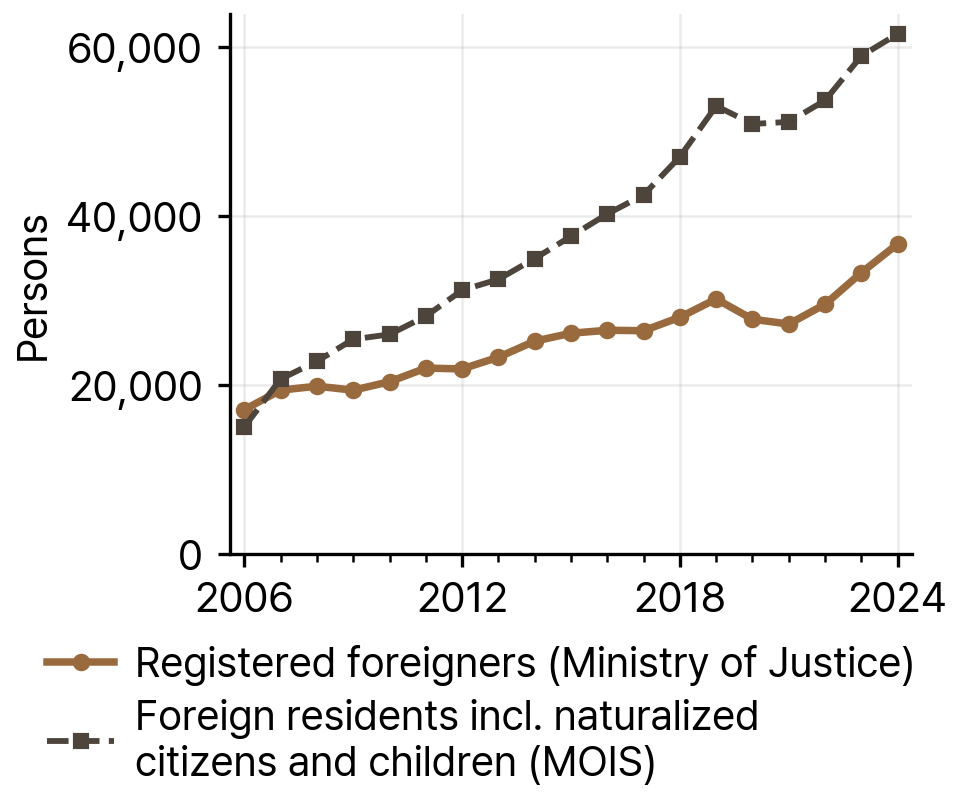
The number of registered foreigners in Daegu rose from 17,104 in 2006 to 25,203 in 2014 and 30,191 in 2019 (Figure 1). It fell to 27,798 in 2020 and 27,230 in 2021, then rose to 29,568 in 2022, 33,305 in 2023 and 36,710 in 2024, the highest count in the series. The 2023 and 2024 totals include Gunwi County, which had 582 registered foreigners in 2024.
The Ministry of the Interior and Safety count grew from 15,068 in 2006 to 34,976 in 2014, 53,023 in 2019 and 61,554 in 2024. It was lower than the registered count in 2006 and higher in every later year; in 2024 it was 1.7 times the registered count.
Registered foreigners per 100 Korean residents rose from 0.7 in 2006 to 1.0 in 2014, 1.2 in 2019 and 1.6 in 2024 (Table 1). In 2024 Daegu ranked 11th among the 17 provinces and metropolitan cities by the number of registered foreigners and 17th, the lowest, by registered foreigners per Korean resident; the national figure was 2.9 per 100.
Source: KIRD dataset, from Ministry of Justice immigration yearbooks and Ministry of the Interior and Safety statistics, 2006-2024.
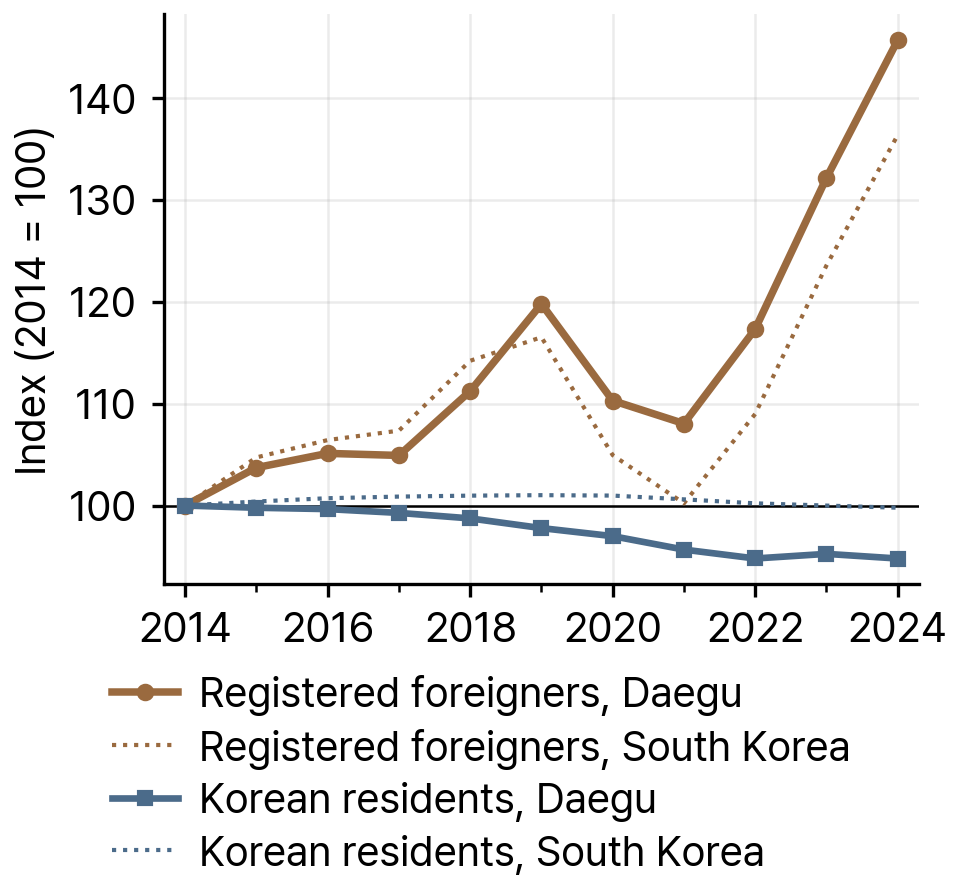
With 2014 set to 100, the index for registered foreigners in Daegu stood at 145.7 in 2024 and the index for Korean residents at 94.8 (Figure 2). Both 2024 values include Gunwi County. Excluding the county, registered foreigners rose 43.3 percent between 2014 and 2024 (from 25,203 to 36,128) and Korean residents fell 6.1 percent (from 2,493,264 to 2,341,166).
Between 2019 and 2024, on the current boundary, the number of registered foreigners increased by 5,981 (19.5 percent, from 30,729 to 36,710) and the number of Korean residents decreased by 98,245 (4.0 percent, from 2,461,874 to 2,363,629). The 2019 figures add Gunwi County's 538 registered foreigners and 23,843 Korean residents to the province totals of 30,191 and 2,438,031.
Source: KIRD dataset, from Ministry of Justice immigration yearbooks and Ministry of the Interior and Safety resident registration statistics, 2014-2024.
Table 1Registered Foreigners, MOIS Foreign Residents and Korean Residents in Daegu, Selected Years, 2006-24
| Year | Registered foreigners | MOIS foreign residents | Korean residents | Registered foreigners per 100 Korean residents |
|---|---|---|---|---|
| 2006 | 17,104 | 15,068 | 2,496,115 | 0.7 |
| 2014 | 25,203 | 34,976 | 2,493,264 | 1.0 |
| 2019 | 30,191 | 53,023 | 2,438,031 | 1.2 |
| 2024 | 36,710 | 61,554 | 2,363,629 | 1.6 |
Note: Province totals follow each year's boundary, so among the years shown only 2024 includes Gunwi County (582 registered foreigners and 22,463 Korean residents). Daegu's district figures for 2019, which include Gunwi County, sum to 30,729 registered foreigners and 2,461,874 Korean residents. In 2024, South Korea had 1,488,353 registered foreigners and 51,217,221 Korean residents, or 2.9 registered foreigners per 100 Korean residents.
Source: KIRD dataset, from Ministry of Justice immigration yearbooks and Ministry of the Interior and Safety statistics, 2006-2024.
Nationalities
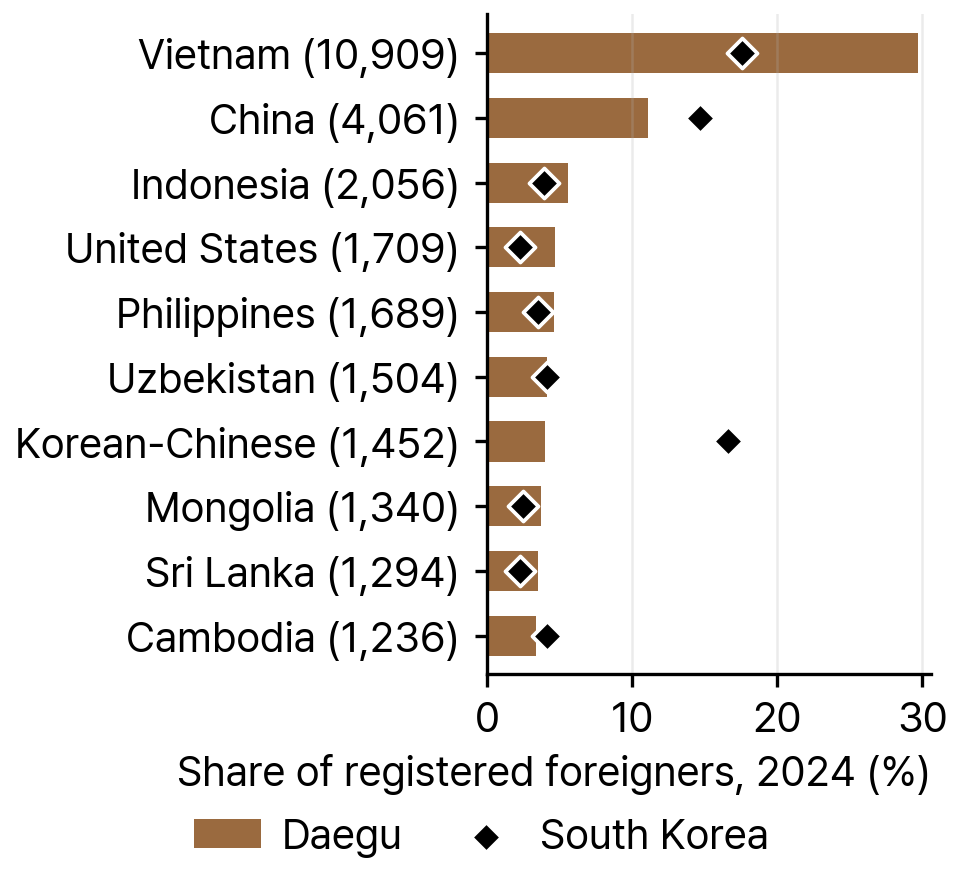
Vietnam was the largest nationality among Daegu's registered foreigners in 2024, with 10,909 people (29.7 percent), up from 8,285 in 2019 (Figure 3 and Table 2). China was second with 4,061 (11.1 percent), down from 4,768, followed by Indonesia (2,056), the United States (1,709) and the Philippines (1,689). The ten largest nationalities together numbered 27,250, or 74.2 percent of registered foreigners, and 131 nationalities were represented in all.
Compared with South Korea as a whole, Daegu had larger shares of Vietnamese (29.7 against 17.6 percent), Indonesians (5.6 against 3.9 percent) and Americans (4.7 against 2.3 percent), and smaller shares of Chinese (11.1 against 14.7 percent) and Korean-Chinese (4.0 against 16.6 percent). The two Chinese groups together made up 15.0 percent of Daegu's registered foreigners (5,513 of 36,710), against 31.3 percent nationally (14.7 plus 16.6).
Among the ten largest nationalities, the number of Mongolians grew fastest between 2019 and 2024, from 347 to 1,340 (3.9 times), followed by Indonesians (up 47.8 percent) and Sri Lankans (up 41.4 percent). The number of Chinese nationals fell 14.8 percent and that of Korean-Chinese 24.8 percent.
Daegu was home to 2.5 percent of South Korea's registered foreigners in 2024 and to larger shares of several national groups, including 6.7 percent of Pakistanis (1,064 of 15,950), 5.1 percent of South Africans (236 of 4,641), 4.9 percent of nationals of Tajikistan (77 of 1,567) and of Americans (1,709 of 34,886), and 4.3 percent of French nationals (227 of 5,314).
The Shannon diversity index of Daegu's registered foreigners by nationality was 2.6 in both 2014 and 2024, the eighth-highest value among the 17 provinces in 2024.
Overseas Koreans with foreign nationality on F-4 status report their residence instead of registering and are not counted among registered foreigners. In 2024, 5,539 of them reported a residence in Daegu, 1.0 percent of the 553,664 nationwide. The largest groups were Korean-Chinese (2,404), US nationals (1,065), Korean-Russians (588), nationals of Uzbekistan (552) and Canadians (341).
Source: KIRD dataset, from Ministry of Justice immigration yearbooks, 2024.
Table 2Ten Largest Nationalities among Registered Foreigners in Daegu, 2019 and 2024
| Nationality | 2019 | 2024 | Share of Daegu's registered foreigners, 2024 (%) | Daegu's share of the nationality's registered foreigners in South Korea, 2024 (%) |
|---|---|---|---|---|
| Vietnam | 8,285 | 10,909 | 29.7 | 4.2 |
| China | 4,768 | 4,061 | 11.1 | 1.9 |
| Indonesia | 1,391 | 2,056 | 5.6 | 3.5 |
| United States | 1,306 | 1,709 | 4.7 | 4.9 |
| Philippines | 1,674 | 1,689 | 4.6 | 3.2 |
| Uzbekistan | 1,634 | 1,504 | 4.1 | 2.4 |
| Korean-Chinese | 1,930 | 1,452 | 4.0 | 0.6 |
| Mongolia | 347 | 1,340 | 3.7 | 3.6 |
| Sri Lanka | 915 | 1,294 | 3.5 | 3.8 |
| Cambodia | 946 | 1,236 | 3.4 | 2.0 |
Note: Korean-Chinese are Chinese nationals of Korean ethnicity, whom the Ministry of Justice counts separately from other Chinese nationals. The 2019 counts exclude Gunwi County, which had 538 registered foreigners in 2019. Daegu had 2.5 percent of all registered foreigners in South Korea in 2024.
Source: KIRD dataset, from Ministry of Justice immigration yearbooks, 2019 and 2024.
Residence Statuses
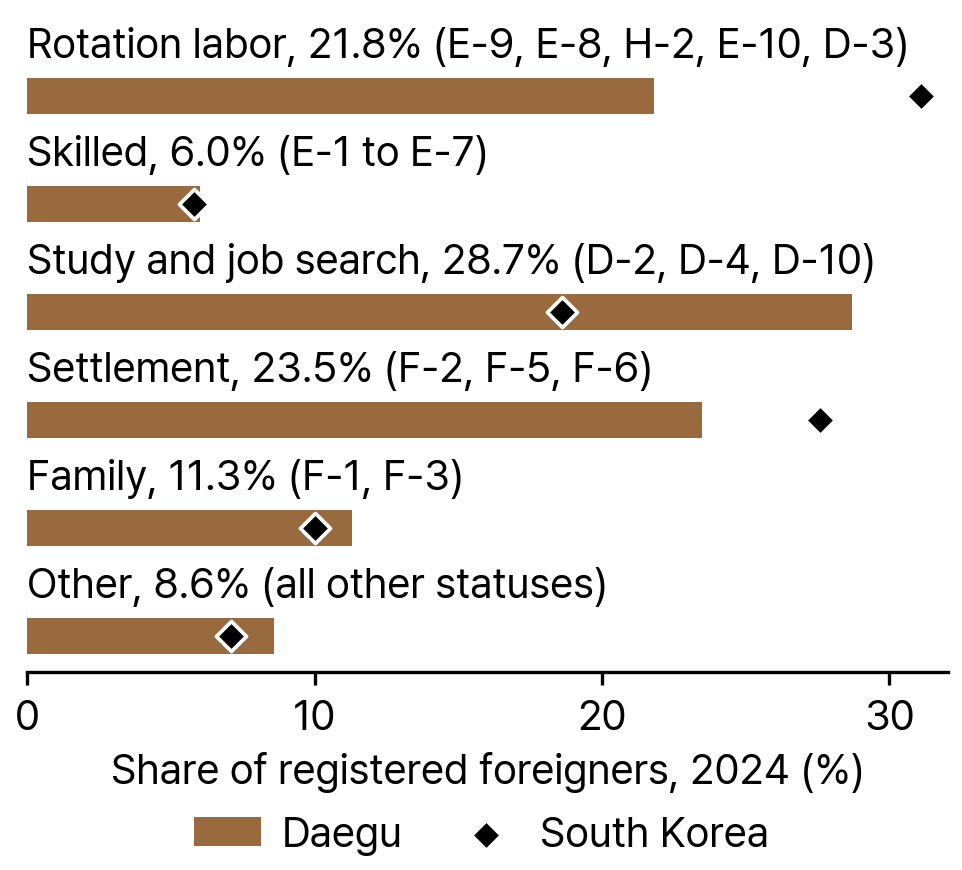
Study and job search was the largest status group among Daegu's registered foreigners in 2024, with 10,547 people, 28.7 percent of the total against 18.6 percent nationally (Figure 4). Settlement statuses covered 8,624 people (23.5 percent, against 27.6 percent nationally), rotation labor 8,001 (21.8 against 31.1 percent), family statuses 4,154 (11.3 against 10.0 percent), skilled statuses 2,216 (6.0 against 5.8 percent) and all other statuses 3,168 (8.6 against 7.1 percent).
E-9 non-professional employment was the most common single status (7,417 people, 20.2 percent), followed by D-2 student (5,494), F-6 marriage migration (5,204) and D-4 general trainee (4,132) (Table 3). Daegu had 5.2 percent of all D-4 holders in South Korea and 3.5 percent of F-6 holders, above its 2.5 percent share of all registered foreigners, and 2.3 percent of E-9 holders and 1.2 percent of F-5 permanent residents, below that share.
The Ministry of the Interior and Safety counted 61,554 foreign residents in Daegu on 1 November 2024. Of these, 45,295 were foreign nationals, comprising 9,897 foreign workers, 5,838 marriage migrants, 8,709 international students, 3,869 ethnic Koreans with foreign nationality and 16,982 other foreigners. The count also included 5,798 naturalized citizens (9.4 percent of the total) and 10,461 children of foreign residents (17.0 percent).
Source: KIRD dataset, from Ministry of Justice immigration yearbooks, 2024.
Table 3Ten Most Common Residence Statuses among Registered Foreigners in Daegu, 2024
| Status | Meaning | Status group | Registered foreigners | Share of Daegu's registered foreigners (%) | Daegu's share of all holders in South Korea (%) |
|---|---|---|---|---|---|
| E-9 | Non-professional employment | Rotation labor | 7,417 | 20.2 | 2.3 |
| D-2 | Student | Study and job search | 5,494 | 15.0 | 3.1 |
| F-6 | Marriage migration | Settlement | 5,204 | 14.2 | 3.5 |
| D-4 | General trainee | Study and job search | 4,132 | 11.3 | 5.2 |
| F-1 | Visiting cohabitation | Family | 2,893 | 7.9 | 3.0 |
| F-5 | Permanent residence | Settlement | 2,401 | 6.5 | 1.2 |
| ETC | Unclassified (SOFA / treaty) | Other | 1,491 | 4.1 | 4.7 |
| G-1 | Other (miscellaneous) | Other | 1,385 | 3.8 | 2.5 |
| F-3 | Dependent family | Family | 1,261 | 3.4 | 2.5 |
| E-7 | Specially designated activities | Skilled | 1,177 | 3.2 | 1.9 |
Note: Status groups follow the Definitions box. Daegu had 2.5 percent of all registered foreigners in South Korea in 2024.
Source: KIRD dataset, from Ministry of Justice immigration yearbooks, 2024.
Districts and Population-Decline Areas
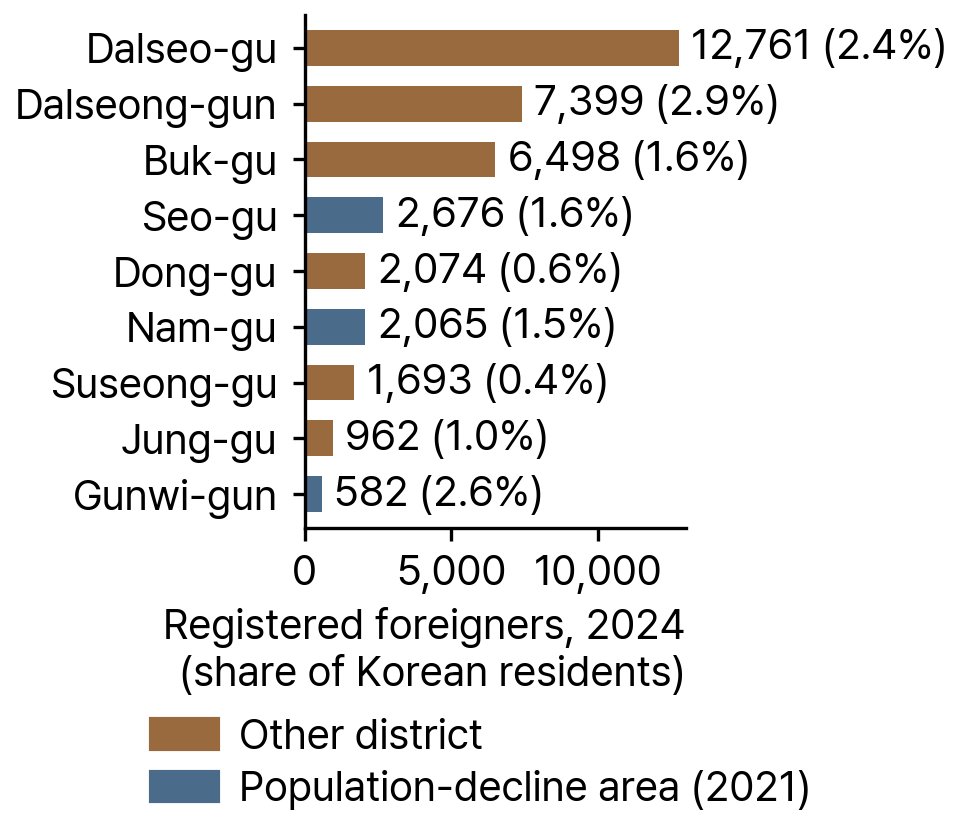
Daegu had nine districts in 2024, seven gu and two gun. Dalseo-gu had the most registered foreigners (12,761, or 34.8 percent of the city's total), followed by Dalseong-gun (7,399) and Buk-gu (6,498); together they had 26,658 registered foreigners, 72.6 percent of the total (Figure 5 and Table 4).
Relative to the Korean population, registered foreigners were most numerous in Dalseong-gun (2.9 per 100 Korean residents), Gunwi-gun (2.6) and Dalseo-gu (2.4) and least numerous in Suseong-gu (0.4) and Dong-gu (0.6).
Between 2019 and 2024, the number of registered foreigners rose in eight of the nine districts, most in Dalseo-gu (by 2,296), Dalseong-gun (1,359) and Buk-gu (1,265), and fell by 27 in Suseong-gu. The number of Korean residents fell in seven districts, most in Dalseo-gu (by 46,866) and Buk-gu (by 24,700), and rose in Jung-gu (by 20,290) and Dalseong-gun (by 1,040).
Seo-gu, Nam-gu and Gunwi-gun are population-decline areas. The Ministry of the Interior and Safety designated Seo-gu and Nam-gu on 19 October 2021, and Gunwi-gun on the same date, when the county was part of North Gyeongsang Province. None of Daegu's districts is an area of interest. Between 2019 and 2024, Seo-gu lost 12,142 Korean residents and gained 195 registered foreigners, Nam-gu lost 11,850 and gained 518, and Gunwi-gun lost 1,380 and gained 44. Together the decline areas lost 25,372 Korean residents and gained 757 registered foreigners, a foreign gain equal to 3.0 percent of the Korean loss; for Daegu as a whole on the current boundary, the figure was 6.1 percent (5,981 against 98,245).
No district in Daegu met the ethnic enclave definition in 2024.
Source: KIRD dataset, from Ministry of Justice immigration yearbooks and Ministry of the Interior and Safety statistics, 2024; population-decline areas as designated in 2021.
Table 4Registered Foreigners and Korean Residents by District in Daegu, 2019-24
| District | Registered foreigners, 2024 | Registered foreigners per 100 Korean residents, 2024 | Change in Korean residents since 2019 | Change in registered foreigners since 2019 | Population-decline area |
|---|---|---|---|---|---|
| Dalseo-gu | 12,761 | 2.4 | −46,866 | +2,296 | No |
| Dalseong-gun | 7,399 | 2.9 | +1,040 | +1,359 | No |
| Buk-gu | 6,498 | 1.6 | −24,700 | +1,265 | No |
| Seo-gu | 2,676 | 1.6 | −12,142 | +195 | Yes |
| Dong-gu | 2,074 | 0.6 | −3,130 | +167 | No |
| Nam-gu | 2,065 | 1.5 | −11,850 | +518 | Yes |
| Suseong-gu | 1,693 | 0.4 | −19,507 | −27 | No |
| Jung-gu | 962 | 1.0 | +20,290 | +164 | No |
| Gunwi-gun | 582 | 2.6 | −1,380 | +44 | Yes |
Note: District figures include Gunwi County in both years. Population-decline areas are those the Ministry of the Interior and Safety designated on 19 October 2021; no district in Daegu is an area of interest.
Source: KIRD dataset, from Ministry of Justice immigration yearbooks and Ministry of the Interior and Safety statistics, 2019-2024.
Population Trends
The number of Korean residents in Daegu was 2,496,115 in 2006, peaked at 2,511,676 in 2010 and fell in every later year except 2023, the year Gunwi County (22,463 Korean residents in 2024) was added to the city. On each year's boundary, the count fell 5.3 percent between 2006 and 2024 (by 132,486, to 2,363,629). Excluding Gunwi County, the 2024 count was 2,341,166, 6.2 percent below the 2006 level. On the current boundary, Daegu lost 98,245 Korean residents (4.0 percent) between 2019 and 2024.
Daegu's registered population fell to 2,353,032 in December 2025, 10,597 (0.4 percent) fewer than a year earlier, while the number of households rose by 8,378 (0.8 percent) to 1,112,508, and one- and two-person households made up 67.0 percent of all households (Daegu Policy Institute, 2025).
Residents aged 65 and older numbered 519,405 in December 2025, 22.1 percent of the population and 26,149 (5.3 percent) more than a year earlier, and Daegu has been a super-aged society, with at least 20 percent of its population aged 65 or older, since April 2024 (Daegu Policy Institute, 2025). According to Statistics Korea's birth and death statistics, the total fertility rate in Daegu rose from 0.70 in 2023 to 0.75 in 2024, when 10,100 babies were born in the city (Maeil Shinmun, 2025).
Daegu lost 4,712 residents through net internal migration in 2024 (a net loss of 0.2 percent). Among residents in their 20s, the net outflow was 6,300, or 2.3 percent, the highest rate for that age group among South Korea's eight special and metropolitan cities (Yeongnam Ilbo, 2025).
Statistics Korea's regional population projections for 2022-2052, released on 28 May 2024, place Daegu among four regions, with Busan, South Gyeongsang and Ulsan, projected to lose more than 20 percent of their population by 2052, and among seven regions projected to lose more than half of their school-age population (ages 6 to 21) (Statistics Korea, 2024). Statistics Korea's 2025 Social Indicators of Korea report projects Daegu's population to fall from 2.335 million in 2025 to 1.796 million in 2052, a decline of 539,000 (TBC, 2026).
Industry and Foreign Workers
The number of registered foreigners on E-9 non-professional employment status in Daegu was 8,237 in 2014, 6,675 in 2019 and 4,910 in 2021, and it rose to 7,417 in 2024, still below the 2014 level (counts before 2023 exclude Gunwi County). E-9 holders made up 20.2 percent of Daegu's registered foreigners in 2024 and 2.3 percent of all E-9 holders in South Korea, and the rotation labor group as a whole covered 21.8 percent of registered foreigners, against 31.1 percent nationally. The Ministry of the Interior and Safety counted 9,897 foreign workers in Daegu on 1 November 2024.
The Ministry of Justice counted 30 seasonal workers on E-8 status in Daegu on 31 December 2023 and 46 on 31 December 2024. A count taken on 31 December misses most seasonal workers, because their contracts end before winter.
A survey conducted for Daegu Metropolitan City by Research Korea from October to December 2025 covered 205 companies, 224 foreign workers and 303 foreign students, and 98.2 percent of the foreign workers surveyed worked in manufacturing (Asia Economy, 2026a). Of the same workers, 93.2 percent had production jobs, 90.2 percent were on E-9 status, and 67.4 percent had worked in Korea for less than three years (Newspim, 2026).
In the same survey, 81.7 percent of the foreign workers said they would continue living in Daegu if they could obtain a visa allowing long-term residence, and 57.5 percent of the companies rated their foreign workers' productivity higher than that of Korean workers (Asia Economy, 2026a).
International Students and Universities
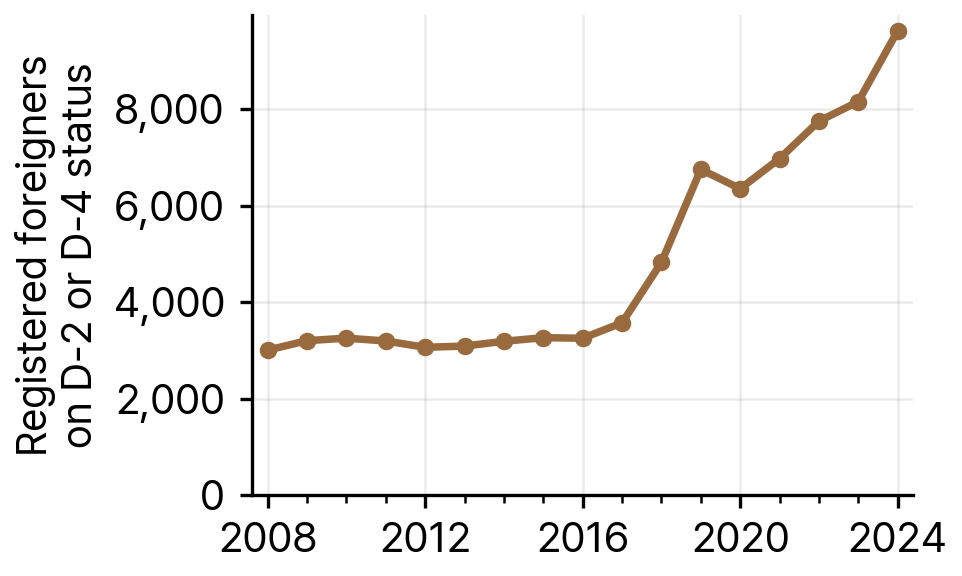
The number of registered foreigners on D-2 student or D-4 general trainee status in Daegu ranged from 3,004 to 3,570 a year between 2008 and 2017, then rose to 4,825 in 2018 and 6,753 in 2019 (Figure 6). After a fall to 6,352 in 2020, it increased each year to 9,626 in 2024 (5,494 on D-2 and 4,132 on D-4), 3.7 percent of all D-2 and D-4 holders in South Korea. Counts before 2023 exclude Gunwi County.
Source: KIRD dataset, from Ministry of Justice immigration yearbooks, 2008-2024.
Korea Educational Development Institute (KEDI) statistics counted 5,991 international students at the 11 higher education institutions located in Daegu on 1 April 2024. Keimyung University had the most, 2,654, followed by Kyungpook National University with 1,972 (KEDI, 2024). Daegu Metropolitan City cited a total of 5,951 international students for 2024 when it set a target of 10,000 by 2028 (Kyunghyang Shinmun, 2025).
Keimyung University had about 4,100 international students in spring 2026, counting Korean-language trainees and undergraduate, graduate and exchange students, and 1,414 new students from 33 countries began its regular Korean-language program that spring (Asia Economy, 2026b).
The KEDI count covers students enrolled at institutions in Daegu on 1 April; the KIRD count covers registered foreigners on D-2 or D-4 status living in Daegu on 31 December.
Provincial Policy
Daegu's ordinance on support for foreign residents and multicultural families (대구광역시 외국인주민 및 다문화가족 지원 조례, Daegu Metropolitan City Ordinance No. 4480) was enacted and took effect on 10 April 2013 (National Law Information Center, 2013).
On 7 March 2024 the city reopened the Daegu Foreign Worker Support Center in Dasa-eup, Dalseong-gun, after it was selected for a Ministry of Employment and Labor program supporting the regional settlement of foreign workers. The program provides up to 200 million won a year in national funds for three years, and the center's budget for 2024 was 400 million won. The center offers grievance counseling, administrative and interpretation support, education in Korean, digital skills and law, and cultural programs (Daegu Metropolitan City, 2024).
Daegu's basic plan for attracting and developing international students sets a target of 10,000 international students by 2028, up from 5,951 in 2024, and provided for an integrated support center for international students (외국인 유학생 원스톱지원센터) and a hub Korean-language center to open in the second half of 2025 (Kyunghyang Shinmun, 2025).
The Ministry of Justice selected Daegu for its pilot of the metropolitan-type visa (광역형 비자), which lasts from April 2025 to the end of December 2026, about 21 months, and provides for about 100 visas. The pilot applies to E-7-1 professional visas for data specialists in ABB fields, robotics engineers, semiconductor electronics engineers, future-mobility mechanical engineers and healthcare life-science specialists. It extends eligibility to junior-college graduates and reduces the required work experience from five years to three (Metro Seoul, 2025).
Two of Daegu's population-decline areas participate in the regional specialized visa (지역특화형 비자) program for 2025 and 2026. Nam-gu has 100 places for the regional specialized talent visa (F-2-R), and the regional specialized skilled worker visa (E-7-4R) has up to 95 places under a quota for all of Daegu; applications for recommendation letters were accepted until 18 September 2026 (Daily DG News, 2025). Seo-gu was allocated 25 F-2-R places for 2025 and 25 for 2026, with no limit on the regional specialized overseas Korean visa (F-4-R), and accepted applications for recommendation letters from 31 March 2025 to 18 September 2026 (Seo-gu District Office, 2025).
Languages
The KIRD dataset estimates the first languages of registered foreigners by allocating each nationality's count across languages according to the first-language shares Ethnologue reports for that country. By this estimate, Vietnamese was the most common first language among Daegu's registered foreigners in 2024 (9,331 speakers), followed by Chinese (4,600), English (1,727), Tagalog or Filipino (1,481) and Indonesian (1,446) (Table 5). Eight languages had 1,000 or more estimated speakers in 2024, adding Khmer (1,342), Mongolian (1,166) and Uzbek (1,122) to those five.
Table 5Estimated First-Language Speakers among Registered Foreigners in Daegu, Ten Most Common Languages, 2024
| Language | Estimated speakers, 2024 |
|---|---|
| Vietnamese | 9,331 |
| Chinese | 4,600 |
| English | 1,727 |
| Tagalog/Filipino | 1,481 |
| Indonesian | 1,446 |
| Khmer | 1,342 |
| Mongolian | 1,166 |
| Uzbek | 1,122 |
| Sinhala | 892 |
| Russian | 823 |
Note: Estimates allocate each nationality's registered foreigners across languages by the first-language shares Ethnologue reports for the country of nationality. Korean is not counted.
Source: KIRD dataset, from Ministry of Justice immigration yearbooks and Ethnologue first-language shares, 2024.
Service Organizations and Community Places
The KIRD census of 1,720 migrant-serving organizations in South Korea lists 53 in Daegu, 14.4 per 10,000 registered foreigners in 2024, against 11.6 per 10,000 nationally. Of the 53, 51 provide services directly to migrants, and 9 have 가족센터 (family center) in their names (Table 6). By the populations they list, 20 serve migrant workers, 15 families, 10 refugees, 6 children and 3 women, and 12 serve all foreign residents; one organization each lists undocumented migrants, international students and youth.
The census includes the Daegu Foreign Worker Support Center in Dalseong-gun and the city's integrated support center for international students in Dalseo-gu, both described under Provincial Policy, as well as the Daegu Overseas Chinese Association in Jung-gu and Pakistani Community Korea in Dalseo-gu.
Table 6Migrant-Serving Organizations in Daegu by Type, KIRD Census
| Type | Organizations |
|---|---|
| Social integration and early adaptation program providers | 15 |
| Medical support institutions | 6 |
| Family centers | 5 |
| Migrant worker support centers | 5 |
| Civic and faith-based support organizations | 5 |
| Migrant community organizations | 5 |
| Foreign resident support centers | 3 |
| Legal and human rights support | 2 |
| Migrant media outlets | 2 |
| Shelters | 2 |
| Migrant-background youth and multicultural education | 1 |
| International student support center | 1 |
| Immigration office | 1 |
| Total | 53 |
Note: Each organization is classified under one type. Nine organizations have 가족센터 (family center) in their names, including organizations classified under other types. The national rate of 11.6 per 10,000 registered foreigners (2024) counts all 1,720 organizations in the census, including 7 with no provincial location.
Source: KIRD census of migrant-serving organizations; registered foreigners from Ministry of Justice immigration yearbooks, 2024.
Chinese laborers, Daegu's earliest foreign workers, began arriving around 1905, when the Gyeongbu railway line between Seoul and Busan opened, and in the following decades foreign residents were concentrated around Jongno street, then the city's downtown commercial center (Park, 2023).
The same encyclopedia entry describes Dalseo-gu as home to more than half of Daegu's registered foreigners, with migrant workers making up 60 percent of the district's foreign residents, and reports that as of 2007 the Ministry of Justice designated the Seongseo industrial estate (성서공단) in Dalseo-gu as one of six special management zones among the 52 areas of dense foreign population it monitored; the entry does not say whether the designation is still in effect (Park, 2023). In the KIRD data for 2024, Dalseo-gu had 34.8 percent of Daegu's registered foreigners (12,761 of 36,710).
Waryong Market (와룡시장) in Sindang-dong, Dalseo-gu, near Keimyung University, sells Asian foods such as sugarcane juice and durian, and the Asian grocery stores and Vietnamese restaurants in Dalseo-gu act as hubs of the district's migrant community networks (Park, 2023).
The mosque in Daehyeon-dong, Buk-gu (다룰이만경북앤드이슬라믹센터), dates from 2012, when Muslim international students at Kyungpook National University rented space near the university's west gate for prayer. In 2014 the students pooled their money to buy a nearby house, and the center was approved as a nonprofit corporation in December of that year. A 2022 study reported the mosque's estimate of about 150 Muslim students at Kyungpook National University (Yuk and Lee, 2022).
By 2025 construction of the mosque had been delayed for five years. In concluding observations published on 7 May 2025 after reviewing South Korea's periodic report, the UN Committee on the Elimination of Racial Discrimination recommended that South Korea take appropriate measures to resolve the delay and described opposition tactics, such as pig heads and banners placed at the construction site, as racist hate crimes and hate speech (Peace News, 2025).
Sources
KIRD dataset (Korea Immigration Regional Dashboard). Spatiotemporal Administrative Dataset of Nationality, Residential Diversity, and Language Demand among Immigrants in South Korea, 2006-2024. openICPSR. https://doi.org/10.3886/E249944V1
Daegu Policy Institute. 2025. Daegu Population Story, as of December 2025 (in Korean). https://www.dpi.re.kr/board/view?menuId=MENU002020803000000&boardId=BOARD00097&schType=0&schText=&schYear=&boardStyle=Image&categoryId=&continent=&pageNum=1&rowCnt=10&no1=1&titleId=6sNrGVrgO7
Maeil Shinmun. 2025. Births in Daegu and Gyeongbuk Rise for the First Time in Nine Years (in Korean). https://www.imaeil.com/page/view/2025022615222614286
Yeongnam Ilbo. 2025. Daegu Has the Largest Net Outflow of People in Their 20s among Special and Metropolitan Cities (in Korean). https://www.yeongnam.com/web/view.php?key=20251013020331116
Statistics Korea. 2024. Population Projections for Provinces, 2022-2052 (in Korean). Korea Policy Briefing. https://www.korea.kr/briefing/policyBriefingView.do?newsId=156632807
TBC. 2026. Population of Daegu and Gyeongbuk Projected to Fall by 940,000 in 26 Years (in Korean). https://www.tbc.co.kr/news/view?id=205040
Asia Economy. 2026a. 57.5% of Daegu Companies Rate Foreign Workers as More Productive than Korean Workers, City Labor Survey Finds (in Korean). https://view.asiae.co.kr/article/2026021809484343678
Newspim. 2026. Daegu Survey of Foreign Workers Identifies Language, Visas and Job Information as Three Main Barriers (in Korean). https://www.newspim.com/news/view/20260215000036
Korea Educational Development Institute (KEDI). 2024. International Students by Institution, Reference Date 1 April 2024 (in Korean). Public Data Portal. https://www.data.go.kr/data/15050054/fileData.do
Kyunghyang Shinmun. 2025. Daegu Aims to Attract 10,000 International Students by 2028 (in Korean). https://www.khan.co.kr/article/202505121340001
Asia Economy. 2026b. Keimyung University Begins the 2026 Academic Year with 1,414 International Students from 33 Countries (in Korean). https://view.asiae.co.kr/article/2026040116540404678
National Law Information Center, Ministry of Government Legislation. 2013. Daegu Metropolitan City Ordinance on Support for Foreign Residents and Multicultural Families (in Korean). https://www.law.go.kr/LSW//ordinInfoP.do?ordinSeq=732766&chrClsCd=010202&gubun=ELIS
Daegu Metropolitan City. 2024. Daegu Foreign Worker Support Center Reopens on 7 March (in Korean). https://info.daegu.go.kr/newshome/mtnmain.php?mtnkey=articleview&mkey=todaylist&mkey2=2&aid=264466&bpage=734&stext=
Metro Seoul. 2025. Daegu Selected for the Metropolitan-Type Visa Pilot Program (in Korean). https://www.metroseoul.co.kr/article/20250403500269
Daily DG News. 2025. Daegu Nam-gu Pursues the 2025 Regional Specialized Visa Program (in Korean). https://www.dailydgnews.com/news/article.html?no=213446
Seo-gu District Office, Daegu. 2025. Notice on the 2025-2026 Regional Specialized Visa Program (in Korean). https://www.dgs.go.kr/portal/board/post/view.do?idx=245375&bcIdx=566&mid=0601010000
Park, Ju-yeon (박주연). 2023. Living together in Daegu: stories of migrant workers in Daegu (대구에서 함께 살아요, 대구 이주노동자 이야기). In Grand Culture Encyclopedia of Daegu (대구역사문화대전). Academy of Korean Studies and Daegu Metropolitan City. https://daegu.grandculture.net/daegu/toc/GC40000049
Yuk, J., & Lee, S. (2022). The camouflage of racism seen through the conflict over the mosque in Buk-gu, Daegu (in Korean). Asia Review, 12(1). Seoul National University Asia Center. https://snuac.snu.ac.kr/2015_snuac/wp-content/uploads/2015/07/%EC%95%84%EC%8B%9C%EC%95%84%EB%A6%AC%EB%B7%B0-12-1-08-%EC%9C%A1%EC%A3%BC%EC%9B%90-%EC%9D%B4%EC%86%8C%ED%9B%88-%EB%85%BC%EB%AC%B8.pdf
Peace News. 2025. Daegu Mosque Stalled for Five Years: UN Committee on the Elimination of Racial Discrimination Recommends That the Korean Government Resolve It (in Korean). https://www.pn.or.kr/news/articleView.html?idxno=32063
Suggested citation: Korea Immigration Regional Dashboard (KIRD). 2026. “Foreign Residents in Daegu.” Foreign Residents in South Korea series, September 2026. Data: Korea Immigration Regional Dashboard (KIRD) dataset, https://doi.org/10.3886/E249944V1. Interactive maps and tables: https://immigrantsinkorea.today.