 Korea Immigration Regional Dashboard
SpotlightSeptember 2026Province profilesDownload PDF
Foreign Residents in Jeonbuk State
Highlights
- Jeonbuk State had 43,795 registered foreigners at the end of 2024, 10th among South Korea's 17 provinces and metropolitan cities, after an increase of 74.6 percent since 2014, while its Korean population decreased by 7.1 percent over the same years, to 1,738,690.
- Vietnamese nationals made up 30.8 percent of the province's registered foreigners in 2024 (13,482 people), against 17.6 percent nationwide, and the province was home to 5.2 percent of all Vietnamese and 5.4 percent of all Cambodian registered foreigners in South Korea, compared with 2.9 percent of all registered foreigners.
- In the ten districts designated as population-decline areas in 2021, the number of registered foreigners rose by 3,544 between 2019 and 2024 while the Korean population fell by 36,689, a foreign gain equal to 9.7 percent of the Korean loss.
At the end of 2024, 43,795 registered foreigners lived in Jeonbuk State, 2.9 percent of the 1,488,353 registered foreigners in South Korea. The province, called North Jeolla Province until it became Jeonbuk Special Self-Governing Province on 18 January 2024, ranked 10th among the 17 provinces and metropolitan cities by the number of registered foreigners and 10th by registered foreigners per Korean resident, with 2.5 registered foreigners per 100 Korean residents against 2.9 nationwide. The Ministry of the Interior and Safety counted 79,224 foreign residents in the province on 1 November 2024, a broader count that adds naturalized citizens and the children of foreign residents. The KIRD series used in this Spotlight are continuous across the change of name.
The number of registered foreigners increased by 74.6 percent between 2014 and 2024, from 25,086 to 43,795, while the Korean population decreased by 7.1 percent, from 1,871,560 to 1,738,690. Between 2019 and 2024 registered foreigners grew by 10,721 (32.4 percent, the eighth-fastest growth among the 17 provinces and metropolitan cities) and Korean residents fell by 80,227 (4.4 percent), so the foreign gain equaled 13.4 percent of the Korean loss.
Compared with registered foreigners nationwide, those in Jeonbuk State in 2024 included more Vietnamese nationals (30.8 percent against 17.6 percent) and fewer Korean-Chinese (3.6 percent against 16.6 percent). Larger shares of them had rotation labor statuses (34.3 percent against 31.1 percent) and study and job search statuses (26.3 percent against 18.6 percent), and a smaller share had settlement statuses (19.5 percent against 27.6 percent). In 2024 the province was home to 8.3 percent of all registered foreigners on E-8 seasonal worker status in South Korea. The KIRD census of migrant-serving organizations lists 18.0 organizations in the province per 10,000 registered foreigners in 2024, against 11.6 nationwide. Ten of its 15 districts were designated population-decline areas in 2021, and the province's regional specialized visa (F-2-R) program covers all ten (Jeonbuk State, 2025a).
Size of the Foreign-Resident Population
The number of registered foreigners in Jeonbuk State rose from 13,475 in 2006 to 25,086 in 2014 and 33,074 in 2019. It fell to 31,288 in 2020 and 30,331 in 2021, 8.3 percent below the 2019 level, and then rose each year to 43,795 in 2024, 44.4 percent above the 2021 count. The 2024 total was 3.25 times the 2006 total, an increase of 30,320 people (225.0 percent).
The MOIS count, which adds naturalized citizens and the children of foreign residents, rose from 18,423 in 2008 to 62,151 in 2019, dipped to 60,684 in 2021 and rose to 79,224 in 2024.
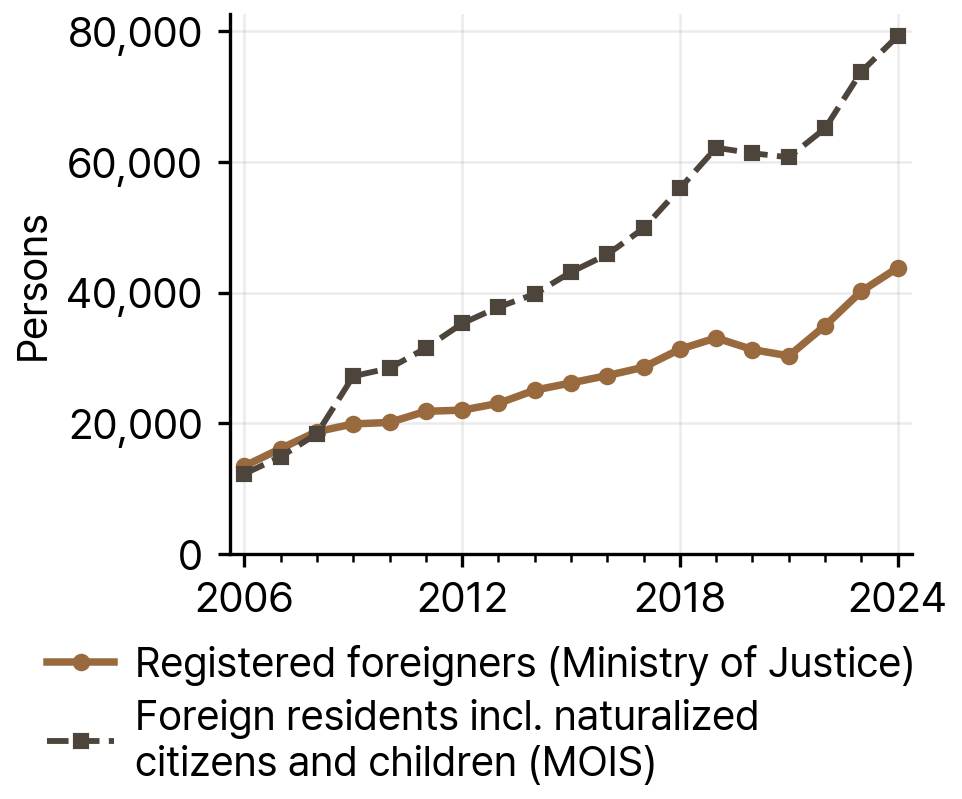
Source: KIRD dataset, from Ministry of Justice immigration yearbooks and Ministry of the Interior and Safety foreign-resident statistics, 2006-2024.
With 2014 set to 100, the number of registered foreigners in the province stood at 174.6 in 2024 and the number of Korean residents at 92.9. Between 2019 and 2024 registered foreigners grew by 32.4 percent (10,721 people), the eighth-fastest growth among the 17 provinces and metropolitan cities, while Korean residents fell by 4.4 percent (80,227 people), a foreign gain equal to 13.4 percent of the Korean loss.
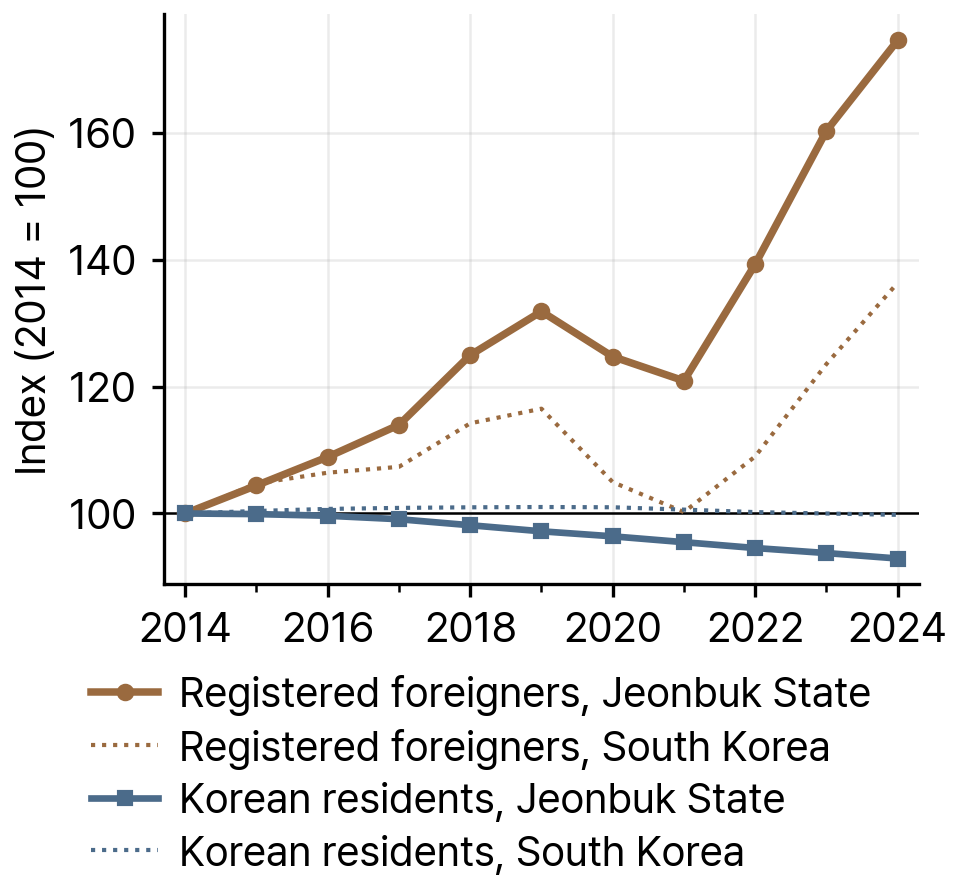
Source: KIRD dataset, from Ministry of Justice immigration yearbooks and Ministry of the Interior and Safety resident registration statistics, 2014-2024.
Registered foreigners per 100 Korean residents rose from 0.7 in 2006 to 1.3 in 2014, 1.8 in 2019 and 2.5 in 2024, when the national figure was 2.9. In 2024 Jeonbuk State ranked 10th among the 17 provinces and metropolitan cities by the number of registered foreigners and 10th by registered foreigners per Korean resident.
Table 1Registered Foreigners, MOIS Foreign Residents and Korean Residents in Jeonbuk State, Selected Years
| Year | Registered foreigners | MOIS foreign residents | Korean residents | Registered foreigners per 100 Korean residents |
|---|---|---|---|---|
| 2006 | 13,475 | – | 1,868,365 | 0.7 |
| 2014 | 25,086 | 39,777 | 1,871,560 | 1.3 |
| 2019 | 33,074 | 62,151 | 1,818,917 | 1.8 |
| 2024 | 43,795 | 79,224 | 1,738,690 | 2.5 |
Note: Registered foreigners are counted on 31 December and MOIS foreign residents on 1 November. The MOIS column starts in 2008, when the count was 18,423. The national ratio in 2024 was 2.9 per 100.
Source: KIRD dataset, from Ministry of Justice immigration yearbooks and Ministry of the Interior and Safety statistics, 2006-2024.
Nationalities
Vietnam was the largest nationality among registered foreigners in Jeonbuk State in 2024, with 13,482 people (30.8 percent of the total), compared with 17.6 percent of registered foreigners nationwide. China followed with 5,228 (11.9 percent), then Cambodia (3,315), Nepal (3,258) and Uzbekistan (2,316). The ten largest nationalities made up 80.9 percent of the province's registered foreigners.
Between 2019 and 2024 the number of Vietnamese nationals rose by 3,459 (34.5 percent), Cambodians by 1,320 (66.2 percent) and Nepalis by 1,370 (72.6 percent), and the number from Myanmar more than doubled, from 810 to 1,630. The number of Chinese nationals fell from 6,074 to 5,228 and the number of Korean-Chinese from 1,978 to 1,562.
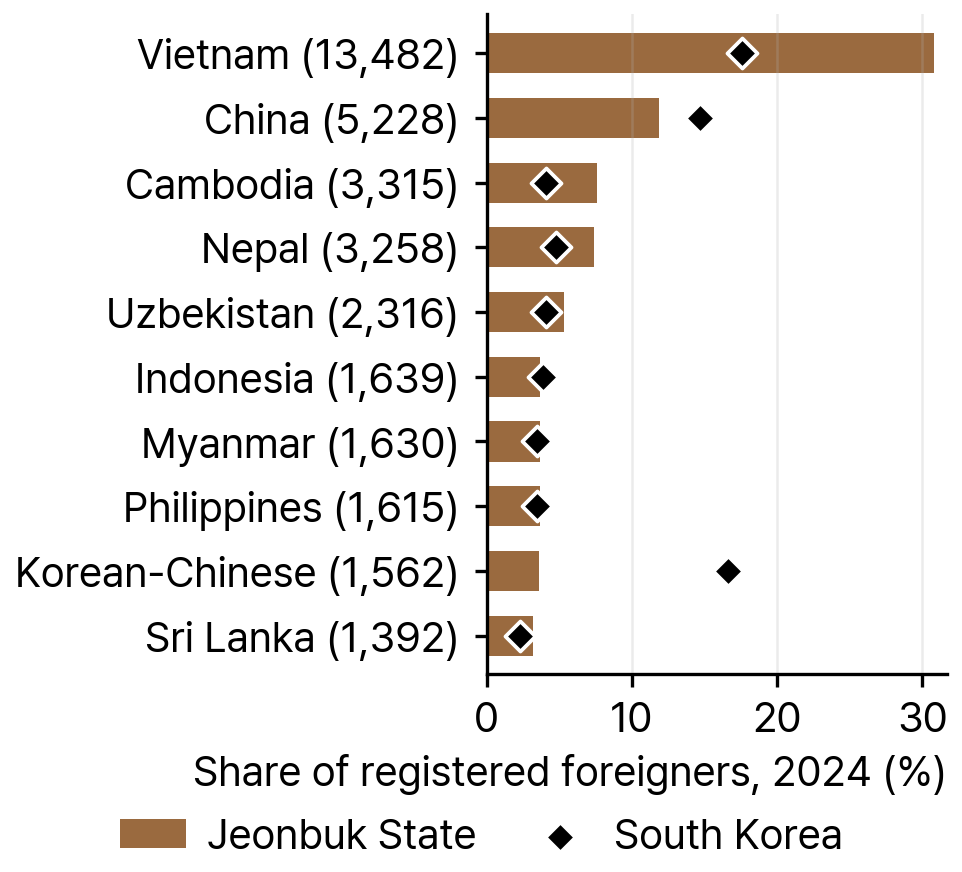
Source: KIRD dataset, from Ministry of Justice immigration yearbooks, 2024.
The province was home to 2.9 percent of all registered foreigners in South Korea in 2024 and to larger shares of several national groups, including 5.4 percent of Cambodians (3,315 of 61,006), 5.2 percent of Vietnamese (13,482 of 261,581) and 4.5 percent of Nepalis (3,258 of 72,151). Its shares of Yemenis (90 of 1,200, or 7.5 percent) and Syrians (124 of 1,904, or 6.5 percent) were higher still. By contrast, 0.6 percent of Korean-Chinese registered foreigners lived in the province, where they made up 3.6 percent of registered foreigners against 16.6 percent nationwide.
The Shannon diversity index of the province's registered foreigners was 2.5 in 2014 and 2.5 in 2024, and in 2024 it was the 13th-highest among the 17 provinces and metropolitan cities. Registered foreigners in the province came from 117 nationalities in 2024.
Overseas Koreans on F-4 status report their residence instead of registering, so they are not counted among registered foreigners. In 2024, 4,295 F-4 holders reported a residence in Jeonbuk State, 0.8 percent of the 553,664 nationwide. Korean-Chinese made up the largest group (2,618), followed by nationals of the United States (893), Canada (257) and Uzbekistan (160) and by Korean-Russians (81).
Table 2Ten Largest Nationalities among Registered Foreigners in Jeonbuk State, 2019 and 2024
| Nationality | 2019 | 2024 | Share of the province's registered foreigners, 2024 (%) | Province's share of the nationality's registered foreigners in South Korea, 2024 (%) |
|---|---|---|---|---|
| Vietnam | 10,023 | 13,482 | 30.8 | 5.2 |
| China | 6,074 | 5,228 | 11.9 | 2.4 |
| Cambodia | 1,995 | 3,315 | 7.6 | 5.4 |
| Nepal | 1,888 | 3,258 | 7.4 | 4.5 |
| Uzbekistan | 1,521 | 2,316 | 5.3 | 3.8 |
| Indonesia | 957 | 1,639 | 3.7 | 2.8 |
| Myanmar | 810 | 1,630 | 3.7 | 3.1 |
| Philippines | 1,273 | 1,615 | 3.7 | 3.1 |
| Korean-Chinese | 1,978 | 1,562 | 3.6 | 0.6 |
| Sri Lanka | 887 | 1,392 | 3.2 | 4.1 |
Note: Korean-Chinese are ethnic Koreans of Chinese nationality, listed separately from other Chinese nationals. Jeonbuk State had 2.9 percent of all registered foreigners in South Korea in 2024.
Source: KIRD dataset, from Ministry of Justice immigration yearbooks, 2019 and 2024.
Residence Statuses
Rotation labor statuses covered 15,022 registered foreigners in Jeonbuk State in 2024, or 34.3 percent, compared with 31.1 percent nationwide. The study and job search group covered 11,515 (26.3 percent, against 18.6 percent nationwide), settlement 8,537 (19.5 percent, against 27.6 percent), family 4,491 (10.3 percent, against 10.0 percent) and skilled 2,033 (4.6 percent, against 5.8 percent). The remaining 2,197 (5.0 percent, against 7.1 percent) had other statuses.
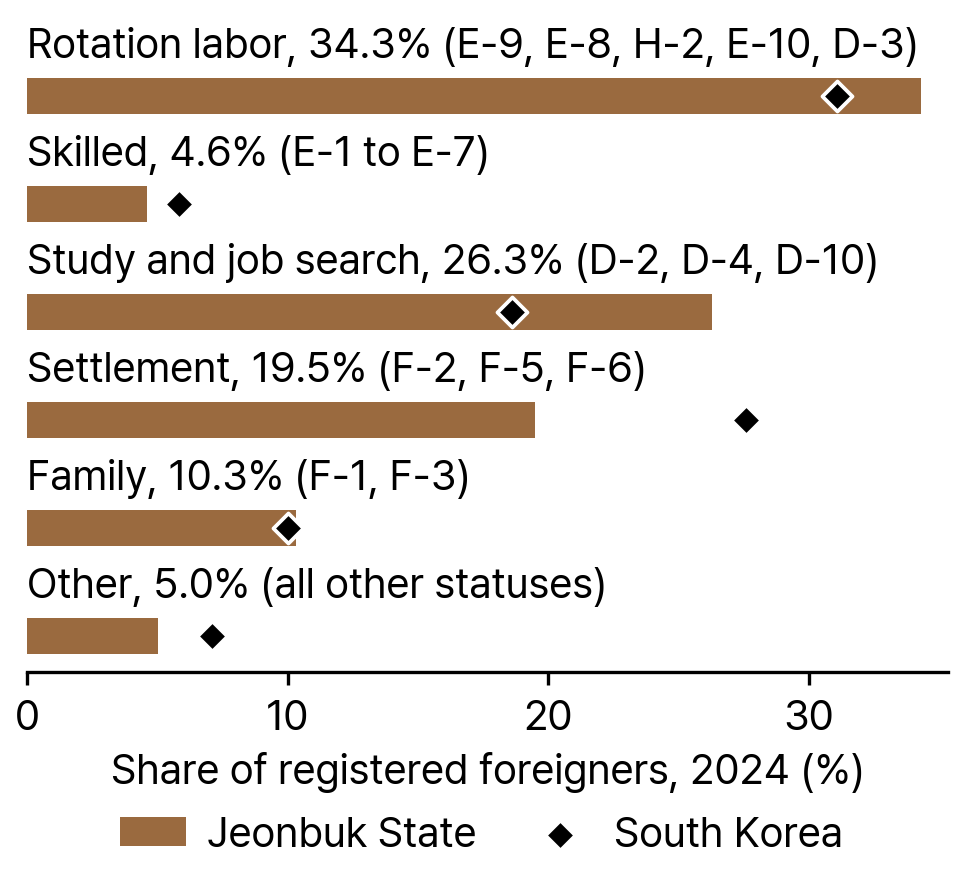
Source: KIRD dataset, from Ministry of Justice immigration yearbooks, 2024.
E-9 non-professional employment was the most common single status in 2024, with 12,355 holders (28.2 percent), followed by D-2 student (6,785), F-6 marriage migration (5,065) and D-4 general trainee (3,888). Against its 2.9 percent share of all registered foreigners, the province had 8.3 percent of all E-8 seasonal worker status holders registered in South Korea on 31 December 2024 (1,626 people) and 4.9 percent of all D-4 general trainees. Its share of F-5 permanent residents was 1.1 percent (2,234 people).
The MOIS count uses its own categories. On 1 November 2024 it recorded 14,956 foreign workers, 5,936 marriage migrants, 10,198 international students, 2,768 foreign nationals of Korean descent and 23,830 other foreigners in the province, 57,688 foreign nationals in all, together with 7,540 naturalized citizens and 13,996 children of foreign residents, for a total of 79,224.
Table 3Ten Most Common Residence Statuses among Registered Foreigners in Jeonbuk State, 2024
| Status | Meaning | Registered foreigners | Share of the province's registered foreigners (%) | Province's share of all holders in South Korea (%) |
|---|---|---|---|---|
| E-9 | Non-professional employment | 12,355 | 28.2 | 3.8 |
| D-2 | Student | 6,785 | 15.5 | 3.8 |
| F-6 | Marriage migration | 5,065 | 11.6 | 3.5 |
| D-4 | General trainee | 3,888 | 8.9 | 4.9 |
| F-1 | Visiting cohabitation | 2,989 | 6.8 | 3.1 |
| F-5 | Permanent residence | 2,234 | 5.1 | 1.1 |
| E-8 | Seasonal worker | 1,626 | 3.7 | 8.3 |
| F-3 | Dependent family | 1,502 | 3.4 | 2.9 |
| E-7 | Specially designated activities | 1,444 | 3.3 | 2.3 |
| G-1 | Other (miscellaneous) | 1,411 | 3.2 | 2.5 |
Note: Counts are registered foreigners on 31 December 2024. Jeonbuk State had 2.9 percent of all registered foreigners in South Korea.
Source: KIRD dataset, from Ministry of Justice immigration yearbooks, 2024.
Districts and Population-Decline Areas
Gunsan-si had the most registered foreigners in Jeonbuk State in 2024 (9,414, or 21.5 percent of the province's total), followed by Iksan-si (6,395) and the two general districts of Jeonju-si, Deokjin-gu (5,946) and Wansan-gu (4,575). Relative to the Korean population, the ratio was highest in Wanju-gun (4.5 registered foreigners per 100 Korean residents), Gimje-si (4.1), Gunsan-si (3.6), Gochang-gun (3.3) and Jeongeup-si (3.2).
Between 2019 and 2024 the number of registered foreigners rose in all 15 districts, most in Gunsan-si (3,313), Gimje-si (1,257), Iksan-si (1,250) and Jeonju-si Deokjin-gu (1,192). The Korean population fell in 14 of the 15 districts. Wanju-gun gained 7,059 Korean residents, and the largest losses were in Iksan-si (19,770), Jeonju-si Wansan-gu (16,929) and Gunsan-si (12,084).
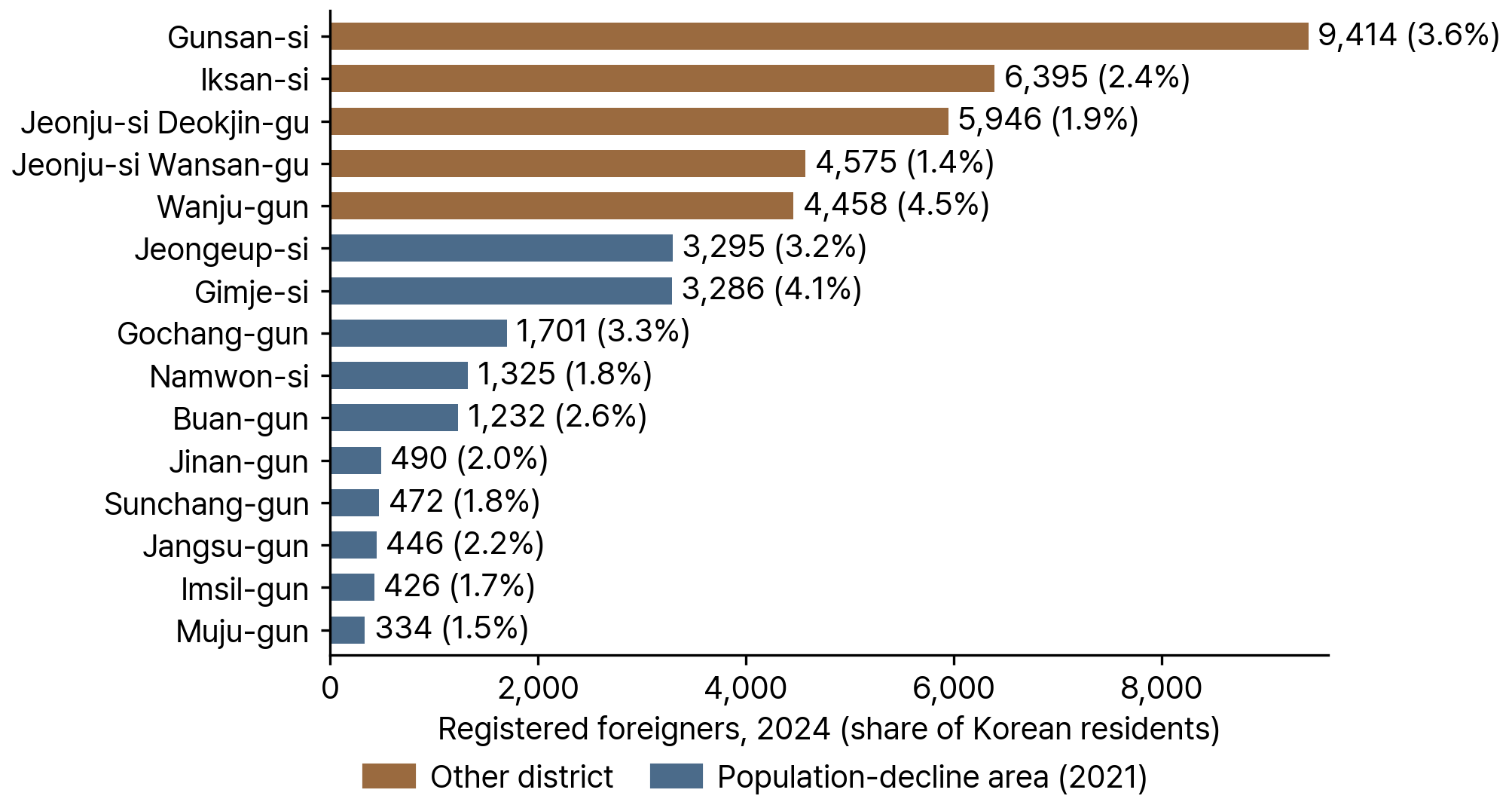
Source: KIRD dataset, from Ministry of Justice immigration yearbooks and Ministry of the Interior and Safety statistics, 2024; population-decline areas as designated by the Ministry of the Interior and Safety in October 2021.
In October 2021 the Ministry of the Interior and Safety designated ten of the province's districts as population-decline areas (Jeongeup-si, Namwon-si, Gimje-si, Jinan-gun, Muju-gun, Jangsu-gun, Imsil-gun, Sunchang-gun, Gochang-gun and Buan-gun) and named Iksan-si an area of interest. In 2024 the ten decline areas were home to 13,007 registered foreigners, 29.7 percent of the province's total.
Between 2019 and 2024 the ten decline areas lost 36,689 Korean residents and gained 3,544 registered foreigners, so the foreign gain equaled 9.7 percent of the Korean loss, against 13.4 percent for the province as a whole. Gimje-si had the largest foreign gain among them (1,257) and lost 3,260 Korean residents. Iksan-si, the area of interest, lost 19,770 Korean residents, more than any other district, and gained 1,250 registered foreigners.
Two districts met the definition of an ethnic enclave in 2024, both for Vietnamese nationals and both population-decline areas. In Jeongeup-si, 1,195 Vietnamese made up 36.3 percent of registered foreigners (location quotient 2.3), and in Buan-gun, 543 Vietnamese made up 44.1 percent (location quotient 2.2).
Table 4Ten Districts with the Most Registered Foreigners in Jeonbuk State, 2024
| District | Registered foreigners, 2024 | Registered foreigners per 100 Korean residents, 2024 | Change in Korean residents, 2019-24 | Change in registered foreigners, 2019-24 | Population-decline area |
|---|---|---|---|---|---|
| Gunsan-si | 9,414 | 3.6 | -12,084 | +3,313 | No |
| Iksan-si | 6,395 | 2.4 | -19,770 | +1,250 | No (area of interest) |
| Jeonju-si Deokjin-gu | 5,946 | 1.9 | -1,814 | +1,192 | No |
| Jeonju-si Wansan-gu | 4,575 | 1.4 | -16,929 | +625 | No |
| Wanju-gun | 4,458 | 4.5 | +7,059 | +797 | No |
| Jeongeup-si | 3,295 | 3.2 | -8,414 | +421 | Yes |
| Gimje-si | 3,286 | 4.1 | -3,260 | +1,257 | Yes |
| Gochang-gun | 1,701 | 3.3 | -4,522 | +738 | Yes |
| Namwon-si | 1,325 | 1.8 | -5,794 | +303 | Yes |
| Buan-gun | 1,232 | 2.6 | -5,229 | +377 | Yes |
Note: The other five districts, all population-decline areas, had 2,168 registered foreigners in 2024: Jinan-gun (490), Sunchang-gun (472), Jangsu-gun (446), Imsil-gun (426) and Muju-gun (334). Population-decline areas and areas of interest are those designated by the Ministry of the Interior and Safety in October 2021.
Source: KIRD dataset, from Ministry of Justice immigration yearbooks and Ministry of the Interior and Safety statistics, 2019 and 2024.
Population Trends
Among the years from 2006 to 2024, the Korean population of Jeonbuk State was highest in 2011, at 1,874,031, and it declined every year from 2012 to 2024, when it stood at 1,738,690. It fell by 129,675 (6.9 percent) between 2006 and 2024, by 132,870 (7.1 percent) between 2014 and 2024 and by 80,227 (4.4 percent) between 2019 and 2024. The province's Korean residents made up 3.4 percent of South Korea's 51,217,221 in 2024.
The province reported 1,724,856 people in its resident registration at the end of 2025 (859,325 men and 865,531 women), in 868,116 households (Jeonbuk State, 2025b).
Jeonbuk Ilbo, citing the Honam Regional Statistics Office, reported 6,780 births in the province in 2024, 2.4 percent more than in 2023, and a total fertility rate of 0.81, above the national rate of 0.75 and the 10th-highest among the 17 provinces and metropolitan cities (Jeonbuk Ilbo, 2025). In Statistics Korea's 2025 figures, 25.4 percent of the province's population was 65 or older, the fourth-highest share after South Jeolla Province (27.4 percent), North Gyeongsang Province (26.1 percent) and Gangwon State (25.7 percent) (Statistics Korea, 2025).
In the second quarter of 2025, 979 more people moved from the province to other parts of South Korea than moved in. Gimje had the largest net inflow among the province's cities and counties (440 people) and Jeonju the largest net outflow (1,930) (News1, 2025).
Statistics Korea's provincial projections for 2022-2052 place the province among six regions, with Seoul, North Gyeongsang, Gwangju, South Jeolla and Daejeon, whose population is projected to decline by about 15 percent by 2052, and among seven provinces where the school-age population (ages 6 to 21) is projected to decline by more than 50 percent over the same period (Statistics Korea, 2023).
Industry and Foreign Workers
In 2022, foreign workers in Jeonbuk State were less concentrated in manufacturing and more concentrated in agriculture than foreign workers nationwide. In employment administration statistics from the Korea Employment Information Service for the fourth quarter of 2022, reproduced in a 2023 Jeonbuk Institute report, 57.3 percent of the province's foreign workers were in manufacturing, 29.9 percent in agriculture and livestock, 7.4 percent in fishing, 4.8 percent in construction and 0.6 percent in services. Nationally, 78.0 percent were in manufacturing and 11.0 percent in agriculture and livestock (Jeonbuk Institute, 2023).
The MOIS count of 1 November 2021 recorded 9,464 foreign workers in the province, 15.6 percent of its foreign residents and 2.4 percent of foreign workers nationwide. Among the provinces outside the metropolitan cities, only Gangwon (1.4 percent) and Jeju (2.1 percent) had smaller shares. The largest nationalities among the province's foreign workers were Cambodian (14.6 percent), Nepali (14.5 percent) and Vietnamese (13.8 percent), while nationally Chinese nationals, including Korean-Chinese, were the largest group (25.8 percent) (Jeonbuk Institute, 2023). On 1 November 2024 the same count recorded 14,956 foreign workers in the province, 18.9 percent of its 79,224 foreign residents.
Registered foreigners on E-9 non-professional employment status numbered 7,812 in 2014 and 8,983 in 2019. The count fell to 7,302 in 2021 and rose to 12,355 in 2024, 69.2 percent above the 2021 level and 3.8 percent of all E-9 holders in South Korea.
The number of E-8 seasonal workers counted on 31 December rose from 24 in 2021 to 447 in 2022, 1,157 in 2023 and 1,626 in 2024, when the province had 8.3 percent of all E-8 holders in South Korea. Most seasonal workers' contracts end before winter, so a count on 31 December misses most of them. In the first half of 2023, 2,660 seasonal workers were allocated to 791 farm employers in 13 of the province's 14 cities and counties, 9.9 percent of the 26,788 allocated nationwide, and Gochang-gun received the most (776) (Jeonbuk Institute, 2023).
Gunsan-si, the district with the most registered foreigners in 2024, contains a free trade zone at the entrance to the Saemangeum seawall, inside the Gunsan No. 2 National Industrial Park (군산2국가산업단지). The city describes it as the country's first free trade zone to combine manufacturing, logistics, trade and distribution. It covers 1,256,000 square meters, and in 2017 it had 30 tenant companies, 25 of them operating, with 1,623 workers (Gunsan City, 2017).
International Students and Universities
Registered foreigners on D-2 student and D-4 general trainee status in Jeonbuk State numbered 4,353 in 2008 and 5,001 in 2009, then declined each year to 3,116 in 2015. The count rose to 9,107 in 2019, dipped to 8,490 in 2020 and then rose each year to 10,673 in 2024, about 3.4 times the 2015 level. In 2024, 6,785 were on D-2 status and 3,888 on D-4 status, and the province had 4.1 percent of all D-2 and D-4 holders in South Korea, against 2.9 percent of all registered foreigners. The MOIS count recorded 10,198 international students in the province on 1 November 2024.
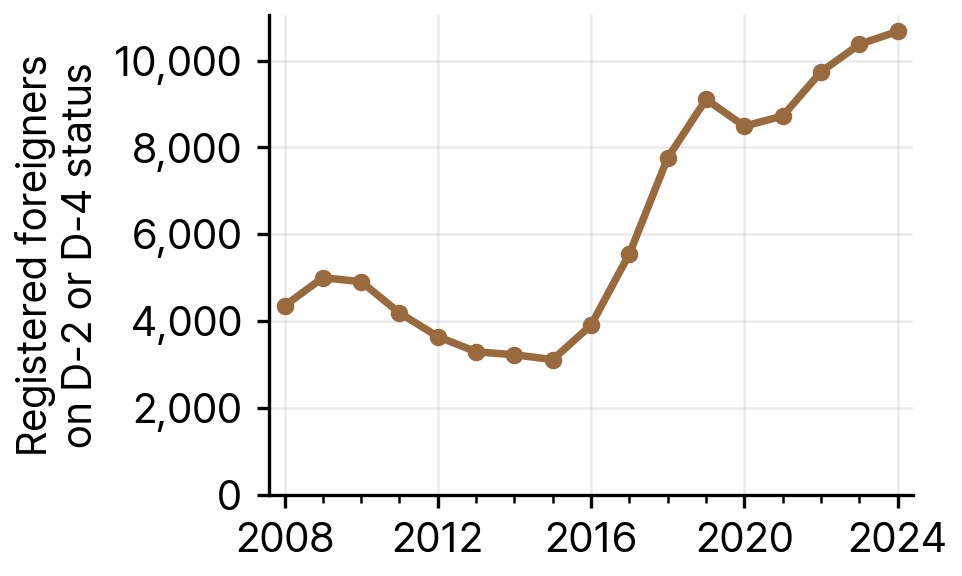
Source: KIRD dataset, from Ministry of Justice immigration yearbooks, 2008-2024.
In the 2026 university information disclosure on Academyinfo (대학알리미), Jeonbuk National University reported 2,722 international students, the most of any university in the province (Academyinfo, 2026a), and Woosuk University in Samnye, Wanju-gun, reported 1,250, the second most (Academyinfo, 2026b). Howon University in Gunsan reported 762, Wonkwang University in Iksan 506 and Kunsan National University 436.
Table 5International Students at Five Universities in Jeonbuk State, 2026 Disclosure
| University | Location | International students, 2026 | Source |
|---|---|---|---|
| Jeonbuk National University | Jeonju | 2,722 | Academyinfo, 2026a |
| Woosuk University | Samnye, Wanju-gun | 1,250 | Academyinfo, 2026b |
| Howon University | Gunsan | 762 | Academyinfo, 2026c |
| Wonkwang University | Iksan | 506 | Academyinfo, 2026d |
| Kunsan National University | Gunsan | 436 | Academyinfo, 2026e |
Note: Counts are the number of international students (외국인 학생 수) that each university reported for 2026 on Academyinfo (대학알리미), the university information disclosure service. Jeonbuk National University had the most international students of any university in the province and Woosuk University the second most.
Source: Academyinfo (대학알리미), Korean Council for University Education, 2026.
The province's ordinance on international students and its 2025 metropolitan-type visa pilot are described under Provincial Policy.
Provincial Policy
The provincial website, as updated in February 2026, lists the Foreign Affairs and International Policy Division (외국인국제정책과) as the office responsible for foreign-resident and international policy in Jeonbuk State (Jeonbuk State, 2026). In 2015 the province established the Jeonbuk International Cooperation Agency (전북국제협력진흥원) to build communication and community between residents and foreign residents and to strengthen the province's international competitiveness (Jeonbuk Institute, 2023).
On 31 March 2023 the province enacted its Ordinance on Support for Foreign Residents, dividing the Ordinance on Support for Foreign Residents and Multicultural Families of 12 August 2016 into separate ordinances for foreign residents and for multicultural families. The new ordinance requires the province to draft and implement a support plan for foreign residents every year. An ordinance on support for international students, enacted on 21 October 2022, covers degree students and language trainees living in the province, with the aim of attracting more international students and raising the region's competitiveness through their participation in community activities (Jeonbuk Institute, 2023).
In August 2023 the Jeonbuk Institute submitted to the provincial governor the final report of its study for a master plan on foreign-resident policy in the province (Jeonbuk Institute, 2023).
The province's regional specialized visa (F-2-R) program covers ten population-declining cities and counties (Jeongeup, Namwon, Gimje, Jinan, Muju, Jangsu, Imsil, Sunchang, Gochang and Buan), the ten districts designated as population-decline areas in 2021. Current and recent holders of technical training (D-3), general training (D-4), hotel entertainment (E-6-2), seasonal work (E-8), non-professional employment (E-9), seafarer employment (E-10), miscellaneous (G-1) or working holiday (H-1) status are not eligible (Jeonbuk State, 2025a).
Under the 2025 pilot program for a metropolitan-type visa (광역형 비자), the province announced settlement support and links with companies to attract and retain 670 international students. It received the central government's implementation guidelines on 13 June 2025, and together with 13 universities in the province it selected 51 majors that match its priority industries and set up an academic structure for these students (Jeonbuk State, 2025c).
Languages
The KIRD dataset estimates first-language speakers by multiplying the number of registered foreigners of each nationality by the share of that country's population with the language as a first language, as reported by Ethnologue. By this estimate, Vietnamese was the most common first language among registered foreigners in Jeonbuk State in 2024 (11,529 speakers), followed by Chinese (5,537) and Khmer (3,364). Ten languages had at least 1,000 estimated speakers in 2024, the others being Nepali (1,696), Uzbek (1,686), Tagalog or Filipino (1,407), Thai (1,160), Indonesian (1,151), Burmese (1,044) and Mongolian (1,007).
Because the estimate applies first-language shares to nationality counts, the estimate for Vietnamese (11,529) is below the number of Vietnamese nationals (13,482).
Table 6Estimated First-Language Speakers among Registered Foreigners in Jeonbuk State, 2024
| Language | Estimated speakers |
|---|---|
| Vietnamese | 11,529 |
| Chinese | 5,537 |
| Khmer | 3,364 |
| Nepali | 1,696 |
| Uzbek | 1,686 |
| Tagalog/Filipino | 1,407 |
| Thai | 1,160 |
| Indonesian | 1,151 |
| Burmese | 1,044 |
| Mongolian | 1,007 |
Note: Estimates multiply the number of registered foreigners of each nationality by the share of that country's population with the language as a first language (Ethnologue) and sum across nationalities. Korean is excluded. The ten languages shown are all those with at least 1,000 estimated speakers in 2024.
Source: KIRD dataset, language estimates from Ministry of Justice nationality counts and Ethnologue first-language shares, 2024.
Service Organizations and Community Places
The KIRD census of 1,720 migrant-serving organizations in South Korea lists 79 in Jeonbuk State, or 18.0 per 10,000 registered foreigners in 2024, compared with 11.6 per 10,000 nationwide. Of the 79, 78 provide services directly to migrants, and 14 have 가족센터 (family center) in their names.
Organizations can name more than one population they serve. Families are the population named most often (33 organizations), followed by workers (22), all foreign residents (15), women (15), refugees (9), undocumented migrants (8), children (6), youth (5), students (4) and ethnic Koreans (1).
St. Joseph Workers' House (성요셉노동자의 집) in Iksan was founded in 1983 and is operated by the migrant ministry office of the Catholic Diocese of Jeonju. It expanded its work with migrant workers in 2008 and provides community support, labor and human rights counseling, help with administrative lawsuits and a shelter for migrants. The Jeonju Workers' Mission Counseling Center (전주근로자선교상담소), also called the Foreign Workers' Mission Center, began its work with Chinese workers in June 1996 and was established in 1998 by the Jeonbuk and Jeonju presbyteries of the Presbyterian Church of Korea. It provides labor and human rights counseling and medical support to migrant workers in Jeonju (Jeonbuk Institute, 2023).
A 2010 newspaper report described Dasik (다식), a Southeast Asian restaurant that Gimje City and the Gimje Multicultural Family Support Center opened that year in the Yocheon-dong housing development district of Gimje. Ten marriage migrant women from the Philippines and Vietnam cooked and sold dishes from their home countries there (Seoul Shinmun, 2010). The report does not establish whether the restaurant still operates.
Sources
Korea Immigration Regional Dashboard (KIRD) dataset, compiled from Ministry of Justice immigration yearbooks and Ministry of the Interior and Safety foreign-resident statistics, 2006-2024. openICPSR. https://doi.org/10.3886/E249944V1
Jeonbuk Institute (전북연구원). 2023. 전라북도 외국인정책 종합계획 수립 연구 (A study for a master plan on foreign-resident policy in Jeollabuk-do). Final report, August 2023. https://repository.jthink.kr/bitstream/2016.oak/1144/1/2023-12_23SU09_%EC%A0%84%EB%9D%BC%EB%B6%81%EB%8F%84%20%EC%99%B8%EA%B5%AD%EC%9D%B8%EC%A0%95%EC%B1%85%20%EC%A2%85%ED%95%A9%EA%B3%84%ED%9A%8D%20%EC%88%98%EB%A6%BD%20%EC%97%B0%EA%B5%AC.pdf
Jeonbuk State (전북특별자치도). 2026. Foreign policy: foreign resident statistics (외국인 주민 통계). Provincial website, updated February 2026. https://www.jeonbuk.go.kr/index.jeonbuk?menuCd=DOM_000000104014003000
Jeonbuk State (전북특별자치도). 2025a. Foreign policy: regional specialized visa program (지역특화형 비자 사업). Provincial website. https://www.jeonbuk.go.kr/index.jeonbuk?menuCd=DOM_000000104014001000
Jeonbuk State (전북특별자치도). 2025c. Press release on the metropolitan-type visa pilot program (광역형 비자 시범사업), 24 June 2025. https://www.jeonbuk.go.kr/newsroom/board/view.jeonbuk?boardId=BBS_0000090&menuCd=DOM_000001101000000000&orderBy=REGISTER_DATE:DESC&paging=ok&startPage=1&dataSid=617407
Jeonbuk State (전북특별자치도). 2025b. Population and households (인구 및 세대), as of 31 December 2025. Provincial website. https://www.jeonbuk.go.kr/index.jeonbuk?menuCd=DOM_000000101004003000
Gunsan City (군산시). 2017. Industrial infrastructure: free trade zone (자유무역지역). City website. https://www.gunsan.go.kr/main/m291
Jeonbuk Ilbo (전북일보). 2025. Births in Jeonbuk rose 2.4 percent last year, with a total fertility rate of 0.81 (in Korean). https://www.jjan.kr/article/20251027580289
Statistics Korea. 2025. 2025 고령자 통계 (2025 statistics on the aged). Press release. https://mods.go.kr/board.es?mid=a10301010000&bid=10820&tag=&act=view&list_no=438832&ref_bid=
News1. 2025. Jeonbuk has a net outflow of 979 people in the second quarter, with the largest inflow in Gimje and the largest outflow in Jeonju (in Korean). https://www.news1.kr/local/jeonbuk/5879618
Statistics Korea. 2023. 장래인구추계(시도편): 2022~2052년 (Population projections for provinces, 2022-2052). Korea.kr policy briefing. https://www.korea.kr/briefing/policyBriefingView.do?newsId=156632807
Academyinfo (대학알리미), Korean Council for University Education. 2026a. University disclosure, Jeonbuk National University. https://www.academyinfo.go.kr/popup/pubinfo1690/list.do?schlId=0000025
Academyinfo (대학알리미), Korean Council for University Education. 2026b. University disclosure, Woosuk University. https://www.academyinfo.go.kr/popup/pubinfo1690/list.do?schlId=0000157
Academyinfo (대학알리미), Korean Council for University Education. 2026c. University disclosure, Howon University. https://www.academyinfo.go.kr/popup/pubinfo1690/list.do?schlId=0000282
Academyinfo (대학알리미), Korean Council for University Education. 2026d. University disclosure, Wonkwang University. https://www.academyinfo.go.kr/popup/pubinfo1690/list.do?schlId=0000159
Academyinfo (대학알리미), Korean Council for University Education. 2026e. University disclosure, Kunsan National University. https://www.academyinfo.go.kr/popup/pubinfo1690/list.do?schlId=0000009
Seoul Shinmun (서울신문). 2010. Marriage migrant women open a restaurant serving the food of their home countries (in Korean). https://www.seoul.co.kr/news/society/multiculture/2010/08/12/20100812800062
Suggested citation: Korea Immigration Regional Dashboard (KIRD). 2026. “Foreign Residents in Jeonbuk State.” Foreign Residents in South Korea series, September 2026. Data: Korea Immigration Regional Dashboard (KIRD) dataset, https://doi.org/10.3886/E249944V1. Interactive maps and tables: https://immigrantsinkorea.today.