 Korea Immigration Regional Dashboard
SpotlightSeptember 2026Province profilesDownload PDF
Foreign Residents in Busan
Highlights
- At the end of 2024, Busan had 55,805 registered foreigners, the ninth-largest number among South Korea's 17 provinces and metropolitan cities, or 1.7 per 100 Korean residents against 2.9 nationally.
- Between 2014 and 2024, the number of registered foreigners in Busan grew 45.6 percent (by 17,490 people), while the city's Korean resident population fell 7.2 percent (by 252,803).
- In 2024, 35.7 percent of Busan's registered foreigners had study and job search statuses (D-2, D-4, D-10), against 18.6 percent nationally, and Busan had 7.3 percent of all D-2 and D-4 holders in South Korea.
Busan had 55,805 registered foreigners on 31 December 2024, 3.7 percent of the 1,488,353 in South Korea, and ranked ninth among the 17 provinces and metropolitan cities by this count. Its share of the country's Korean residents was larger, 6.4 percent (3,266,598 of 51,217,221). With 1.7 registered foreigners per 100 Korean residents, against 2.9 nationally, Busan ranked 15th of the 17 provinces on this ratio. The Ministry of the Interior and Safety (MOIS) counted 88,542 foreign residents in Busan in November 2024, a broader count that adds naturalized citizens and the children of foreign residents.
The number of registered foreigners in Busan grew 45.6 percent between 2014 and 2024, from 38,315 to 55,805, while the Korean resident population fell 7.2 percent, from 3,519,401 to 3,266,598. The foreign count dropped in 2020 and 2021 and rose in each year from 2022 to 2024. Between 2019 and 2024 it increased by 9,806 (21.3 percent, the 12th-fastest growth among the 17 provinces), a gain equal to 6.7 percent of the 147,243 Korean residents Busan lost over the same five years.
Busan's foreign population differs from the national one in its residence statuses and nationalities. In 2024, the study and job search statuses (D-2, D-4, D-10) covered 35.7 percent of its registered foreigners, against 18.6 percent nationally, and D-2 student status was the most common single status. Vietnamese nationals made up 27.6 percent of registered foreigners in Busan (17.6 percent nationally) and Korean-Chinese residents 3.3 percent (16.6 percent nationally). Busan also had 15.3 percent of all holders of E-10 crew employment status in South Korea. Statistics Korea projects that Busan's total population will fall 25.8 percent between 2022 and 2052, the largest projected decline among the 17 provinces (Kookje Ilbo, 2024).
Size of the Foreign-Resident Population
The number of registered foreigners in Busan rose from 23,381 in 2006 to 38,315 in 2014, with small declines in 2009 and 2012, and to 45,999 in 2019. It fell to 40,366 in 2020 and 39,420 in 2021, 6,579 fewer (14.3 percent) than in 2019, then rose to 42,863 in 2022, 49,090 in 2023, and 55,805 in 2024, the highest count in the series. The 2024 count was 2.4 times the 2006 count.
The MOIS count of foreign residents grew from 33,192 in 2008 to 77,968 in 2019, declined to 73,185 in 2020 and 72,361 in 2021, and rose to 88,542 in 2024, 2.7 times the 2008 count. Of the 2024 total, 67,762 were foreign nationals, 7,589 were naturalized citizens, and 13,191 were children of foreign residents.
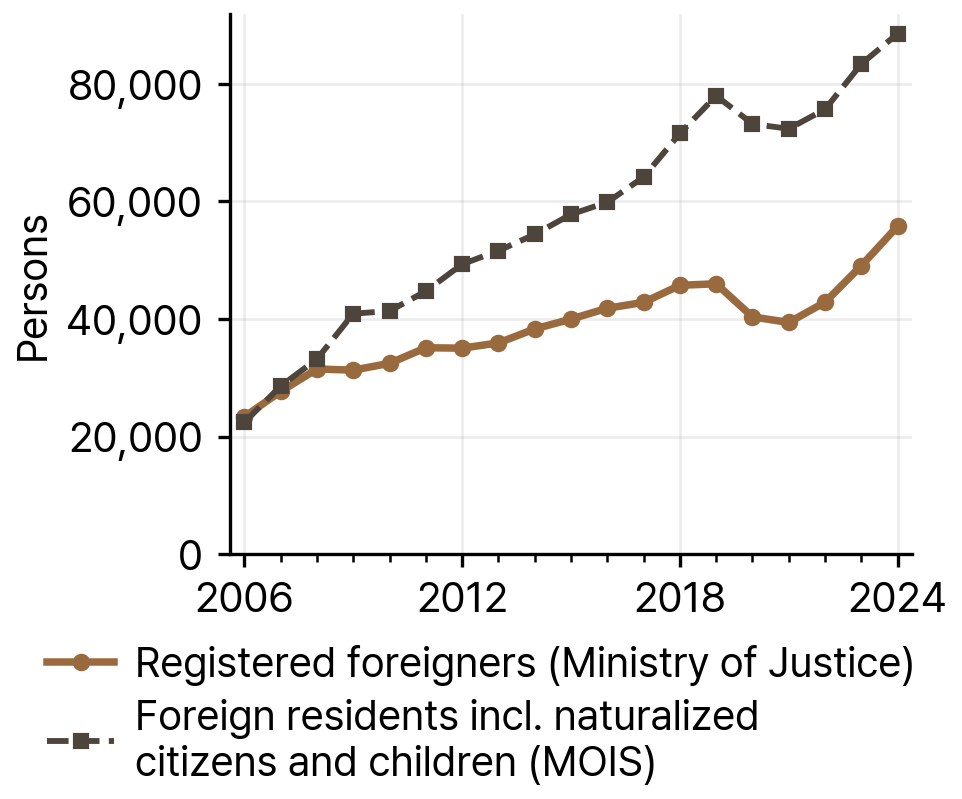
Source: KIRD dataset, from Ministry of Justice immigration yearbooks and Ministry of the Interior and Safety statistics, 2006-2024.
Busan ranked ninth among the 17 provinces and metropolitan cities by the number of registered foreigners in 2024 and 15th by registered foreigners per Korean resident. The number of registered foreigners per 100 Korean residents rose from 0.6 in 2006 to 1.1 in 2014, 1.3 in 2019, and 1.7 in 2024, against 2.9 for South Korea in 2024.
With 2014 set to 100, the index of registered foreigners in Busan stood at 145.6 in 2024 (55,805 against 38,315) and the index of Korean residents at 92.8 (3,266,598 against 3,519,401). Between 2019 and 2024, the registered-foreigner count grew 21.3 percent, the 12th-fastest growth among the 17 provinces, and the Korean population fell 4.3 percent. The foreign gain of 9,806 people from 2019 to 2024 equaled 6.7 percent of the Korean loss of 147,243.
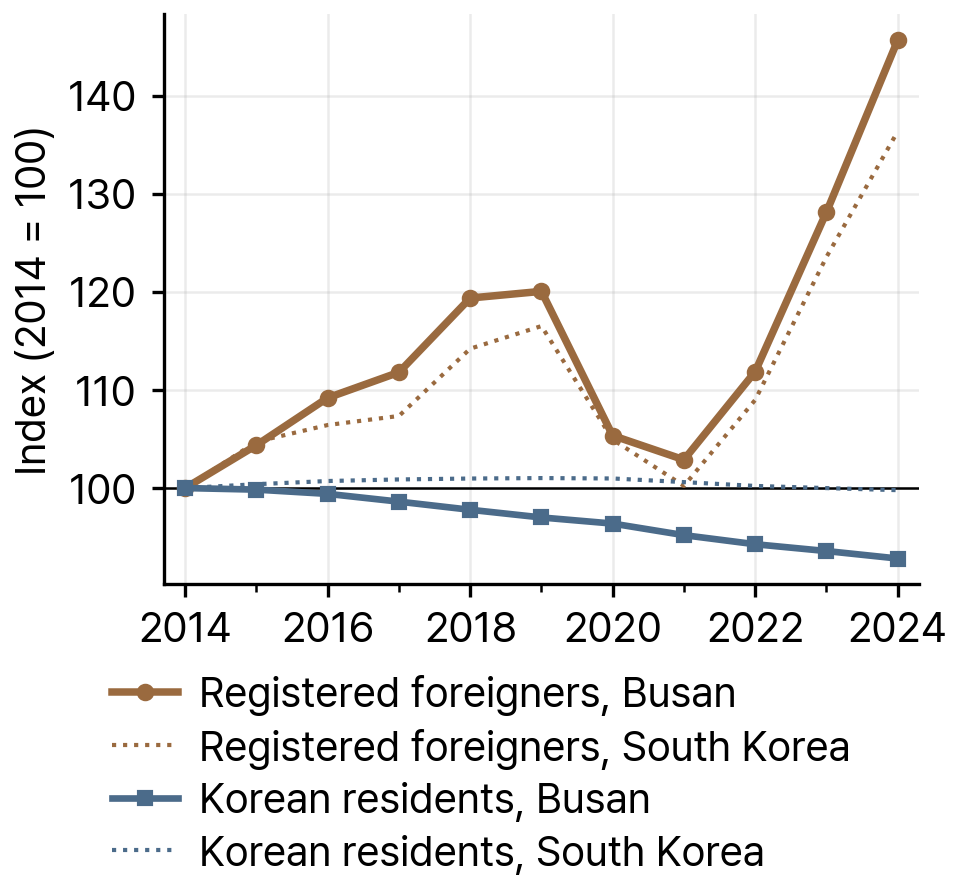
Source: KIRD dataset, from Ministry of Justice immigration yearbooks and Ministry of the Interior and Safety resident registration statistics, 2014-2024.
Table 1Registered Foreigners, MOIS Foreign Residents, and Korean Residents in Busan, Selected Years, 2006-24
| Year | Registered foreigners | MOIS foreign residents | Korean residents | Registered foreigners per 100 Korean residents |
|---|---|---|---|---|
| 2006 | 23,381 | n.a. | 3,611,992 | 0.6 |
| 2014 | 38,315 | 54,394 | 3,519,401 | 1.1 |
| 2019 | 45,999 | 77,968 | 3,413,841 | 1.3 |
| 2024 | 55,805 | 88,542 | 3,266,598 | 1.7 |
Note: Registered foreigners are counted on 31 December and MOIS foreign residents on 1 November. MOIS foreign residents are shown from 2008 (33,192 in Busan that year); the figure above also plots the MOIS counts for 2006 and 2007. n.a. = not reported. South Korea had 2.9 registered foreigners per 100 Korean residents in 2024.
Source: KIRD dataset, from Ministry of Justice immigration yearbooks and Ministry of the Interior and Safety statistics, 2006-2024.
Nationalities
Vietnam was the largest nationality among Busan's registered foreigners in 2024, with 15,389 people (27.6 percent), up from 12,131 in 2019; nationally, Vietnamese nationals made up 17.6 percent of registered foreigners. China followed with 8,221 (14.7 percent), down from 9,294 in 2019, then Indonesia (3,903), Nepal (2,765), Uzbekistan (2,396), the Philippines (2,322), and Myanmar (2,312). The ten largest groups made up 75.8 percent of Busan's registered foreigners (42,274 of 55,805).
Korean-Chinese residents (Chinese nationals of Korean descent, counted separately from other Chinese nationals) made up 16.6 percent of registered foreigners in South Korea in 2024 and 3.3 percent in Busan (1,856 people), down from 2,492 in Busan in 2019. Among the ten largest groups, Nepali nationals grew fastest between 2019 and 2024, from 1,050 to 2,765 (2.6 times), followed by nationals of Myanmar (from 1,276 to 2,312, up 81.2 percent) and Indonesia (from 2,710 to 3,903, up 44.0 percent).
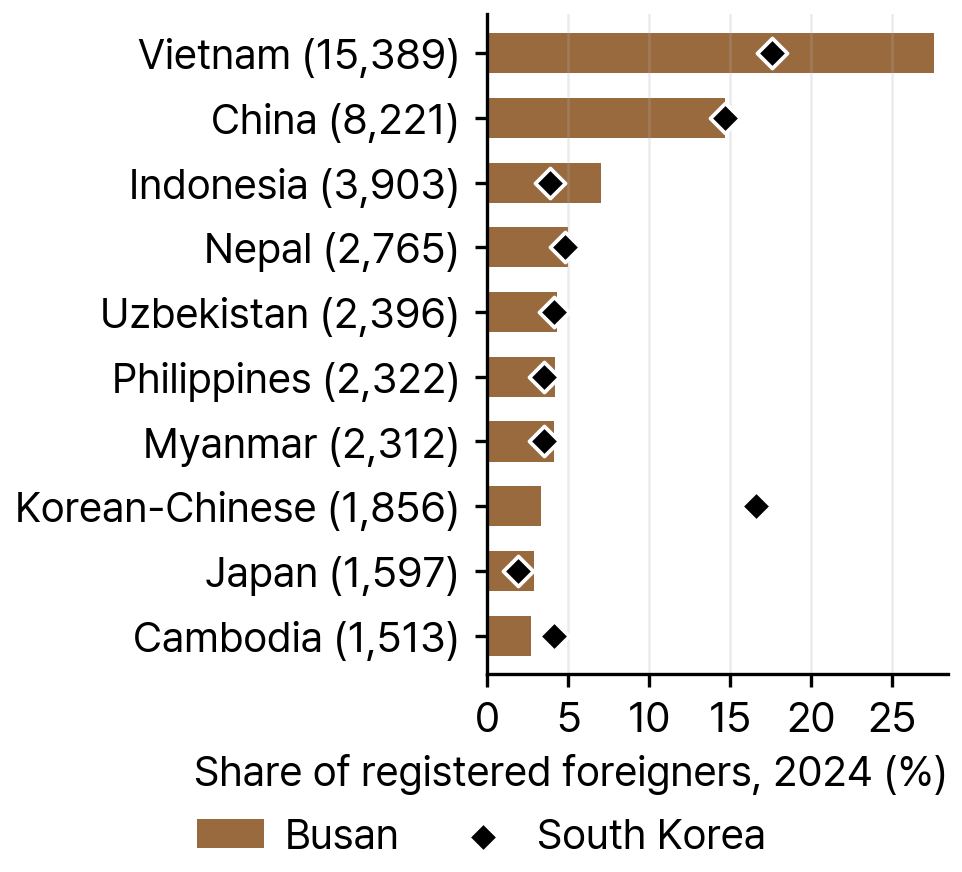
Source: KIRD dataset, from Ministry of Justice immigration yearbooks, 2024.
Table 2Ten Largest Nationalities among Registered Foreigners in Busan, 2019 and 2024
| Nationality | 2019 | 2024 | Share of Busan's registered foreigners, 2024 (%) | Busan's share of this nationality's registered foreigners in South Korea, 2024 (%) |
|---|---|---|---|---|
| Vietnam | 12,131 | 15,389 | 27.6 | 5.9 |
| China | 9,294 | 8,221 | 14.7 | 3.8 |
| Indonesia | 2,710 | 3,903 | 7.0 | 6.7 |
| Nepal | 1,050 | 2,765 | 5.0 | 3.8 |
| Uzbekistan | 1,868 | 2,396 | 4.3 | 3.9 |
| Philippines | 1,956 | 2,322 | 4.2 | 4.5 |
| Myanmar | 1,276 | 2,312 | 4.1 | 4.4 |
| Korean-Chinese | 2,492 | 1,856 | 3.3 | 0.8 |
| Japan | 1,396 | 1,597 | 2.9 | 5.7 |
| Cambodia | 1,205 | 1,513 | 2.7 | 2.5 |
Note: Korean-Chinese are Chinese nationals of Korean descent, counted separately from other Chinese nationals. Busan had 3.7 percent of all registered foreigners in South Korea in 2024.
Source: KIRD dataset, from Ministry of Justice immigration yearbooks, 2019 and 2024.
Busan had 3.7 percent of South Korea's registered foreigners in 2024 and larger shares of several national groups: 8.5 percent of Korean-Russian registered foreigners (203 of 2,383), 7.4 percent of Taiwanese (1,280 of 17,384), 6.7 percent of Indonesians (3,903 of 58,248), 6.5 percent of Canadians (291 of 4,452), and 6.3 percent of Iranians (84 of 1,336). Among the ten largest groups, it also had 5.9 percent of Vietnamese and 5.7 percent of Japanese registered foreigners.
Registered foreigners in Busan came from 144 nationalities in 2024. The Shannon diversity index, which increases with the number of nationalities and with the evenness of their shares, was 2.5 in both 2014 and 2024, and Busan ranked 10th of the 17 provinces on this index in 2024.
Overseas Koreans of foreign nationality on F-4 status report their residence instead of registering, so they are not counted among registered foreigners. In 2024, 7,485 F-4 holders reported residence in Busan, 1.4 percent of the 553,664 in South Korea. The largest groups were Korean-Chinese (2,860), U.S. nationals (1,818), Korean-Russians (1,210), Canadians (594), and Australians (243).
Residence Statuses
The study and job search group (D-2, D-4, D-10) covered 35.7 percent of Busan's registered foreigners in 2024 (19,924 people), compared with 18.6 percent nationally. Rotation labor statuses covered 24.2 percent (13,496), against 31.1 percent nationally, and settlement statuses 21.0 percent (11,714), against 27.6 percent. Family statuses accounted for 8.0 percent (4,457; 10.0 percent nationally), skilled statuses for 6.8 percent (3,811; 5.8 percent), and all other statuses for 4.3 percent (2,403; 7.1 percent).
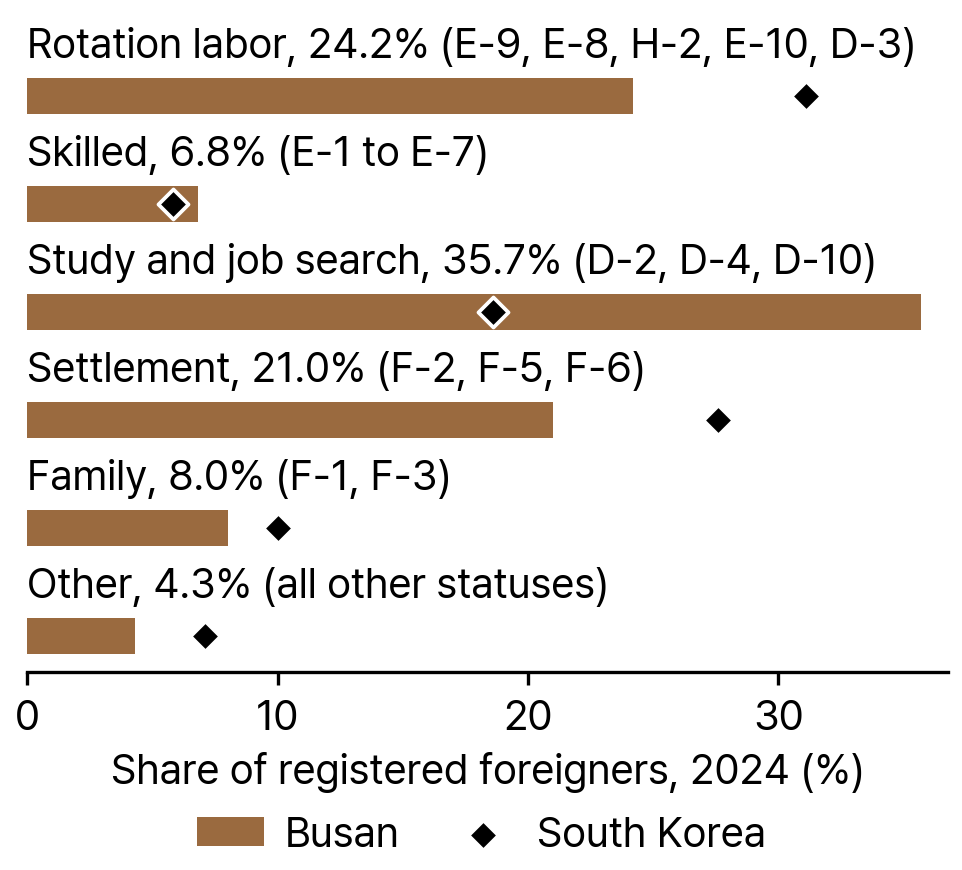
Source: KIRD dataset, from Ministry of Justice immigration yearbooks, 2024.
D-2 student status was the most common single status in 2024, with 13,136 holders (23.5 percent of Busan's registered foreigners), and Busan had 7.4 percent of all D-2 holders in South Korea. E-9 non-professional employment came second (9,497), followed by F-6 marriage migration (6,429), D-4 general trainee (5,726), and F-5 permanent residence (3,843). Busan had 15.3 percent of all E-10 crew employment holders in South Korea (3,296 people), the largest national share among its ten most common statuses.
Within the groups, E-9 and E-10 holders made up 12,793 of the 13,496 people on rotation labor statuses (9,497 plus 3,296). D-10 job seekers numbered 1,062 (the study and job search total of 19,924, minus 13,136 D-2 and 5,726 D-4 holders). F-6 marriage migrants were the largest status in the settlement group (6,429 of 11,714).
Table 3Ten Most Common Residence Statuses among Registered Foreigners in Busan, 2024
| Status | Meaning | Registered foreigners, 2024 | Share of Busan's registered foreigners (%) | Busan's share of all holders in South Korea (%) |
|---|---|---|---|---|
| D-2 | Student | 13,136 | 23.5 | 7.4 |
| E-9 | Non-professional employment | 9,497 | 17.0 | 2.9 |
| F-6 | Marriage migration | 6,429 | 11.5 | 4.4 |
| D-4 | General trainee | 5,726 | 10.3 | 7.2 |
| F-5 | Permanent residence | 3,843 | 6.9 | 1.9 |
| E-10 | Crew employment | 3,296 | 5.9 | 15.3 |
| F-1 | Visiting cohabitation | 2,720 | 4.9 | 2.8 |
| E-7 | Specially designated activities | 2,362 | 4.2 | 3.8 |
| F-3 | Dependent family | 1,737 | 3.1 | 3.4 |
| F-2 | Residential | 1,442 | 2.6 | 2.4 |
Note: Busan had 3.7 percent of all registered foreigners in South Korea in 2024. Status groups are defined under Definitions.
Source: KIRD dataset, from Ministry of Justice immigration yearbooks, 2024.
The MOIS count of 1 November 2024 groups foreign residents differently. Of Busan's 88,542 foreign residents, 67,762 were foreign nationals, among them 17,778 international students, 16,445 foreign workers, 7,518 marriage migrants, 4,432 ethnic Koreans of foreign nationality, and 21,589 other foreign nationals. The count also included 7,589 naturalized citizens and 13,191 children of foreign residents.
Districts and Population-Decline Areas
Busan has 16 districts, 15 gu and one county (Gijang-gun). In 2024 the most registered foreigners lived in Nam-gu (7,387), Gangseo-gu (6,852), and Sasang-gu (6,574), which together accounted for 37.3 percent of the city's total (20,813 of 55,805). Relative to the Korean population, Jung-gu had the highest ratio, 6.8 registered foreigners per 100 Korean residents, followed by Gangseo-gu (4.8) and Sasang-gu (3.3). Yeonje-gu had the fewest registered foreigners (886) and is the one district not shown in the figure.
Between 2019 and 2024 the number of registered foreigners rose in 15 of the 16 districts and fell only in Buk-gu (by 165). The largest gains were in Gangseo-gu (1,726), Sasang-gu (1,632), and Nam-gu (1,456). Korean residents declined in 11 districts, most in Haeundae-gu (29,698 fewer), Geumjeong-gu (29,130), and Saha-gu (28,513), and increased in Gangseo-gu (13,223 more), Gijang-gun (10,910), Yeonje-gu (3,194), Dongnae-gu (3,123), and Busanjin-gu (1,401).
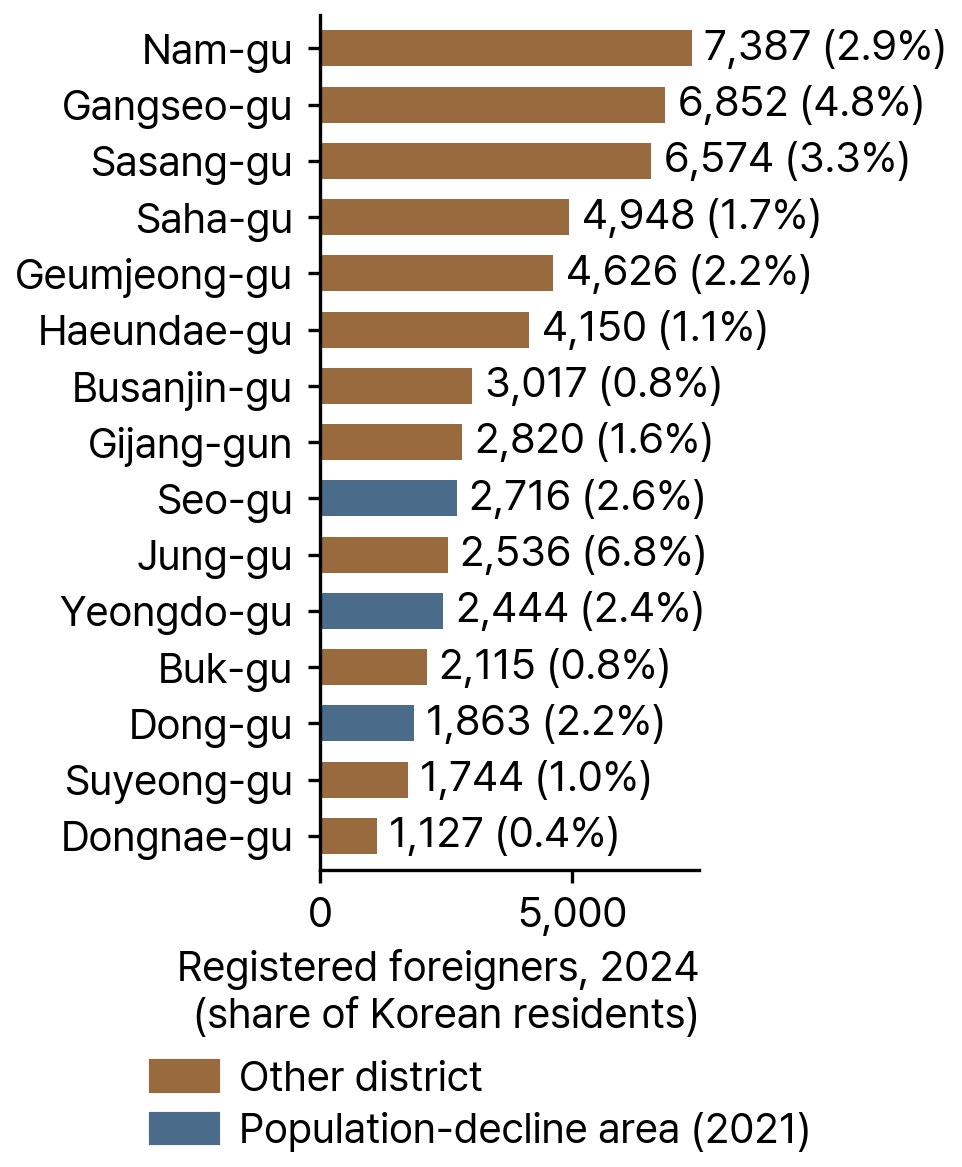
Source: KIRD dataset, from Ministry of Justice immigration yearbooks and Ministry of the Interior and Safety statistics, 2024; Ministry of the Interior and Safety list of population-decline areas, 2021.
Table 4Ten Districts of Busan with the Most Registered Foreigners, 2024
| District | Registered foreigners, 2024 | Registered foreigners per 100 Korean residents, 2024 | Change in Korean residents, 2019-24 | Change in registered foreigners, 2019-24 | Population-decline area |
|---|---|---|---|---|---|
| Nam-gu | 7,387 | 2.9 | -19,982 | +1,456 | No |
| Gangseo-gu | 6,852 | 4.8 | +13,223 | +1,726 | No |
| Sasang-gu | 6,574 | 3.3 | -19,459 | +1,632 | No |
| Saha-gu | 4,948 | 1.7 | -28,513 | +688 | No |
| Geumjeong-gu | 4,626 | 2.2 | -29,130 | +153 | No (area of interest) |
| Haeundae-gu | 4,150 | 1.1 | -29,698 | +126 | No |
| Busanjin-gu | 3,017 | 0.8 | +1,401 | +356 | No |
| Gijang-gun | 2,820 | 1.6 | +10,910 | +857 | No |
| Seo-gu | 2,716 | 2.6 | -5,041 | +839 | Yes |
| Jung-gu | 2,536 | 6.8 | -4,373 | +602 | No (area of interest) |
Note: Population-decline areas and areas of interest as designated by the Ministry of the Interior and Safety in October 2021. The other two population-decline areas, Yeongdo-gu (2,444 registered foreigners) and Dong-gu (1,863), are not among the ten districts shown.
Source: KIRD dataset, from Ministry of Justice immigration yearbooks and Ministry of the Interior and Safety statistics, 2019 and 2024; Ministry of the Interior and Safety list of population-decline areas, 2021.
In October 2021 the Ministry of the Interior and Safety designated three Busan districts, Seo-gu, Yeongdo-gu, and Dong-gu, as population-decline areas and two, Jung-gu and Geumjeong-gu, as areas of interest. From 2019 to 2024 the population-decline areas together lost 20,269 Korean residents and gained 1,691 registered foreigners, a foreign gain equal to 8.3 percent of the Korean loss. In 2024 they had 7,023 registered foreigners (2,716 in Seo-gu, 2,444 in Yeongdo-gu, and 1,863 in Dong-gu) and 292,836 Korean residents, or 2.4 registered foreigners per 100 Korean residents, against 1.7 for Busan as a whole.
The two areas of interest lost 33,503 Korean residents from 2019 to 2024 (4,373 in Jung-gu and 29,130 in Geumjeong-gu) and gained 755 registered foreigners (602 and 153), a gain equal to 2.3 percent of the Korean loss.
Three districts met this Spotlight's definition of an ethnic enclave in 2024, all for Vietnamese nationals: Sasang-gu (2,644 Vietnamese registered foreigners, 40.2 percent of the district's registered foreigners, location quotient 2.6), Seo-gu (1,297; 47.8 percent; 2.5), and Jung-gu (943; 37.2 percent; 4.9). Seo-gu is a population-decline area and Jung-gu an area of interest.
Population Trends
Busan's Korean resident population fell from 3,611,992 in 2006 to 3,519,401 in 2014, 3,413,841 in 2019, and 3,266,598 in 2024. The loss was 345,394 people (9.6 percent) over 2006-24, 252,803 (7.2 percent) over 2014-24, and 147,243 (4.3 percent) over 2019-24, and the population declined in every year from 2011 to 2024. Over 2006-24 the number of registered foreigners increased by 32,424, from 23,381 to 55,805.
Busan's total fertility rate was 0.68 in 2024, the second-lowest among the 17 provinces after Seoul (0.58), against a national rate of 0.75 (Statistics Korea, 2025). Its working-age population (ages 15 to 64) fell from 2,179,000 in 2024 to 2,129,000 in 2025, a drop of 2.3 percent (50,000 people) and the steepest rate of decline among the 17 provinces. Over the same year the population aged 65 and older rose 5.1 percent, from 768,000 to 807,000 (Kookje Ilbo, 2026).
Busan has recorded net outmigration every year since 1989, and its net outmigration rate was 0.4 percent in 2024 (News1, 2025). In Statistics Korea's provincial population projections, Busan's total population falls from 3,303,000 in 2022 to 2,991,000 in 2035, the first year below 3 million, and to 2,451,000 in 2052. The projected decline of 25.8 percent from 2022 to 2052 is the largest among the 17 provinces (Kookje Ilbo, 2024).
Industry and Foreign Workers
Non-professional employment (E-9), the general permit of the Employment Permit System (EPS), was the most common work status among Busan's registered foreigners. E-9 holders numbered 9,668 in 2014, 8,186 in 2019, and 6,069 in 2021, and rose to 9,497 in 2024, still below the 2014 level. The 2024 count was 17.0 percent of Busan's registered foreigners and 2.9 percent of all E-9 holders in South Korea, less than Busan's 3.7 percent share of all registered foreigners. The MOIS count of 1 November 2024 classified 16,445 of Busan's foreign residents as foreign workers.
In the first quarter of 2022, 1,302 business establishments in Busan were registered under the EPS, 1,178 of them under the general E-9 permit; in the second quarter of 2022 the figures were 1,283 and 1,170 (Korea Employment Information Service, 2022).
Busan also had 3,296 registered foreigners on E-10 crew employment status in 2024, 5.9 percent of its registered foreigners and 15.3 percent of all E-10 holders in South Korea.
A 2023 news report counted the most foreign residents in Nam-gu (7,938) and attributed this to the district's universities and international students. It attributed the next-largest counts, in Sasang-gu (7,666), Saha-gu (7,323), and Gangseo-gu (6,594), to the Sasang and Noksan industrial parks, which in the report's account provide more jobs for foreign workers there than in other districts (Sisa Journal, 2023). These counts predate the 2024 registered-foreigner counts in the district table.
Seasonal workers on E-8 status hardly appear in the year-end count, with 3 registered in Busan on 31 December 2023 and 28 on 31 December 2024. The 31 December count misses most seasonal workers, because their contracts end before winter, so these figures do not measure seasonal employment in Busan over the year. To our knowledge, no published source reports an allocation of seasonal workers to Busan.
International Students and Universities
Registered foreigners on D-2 (student) or D-4 (general trainee) status in Busan numbered 5,507 in 2008 and 6,453 in 2014. The count rose to 13,484 in 2019, fell by 2,587 to 10,897 in 2020, and rose in each year from 2021 to 18,862 in 2024, the highest in the series and 3.4 times the 2008 count. In 2024 Busan had 7.3 percent of all D-2 and D-4 holders in South Korea, about twice its 3.7 percent share of all registered foreigners.
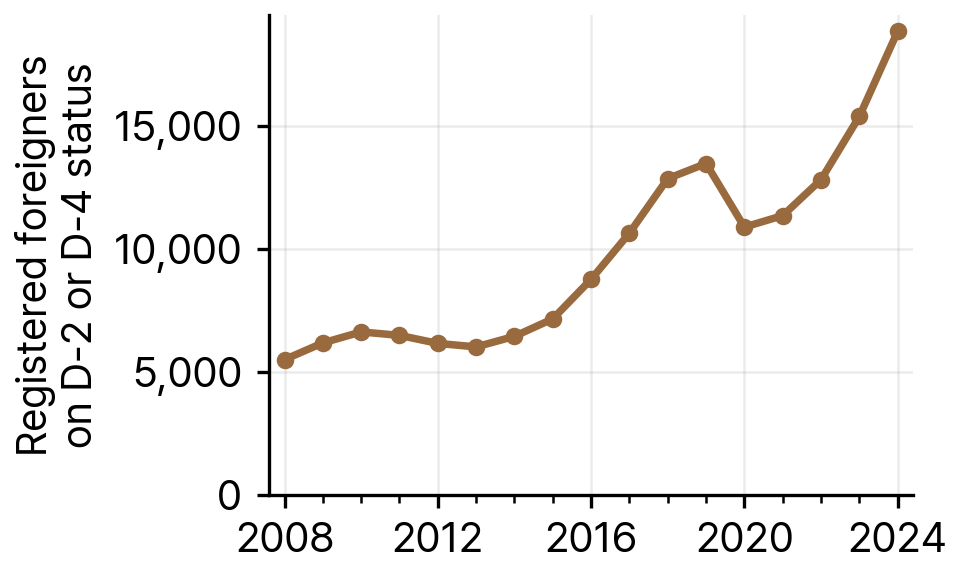
Source: KIRD dataset, from Ministry of Justice immigration yearbooks, 2008-2024.
In the count of the Korean Educational Development Institute (KEDI) as of 1 April 2024, Kyungsung University had the most international students among Busan's higher education institutions (1,930), followed by Dong-A University (1,846), Pusan National University (1,793), Pukyong National University (1,741), and Dongseo University (1,625). KEDI's institution-level figures for Busan sum to 15,063 international students at 24 universities and colleges, and the universities named above enrolled 8,935 of them (59.3 percent) (KEDI, 2024).
According to the city, Busan had 24,328 international students in 2026, about 30 percent more than the 18,630 of 2025, and the city aims to attract 30,000 international students by 2028 (The CEN News, 2026). The KEDI and city counts come from different sources and dates than the D-2 and D-4 counts above. The metropolitan-type visa pilot and the support hub for international students are described under Provincial Policy.
Provincial Policy
Busan's Ordinance on Support for Foreign Residents is managed by the Population Policy Officer in the city's Population and Youth Policy Bureau, and its current version took effect on 23 September 2026 (Ordinance No. 8003). Article 7, unchanged since a full revision of the ordinance on 3 April 2024, requires the mayor to prepare and carry out an annual Foreign Resident Support Plan covering support goals, a survey of foreign residents' living conditions, and education, counseling, medical, and childcare services for foreign residents and their families (Local Statutes Information System, 2026).
Article 6-2, added on 16 April 2025 (Ordinance No. 7568), allows the mayor to support children and adolescents in foreign-resident families with education for school adjustment and language skills, home-visit learning before school entry, social and cultural adaptation education for children who came to Korea partway through childhood, and the cost of care for infants and young children at daycare centers under the Infant Care Act (Local Statutes Information System, 2026).
The national government's 2026 foreign policy implementation plan for local governments lists 50 tasks for Busan, with a 2026 budget of KRW 11,922 million, 13.8 percent more than the KRW 10,474 million of 2025 (Joint Government Ministries, 2026).
For the 2025 regional specialized visa program, Busan accepted applications at district offices from 26 March to 25 April 2025. The program supports foreign nationals in obtaining F-2-R, E-7-4R, and F-4-R visas on conditions that include living and working in the population-decline areas of Seo-gu, Dong-gu, and Yeongdo-gu or the areas of interest of Jung-gu and Geumjeong-gu (Busan Metropolitan City, 2025a).
The Ministry of Justice selected Busan on 3 April 2025 for its metropolitan-type visa pilot program. Under the program the city plans to bring 1,000 international students to local universities over two years, with the aim of training professionals for the semiconductor, secondary-battery, and future automotive-parts industries (Busan Metropolitan City, 2025b). In the first year, Busan recruited 335 students from 10 countries, including Bangladesh, Nepal, and Vietnam, through 14 local universities (Kookje Ilbo, 2025).
In February 2026 the city opened the Integrated Support Hub for Foreign Students. With the Busan Immigration Service, the hub offers group fingerprint registration for new international students, financial and visa counseling, Korean-language education, and cultural mentoring (The CEN News, 2026).
The nonprofit Association With Migrants began operating the city-commissioned Busan Foreign Workers Support Center in 2012 and renamed it the Busan Foreign Residents Support Center in 2021 (Association With Migrants, 2021).
Languages
The KIRD dataset estimates the first languages of registered foreigners by applying Ethnologue's first-language shares for each country of origin to the nationality counts. By this estimate, Vietnamese was the most common first language among Busan's registered foreigners in 2024, with 13,164 speakers (23.6 percent of 55,805). Chinese followed with 9,278, then Indonesian (2,748), Tagalog/Filipino (2,041), Russian (1,881), English (1,795), Uzbek (1,752), Khmer (1,672), Japanese (1,566), and Burmese (1,464).
Twelve languages had at least 1,000 estimated first-language speakers among Busan's registered foreigners in 2024. Korean is excluded from the estimates, so Korean-Chinese residents, whose first language the dataset takes to be Korean, add no speakers. The estimates also do not cover naturalized citizens or overseas Koreans on F-4 status, who are not registered foreigners.
Service Organizations and Community Places
The KIRD census of 1,720 migrant-serving organizations in South Korea lists 88 in Busan (5.1 percent of the total), or 15.8 per 10,000 registered foreigners, against 11.6 nationally. Of the 88, 84 provide services directly, and 13 are family centers (가족센터). The census also counts 6 medical providers, 4 foreign-resident support centers, 4 migrant-worker centers, 4 nongovernmental organizations, 4 community groups, 3 international student centers, 3 youth and education organizations, 2 schools, 2 research institutes, 2 administrative offices, 2 media outlets, and 1 legal office.
Counted by the populations they serve, 30 of Busan's 88 organizations work with families, 27 with all migrants, 19 with workers, and 11 with children. Six each work with refugees, undocumented migrants, and students, and one each with women and youth. An organization can be counted under more than one population.
Choryang-dong, near Busan Station in Dong-gu, contains two places associated with foreign residents. A 2022 study describes the area known as Texas Village as the “debut stage” in Korea for Russian-speaking migrants and shuttle traders after South Korea and Russia established diplomatic relations in the 1990s (Noh, 2022). Development of Shanghai Street in the neighborhood's Chinatown began after Busan and Shanghai became sister cities in 1993; the area was designated a Chinatown special zone in 2007 and has hosted a Chinatown festival each October since 2008 (EKW, 2019).
The Busan Mosque in Geumjeong-gu opened in September 1980. A 2002 news report put its congregation at about 1,000 people, 99 percent of them foreigners and about half Indonesian (OhmyNews, 2002).
Sources
KIRD dataset (Korea Immigration Regional Dashboard), openICPSR, compiled from Ministry of Justice immigration yearbooks and Ministry of the Interior and Safety statistics, 2006-2024. https://doi.org/10.3886/E249944V1
Kookje Ilbo. 2024. Busan Population Projected to Drop to 2.45 Million in 2052; Working-Age Population of the Southeast Region to Halve (in Korean), citing Statistics Korea provincial population projections, 2022-2052. https://www.kookje.co.kr/news2011/asp/newsbody.asp?code=0200&key=20240528.99099008288
Statistics Korea, via Korea Policy Briefing (대한민국 정책브리핑). 2025. 2024 Birth and Death Statistics (Preliminary), briefing of 26 February 2025 (in Korean). https://www.korea.kr/briefing/policyBriefingView.do?newsId=156676180
Kookje Ilbo. 2026. Busan's Population Declining Fastest; 25 Percent of One-Person Households Aged 70 or Older (in Korean). https://www.kookje.co.kr/news2011/asp/newsbody.asp?code=0200&key=20260729.22003008305
News1. 2025. Busan's Net Population Outflow Rate 0.4 Percent Last Year, Outflow Every Year since 1989 (in Korean), citing the Southeast Regional Statistics Office. https://www.news1.kr/local/busan-gyeongnam/5686005
Korea Employment Information Service, via e-Narajipyo (e-나라지표). Employment Permit System Employment Trends: Establishments by Province and Permit Type, 2022 (in Korean). https://www.index.go.kr/unity/potal/main/EachDtlPageDetail.do?idx_cd=1501
Sisa Journal. 2023. Busan's Foreign-Resident Rate Second from the Bottom: Will Support Policies Take Effect? (in Korean). https://www.sisajournal.com/news/articleView.html?idxno=259355
Korean Educational Development Institute (KEDI). 2024. International Students in Korean Higher Education Institutions, 2024 (2024년도 국내 고등교육기관 외국인 유학생 현황), hosted by the National Assembly Library (in Korean). https://clik.nanet.go.kr/clikr-collection/policyinfo/202/1013/2024/CLIKC4856094490052227_attach_1.xlsx
The CEN News (더쎈뉴스). 2026. Busan's International Students Pass 24,000, Up 5,700 in One Year (in Korean). https://www.mhns.co.kr/news/articleView.html?idxno=761338
Local Statutes Information System (자치법규정보시스템), Ministry of the Interior and Safety. 2026. Busan Metropolitan City Ordinance on Support for Foreign Residents (부산광역시 외국인주민 지원 조례), Ordinance No. 8003, in force from 23 September 2026 (in Korean). https://www.elis.go.kr/allalr/selectAlrBdtOne?alrNo=26000063002003&histNo=011
Joint Government Ministries (관계부처 합동), led by the Ministry of Justice. 2026. 2026 Foreign Policy Implementation Plan: Local Governments (2026년 외국인정책 시행계획, 지방자치단체) (in Korean). https://www.immigration.go.kr/bbs/immigration/226/493572/download.do
Busan Metropolitan City. 2025a. Busan Recruits Foreign Talent for the 2025 Regional Specialized Visa Program (in Korean). https://www.busan.go.kr/nbtnewsBU/1673075
Busan Metropolitan City. 2025b. Busan Selected for the Ministry of Justice Metropolitan-Type Visa Pilot Program (in Korean). https://www.busan.go.kr/nbtnewsBU/1675395
Kookje Ilbo. 2025. Busan Attracts Its First 335 International Students through the Metropolitan-Type Visa (in Korean), via Daum. https://v.daum.net/v/20251022191624924
Association With Migrants (이주민과함께). History (in Korean). https://somi.or.kr/연혁/
Noh, Yongseck (노용석). 2022. A Study on the Formation of Texas Street near Busan Station and the Influx of Former Soviet Bloc Migrants (부산역 인근 '텍사스촌'의 형성과 러시아어권 이주민 유입 연구). 민족문화논총 (Minjok Munhwa Nonchong) 82: 353-384. https://www.kci.go.kr/kciportal/mobile/ci/sereArticleSearch/ciSereArtiView.kci?sereArticleSearchBean.artiId=ART002924734
EKW (동포세계신문). 2019. Choryang-dong, Dong-gu, Busan: A Multinational Street That Tells Korea's Modern History (in Korean). https://www.ekw.co.kr/news/articleView.html?idxno=1842
OhmyNews. 2002. Busan Islamic Center, a Mecca of Their Own (in Korean). https://www.ohmynews.com/NWS_Web/View/at_pg.aspx?CNTN_CD=A0000099938
Suggested citation: Korea Immigration Regional Dashboard (KIRD). 2026. “Foreign Residents in Busan.” Foreign Residents in South Korea series, September 2026. Data: Korea Immigration Regional Dashboard (KIRD) dataset, https://doi.org/10.3886/E249944V1. Interactive maps and tables: https://immigrantsinkorea.today.