 Korea Immigration Regional Dashboard
SpotlightSeptember 2026Province profilesDownload PDF
Foreign Residents in North Chungcheong Province
Highlights
- At the end of 2024, North Chungcheong Province had 56,301 registered foreigners, the eighth-largest number among South Korea's 17 provinces and metropolitan cities and the third-highest ratio to Korean residents (3.5 per 100, against 2.9 nationally).
- Between 2019 and 2024 the number of registered foreigners in the province grew 38.3 percent (15,587 people), the second-fastest growth among the 17 provinces, while the Korean resident population fell 0.6 percent (8,830 people).
- Rotation labor statuses covered 41.0 percent of the province's registered foreigners in 2024, against 31.1 percent nationally, and the province was home to 6.1 percent of all E-9 non-professional employment visa holders in South Korea.
North Chungcheong Province (Chungcheongbuk-do) had 56,301 registered foreigners on 31 December 2024, 3.8 percent of the 1,488,353 registered foreigners in South Korea. The province ranked eighth among the 17 provinces and metropolitan cities by that count and third by the ratio of registered foreigners to Korean residents, with 3.5 per 100 Korean residents against 2.9 nationally. The Ministry of the Interior and Safety counted 97,341 foreign residents in the province on 1 November 2024, a broader count that includes naturalized citizens and children of foreign residents.
The number of registered foreigners rose from 17,334 in 2006 to 56,301 in 2024, about 3.2 times the 2006 count, while the Korean resident population grew 6.5 percent, from 1,494,559 to 1,591,177. Between 2019 and 2024, registered foreigners increased by 15,587 (38.3 percent), the second-fastest growth among the 17 provinces, and Korean residents decreased by 8,830 (0.6 percent), so the foreign gain equaled 176.5 percent of the Korean loss. In the six districts designated as population-decline areas, the gain of 2,414 registered foreigners equaled 11.1 percent of the loss of 21,791 Korean residents.
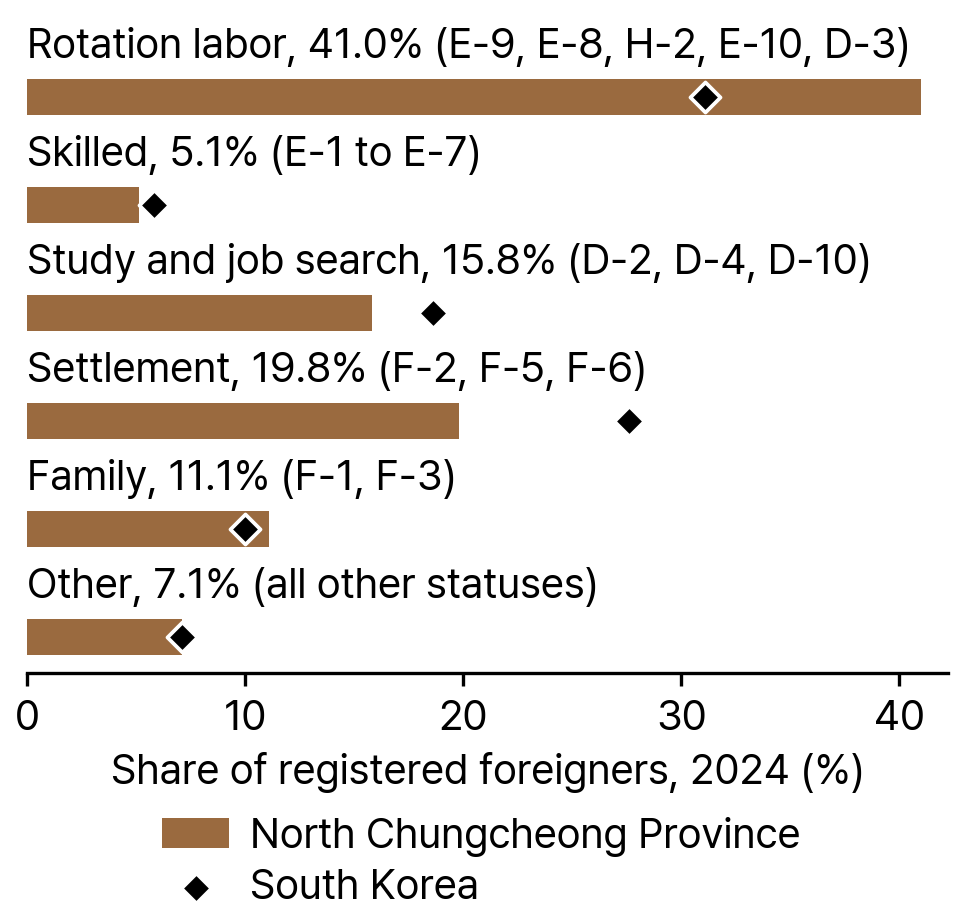
Compared with registered foreigners nationwide, those in North Chungcheong in 2024 were more likely to hold rotation labor statuses (41.0 percent against 31.1 percent) and less likely to hold settlement statuses (19.8 percent against 27.6 percent). The province was home to 6.1 percent of the country's E-9 non-professional employment visa holders and 7.6 percent of its registered Nepali nationals. By the Shannon index, its registered foreigners were the most diverse by nationality of the 17 provinces, with Vietnamese nationals the largest group at 16.2 percent. Eumseong-gun had 15.1 registered foreigners per 100 Korean residents, and Eumseong-gun and Jincheon-gun together accounted for 39.5 percent of the province's registered foreigners.
Size of the Foreign-Resident Population
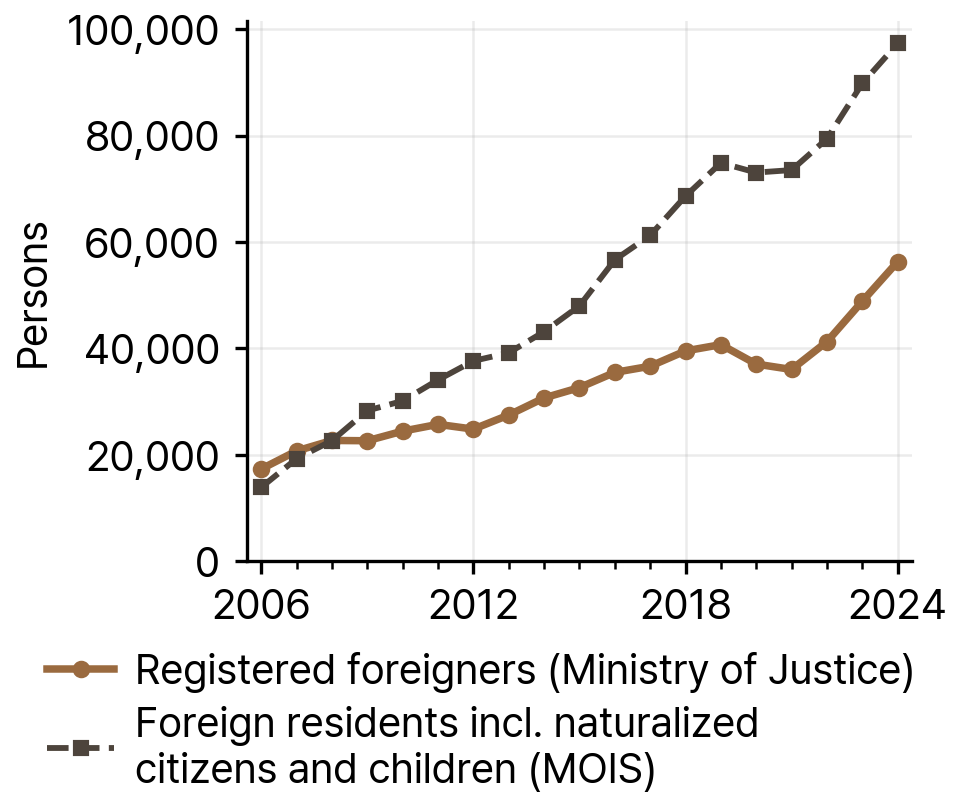
The number of registered foreigners in North Chungcheong rose from 17,334 in 2006 to 30,700 in 2014 and 40,714 in 2019 (Figure 1 and Table 1). It fell to 37,060 in 2020 and 36,045 in 2021, 11.5 percent below the 2019 level, then rose to 41,270 in 2022, 48,866 in 2023 and 56,301 in 2024, the highest count in the 2006-2024 series. The increase from 2023 to 2024 alone was 7,435 people (15.2 percent).
The MOIS count of foreign residents, which adds naturalized citizens and children of foreign residents, rose from 22,669 in 2008 to 43,148 in 2014 and 74,880 in 2019. It fell to 73,064 in 2020, rose in each year after that and stood at 97,341 in 2024, 1.7 times the registered-foreigner count (97,341 against 56,301).
Registered foreigners per 100 Korean residents rose from 1.2 in 2006 to 1.9 in 2014, 2.5 in 2019 and 3.5 in 2024; the national ratio in 2024 was 2.9. In 2024 the province ranked eighth among the 17 provinces by the number of registered foreigners and third by registered foreigners per Korean resident. It was home to 3.8 percent of all registered foreigners in South Korea.
Source: KIRD dataset, from Ministry of Justice immigration yearbooks and Ministry of the Interior and Safety statistics, 2006-2024.
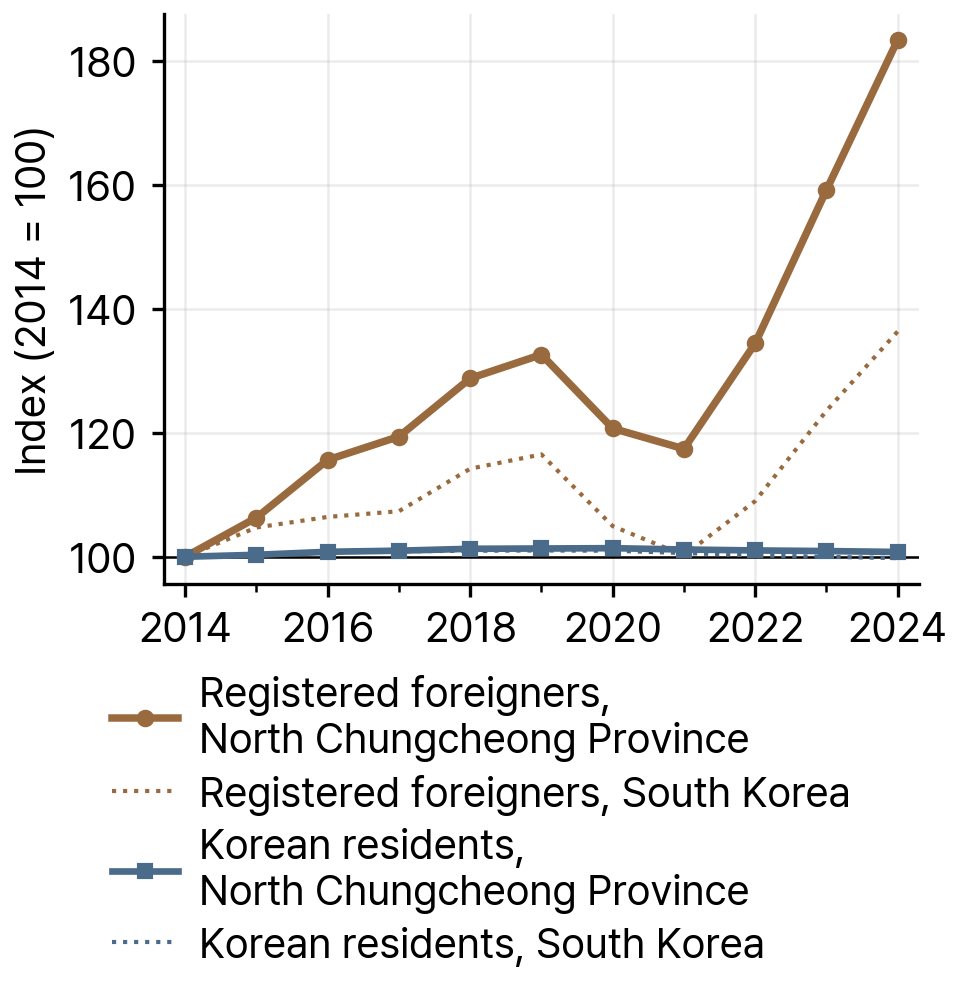
Figure 2 sets registered foreigners and Korean residents in 2014 to 100, for the province and for South Korea. By 2024 the index for registered foreigners in the province stood at 183.4 (56,301 against 30,700) and the index for Korean residents at 100.8 (1,591,177 against 1,578,933). The Korean resident count peaked at 1,600,837 in 2020 and declined in each year from 2021 to 2024.
Source: KIRD dataset, from Ministry of Justice immigration yearbooks and Ministry of the Interior and Safety resident registration statistics, 2014-2024.
Table 1Registered Foreigners, MOIS Foreign Residents and Korean Residents in North Chungcheong Province, Selected Years, 2006-24
| Year | Registered foreigners | MOIS foreign residents | Korean residents | Registered foreigners per 100 Korean residents |
|---|---|---|---|---|
| 2006 | 17,334 | n/a | 1,494,559 | 1.2 |
| 2014 | 30,700 | 43,148 | 1,578,933 | 1.9 |
| 2019 | 40,714 | 74,880 | 1,600,007 | 2.5 |
| 2024 | 56,301 | 97,341 | 1,591,177 | 3.5 |
Note: Registered foreigners are counted on 31 December and MOIS foreign residents on 1 November. MOIS counts are used from 2008, so the 2006 cell is n/a. Figure 1 also shows the MOIS counts for 2006 (13,889) and 2007 (19,274); both were lower than the registered-foreigner counts of those years (17,334 and 20,733).
Source: KIRD dataset, from Ministry of Justice immigration yearbooks and Ministry of the Interior and Safety statistics, 2006-2024.
Nationalities
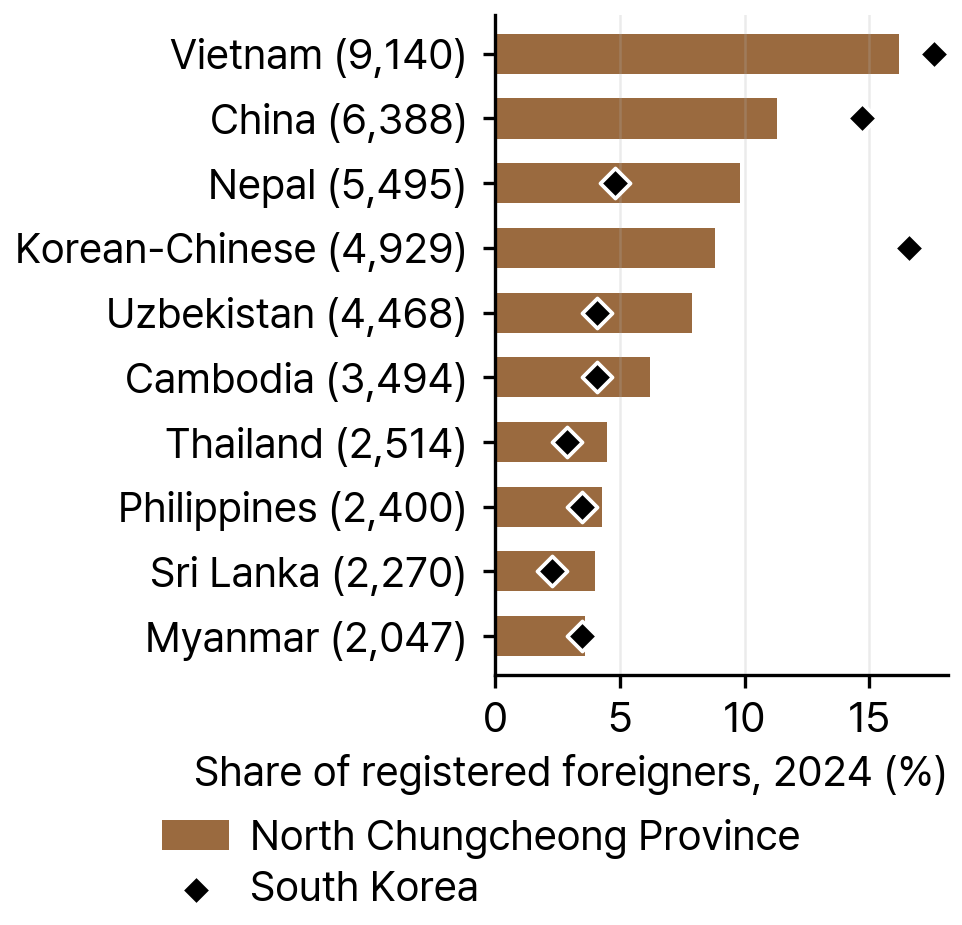
Vietnamese nationals were the largest group of registered foreigners in North Chungcheong in 2024 (9,140, or 16.2 percent), followed by Chinese (6,388, 11.3 percent), Nepali (5,495, 9.8 percent), Korean-Chinese (4,929, 8.8 percent) and Uzbek nationals (4,468, 7.9 percent) (Figure 3 and Table 2). The ten largest nationalities made up 76.6 percent of registered foreigners (43,145 of 56,301).
The province was home to 3.8 percent of all registered foreigners in South Korea in 2024 and to larger shares of several of its main groups: 7.6 percent of registered Nepali nationals, 7.2 percent of Uzbek nationals, 6.7 percent of Sri Lankans, 5.8 percent of Thais, 5.7 percent of Cambodians and 4.6 percent of Filipinos. Its shares of Vietnamese (3.5 percent), Chinese (2.9 percent) and Korean-Chinese (2.0 percent) were smaller. Korean-Chinese made up 8.8 percent of the province's registered foreigners, against 16.6 percent nationally.
Among all nationalities with at least 1,000 registered foreigners in South Korea, the province's largest shares were of Malaysians (578 of 5,134, or 11.3 percent), Ethiopians (144 of 1,445, 10.0 percent), Korean-Russians (209 of 2,383, 8.8 percent), Nepali nationals (5,495 of 72,151, 7.6 percent) and Yemenis (91 of 1,200, 7.6 percent).
Between 2019 and 2024, the number of Nepali nationals more than doubled, from 2,627 to 5,495, and the number of Myanmar nationals almost doubled, from 1,025 to 2,047. Cambodians increased 65.1 percent and Sri Lankans 56.3 percent. Korean-Chinese were the only one of the ten largest groups to decline, from 6,082 to 4,929 (19.0 percent).
Source: KIRD dataset, from Ministry of Justice immigration yearbooks, 2024.
Table 2Ten Largest Nationalities among Registered Foreigners in North Chungcheong Province, 2019 and 2024
| Nationality | 2019 | 2024 | Share of the province's registered foreigners, 2024 (%) | Province's share of all registered foreigners of this nationality, 2024 (%) |
|---|---|---|---|---|
| Vietnam | 6,929 | 9,140 | 16.2 | 3.5 |
| China | 5,110 | 6,388 | 11.3 | 2.9 |
| Nepal | 2,627 | 5,495 | 9.8 | 7.6 |
| Korean-Chinese | 6,082 | 4,929 | 8.8 | 2.0 |
| Uzbekistan | 3,542 | 4,468 | 7.9 | 7.2 |
| Cambodia | 2,116 | 3,494 | 6.2 | 5.7 |
| Thailand | 1,743 | 2,514 | 4.5 | 5.8 |
| Philippines | 2,056 | 2,400 | 4.3 | 4.6 |
| Sri Lanka | 1,452 | 2,270 | 4.0 | 6.7 |
| Myanmar | 1,025 | 2,047 | 3.6 | 3.9 |
Note: The province was home to 3.8 percent of all registered foreigners in South Korea in 2024. Korean-Chinese are counted separately from other Chinese nationals.
Source: KIRD dataset, from Ministry of Justice immigration yearbooks, 2019 and 2024.
By the Shannon diversity index, which rises with the number of nationalities and the evenness of their shares, registered foreigners in North Chungcheong were the most diverse of the 17 provinces in 2024, with an index of 2.7, up from 2.5 in 2014. The 2024 data recorded 117 nationalities in the province.
Overseas Koreans on F-4 status report their residence instead of registering and are not counted above. In 2024, 16,418 F-4 holders reported residence in the province, 3.0 percent of the 553,664 nationwide. Korean-Chinese were the largest group (9,326), followed by Korean-Russians (2,563) and nationals of Uzbekistan (2,206), Kazakhstan (787) and the United States (635). The F-4 Korean-Chinese outnumbered the 4,929 registered Korean-Chinese by almost two to one.
Residence Statuses
Registered foreigners in North Chungcheong held rotation labor statuses more often than registered foreigners nationwide (Figure 4). In 2024 these statuses covered 41.0 percent of the province's registered foreigners (23,080 people), against 31.1 percent nationally. Settlement statuses covered 19.8 percent (27.6 percent nationally), study and job search statuses 15.8 percent (18.6 percent), family statuses 11.1 percent (10.0 percent), skilled statuses 5.1 percent (5.8 percent) and other statuses 7.1 percent (7.1 percent).
Source: KIRD dataset, from Ministry of Justice immigration yearbooks, 2024.
The E-9 non-professional employment visa was the most common status in 2024, held by 20,089 people, or 35.7 percent of the province's registered foreigners and 6.1 percent of all E-9 holders in South Korea (Table 3). D-2 students were next (6,135), followed by F-6 marriage migrants (5,056), F-5 permanent residents (4,419) and F-1 visiting cohabitation holders (4,317). Among the ten most common statuses, the province's share of all holders in the country was highest for E-9 and for G-1, a miscellaneous status (5.6 percent), and lowest for F-5 (2.2 percent) and H-2 visiting employment (2.7 percent).
Table 3Ten Most Common Residence Statuses among Registered Foreigners in North Chungcheong Province, 2024
| Status | Meaning | Registered foreigners | Share of the province's registered foreigners (%) | Province's share of all holders in South Korea (%) |
|---|---|---|---|---|
| E-9 | Non-professional employment | 20,089 | 35.7 | 6.1 |
| D-2 | Student | 6,135 | 10.9 | 3.4 |
| F-6 | Marriage migration | 5,056 | 9.0 | 3.4 |
| F-5 | Permanent residence | 4,419 | 7.8 | 2.2 |
| F-1 | Visiting cohabitation | 4,317 | 7.7 | 4.5 |
| G-1 | Other (miscellaneous) | 3,171 | 5.6 | 5.6 |
| H-2 | Visiting employment | 2,524 | 4.5 | 2.7 |
| E-7 | Specially designated activities | 2,463 | 4.4 | 3.9 |
| D-4 | General trainee | 2,431 | 4.3 | 3.0 |
| F-3 | Dependent family | 1,944 | 3.5 | 3.8 |
Note: Shares of the province's registered foreigners use the 2024 total of 56,301. Meanings follow the English status labels in the KIRD dataset.
Source: KIRD dataset, from Ministry of Justice immigration yearbooks, 2024.
The MOIS count classifies foreign residents by other categories. Of the 97,341 foreign residents it counted in the province on 1 November 2024, 78,349 did not hold Korean nationality: 24,432 foreign workers, 6,065 marriage migrants, 7,705 international students, 13,240 ethnic Koreans of foreign nationality and 26,907 other foreign nationals. The remaining 18,992 were naturalized citizens (7,530) and children of foreign residents (11,462).
Districts and Population-Decline Areas
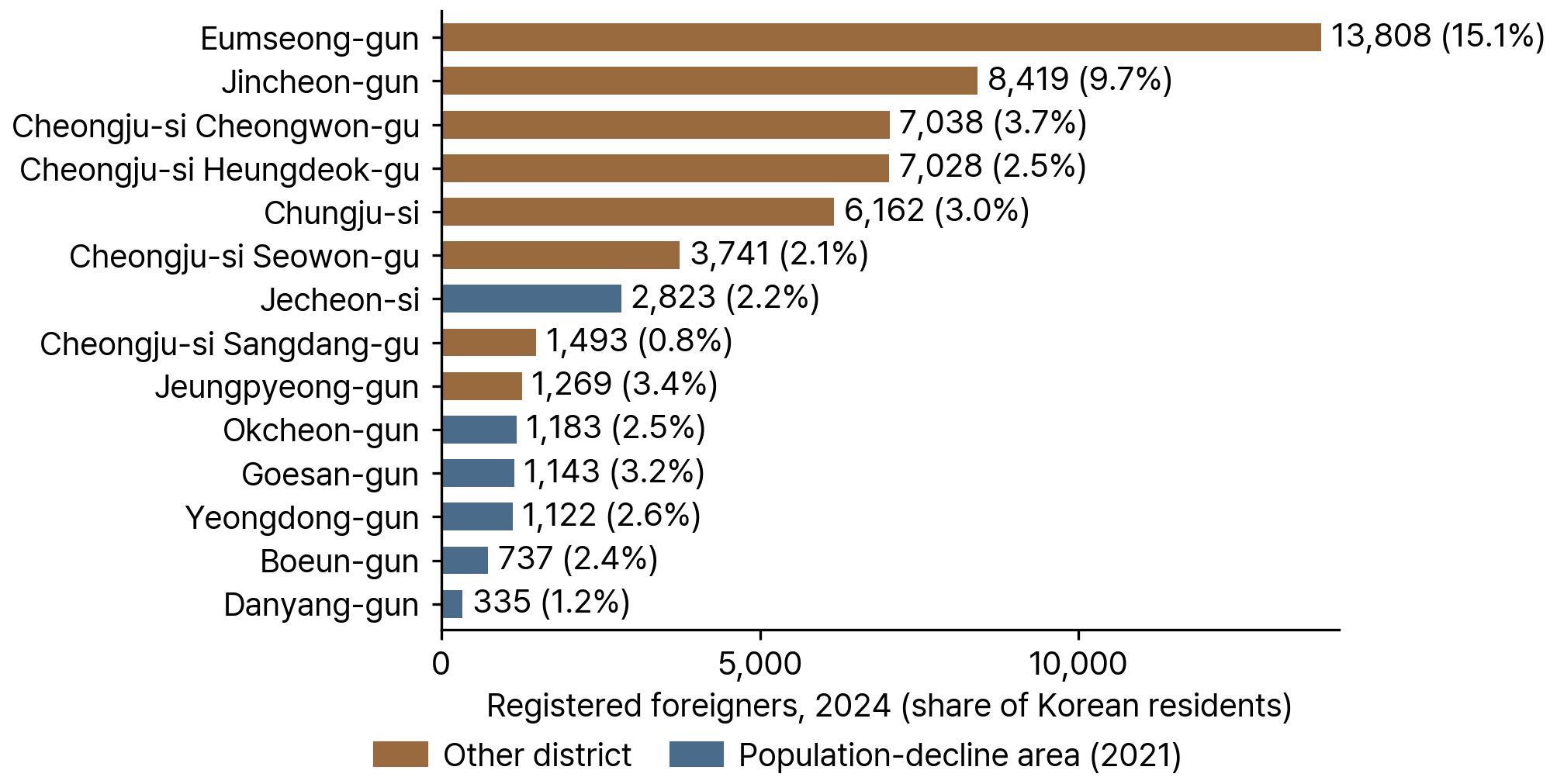
The KIRD data divide North Chungcheong into 14 districts, made up of Cheongju-si's four general districts (gu), the cities of Chungju-si and Jecheon-si, and eight counties (gun). Eumseong-gun had the most registered foreigners in 2024 (13,808), 24.5 percent of the provincial total, and the highest ratio to Korean residents, 15.1 per 100 (Figure 5 and Table 4). Jincheon-gun followed with 8,419 (9.7 per 100 Korean residents). The two counties together accounted for 39.5 percent of the province's registered foreigners (22,227 of 56,301).
Cheongju's four general districts had 19,300 registered foreigners in 2024, 34.3 percent of the provincial total, or 2.3 per 100 Korean residents (19,300 against 854,537). Cheongwon-gu (7,038) and Heungdeok-gu (7,028) had the most. Chungju-si had 6,162 registered foreigners (3.0 per 100 Korean residents).
Between 2019 and 2024, the number of registered foreigners rose in all 14 districts. The largest gains were in Eumseong-gun (4,356), Cheongju-si Cheongwon-gu (2,571) and Jincheon-gun (2,346), which together accounted for 59.5 percent of the provincial increase of 15,587. Korean residents declined in 11 of the 14 districts. In Eumseong-gun the gain of 4,356 registered foreigners exceeded the loss of 3,746 Korean residents, and Jincheon-gun gained both Korean residents (5,453) and registered foreigners (2,346). Korean resident counts in Cheongju's general districts moved in opposite directions, from a gain of 23,701 in Heungdeok-gu to a loss of 21,588 in Seowon-gu, with a net gain of 14,971 for the city.
Source: KIRD dataset, from Ministry of Justice immigration yearbooks and Ministry of the Interior and Safety resident registration statistics, 2024; population-decline areas as designated by the Ministry of the Interior and Safety in October 2021.
Table 4Ten Districts with the Most Registered Foreigners in North Chungcheong Province, 2019-24
| District | Registered foreigners, 2024 | Per 100 Korean residents, 2024 | Change in Korean residents, 2019-24 | Change in registered foreigners, 2019-24 | Population-decline area |
|---|---|---|---|---|---|
| Eumseong-gun | 13,808 | 15.1 | -3,746 | +4,356 | No |
| Jincheon-gun | 8,419 | 9.7 | +5,453 | +2,346 | No |
| Cheongju-si Cheongwon-gu | 7,038 | 3.7 | -6,742 | +2,571 | No |
| Cheongju-si Heungdeok-gu | 7,028 | 2.5 | +23,701 | +1,624 | No |
| Chungju-si | 6,162 | 3.0 | -3,496 | +829 | No |
| Cheongju-si Seowon-gu | 3,741 | 2.1 | -21,588 | +659 | No |
| Jecheon-si | 2,823 | 2.2 | -6,048 | +1,198 | Yes |
| Cheongju-si Sangdang-gu | 1,493 | 0.8 | +19,600 | +298 | No |
| Jeungpyeong-gun | 1,269 | 3.4 | -221 | +490 | No |
| Okcheon-gun | 1,183 | 2.5 | -2,819 | +436 | Yes |
Note: Per 100 Korean residents is registered foreigners divided by Korean residents in the district, times 100. The four districts not shown, all population-decline areas, are Goesan-gun (1,143 registered foreigners in 2024), Yeongdong-gun (1,122), Boeun-gun (737) and Danyang-gun (335).
Source: KIRD dataset, from Ministry of Justice immigration yearbooks and Ministry of the Interior and Safety resident registration statistics, 2019-2024; population-decline areas as designated by the Ministry of the Interior and Safety in October 2021.
The Ministry of the Interior and Safety designated six of the province's districts as population-decline areas in October 2021: Jecheon-si and the counties of Goesan, Yeongdong, Okcheon, Boeun and Danyang. It designated no area of interest in the province. From 2019 to 2024 these areas together lost 21,791 Korean residents and gained 2,414 registered foreigners, a foreign gain equal to 11.1 percent of the Korean loss. In 2024 they had 7,343 registered foreigners (13.0 percent of the provincial total), or 2.3 per 100 Korean residents (7,343 against 314,455), below the provincial ratio of 3.5. Jecheon-si had the most registered foreigners among them (2,823) and the largest gain (1,198), and Danyang-gun the fewest (335).
By the definition used in this Spotlight, the province had one ethnic enclave in 2024. In Cheongju-si Cheongwon-gu, 2,504 Chinese nationals made up 35.6 percent of the district's registered foreigners, with a location quotient of 3.1.
Population Trends
The Korean resident population of North Chungcheong grew from 1,494,559 in 2006 to a peak of 1,600,837 in 2020, then declined each year to 1,591,177 in 2024. It grew 0.8 percent (12,244 people) between 2014 and 2024 and fell 0.6 percent (8,830 people) between 2019 and 2024. Over the same two periods, registered foreigners grew 83.4 percent (25,601 people) and 38.3 percent (15,587 people).
The province's population passed 1.66 million for the first time at the end of March 2026, and its month-on-month growth rate that month was the highest of any province (Chungbuk Daily, 2026). Internal migration brought a net inflow of 5,468 people in the fourth quarter of 2025, 3,770 more than in the same quarter a year earlier, and a net inflow of 10,789 for the whole of 2025 (Newspim, 2026a).
The total fertility rate in the province fell to 0.87 in 2022 and rose to 0.88 in 2024 and 0.96 in 2025, according to Statistics Korea figures (Newspim, 2026b). In 2025, 21.9 percent of the province's population was aged 65 or older, and the province was one of nine where that share exceeded 20 percent (Statistics Korea, 2025).
Statistics Korea's provincial population projections for 2022-2052, released on 28 May 2024, placed North Chungcheong among five provinces, with Gangwon, Jeju, Incheon and South Chungcheong, projected to continue growing through the 2030s before declining (Statistics Korea, 2024).
Industry and Foreign Workers
Among factories newly registered nationwide in 2023, North Chungcheong had the second-highest ratio of foreign to Korean workers of any province, 6.2 percent, after South Chungcheong's 6.7 percent, and the third-largest number of newly hired foreign factory workers, after Gyeonggi and South Chungcheong. The Migration Research and Training Centre brief that reports these figures attributes foreign factory employment in the Chungcheong region to new industrial parks and root industries such as steel and metals (MRTC, 2024).
In Jincheon and Eumseong, the development plan for the second urban high-tech industrial park of the innovation city was approved on 8 June 2023, and construction began on 7 March 2024 (Eumseong County, 2024). Chungju's advanced industrial park in Daesowon-myeon covers 1,992,339 square meters and targets companies in electronics, electrical and information technology, precision machinery, materials, solar power, and aircraft and transport equipment (Chungju City, 2025).
E-9 non-professional employment visa holders, admitted through the Employment Permit System, numbered 11,550 in 2014, 14,680 in 2019, 12,239 in 2021 and 20,089 in 2024 (see Residence Statuses). The 2024 count was 36.8 percent above that of 2019 and 64.1 percent above that of 2021.
The Ministry of Justice count on 31 December misses most seasonal workers, because their contracts end before winter. It recorded 4 E-8 seasonal workers in the province in 2021, 68 in 2022, 361 in 2023 and 403 in 2024. The province was allocated 4,672 seasonal agricultural workers for the first half of 2025 and 6,008 for 2026, 28.6 percent more (inews24, 2026).
International Students and Universities
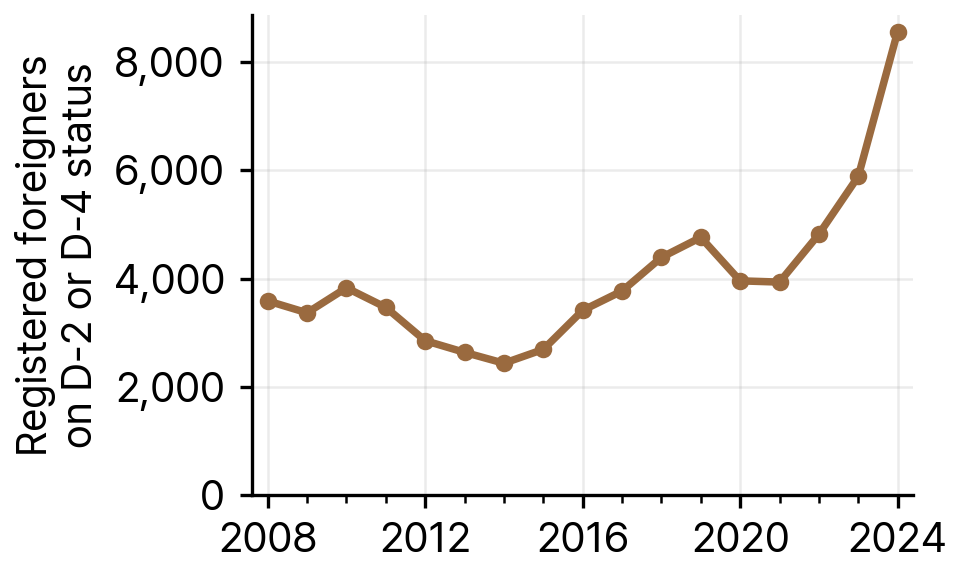
Registered foreigners on D-2 student or D-4 general trainee status numbered 3,586 in 2008 and 2,434 in 2014. The count rose to 4,760 in 2019, fell to 3,957 in 2020 and 3,934 in 2021, and then rose to 4,820 in 2022, 5,889 in 2023 and 8,566 in 2024, an increase of 45.5 percent in the last year (Figure 6). The 2024 total comprised 6,135 D-2 students and 2,431 D-4 trainees and equaled 3.3 percent of all D-2 and D-4 holders in South Korea.
Source: KIRD dataset, from Ministry of Justice immigration yearbooks, 2008-2024.
In the Korean Educational Development Institute's count of international students on 1 April 2024, Cheongju University had the most in the province (1,543), followed by Chungbuk National University (1,109), Far East University (534) and Seowon University (445). Chungcheong University had the most among the province's junior colleges (409). The per-institution counts for the 16 higher-education institutions in the province sum to 5,361, and the two largest universities enrolled 49.5 percent of them (2,652) (KEDI, 2024).
The KEDI figures refer to 1 April 2024 and the Ministry of Justice figures to 31 December 2024. In April 2025 the province received a quota of 830 D-2 visas under a pilot of metropolitan-type visas (JoongAng Ilbo, 2025), described under Provincial Policy.
Provincial Policy
North Chungcheong's ordinance on support for foreign residents was last amended on 13 February 2026 (Ordinance No. 5529). The amendment added Article 14-2, which authorizes the province to establish and operate an integrated support center for foreign residents. The ordinance assigns its duties to the governor and does not name an administering department (Chungcheongbuk-do, 2026).
On 11 March 2024, Governor Kim Young-hwan announced the province's bid to host the planned national immigration agency. The announcement cited Eumseong-gun and Jincheon-gun as first and fourth in the country in the ratio of foreign residents to total population, and the province's work on cities specialized for foreign residents, such as Osong International City (Edaily, 2024).
On 2 April 2025, North Chungcheong was one of 14 regions selected for a pilot of metropolitan-type visas (광역형 비자) and received a quota of 830 D-2 student visas. For these students the required financial guarantee was lowered from 16 million to 8 million won, and permitted part-time work rose from 25 to 30 hours a week for those at TOPIK level 3 or above (JoongAng Ilbo, 2025).
Under the regional specialized visa (F-2-R) program for 2025, the six population-decline areas (Jecheon-si and the counties of Boeun, Okcheon, Yeongdong, Goesan and Danyang) had a combined quota of 311 people. From 2 July 2025, the income requirement was lowered from 70 percent of per-capita gross national income to the annual living wage of 29,601,924 won, and local governments' designation of permitted jobs was abolished, so holders may work in any industry within population-decline areas (Kyunghyang Shinmun, 2025).
In 2024 the province awarded special adjustment grants of 150 million won each to Eumseong-gun and Jincheon-gun to improve settlement conditions for foreign workers. The grants paid for a smart classroom and a counseling room at Eumseong's foreign resident support center and expanded the classrooms of the Chungbuk Foreign Migrant Workers Support Center in Jincheon from four to ten (Nongmin Sinmun, 2024).
Seasonal worker allocations are described under Industry and Foreign Workers, and the city support centers in Cheongju and Jecheon under Service Organizations and Community Places.
Languages
The KIRD dataset estimates the first languages of registered foreigners by dividing each nationality's count among its country's first languages, using first-language shares from Ethnologue. By this estimate, Vietnamese was the most common first language among registered foreigners in North Chungcheong in 2024 (7,826 speakers), followed by Chinese (6,683), Khmer (3,472), Uzbek (3,299), Nepali (2,860), Russian (2,262), Thai (2,236), Tagalog or Filipino (2,095), Mongolian (1,634) and Sinhala (1,566). Fifteen languages had an estimated 1,000 or more speakers in 2024.
The estimate excludes Korean, so the 4,929 registered Korean-Chinese, whose first language the dataset records as Korean, add no speakers to these counts. Because each nationality is divided among its country's first languages, the estimate of 2,860 Nepali speakers is lower than the 5,495 registered Nepali nationals.
Jecheon's Foreign Resident Center plans interpreters for seven languages, including Vietnamese, Chinese, English, Nepali and Russian, from 2027 (Sinailbo, 2026).
Service Organizations and Community Places
Of the 1,720 migrant-serving organizations in the KIRD census, 66 are in North Chungcheong, all of them providing direct services. The province has 11.7 organizations per 10,000 registered foreigners (66 against 56,301 in 2024), close to the national rate of 11.6. Twelve of the 66 are family centers (가족센터). The others include 13 nongovernmental organizations, 5 medical providers, 5 community groups, 4 worker centers and 3 administrative offices.
Counting every population an organization names, 24 of the 66 serve families, 21 workers, 15 refugees, 8 children, 5 women, 4 undocumented migrants, 3 overseas Koreans, 3 students and 2 youth, and 10 serve all foreign residents.
Cheongju's Foreign Resident Support Center in Heungdeok-gu states its purpose as supporting the stable settlement of foreign residents and their communication and exchange with the local community. The city contracts its operation to the nonprofit Chungbuk International Cooperation Association (Cheongju City, 2025).
Jecheon's support center began as a center for overseas Koreans. The city signed an agreement with Daewon University on 18 September 2026 to operate it as a Foreign Resident Center for all foreign residents and planned a signboard ceremony for October 2026. The city's foreign resident population had grown from 1,916 at the end of 2022 to 4,400 at the end of June 2026 (Sinailbo, 2026).
In Cheongju, Central Asian residents and Koryo-saram (고려인, ethnic Koreans of the former Soviet Union) began living in Bongmyeong 1-dong in 2008. Grocery stores and other shops with Russian-language signs line its streets, and the concentration has spread to neighboring Sachang-dong and Bokdae-dong (Jungbu Maeil, 2024). In 2023, foreign residents made up 22.1 percent of Bongmyeong 1-dong's population, about one in five and the highest share of any neighborhood (dong) in Cheongju (Chungcheong Today, 2025).
Sources
Korea Immigration Regional Dashboard (KIRD). 2026. Spatiotemporal administrative dataset of nationality, residential diversity, and language demand among immigrants in South Korea, 2006-2024. openICPSR. https://doi.org/10.3886/E249944V1
Chungbuk Daily. 2026. North Chungcheong Province population passes 1.66 million (in Korean). 21 April 2026. https://www.cbdaily.co.kr/news/article.html?no=61732
Newspim. 2026a. North Chungcheong records net inflow of 5,468 people in the fourth quarter of 2025 (in Korean). 9 March 2026. https://www.newspim.com/news/view/20260309000624
Newspim. 2026b. Report of 28 May 2026 on North Chungcheong's total fertility rate, citing Statistics Korea birth statistics (in Korean). https://www.newspim.com/news/view/20260528001017
Statistics Korea. 2025. 2025 Statistics on the Aged (in Korean). https://mods.go.kr/board.es?mid=a10301010000&bid=10820&tag=&act=view&list_no=438832&ref_bid=
Statistics Korea. 2024. Population Projections by Province: 2022-2052 (in Korean). Korea.kr policy briefing, 28 May 2024. https://www.korea.kr/briefing/policyBriefingView.do?newsId=156632807
Migration Research and Training Centre (MRTC). 2024. Foreign Workers in Registered Factories Nationwide and Their Regional Distribution, 2010-2023. Statistical Brief 2024-07 (in Korean). https://www.mrtc.re.kr/lib/download.php?file_name=%5B%ED%86%B5%EA%B3%84%EB%B8%8C%EB%A6%AC%ED%94%84(2024-07)%5D+%EC%A0%84%EA%B5%AD+%EB%93%B1%EB%A1%9D+%EA%B3%B5%EC%9E%A5+%EC%99%B8%EA%B5%AD%EC%9D%B8+%EA%B7%BC%EB%A1%9C%EC%9E%90+%ED%98%84%ED%99%A9%EA%B3%BC+%EC%A7%80%EC%97%AD+%EB%B6%84%ED%8F%AC+(2010~2023).pdf&save_file=a_202409041013541.pdf&meta=free
Eumseong County. 2024. Jincheon-Eumseong Innovation City Urban High-Tech Industrial Park 2 (in Korean). https://www.eumseong.go.kr/www/contents.do?key=2003
Chungju City. 2025. Advanced Industrial Park (in Korean). https://www.chungju.go.kr/www/contents.do?key=564
inews24. 2026. More foreign seasonal workers next year: 6,008 allocated to North Chungcheong (in Korean). https://www.inews24.com/view/1921130
Korean Educational Development Institute (KEDI) and Ministry of Education. 2024. Foreign Students in Higher Education Institutions by Institution, 2024 (in Korean). National Assembly Library copy. https://clik.nanet.go.kr/clikr-collection/policyinfo/202/1013/2024/CLIKC4856094490052227_attach_1.xlsx
JoongAng Ilbo. 2025. Metropolitan-type visa gives momentum to the work-study K-international student system. Regional joint series on the Chungcheong region (in Korean). 28 April 2025. https://v.daum.net/v/20250428053052487
Chungcheongbuk-do. 2026. Ordinance on Support for Foreign Residents of Chungcheongbuk-do, as amended 13 February 2026 (Ordinance No. 5529). Local Ordinance Information System (in Korean). https://www.elis.go.kr/alrpop/alrDtlsPop?alrNo=43000029000003&histNo=005
Edaily. 2024. North Chungcheong bids to host the immigration agency, citing its proximity to Sejong (in Korean). 12 March 2024. https://edaily.co.kr/News/Read?mediaCodeNo=257&newsId=03034006638822664
Kyunghyang Shinmun. 2025. North Chungcheong eases requirements for regional specialized visas to attract foreign talent (in Korean). 6 July 2025. https://www.khan.co.kr/article/202507061358001
Nongmin Sinmun. 2024. North Chungcheong improves settlement conditions for foreign workers, with Eumseong and Jincheon selected (in Korean). 26 May 2024. https://www.nongmin.com/article/20240526500013
Cheongju City. 2025. Cheongju Foreign Resident Support Center (in Korean). https://www.cheongju.go.kr/www/contents.do?key=23546
Sinailbo. 2026. Jecheon expands its overseas Korean support center into a foreign resident support center for all foreign residents (in Korean). 21 September 2026. https://www.shinailbo.co.kr/news/articleView.html?idxno=5064564
Jungbu Maeil. 2024. A visit to Bongmyeong-dong in Cheongju, where Central Asian residents have increased (in Korean). https://www.jbnews.com/news/articleView.html?idxno=1460543
Chungcheong Today. 2025. Cheongju enters the era of 30,000 foreign residents, with one in five residents of Bongmyeong 1-dong foreign (in Korean). 13 January 2025. https://www.cctoday.co.kr/news/articleView.html?idxno=2206515
Suggested citation: Korea Immigration Regional Dashboard (KIRD). 2026. “Foreign Residents in North Chungcheong Province.” Foreign Residents in South Korea series, September 2026. Data: Korea Immigration Regional Dashboard (KIRD) dataset, https://doi.org/10.3886/E249944V1. Interactive maps and tables: https://immigrantsinkorea.today.