 Korea Immigration Regional Dashboard
SpotlightSeptember 2026Province profilesDownload PDF
Foreign Residents in South Jeolla Province
Highlights
- South Jeolla Province had 57,189 registered foreigners at the end of 2024, 65.1 percent more than in 2019 and the fastest growth among the 17 provinces and metropolitan cities, while its Korean population fell 4.3 percent over the same period.
- In 2024, 56.5 percent of the province's registered foreigners were on rotation labor statuses, against 31.1 percent nationally, and the province had 29.3 percent of all registered E-8 seasonal workers and 18.1 percent of all registered E-10 crew workers in South Korea.
- The 16 counties designated as population-decline areas lost 53,230 Korean residents and gained 14,552 registered foreigners between 2019 and 2024, and in 2024 they were home to 57.6 percent of the province's registered foreigners (32,963 of 57,189).
South Jeolla Province (Jeollanam-do), in the southwest of South Korea, had 57,189 registered foreigners on 31 December 2024, or 3.8 percent of the national total of 1,488,353. It ranked seventh among the 17 provinces and metropolitan cities by number of registered foreigners and fifth by registered foreigners per Korean resident, with 3.2 per 100 Korean residents against 2.9 for the country as a whole. The Ministry of the Interior and Safety (MOIS), whose count adds naturalized citizens and children of foreign residents, recorded 95,832 foreign residents in the province in 2024.
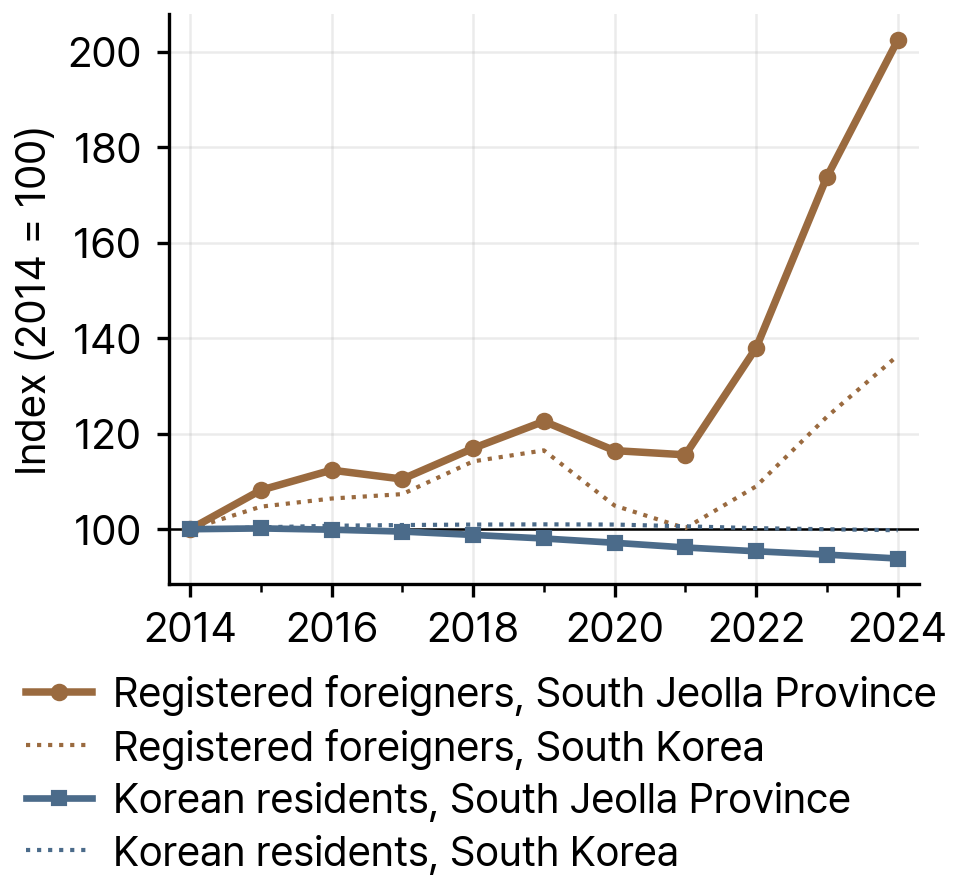
The number of registered foreigners in the province doubled between 2014 and 2024 (up 102.4 percent, from 28,254 to 57,189), while the number of Korean residents fell 6.1 percent (from 1,905,780 to 1,788,819). Most of the increase came after 2021, when the count was 32,656. Between 2019 and 2024 registered foreigners grew 65.1 percent, the fastest growth among the 17 provinces, and the gain of 22,551 registered foreigners equaled 28.2 percent of the loss of 79,926 Korean residents.
Registered foreigners in South Jeolla are concentrated in rotation labor statuses and in counties with declining Korean populations. In 2024, 56.5 percent were on rotation labor statuses (mainly E-9 non-professional employment, E-8 seasonal work and E-10 crew employment), against 31.1 percent nationally, and 14.9 percent were on settlement statuses, against 27.6 percent. The 16 counties designated as population-decline areas were home to 57.6 percent of the province's registered foreigners. Yeongam-gun, the site of the HD Hyundai Samho shipyard and the Daebul national industrial park (Namdo Ilbo, 2024; Namdo Ilbo, 2026), had 18.8 registered foreigners per 100 Korean residents, the highest ratio in the province. Vietnamese nationals made up 31.3 percent of registered foreigners, and the province had 28.7 percent of all registered foreigners from Timor-Leste in South Korea.
Size of the Foreign-Resident Population
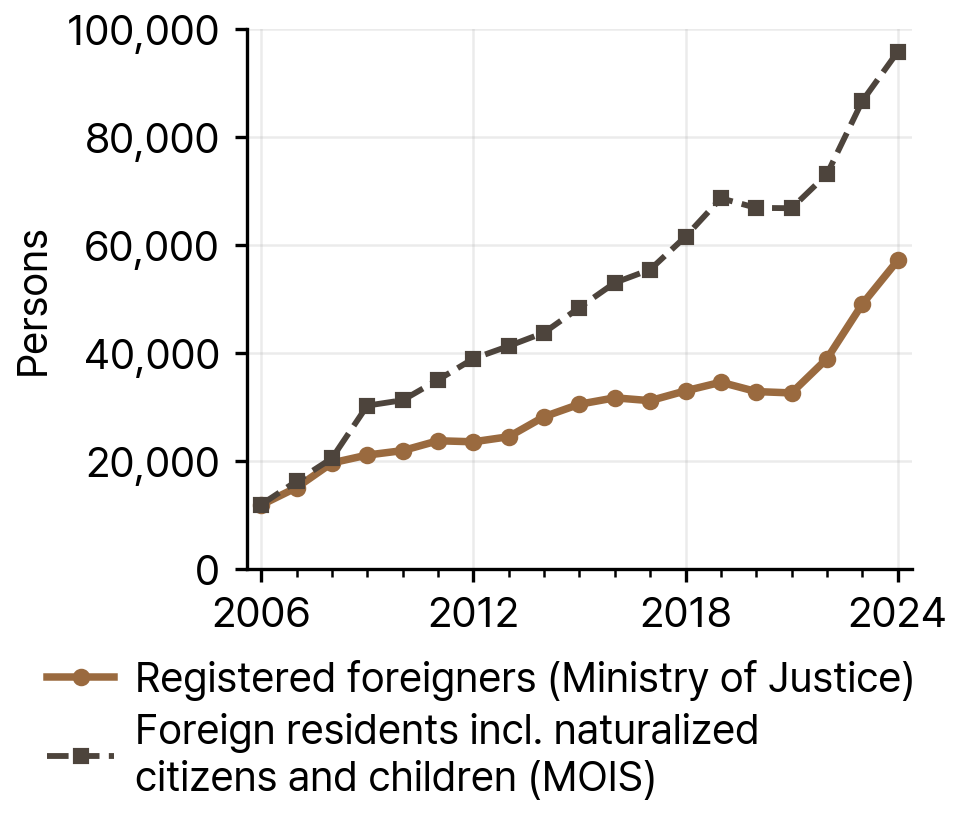
South Jeolla Province had 11,905 registered foreigners in 2006, 28,254 in 2014, 34,638 in 2019 and 57,189 in 2024 (see Figure 1 and Table 1). The number fell slightly in 2020 (to 32,906) and 2021 (to 32,656) and then rose by 6,332 in 2022, 10,122 in 2023 and 8,079 in 2024. Over the whole period the count grew by 45,284 people, or 380.4 percent.
The Ministry of the Interior and Safety count of foreign residents, taken on 1 November, rose from 20,551 in 2008 to 43,828 in 2014, 68,719 in 2019 and 95,832 in 2024, with small declines in 2020 and 2021. The 2024 count was 1.68 times the number of registered foreigners (95,832 against 57,189) and included 8,171 naturalized citizens and 16,725 children of foreign residents.
Source: KIRD dataset, from Ministry of Justice immigration yearbooks and Ministry of the Interior and Safety statistics, 2006-2024.
Indexed to 2014 = 100, the number of registered foreigners in the province stood at 122.6 in 2019 and 202.4 in 2024, and the number of Korean residents at 93.9 in 2024 (see Figure 2). Between 2019 and 2024 registered foreigners grew faster in South Jeolla than in any other province, while the province's Korean population fell 4.3 percent.
Source: KIRD dataset, from Ministry of Justice immigration yearbooks and Ministry of the Interior and Safety resident registration statistics, 2014-2024.
In 2024 the province ranked seventh among the 17 provinces and metropolitan cities by number of registered foreigners and fifth by registered foreigners per Korean resident. It had 3.2 registered foreigners per 100 Korean residents, up from 0.6 in 2006 and above the national ratio of 2.9.
Table 1Registered Foreigners, Foreign Residents and Korean Residents in South Jeolla Province, Selected Years, 2006-24
| Year | Registered foreigners | MOIS foreign residents | Korean residents | Registered foreigners per 100 Korean residents |
|---|---|---|---|---|
| 2006 | 11,905 | n/a | 1,942,925 | 0.6 |
| 2014 | 28,254 | 43,828 | 1,905,780 | 1.5 |
| 2019 | 34,638 | 68,719 | 1,868,745 | 1.9 |
| 2024 | 57,189 | 95,832 | 1,788,819 | 3.2 |
Note: Registered foreigners are counted on 31 December and MOIS foreign residents on 1 November. The MOIS count adds naturalized citizens and children of foreign residents and is shown from 2008, when it stood at 20,551.
Source: KIRD dataset, from Ministry of Justice immigration yearbooks and Ministry of the Interior and Safety statistics, 2006-2024.
Nationalities
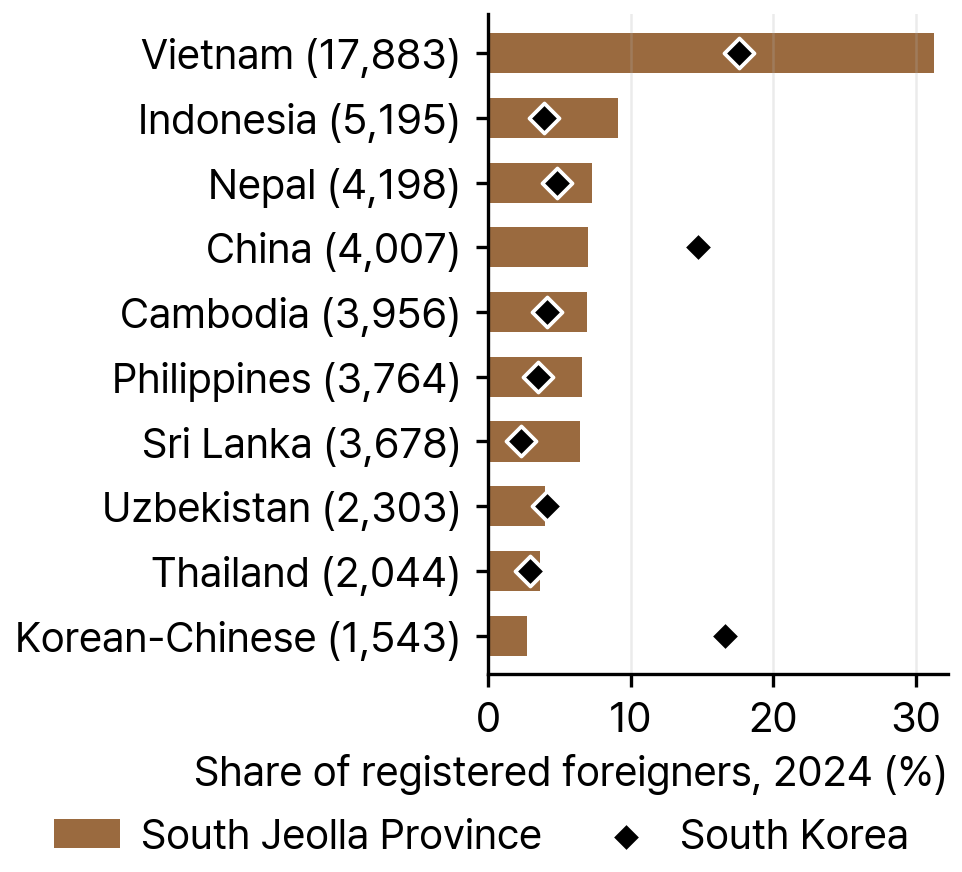
Vietnam was the largest nationality among registered foreigners in South Jeolla Province in 2024, with 17,883 people or 31.3 percent of the total, against 17.6 percent of registered foreigners nationally (see Figure 3 and Table 2). Indonesia (5,195), Nepal (4,198), China (4,007, excluding Korean-Chinese), Cambodia (3,956), the Philippines (3,764) and Sri Lanka (3,678) followed, with 6.4 to 9.1 percent each. The ten largest nationalities together accounted for 48,571 people (84.9 percent).
Source: KIRD dataset, from Ministry of Justice immigration yearbooks, 2024.
Between 2019 and 2024 the number of Vietnamese nationals rose by 7,489, or 33.2 percent of the province's total increase of 22,551. The Philippine (up 130.4 percent), Indonesian (126.4 percent), Thai (124.6 percent) and Nepali (114.7 percent) populations more than doubled. Korean-Chinese registered foreigners, the only group among the ten to decline, fell from 1,935 to 1,543.
Table 2Ten Largest Nationalities among Registered Foreigners in South Jeolla Province, 2019 and 2024
| Nationality | 2019 | 2024 | Share of the province's registered foreigners, 2024 (%) | Province's share of all registered foreigners of this nationality in South Korea, 2024 (%) |
|---|---|---|---|---|
| Vietnam | 10,394 | 17,883 | 31.3 | 6.8 |
| Indonesia | 2,295 | 5,195 | 9.1 | 8.9 |
| Nepal | 1,955 | 4,198 | 7.3 | 5.8 |
| China | 3,304 | 4,007 | 7.0 | 1.8 |
| Cambodia | 2,934 | 3,956 | 6.9 | 6.5 |
| Philippines | 1,634 | 3,764 | 6.6 | 7.2 |
| Sri Lanka | 2,753 | 3,678 | 6.4 | 10.8 |
| Uzbekistan | 1,451 | 2,303 | 4.0 | 3.7 |
| Thailand | 910 | 2,044 | 3.6 | 4.7 |
| Korean-Chinese | 1,935 | 1,543 | 2.7 | 0.6 |
Note: Korean-Chinese are Chinese nationals of Korean ethnicity, counted separately from other Chinese nationals. The province had 3.8 percent of all registered foreigners in South Korea in 2024.
Source: KIRD dataset, from Ministry of Justice immigration yearbooks, 2019 and 2024.
The province had 3.8 percent of all registered foreigners in South Korea in 2024 but larger shares of several nationalities. It was home to 1,246 of the 4,336 registered foreigners from Timor-Leste in the country (28.7 percent), 881 of the 6,641 from Laos (13.3 percent), 3,678 of the 33,965 from Sri Lanka (10.8 percent), 112 of the 1,200 from Yemen (9.3 percent) and 5,195 of the 58,248 from Indonesia (8.9 percent).
The Shannon diversity index of nationalities rises when registered foreigners are spread over more nationalities in more even shares. It was 2.4 in 2014 and again in 2024. The province ranked 14th of the 17 provinces on this index in 2024, although registered foreigners of 108 nationalities were counted there.
Overseas Koreans on F-4 status report their residence instead of registering and are not counted as registered foreigners. In 2024, 4,049 of them reported residence in South Jeolla Province, 0.7 percent of the 553,664 nationwide. Most were Korean-Chinese (2,797), followed by citizens of the United States (627), Canada (166) and Uzbekistan (137) and by Korean-Russians (129). The 2,797 Korean-Chinese on F-4 status outnumbered the 1,543 Korean-Chinese registered foreigners in the province.
Residence Statuses
In 2024, 32,288 registered foreigners in South Jeolla Province (56.5 percent) were on rotation labor statuses, against 31.1 percent of registered foreigners nationally (see Figure 4). Settlement statuses covered 14.9 percent (27.6 percent nationally), study and job search statuses 10.5 percent (18.6 percent), family statuses 8.1 percent (10.0 percent) and other statuses 4.4 percent (7.1 percent), all below the national shares. Skilled statuses covered 5.7 percent, close to the national 5.8 percent.
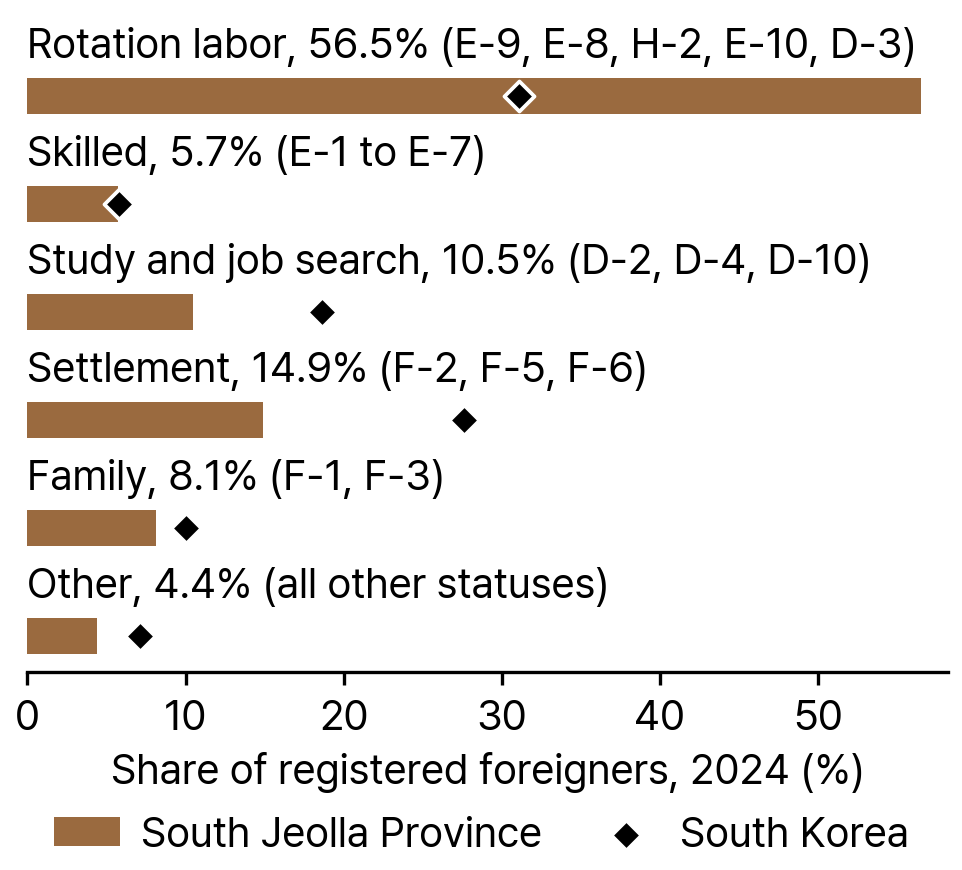
Source: KIRD dataset, from Ministry of Justice immigration yearbooks, 2024.
The E-9 non-professional employment status, issued under the Employment Permit System, was the most common status in the province, with 22,070 holders (38.6 percent of registered foreigners). E-8 seasonal work (5,769) and F-6 marriage migration (5,752) followed, with 10.1 percent each (see Table 3). On 31 December 2024 the province had 29.3 percent of all E-8 holders in South Korea and 18.1 percent of all E-10 crew employment holders, compared with its 3.8 percent share of all registered foreigners. Its shares of D-2 student holders (2.0 percent) and F-5 permanent residents (1.0 percent) were below that level.
Table 3Ten Most Common Residence Statuses among Registered Foreigners in South Jeolla Province, 2024
| Status | Meaning | Registered foreigners | Share of the province's registered foreigners (%) | Province's share of all holders of this status in South Korea (%) |
|---|---|---|---|---|
| E-9 | Non-professional employment | 22,070 | 38.6 | 6.7 |
| E-8 | Seasonal worker | 5,769 | 10.1 | 29.3 |
| F-6 | Marriage migration | 5,752 | 10.1 | 3.9 |
| E-10 | Crew employment | 3,907 | 6.8 | 18.1 |
| D-2 | Student | 3,518 | 6.2 | 2.0 |
| F-1 | Visiting cohabitation | 3,481 | 6.1 | 3.6 |
| E-7 | Specially designated activities | 2,722 | 4.8 | 4.3 |
| F-5 | Permanent residence | 2,058 | 3.6 | 1.0 |
| D-4 | General trainee | 2,054 | 3.6 | 2.6 |
| G-1 | Other (miscellaneous) | 1,701 | 3.0 | 3.0 |
Note: Counts on 31 December 2024. The province had 3.8 percent of all registered foreigners in South Korea.
Source: KIRD dataset, from Ministry of Justice immigration yearbooks, 2024.
The Ministry of the Interior and Safety uses different categories. Of the 95,832 foreign residents it counted in the province on 1 November 2024, 70,936 were foreign nationals, among them 29,115 foreign workers, 6,705 marriage migrants, 4,938 international students, 2,896 ethnic Koreans of foreign nationality and 27,282 other foreigners. The count also included 8,171 naturalized citizens and 16,725 children of foreign residents, who together made up 26.0 percent of the total (24,896 of 95,832).
Districts and Population-Decline Areas
South Jeolla Province is divided into 5 cities (si) and 17 counties (gun), referred to here as districts. Yeongam-gun had the most registered foreigners in 2024 (9,673, or 16.9 percent of the province's total), followed by Yeosu-si (7,322), Wando-gun (5,110), Naju-si (4,748) and Mokpo-si (4,646) (see Figure 5 and Table 4). The 17 counties together had 35,203 registered foreigners (61.6 percent).
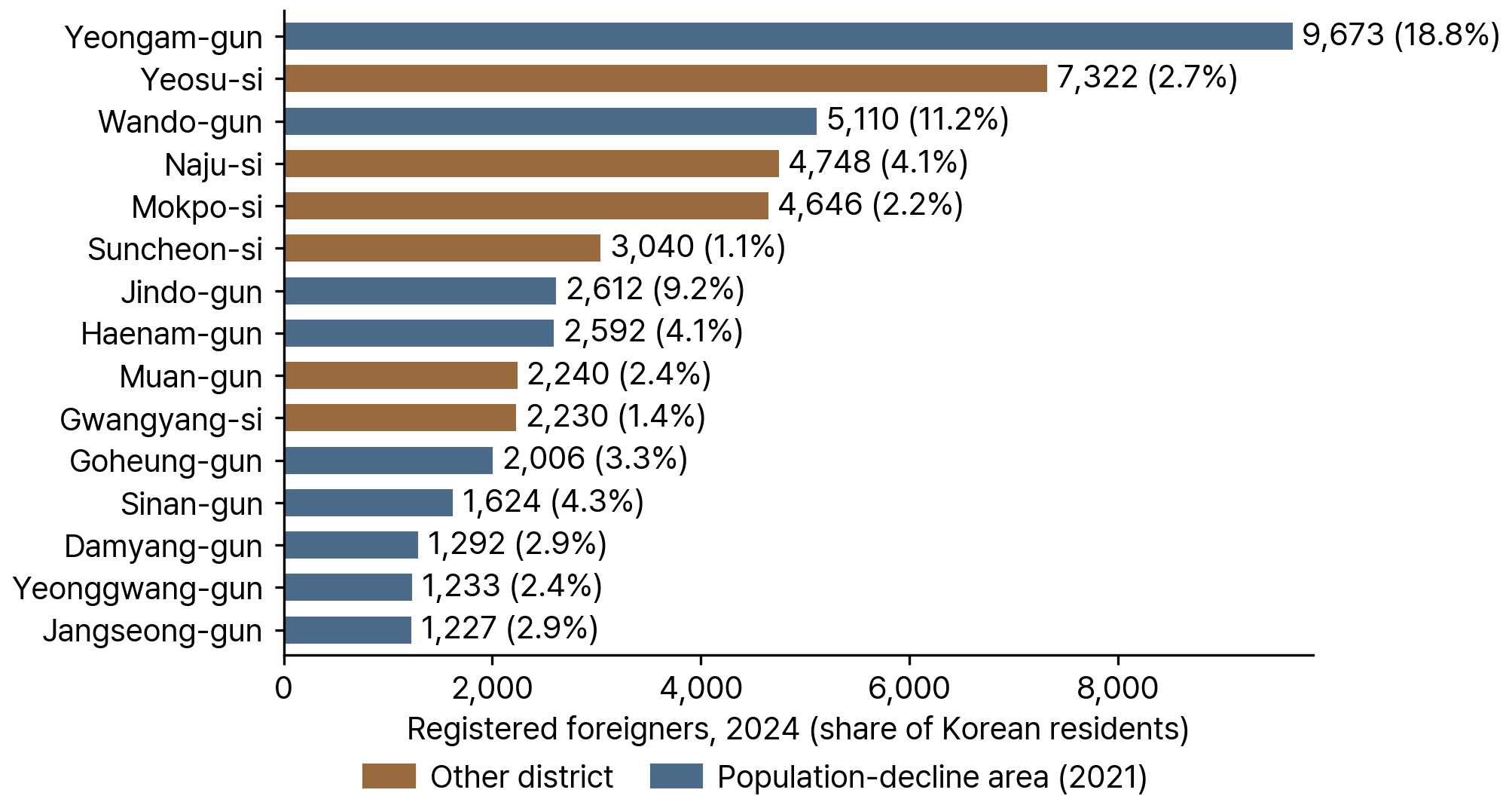
Source: KIRD dataset, from Ministry of Justice registered-foreigner statistics by district and Ministry of the Interior and Safety resident registration statistics, 2024; population-decline areas as designated by the Ministry of the Interior and Safety in October 2021.
Yeongam-gun also had the highest ratio of registered foreigners to Korean residents, 18.8 per 100, followed by Wando-gun (11.2) and Jindo-gun (9.2). Among the cities, the ratio ranged from 1.1 per 100 in Suncheon-si to 4.1 in Naju-si.
Between 2019 and 2024 the number of registered foreigners rose in 21 of the 22 districts, and Gurye-gun, the exception, had 20 fewer. Korean residents declined in 20 districts and increased only in Muan-gun (by 11,582) and Naju-si (by 1,990). In Yeongam-gun the gain of 5,157 registered foreigners exceeded the loss of 3,202 Korean residents, and the county accounted for 22.9 percent of the province's increase in registered foreigners (5,157 of 22,551). Mokpo-si lost the most Korean residents (19,971) and gained 1,332 registered foreigners.
Table 4Ten Districts with the Most Registered Foreigners in South Jeolla Province, 2024
| District | Registered foreigners, 2024 | Registered foreigners per 100 Korean residents, 2024 | Change in Korean residents, 2019-24 | Change in registered foreigners, 2019-24 | Population-decline area |
|---|---|---|---|---|---|
| Yeongam-gun | 9,673 | 18.8 | -3,202 | +5,157 | Yes |
| Yeosu-si | 7,322 | 2.7 | -14,970 | +2,629 | No |
| Wando-gun | 5,110 | 11.2 | -5,058 | +2,941 | Yes |
| Naju-si | 4,748 | 4.1 | +1,990 | +1,967 | No |
| Mokpo-si | 4,646 | 2.2 | -19,971 | +1,332 | No |
| Suncheon-si | 3,040 | 1.1 | -3,269 | +916 | No |
| Jindo-gun | 2,612 | 9.2 | -2,237 | +1,095 | Yes |
| Haenam-gun | 2,592 | 4.1 | -7,234 | +1,140 | Yes |
| Muan-gun | 2,240 | 2.4 | +11,582 | +612 | No |
| Gwangyang-si | 2,230 | 1.4 | -2,058 | +543 | No |
Note: Districts are the province's cities (si) and counties (gun). Population-decline areas are those designated by the Ministry of the Interior and Safety in October 2021.
Source: KIRD dataset, from Ministry of Justice registered-foreigner statistics by district and Ministry of the Interior and Safety resident registration statistics, 2019 and 2024; population-decline areas as designated by the Ministry of the Interior and Safety in October 2021.
In October 2021 the Ministry of the Interior and Safety designated 16 of the province's 17 counties as population-decline areas. They are Boseong-gun, Damyang-gun, Gangjin-gun, Goheung-gun, Gokseong-gun, Gurye-gun, Haenam-gun, Hampyeong-gun, Hwasun-gun, Jangheung-gun, Jangseong-gun, Jindo-gun, Sinan-gun, Wando-gun, Yeongam-gun and Yeonggwang-gun. Muan-gun and the cities were not designated, and no district in the province was named an area of interest.
Between 2019 and 2024 the population-decline areas lost 53,230 Korean residents (7.4 percent, from 723,981 to 670,751) and gained 14,552 registered foreigners (79.0 percent, from 18,411 to 32,963). The foreign gain equaled 27.3 percent of the Korean loss. In the other six districts, Korean residents fell by 26,696 and registered foreigners rose by 7,999. In 2024 the decline areas had 37.5 percent of the province's Korean residents and 57.6 percent of its registered foreigners, or 4.9 registered foreigners per 100 Korean residents against 3.2 for the province.
By the definition used in this Spotlight, five districts were Vietnamese ethnic enclaves in 2024, and no other nationality formed an enclave in the province. Vietnamese nationals made up 60.8 percent of registered foreigners in Boseong-gun (675 people, location quotient 3.6) and 48.4 percent in Goheung-gun (971 people, location quotient 3.2). The other enclaves were Naju-si (1,791 people, 37.7 percent, location quotient 3.0), Sinan-gun (545 people, 33.6 percent, location quotient 2.8) and Jindo-gun (810 people, 31.0 percent, location quotient 5.6).
Population Trends
The number of Korean residents in South Jeolla Province fell from 1,942,925 in 2006 to 1,905,780 in 2014, 1,868,745 in 2019 and 1,788,819 in 2024, a loss of 154,106 people (7.9 percent). Korean residents fell by 37,035 between 2014 and 2019 and by 79,926 (4.3 percent) between 2019 and 2024. The count fell in every year from 2016 to 2024, and the largest annual loss was 18,746 in 2021. In 2024 the province had 3.5 percent of South Korea's 51,217,221 Korean residents.
Over a longer period, the province's population fell from 2.50 million in 1990 and 2.13 million in 2000 to 1.79 million in March 2024, a decline of about 700,000 over 34 years (Newsis, 2024).
The province's total fertility rate rose from 0.97 in 2023 to 1.03 in 2024, the highest in the country for the second consecutive year (in 2024 tied with Sejong), and births rose from 7,828 to 8,226, an increase of 398 (5.1 percent), according to Statistics Korea's provisional birth and death statistics for 2024 (Pressian, 2025).
Residents aged 65 and over made up 28.46 percent of the province's population in the Ministry of the Interior and Safety's resident registration statistics for 2025, the highest share of any province, ahead of North Gyeongsang (27.46 percent), Gangwon (26.81 percent) and North Jeolla (26.61 percent) (Seoul Economic Daily, 2026). In Statistics Korea's provincial projections for 2022 to 2052, South Jeolla and North Gyeongsang had the highest shares of residents aged 65 and over in 2022, and South Jeolla had the highest median age (50.1 years). South Jeolla is one of four provinces, with Ulsan, South Gyeongsang and North Gyeongsang, where the population aged 0 to 14 is projected to fall by 50 percent or more by 2052 (Statistics Korea, 2024).
In Statistics Korea's domestic migration statistics for 2024, South Jeolla was one of 12 provinces where more people moved out than moved in, and education was the reason with the largest net outflow from the province. The Honam region, which includes South Jeolla and Gwangju, lost about 18,000 people through net out-migration, 3,000 more than in 2023 (Statistics Korea, 2025).
Industry and Foreign Workers
Registered foreigners on E-9 non-professional employment status, issued under the Employment Permit System, numbered 10,491 in the province in 2014 and 14,496 in 2019. The count fell to 12,291 in 2021 and rose to 22,070 in 2024, 79.6 percent above the 2021 level and 6.7 percent of all E-9 holders in South Korea. Crew employment (E-10) holders numbered 3,907 in 2024, 18.1 percent of all E-10 holders in the country (see Table 5).
E-8 seasonal workers numbered 794 on 31 December 2022, 3,019 on 31 December 2023 and 5,769 on 31 December 2024, when the province had 29.3 percent of all E-8 holders in South Korea. Because the Ministry of Justice counts status holders on 31 December, these figures miss the seasonal workers whose contracts ended before winter. In 2024 the province was allocated 5,818 seasonal workers, of whom 3,846 had arrived by early July (Seoul Shinmun, 2024a).
As of November 2024, the HD Hyundai Samho shipyard in Yeongam and its in-house subcontractors employed about 12,000 workers, about 25 percent of them (about 3,000) foreign nationals. The same report put the number of foreign workers in the province's manufacturing sector, including shipbuilding, at 4,946 in December 2022 and 6,404 in June 2024, an increase of about 1,500 (Namdo Ilbo, 2024). A March 2026 report said foreign nationals made up more than half of the workers at the Daebul national industrial park (대불국가산업단지) in Yeongam and about 30 percent of on-site workers at HD Hyundai Samho, including its subcontractors (Namdo Ilbo, 2026).
Table 5Foreign Workers in South Jeolla Province, Selected Indicators, 2014-26
| Indicator | Value | Source |
|---|---|---|
| Registered foreigners on E-9 status, 2014 | 10,491 | KIRD dataset |
| Registered foreigners on E-9 status, 2019 | 14,496 | KIRD dataset |
| Registered foreigners on E-9 status, 2021 | 12,291 | KIRD dataset |
| Registered foreigners on E-9 status, 2024 | 22,070 (6.7% of all E-9 holders in South Korea) | KIRD dataset |
| Registered foreigners on E-8 status, 31 December 2022 | 794 | KIRD dataset |
| Registered foreigners on E-8 status, 31 December 2023 | 3,019 | KIRD dataset |
| Registered foreigners on E-8 status, 31 December 2024 | 5,769 (29.3% of all E-8 holders in South Korea) | KIRD dataset |
| Registered foreigners on E-10 status, 2024 | 3,907 (18.1% of all E-10 holders in South Korea) | KIRD dataset |
| Seasonal workers allocated to the province, 2024 | 5,818, of whom 3,846 had arrived by early July | Seoul Shinmun, 2024a |
| Foreign workers in manufacturing, including shipbuilding, December 2022 and June 2024 | 4,946 and 6,404 | Namdo Ilbo, 2024 |
| Workers at the HD Hyundai Samho shipyard and its in-house subcontractors, November 2024 | About 12,000, of whom about 3,000 (25%) were foreign nationals | Namdo Ilbo, 2024 |
| Foreign share of workers at the Daebul national industrial park, 2026 | More than half | Namdo Ilbo, 2026 |
Note: E-9, E-8 and E-10 counts are registered foreigners on 31 December of each year, so the E-8 counts miss the seasonal workers whose contracts ended before winter.
Source: KIRD dataset and news reports as listed in each row.
International Students and Universities
Registered foreigners on D-2 (student) or D-4 (general trainee) status numbered 2,773 in the province in 2008 and 3,206 in 2010, fell to 1,326 in 2014 and then rose to 2,438 in 2019 and 5,572 in 2024 (see Figure 6). The 2024 count, 3,518 on D-2 and 2,054 on D-4, was 4.2 times that of 2014 and equaled 2.2 percent of all D-2 and D-4 holders in South Korea, below the province's 3.8 percent share of all registered foreigners.
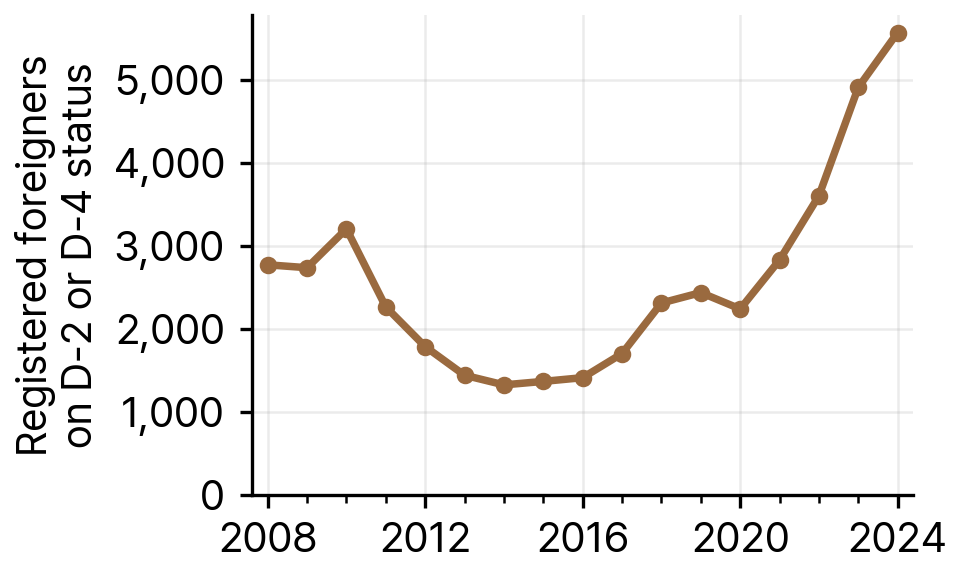
Source: KIRD dataset, from Ministry of Justice immigration yearbooks, 2008-2024.
A 2025 report put the number of international students in South Jeolla at about 5,000 (Women's News, 2025). Dongshin University in Naju-si had 2,352 international students from 23 countries as of 1 September 2026, including 201 language-program students, and admitted 344 new international students from eight countries (190 undergraduates and 154 graduate students) in the fall 2026 semester (Money Today, 2026). Mokpo Science University, a junior college in Mokpo-si, had 288 international students as of 31 December 2025, according to Ministry of Justice international-student data (K-Study Times, 2026).
Under a five-year program for 2025 to 2029 worth 15 billion won, which supports the settlement of international students in the region, Sunchon National University was designated the Korean-language center for the province's eastern area, Mokpo National University for its western area and Dongshin University for its north-central area (Women's News, 2025).
Sehan University, which has campuses in Yeongam-gun and in Dangjin in South Chungcheong Province, was one of 24 universities nationwide (11 for degree programs and 13 for language programs) placed under enhanced visa screening for international students for one year from the fall 2025 semester. The measure followed the 2024 evaluation by the Ministry of Education and the Ministry of Justice of universities' internationalization capacity and of their recruitment and management of international students (University Journal, 2025).
From 2 April 2025, South Jeolla was also one of the provinces covered by the Ministry of Justice's pilot of metropolitan-type visas. Under the pilot, North Jeolla, South Jeolla and Jeju eased visa issuance conditions and expanded part-time work hours for international students in foundational manufacturing and tourism, whereas the pilot in Seoul, Busan, Gwangju, Gangwon and North and South Chungcheong covered talent for semiconductors, robotics, artificial intelligence, batteries and bio industries (Korea JoongAng Daily, 2025).
Provincial Policy
South Jeolla's basic ordinance on foreign residents is the Jeollanam-do Ordinance on Support for Foreign Residents, whose current text is Ordinance No. 6024 of 13 June 2024. Its stated purpose is to help foreign residents living in the province adapt to their communities and to improve their daily lives (South Jeolla Province, 2024).
In 2024 the province expanded its settlement-support program for foreign residents from two operating agencies to four, adding the Jeonnam Migrant Integration Support Center in Mokpo and Road World Vision in Suncheon, and funded each agency with about 10 million won (Seoul Shinmun, 2024b).
In 2025 the province extended its regional specialized visa program to 13 population-decline counties (Damyang, Gokseong, Gurye, Goheung, Hwasun, Jangheung, Gangjin, Haenam, Yeongam, Yeonggwang, Jangseong, Jindo and Sinan), seven more than the year before. It aimed to attract 386 people on the regional talented-personnel visa (F-2-R) and 308 on the regional specialized skilled-worker visa (E-7-4R), 694 in all (Newsis, 2025).
For seasonal workers, in 2024 the province funded interpretation helpers at the county level, medical-cost support of up to 250,000 won per worker and 2.1 billion won for remodeling vacant houses and idle agricultural-cooperative facilities into dormitories (Seoul Shinmun, 2024a).
On 24 September 2025 the province convened the final report meeting of a joint study with the Ministry of Justice's Immigration Policy Research Institute and the Jeonnam Institute, titled "Survey of Foreign Residents and Firms in Response to Industrial Demand and Development of a Jeonnam-style Immigration Policy Model." The study surveyed about 1,300 foreign residents and 707 firms. The province also formed an interdepartmental task force covering eight areas to draft a master plan for supporting foreign residents (Korea NGO News, 2025).
In 2026 the province plans a 4 billion won project, from the second half of the year, to choose one area where foreign residents are concentrated through a competition among its cities and counties and develop it as a "foreigner-specialized street," with murals, night lighting, a landmark, community space, multilingual signs and safety facilities (Mokpo Times, 2026). Measures for international students are described in the section on international students and universities.
Languages
In estimates built from nationality counts and the share of each country's population that speaks a language as a first language (from Ethnologue), Vietnamese was the most common first language among registered foreigners in South Jeolla Province in 2024, with an estimated 15,288 speakers. Chinese (4,446), Khmer (4,041), Indonesian (3,640), Tagalog or Filipino (3,265), Sinhala (2,534), Nepali (2,180), Thai (1,926), Uzbek (1,659) and Tamil (956) followed. Nine languages had an estimated 1,000 speakers or more.
Each nationality is divided among languages in proportion to the first-language shares of its country, so a language can have fewer estimated speakers than the matching nationality has registered foreigners. The province had 17,883 Vietnamese nationals and an estimated 15,288 Vietnamese speakers, for example, and 4,198 Nepali nationals and an estimated 2,180 Nepali speakers. The estimates cover registered foreigners only.
Service Organizations and Community Places
The KIRD census of 1,720 migrant-serving organizations in South Korea lists 92 in South Jeolla Province, or 16.1 per 10,000 registered foreigners, against 11.6 per 10,000 nationally. Ninety of them provide services directly to migrants. Twenty-three are family centers (가족센터), and the others include 16 nongovernmental organizations, 6 medical institutions, 6 community groups, 5 administrative offices, 3 worker centers and 3 shelters.
An organization can serve more than one population. Forty of the 92 organizations name families among the populations they serve, 27 name workers, 24 all migrants, 12 refugees, 9 women, 7 children and 6 undocumented migrants.
A 2026 report on Samho-eup in Yeongam-gun, next to the Daebul industrial park, described grocery shelves stocked with tropical fruit such as mangoes, pineapples and bananas and with strong-smelling vegetables, and foreign workers gathering outside a shop called Asia Mart. A seafood-shop owner said that foreign customers communicated easily with local residents, and in the evening some workers shared canned beer on benches in the parking lots of one-room apartment buildings (Namdo Ilbo, 2026).
The same report put foreign residents at 21.1 percent of Yeongam County's population and described it as the highest immigrant share of any county or city in South Korea. In the KIRD data, which compare registered foreigners with Korean residents, Yeongam-gun had 18.8 registered foreigners per 100 Korean residents in 2024.
Migrant workers at the Daebul industrial park also organized an amateur soccer league by nationality. Starting on 19 March 2025, 116 players on five national teams (Vietnam, Indonesia, Thailand, Nepal and Korea) were scheduled to play three matches every Tuesday and Wednesday evening through November, 180 games in all (Bitgaram News, 2025).
Sources
Korea Immigration Regional Dashboard (KIRD). 2026. Spatiotemporal administrative dataset of nationality, residential diversity, and language demand among immigrants in South Korea, 2006-2024. openICPSR. https://doi.org/10.3886/E249944V1
South Jeolla Province. 2024. Jeollanam-do Ordinance on Support for Foreign Residents, Ordinance No. 6024, 13 June 2024 (in Korean; text from the ULEX legal database). https://www.ulex.co.kr/%EB%B2%95%EB%A5%A0/1938623-2151068-%EC%A0%84%EB%9D%BC%EB%82%A8%EB%8F%84%EC%99%B8%EA%B5%AD%EC%9D%B8%EC%A3%BC%EB%AF%BC
Seoul Shinmun. 2024b. South Jeolla Province expands the agencies that support the settlement of foreign residents (in Korean). https://go.seoul.co.kr/news/newsView.php?id=20240821500098
Seoul Shinmun. 2024a. South Jeolla Province moves to improve conditions for foreign seasonal workers (in Korean). https://go.seoul.co.kr/news/newsView.php?id=20240702500074
Newsis. 2025. South Jeolla expands regional specialized visas, aims to attract 694 foreign workers (in Korean). https://www.newsis.com/view/NISX20250315_0003099888
Korea JoongAng Daily. 2025. Government to launch region-specific visas, top-tier visa for foreign talent. https://www.koreajoongangdaily.com/korea/10137881
Korea NGO News. 2025. South Jeolla Province shares region-based immigration and foreign-resident policy (in Korean). https://www.ngonews.kr/news/articleView.html?idxno=214855
Mokpo Times. 2026. South Jeolla discusses plans for a foreigner-specialized street (in Korean). https://www.mokpotimes.com/news/articleView.html?idxno=166859
Women's News. 2025. Korean-language centers at Sunchon National University and other universities for international students in South Jeolla (in Korean). https://www.womennews.co.kr/news/articleView.html?idxno=268910
Namdo Ilbo. 2024. Foreign residents in Gwangju and South Jeolla, part 2: 3,000 foreign workers at Hyundai Samho in Yeongam and Korean shipbuilding (in Korean). https://www.namdonews.com/news/articleView.html?idxno=798767
Namdo Ilbo. 2026. Foreign worker report, part 8: a visit to Samho-eup in Yeongam, a small global village (in Korean; via Daum News). https://v.daum.net/v/20260331185430697
Newsis. 2024. South Jeolla's population crisis, part 1: the population cliff and out-migration (in Korean; republished by jifsc.com). https://jifsc.com/bbs/board.php?bo_table=life_02&wr_id=3&page=2
Pressian. 2025. South Jeolla's total fertility rate at 1.03 in 2024, first in the country for a second year (in Korean). https://www.pressian.com/pages/articles/2025022617140654526
Seoul Economic Daily. 2026. Korea grows older as the population aged 65 and over passes 21 percent (in Korean). https://m.sedaily.com/amparticle/14165982
Statistics Korea. 2024. Provincial population projections, 2022-2052 (in Korean; Korea.kr policy briefing). https://www.korea.kr/briefing/policyBriefingView.do?newsId=156632807
Statistics Korea. 2025. Results of the 2024 domestic migration statistics (in Korean; Korea.kr policy briefing). https://www.korea.kr/briefing/policyBriefingView.do?newsId=156672078
Money Today. 2026. Dongshin University grows into a global campus with 2,352 international students (in Korean). https://www.mt.co.kr/policy/2026/09/07/2026090710250215174
K-Study Times. 2026. Mokpo Science University: 288 international students as of 31 December 2025 (in Korean). https://kstudytimes.kr/universities/mpu/foreign-students
University Journal (Daehak Journal). 2025. Student visa issuance restricted at 24 universities, including Sehan University and Dongduk Women's University (in Korean). https://dhnews.co.kr/news/view/1065588403390508
Bitgaram News. 2025. Migrant workers' soccer "World Cup" opens at the Daebul industrial park in Yeongam (in Korean). https://www.focusi.co.kr/news/articleView.html?idxno=338923
Suggested citation: Korea Immigration Regional Dashboard (KIRD). 2026. “Foreign Residents in South Jeolla Province.” Foreign Residents in South Korea series, September 2026. Data: Korea Immigration Regional Dashboard (KIRD) dataset, https://doi.org/10.3886/E249944V1. Interactive maps and tables: https://immigrantsinkorea.today.