 Korea Immigration Regional Dashboard
SpotlightSeptember 2026Province profilesDownload PDF
Foreign Residents in North Gyeongsang Province
Highlights
- North Gyeongsang Province had 76,768 registered foreigners at the end of 2024, sixth among South Korea's 17 provinces and metropolitan cities, and within its current boundary their number rose 33.3 percent between 2019 and 2024 (from 57,581), while the Korean population fell 4.2 percent (from 2,641,993 to 2,531,384).
- Rotation labor statuses covered 39.3 percent of the province's registered foreigners in 2024, against 31.1 percent nationwide, and the province had 14.8 percent of all E-10 crew employment holders and 14.6 percent of all E-8 seasonal workers in South Korea, compared with 5.2 percent of all registered foreigners.
- In the 15 districts designated as population-decline areas in 2021, the number of registered foreigners rose by 5,360 between 2019 and 2024 while the Korean population fell by 56,885, a foreign gain equal to 9.4 percent of the Korean loss.
At the end of 2024, 76,768 registered foreigners lived in North Gyeongsang Province (Gyeongsangbuk-do), 5.2 percent of the 1,488,353 registered foreigners in South Korea. The province ranked sixth among the 17 provinces and metropolitan cities by the number of registered foreigners and seventh by registered foreigners per Korean resident, with 3.0 registered foreigners per 100 Korean residents against 2.9 nationwide. The Ministry of the Interior and Safety counted 128,725 foreign residents in the province on 1 November 2024, a broader count that adds naturalized citizens and the children of foreign residents.
Gunwi County moved from the province to Daegu on 1 July 2023. Province totals in this Spotlight follow each year's boundary, so they include Gunwi County through 2022, while district figures exclude it in every year. Within the current boundary, the number of registered foreigners increased by 19,187 between 2019 and 2024, from 57,581 to 76,768 (33.3 percent), and the number of Korean residents decreased by 110,609, from 2,641,993 to 2,531,384 (4.2 percent), so the foreign gain equaled 17.3 percent of the Korean loss. The 2019 figures subtract Gunwi County's 538 registered foreigners and 23,843 Korean residents from the province totals of 58,119 and 2,665,836. Registered foreigners per 100 Korean residents rose from 1.1 in 2006 to 1.8 in 2014, 2.2 in 2019 and 3.0 in 2024.
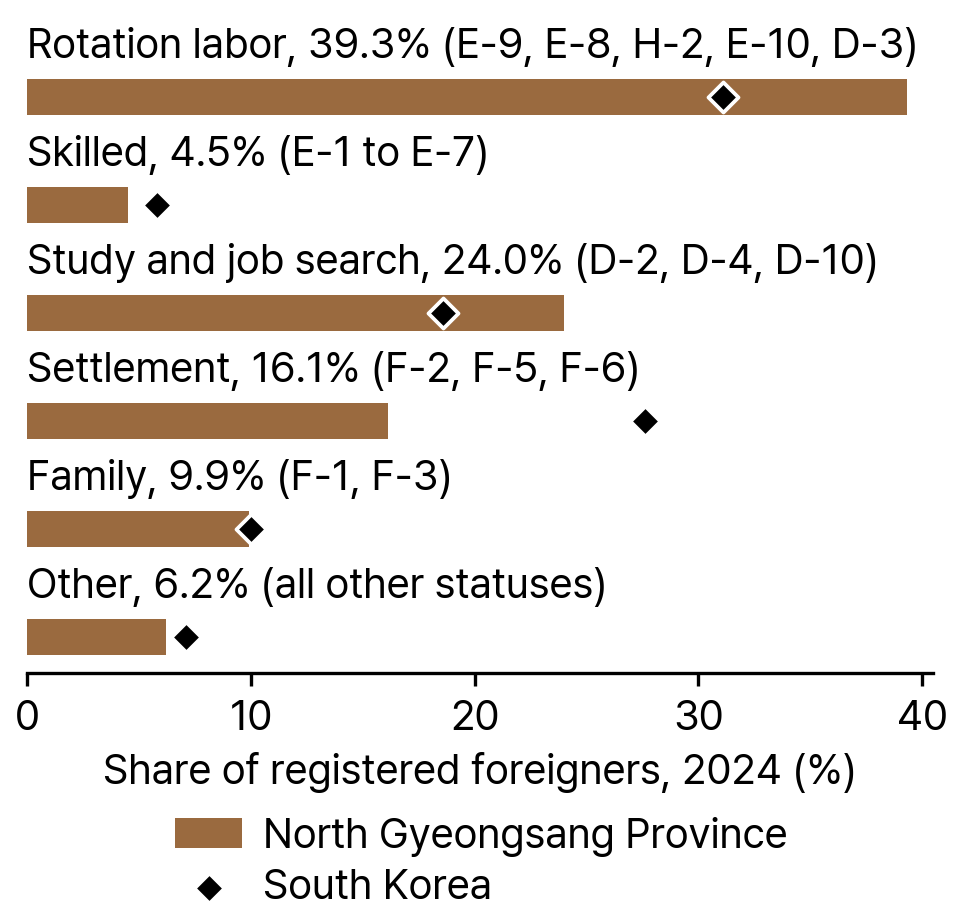
Compared with registered foreigners nationwide, those in North Gyeongsang Province in 2024 included more Vietnamese nationals (30.8 percent against 17.6 percent) and Indonesians (8.0 percent against 3.9 percent) and fewer Korean-Chinese (3.6 percent against 16.6 percent). Larger shares of them had rotation labor statuses (39.3 percent against 31.1 percent) and study and job search statuses (24.0 percent against 18.6 percent), and a smaller share had settlement statuses (16.1 percent against 27.6 percent). Gyeongsan-si, where the four universities in the province with the most international students in 2025 have their main campuses, had 18,485 registered foreigners in 2024, 24.1 percent of the province's total, and was the only district in the province whose Korean population grew between 2019 and 2024. Gyeongju-si was home to 5,838 of the province's 6,401 Koryoin, ethnic Koreans who returned from the former Soviet Union, in November 2024 (Kyongbuk Ilbo, 2026a). Fifteen of the province's 23 districts were designated population-decline areas in 2021.
Size of the Foreign-Resident Population
The number of registered foreigners in North Gyeongsang Province rose from 29,709 in 2006 to 47,805 in 2014 and 58,119 in 2019. It fell to 52,469 in 2020 and 51,100 in 2021, 12.1 percent below the 2019 level, and then rose each year to 76,768 in 2024, 50.2 percent above the 2021 count. The 2024 total was 2.58 times the 2006 total, an increase of 47,059 people (158.4 percent). The totals through 2022 include Gunwi County, which had 538 registered foreigners in 2019.
The MOIS count, which adds naturalized citizens and the children of foreign residents, rose from 36,685 in 2008 to 104,596 in 2019, dipped to 98,566 in 2020 and 98,197 in 2021 and rose to 128,725 in 2024.
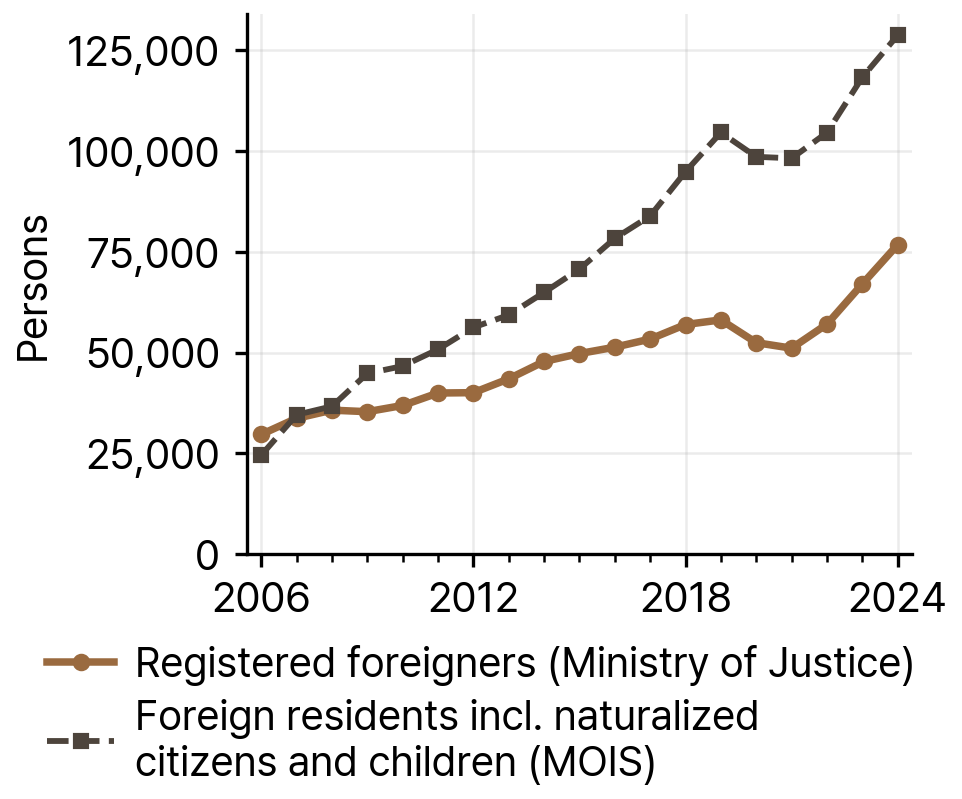
Source: KIRD dataset, from Ministry of Justice immigration yearbooks and Ministry of the Interior and Safety foreign-resident statistics, 2006-2024. Totals follow each year's boundary and include Gunwi County through 2022.
With 2014 set to 100, the number of registered foreigners in the province stood at 160.6 in 2024 and the number of Korean residents at 93.7. Both series follow each year's boundary. The Korean population fell by 46,168 between 2022 and 2023, a drop that includes Gunwi County's move to Daegu, against 26,117 between 2021 and 2022 and 22,940 between 2023 and 2024.
Within the current boundary, registered foreigners increased by 19,187 (33.3 percent) between 2019 and 2024 and Korean residents decreased by 110,609 (4.2 percent), so the foreign gain equaled 17.3 percent of the Korean loss. The province totals, which include Gunwi County in 2019, show an increase of 18,649 registered foreigners (32.1 percent) and a decrease of 134,452 Korean residents (5.0 percent), a ratio of 13.9 percent.
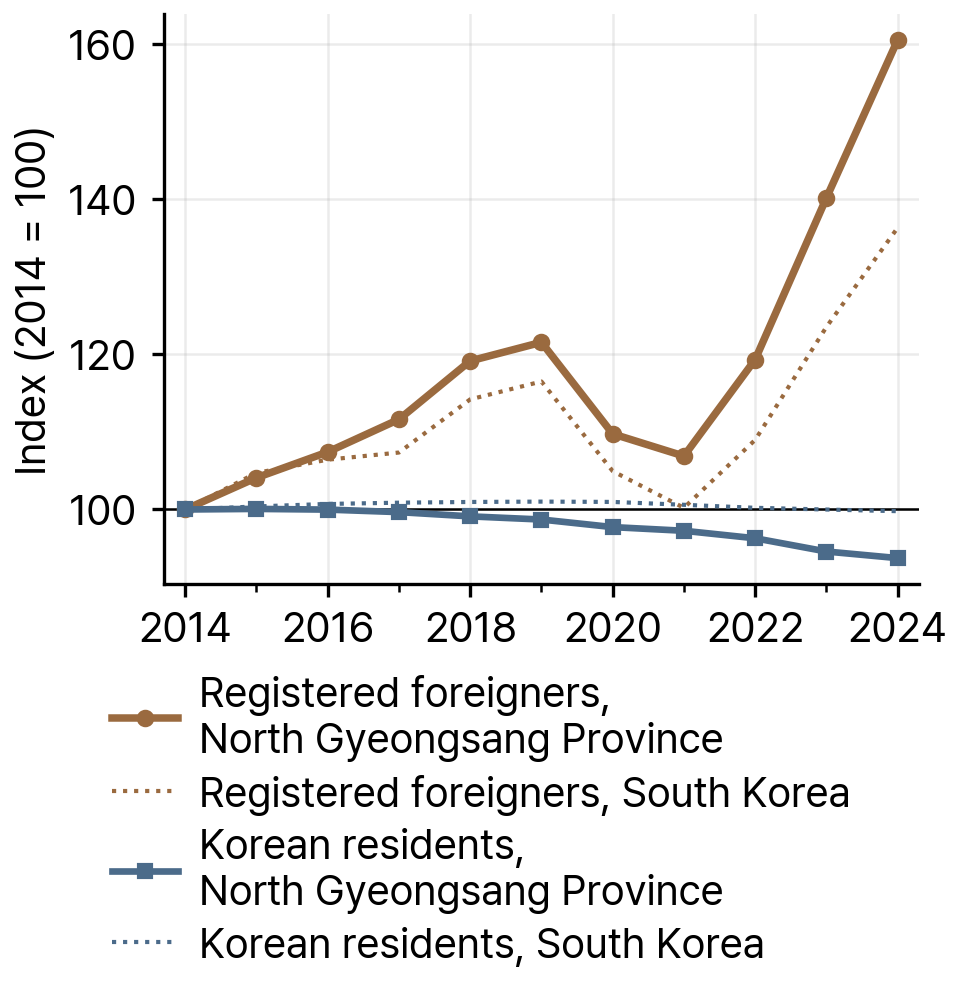
Source: KIRD dataset, from Ministry of Justice immigration yearbooks and Ministry of the Interior and Safety resident registration statistics, 2014-2024. Province series follow each year's boundary and include Gunwi County through 2022.
Registered foreigners per 100 Korean residents rose from 1.1 in 2006 to 1.8 in 2014, 2.2 in 2019 and 3.0 in 2024, when the national figure was 2.9. In 2024 North Gyeongsang Province ranked sixth among the 17 provinces and metropolitan cities by the number of registered foreigners and seventh by registered foreigners per Korean resident.
Table 1Registered Foreigners, MOIS Foreign Residents and Korean Residents in North Gyeongsang Province, Selected Years
| Year | Registered foreigners | MOIS foreign residents | Korean residents | Registered foreigners per 100 Korean residents |
|---|---|---|---|---|
| 2006 | 29,709 | – | 2,688,577 | 1.1 |
| 2014 | 47,805 | 64,931 | 2,700,794 | 1.8 |
| 2019 | 58,119 | 104,596 | 2,665,836 | 2.2 |
| 2024 | 76,768 | 128,725 | 2,531,384 | 3.0 |
Note: Registered foreigners are counted on 31 December and MOIS foreign residents on 1 November. The MOIS column starts in 2008, when the count was 36,685. Totals follow each year's boundary, so those for 2006, 2014 and 2019 include Gunwi County, which moved to Daegu on 1 July 2023; in 2019 the county had 538 registered foreigners and 23,843 Korean residents. South Korea had 2.9 registered foreigners per 100 Korean residents in 2024.
Source: KIRD dataset, from Ministry of Justice immigration yearbooks and Ministry of the Interior and Safety statistics, 2006-2024.
Nationalities
Vietnam was the largest nationality among registered foreigners in North Gyeongsang Province in 2024, with 23,632 people (30.8 percent of the total), compared with 17.6 percent of registered foreigners nationwide. China followed with 7,912 (10.3 percent), then Indonesia (6,115), Uzbekistan (4,815) and Nepal (4,498). The ten largest nationalities made up 80.8 percent of the province's registered foreigners (62,033 of 76,768).
Between 2019 and 2024 the number of Vietnamese nationals rose by 5,130 (27.7 percent), Chinese nationals by 2,101 (36.2 percent), Indonesians by 1,926 (46.0 percent) and Nepalis by 1,605 (55.5 percent), and the number of Thai nationals rose from 1,435 to 2,191 (52.7 percent). The number of Korean-Chinese fell from 3,388 to 2,800 (17.4 percent). The 2019 counts include Gunwi County, which had 538 registered foreigners of all nationalities that year.
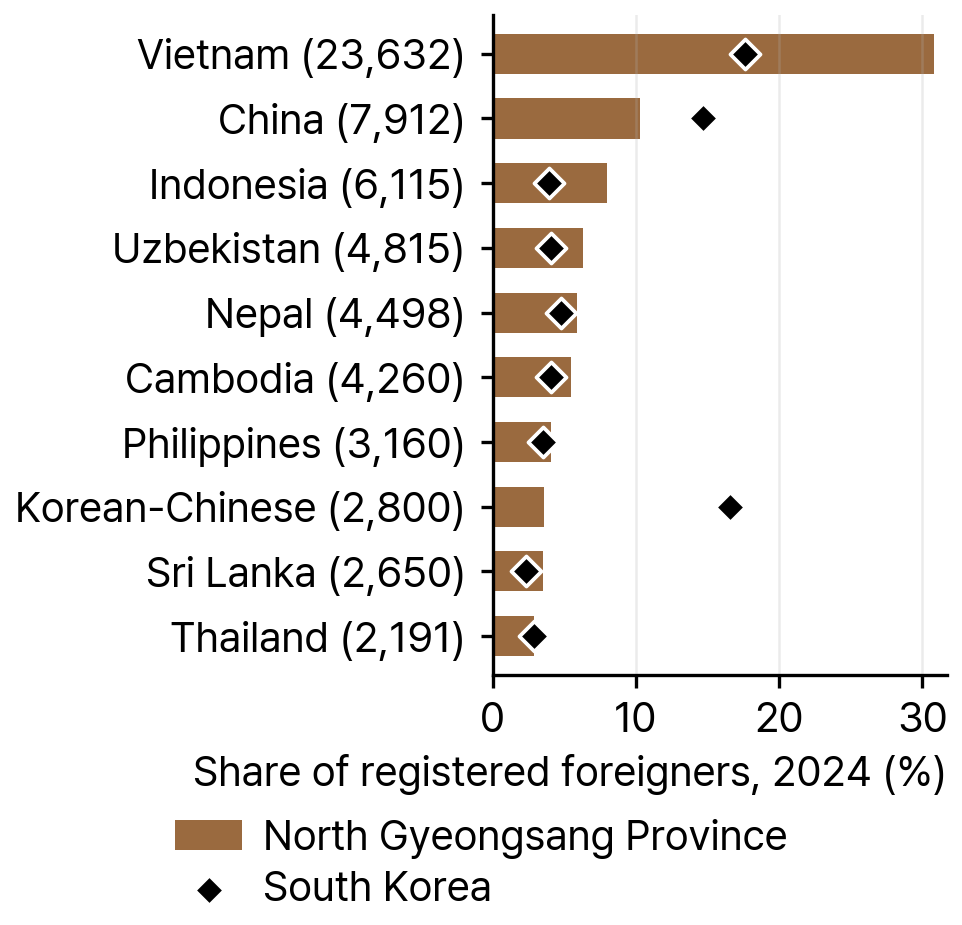
Source: KIRD dataset, from Ministry of Justice immigration yearbooks, 2024.
The province was home to 5.2 percent of all registered foreigners in South Korea in 2024 and to larger shares of several national groups, including 10.5 percent of Indonesians (6,115 of 58,248), 9.0 percent of Vietnamese (23,632 of 261,581), 7.8 percent each of Uzbek and Sri Lankan nationals and 7.0 percent of Cambodians. Its shares of Syrians (187 of 1,904, or 9.8 percent), Egyptians (225 of 2,835, or 7.9 percent) and Yemenis (94 of 1,200, or 7.8 percent) were also larger than its overall share. By contrast, 1.1 percent of Korean-Chinese registered foreigners lived in the province, where they made up 3.6 percent of registered foreigners against 16.6 percent nationwide.
The Shannon diversity index of the province's registered foreigners was 2.5 in 2014 and 2.5 in 2024, and in 2024 it ranked 11th among the 17 provinces and metropolitan cities. Registered foreigners in the province came from 130 nationalities in 2024.
Overseas Koreans on F-4 status report their residence instead of registering, so they are not counted among registered foreigners. In 2024, 10,697 F-4 holders reported a residence in North Gyeongsang Province, 1.9 percent of the 553,664 nationwide. Korean-Chinese made up the largest group (4,845), followed by nationals of Uzbekistan (1,480) and Kazakhstan (1,363), Korean-Russians (1,344) and nationals of the United States (845).
Table 2Ten Largest Nationalities among Registered Foreigners in North Gyeongsang Province, 2019 and 2024
| Nationality | 2019 | 2024 | Share of the province's registered foreigners, 2024 (%) | Province's share of the nationality's registered foreigners in South Korea, 2024 (%) |
|---|---|---|---|---|
| Vietnam | 18,502 | 23,632 | 30.8 | 9.0 |
| China | 5,811 | 7,912 | 10.3 | 3.6 |
| Indonesia | 4,189 | 6,115 | 8.0 | 10.5 |
| Uzbekistan | 3,824 | 4,815 | 6.3 | 7.8 |
| Nepal | 2,893 | 4,498 | 5.9 | 6.2 |
| Cambodia | 3,279 | 4,260 | 5.5 | 7.0 |
| Philippines | 2,623 | 3,160 | 4.1 | 6.1 |
| Korean-Chinese | 3,388 | 2,800 | 3.6 | 1.1 |
| Sri Lanka | 1,974 | 2,650 | 3.5 | 7.8 |
| Thailand | 1,435 | 2,191 | 2.9 | 5.0 |
Note: Korean-Chinese are ethnic Koreans of Chinese nationality, whom the Ministry of Justice counts separately from other Chinese nationals. The 2019 counts include Gunwi County, which moved to Daegu in 2023 and had 538 registered foreigners in 2019. North Gyeongsang Province had 5.2 percent of all registered foreigners in South Korea in 2024.
Source: KIRD dataset, from Ministry of Justice immigration yearbooks, 2019 and 2024.
Residence Statuses
Rotation labor statuses covered 30,188 registered foreigners in North Gyeongsang Province in 2024, or 39.3 percent, compared with 31.1 percent nationwide. The study and job search group covered 18,388 (24.0 percent, against 18.6 percent nationwide), settlement 12,380 (16.1 percent, against 27.6 percent), family 7,575 (9.9 percent, against 10.0 percent) and skilled 3,449 (4.5 percent, against 5.8 percent). The remaining 4,788 (6.2 percent, against 7.1 percent) had other statuses.
Source: KIRD dataset, from Ministry of Justice immigration yearbooks, 2024.
E-9 non-professional employment was the most common single status in 2024, with 22,347 holders (29.1 percent), followed by D-2 student (10,930), F-6 marriage migration (7,266) and D-4 general trainee (6,214). Against its 5.2 percent share of all registered foreigners, the province had 14.8 percent of all E-10 crew employment holders in South Korea (3,199 people) and 14.6 percent of all E-8 seasonal workers (2,878), as well as 7.8 percent of D-4 general trainees and 6.8 percent of E-9 holders. Its share of F-5 permanent residents was 1.6 percent (3,312 people).
Within the rotation labor group, E-9, E-10 and E-8 holders numbered 28,424 of 30,188 in 2024, and the other 1,764 had H-2 or D-3 status. In the study and job search group, D-2 and D-4 holders numbered 17,144 of 18,388, leaving 1,244 on D-10 status.
The MOIS count uses its own categories. On 1 November 2024 it recorded 29,693 foreign workers, 8,291 marriage migrants, 16,541 international students, 8,327 foreign nationals of Korean descent and 38,300 other foreigners in the province, 101,152 foreign nationals in all, together with 9,765 naturalized citizens and 17,808 children of foreign residents, for a total of 128,725.
Table 3Ten Most Common Residence Statuses among Registered Foreigners in North Gyeongsang Province, 2024
| Status | Meaning | Registered foreigners | Share of the province's registered foreigners (%) | Province's share of all holders in South Korea (%) |
|---|---|---|---|---|
| E-9 | Non-professional employment | 22,347 | 29.1 | 6.8 |
| D-2 | Student | 10,930 | 14.2 | 6.1 |
| F-6 | Marriage migration | 7,266 | 9.5 | 5.0 |
| D-4 | General trainee | 6,214 | 8.1 | 7.8 |
| F-1 | Visiting cohabitation | 4,978 | 6.5 | 5.1 |
| F-5 | Permanent residence | 3,312 | 4.3 | 1.6 |
| E-10 | Crew employment | 3,199 | 4.2 | 14.8 |
| G-1 | Other (miscellaneous) | 3,145 | 4.1 | 5.6 |
| E-8 | Seasonal worker | 2,878 | 3.7 | 14.6 |
| F-3 | Dependent family | 2,597 | 3.4 | 5.1 |
Note: Counts are registered foreigners on 31 December 2024. North Gyeongsang Province had 5.2 percent of all registered foreigners in South Korea in 2024.
Source: KIRD dataset, from Ministry of Justice immigration yearbooks, 2024.
Districts and Population-Decline Areas
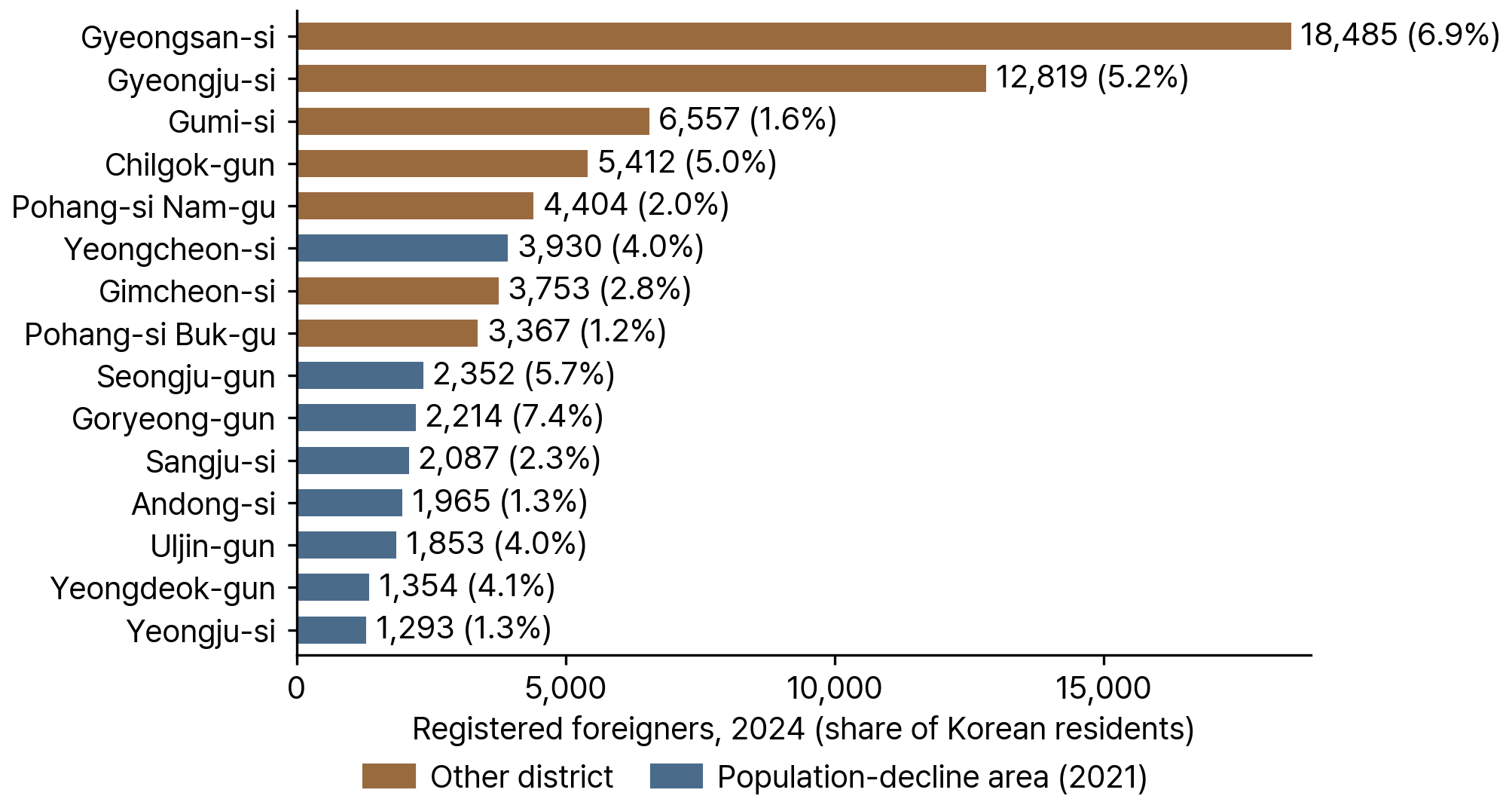
Gyeongsan-si had the most registered foreigners in North Gyeongsang Province in 2024 (18,485, or 24.1 percent of the province's total), followed by Gyeongju-si (12,819), Gumi-si (6,557), Chilgok-gun (5,412) and the Nam-gu general district of Pohang-si (4,404). Relative to the Korean population, the ratio was highest in Goryeong-gun (7.4 registered foreigners per 100 Korean residents), Gyeongsan-si (6.9), Seongju-gun (5.7), Gyeongju-si (5.2) and Chilgok-gun (5.0), and lowest in Yecheon-gun (1.1) and Pohang-si Buk-gu (1.2).
Between 2019 and 2024 the number of registered foreigners rose in 22 of the 23 districts, most in Gyeongsan-si (6,772), Gumi-si (1,580), Chilgok-gun (1,374), Gimcheon-si (1,362) and Pohang-si Nam-gu (1,123), and fell by 17 in Ulleung-gun. The Korean population fell in every district except Gyeongsan-si, which gained 3,213 Korean residents. The largest Korean losses were in Pohang-si Nam-gu (15,020), Gumi-si (14,922) and Gyeongju-si (10,633).
Source: KIRD dataset, from Ministry of Justice immigration yearbooks and Ministry of the Interior and Safety statistics, 2024; population-decline areas as designated by the Ministry of the Interior and Safety in October 2021.
On 19 October 2021 the Ministry of the Interior and Safety designated 15 of the province's current districts as population-decline areas (Andong-si, Mungyeong-si, Sangju-si, Yeongcheon-si, Yeongju-si, Bonghwa-gun, Cheongdo-gun, Cheongsong-gun, Goryeong-gun, Seongju-gun, Uiseong-gun, Uljin-gun, Ulleung-gun, Yeongdeok-gun and Yeongyang-gun) and named Gyeongju-si and Gimcheon-si areas of interest. Gunwi-gun, designated on the same date while it was part of the province, is counted under Daegu. In 2024 the 15 decline areas were home to 21,385 registered foreigners, 27.9 percent of the province's total.
Between 2019 and 2024 the 15 decline areas lost 56,885 Korean residents and gained 5,360 registered foreigners, so the foreign gain equaled 9.4 percent of the Korean loss, against 17.3 percent for the province as a whole within its current boundary. Sangju-si had the largest foreign gain among them (1,097) and lost 8,838 Korean residents. The two areas of interest lost 10,633 (Gyeongju-si) and 5,783 (Gimcheon-si) Korean residents and gained 1,025 and 1,362 registered foreigners.
Four districts met the definition of an ethnic enclave for at least one nationality in 2024, three of them population-decline areas. In Gyeongsan-si, 6,362 Vietnamese made up 34.4 percent of registered foreigners (location quotient 4.7). In Uljin-gun, Vietnamese (816, or 44.0 percent; location quotient 3.5) and Indonesians (714, or 38.5 percent; location quotient 13.6) each met the definition. In Yeongdeok-gun, 578 Vietnamese made up 42.7 percent (location quotient 3.4), and in Cheongdo-gun, 462 Cambodians made up 37.3 percent (location quotient 9.6).
Table 4Ten Districts with the Most Registered Foreigners in North Gyeongsang Province, 2024
| District | Registered foreigners, 2024 | Registered foreigners per 100 Korean residents, 2024 | Change in Korean residents, 2019-24 | Change in registered foreigners, 2019-24 | Population-decline area |
|---|---|---|---|---|---|
| Gyeongsan-si | 18,485 | 6.9 | +3,213 | +6,772 | No |
| Gyeongju-si | 12,819 | 5.2 | -10,633 | +1,025 | No (area of interest) |
| Gumi-si | 6,557 | 1.6 | -14,922 | +1,580 | No |
| Chilgok-gun | 5,412 | 5.0 | -9,664 | +1,374 | No |
| Pohang-si Nam-gu | 4,404 | 2.0 | -15,020 | +1,123 | No |
| Yeongcheon-si | 3,930 | 4.0 | -4,327 | +679 | Yes |
| Gimcheon-si | 3,753 | 2.8 | -5,783 | +1,362 | No (area of interest) |
| Pohang-si Buk-gu | 3,367 | 1.2 | -424 | +569 | No |
| Seongju-gun | 2,352 | 5.7 | -2,563 | +654 | Yes |
| Goryeong-gun | 2,214 | 7.4 | -2,311 | +465 | Yes |
Note: The other 13 districts had 13,475 registered foreigners in 2024. All of them except Yecheon-gun (586) are population-decline areas: Sangju-si (2,087), Andong-si (1,965), Uljin-gun (1,853), Yeongdeok-gun (1,354), Yeongju-si (1,293), Cheongdo-gun (1,238), Mungyeong-si (1,110), Uiseong-gun (835), Bonghwa-gun (397), Cheongsong-gun (346), Yeongyang-gun (260) and Ulleung-gun (151). District figures count Gunwi County under Daegu in every year. Population-decline areas and areas of interest are those designated by the Ministry of the Interior and Safety in October 2021.
Source: KIRD dataset, from Ministry of Justice immigration yearbooks and Ministry of the Interior and Safety statistics, 2019 and 2024.
Population Trends
Among the years from 2006 to 2024, the Korean population of North Gyeongsang Province was highest in 2015, at 2,702,826, and it declined every year from 2016 to 2024, when it stood at 2,531,384. By the province totals, it fell by 157,193 (5.8 percent) between 2006 and 2024, by 169,410 (6.3 percent) between 2014 and 2024 and by 134,452 (5.0 percent) between 2019 and 2024. These totals include Gunwi County through 2022, and the fall of 46,168 between 2022 and 2023 includes the county's move to Daegu. Within the current boundary, the Korean population fell by 110,609 (4.2 percent) between 2019 and 2024. The province's Korean residents made up 4.9 percent of South Korea's 51,217,221 in 2024.
The province's resident registration population fell from 2.639 million in 2020, when Gunwi County was still part of the province, to 2.507 million in 2025 and dropped below 2.5 million in May 2026 (Gyeongbuk Domin Ilbo, 2026).
The province's total fertility rate rose for a second consecutive year, from a record low of 0.86 in 2023 to a provisional 0.93 in 2025, 0.13 points above the national average of 0.80 in 2025. Its crude birth rate rose from 4.0 per 1,000 population in 2023 to 4.2 in 2025 (Eroun.net, 2026). A report on Statistics Korea's 2025 statistics on older people, published on 29 September 2025, put the share of the province's population aged 65 and over at 26.1 percent, the second-highest share after South Jeolla Province (27.4 percent) and ahead of Gangwon State (25.7 percent) (Gyeongbuk Gumi Sinmun, 2025).
Statistics Korea's provincial population projections for 2022-2052, released in 2024, put the share of the province's population aged 65 and over at 49.4 percent in 2052, the second-highest after South Jeolla Province (49.6 percent). The province is one of four provinces and metropolitan cities, with Ulsan, South Gyeongsang Province and South Jeolla Province, where the population aged 0 to 14 is projected to fall by more than half between 2022 and 2052 (Statistics Korea, 2024).
Between July 2022 and May 2026, the province had a net outflow of 38,524 residents aged 20 to 39 to other parts of South Korea, the second-largest after South Gyeongsang Province (46,075). Over the same period about 60,000 people in this age group left Daegu and the province for areas with semiconductor and other advanced industries (Kyongbuk Ilbo, 2026b).
Industry and Foreign Workers
Registered foreigners on E-9 non-professional employment status in North Gyeongsang Province numbered 20,371 in 2014 and 19,085 in 2019. The count fell to 14,609 in 2021 and rose to 22,347 in 2024, 53.0 percent above the 2021 level and 6.8 percent of all E-9 holders in South Korea. The counts for 2014, 2019 and 2021 include Gunwi County. The MOIS count recorded 29,693 foreign workers in the province on 1 November 2024, 23.1 percent of its 128,725 foreign residents.
The province also had 3,199 registered foreigners on E-10 crew employment status in 2024, 14.8 percent of all E-10 holders in South Korea. As of 2024, Pohang was the only city in the province that subsidized the cost of bringing in foreign fishing crew and their health checkups, which it had done since 2017. In 2024 a city delegation visited Vietnam to interview and select crew and discussed with two recruitment agencies the problems of crew leaving their workplaces and remaining in Korea without authorization (Gyeongbuk Maeil, 2024).
The number of E-8 seasonal workers counted on 31 December rose from 69 in 2021 to 498 in 2022, 1,890 in 2023 and 2,878 in 2024, when the province had 14.6 percent of all E-8 holders in South Korea. Most seasonal workers' contracts end before winter, so a count on 31 December misses most of them. The province brought in 12,544 foreign seasonal workers in 2025 and received an allocation of 14,638 for 2026, 16 percent more and the largest allocation of any province (Kyongbuk Ilbo, 2026c).
Seongju-gun, the largest melon-growing area in South Korea, depends on foreign seasonal workers for the labor concentrated in transplanting, crop management, harvesting and sorting, because rural depopulation and aging have made domestic workers unavailable. A 2026 news feature reported that the saying that farming there is impossible without foreign workers is no longer an exaggeration (Daegu Ilbo, 2026).
Seongju-gun has signed a memorandum with Cambodia's labor ministry and will add Cambodia to Laos, the Philippines and Vietnam as a source of seasonal workers from its program for the first half of 2027. Entry for the 2027 program moves earlier, to late December 2026, January 2027 and February 2027, from January, February and mid-March in earlier programs (Kyongbuk Ilbo, 2026d).
International Students and Universities
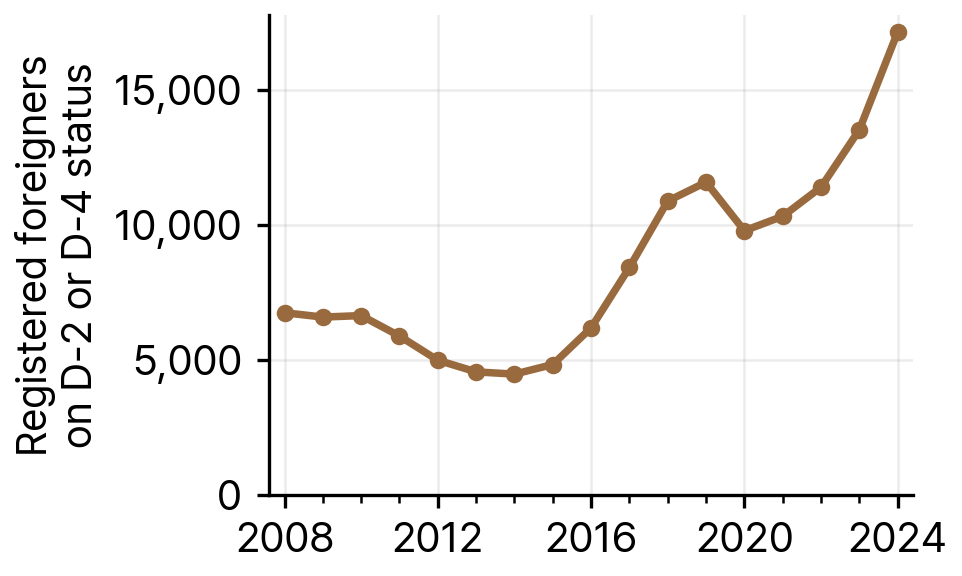
Registered foreigners on D-2 student and D-4 general trainee status in North Gyeongsang Province numbered 6,748 in 2008 and declined to 4,474 in 2014, the lowest count in the series. The count increased in each year from 2015 to 2019, when it was 11,583, dipped to 9,785 in 2020 and then rose each year to 17,144 in 2024, about 3.8 times the 2014 level. In 2024, 10,930 were on D-2 status and 6,214 on D-4 status, and the province had 6.6 percent of all D-2 and D-4 holders in South Korea, against 5.2 percent of all registered foreigners. The MOIS count recorded 16,541 international students in the province on 1 November 2024.
Source: KIRD dataset, from Ministry of Justice immigration yearbooks, 2008-2024.
Among universities with main campuses in the province, Daegu University had the most international students in the August 2025 disclosure on Academyinfo (대학알리미), with 1,660, followed by Daegu Haany University (1,637), Yeungnam University (1,439) and Daegu Catholic University (1,178). All four have their main campuses in Gyeongsan-si (Kyongbuk Ilbo, 2025a), the district with the most registered foreigners in the province in 2024 (18,485).
Table 5International Students at Four Universities in Gyeongsan-si, August 2025 Disclosure
| University | International students, August 2025 |
|---|---|
| Daegu University | 1,660 |
| Daegu Haany University | 1,637 |
| Yeungnam University | 1,439 |
| Daegu Catholic University | 1,178 |
Note: Counts are the numbers of international students in the August 2025 disclosure on Academyinfo (대학알리미). The four are the universities with main campuses in North Gyeongsang Province that had the most international students; universities with main campuses in Daegu are not included.
Source: Kyongbuk Ilbo, 2025a, from Academyinfo (대학알리미), August 2025.
The Ministry of Education and the Korean Educational Development Institute counted 22,456 international students in the province in their 2026 Basic Statistics on Education, 6,347 (39.4 percent) more than the 16,109 of the previous year. Students in degree programs increased by 49.1 percent to 18,736, of whom 14,333 were undergraduates, and master's and doctoral students increased by 51.8 percent to 4,403 (Financial News, 2026).
The province's scholarship program for international graduate students in natural science and engineering is described under Provincial Policy.
Provincial Policy
In January 2023 the province set up a Foreign Community Division (외국인공동체과) under its Local Era Policy Bureau to strengthen its immigration and foreign-resident policy (Seoul Sinmun, 2023). In 2024 it prepared an immigration policy master plan, the K-Dream Foreign Resident Responsibility System (K-드림 외국인책임제), with 3 strategies, 9 strategic tasks and 27 detailed tasks, which the province describes as a full-cycle model covering the process from attracting immigrants to social integration (Munhwa Ilbo, 2024).
As of September 2025 the province operated the K-Dream Foreign Support Center in Gumi and an overseas talent recruitment center in Uzbekistan and supported 14 foreign-resident counseling centers (Metro Seoul, 2025a).
Under the metropolitan-type visa (광역형 비자) pilot, in effect from 1 July 2025 to 31 December 2026, the province designs its own requirements and procedures for 23 professional (E-7-1) and 2 semi-professional (E-7-2) occupations under the E-7 status and plans to bring 350 foreign workers into its 22 cities and counties over the two years (Metro Seoul, 2025b).
In June 2025 the province became the fifth region, after Seoul, Busan, Gangwon and Jeju, where hotels and vacation condominiums may legally employ workers on E-9 status, as building cleaners, kitchen assistants and hall servers (Kyongbuk Ilbo, 2025b).
In December 2025 the province evaluated the foreign-resident policies of its cities and counties, the first such evaluation by a provincial-level government in South Korea. Seongju-gun received the grand prize, and Gyeongju-si and Goryeong-gun received top-excellence awards (Yeongnam Economy, 2025).
The province's own invitational scholarship program for international students (K-GKS, 경북형 초청장학제도) pays full-semester scholarships to master's and doctoral students in natural science and engineering, on condition that they remain in the province for three years after graduation (Financial News, 2026).
Languages
The KIRD dataset estimates first-language speakers by multiplying the number of registered foreigners of each nationality by the share of that country's population with the language as a first language, as reported by Ethnologue. By this estimate, Vietnamese was the most common first language among registered foreigners in North Gyeongsang Province in 2024 (20,202 speakers), followed by Chinese (8,409), Khmer (4,415) and Indonesian (4,287). Sixteen languages had at least 1,000 estimated speakers in 2024, and the table shows the ten with the most.
Because the estimate applies first-language shares to nationality counts, it differs from the counts by nationality. The estimate for Vietnamese (20,202) is below the number of Vietnamese nationals (23,632), and the estimate for Chinese (8,409) is above the number of Chinese nationals (7,912).
Table 6Estimated First-Language Speakers among Registered Foreigners in North Gyeongsang Province, 2024
| Language | Estimated speakers |
|---|---|
| Vietnamese | 20,202 |
| Chinese | 8,409 |
| Khmer | 4,415 |
| Indonesian | 4,287 |
| Uzbek | 3,556 |
| Tagalog/Filipino | 2,754 |
| Nepali | 2,345 |
| Thai | 2,055 |
| Russian | 1,859 |
| Sinhala | 1,827 |
Note: Estimates multiply the number of registered foreigners of each nationality by the share of that country's population with the language as a first language (Ethnologue) and sum across nationalities. Korean is excluded. Sixteen languages had at least 1,000 estimated speakers in 2024; the table shows the ten with the most.
Source: KIRD dataset, language estimates from Ministry of Justice nationality counts and Ethnologue first-language shares, 2024.
Service Organizations and Community Places
The KIRD census of 1,720 migrant-serving organizations in South Korea lists 106 in North Gyeongsang Province, or 13.8 per 10,000 registered foreigners in 2024, compared with 11.6 per 10,000 nationwide. Of the 106, 103 provide services directly to migrants, and 22 have 가족센터 (family center) in their names.
Organizations can name more than one population they serve. Families are the population named most often (39 organizations), followed by workers (29), refugees (12), youth (10), children (8), undocumented migrants (7), students (4), women (4) and overseas Koreans (3). Another 25 organizations serve all foreign residents.
In November 2024 the province had 6,401 Koryoin, ethnic Koreans who returned from the former Soviet Union. Of these, 5,838 (91.2 percent) lived in Gyeongju, 175 in Gyeongsan, 148 in Yeongcheon and 240 in other areas (Kyongbuk Ilbo, 2026a).
Seonggeon-dong in Gyeongju, a former university-student district near the Gyeongju campus of Dongguk University, has become known as a Koryoin village. A foreign residents' help center opened there in 2015, a Koryoin village center in 2018 and the provincial Gyeongbuk Koryoin Integrated Support Center in 2020. A 2021 report described a Russian bakery with Central Asian clay ovens in the neighborhood, as well as public notices written in Russian, Vietnamese and Chinese (The AsiaN, 2021).
At Heungmu Elementary School in Seonggeon-dong, Koryoin students made up more than 30 percent of enrollment by 2021, and the school had five Russian-speaking bilingual instructors (The AsiaN, 2021).
Sources
Korea Immigration Regional Dashboard (KIRD) dataset, compiled from Ministry of Justice immigration yearbooks and Ministry of the Interior and Safety foreign-resident statistics, 2006-2024. openICPSR. https://doi.org/10.3886/E249944V1
Kyongbuk Ilbo (경북일보). 2026a. Ninety-one percent of Gyeongbuk's Koryoin live in Gyeongju, and the Korea-Central Asia summit draws attention to their settlement (in Korean). https://www.kyongbuk.co.kr/news/articleView.html?idxno=4084309
Gyeongbuk Domin Ilbo (경북도민일보). 2026. Gyeongbuk's population falls below 2.5 million, and the province looks to its living population of 5.04 million (in Korean). https://www.hidomin.com/news/articleView.html?idxno=709207
Eroun.net (이로운넷). 2026. Gyeongbuk's total fertility rate rises for a second consecutive year (in Korean). https://www.eroun.net/news/articleView.html?idxno=77536
Gyeongbuk Gumi Sinmun (경북구미신문). 2025. Older people make up 20.3 percent of the population in 2025, and the relative poverty rate of retirees is 39.8 percent (in Korean). https://www.guminews.net/news/articleView.html?idxno=11246
Statistics Korea (통계청). 2024. 장래인구추계 시도편: 2022-2052년 (Population projections for provinces, 2022-2052). Press release. https://mods.go.kr/board.es?mid=a10301010000&bid=207&act=view&list_no=431113
Kyongbuk Ilbo (경북일보). 2026b. Net outflow of 60,810 people aged 20 to 39 from Daegu and Gyeongbuk, with Gyeongbuk second nationally (in Korean). https://www.kyongbuk.co.kr/news/articleView.html?idxno=4083254
Gyeongbuk Maeil (경북매일). 2024. Bringing in foreign crew matched to the needs of the fishing industry (in Korean). https://www.kbmaeil.com/article/202403180387888
Kyongbuk Ilbo (경북일보). 2026c. Foreign seasonal workers in Gyeongbuk pass 10,000, easing the rural labor shortage (in Korean). https://www.kyongbuk.co.kr/news/articleView.html?idxno=4072833
Daegu Ilbo (대구일보). 2026. News focus: farming that cannot be done without foreign workers, and the need for new farm policy (in Korean). https://www.idaegu.com/news/articleView.html?idxno=665219
Kyongbuk Ilbo (경북일보). 2026d. Seongju-gun expands its foreign seasonal workers to four countries and moves entry earlier (in Korean). https://www.kyongbuk.co.kr/news/articleView.html?idxno=4081114
Kyongbuk Ilbo (경북일보). 2025a. International students in Gyeongbuk and Daegu up 38.32 percent from the previous year, above the rates for Seoul and the country (in Korean). https://www.kyongbuk.co.kr/news/articleView.html?idxno=4050958
Financial News (파이낸셜뉴스). 2026. Gyeongbuk moves from recruiting international students to keeping them in the province, with degree-program students up 49.1 percent (in Korean). https://www.fnnews.com/news/202609280804102766
Seoul Sinmun (서울신문). 2023. North Gyeongsang Province joins the bid to host the immigration agency, citing its strengthened immigration policy (in Korean). https://www.seoul.co.kr/news/society/2023/12/12/20231212500103
Munhwa Ilbo (문화일보). 2024. 'Overcoming the risk of regional extinction by attracting immigrants': North Gyeongsang Province prepares an immigration policy master plan (in Korean). https://www.munhwa.com/article/11422000
Metro Seoul (메트로서울). 2025a. North Gyeongsang Province holds a public forum on support for Koryoin settlement (in Korean). https://www.metroseoul.co.kr/article/20250901500055
Metro Seoul (메트로서울). 2025b. North Gyeongsang Province launches its metropolitan-type visa pilot program (in Korean). https://www.metroseoul.co.kr/article/20250709500593
Kyongbuk Ilbo (경북일보). 2025b. Gyeongbuk allows hotels and condominiums to employ foreign workers legally (in Korean). https://www.kyongbuk.co.kr/news/articleView.html?idxno=4044539
Yeongnam Economy (영남경제). 2025. North Gyeongsang Province holds its first evaluation of cities and counties on foreign-resident policy, with the grand prize to Seongju (in Korean). https://www.ynenews.kr/news/articleView.html?idxno=72364
The AsiaN (디아시안). 2021. Koryoin village in Seonggeon-dong, Gyeongju, part 1: Eurasian Koryoin revive Gyeongju as an international city (in Korean). https://kor.theasian.asia/archives/293932
Suggested citation: Korea Immigration Regional Dashboard (KIRD). 2026. “Foreign Residents in North Gyeongsang Province.” Foreign Residents in South Korea series, September 2026. Data: Korea Immigration Regional Dashboard (KIRD) dataset, https://doi.org/10.3886/E249944V1. Interactive maps and tables: https://immigrantsinkorea.today.