 Korea Immigration Regional Dashboard
SpotlightSeptember 2026Province profilesDownload PDF
Foreign Residents in Incheon
Highlights
- At the end of 2024, Incheon had 89,129 registered foreigners, the fifth-largest number among South Korea's 17 provinces and metropolitan cities and 61.1 percent more than in 2014, while its Korean population grew 4.1 percent over the same ten years.
- Settlement statuses (F-2, F-5 and F-6) covered 40.7 percent of Incheon's registered foreigners in 2024, against 27.6 percent nationally, and 9.7 percent of all permanent residents (F-5) in South Korea lived in Incheon.
- In 2024 Incheon was home to 36.4 percent of the Yemeni nationals registered in South Korea (437 of 1,200), 24.3 percent of Tajik nationals and 22.4 percent of Egyptian nationals, compared with its 6.0 percent share of all registered foreigners.
On 31 December 2024, 89,129 registered foreigners lived in Incheon, 6.0 percent of the 1,488,353 in South Korea. Incheon ranked fifth among the 17 provinces and metropolitan cities by that count and eighth by registered foreigners per Korean resident, with 3.0 registered foreigners for every 100 Korean residents against 2.9 nationally. The Ministry of the Interior and Safety (MOIS), whose count adds naturalized citizens and the children of foreign residents, recorded 169,219 foreign residents in Incheon on 1 November 2024, 1.90 times the registered count.
The number of registered foreigners in Incheon more than doubled between 2006 and 2024, from 39,466 to 89,129 (an increase of 125.8 percent), while the number of Korean residents grew 15.1 percent, from 2,624,391 to 3,021,010. Between 2014 and 2024, registered foreigners increased 61.1 percent and Korean residents 4.1 percent. The registered count fell from 72,259 in 2019 to 66,364 in 2021 and then rose by 22,765 to its 2024 level. Its growth of 23.3 percent between 2019 and 2024 ranked tenth among the 17 provinces, while Korean residents grew 2.2 percent. In January 2024 the city's Korean population passed 3 million for the first time (Incheon Metropolitan City, 2024).
In 2024, larger shares of Incheon's registered foreigners than of all registered foreigners in South Korea were on settlement statuses (40.7 against 27.6 percent) and family statuses (13.7 against 10.0 percent). Smaller shares were on rotation labor statuses (23.3 against 31.1 percent) and study and job search statuses (9.7 against 18.6 percent). Korean-Chinese (ethnic Koreans of Chinese nationality) were the largest group, at 22.9 percent of registered foreigners against 16.6 percent nationally. The city was also home to large shares of the Yemeni, Tajik, Egyptian, Syrian and Kyrgyz nationals registered in the country. Yeonsu-gu, which includes Songdo and Hambak-maul, a neighborhood of Koryoin (ethnic Koreans from the former Soviet Union), had the most registered foreigners of Incheon's ten districts in 2024 and the most per Korean resident. Incheon's Chinatown in Jung-gu dates from a Qing Chinese concession set up in 1884, the first foreign concession in Korea (Kyeongin Ilbo, 2026).
Size of the Foreign-Resident Population
Incheon had 39,466 registered foreigners in 2006, 55,323 in 2014 and 72,259 in 2019 (see Figure 1). The count fell to 67,648 in 2020 and 66,364 in 2021, 8.2 percent below the 2019 level, then rose to 71,849 in 2022, 81,016 in 2023 and 89,129 in 2024, the highest count since the series began in 2006. The increase from 2023 to 2024 alone was 8,113, or 10.0 percent.
The MOIS count of foreign residents, which adds naturalized Korean citizens and the children of foreign residents, rose from 49,253 in 2008 to 82,523 in 2014, 130,292 in 2019 and 169,219 in 2024, increasing in every year of the period. It was 1.02 times the registered count in 2008, 1.49 times in 2014 and 1.90 times in 2024.
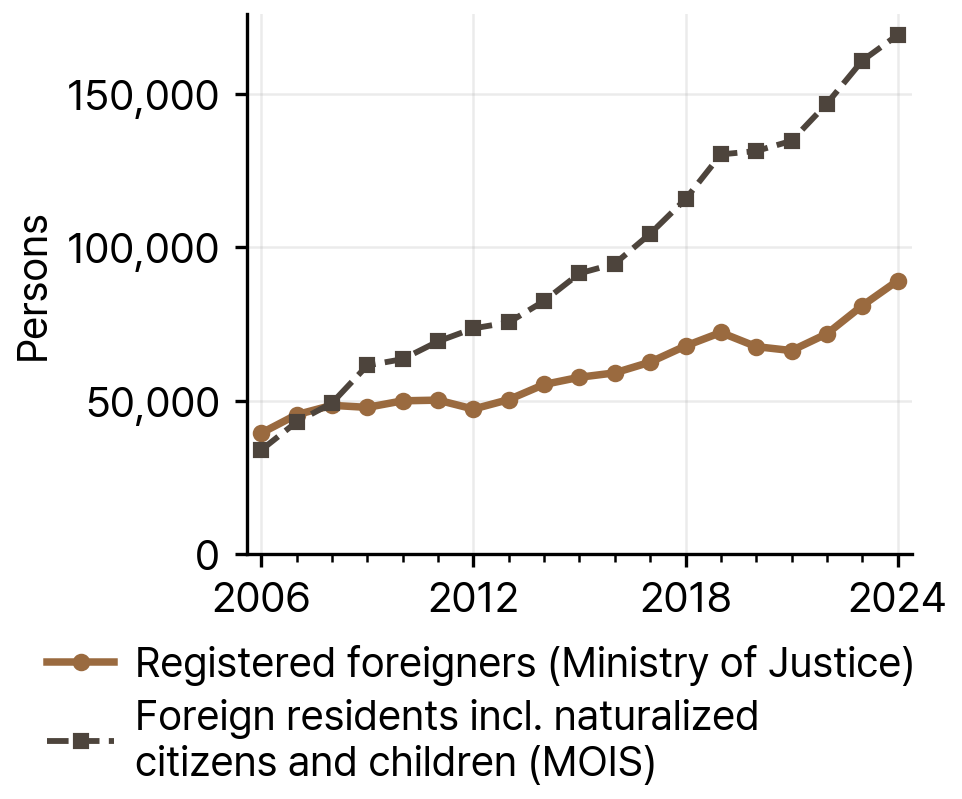
Source: KIRD dataset, from Ministry of Justice immigration yearbooks and Ministry of the Interior and Safety statistics, 2006-2024.
With 2014 set to 100, registered foreigners in Incheon stood at 161.1 in 2024 and Korean residents at 104.1 (see Figure 2). Registered foreigners increased by 33,806 over 2014-24 and Korean residents by 118,402, so registered foreigners accounted for 22.2 percent of the combined increase of 152,208.
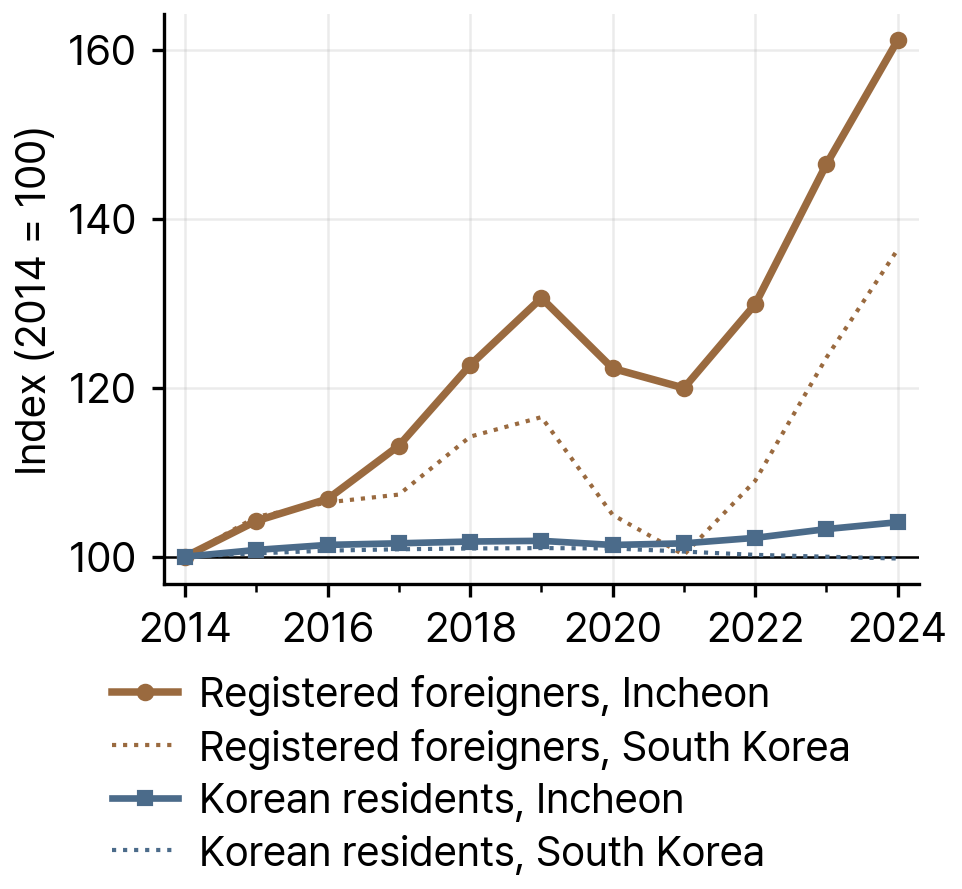
Source: KIRD dataset, from Ministry of Justice immigration yearbooks and Ministry of the Interior and Safety resident registration statistics, 2014-2024.
In 2024 Incheon ranked fifth among the 17 provinces and metropolitan cities by the number of registered foreigners and eighth by registered foreigners per Korean resident. It had 3.0 registered foreigners per 100 Korean residents in 2024, up from 1.5 in 2006, 1.9 in 2014 and 2.4 in 2019, against 2.9 for South Korea as a whole (see Table 1).
Table 1Registered Foreigners, MOIS Foreign Residents and Korean Residents in Incheon, Selected Years, 2006-24
| Year | Registered foreigners | MOIS foreign residents | Korean residents | Registered foreigners per 100 Korean residents |
|---|---|---|---|---|
| 2006 | 39,466 | – | 2,624,391 | 1.5 |
| 2014 | 55,323 | 82,523 | 2,902,608 | 1.9 |
| 2019 | 72,259 | 130,292 | 2,957,026 | 2.4 |
| 2024 | 89,129 | 169,219 | 3,021,010 | 3.0 |
Note: Registered foreigners are counted on 31 December and MOIS foreign residents on 1 November. The table shows MOIS counts from 2008, when the MOIS count for Incheon was 49,253. Korean residents are Korean nationals in the MOIS resident registration count.
Source: KIRD dataset, from Ministry of Justice immigration yearbooks and Ministry of the Interior and Safety statistics, 2006-2024.
Nationalities
Korean-Chinese were the largest group among Incheon's registered foreigners in 2024 (20,395, or 22.9 percent), followed by Chinese nationals other than Korean-Chinese (13,037, or 14.6 percent) and Vietnamese nationals (9,829, or 11.0 percent) (see Figure 3 and Table 2). Korean-Chinese and other Chinese nationals together made up 37.5 percent of registered foreigners in 2024 (33,432), down from 42.0 percent in 2019 (30,355 of 72,259). The ten largest nationalities accounted for 65,005 people, 72.9 percent of the 2024 total.
Compared with all registered foreigners in South Korea in 2024, Incheon had larger shares of Korean-Chinese (22.9 against 16.6 percent), Myanmar (5.4 against 3.5 percent) and Kazakh nationals (2.9 against 1.4 percent). Its shares of Vietnamese (11.0 against 17.6 percent) and Indonesian nationals (2.7 against 3.9 percent) were smaller.
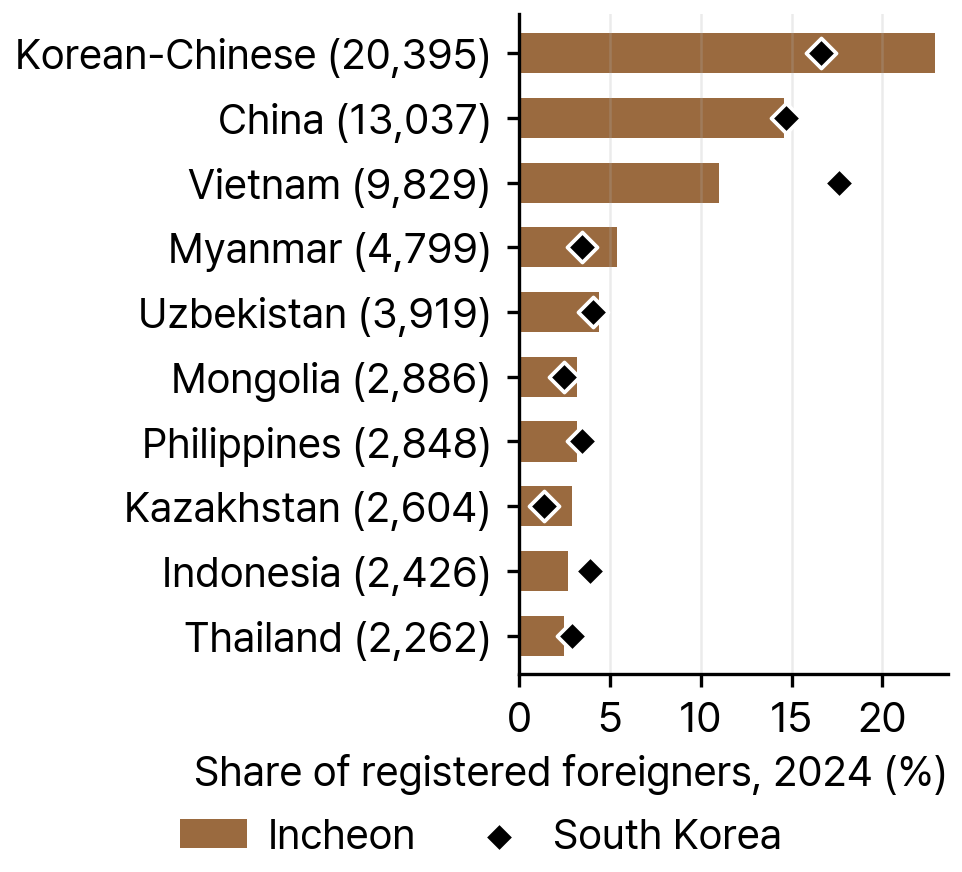
Source: KIRD dataset, from Ministry of Justice immigration yearbooks, 2024.
Between 2019 and 2024 the number of Myanmar nationals in Incheon more than doubled, from 2,337 to 4,799, and Myanmar was the fourth-largest nationality in 2024. Mongolian nationals increased 53.5 percent (from 1,880 to 2,886), Kazakh nationals 50.3 percent (from 1,732 to 2,604) and Indonesian nationals 45.2 percent (from 1,671 to 2,426). The number of Filipino nationals changed little, from 2,838 to 2,848.
Table 2Ten Largest Nationalities among Registered Foreigners in Incheon, 2019 and 2024
| Nationality | 2019 | 2024 | Share of Incheon's registered foreigners, 2024 (%) | Share of all registered foreigners in South Korea, 2024 (%) | Incheon's share of the nationality in South Korea, 2024 (%) |
|---|---|---|---|---|---|
| Korean-Chinese | 19,071 | 20,395 | 22.9 | 16.6 | 8.3 |
| China | 11,284 | 13,037 | 14.6 | 14.7 | 6.0 |
| Vietnam | 9,294 | 9,829 | 11.0 | 17.6 | 3.8 |
| Myanmar | 2,337 | 4,799 | 5.4 | 3.5 | 9.2 |
| Uzbekistan | 3,663 | 3,919 | 4.4 | 4.1 | 6.3 |
| Mongolia | 1,880 | 2,886 | 3.2 | 2.5 | 7.7 |
| Philippines | 2,838 | 2,848 | 3.2 | 3.5 | 5.5 |
| Kazakhstan | 1,732 | 2,604 | 2.9 | 1.4 | 12.7 |
| Indonesia | 1,671 | 2,426 | 2.7 | 3.9 | 4.2 |
| Thailand | 1,862 | 2,262 | 2.5 | 2.9 | 5.2 |
Note: China excludes Korean-Chinese, who are counted separately. Incheon had 6.0 percent of all registered foreigners in South Korea in 2024, so a value above 6.0 in the last column means the nationality is more concentrated in Incheon than registered foreigners as a whole.
Source: KIRD dataset, from Ministry of Justice immigration yearbooks, 2019 and 2024.
In 2024 Incheon's shares of several smaller national groups were far above its 6.0 percent share of all registered foreigners. The city was home to 437 of the 1,200 Yemeni nationals registered in South Korea (36.4 percent), 380 of 1,567 Tajik nationals (24.3 percent) and 635 of 2,835 Egyptian nationals (22.4 percent). It also had 298 of 1,904 Syrian nationals (15.7 percent) and 1,148 of 8,170 Kyrgyz nationals (14.1 percent). Among the ten largest nationalities, the city's share was highest for Kazakh (12.7 percent), Myanmar (9.2 percent) and Korean-Chinese nationals (8.3 percent).
The Shannon diversity index (H), which rises as registered foreigners are spread more evenly over more nationalities, increased from 2.4 in 2014 to 2.6 in 2024, when Incheon ranked seventh among the 17 provinces. Registered foreigners in Incheon came from 160 nationality categories in 2024.
Overseas Koreans on F-4 status report their residence instead of registering, so they are not included in the counts above. In 2024, 43,637 F-4 residence reports listed an address in Incheon, 7.9 percent of the 553,664 in South Korea. Korean-Chinese accounted for 28,838 of them (66.1 percent), followed by Korean-Russians (4,909) and nationals of Uzbekistan (3,157), the United States (2,458) and Kazakhstan (1,960). Adding the two counts, 49,233 Korean-Chinese in Incheon were registered foreigners or F-4 residents in 2024.
Residence Statuses
In 2024, settlement statuses (F-2, F-5 and F-6) covered 40.7 percent of Incheon's registered foreigners (36,291 people), compared with 27.6 percent nationally, and family statuses (F-1 and F-3) covered 13.7 percent (12,254), compared with 10.0 percent (see Figure 4). Rotation labor accounted for 23.3 percent (20,790), study and job search for 9.7 percent (8,638) and skilled statuses for 3.9 percent (3,512), below the national shares of 31.1, 18.6 and 5.8 percent. The other group made up 8.6 percent (7,644), against 7.1 percent in South Korea.
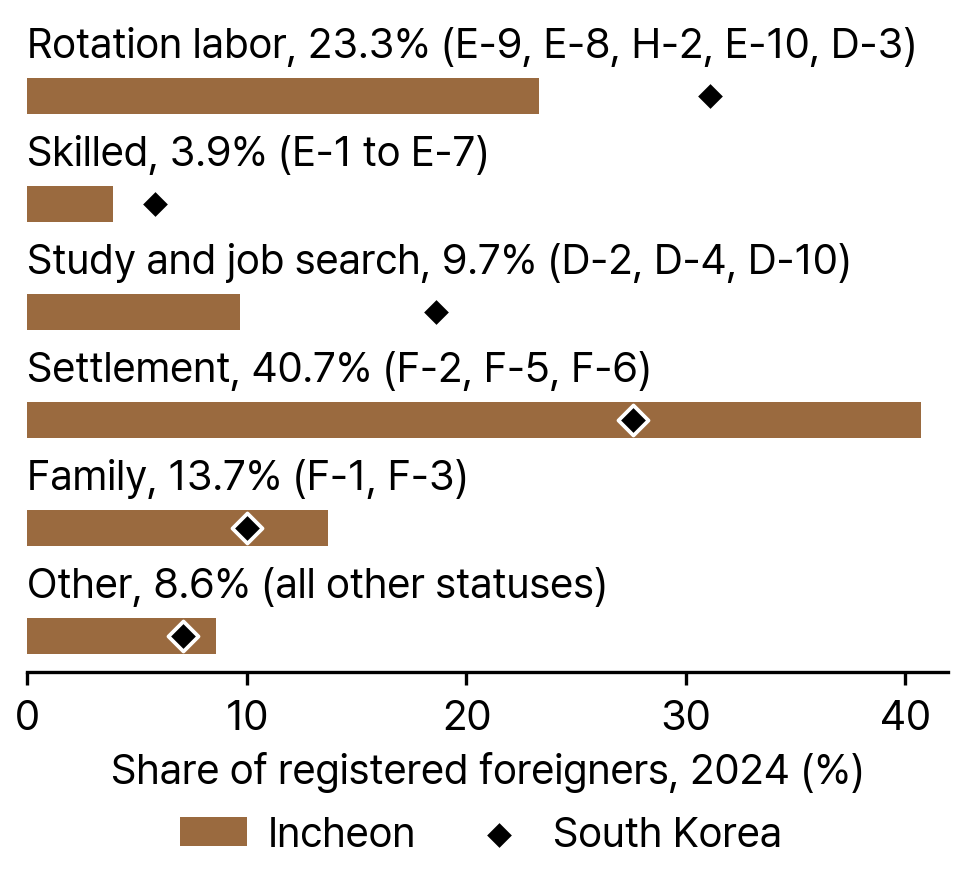
Source: KIRD dataset, from Ministry of Justice immigration yearbooks, 2024.
Permanent residence (F-5) was the most common single status in 2024, with 19,601 registered foreigners (22.0 percent), and Incheon was home to 9.7 percent of all F-5 holders in South Korea (see Table 3). Non-professional employment (E-9) followed with 14,664 (16.5 percent) and marriage migration (F-6) with 10,901 (12.2 percent). The ten largest statuses in Table 3 accounted for 81,582 people (91.5 percent).
In 2024, Incheon's share of the national holders of a status was above its 6.0 percent share of all registered foreigners for seven of the ten statuses in Table 3. It was highest for F-5 (9.7 percent), F-2 residential (9.5 percent) and F-3 dependent family (8.8 percent), followed by G-1 other (8.2 percent), F-1 visiting cohabitation (8.0 percent), F-6 (7.4 percent) and H-2 visiting employment (6.3 percent). It was below 6.0 percent for E-9 (4.5 percent), D-2 student (3.1 percent) and D-4 general trainee (3.2 percent).
Table 3Ten Most Common Residence Statuses among Registered Foreigners in Incheon, 2024
| Status | Meaning | Registered foreigners | Share of Incheon's registered foreigners (%) | Incheon's share of all holders in South Korea (%) |
|---|---|---|---|---|
| F-5 | Permanent residence | 19,601 | 22.0 | 9.7 |
| E-9 | Non-professional employment | 14,664 | 16.5 | 4.5 |
| F-6 | Marriage migration | 10,901 | 12.2 | 7.4 |
| F-1 | Visiting cohabitation | 7,730 | 8.7 | 8.0 |
| F-2 | Residential | 5,789 | 6.5 | 9.5 |
| H-2 | Visiting employment | 5,777 | 6.5 | 6.3 |
| D-2 | Student | 5,460 | 6.1 | 3.1 |
| G-1 | Other (miscellaneous) | 4,610 | 5.2 | 8.2 |
| F-3 | Dependent family | 4,524 | 5.1 | 8.8 |
| D-4 | General trainee | 2,526 | 2.8 | 3.2 |
Note: Incheon had 6.0 percent of all registered foreigners in South Korea in 2024, so a value above 6.0 in the last column means the status is more common in Incheon than in the country as a whole.
Source: KIRD dataset, from Ministry of Justice immigration yearbooks, 2024.
The MOIS count sorts foreign residents into its own categories. Of the 169,219 foreign residents it recorded in Incheon on 1 November 2024, 127,960 were foreign nationals, among them 33,694 ethnic Koreans of foreign nationality, 23,039 foreign workers, 14,483 marriage migrants, 7,397 international students and 49,347 other foreign nationals. The remaining 41,259 (24.4 percent of the total) were 22,065 naturalized Korean citizens and 19,194 children of foreign residents.
Districts and Population-Decline Areas
Incheon had ten districts in 2024, eight urban districts (gu) and two rural counties (gun). Yeonsu-gu had the most registered foreigners (18,098), followed by Bupyeong-gu (17,009), Seo-gu (15,810), Namdong-gu (13,399) and Michuhol-gu (13,004) (see Figure 5 and Table 4). Those districts together accounted for 77,320 registered foreigners, 86.8 percent of the city total. Yeonsu-gu also had the most registered foreigners per Korean resident (4.5 per 100), followed by Bupyeong-gu (3.4), Jung-gu and Michuhol-gu (3.2 each) and Ongjin-gun (3.0).
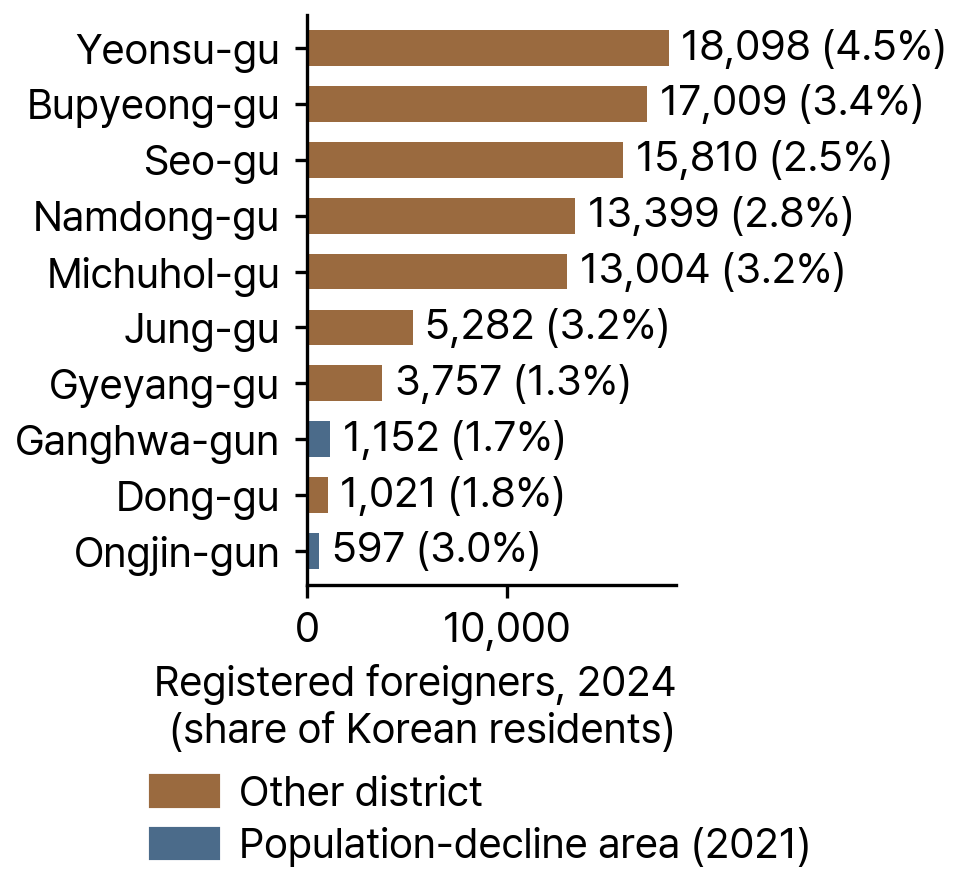
Source: KIRD dataset, from Ministry of Justice immigration yearbooks and Ministry of the Interior and Safety statistics, 2024.
Between 2019 and 2024 the number of registered foreigners rose in all ten districts, most in Yeonsu-gu (by 4,921), Michuhol-gu (3,372), Seo-gu (2,951) and Bupyeong-gu (2,460). Korean residents increased in five districts, led by Seo-gu (89,508), Yeonsu-gu (33,663) and Jung-gu (31,978), and decreased in the other five, led by Namdong-gu (46,479 fewer), Gyeyang-gu (23,244 fewer) and Bupyeong-gu (18,377 fewer). Where Korean residents declined, their combined loss was 94,801 and the combined gain in registered foreigners was 4,301.
Table 4Registered Foreigners and Korean Residents by District in Incheon, 2019-24
| District | Registered foreigners, 2024 | Per 100 Korean residents, 2024 | Change in Korean residents, 2019-24 | Change in registered foreigners, 2019-24 | Population-decline area |
|---|---|---|---|---|---|
| Yeonsu-gu | 18,098 | 4.5 | +33,663 | +4,921 | No |
| Bupyeong-gu | 17,009 | 3.4 | -18,377 | +2,460 | No |
| Seo-gu | 15,810 | 2.5 | +89,508 | +2,951 | No |
| Namdong-gu | 13,399 | 2.8 | -46,479 | +972 | No |
| Michuhol-gu | 13,004 | 3.2 | +3,412 | +3,372 | No |
| Jung-gu | 5,282 | 3.2 | +31,978 | +1,032 | No |
| Gyeyang-gu | 3,757 | 1.3 | -23,244 | +411 | No |
| Ganghwa-gun | 1,152 | 1.7 | +224 | +293 | Yes |
| Dong-gu | 1,021 | 1.8 | -6,131 | +86 | No (area of interest) |
| Ongjin-gun | 597 | 3.0 | -570 | +372 | Yes |
Note: Per 100 Korean residents is the number of registered foreigners divided by the number of Korean residents, times 100. Changes compare 2024 with 2019. The Ministry of the Interior and Safety designated Ganghwa-gun and Ongjin-gun as population-decline areas and Dong-gu as an area of interest on 19 October 2021.
Source: KIRD dataset, from Ministry of Justice immigration yearbooks and Ministry of the Interior and Safety statistics, 2019-2024.
The Ministry of the Interior and Safety designated Ganghwa-gun and Ongjin-gun as population-decline areas in October 2021 and named Dong-gu an area of interest. In 2024, Ganghwa-gun had 1,152 registered foreigners (1.7 per 100 Korean residents) and Ongjin-gun 597 (3.0 per 100). Between 2019 and 2024, Ganghwa-gun gained 224 Korean residents and 293 registered foreigners, and Ongjin-gun lost 570 Korean residents and gained 372 registered foreigners, raising its count of registered foreigners from 225 to 597. Combined, the two counties lost 346 Korean residents and gained 665 registered foreigners, a foreign gain equal to 192.2 percent of the Korean loss. In Dong-gu the Korean population fell by 6,131 and the number of registered foreigners rose by 86, a gain equal to 1.4 percent of the Korean loss.
Two districts met the definition of an ethnic enclave used in this Spotlight in 2024. In Bupyeong-gu, 8,903 Korean-Chinese made up 52.3 percent of registered foreigners (location quotient 3.7), and they were 43.7 percent of all Korean-Chinese registered foreigners in Incheon. In Ongjin-gun, 214 Indonesian nationals made up 35.8 percent of registered foreigners (location quotient 9.4). Yeonsu-gu, which contains the Koryoin neighborhood of Hambak-maul, had no enclave by this definition (see Service Organizations and Community Places).
Population Trends
Incheon's Korean population grew from 2,624,391 in 2006 to 2,902,608 in 2014, 2,957,026 in 2019 and 3,021,010 in 2024. It grew 15.1 percent over 2006-24, 4.1 percent over 2014-24 and 2.2 percent over 2019-24. The count dipped to 2,942,828 in 2020 and rose in each year from 2021 to 2024. In 2024 Incheon had 5.9 percent of South Korea's 51,217,221 Korean residents and 6.0 percent of its registered foreigners.
The city's resident registration population of Korean nationals passed 3 million for the first time at 6 p.m. on 29 January 2024, when it stood at 3,000,043. Incheon became the third city in South Korea to pass 3 million and the first metropolitan city to do so since Busan in 1980. An earlier crossing of 3 million, in October 2016, had included registered foreign residents (Incheon Metropolitan City, 2024).
Incheon's total fertility rate rose 9.8 percent to 0.76 in 2024, above the national average of 0.75. Births rose 11.6 percent to 15,242, according to provisional Statistics Korea figures released on 26 February 2025 (Incheon Metropolitan City, 2025). Registered residents aged 65 and older numbered 495,272 in 2023 data released with the city's 2024 regional statistics, 16.4 percent of the population, up 30.9 percent from 2019 and 7.3 percent from the previous year (Incheon Today, 2024).
In Statistics Korea's 2024 domestic migration statistics, released on 24 January 2025, Incheon was one of five provinces and metropolitan cities where more people moved in than moved out. It also had net in-migration in every age group (Statistics Korea, 2025). In December 2024 the city applied Statistics Korea's 2022-2052 provincial projections to its own districts. The results projected growth from 2.975 million people in 2022 to a peak of about 3.126 million in 2037 and a decline to about 3.111 million by 2042. The projection described Incheon as the only one of South Korea's six metropolitan cities whose population continues to grow. Incheon became an aged society in 2022 and was projected to become a super-aged society by 2027 (Newsis, 2024).
Industry and Foreign Workers
The number of registered foreigners with E-9 non-professional employment status, issued under the Employment Permit System, was 16,134 in Incheon in 2014, 13,538 in 2019, 10,812 in 2021 and 14,664 in 2024. The 2021 count was 33.0 percent below the 2014 level, and the count then rose 35.6 percent by 2024. E-9 holders made up 29.2 percent of Incheon's registered foreigners in 2014 and 16.5 percent in 2024. In 2024 Incheon had 4.5 percent of all E-9 holders in South Korea, below its 6.0 percent share of all registered foreigners. Rotation labor statuses as a group covered 23.3 percent of the city's registered foreigners in 2024, against 31.1 percent nationally.
A 2025 report on the Namdong National Industrial Park (남동국가산업단지) cited Ministry of Justice figures showing 14,613 foreign workers in Incheon with E9-01 (manufacturing) permits in March 2025, up from 10,077 a year earlier. The report did not break down that citywide figure by district. According to the same report, about 90 percent of the industrial park's tenant firms had fewer than 10 employees and more than 95 percent fewer than 30. Business owners there said the labor shortage left them able to hire almost only foreign workers (Kihoilbo, 2025). The March counts refer to one manufacturing subcategory of E-9 and to a different date than the KIRD count of all E-9 holders on 31 December (14,664 in 2024).
An Incheon Development Institute brief counted 25,628 foreign workers in Incheon in 2017, led by Korean-Chinese (7,503, or 29.3 percent) and followed by Vietnamese, Filipino and Indonesian nationals. Namdong-gu, where the Namdong National Industrial Park is located, had the most foreign workers among the city's districts (7,773), ahead of Seo-gu (7,013) and Bupyeong-gu (3,476) (Incheon Development Institute, 2017).
The Ministry of Justice counts E-8 seasonal workers on 31 December, and because their contracts end before winter, that count misses most seasonal workers. Among the years 2021 to 2024, the year-end count for Incheon recorded E-8 holders only on 31 December 2023, when there were 4. Ganghwa-gun's recruitment of seasonal farm workers from Laos is described under Provincial Policy.
International Students and Universities
Registered foreigners on student (D-2) or general trainee (D-4) status in Incheon numbered 1,848 in 2008, 2,490 in 2014, 6,330 in 2019 and 7,986 in 2024 (see Figure 6). The count fell to 5,250 in 2021, 17.1 percent below the 2019 level, and then rose 52.1 percent by 2024. In 2024, 5,460 were on D-2 status and 2,526 on D-4 status.
Incheon had 3.1 percent of all D-2 and D-4 holders in South Korea in 2024, about half its 6.0 percent share of registered foreigners. Study and job search statuses (D-2, D-4 and D-10) covered 9.7 percent of the city's registered foreigners, against 18.6 percent nationally.
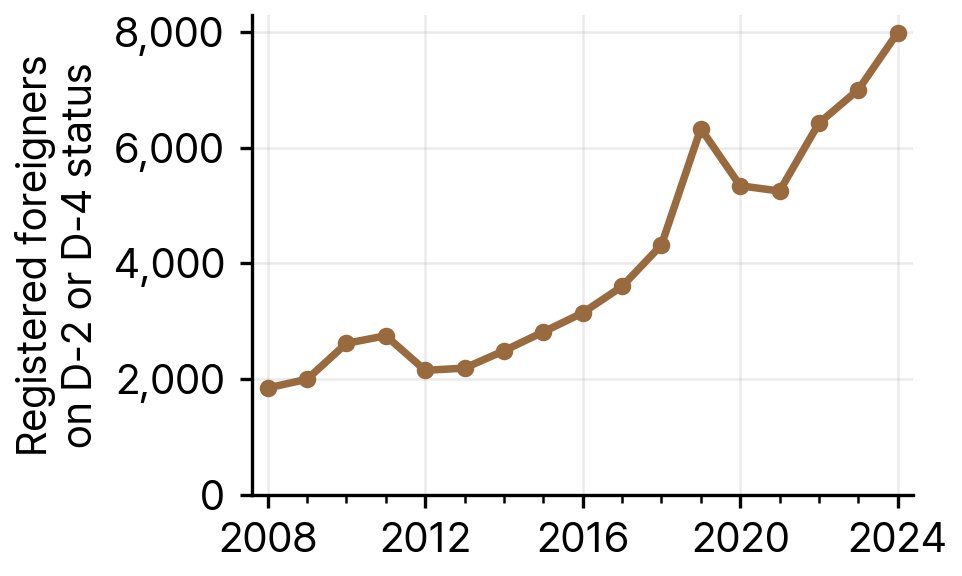
Source: KIRD dataset, from Ministry of Justice immigration yearbooks, 2008-2024.
Inha University's main campus in Michuhol-gu reported 1,954 foreign students in the 2026 key indicators of the University Information Disclosure service (대학알리미). Incheon National University's main campus in Songdo, Yeonsu-gu, reported 512 in the same 2026 figures (Academyinfo, 2026).
Incheon Global Campus in Songdo is home to branch campuses of foreign universities in the Incheon Free Economic Zone. It enrolled 4,519 students in the spring 2025 semester, up from 45 when it opened in 2012 (Incheon Today, 2025a). About 10 percent of those students (about 450) were foreign nationals enrolled as long-term students, short of the campus's original target of 40 percent. Including exchange and short-term program participants, the foreign share was about 30 percent (Incheon Today, 2025b).
A news report put the number of D-2 holders in university and graduate programs living in Incheon at 5,460 as of 3 October 2025, the third-lowest among South Korea's seven special and metropolitan cities (Kyeongin Ilbo, 2025). That figure equals the Ministry of Justice count of D-2 holders in Incheon on 31 December 2024 in the KIRD data. A metropolitan-type visa pilot for students at Incheon Global Campus is described under Provincial Policy.
Provincial Policy
Incheon's Ordinance on Support for Foreign Residents and Multicultural Families aims to help foreign residents and multicultural families living in the city establish themselves as members of the local community by supporting stable family life and self-reliance. The version in force since 8 January 2024 is Ordinance No. 7166. An amendment dated 30 November 2023 changed the deputy mayor named in the ordinance from the political deputy mayor for culture and welfare to the political deputy mayor for Global City affairs, the renamed office (U-LEX, 2024).
On 22 May 2024, Yeonsu-gu promulgated the Ordinance on Social Integration of Korean and Foreign Residents, reported as the first ordinance of its kind enacted by a local government in South Korea. It was prompted in part by the district's foreign population and by Hambak-dong, where more than 65 percent of residents are foreign nationals (Kihoilbo, 2024).
Ganghwa-gun and Ongjin-gun were among the 89 population-decline areas eligible for the first one-year pilot round of the Ministry of Justice's regional specialized visa program, which began on 4 October 2022. The program grants qualifying foreign talent and the families of overseas Koreans special conditions of residence and employment, with the aim of easing labor shortages in areas at risk of decline (Incheon Today, 2022).
In March 2025 the Ministry of Justice selected Incheon for its metropolitan-type visa pilot, which covers the second half of 2025 through 2026. The pilot targets about 60 D-2 students at the foreign university branch campuses of Incheon Global Campus in Songdo, extends their maximum period of residence from one year to two years and eases limits on internships during the semester (Siminilbo, 2025).
Ganghwa-gun arranged its first intake of E-8 seasonal farm workers under a memorandum of understanding signed in 2025 with the Ministry of Labor and Social Welfare of Laos. A May 2026 report said 35 Lao workers would arrive in mid-May 2026 and be placed with local agricultural cooperatives and individual farms for the farming season (Ganghwa Today, 2026).
The city opened the Incheon Support Center for Foreign Residents (인천외국인종합지원센터) in Namdong-gu in March 2016 to improve conditions for foreign residents' long-term residence and daily life. At its opening it offered a weekday counseling desk in Korean, English, Filipino, Chinese and Vietnamese, with information on education and housing and referrals for legal and labor questions, as well as Korean-language classes (Bupyeong-gu Office, 2016).
Languages
The KIRD dataset estimates the first languages of registered foreigners by dividing each nationality's count among the languages spoken as a first language in that country, using first-language shares from Ethnologue. Korean is excluded, so Korean-Chinese residents, whose first language the method takes to be Korean, add no speakers to the estimates.
By this estimate, Chinese was the most common first language among Incheon's registered foreigners in 2024 (14,461 speakers), followed by Vietnamese (8,424), Russian (3,564), Uzbek (3,118) and Burmese (3,052). Arabic ranked sixth (2,630), ahead of Mongolian (2,523), Tagalog/Filipino (2,503), Thai (2,017) and Kazakh (1,995). Sixteen languages had at least 1,000 estimated speakers in Incheon in 2024.
When the Incheon Support Center for Foreign Residents opened in 2016, its counseling desk offered Korean, English, Filipino, Chinese and Vietnamese (see Provincial Policy). Those languages covered three of the ten most common estimated first languages of 2024 (Chinese, Vietnamese and Tagalog/Filipino).
Service Organizations and Community Places
The KIRD census of 1,720 migrant-serving organizations in South Korea lists 108 in Incheon, or 12.1 per 10,000 registered foreigners in 2024, against 11.6 per 10,000 nationally. Of the 108, 104 provide services directly. By type, the census counts 25 program sites, 14 medical providers, 14 nongovernmental organizations, 10 family centers (가족센터) and 10 community associations in the city. It also lists 6 foreign resident support centers, 6 migrant worker centers, 5 youth and education providers, 5 overseas Korean organizations and 4 shelters.
Counting each population an organization names as a target group, 37 of Incheon's organizations serve workers, 28 serve families, 20 children, 18 refugees, 12 undocumented migrants and 11 diaspora communities, and 16 serve all migrants.
A 2022 report described Hambak-maul in Yeonsu-gu as the largest Koryoin settlement in South Korea formed along a single street; Koryoin are ethnic Koreans from the former Soviet Union. About 10,000 people lived there officially, of whom a little over 5,000 were registered Koryoin, rising to about 7,000 when residents not clearly classified as Koryoin were included. About 60 to 70 restaurants and shops there were operated by Koryoin (Incheon Ilbo, 2022).
Incheon's Chinatown in Jung-gu dates from 1884, when a Qing Chinese concession, the first foreign concession in Korea, was set up there. The 1882 commercial treaty between Joseon and Qing China had first permitted Chinese migration to Korea. The overseas Chinese population grew from fewer than 200 at the start to more than 10,000 by 1910. In 2026 the community was centered on overseas Chinese of Taiwanese (Republic of China) nationality, whose community had lived in the city for more than 140 years (Kyeongin Ilbo, 2026).
By 2020 a Myanmar community had formed around Bupyeong 1-dong in Bupyeong-gu, centered on a Myanmar Buddhist temple. It grew with 112 Myanmar refugees resettled there under a 2015-2018 government pilot program and with Myanmar migrant workers on E-9 permits, and Myanmar restaurants, phone shops and temples were clustered along Gwangjang-ro 4-gil (EKW, 2020). In the KIRD data, the number of registered Myanmar nationals in Incheon rose from 2,337 in 2019 to 4,799 in 2024, and Incheon had 9.2 percent of all registered Myanmar nationals in South Korea in 2024.
Sources
Korea Immigration Regional Dashboard (KIRD) dataset, compiled from Ministry of Justice immigration yearbooks and Ministry of the Interior and Safety statistics, 2006-2024. openICPSR. https://doi.org/10.3886/E249944V1
Incheon Metropolitan City. 2024. Incheon becomes a city of 3 million registered residents, the first metropolitan city in 44 years since Busan (in Korean). https://www.incheon.go.kr/IC010205/view?repSeq=DOM_0000000009209885&curPage=1&srchRepTitle=%EC%A3%BC%EB%AF%BC%EB%93%B1%EB%A1%9D
Kyeongin Ilbo. 2026. Incheon's 100-year neighbor, the Chinatown alley (in Korean). https://www.kyeongin.com/article/1763524
Incheon Metropolitan City. 2025. Incheon leads in overcoming low fertility, first in the country in birth growth (in Korean). https://www.incheon.go.kr/IC010205/view?repSeq=DOM_0000000011893551&curPage=99
Incheon Today. 2024. Incheon population statistics 2: Population aged 65 and older nears 500,000, up 30 percent in four years (in Korean). https://www.incheontoday.com/news/articleView.html?idxno=260178
Statistics Korea, via Korea.kr policy briefing. 2025. Results of the 2024 domestic migration statistics (in Korean). https://www.korea.kr/briefing/policyBriefingView.do?newsId=156672078
Newsis. 2024. Incheon population projected at 3,126,000 in 2037, super-aged society in 2027 (in Korean). https://www.newsis.com/view/NISX20241206_0002986335
Kihoilbo. 2025. Incheon's root-industry workplaces are being filled by foreign workers (in Korean). https://www.kihoilbo.co.kr/news/articleView.html?idxno=1144591
Incheon Development Institute. 2017. Multicultural indicators of Incheon: Foreign workers in Incheon (in Korean). https://www.ii.re.kr/base/board/read?boardManagementNo=18&boardNo=1236&menuLevel=2&menuNo=79
Korean Council for University Education. 2026. University Information Disclosure (Academyinfo) search results for Inha University and Incheon National University, number of foreign students (in Korean). https://www.academyinfo.go.kr/search/search.do
Incheon Today. 2025a. Incheon Global Campus grows 100-fold, from 45 students at opening to about 4,500 this year (in Korean). https://www.incheontoday.com/news/articleView.html?idxno=263939
Incheon Today. 2025b. Incheon Global Campus foreign students only 10 percent of enrollment (in Korean). https://www.incheontoday.com/news/articleView.html?idxno=303798
Kyeongin Ilbo. 2025. Worried about visas even after admission, Incheon universities face difficulties (in Korean). Via Daum. https://v.daum.net/v/20251013202227537
U-LEX. 2024. Incheon Metropolitan City Ordinance on Support for Foreign Residents and Multicultural Families, Ordinance No. 7166 (in Korean). https://www.ulex.co.kr/%EB%B2%95%EB%A5%A0/1877769-2171559-%EC%9D%B8%EC%B2%9C%EA%B4%91%EC%97%AD%EC%8B%9C%EC%99%B8%EA%B5%AD%EC%9D%B8%EC%A3%BC
Kihoilbo. 2024. Incheon's Yeonsu-gu enacts and promulgates the country's first ordinance on social integration of Korean and foreign residents (in Korean). https://www.kihoilbo.co.kr/news/articleView.html?idxno=1089547
Incheon Today. 2022. Ministry of Justice promotes foreign residents' settlement in Ganghwa and Ongjin through the regional specialized visa (in Korean). https://www.incheontoday.com/news/articleView.html?idxno=220257
Siminilbo. 2025. Incheon pursues a metropolitan-type visa pilot as a global education city (in Korean). https://www.siminilbo.co.kr/news/newsview.php?ncode=1160281043513388
Ganghwa Today. 2026. Ganghwa-gun eases farm labor shortage with the first entry of foreign seasonal workers (in Korean). https://www.ghtoday.co.kr/news/view.php?bIdx=8915
Bupyeong-gu Office, Incheon. 2016. Notice on the opening of the Incheon Support Center for Foreign Residents (in Korean). https://www.icbp.go.kr/dong/bbs/bbsMsgDetail.do?msg_seq=37864&bcd=dong_notice&dong=sangok4&pgno=392
Incheon Ilbo. 2022. Diaspora Incheon 5: The people of Hambak-maul (in Korean). https://www.incheonilbo.com/news/articleView.html?idxno=1156699
EKW (Dongpo Segye Sinmun). 2020. The Myanmar village formed in Bupyeong 1-dong, Incheon (in Korean). https://www.ekw.co.kr/news/articleView.html?idxno=1901
Suggested citation: Korea Immigration Regional Dashboard (KIRD). 2026. “Foreign Residents in Incheon.” Foreign Residents in South Korea series, September 2026. Data: Korea Immigration Regional Dashboard (KIRD) dataset, https://doi.org/10.3886/E249944V1. Interactive maps and tables: https://immigrantsinkorea.today.