 Korea Immigration Regional Dashboard
SpotlightSeptember 2026Province profilesDownload PDF
Foreign Residents in South Chungcheong Province
Highlights
- At the end of 2024, South Chungcheong Province had 96,687 registered foreigners, the fourth-largest number among South Korea's 17 provinces and metropolitan cities and the largest relative to the Korean population, at 4.5 per 100 Korean residents against 2.9 nationally.
- Registered foreigners increased 77.2 percent between 2014 and 2024 while Korean residents increased 3.6 percent, and in the province's nine population-decline areas the gain of 9,857 registered foreigners from 2019 to 2024 equaled 23.2 percent of the 42,404 Korean residents those areas lost.
- Rotation labor statuses covered 42.1 percent of the province's registered foreigners in 2024, against 31.1 percent nationally, and its 30,040 holders of the E-9 non-professional employment status made up 9.2 percent of all E-9 holders in South Korea.
South Chungcheong Province (Chungcheongnam-do) had 96,687 registered foreigners on 31 December 2024, 6.5 percent of the 1,488,353 in South Korea and the fourth-largest number among the 17 provinces and metropolitan cities. With 4.5 registered foreigners per 100 Korean residents, the province had the highest ratio of the 17; the national ratio was 2.9. The Ministry of the Interior and Safety (MOIS) count of foreign residents, which also includes naturalized citizens and the children of foreign residents, was 169,245 in 2024, 1.75 times the registered count.
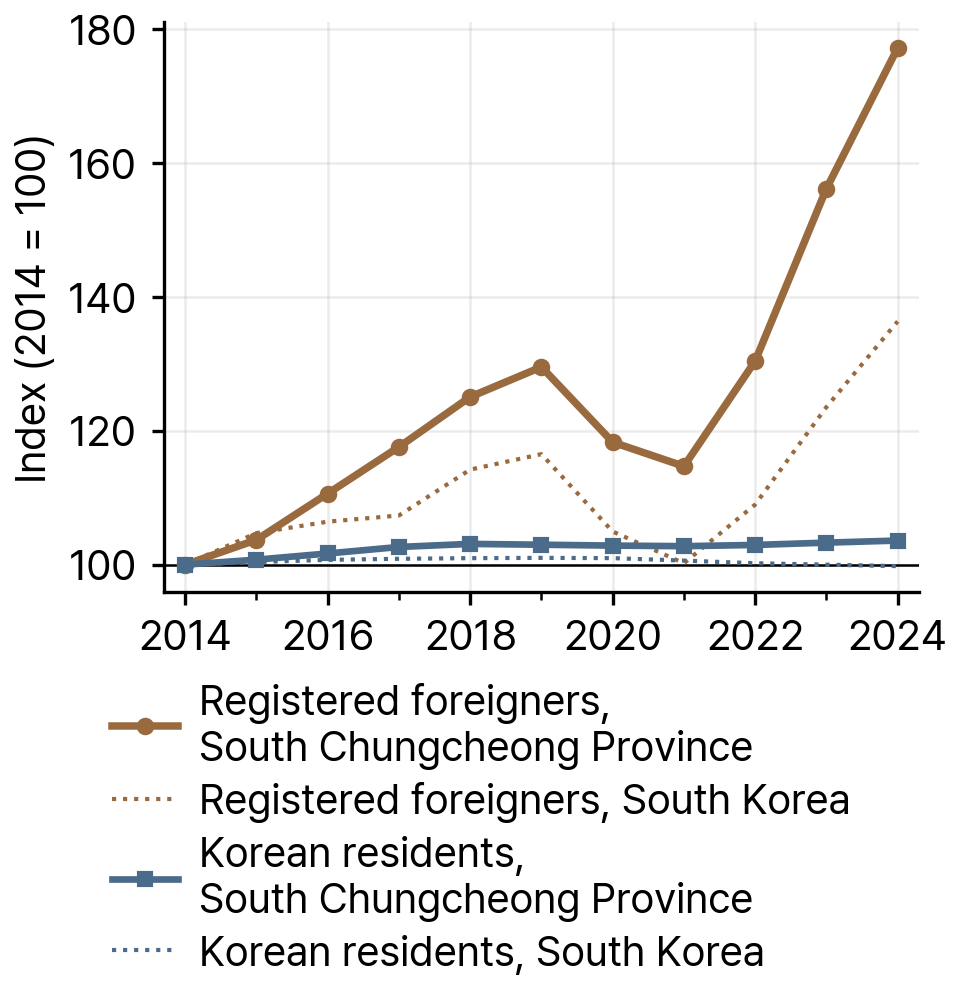
The foreign-resident population grew much faster than the Korean population. Between 2014 and 2024 the number of registered foreigners rose 77.2 percent, from 54,557 to 96,687, while the number of Korean residents rose 3.6 percent, from 2,062,273 to 2,136,574. From 2019 to 2024 the province added 26,012 registered foreigners (36.8 percent, the fourth-fastest growth among the 17) and 12,865 Korean residents (0.6 percent). The registered count fell from 70,675 in 2019 to 62,578 in 2021 and then rose in each of the next three years.
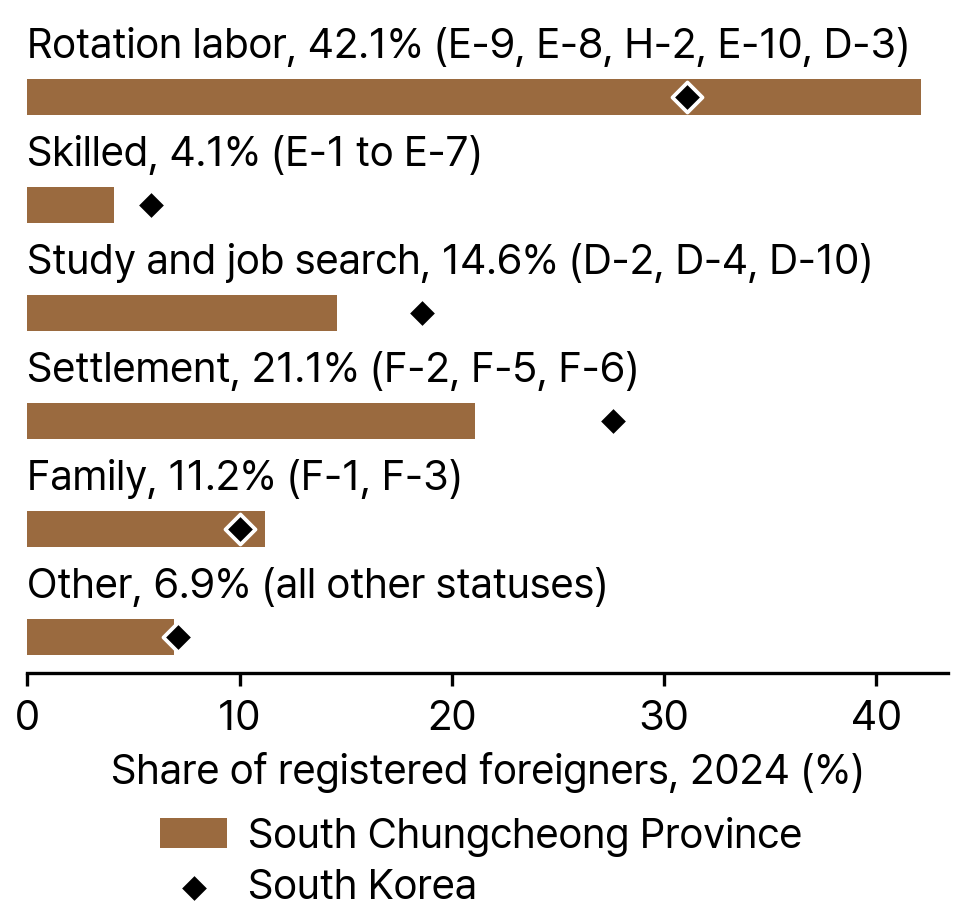
Rotation labor statuses covered 42.1 percent of the province's registered foreigners in 2024, against 31.1 percent nationally, and settlement statuses 21.1 percent, against 27.6 percent. Among factories newly registered in 2023, the province had the highest ratio of foreign to Korean workers of any province (MRTC, 2024). Vietnam was the largest nationality (21.6 percent), and the province was home to 15.7 percent of all registered Kazakhstan nationals in South Korea, 11.5 percent of Cambodians and 11.4 percent of Nepalis. Nine of its cities and counties were designated population-decline areas in 2021, and the five districts that met this Spotlight's definition of an ethnic enclave in 2024, all for Vietnamese nationals, were among them.
Size of the Foreign-Resident Population
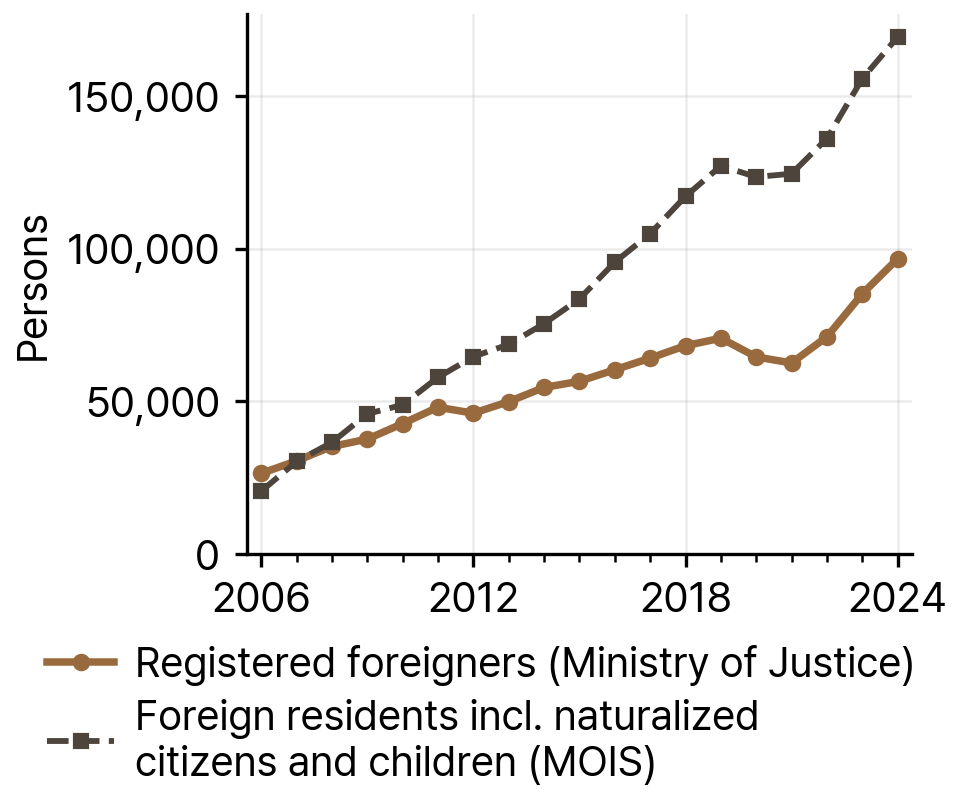
The number of registered foreigners in South Chungcheong Province rose from 26,441 in 2006 to 54,557 in 2014 and 70,675 in 2019 (Figure 1). It fell to 64,546 in 2020 and 62,578 in 2021, 8,097 fewer than in 2019 (a drop of 11.5 percent), then rose to 71,159 in 2022, 85,215 in 2023 and 96,687 in 2024, the highest count in the series. The increase from 2023 to 2024 alone was 11,472 people (13.5 percent).
The MOIS count of foreign residents rose from 75,438 in 2014 to 127,057 in 2019 and 169,245 in 2024, an increase of 124.3 percent over ten years. It fell to 123,430 in 2020 and rose in each year from 2021 to 2024.
Source: KIRD dataset, from Ministry of Justice immigration yearbooks and Ministry of the Interior and Safety statistics, 2006-2024.
The province's figures for 2006 to 2011 include the area that became Sejong Special Self-Governing City in 2012. The counts of registered foreigners and Korean residents both drop between 2011 and 2012 mainly for this reason, from 48,091 to 46,141 and from 2,101,284 to 2,028,777.
Korean residents numbered 2,062,273 in 2014, 2,123,709 in 2019 and 2,136,574 in 2024. With 2014 set to 100, the number of registered foreigners in the province stood at 177.2 in 2024 and the number of Korean residents at 103.6 (Figure 2). Registered foreigners per 100 Korean residents rose from 1.3 in 2006 to 2.6 in 2014, 3.3 in 2019 and 4.5 in 2024 (Table 1).
Source: KIRD dataset, from Ministry of Justice immigration yearbooks and Ministry of the Interior and Safety resident-registration statistics, 2014-2024.
In 2024 the province ranked fourth among the 17 provinces and metropolitan cities by the number of registered foreigners and first by registered foreigners per Korean resident. Its ratio of 4.5 per 100 compared with 2.9 for South Korea as a whole.
Table 1Registered Foreigners, MOIS Foreign Residents and Korean Residents in South Chungcheong Province, Selected Years, 2006-24
| Year | Registered foreigners | MOIS foreign residents | Korean residents | Registered foreigners per 100 Korean residents |
|---|---|---|---|---|
| 2006 | 26,441 | – | 1,974,433 | 1.3 |
| 2014 | 54,557 | 75,438 | 2,062,273 | 2.6 |
| 2019 | 70,675 | 127,057 | 2,123,709 | 3.3 |
| 2024 | 96,687 | 169,245 | 2,136,574 | 4.5 |
Note: The MOIS series is shown from 2008. The MOIS count published for 2006 (20,641, plotted in Figure 1) was below the registered count for that year. Figures for 2006 include the area that became Sejong Special Self-Governing City in 2012. South Korea had 2.9 registered foreigners per 100 Korean residents in 2024.
Source: KIRD dataset, from Ministry of Justice immigration yearbooks and Ministry of the Interior and Safety statistics, 2006-2024.
Nationalities
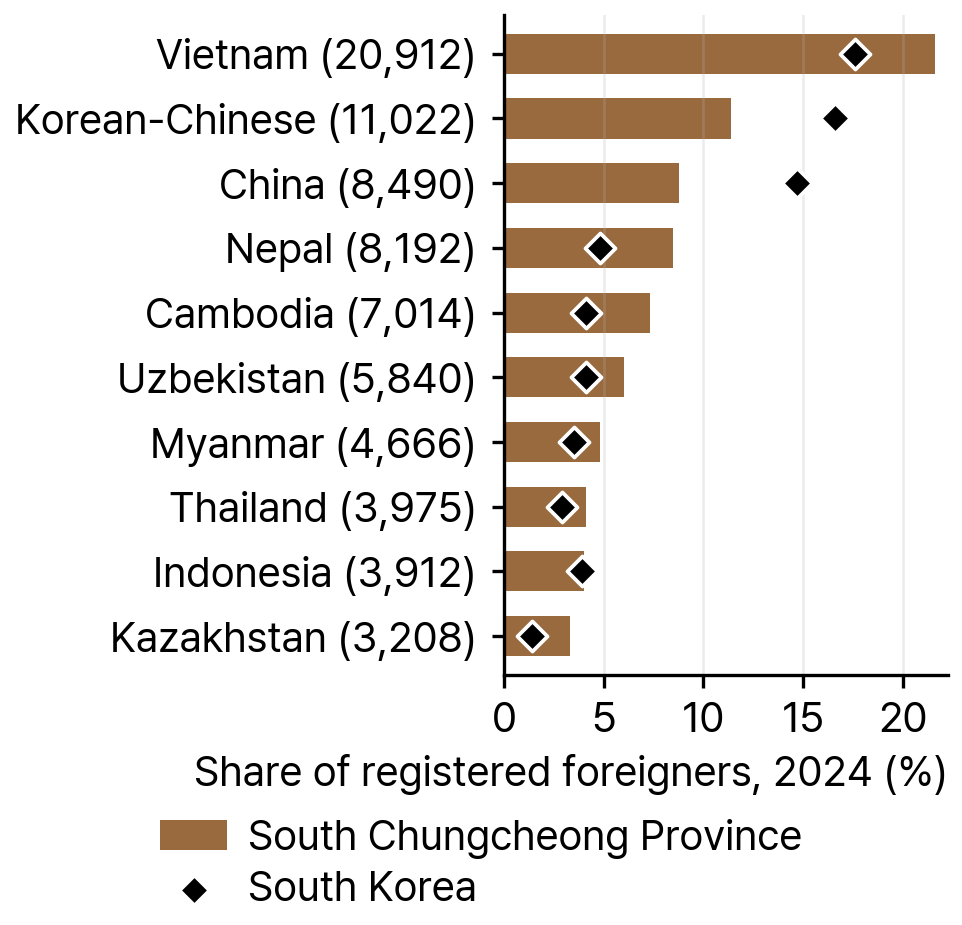
Vietnam was the largest nationality among registered foreigners in the province in 2024, with 20,912 people (21.6 percent of the total, compared with 17.6 percent nationally). Korean-Chinese residents, Chinese nationals of Korean descent, numbered 11,022 (11.4 percent). They were followed by nationals of China (8,490), Nepal (8,192), Cambodia (7,014), Uzbekistan (5,840), Myanmar (4,666), Thailand (3,975), Indonesia (3,912) and Kazakhstan (3,208) (Figure 3). These ten groups made up 79.9 percent of registered foreigners in the province.
Source: KIRD dataset, from Ministry of Justice immigration yearbooks, 2024.
Between 2019 and 2024 the number of Vietnamese nationals rose by 8,707 (71.3 percent), and Vietnam passed the Korean-Chinese group, which had been larger in 2019 (12,670 against 12,205). Among the ten largest groups, nationals of Myanmar grew fastest, from 1,737 to 4,666 (168.6 percent), followed by Nepalis (73.3 percent) and Vietnamese. The Korean-Chinese group shrank by 1,648 (13.0 percent) and Chinese nationals by 384 (4.3 percent) (Table 2).
Table 2Ten Largest Nationalities among Registered Foreigners in South Chungcheong Province, 2019 and 2024
| Nationality | 2019 | 2024 | Share of the province's registered foreigners, 2024 (%) | Province's share of the nationality's registered foreigners in South Korea, 2024 (%) |
|---|---|---|---|---|
| Vietnam | 12,205 | 20,912 | 21.6 | 8.0 |
| Korean-Chinese | 12,670 | 11,022 | 11.4 | 4.5 |
| China | 8,874 | 8,490 | 8.8 | 3.9 |
| Nepal | 4,726 | 8,192 | 8.5 | 11.4 |
| Cambodia | 4,569 | 7,014 | 7.3 | 11.5 |
| Uzbekistan | 5,373 | 5,840 | 6.0 | 9.5 |
| Myanmar | 1,737 | 4,666 | 4.8 | 9.0 |
| Thailand | 2,782 | 3,975 | 4.1 | 9.1 |
| Indonesia | 2,491 | 3,912 | 4.0 | 6.7 |
| Kazakhstan | 2,529 | 3,208 | 3.3 | 15.7 |
Note: Korean-Chinese are Chinese nationals of Korean descent, listed separately from other Chinese nationals. The province had 6.5 percent of all registered foreigners in South Korea in 2024.
Source: KIRD dataset, from Ministry of Justice immigration yearbooks, 2019 and 2024.
The province was home to 6.5 percent of all registered foreigners in South Korea in 2024 and to larger shares of several national groups. It had 15.7 percent of all registered Kazakhstan nationals in the country (3,208 of 20,482), 14.4 percent of Korean-Russians (Russian nationals of Korean descent; 344 of 2,383), 11.5 percent of Cambodians (7,014 of 61,006), 11.4 percent of Nepalis (8,192 of 72,151) and 11.3 percent of Kyrgyzstan nationals (927 of 8,170).
The Shannon diversity index of nationalities, which rises as registered foreigners are spread more evenly over more nationalities, increased from 2.4 in 2014 to 2.6 in 2024, the second-highest value among the 17 provinces. Registered foreigners of 133 nationalities lived in the province in 2024.
Overseas Koreans on F-4 status are not registered foreigners and are not part of these counts. In 2024, 34,193 of them reported a place of residence in the province, 6.2 percent of the 553,664 residence reports nationally. Korean-Chinese filed 19,351 of the reports (56.6 percent). Korean-Russians (4,610) and nationals of Uzbekistan (4,415) and Kazakhstan (2,922), ethnic Koreans from the former Soviet Union who are also called Goryeoin, filed 11,947, and United States nationals filed 1,172.
Residence Statuses
Rotation labor statuses (E-9, E-8, H-2, E-10 and D-3) covered 42.1 percent of registered foreigners in the province in 2024 (40,716 people), against 31.1 percent nationally (Figure 4). Settlement statuses covered 21.1 percent (20,363 people; 27.6 percent nationally), study and job search 14.6 percent (14,145; 18.6 percent), family 11.2 percent (10,808; 10.0 percent), skilled statuses 4.1 percent (3,998; 5.8 percent) and all other statuses 6.9 percent (6,657; 7.1 percent).
Source: KIRD dataset, from Ministry of Justice immigration yearbooks, 2024.
E-9 non-professional employment was the most common single status, with 30,040 holders in 2024, 31.1 percent of the province's registered foreigners and 9.2 percent of all E-9 holders in South Korea (Table 3). Permanent residence (F-5, 9,239 holders), student (D-2, 8,574), marriage migration (F-6, 8,121) and visiting cohabitation (F-1, 7,857) followed. Among the ten most common statuses, the province's largest share of a national total was for E-8 seasonal workers, 15.7 percent of all holders counted on 31 December 2024.
Table 3Ten Most Common Residence Statuses among Registered Foreigners in South Chungcheong Province, 2024
| Status | Meaning | Registered foreigners | Share of the province's registered foreigners (%) | Province's share of all holders in South Korea (%) |
|---|---|---|---|---|
| E-9 | Non-professional employment | 30,040 | 31.1 | 9.2 |
| F-5 | Permanent residence | 9,239 | 9.6 | 4.6 |
| D-2 | Student | 8,574 | 8.9 | 4.8 |
| F-6 | Marriage migration | 8,121 | 8.4 | 5.5 |
| F-1 | Visiting cohabitation | 7,857 | 8.1 | 8.1 |
| H-2 | Visiting employment | 5,393 | 5.6 | 5.9 |
| D-4 | General trainee | 4,770 | 4.9 | 6.0 |
| G-1 | Other (miscellaneous) | 4,352 | 4.5 | 7.7 |
| E-7 | Specially designated activities | 3,272 | 3.4 | 5.2 |
| E-8 | Seasonal worker | 3,094 | 3.2 | 15.7 |
Note: Counts are registered foreigners on 31 December 2024, so F-4 overseas Koreans are not included. Status groups are defined in the Definitions box.
Source: KIRD dataset, from Ministry of Justice immigration yearbooks, 2024.
The MOIS count of 169,245 foreign residents in 2024 comprised 139,111 foreign nationals, 12,411 naturalized citizens and 17,723 children of foreign residents. MOIS divides the foreign nationals into workers (40,237), marriage migrants (10,169), international students (12,407), ethnic Koreans with foreign nationality (28,102) and other foreign nationals (48,196).
Districts and Population-Decline Areas
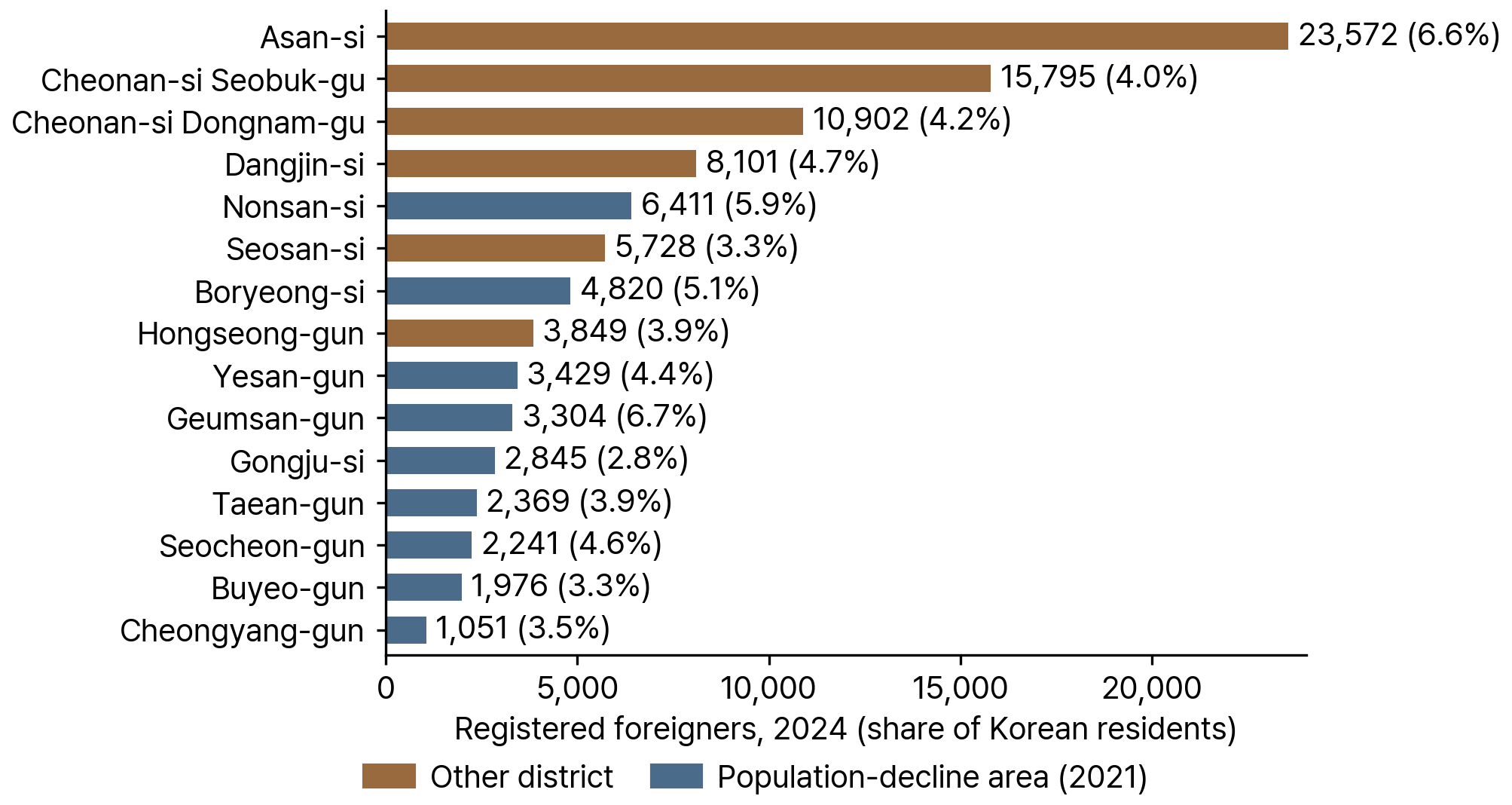
The KIRD district-level data divide the province into 16 districts, the seven cities (si) and seven counties (gun) outside Cheonan and the two gu of Cheonan (Dongnam-gu and Seobuk-gu). Asan-si had the most registered foreigners in 2024 (23,572), followed by Cheonan-si Seobuk-gu (15,795), Cheonan-si Dongnam-gu (10,902) and Dangjin-si (8,101) (Figure 5 and Table 4). Asan and the two Cheonan districts together accounted for 52.0 percent of the province's registered foreigners (50,269 of 96,687).
Source: KIRD dataset, from Ministry of Justice immigration yearbooks and Ministry of the Interior and Safety statistics, 2024; population-decline areas as designated by the Ministry of the Interior and Safety in October 2021.
Relative to the Korean population, the highest ratios were in Geumsan-gun (6.7 registered foreigners per 100 Korean residents), Asan-si (6.6), Nonsan-si (5.9), Boryeong-si (5.1) and Dangjin-si (4.7). Gyeryong-si, the one district not shown in Figure 5, had the fewest registered foreigners (294) and the lowest ratio (0.6).
Between 2019 and 2024 the number of registered foreigners rose in all 16 districts. The Korean population grew in five districts, led by Asan-si (40,619 more Korean residents), and fell in the other 11. In Seosan-si, Hongseong-gun and Yesan-gun the increase in registered foreigners was larger than the decrease in Korean residents (Table 4).
Table 4Ten Districts with the Most Registered Foreigners in South Chungcheong Province, 2024
| District | Registered foreigners, 2024 | Per 100 Korean residents, 2024 | Change in Korean residents, 2019-24 | Change in registered foreigners, 2019-24 | Population-decline area |
|---|---|---|---|---|---|
| Asan-si | 23,572 | 6.6 | +40,619 | +4,893 | No |
| Cheonan-si Seobuk-gu | 15,795 | 4.0 | +5,901 | +4,853 | No |
| Cheonan-si Dongnam-gu | 10,902 | 4.2 | +1,761 | +1,546 | No |
| Dangjin-si | 8,101 | 4.7 | +4,889 | +2,119 | No |
| Nonsan-si | 6,411 | 5.9 | -10,313 | +2,272 | Yes |
| Seosan-si | 5,728 | 3.3 | -245 | +1,267 | No |
| Boryeong-si | 4,820 | 5.1 | -7,334 | +1,772 | Yes |
| Hongseong-gun | 3,849 | 3.9 | -1,225 | +1,400 | No |
| Yesan-gun | 3,429 | 4.4 | -466 | +1,179 | Yes |
| Geumsan-gun | 3,304 | 6.7 | -2,642 | +965 | Yes |
Note: Per 100 Korean residents is registered foreigners divided by Korean residents, times 100. The other six districts are Gongju-si, Taean-gun, Seocheon-gun, Buyeo-gun and Cheongyang-gun, all population-decline areas, and Gyeryong-si.
Source: KIRD dataset, from Ministry of Justice immigration yearbooks and Ministry of the Interior and Safety statistics, 2019-2024; population-decline areas as designated by the Ministry of the Interior and Safety in October 2021.
In October 2021 the Ministry of the Interior and Safety designated nine of the province's districts as population-decline areas, namely Gongju-si, Boryeong-si, Nonsan-si, Geumsan-gun, Buyeo-gun, Seocheon-gun, Cheongyang-gun, Yesan-gun and Taean-gun. None of the province's districts was designated an area of interest. The nine decline areas had 28,446 registered foreigners in 2024, 29.4 percent of the province's total.
Between 2019 and 2024 the nine decline areas lost 42,404 Korean residents and gained 9,857 registered foreigners, a foreign gain equal to 23.2 percent of the Korean loss. The Korean loss was largest in Nonsan-si (10,313), Boryeong-si (7,334) and Buyeo-gun (7,190). Nonsan-si also gained the most registered foreigners (2,272), and Yesan-gun was the only decline area where the foreign gain (1,179) exceeded the Korean loss (466). The same nine cities and counties are the participants in the province's 2025 regional specialized visa program, described under Provincial Policy.
Five districts met this Spotlight's definition of an ethnic enclave in 2024, all for Vietnamese nationals and all in population-decline areas. They were Boryeong-si (2,234 Vietnamese residents, 46.3 percent of the district's registered foreigners, location quotient 4.7), Taean-gun (1,283; 54.2 percent; 4.2), Geumsan-gun (1,074; 32.5 percent; 4.2), Seocheon-gun (821; 36.6 percent; 3.3) and Cheongyang-gun (321; 30.5 percent; 2.1).
Population Trends
The Korean resident population of the province grew 3.6 percent between 2014 and 2024 (74,301 people) and 0.6 percent between 2019 and 2024 (12,865 people). It declined slightly from 2,123,709 in 2019 to 2,119,257 in 2021 and then rose to 2,136,574 in 2024, the highest figure in the series.
The growth from 2019 to 2024 came from five districts, Asan-si (40,619 more Korean residents), Cheonan-si Seobuk-gu (5,901), Dangjin-si (4,889), Gyeryong-si (3,569) and Cheonan-si Dongnam-gu (1,761), which together gained 56,739 Korean residents. The other 11 districts lost 43,874.
The provincial government counted 2,138,938 people on the resident register in August 2026, 2,185 (0.1 percent) more than at the end of 2025; the register excludes foreign nationals (Chungcheongnam-do, 2026a). In May 2026, 515,078 of the 2,138,517 registered residents (24.1 percent) were aged 65 and older (Chungcheongnam-do, 2026b).
The total fertility rate in the province rose from 0.84 in 2023 to 0.88 in 2024. In 2024 the rate was highest in South Jeolla Province and Sejong (1.03 each) and lowest in Seoul (0.58) (Statistics Korea, 2025a).
Domestic migration added 14,664 people to the province in 2024, a net inflow rate of 0.7 percent. South Chungcheong was one of five provinces with a net inflow that year, with Gyeonggi, Incheon, Sejong and North Chungcheong (Statistics Korea, 2025b).
The province also publishes population projections for its cities and counties for 2022 to 2042 as approved statistics (approval no. 213011, first approved on 16 November 2017), as basic data for its medium- and long-term development plans (Chungcheongnam-do, 2024).
Industry and Foreign Workers
The number of registered foreigners with the E-9 non-professional employment status, issued under the Employment Permit System (EPS), was 18,755 in 2014, 22,116 in 2019, 17,952 in 2021 and 30,040 in 2024. The 2024 count was 35.8 percent above the 2019 count, and E-9 holders made up 73.8 percent of the province's rotation labor group.
Among factories newly registered in 2023, foreign employment in South Chungcheong equaled 6.7 percent of Korean employment, the highest ratio of any province, ahead of North Chungcheong (6.2 percent) and Gyeonggi and South Jeolla (5.5 percent each). By number, the province ranked second in new foreign employment at newly registered factories in 2023, after Gyeonggi with 2,818 workers (MRTC, 2024).
Over 2010 to 2023, Asan-si ranked fifth among South Korea's cities, counties and districts in cumulative foreign employment at newly registered factories, with 3,269 workers. The report attributed this pattern to new industrial parks in the Chungcheong region built around steel, metal and other root industries (ppuri saneop) (MRTC, 2024).
The province has seven Foreign Investment Zones of the industrial-park type, in Cheonan, Asan and Dangjin, covering 1,496,473.1 square meters. The provincial government reported in 2026 that 89.7 percent of their rental space was leased and that 74 foreign-invested companies were registered in them (67 operating, 6 under construction and 1 in preparation). Another 17 foreign-invested companies were in individual-type zones in Cheonan (7), Asan (5), Seosan (3), Dangjin (1) and Yesan (1) (Chungcheongnam-do, 2026c). The Local Ordinance Information System (ELIS) lists a separate Foreign Investment Promotion Ordinance with an effective date of 10 August 2026 (ELIS, 2026).
E-8 seasonal workers in the KIRD data are counted on 31 December. Most seasonal workers' contracts end before winter, so the year-end count misses most of them. The count in the province rose from 11 in 2021 to 527 in 2022, 2,229 in 2023 and 3,094 in 2024, when it equaled 15.7 percent of the national year-end total.
For 2025 the provincial government aimed to bring in more than 9,000 foreign seasonal workers across 14 participating cities and counties to supply farm labor, supported by 14 public agricultural labor intermediary centers, one province-level intermediary organization and worker dormitories under construction in three cities and counties (Jungbu Maeil, 2025).
International Students and Universities
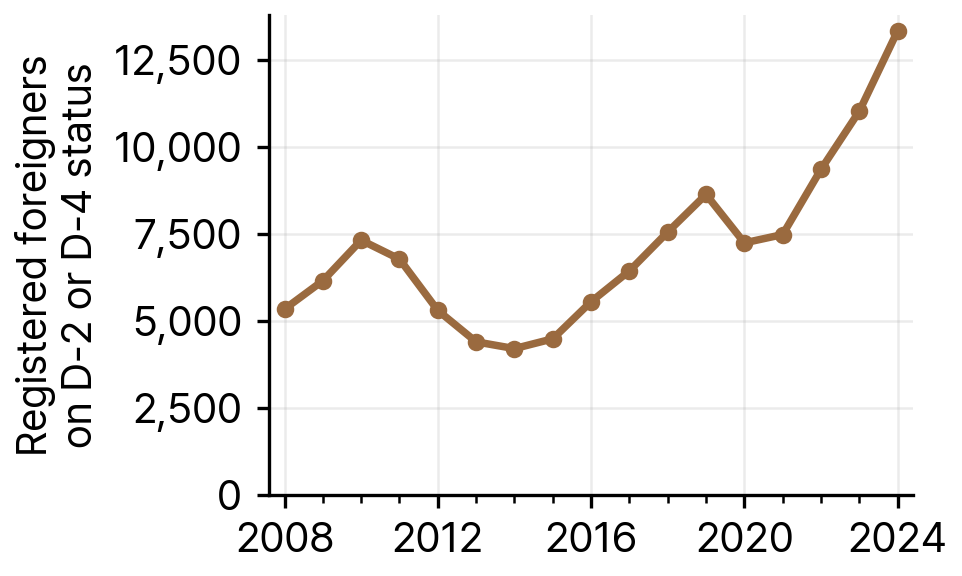
Registered foreigners on student (D-2) and general trainee (D-4) status numbered 5,344 in 2008 and 7,324 in 2010, fell to 4,207 in 2014 and grew to 8,638 in 2019 (Figure 6); figures before 2012 include the area that became Sejong. After 7,247 in 2020 and 7,486 in 2021, the count increased to 13,344 in 2024 (8,574 on D-2 and 4,770 on D-4), 3.2 times the 2014 level. The province had 5.2 percent of all D-2 and D-4 holders in South Korea in 2024, below its 6.5 percent share of all registered foreigners.
Source: KIRD dataset, from Ministry of Justice immigration yearbooks, 2008-2024.
Other counts use different dates and definitions. The MOIS count for 2024 listed 12,407 international students in the province. In the disclosure data of the Korean Educational Development Institute (KEDI), the province's 23 higher education institutions reported 12,713 international students as of 1 April 2024, counting degree students and language trainees together (KEDI, 2024).
By the KEDI count for 1 April 2024, the institutions with the most international students were Sun Moon University (1,980), Namseoul University (1,902), Joongbu University (1,628), Hoseo University (999) and Soonchunhyang University (961) (KEDI, 2024). Sun Moon University reported 1,957 international students from 59 countries in September 2024 and a goal of 3,000 by 2027 (Seoul Pn, 2024).
Soonchunhyang University established an International College for international students only, with programs in Global Free Major, Global Health, Global Industrial Engineering and Global Sports Management, and aims to recruit about 3,000 international students over five years (Goodmorning Chungcheong, 2026). Six universities in the province, Sun Moon and Soonchunhyang among them, participate in the metropolitan-type visa pilot described under Provincial Policy.
Provincial Policy
As of 2026, foreign-resident affairs in the provincial government were the responsibility of the Foreign Policy Division in the Youth and Women Bureau. On 12 May 2025 the province replaced its combined ordinance on foreign residents and multicultural families with two separate ordinances, the Ordinance on Support for Foreign Residents and the Ordinance on Support for Multicultural Families (ELIS, 2026).
The same division administers the Ordinance on Support for Goryeoin Residents, which the province has had since 17 August 2021, and the Ordinance on the Protection and Support of Foreign Workers, listed with an effective date of 30 December 2025 (ELIS, 2026).
The Chungnam Foreign Global Center opened in March 2025 in the Asan branch of the Chungnam Economic Promotion Foundation as a dedicated body for planning and implementing the province's policies on foreign residents (DTNews24, 2025). ELIS lists the ordinance on the center's establishment and operation with an effective date of 31 July 2026 (ELIS, 2026).
Under the 2025 regional specialized visa program, nine cities and counties in the province (Gongju, Boryeong, Nonsan, Geumsan, Buyeo, Seocheon, Cheongyang, Yesan and Taean) shared a quota of 668 F-2-R (regional talent) visas, with visa applications accepted from 4 March 2025 to 31 December 2026 (Chungcheongnam-do, 2025a). They are the nine districts designated as population-decline areas in 2021.
The province was also selected for the Ministry of Justice's 2025 metropolitan-type visa pilot, after meetings with universities and companies and consultation with experts. Six universities participate (Ajou Motor College, Konyang University, Sun Moon University, Soonchunhyang University, Hoseo University and Hyejeon College), with a target of issuing visas under eased requirements to 250 international students by 2026 (Chungcheongnam-do, 2025b).
In 2026 the province funded 15 multicultural family support centers, one in each of its cities and counties, alongside a province-wide Foreign Resident Integrated Support Call Center (1522-1866) (Chungcheongnam-do, 2026d). Its seasonal worker program for 2025 is described under Industry and Foreign Workers.
Languages
The KIRD dataset estimates first languages by dividing each nationality's count among the languages of its country of origin, using Ethnologue first-language shares. Korean is excluded, so the province's 11,022 Korean-Chinese residents add nothing to the estimates.
By this estimate, the most common first languages among registered foreigners in the province in 2024 were Vietnamese (17,897 speakers), Chinese (9,110), Khmer (7,007), Uzbek (4,397) and Nepali (4,269). Thai (3,570), Russian (3,546), Burmese (2,995), Indonesian (2,745) and Tagalog or Filipino (2,602) followed, and 17 languages had at least 1,000 estimated speakers.
Service Organizations and Community Places
The KIRD census of 1,720 migrant-serving organizations in South Korea lists 75 in South Chungcheong Province, 7.8 per 10,000 registered foreigners in 2024, against 11.6 per 10,000 nationally. All but one of the 75 provide services directly to migrants, and 13 have family center (gajok senteo) in their names.
The populations the organizations name most often are families (26 organizations), workers (20) and all foreign residents (19), followed by refugees (12), women (6), undocumented migrants (4), young people (4), children (3), overseas Koreans (3) and students (2). An organization can name more than one population. The census also counts six community groups and three religious sites among the 75.
Cheonan, the province's largest city, counted 40,917 foreign residents in January 2026, 5.8 percent of its population of 705,186. The largest numbers lived in Sinan-dong (5,515) and Seonghwan-eup (4,048), together 23.4 percent of the city's foreign residents (Seoul Shinmun, 2026). The city's count is not directly comparable with the registered-foreigner counts in this Spotlight.
In Asan, the high share of migrant residents in Sinchang-myeon, among them foreign workers and Goryeoin, was one reason the city opened the Asan Dagachi Education Center there in September 2026. The center occupies a former school site and combines a lifelong learning branch, a youth center, a family center branch and a multicultural education support center (News Home, 2026).
Sources
KIRD dataset (Korea Immigration Regional Dashboard), compiled from Ministry of Justice immigration yearbooks and Ministry of the Interior and Safety foreign-resident and resident-registration statistics, 2006-2024. openICPSR. https://doi.org/10.3886/E249944V1
Migration Research and Training Centre (MRTC). 2024. Foreign Workers at Registered Factories Nationwide and Their Regional Distribution, 2010-2023. Statistical Brief No. 2024-7 (in Korean). https://www.mrtc.re.kr/lib/download.php?file_name=%5B%ED%86%B5%EA%B3%84%EB%B8%8C%EB%A6%AC%ED%94%84%282024-07%29%5D+%EC%A0%84%EA%B5%AD+%EB%93%B1%EB%A1%9D+%EA%B3%B5%EC%9E%A5+%EC%99%B8%EA%B5%AD%EC%9D%B8+%EA%B7%BC%EB%A1%9C%EC%9E%90+%ED%98%84%ED%99%A9%EA%B3%BC+%EC%A7%80%EC%97%AD+%EB%B6%84%ED%8F%AC+%282010~2023%29.pdf&save_file=a_202409041013541.pdf&meta=free
Chungcheongnam-do. 2026a. Population of South Chungcheong Province (in Korean). https://www.chungnam.go.kr/cnportal/cnStats/cnstats/list.do?menuNo=500908
Chungcheongnam-do. 2026b. Elderly population statistics, integrated welfare portal, from KOSIS (in Korean). https://www.chungnam.go.kr/welfare/stats/welfareStatistics/elderly.do?menuNo=2100067
Statistics Korea (now the National Data Agency). 2025a. 2024 Birth Statistics. Press release, 27 August 2025 (in Korean). https://mods.go.kr/boardDownload.es?bid=204&list_no=438237&seq=4
Statistics Korea (now the National Data Agency). 2025b. 2024 Domestic Migration Statistics. Press release and statistical tables (in Korean). https://mods.go.kr/board.es?mid=a10301010000&bid=205&act=view&list_no=434904&nPage=1&ref_bid=
Chungcheongnam-do. 2024. Population Projections for the Cities and Counties of South Chungcheong Province, 2022-2042. Provincial statistics portal (in Korean). https://alldam.chungnam.go.kr/board/view.chungnam?boardId=BBS_0000023&menuCd=DOM_000000202007001003&paging=ok&startPage=1&dataSid=1533
Chungcheongnam-do. 2026c. Foreign Investment Zones in South Chungcheong Province (in Korean). https://www.chungnam.go.kr/cnportal/main/contents.do?menuNo=500291
Ministry of the Interior and Safety, Local Ordinance Information System (ELIS). 2026. Ordinances of Chungcheongnam-do (in Korean). https://www.elis.go.kr/alrpop/locgovAlrPopup?ctpvCd=44&sggCd=000
Jungbu Maeil. 2025. South Chungcheong Aims to Bring in 9,000 Foreign Seasonal Workers to Ease Rural Labor Shortages (in Korean). https://www.jbnews.com/news/articleView.html?idxno=1470201
Korean Educational Development Institute (KEDI). 2024. International Students by Higher Education Institution, 2024. Public Data Portal file, National Assembly Library copy (in Korean). https://clik.nanet.go.kr/clikr-collection/policyinfo/202/1013/2024/CLIKC4856094490052227_attach_1.xlsx
Seoul Pn (Seoul Shinmun). 2024. Sun Moon University Expands Korean-Language Education and Internationalization to Prepare for 3,000 International Students (in Korean). https://go.seoul.co.kr/news/newsView.php?id=20240909500273
Goodmorning Chungcheong. 2026. With 300,000 International Students in Korea, Soonchunhyang University Establishes an International College for Foreign Students (in Korean). https://www.goodmorningcc.com/news/articleView.html?idxno=442715
DTNews24. 2025. Chungnam Foreign Global Center Draws Attention as a Gateway for International Talent (in Korean). https://www.dtnews24.com/news/articleView.html?idxno=791514
Chungcheongnam-do. 2025a. Public Announcement of the 2025 Regional Specialized Visa Program in South Chungcheong Province, July (in Korean). https://www.chungnam.go.kr/cnportal/province/province/view.do?nttId=2160619&menuNo=500487&pageIndex=1&sdate=2024-07-11&edate=2025-07-11
Chungcheongnam-do. 2025b. Province Pursues a Metropolitan-Type Visa to Attract International Students. Press release (in Korean). https://www.chungnam.go.kr/cnportal/cnapcPressList/cnapcPress/view.do?nttId=2158060&menuNo=500498&pageIndex=1
Chungcheongnam-do. 2026d. Support for Multicultural Families, integrated welfare portal (in Korean). https://www.chungnam.go.kr/welfare/main/contents.do?menuNo=2100053
Seoul Shinmun. 2026. With 40,000 Foreign Residents, Cheonan Builds a Global City of Coexistence (in Korean). https://www.seoul.co.kr/news/society/health-welfare/2026/02/20/20260220500251
News Home. 2026. A Closed School Reopens as an Education, Culture and Welfare Center in Sinchang, Asan (in Korean). https://www.news-home.co.kr/news/articleView.html?idxno=74498
Suggested citation: Korea Immigration Regional Dashboard (KIRD). 2026. “Foreign Residents in South Chungcheong Province.” Foreign Residents in South Korea series, September 2026. Data: Korea Immigration Regional Dashboard (KIRD) dataset, https://doi.org/10.3886/E249944V1. Interactive maps and tables: https://immigrantsinkorea.today.