 Korea Immigration Regional Dashboard
SpotlightSeptember 2026Province profilesDownload PDF
Foreign Residents in South Gyeongsang Province
Highlights
- South Gyeongsang Province had 102,333 registered foreigners at the end of 2024, the third-largest number among the 17 provinces and metropolitan cities and 34.4 percent more than in 2019, while the number of Korean residents in the province fell 4.0 percent (134,173 people) over the same five years.
- Rotation labor statuses (E-9, E-8, H-2, E-10, D-3) covered 49.0 percent of the province's registered foreigners in 2024, against 31.1 percent nationally, and the province had 12.4 percent of all E-9 non-professional employment holders in South Korea, compared with its 6.9 percent share of all registered foreigners.
- Vietnamese nationals made up 25.5 percent of the province's registered foreigners in 2024, against 17.6 percent nationally, and the province was home to 17.8 percent of all registered Indonesians and 16.4 percent of registered Sri Lankans in South Korea.
South Gyeongsang Province (Gyeongsangnam-do) had 102,333 registered foreigners on 31 December 2024, 6.9 percent of the 1,488,353 in South Korea. It ranked third among the 17 provinces and metropolitan cities by this count, after Gyeonggi Province and Seoul, and sixth by registered foreigners per Korean resident, with 3.2 per 100 Korean residents against 2.9 nationally. The Ministry of the Interior and Safety (MOIS), whose count adds naturalized citizens and the children of foreign residents, recorded 162,714 foreign residents in the province on 1 November 2024.
The number of registered foreigners rose from 35,915 in 2006 to 82,316 in 2015, fell to 63,148 in 2021, and rose again to 102,333 in 2024, the highest count between 2006 and 2024. Between 2019 and 2024 it grew 34.4 percent (26,210 people), the seventh-fastest growth among the 17 provinces, while the number of Korean residents fell 4.0 percent (134,173 people); the foreign gain equaled 19.5 percent of the Korean loss. The Korean resident population peaked at 3,380,404 in 2017 and declined in every year after that, to 3,228,380 in 2024.
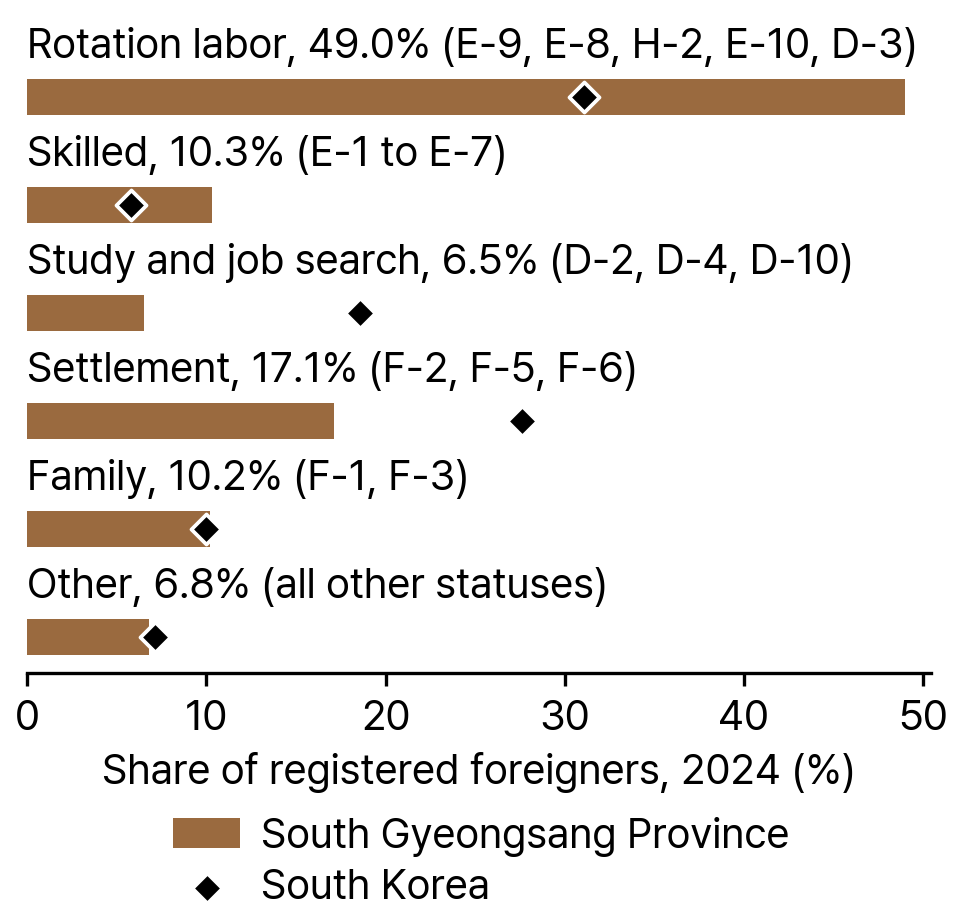
Compared with registered foreigners nationally, those in the province in 2024 were more likely to have rotation labor statuses (49.0 percent, against 31.1 percent) and skilled statuses (10.3 percent, against 5.8 percent) and less likely to have study and job-search statuses (6.5 percent, against 18.6 percent). Vietnamese nationals made up 25.5 percent of them and Indonesians 10.1 percent, while Chinese and Korean-Chinese nationals together made up 10.2 percent, against 31.3 percent nationally. Gimhae-si and Geoje-si had 38.8 percent of the province's registered foreigners in 2024 and 47.2 percent of its net gain between 2019 and 2024. All ten of the province's counties and one city, Miryang-si, were designated population-decline areas in 2021, and in these 11 districts registered foreigners increased by 6,293 between 2019 and 2024 while Korean residents decreased by 47,087.
Size of the Foreign-Resident Population
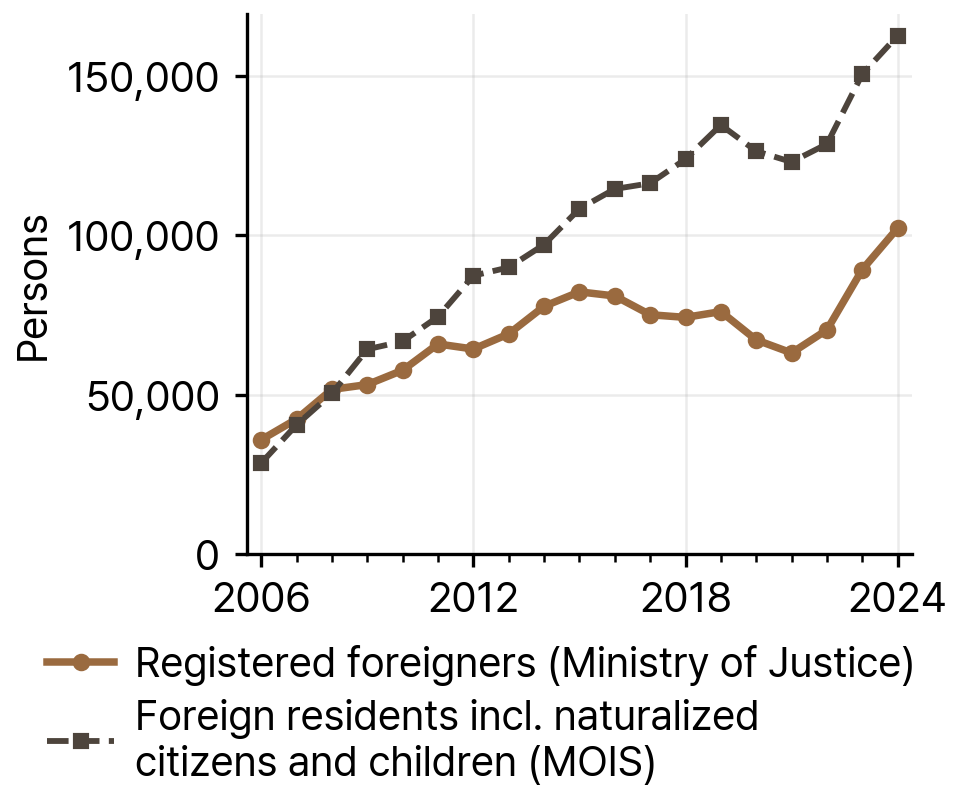
The number of registered foreigners in South Gyeongsang Province rose from 35,915 in 2006 to 82,316 in 2015, more than twice the 2006 count (see Figure 1). It declined to 74,304 in 2018 and, after a rise to 76,123 in 2019, fell to 63,148 in 2021, 17.0 percent below the 2019 count. It then increased to 70,390 in 2022, 89,312 in 2023, and 102,333 in 2024, the highest count between 2006 and 2024 and 62.1 percent above the 2021 count.
The MOIS count of foreign residents, which adds naturalized citizens and the children of foreign residents, was smaller than the registered count from 2006 to 2008 and larger in every year from 2009 to 2024. It rose every year from 50,431 in 2008 to 134,675 in 2019, declined to 123,074 in 2021, and increased to 162,714 in 2024. Between 2015 and 2019, when the registered count fell by 6,193 (from 82,316 to 76,123), the MOIS count rose by 26,300 (from 108,375 to 134,675).
Source: KIRD dataset, from Ministry of Justice immigration yearbooks and Ministry of the Interior and Safety foreign-resident statistics, 2006-2024.
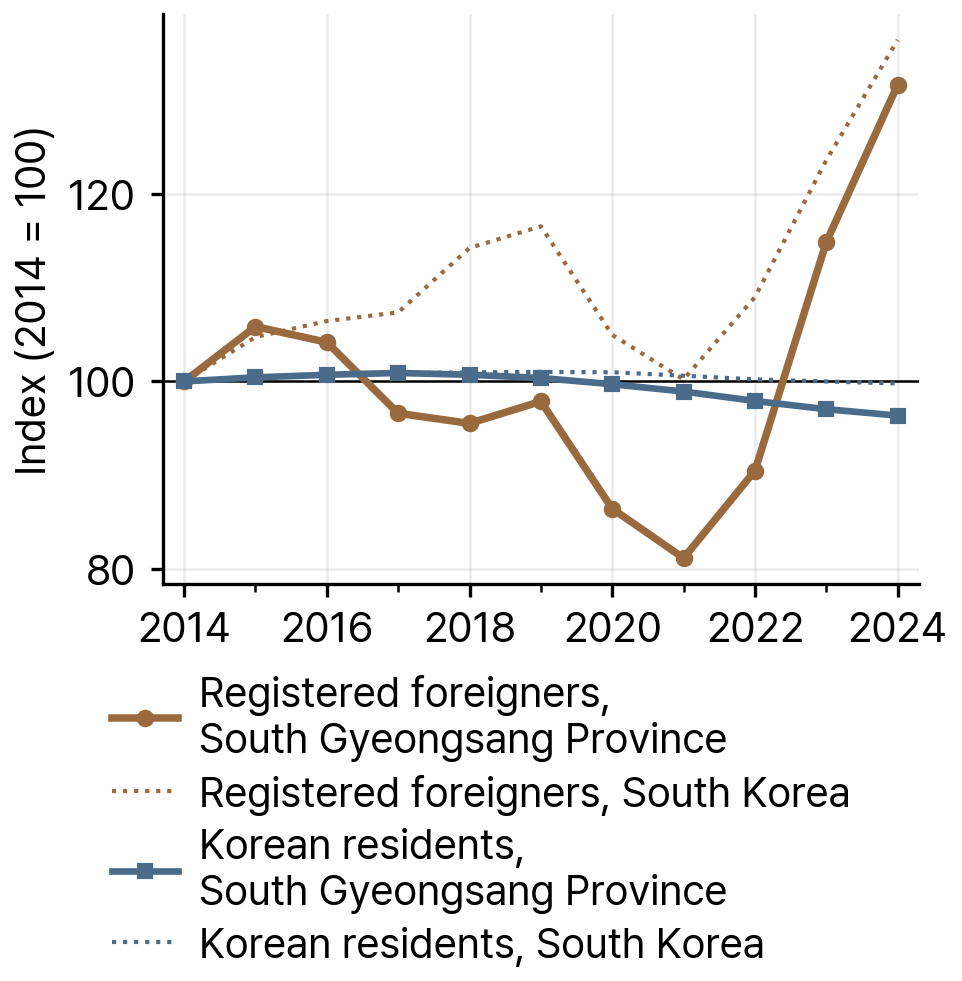
With 2014 set to 100, the index of registered foreigners in the province rose to 105.8 in 2015, fell to 81.2 in 2021, and was 131.6 in 2024 (see Figure 2, which also shows the indexes for South Korea as a whole). The index of Korean residents in the province was highest in 2017 (100.9) and declined to 96.4 in 2024. Over the ten years from 2014 to 2024, the registered count grew 31.6 percent (24,555 people) and the Korean count fell 3.6 percent (121,877 people).
Source: KIRD dataset, from Ministry of Justice immigration yearbooks and Ministry of the Interior and Safety resident registration statistics, 2014-2024.
In 2024 the province ranked third among the 17 provinces by the number of registered foreigners and sixth by registered foreigners per Korean resident (3.2 per 100 Korean residents, against 2.9 for South Korea as a whole). It had 6.9 percent of the country's registered foreigners and 6.3 percent of its Korean residents (3,228,380 of 51,217,221). Between 2006 and 2024 the registered count grew 184.9 percent (66,418 people) and the Korean count 1.7 percent (55,523 people) (see Table 1).
Table 1Registered Foreigners, MOIS Foreign Residents, and Korean Residents in South Gyeongsang Province, Selected Years, 2006-24
| Year | Registered foreigners | MOIS foreign residents | Korean residents | Registered foreigners per 100 Korean residents |
|---|---|---|---|---|
| 2006 | 35,915 | n/a | 3,172,857 | 1.1 |
| 2014 | 77,778 | 97,148 | 3,350,257 | 2.3 |
| 2019 | 76,123 | 134,675 | 3,362,553 | 2.3 |
| 2024 | 102,333 | 162,714 | 3,228,380 | 3.2 |
Note: MOIS counts are shown from 2008, when MOIS counted 50,431 foreign residents in the province; n/a = not shown. Registered foreigners are counted on 31 December and MOIS foreign residents on 1 November.
Source: KIRD dataset, from Ministry of Justice immigration yearbooks and Ministry of the Interior and Safety statistics, 2006-2024.
Nationalities
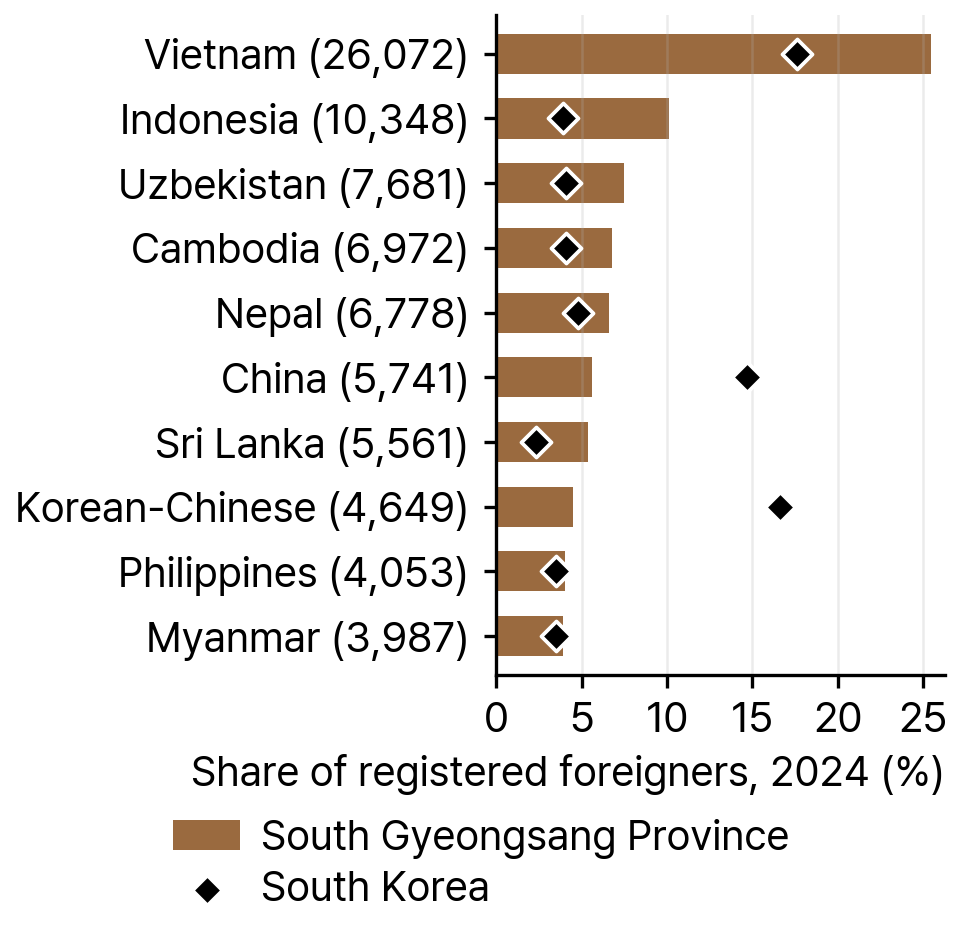
Vietnamese nationals were the largest group of registered foreigners in the province in 2024 (26,072 people, 25.5 percent), against 17.6 percent of registered foreigners nationally (see Figure 3 and Table 2). Indonesians followed with 10,348 (10.1 percent, against 3.9 percent nationally), then Uzbeks with 7,681 (7.5 percent), Cambodians with 6,972 (6.8 percent), and Nepalis with 6,778 (6.6 percent). The ten largest groups made up 80.0 percent of the province's registered foreigners in 2024.
Between 2019 and 2024 the Vietnamese group grew by 7,309 (from 18,763 to 26,072), equal to 27.9 percent of the province's net gain of 26,210 registered foreigners. Among the ten largest groups, the fastest growth was among Nepalis (84.7 percent, from 3,670 to 6,778), Sri Lankans (72.2 percent, from 3,229 to 5,561), nationals of Myanmar (68.8 percent, from 2,362 to 3,987), and Indonesians (54.3 percent, from 6,705 to 10,348).
Chinese nationals decreased from 6,271 in 2019 to 5,741 in 2024 and Korean-Chinese from 5,845 to 4,649. In 2024 the two groups together made up 10.2 percent of the province's registered foreigners (10,390 people), against 31.3 percent nationally (14.7 percent Chinese and 16.6 percent Korean-Chinese).
Source: KIRD dataset, from Ministry of Justice immigration yearbooks, 2024.
Table 2Ten Largest Nationalities among Registered Foreigners in South Gyeongsang Province, 2019 and 2024
| Nationality | 2019 | 2024 | Share of the province's registered foreigners, 2024 (%) | Province's share of this nationality's registered foreigners in South Korea, 2024 (%) |
|---|---|---|---|---|
| Vietnam | 18,763 | 26,072 | 25.5 | 10.0 |
| Indonesia | 6,705 | 10,348 | 10.1 | 17.8 |
| Uzbekistan | 6,620 | 7,681 | 7.5 | 12.4 |
| Cambodia | 4,728 | 6,972 | 6.8 | 11.4 |
| Nepal | 3,670 | 6,778 | 6.6 | 9.4 |
| China | 6,271 | 5,741 | 5.6 | 2.6 |
| Sri Lanka | 3,229 | 5,561 | 5.4 | 16.4 |
| Korean-Chinese | 5,845 | 4,649 | 4.5 | 1.9 |
| Philippines | 3,621 | 4,053 | 4.0 | 7.8 |
| Myanmar | 2,362 | 3,987 | 3.9 | 7.7 |
Note: Korean-Chinese (한국계중국인) are listed separately from other Chinese nationals in the Ministry of Justice data. The province had 6.9 percent of all registered foreigners in South Korea in 2024.
Source: KIRD dataset, from Ministry of Justice immigration yearbooks, 2019 and 2024.
The province had larger shares of several national groups than its 6.9 percent share of all registered foreigners in South Korea in 2024. It was home to 20.3 percent of registered nationals of Timor-Leste (881 of 4,336), 17.8 percent of Indonesians (10,348 of 58,248), 17.6 percent of Laotians (1,169 of 6,641), 16.4 percent of Sri Lankans (5,561 of 33,965), and 16.1 percent of Brazilians (236 of 1,464).
The Shannon diversity index of the province's registered foreigners was 2.6 in both 2014 and 2024, the fourth-highest value among the 17 provinces in 2024. Registered foreigners in the province came from 121 nationalities in 2024.
Overseas Koreans on F-4 status report their residence instead of registering and are not counted among registered foreigners. In 2024, 14,937 F-4 holders reported residence in the province, 2.7 percent of the 553,664 in South Korea, a smaller share than the province's 6.9 percent of registered foreigners. Korean-Chinese made up 7,677 of them, followed by Korean-Russians (2,306) and holders of Uzbek (1,909), U.S. (1,025), and Kazakh (990) nationality. Counting both groups, 12,326 Korean-Chinese residents were recorded in the province in 2024 (7,677 reporting residence on F-4 status and 4,649 registered foreigners).
Residence Statuses
Rotation labor statuses covered 49.0 percent of the province's registered foreigners in 2024 (50,133 people), against 31.1 percent nationally, and skilled statuses covered 10.3 percent (10,566), against 5.8 percent (see Figure 4). Settlement statuses covered 17.1 percent (17,503), against 27.6 percent nationally, and study and job-search statuses 6.5 percent (6,689), against 18.6 percent. Family statuses covered 10.2 percent (10,455), close to the national 10.0 percent, and all other statuses 6.8 percent (6,987), against 7.1 percent.
Source: KIRD dataset, from Ministry of Justice immigration yearbooks, 2024.
E-9 non-professional employment was the most common single status in 2024 (40,717 holders, 39.8 percent of registered foreigners), followed by E-7 specially designated activities (9,548, 9.3 percent) and F-6 marriage migration (9,510, 9.3 percent) (see Table 3). Against its 6.9 percent share of all registered foreigners, the province had 12.4 percent of E-9 holders in South Korea, 15.2 percent of E-7 holders, 16.6 percent of E-10 crew employment holders, and 19.0 percent of those registered on E-8 seasonal worker status. Its shares of F-5 permanent residents (2.8 percent) and D-2 students (1.9 percent) were smaller.
Table 3Ten Most Common Residence Statuses among Registered Foreigners in South Gyeongsang Province, 2024
| Status | Meaning | Status group | Registered foreigners | Share of the province's registered foreigners (%) | Province's share of all holders in South Korea (%) |
|---|---|---|---|---|---|
| E-9 | Non-professional employment | Rotation labor | 40,717 | 39.8 | 12.4 |
| E-7 | Specially designated activities | Skilled | 9,548 | 9.3 | 15.2 |
| F-6 | Marriage migration | Settlement | 9,510 | 9.3 | 6.5 |
| F-1 | Visiting cohabitation | Family | 6,178 | 6.0 | 6.4 |
| F-5 | Permanent residence | Settlement | 5,578 | 5.5 | 2.8 |
| G-1 | Other (miscellaneous) | Other | 4,682 | 4.6 | 8.3 |
| F-3 | Dependent family | Family | 4,277 | 4.2 | 8.3 |
| E-8 | Seasonal worker | Rotation labor | 3,738 | 3.7 | 19.0 |
| E-10 | Crew employment | Rotation labor | 3,571 | 3.5 | 16.6 |
| D-2 | Student | Study and job search | 3,426 | 3.3 | 1.9 |
Note: Shares of the province's registered foreigners are out of 102,333. The ten statuses together covered 91,225 registered foreigners (89.1 percent).
Source: KIRD dataset, from Ministry of Justice immigration yearbooks, 2024.
The MOIS count of 162,714 foreign residents in the province in 2024 comprised 128,519 foreign nationals, 12,422 naturalized citizens, and 21,773 children of foreign residents. MOIS classified the foreign nationals as workers (54,925), marriage migrants (10,839), international students (5,594), ethnic Koreans of foreign nationality (11,767), and other foreign residents (45,394). Workers made up 33.8 percent of the MOIS total in 2024 and children 13.4 percent.
Districts and Population-Decline Areas
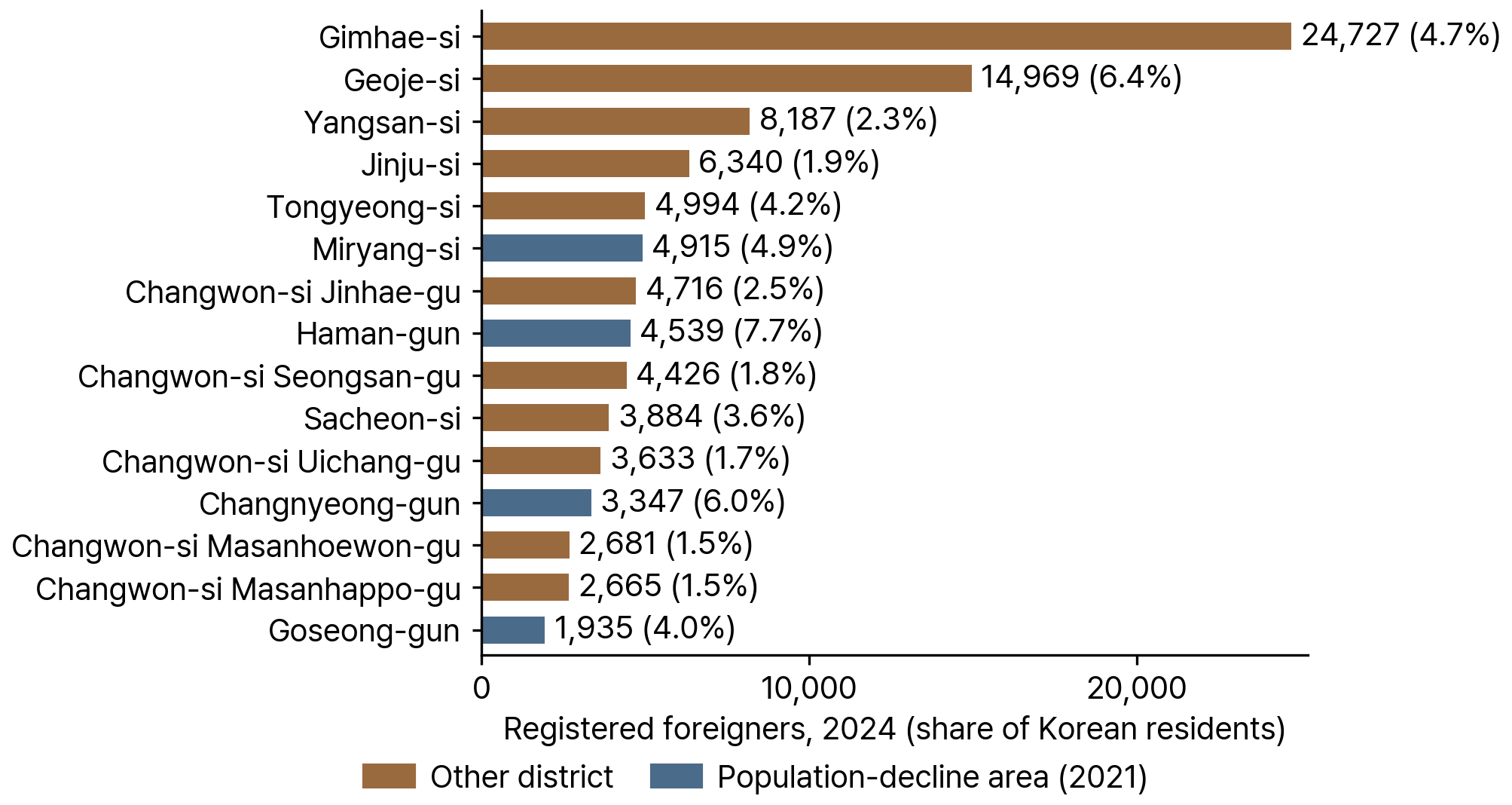
The KIRD data divide the province into 22 districts, made up of seven cities (si), Changwon-si's five districts (gu), and ten counties (gun). Gimhae-si had the most registered foreigners in 2024 (24,727, or 24.2 percent of the province's total), followed by Geoje-si (14,969), Yangsan-si (8,187), and Jinju-si (6,340); Changwon-si's five districts together had 18,121 (see Figure 5 and Table 4). In 2024, registered foreigners per 100 Korean residents ranged from 1.4 in Hamyang-gun to 7.7 in Haman-gun and were also high in Geoje-si (6.4) and Changnyeong-gun (6.0).
Between 2019 and 2024 registered foreigners increased in 21 of the 22 districts, and Korean residents decreased in 19. Geoje-si (by 6,667, from 8,302 to 14,969) and Gimhae-si (by 5,714, from 19,013 to 24,727) had the largest foreign gains, together 47.2 percent of the province's net gain of 26,210. The foreign gain equaled 43.6 percent of Geoje-si's loss of 15,304 Korean residents and 53.0 percent of Gimhae-si's loss of 10,779.
Within Changwon-si, Korean residents increased between 2019 and 2024 in Seongsan-gu (by 23,544) and Masanhappo-gu (by 427) and decreased in the other three districts. Uichang-gu had the largest Korean loss in the province (48,887) and was the only district where registered foreigners decreased (by 31). For the city as a whole, Korean residents fell by 44,882 and registered foreigners rose by 3,048. Outside Changwon-si, Yangsan-si was the only district that gained Korean residents (8,772).
Source: KIRD dataset, from Ministry of Justice immigration yearbooks and Ministry of the Interior and Safety resident registration statistics, 2024; Ministry of the Interior and Safety designation of population-decline areas, 2021.
Table 4Registered Foreigners and Korean Residents in the Ten Districts with the Most Registered Foreigners, South Gyeongsang Province, 2019-24
| District | Registered foreigners, 2024 | Per 100 Korean residents, 2024 | Change in Korean residents, 2019-24 | Change in registered foreigners, 2019-24 | Population-decline area |
|---|---|---|---|---|---|
| Gimhae-si | 24,727 | 4.7 | -10,779 | +5,714 | No |
| Geoje-si | 14,969 | 6.4 | -15,304 | +6,667 | No |
| Yangsan-si | 8,187 | 2.3 | +8,772 | +1,868 | No |
| Jinju-si | 6,340 | 1.9 | -8,549 | +1,121 | No |
| Tongyeong-si | 4,994 | 4.2 | -12,923 | +1,032 | No (area of interest) |
| Miryang-si | 4,915 | 4.9 | -4,861 | +2,045 | Yes |
| Changwon-si Jinhae-gu | 4,716 | 2.5 | -4,883 | +1,335 | No |
| Haman-gun | 4,539 | 7.7 | -6,858 | +1,041 | Yes |
| Changwon-si Seongsan-gu | 4,426 | 1.8 | +23,544 | +731 | No |
| Sacheon-si | 3,884 | 3.6 | -3,421 | +467 | No (area of interest) |
| Province total | 102,333 | 3.2 | -134,173 | +26,210 |
Note: Per 100 Korean residents is the number of registered foreigners divided by the number of Korean residents in the district, times 100. The ten districts had 81,697 of the province's registered foreigners in 2024 (79.8 percent).
Source: KIRD dataset, from Ministry of Justice immigration yearbooks and Ministry of the Interior and Safety resident registration statistics, 2019 and 2024; Ministry of the Interior and Safety designation of population-decline areas, 2021.
Eleven of the 22 districts, all ten counties and Miryang-si, were among the 89 population-decline areas that the Ministry of the Interior and Safety designated in October 2021. The ten counties are Haman-gun, Changnyeong-gun, Goseong-gun, Uiryeong-gun, Sancheong-gun, Namhae-gun, Hapcheon-gun, Hadong-gun, Geochang-gun, and Hamyang-gun. Tongyeong-si and Sacheon-si are among the 18 areas of interest.
Between 2019 and 2024 the 11 decline areas lost 47,087 Korean residents (8.0 percent, from 585,660 to 538,573) and gained 6,293 registered foreigners (42.5 percent, from 14,818 to 21,111), so the foreign gain equaled 13.4 percent of the Korean loss (see Table 5). Miryang-si accounted for 2,045 of the foreign gain, and in Hamyang-gun registered foreigners rose by 14. In 2024 the decline areas had 3.9 registered foreigners per 100 Korean residents, against 3.2 for the province as a whole.
In the two areas of interest, Korean residents fell by 16,344 between 2019 and 2024 (12,923 in Tongyeong-si and 3,421 in Sacheon-si), and registered foreigners rose by 1,499 (1,032 and 467), a foreign gain equal to 9.2 percent of the Korean loss.
Table 5Korean Residents and Registered Foreigners in the Population-Decline Areas and Areas of Interest of South Gyeongsang Province, 2019-24
| District | Designation | Registered foreigners, 2024 | Per 100 Korean residents, 2024 | Change in Korean residents, 2019-24 | Change in registered foreigners, 2019-24 | Foreign gain as share of Korean loss (%) |
|---|---|---|---|---|---|---|
| Miryang-si | Population-decline area | 4,915 | 4.9 | -4,861 | +2,045 | 42.1 |
| Haman-gun | Population-decline area | 4,539 | 7.7 | -6,858 | +1,041 | 15.2 |
| Changnyeong-gun | Population-decline area | 3,347 | 6.0 | -6,246 | +558 | 8.9 |
| Goseong-gun | Population-decline area | 1,935 | 4.0 | -4,271 | +679 | 15.9 |
| Namhae-gun | Population-decline area | 1,180 | 3.0 | -3,790 | +319 | 8.4 |
| Sancheong-gun | Population-decline area | 990 | 3.0 | -2,158 | +382 | 17.7 |
| Uiryeong-gun | Population-decline area | 967 | 3.8 | -2,018 | +202 | 10.0 |
| Hapcheon-gun | Population-decline area | 939 | 2.3 | -4,979 | +344 | 6.9 |
| Hadong-gun | Population-decline area | 913 | 2.2 | -5,809 | +388 | 6.7 |
| Geochang-gun | Population-decline area | 868 | 1.5 | -2,591 | +321 | 12.4 |
| Hamyang-gun | Population-decline area | 518 | 1.4 | -3,506 | +14 | 0.4 |
| Population-decline areas, total | 21,111 | 3.9 | -47,087 | +6,293 | 13.4 | |
| Tongyeong-si | Area of interest | 4,994 | 4.2 | -12,923 | +1,032 | 8.0 |
| Sacheon-si | Area of interest | 3,884 | 3.6 | -3,421 | +467 | 13.7 |
| Areas of interest, total | 8,878 | 3.9 | -16,344 | +1,499 | 9.2 |
Note: The last column divides the change in registered foreigners by the loss of Korean residents in the same row, times 100. Totals are sums of the districts listed.
Source: KIRD dataset, from Ministry of Justice immigration yearbooks and Ministry of the Interior and Safety resident registration statistics, 2019 and 2024; Ministry of the Interior and Safety designation of population-decline areas, 2021.
Four districts in the province contained an ethnic enclave in 2024 by the KIRD definition. Two of them were Indonesian enclaves, in Tongyeong-si, where 2,056 Indonesians made up 41.2 percent of registered foreigners (location quotient 15.3), and in Namhae-gun, where 540 made up 45.8 percent (location quotient 11.9). The two districts had 2,596 (25.1 percent) of the province's 10,348 registered Indonesians. The other two were Vietnamese enclaves, in Hadong-gun, where 425 Vietnamese nationals made up 46.5 percent of registered foreigners (location quotient 2.0), and in Uiryeong-gun, where 299 made up 30.9 percent (location quotient 2.3).
Population Trends
The number of Korean residents in South Gyeongsang Province rose every year from 3,172,857 in 2006 to 3,380,404 in 2017 and declined every year from 2018 to 2024, to 3,228,380. The largest annual decline was in 2022 (33,690 people). The Korean count fell 3.6 percent between 2014 and 2024 (121,877 people) and 4.0 percent between 2019 and 2024 (134,173 people), and in 2024 it was 1.7 percent (55,523 people) above its 2006 level.
In the population census with a reference date of 1 November 2025, the province had a total population of 3,252,634, including 3,117,070 Korean nationals. Its population was 6.3 percent of South Korea's and the third-largest among the 17 provinces, and it had fallen 2.9 percent since 2018, when it was 3,350,350 (Gyeongnam Ilbo, 2026a). The other 135,564 people in the census total (3,252,634 less 3,117,070) were foreign nationals. The census counts differ from the resident registration and immigration counts used elsewhere in this Spotlight.
In July 2026, 22,946 people moved into the province from elsewhere in South Korea and 23,759 moved out, a net outflow of 813, against a net outflow of 1,104 in July 2025 (Gyeongnam News, 2026).
The province's total fertility rate fell from 1.41 in 2014 to 0.80 in 2023 and then rose for two consecutive years, to 0.82 in 2024 and 0.88 in 2025, according to Statistics Korea's provisional birth and death statistics for 2025 (Gyeongnam Domin Ilbo, 2026a). Statistics Korea's 2025 Elderly Statistics, released on 29 September 2025, counted 716,000 people aged 65 and older in the province, 22.2 percent of its population (Gyeongnam Domin Ilbo, 2025a).
In an analysis of Statistics Korea's population projections by the Dongnam Regional Statistics Office, the province's population is projected to decline 21 percent, from 3.287 million in 2022 to 2.597 million in 2052. Over the same period the share aged 65 and older is projected to rise from 18.7 percent to 47.8 percent and the share aged 0 to 14 to fall from 12.2 percent to 6.5 percent (Gyeongnam Domin Ilbo, 2025b).
Industry and Foreign Workers
Registered foreigners on E-9 non-professional employment status, the status of workers admitted through the Employment Permit System (EPS), numbered 38,195 in the province in 2014, 33,356 in 2019, 24,717 in 2021, and 40,717 in 2024. The 2024 count was 64.7 percent above the 2021 count and 6.6 percent above the 2014 count. E-9 holders made up 39.8 percent of the province's registered foreigners in 2024 and 12.4 percent of all E-9 holders in South Korea.
A 2026 news report counted 16.8 foreign workers per 1,000 population in the province in 2024, the third-highest ratio among South Korea's provinces. According to the report, the number of foreign workers had grown most over the previous ten years in manufacturing and in agriculture, forestry, and fisheries, and in areas such as Geoje and Miryang (Gyeongnam Ilbo, 2026b). In the KIRD data, Geoje-si and Miryang-si had the largest and third-largest gains in registered foreigners among the province's districts between 2019 and 2024 (6,667 and 2,045).
In Geoje's shipbuilding industry, 4,292 foreign workers were placed in the first half of 2023, and the count was 4,565 at the end of July 2023; the two major shipyards and their subcontractors estimated that they needed about 1,000 more by the end of that year (Geoje Sinmun, 2023).
The number of foreign residents in Geoje rose from 5,410 in August 2022 to 15,790 in August 2025, an increase that News1 attributed to demand for labor in the city's shipbuilding industry. The Geoje Foreign Worker Support Center opened in March 2025, and about 2,500 foreign workers visited it after it opened (News1, 2025).
Registered foreigners on E-8 seasonal worker status numbered 326 on 31 December 2022, 1,873 on 31 December 2023, and 3,738 on 31 December 2024, when the province had 19.0 percent of those registered on E-8 status in South Korea. A count taken on 31 December misses the seasonal workers whose contracts end before winter. The Busan Ilbo reported 1,142 foreign seasonal workers on E-8 visas employed in the province's agriculture in 2022, 3,465 in 2023, and 7,380 in 2024, two to three times as many each year as in the year before (Busan Ilbo, 2025). The 3,738 counted on 31 December 2024 were about half of the 7,380 in that report for 2024.
The province's recruitment of foreign workers for shipbuilding and manufacturing through the metropolitan-type visa and the regional specialized visa (F-2-R) is described under Provincial Policy.
International Students and Universities
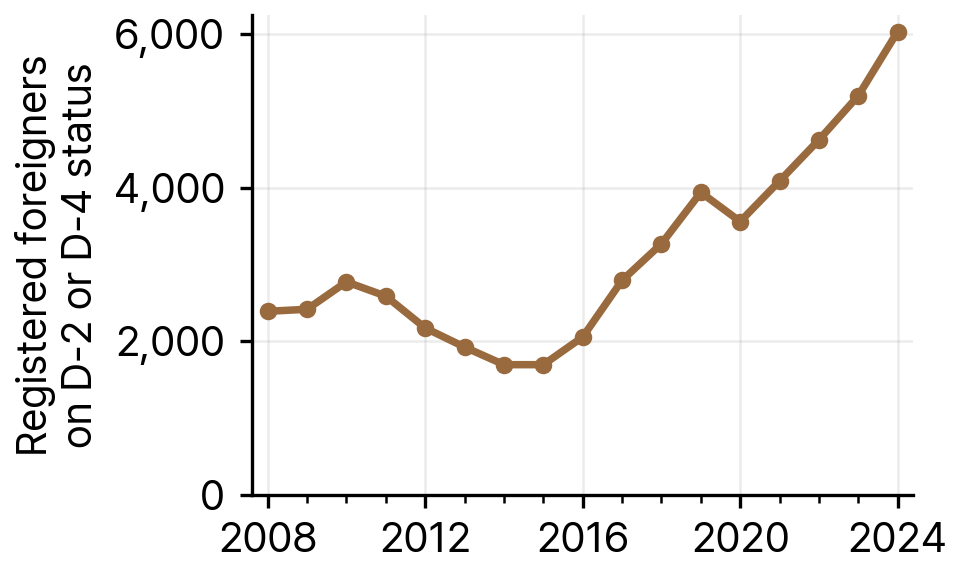
Registered foreigners on D-2 student and D-4 general trainee status in the province numbered 2,392 in 2008 and 2,776 in 2010, declined to 1,697 in 2014, the same count as in 2015, and rose to 3,942 in 2019 (see Figure 6). After a drop to 3,562 in 2020, the count rose each year to 6,037 in 2024 (3,426 on D-2 status and, by difference, 2,611 on D-4), about 3.6 times the 2014 count. In 2024 the province had 2.3 percent of all D-2 and D-4 holders in South Korea, against its 6.9 percent share of all registered foreigners.
Source: KIRD dataset, from Ministry of Justice immigration yearbooks, 2008-2024.
As of April 2025, 4,162 international students were enrolled at 20 universities in the province (Gyeongnam Ilbo, 2026c). At that date Inje University had the most (1,025), followed by Kyungnam University (576), Gyeongsang National University (571), Changwon National University (451), and Masan University (393) (Gyeongnam Domin Ilbo, 2026b). Together they had 3,016 of the 4,162 students (72.5 percent).
The university counts differ from the KIRD count of 6,037, which refers to registered foreigners on D-2 or D-4 status on 31 December 2024, and from the MOIS count of 5,594 international students on 1 November 2024.
Under a regional pilot for 2025 linked to the Regional Innovation System and Education (RISE) program, four colleges in the province each developed an industry specialization for recruiting international students and placing them in jobs, with Masan University in root industries and caregiving, Geoje College in welding, Geochang College in automotive work, and Namhae College in aviation manufacturing (Kukinews, 2024). The province's target of 10,000 international students by 2028 and its council for supporting international students are described under Provincial Policy.
Provincial Policy
South Gyeongsang Province's Ordinance on Support for Foreign Residents (경상남도 외국인주민 지원 조례) is administered by the Women and Family Division of the provincial Welfare and Women Bureau, and the Local Regulations Information System lists the ordinance with the date 2 January 2024 (ELIS, 2024). Under Article 19 of the ordinance, the province established the Gyeongsangnam-do Foreign Residents Support Center, which the nonprofit Gyeongnam Migrant Workers' Labor Welfare Center (경남이주민노동복지센터) operates under contract at an office in Palyong-dong, Uichang-gu, Changwon (Changwon City, 2024).
The province's 2026 population policy covers its 11 population-decline areas and 2 areas of interest and funds 70 projects worth 796.8 billion won. Six of the projects, worth 11.4 billion won, promote the inflow of foreign workers under region-specific programs (Gyeongnam Sinmun, 2026).
In the first round of applications for the metropolitan-type visa (광역형 비자) pilot in 2025, the Ministry of Justice approved the province's request for 130 workers in 21 machinery and metals occupations and did not approve its request for 800 workers in three shipbuilding occupations, pending better methods of verifying skills in occupations such as welding and painting (KNN, 2025a).
A December 2025 report stated that 670 foreign workers were to arrive in the province under the pilot by the end of 2026, 540 in shipbuilding and 130 in machine-parts and information and communications technology jobs on E-7-1 visas, as part of 1,130 planned for the province and Ulsan together. The province had sent skill-verification teams to Vietnam, Indonesia, and Thailand from July 2025 (Seoul Sinmun, 2025a).
The Gyeongnam Visa Support Center, in full operation since December 2025, provides visa-conversion counseling and job matching together as a single service for employers in manufacturing, shipbuilding, and machinery. For the regional specialized visa (F-2-R), 231 foreign workers were recommended in 2024 and 750 in 2025 (Seoul Sinmun, 2025b).
In 2026 the province adopted its first integrated support plan for international students. The plan aims to raise their number from 4,162 in April 2025 to 10,000 by 2028 and their rate of local employment from 15 percent to 25 percent (Gyeongnam Domin Ilbo, 2026c).
A council for supporting international students, launched in 2026, brings together 24 organizations. Its members are the province, 17 universities in the province, the Changwon Immigration Office, the regional center for local talent development (경남앵커센터, formerly the Gyeongnam RISE Center), the Gyeongnam Visa Support Center, the Gyeongnam Foreign Residents Support Center, NH Nonghyup Bank, and BNK Gyeongnam Bank (Gyeongnam Domin Ilbo, 2026b).
Languages
The KIRD dataset estimates first-language speakers among registered foreigners by multiplying each nationality count by the first-language shares that Ethnologue reports for that country. By this estimate, 17 languages had at least 1,000 speakers among the province's registered foreigners in 2024. Vietnamese was the most common first language (22,300 estimated speakers), followed by Indonesian (7,252), Khmer (7,043), Chinese (6,619), and Uzbek (5,584). Sinhala (3,832), Nepali (3,535), Tagalog/Filipino (3,529), Russian (3,074), and Thai (2,924) were the next five.
Because each nationality is divided among the first languages reported for its country, an estimate can be smaller than the count of the corresponding nationality, as with Nepali (3,535 estimated speakers, against 6,778 registered Nepali nationals) and Sinhala (3,832, against 5,561 Sri Lankan nationals). The estimates exclude Korean, and the dataset has no first-language shares for Korean-Chinese residents, so the province's 4,649 registered Korean-Chinese are not counted under any language.
Service Organizations and Community Places
The KIRD census of 1,720 migrant-serving organizations in South Korea lists 96 in South Gyeongsang Province, or 9.4 per 10,000 registered foreigners in 2024, against 11.6 per 10,000 nationally. Of the 96, 93 provide services directly to migrants, and 21 have 가족센터 (family center) in their names. The census also counts 10 medical providers, 7 worker centers, 7 nongovernmental organizations, 5 administrative offices, 3 resident support centers, and 3 youth and education providers in the province.
Organizations can name more than one population they serve. In the province, 35 name workers, 30 name families, and 24 name all foreign residents. Smaller numbers name refugees (8), children (7), undocumented migrants (7), youth (6), overseas Koreans (4), and women (4), and one names students.
The administrative offices in the census are the Changwon Immigration Office, its branch offices in Geoje, Sacheon, and Tongyeong, and the Gimhae branch of the Busan Immigration Office. The worker centers include foreign worker support centers in Gimhae, Yangsan, Geoje, and Sacheon and a support center for foreign workers on aquaculture farms in Tongyeong. The census also lists a support center for Goryeoin (ethnic Koreans from the former Soviet Union) in Yangsan-si and, as a place of worship, the Changwon headquarters of the Indonesian Muslim Community (KMI), the Masjid Sayyidina Bilal, in Changwon-si Seongsan-gu.
In the old downtown of Gimhae-si, the district with the most registered foreigners in the province, shops selling food and daily necessities to migrant workers multiplied from around 2008 and formed what became known as the foreign street (외국인 거리). A 2013 study described the street as a place for exchanging information and for shopping and as a source of psychological stability for migrants (Cha and Cha, 2013).
The Gimhae Foreign Workers Support Center, established in December 2008, has served migrants from nine countries, among them China, Vietnam, Uzbekistan, Indonesia, Thailand, Nepal, Cambodia, and Sri Lanka. Its director put the number of foreign residents in Gimhae at about 28,000 as of November 2018 (Gyeongnam Domin Ilbo, 2019).
The Changwon Foreign Workers Support Center in Masanhappo-gu, operated by the Tongdosa Social Welfare Foundation, offers counseling on unpaid wages, industrial accidents, changes of workplace, and immigration matters, along with interpretation and Korean-language classes, and has resident counselors for Vietnamese, Cambodian, Nepali, Indonesian, and Uzbek workers (Gyeongnam Ilbo, 2026d).
In 2025 Changwon's commercial revitalization foundation began working with a foreign worker support center to introduce foreign workers living in Bongam-dong, Odong-dong, and other parts of the city's Masan area to the nearby Changdong shopping district (KNN, 2025b).
Sources
Korea Immigration Regional Dashboard (KIRD). 2026. Spatiotemporal administrative dataset of nationality, residential diversity, and language demand among immigrants in South Korea, 2006-2024. openICPSR. https://doi.org/10.3886/E249944V1
Gyeongnam Ilbo. 2026a. Gyeongnam, a province of declining population, sees more one-person households and foreign residents (in Korean). https://www.gnnews.co.kr/news/articleView.html?idxno=642211
Gyeongnam News. 2026. Domestic migration at its lowest in four years, with a net outflow of 813 from Gyeongnam; in the end, jobs retain people (in Korean). https://www.gnnews24.kr/news/articleView.html?idxno=33933
Gyeongnam Domin Ilbo. 2026a. Gyeongnam's total fertility rate rises for a second year, to 0.88; a structural approach beyond the economy is needed (in Korean). https://www.idomin.com/news/articleView.html?idxno=957078
Gyeongnam Domin Ilbo. 2025a. Gyeongnam's elderly population up 40,000 in a year; in ten years one in three residents will be elderly (in Korean). https://www.idomin.com/news/articleView.html?idxno=947365
Gyeongnam Domin Ilbo. 2025b. Gyeongnam's population to shrink by 690,000 in 30 years, with the elderly near half (in Korean). https://www.idomin.com/news/articleView.html?idxno=940221
Gyeongnam Ilbo. 2026b. Allocation of foreign workers in Gyeongnam needs refinement (in Korean). https://www.gnnews.co.kr/news/articleView.html?idxno=644630
News1 (via Daum). 2025. Shipbuilding city Geoje: a support center establishes itself amid a surge of foreign workers (in Korean). https://v.daum.net/v/20251004070131113
Geoje Sinmun. 2023. Geoje shipbuilding short of labor, with 4,292 foreign workers deployed (in Korean). https://www.geojenews.co.kr/news/articleView.html?idxno=78176
Busan Ilbo. 2025. Foreign seasonal workers in demand in Gyeongnam (in Korean). https://www.busan.com/view/busan/view.php?code=2025020614454081060
Gyeongnam Ilbo. 2026c. Gyeongnam moves to attract 10,000 international students (in Korean). https://www.gnnews.co.kr/news/articleView.html?idxno=635127
Gyeongnam Domin Ilbo. 2026b. Gyeongnam launches a council to support international students, strengthening local employment and settlement (in Korean). https://www.idomin.com/news/articleView.html?idxno=2008523
Kukinews (via Daum). 2024. South Gyeongsang Province pursues the recruitment of 10,000 international students (in Korean). https://v.daum.net/v/1sS7tFTN7M?f=p
Local Regulations Information System (ELIS, 자치법규정보시스템). 2024. List of Gyeongsangnam-do local regulations, entry for the Gyeongsangnam-do Ordinance on Support for Foreign Residents (in Korean). https://www.elis.go.kr/alrpop/locgovAlrPopup?ctpvCd=48&sggCd=000
Changwon City. 2024. Gyeongsangnam-do Foreign Residents Support Center (in Korean). https://www.changwon.go.kr/cwportal/depart/11061/14440/14445.web
Gyeongnam Sinmun (via Daum). 2026. Protecting Gyeongnam's population: 70 projects at a cost of 796.8 billion won (in Korean). https://v.daum.net/v/20260119215325861
KNN. 2025a. Metropolitan-type visa for Gyeongnam's shipbuilding sector held back; the province looks for measures (in Korean). https://news.knn.co.kr/news/article/171711
Seoul Sinmun. 2025a. Ulsan and Gyeongnam launch the metropolitan-type visa, with hopes of easing labor shortages and with concerns (in Korean). https://go.seoul.co.kr/news/newsView.php?id=20251219027006
Seoul Sinmun. 2025b. Gyeongnam Visa Support Center begins full operation to make the regional specialized visa more effective (in Korean). https://go.seoul.co.kr/news/newsView.php?id=20251204500164
Gyeongnam Domin Ilbo. 2026c. Gyeongnam prepares its first integrated support plan for international students (in Korean). https://www.idomin.com/news/articleView.html?idxno=2003753
Cha, Chul Wook, and Yun-Jung Cha. 2013. Signification of Migrant Workers' Space and the Formation of Foreigner Avenue in Gimhae (김해 이주노동자들의 공간 의미화와 '외국인 거리'의 형성). 한국민족문화 (Journal of Koreanology) 47: 361-396. https://www.dbpia.co.kr/Journal/articleDetail?nodeId=NODE02178130
Gyeongnam Domin Ilbo. 2019. Profile of the director of the Gimhae Foreign Workers Support Center, in a series on figures of the Gimhae region (in Korean). https://www.idomin.com/news/articleView.html?idxno=594107
Gyeongnam Ilbo. 2026d. A visit to the Changwon Foreign Workers Support Center, which supports the settlement of foreign residents (in Korean). https://www.gnnews.co.kr/news/articleView.html?idxno=640140
KNN. 2025b. Changwon works with foreign residents to revitalize commercial districts (in Korean). https://news.knn.co.kr/news/article/170680
Suggested citation: Korea Immigration Regional Dashboard (KIRD). 2026. “Foreign Residents in South Gyeongsang Province.” Foreign Residents in South Korea series, September 2026. Data: Korea Immigration Regional Dashboard (KIRD) dataset, https://doi.org/10.3886/E249944V1. Interactive maps and tables: https://immigrantsinkorea.today.