 Korea Immigration Regional Dashboard
SpotlightSeptember 2026Province profilesDownload PDF
Foreign Residents in Gwangju
Highlights
- Gwangju had 26,557 registered foreigners at the end of 2024, 55.6 percent more than in 2014 (17,064), while its Korean population fell 4.6 percent over the same years, from 1,475,884 to 1,408,422.
- Study and job search statuses (D-2, D-4 and D-10) covered 32.2 percent of Gwangju's registered foreigners in 2024, against 18.6 percent nationally, and D-2 student status was the most common single status, with 5,173 holders.
- Vietnamese nationals were the largest group in 2024, with 7,887 people or 29.7 percent of registered foreigners (17.6 percent nationally), and their increase of 2,372 since 2019 equaled 86.8 percent of the city's net gain of 2,732 registered foreigners.
At the end of 2024, 26,557 registered foreigners lived in Gwangju Metropolitan City, 1.8 percent of the 1,488,353 registered foreigners in South Korea. Gwangju ranked 14th among the 17 provinces and metropolitan cities by the number of registered foreigners and 12th by registered foreigners per Korean resident, with 1.9 per 100 Korean residents against 2.9 nationally. The Ministry of the Interior and Safety, whose count adds naturalized citizens and the children of foreign residents, counted 47,728 foreign residents in the city in 2024.
The number of registered foreigners more than tripled between 2006 and 2024, from 8,155 to 26,557. The Korean population was almost the same at both ends of that period (1,407,798 in 2006 and 1,408,422 in 2024), after peaking at 1,475,884 in 2014. Between 2014 and 2024, Korean residents decreased by 67,462 (4.6 percent) and registered foreigners increased by 9,493 (55.6 percent). Growth in the registered count slowed from 39.6 percent between 2014 and 2019 (from 17,064 to 23,825) to 11.5 percent between 2019 and 2024, the 14th-fastest growth among the 17 provinces in the later period. The gain of 2,732 registered foreigners from 2019 to 2024 equaled 5.7 percent of the city's loss of 48,046 Korean residents over the same years.
Compared with registered foreigners nationally, those in Gwangju were more often students and trainees and less often rotation workers. In 2024, study and job search statuses (D-2, D-4 and D-10) covered 32.2 percent of them, against 18.6 percent nationally, and rotation labor statuses 20.4 percent, against 31.1 percent. Vietnamese nationals made up 29.7 percent of the total. More than half of the city's registered foreigners (56.3 percent) lived in one district, Gwangsan-gu, where the Hanam industrial park and the Koryoin Village of Wolgok-dong are located. The city created a dedicated Foreign Resident Affairs Division in July 2023, which it describes as the first among Korea's special and metropolitan cities (Kyunghyang Shinmun, 2024). The KIRD census of migrant-serving organizations lists 109 organizations in Gwangju, 41.0 per 10,000 registered foreigners in 2024, against 11.6 nationally.
Size of the Foreign-Resident Population
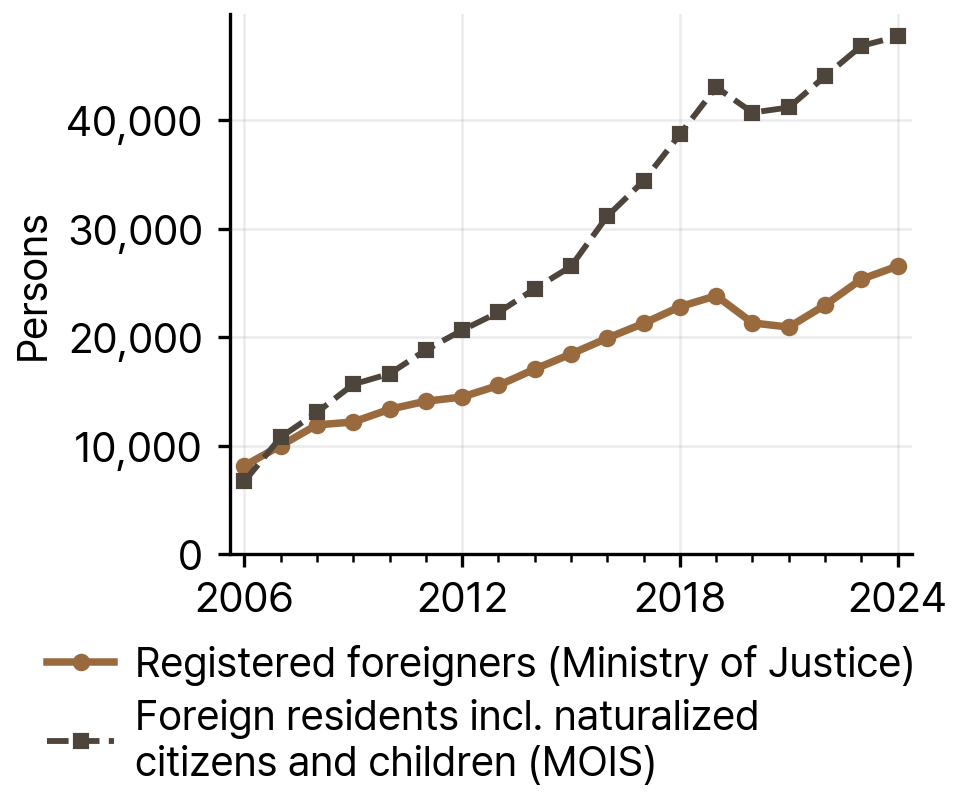
Gwangju had 26,557 registered foreigners at the end of 2024, up from 8,155 in 2006, 17,064 in 2014 and 23,825 in 2019 (Figure 1 and Table 1). The count rose every year from 2006 to 2019. It fell to 21,323 in 2020 and 20,934 in 2021, when it was 2,891 (12.1 percent) below the 2019 level, and then rose each year to the 2024 total, the highest in the series.
The Ministry of the Interior and Safety count rose from 13,077 in 2008 to 24,466 in 2014 and 43,053 in 2019. It fell to 40,715 in 2020, grew again from 2021 and stood at 47,728 in 2024, 1.8 times the number of registered foreigners. That year it included 4,229 naturalized citizens and 7,617 children of foreign residents.
Source: KIRD dataset, from Ministry of Justice immigration yearbooks and Ministry of the Interior and Safety foreign-resident statistics, 2006-2024.
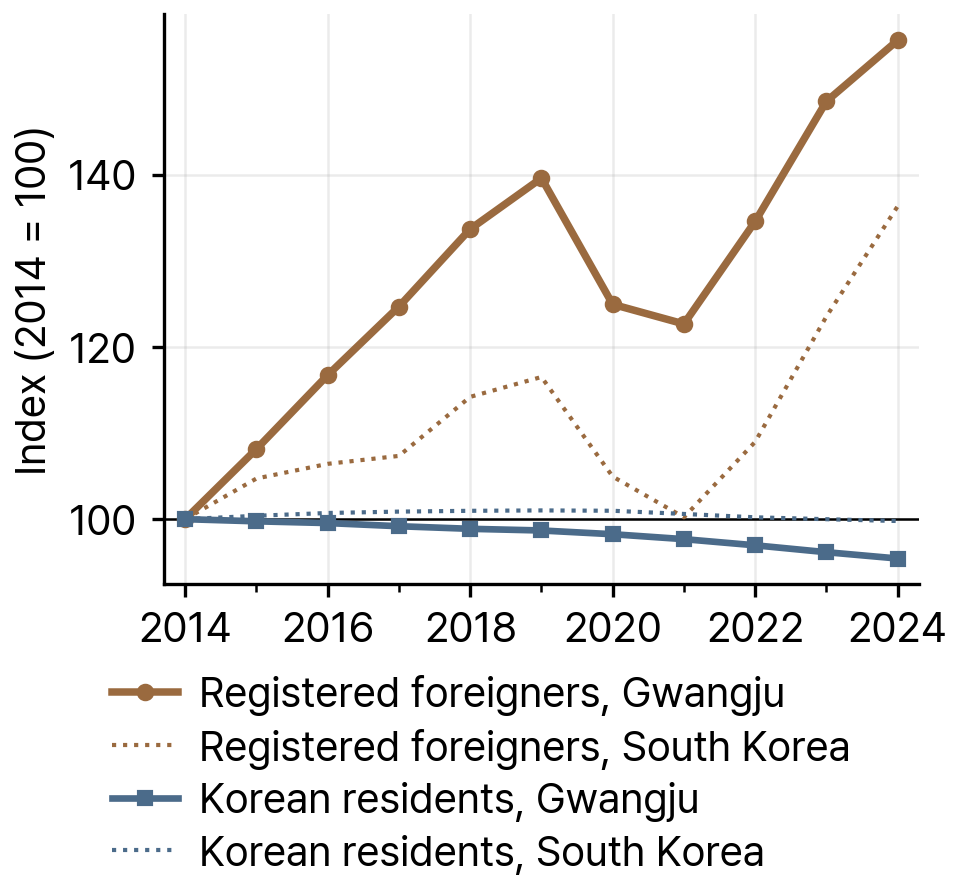
Gwangju's Korean population peaked at 1,475,884 in 2014 and declined every year after that, to 1,408,422 in 2024. With 2014 set to 100, the index for registered foreigners in Gwangju stood at 155.6 in 2024 and the index for Korean residents at 95.4 (Figure 2). Between 2019 and 2024 the registered count grew 11.5 percent (from 23,825 to 26,557), the 14th-fastest growth among the 17 provinces and metropolitan cities, while the number of Korean residents fell 3.3 percent (from 1,456,468 to 1,408,422).
Source: KIRD dataset, from Ministry of Justice immigration yearbooks and Ministry of the Interior and Safety resident registration statistics, 2014-2024.
Registered foreigners per 100 Korean residents rose from 0.6 in 2006 to 1.2 in 2014, 1.6 in 2019 and 1.9 in 2024, against 2.9 for South Korea as a whole in 2024. That year Gwangju ranked 14th among the 17 provinces and metropolitan cities by the number of registered foreigners and 12th by registered foreigners per Korean resident.
Table 1Registered Foreigners, Foreign Residents and Korean Residents in Gwangju, Selected Years, 2006-24
| Year | Registered foreigners | Foreign residents (MOIS) | Korean residents | Registered foreigners per 100 Korean residents |
|---|---|---|---|---|
| 2006 | 8,155 | – | 1,407,798 | 0.6 |
| 2014 | 17,064 | 24,466 | 1,475,884 | 1.2 |
| 2019 | 23,825 | 43,053 | 1,456,468 | 1.6 |
| 2024 | 26,557 | 47,728 | 1,408,422 | 1.9 |
Note: Registered foreigners are counted by the Ministry of Justice on 31 December. Foreign residents are counted by the Ministry of the Interior and Safety (MOIS) on 1 November and include naturalized citizens and the children of foreign residents. The table shows MOIS counts from 2008, when the ministry counted 13,077 foreign residents in Gwangju (– = not shown). In 2024, South Korea had 2.9 registered foreigners per 100 Korean residents.
Source: KIRD dataset, from Ministry of Justice immigration yearbooks and Ministry of the Interior and Safety statistics, 2006-2024.
Nationalities
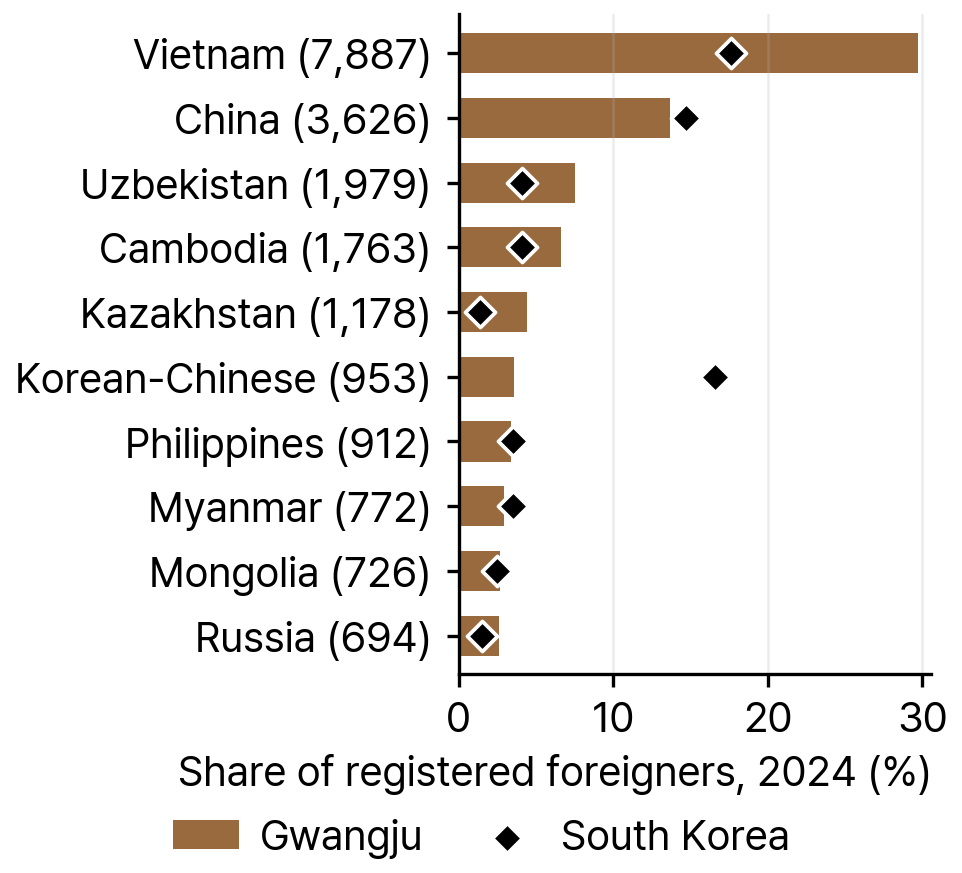
Vietnamese nationals were the largest group among Gwangju's registered foreigners in 2024, with 7,887 people or 29.7 percent, against 17.6 percent of registered foreigners nationally (Figure 3 and Table 2). Nationals of China (3,626, or 13.7 percent), Uzbekistan (1,979), Cambodia (1,763) and Kazakhstan (1,178) followed. Korean-Chinese, whom the Ministry of Justice counts separately from other Chinese nationals, numbered 953 (3.6 percent), against 16.6 percent of registered foreigners nationally.
Between 2019 and 2024 the number of Vietnamese nationals rose by 2,372, from 5,515 to 7,887, equal to 86.8 percent of the net increase of 2,732 in all registered foreigners. Among the ten largest groups, the fastest growth was among nationals of Myanmar (from 399 to 772, up 93.5 percent), Cambodia (from 1,173 to 1,763, up 50.3 percent) and Russia (from 484 to 694, up 43.4 percent). The numbers of Chinese nationals (from 4,468 to 3,626), Uzbek nationals (from 2,679 to 1,979), Korean-Chinese (from 1,396 to 953) and Filipino nationals (from 953 to 912) fell.
Source: KIRD dataset, from Ministry of Justice immigration yearbooks, 2024.
Gwangju was home to 1.8 percent of all registered foreigners in South Korea in 2024 and to larger shares of several national groups. Its shares were 8.1 percent for Ukrainian nationals (221 of 2,730), 5.8 percent for Kazakh nationals (1,178 of 20,482), 3.3 percent for South African nationals (152 of 4,641) and 3.2 percent each for Korean-Russians (77 of 2,383) and Uzbek nationals (1,979 of 61,733).
Registered foreigners in Gwangju came from 113 nationality groups in 2024. The Shannon diversity index, which rises with the number of groups and the evenness of their shares, was 2.5 in both 2014 and 2024, the 12th-highest value among the 17 provinces and metropolitan cities in 2024.
Overseas Koreans on F-4 status report their residence instead of registering and are not counted among registered foreigners. In 2024, 6,175 of them reported a residence in Gwangju, 1.1 percent of the 553,664 in South Korea. The largest groups were nationals of Uzbekistan (1,673), Korean-Chinese (1,654), Korean-Russians (1,001), nationals of Kazakhstan (739) and nationals of the United States (422).
Table 2Ten Largest Nationalities among Registered Foreigners in Gwangju, 2019 and 2024
| Nationality | 2019 | 2024 | Share of Gwangju's registered foreigners, 2024 (%) | Gwangju's share of the group in South Korea, 2024 (%) |
|---|---|---|---|---|
| Vietnam | 5,515 | 7,887 | 29.7 | 3.0 |
| China | 4,468 | 3,626 | 13.7 | 1.7 |
| Uzbekistan | 2,679 | 1,979 | 7.5 | 3.2 |
| Cambodia | 1,173 | 1,763 | 6.6 | 2.9 |
| Kazakhstan | 1,051 | 1,178 | 4.4 | 5.8 |
| Korean-Chinese | 1,396 | 953 | 3.6 | 0.4 |
| Philippines | 953 | 912 | 3.4 | 1.8 |
| Myanmar | 399 | 772 | 2.9 | 1.5 |
| Mongolia | 555 | 726 | 2.7 | 1.9 |
| Russia | 484 | 694 | 2.6 | 3.1 |
Note: China excludes Korean-Chinese and Russia excludes Korean-Russians, whom the Ministry of Justice counts separately. Gwangju had 1.8 percent of all registered foreigners in South Korea in 2024.
Source: KIRD dataset, from Ministry of Justice immigration yearbooks, 2019 and 2024.
Residence Statuses
Study and job search was the largest status group in Gwangju in 2024, with 8,562 registered foreigners or 32.2 percent, against 18.6 percent nationally (Figure 4). Rotation labor covered 5,425 people (20.4 percent, against 31.1 percent nationally), settlement 5,401 (20.3 percent, against 27.6 percent), family 3,971 (15.0 percent, against 10.0 percent) and skilled statuses 1,160 (4.4 percent, against 5.8 percent). The other 2,038 (7.7 percent, against 7.1 percent nationally) were on other statuses.
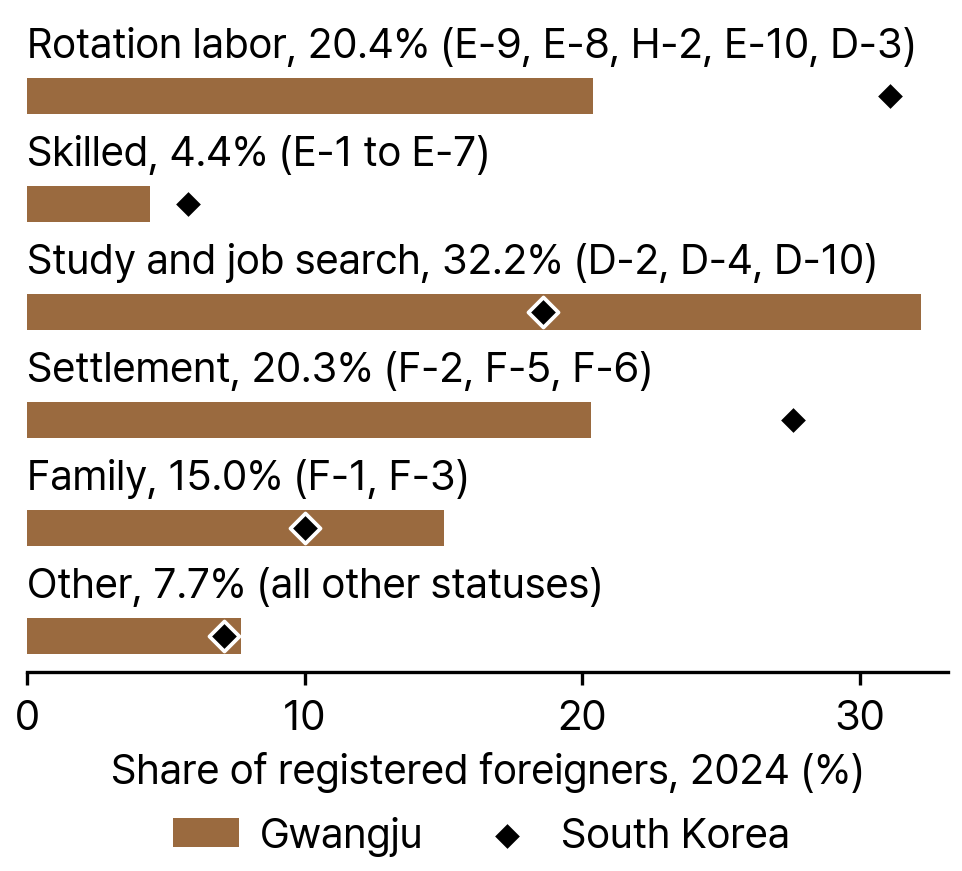
Source: KIRD dataset, from Ministry of Justice immigration yearbooks, 2024.
D-2 student status was the most common single status in 2024, with 5,173 holders (19.5 percent), followed by E-9 non-professional employment (4,522), F-6 marriage migration (3,311), F-1 visiting cohabitation (3,004) and D-4 general trainee status (2,672) (Table 3). Among the ten most common statuses, Gwangju's share of all holders in South Korea was highest for D-10 job seekers (3.9 percent), D-4 (3.3 percent), F-1 (3.1 percent), the G-1 miscellaneous status (3.0 percent) and D-2 (2.9 percent). It was lowest for F-5 permanent residence (0.7 percent), H-2 visiting employment (1.0 percent) and E-9 (1.4 percent), all below the city's 1.8 percent share of registered foreigners.
Table 3Ten Most Common Residence Statuses among Registered Foreigners in Gwangju, 2024
| Status | Meaning | Registered foreigners | Share of Gwangju's registered foreigners (%) | Gwangju's share of all holders in South Korea (%) |
|---|---|---|---|---|
| D-2 | Student | 5,173 | 19.5 | 2.9 |
| E-9 | Non-professional employment | 4,522 | 17.0 | 1.4 |
| F-6 | Marriage migration | 3,311 | 12.5 | 2.3 |
| F-1 | Visiting cohabitation | 3,004 | 11.3 | 3.1 |
| D-4 | General trainee | 2,672 | 10.1 | 3.3 |
| G-1 | Other (miscellaneous) | 1,688 | 6.4 | 3.0 |
| F-5 | Permanent residence | 1,513 | 5.7 | 0.7 |
| F-3 | Dependent family | 967 | 3.6 | 1.9 |
| H-2 | Visiting employment | 875 | 3.3 | 1.0 |
| D-10 | Job seeker | 717 | 2.7 | 3.9 |
Note: Meanings follow the Ministry of Justice status labels. Gwangju had 1.8 percent of all registered foreigners in South Korea in 2024.
Source: KIRD dataset, from Ministry of Justice immigration yearbooks, 2024.
The Ministry of the Interior and Safety count uses its own categories. Of the 47,728 foreign residents it counted in Gwangju in 2024, 35,882 were foreign nationals, made up of 6,400 workers, 3,760 marriage migrants, 7,430 international students, 5,021 ethnic Koreans of foreign nationality and 13,271 other foreign nationals. The other 11,846 were 4,229 naturalized citizens and 7,617 children of foreign residents.
Districts and Population-Decline Areas
Gwangju is divided into five autonomous districts (gu). Gwangsan-gu had 14,957 registered foreigners in 2024, 56.3 percent of the city's total (14,957 of 26,557), and 3.8 per 100 Korean residents (Figure 5 and Table 4). It was followed by Buk-gu with 5,295 (1.2 per 100 Korean residents), Seo-gu with 2,714 (1.0), Dong-gu with 1,879 (1.8) and Nam-gu with 1,712 (0.8).
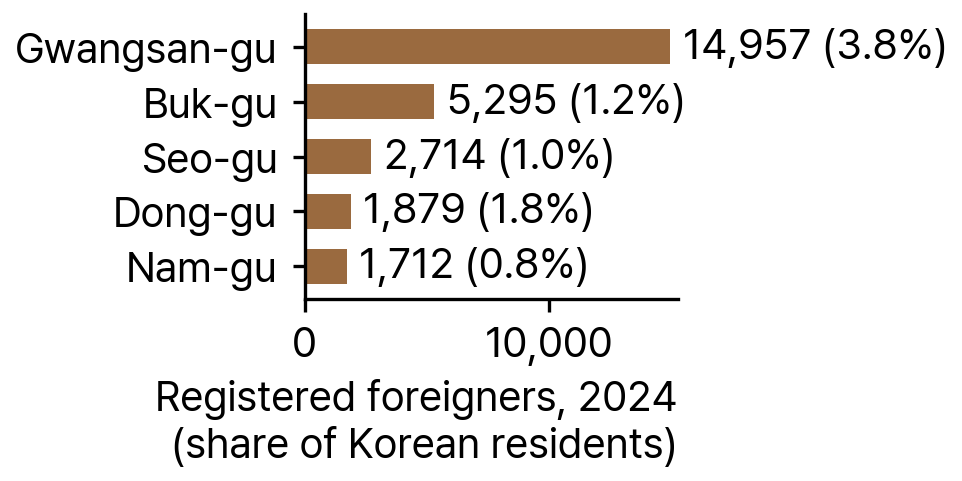
Source: KIRD dataset, from Ministry of Justice immigration yearbooks and Ministry of the Interior and Safety resident registration statistics, 2024.
Between 2019 and 2024, four of Gwangju's five districts lost Korean residents, and Dong-gu gained 7,618. Seo-gu lost the most (21,925) and gained 1,023 registered foreigners. Gwangsan-gu lost 13,704 Korean residents and gained 1,496 registered foreigners, the largest gain of any district. Dong-gu was the only district where the number of registered foreigners fell, by 40.
Table 4Registered Foreigners and Korean Residents by District in Gwangju, 2019-24
| District | Registered foreigners, 2024 | Per 100 Korean residents, 2024 | Change in Korean residents, 2019-24 | Change in registered foreigners, 2019-24 | Population-decline area |
|---|---|---|---|---|---|
| Gwangsan-gu | 14,957 | 3.8 | -13,704 | +1,496 | No |
| Buk-gu | 5,295 | 1.2 | -9,572 | +94 | No |
| Seo-gu | 2,714 | 1.0 | -21,925 | +1,023 | No |
| Dong-gu | 1,879 | 1.8 | +7,618 | -40 | No (area of interest) |
| Nam-gu | 1,712 | 0.8 | -10,463 | +159 | No |
Note: Population-decline areas and areas of interest as designated by the Ministry of the Interior and Safety in October 2021. For Gwangju as a whole, the change from 2019 to 2024 was -48,046 Korean residents and +2,732 registered foreigners.
Source: KIRD dataset, from Ministry of Justice immigration yearbooks and Ministry of the Interior and Safety statistics, 2019-2024.
None of Gwangju's districts was among the 89 population-decline areas that the Ministry of the Interior and Safety designated in October 2021. Dong-gu was one of the 18 areas of interest named at the same time. Between 2019 and 2024 it gained 7,618 Korean residents and lost 40 registered foreigners. Dong-gu was again among 18 areas of interest in a designation announced jointly by the Ministry of the Interior and Safety and the industry ministry, effective 31 December 2025 (Asia Economy, 2025).
In 2025 the Ministry of Justice extended its regional specialized visa (F-2-R) from the 89 population-decline areas to 107 areas by adding the 18 areas of interest, the category that includes Dong-gu. The program had 85 participating basic local governments (cities, counties and districts), and the ministry planned a total of 5,072 places under the visa nationwide (Edaily, 2025).
No district in Gwangju met the definition of an ethnic enclave used in this profile in 2024, a location quotient of at least 2 for a nationality (its share of the district's registered foreigners divided by its share of all registered foreigners nationwide) with the group making up at least 30 percent of the district's registered foreigners.
Population Trends
Gwangju's Korean population rose from 1,407,798 in 2006 to a peak of 1,475,884 in 2014 and fell every year from 2015 to 2024, when it was 1,408,422, 624 more than in 2006. It fell by 67,462 (4.6 percent) between 2014 and 2024 and by 48,046 (3.3 percent) between 2019 and 2024. The gain of 2,732 registered foreigners over the latter period equaled 5.7 percent of that loss.
The 2025 Population and Housing Census counted 1,432,000 people in Gwangju, 12,000 fewer than in 2024 and 46,000 fewer than in 2020 (Mudeung Ilbo, 2025). The resident-registration population was 1,399,880 in May 2025, below 1.4 million (Siminsori, 2025).
In 2024 Gwangju had the highest net out-migration rate among the 17 provinces and metropolitan cities (-0.6 percent) for the second year in a row, according to Statistics Korea's domestic migration statistics (Namdo Ilbo, 2025a). Net out-migration of people in their 20s and 30s rose from 3,137 in 2020 to 5,860 in 2024, 73.6 percent of the city's total net out-migration that year (Siminsori, 2025).
Gwangju's total fertility rate was 0.70 in 2024, down from 0.71 in 2023. Across the city's districts it ranged from 0.59 in Seo-gu and Nam-gu to 0.86 in Dong-gu (Namdo Ilbo, 2025b).
A population impact assessment commissioned by the city and released on 7 December 2025 projects that Gwangju's population will fall by about 266,000 people (18.4 percent) between 2025 and 2052. Over the same period the median age rises from 45.1 to 57.3, the share of people aged 15 to 64 falls from 70.9 percent to 52.5 percent, and the share aged 65 and older rises from 17.9 percent to 38.8 percent (Gwangju Maeil Shinmun, 2025).
Industry and Foreign Workers
Registered foreigners on E-9 (non-professional employment) status, the status issued under the Employment Permit System, numbered 4,422 in Gwangju in 2014, 4,002 in 2019, 3,307 in 2021 and 4,522 in 2024. In 2024 they made up 17.0 percent of the city's registered foreigners and 1.4 percent of all E-9 holders in South Korea.
Ministry of Employment and Labor data for the second quarter of 2026 count 3,599 E-9 workers in Gwangju. Of these, 3,171 (88.1 percent) worked in manufacturing, 199 in agriculture and livestock, 186 in construction and 43 in services, and none in fishing, mining or forestry (Ministry of Employment and Labor, 2026).
The Ministry of the Interior and Safety count of foreign workers in Gwangju fell from 7,312 in 2019 to 6,006 in 2023, a decline of about 18 percent, while the count in neighboring South Jeolla Province rose about 36 percent, from 18,839 to 25,625 (Namdo Ilbo, 2024a). In the KIRD data, the ministry counted 6,400 foreign workers in Gwangju in 2024.
The same 2024 report describes foreign workers in Gwangju as concentrated in the root industries (ppuri saneop) of the Hanam industrial park, including steel-product manufacturing and processing, casting, molding, machining and welding. It reported that these sectors were losing foreign staff amid a prolonged downturn in construction and wage competition from the Seoul metropolitan area (Namdo Ilbo, 2024a).
Seasonal workers on E-8 status numbered 5 on 31 December 2022 and 14 on 31 December of both 2023 and 2024. The Ministry of Justice count is taken on 31 December and misses most seasonal workers, whose contracts end before winter. To our knowledge, no published source reports a seasonal-worker allocation or arrival count for Gwangju alone.
International Students and Universities
Registered foreigners on D-2 (student) or D-4 (general trainee) status in Gwangju numbered 2,995 in 2008 and 3,378 in 2014. The count nearly doubled by 2019, to 6,525, fell to 5,585 in 2020 and rose every year after that, to 7,845 in 2024 (Figure 6). Gwangju had 3.0 percent of all D-2 and D-4 holders in South Korea in 2024, against 1.8 percent of all registered foreigners. Another 717 registered foreigners were on D-10 job seeker status.
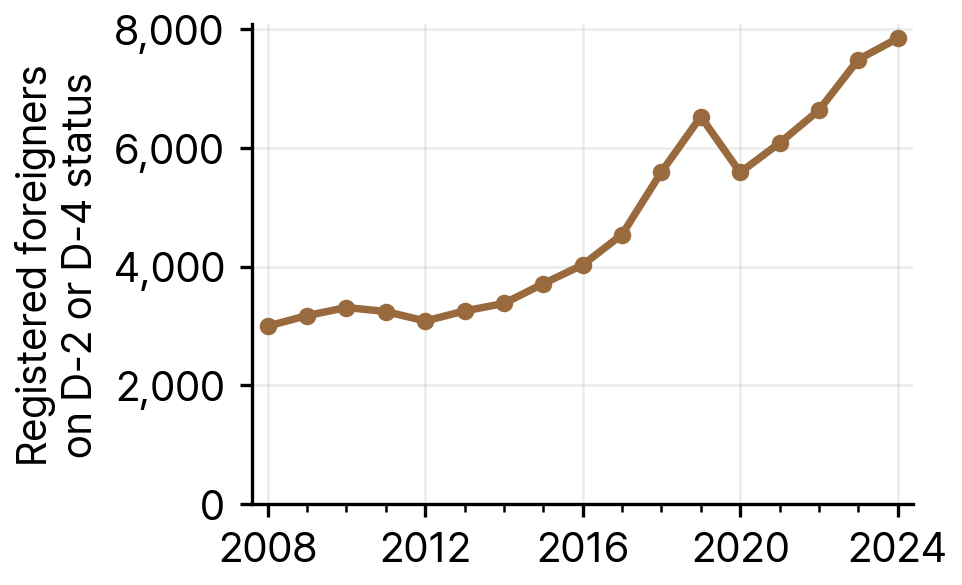
Source: KIRD dataset, from Ministry of Justice immigration yearbooks, 2008-2024.
The Ministry of the Interior and Safety counted 7,430 international students in Gwangju in 2024, 20.7 percent of the 35,882 foreign nationals in its count (7,430 divided by 35,882). A newspaper report of the ministry's count put Gwangju's international students at 7,199 in November 2023. As of November 2023, the universities with the most international students were Honam University (1,293), Chonnam National University (884, excluding its Yeosu campus and graduate students), Gwangju Women's University (714), Songwon University (554), Gwangju University (462) and Chosun University (290) (Namdo Ilbo, 2024b).
Education statistics for 1 April 2024 counted 1,753 international students at Honam University, of whom 1,474 (84.1 percent) were Chinese nationals (SBS News, 2026).
The city cites 6,339 international students enrolled in its higher education institutions in 2024 as the baseline for its plan to raise the number to 12,000 by 2029 (Korea.net, 2025). The counts in this section differ in scope. The city's figure covers students enrolled in higher education, the Ministry of the Interior and Safety figure covers international students among foreign residents, and the KIRD series covers all registered foreigners on D-2 or D-4 status. The city's measures for international students are described under Provincial Policy.
Provincial Policy
Gwangju's basic ordinance on foreign residents, the Gwangju Metropolitan City Ordinance on Support for Foreign Residents, was enacted on 28 September 2020. Its stated purpose is to improve foreign residents' living conditions, protect their human rights and contribute to social integration (U-LEX, 2020).
In July 2023 the city created a Foreign Resident Affairs Division (외국인주민과), which it describes as the first dedicated department of its kind among Korea's special and metropolitan cities (Kyunghyang Shinmun, 2024). Gwangsan-gu had created its own Foreign Resident Affairs Division, the first among Gwangju's five districts, by upgrading its multicultural team with effect from 31 December 2022. At the time, 54 percent of Gwangju's foreign residents, about 22,859 people as of 2021, lived in Gwangsan-gu (Namdo Ilbo, 2022).
The Gwangju Foreign Resident Support Center opened on 14 April 2024 near the Hanam industrial park in Gwangsan-gu, in the facility of the former Gwangju foreign workers' support center. The Gwangju International Center, chosen in a public competition in March 2024, operates it through 2026. It offers interpretation, residence and labor counseling and Korean-language education to international students, marriage migrants and overseas Koreans in addition to foreign workers, the group the earlier center served (Kyunghyang Shinmun, 2024).
Under the Ministry of Justice's 2025 pilot of metropolitan-type visas (gwangyeokhyeong bija), Gwangju was one of 10 provincial-level governments that submitted business plans for a customized student visa (D-2) scheme tied to designated priority fields of study. The others were Seoul, Busan, Incheon, Gangwon State, North Chungcheong Province, South Chungcheong Province, Jeonbuk State, South Jeolla Province and Jeju (MRTC, 2025).
In 2025 the city submitted to the city council a draft International Student Support Ordinance, which would be the city's first legal basis for attracting international students and helping them remain in the region, in response to regional population decline and the crisis of local universities. The legislative notice period was 9 to 29 September 2025, and the city expected the council to approve the ordinance by December 2025. The city's targets are 12,000 international students and a local settlement rate of 10 percent by 2029, up from under 5 percent, with 51.25 billion won for 2025 and 2026 (42.97 billion won in national funds and 8.28 billion won in city funds) (Local Newspapers Association of Korea, 2025).
An integrated support plan for international students for 2025 to 2029 commits 25.85 billion won to regionally customized recruitment, talent development and student-life support, and support for employment, startups and settlement. It includes a Gwangju Global Hub Center and overseas study fairs organized jointly with local universities (Korea.net, 2025). National measures that apply to Dong-gu as a population-decline area of interest are described under Districts and Population-Decline Areas.
Languages
The KIRD dataset estimates first-language speakers among registered foreigners from nationality counts and Ethnologue first-language shares. By this estimate, Vietnamese was the most common first language among Gwangju's registered foreigners in 2024, with 6,744 speakers. Chinese (3,777), Khmer (1,800), Uzbek (1,481) and Russian (1,339) followed, and these five were the only languages with 1,000 or more estimated speakers (Table 5). Kazakh (883), Tagalog or Filipino (797), Mongolian (636), Thai (586) and Burmese (495) completed the ten most common.
Table 5Ten Most Common Estimated First Languages among Registered Foreigners in Gwangju, 2024
| Language | Estimated speakers |
|---|---|
| Vietnamese | 6,744 |
| Chinese | 3,777 |
| Khmer | 1,800 |
| Uzbek | 1,481 |
| Russian | 1,339 |
| Kazakh | 883 |
| Tagalog/Filipino | 797 |
| Mongolian | 636 |
| Thai | 586 |
| Burmese | 495 |
Note: Speakers are estimated by applying Ethnologue first-language shares to the number of registered foreigners of each nationality.
Source: KIRD dataset, from Ministry of Justice immigration yearbooks and Ethnologue first-language shares, 2024.
Service Organizations and Community Places
The KIRD census of 1,720 migrant-serving organizations in South Korea lists 109 in Gwangju, 41.0 per 10,000 registered foreigners in 2024, against 11.6 per 10,000 nationally. Of the 109, 103 provide direct services. The most common types are medical providers (27), program sites (18), nongovernmental organizations (18), community organizations (14) and worker centers (11). Five of the 109, identified by name, are family centers (gajok senteo).
By population served, 44 organizations serve workers, 27 families, 14 refugees, 9 women, 8 all migrants, 8 overseas Korean (diaspora) communities, 7 children and 6 undocumented migrants, and 4 each serve students and youth. An organization can serve more than one population, so these counts sum to 131.
According to the Ministry of Justice, 4,762 Koryoin lived in Wolgok 1-dong and 2-dong in Gwangsan-gu in June 2024, 176 times the 27 recorded in 2008, and their number is estimated at about 7,000 when undocumented residents are included (Namdo Ilbo, 2024c).
The area, known as the Koryoin Village, is the subject of a "history and culture village number one" (yeoksa munhwa maeul 1beonji) project that presents Koryoin history, life and culture (Namdo Ilbo, 2022). The Digital Encyclopedia of Gwangju Culture describes it as a representative place where Koryoin lead a communal life. It lists a support center opened in 2005 that grew into an integrated support center, a kindergarten opened in 2012, a Koryoin FM radio station launched in 2016 as the first of its kind in the country, and a Koryoin history museum that received a presidential award for its record-keeping in 2020 (Jang, 2020).
In Wolgok 2-dong, near the village, the Darasil Merchants' Association (달아실상인회) had grown from 23 founding members to 68 merchants by 2026, a mix of long-established businesses and businesses operated by immigrants that includes restaurants, a bakery and an art gallery, under an initiative to create jobs for Koryoin who moved to Gwangju (News Portal 1, 2026).
Sources
Korea Immigration Regional Dashboard (KIRD) dataset, compiled from Ministry of Justice immigration yearbooks and Ministry of the Interior and Safety statistics, 2006-2024. openICPSR. https://doi.org/10.3886/E249944V1
Kyunghyang Shinmun. 2024. Gwangju Foreign Resident Support Center opens on 14 April to help foreign residents build stable lives (in Korean). https://www.khan.co.kr/article/202404091326001
Asia Economy. 2025. Eighteen population-decline areas of interest designated, including Dongducheon, Gyeongju and Iksan (in Korean). https://v.daum.net/v/20251230120242189
Edaily. 2025. Ministry of Justice expands the placement of foreign nationals in depopulating areas through the regional specialized visa (in Korean). https://edaily.co.kr/News/Read?mediaCodeNo=257&newsId=03329206642072488
Mudeung Ilbo. 2025. Jeonnam and Gwangju population 3.21 million last year, with Gwangju alone losing 12,000 (in Korean). https://m.mdilbo.com/detail/c3QycN/757503
Siminsori. 2025. As Gwangju falls below 1.4 million, young people in their 20s and 30s are also leaving (in Korean). http://www.siminsori.com/news/articleView.html?idxno=292740
Namdo Ilbo. 2025a. Gwangju has the highest net population outflow in the country for the second year in a row (in Korean). https://www.namdonews.com/news/articleView.html?idxno=810222
Namdo Ilbo. 2025b. Gwangju Dong-gu has the highest total fertility rate of the city's five districts (in Korean). https://www.namdonews.com/news/articleView.html?idxno=811192
Gwangju Maeil Shinmun. 2025. Gwangju population projected to drop into the 1.2 million range by 2050 (in Korean), via Daum. https://v.daum.net/v/20251207195949092
Ministry of Employment and Labor. 2026. E-9 foreign workers under the general Employment Permit System by province and industry, quarterly (in Korean). KOSIS table DT_11827_A003. https://kosis.kr/statHtml/statHtml.do?orgId=118&tblId=DT_11827_A003&conn_path=I2
Namdo Ilbo. 2024a. Gwangju and Jeonnam foreign resident report, part 6: Foreign workers leaving Gwangju (in Korean). https://www.namdonews.com/news/articleView.html?idxno=800450
Namdo Ilbo. 2024b. Gwangju and Jeonnam foreign resident report, part 5: Regional universities compete to recruit international students (in Korean). https://www.namdonews.com/news/articleView.html?idxno=800248
SBS News. 2026. Investigation into false academic records of Chinese students; Chinese students make up 84 percent of international students at Honam University (in Korean). https://news.sbs.co.kr/news/endPage.do?news_id=N1008504301
Korea.net (Korean Culture and Information Service). 2025. Gwangju plans for 12,000 international students (in Korean). https://www.korean-culture.org/koreanet/view.do?seq=1051512
U-LEX. 2020. Gwangju Metropolitan City Ordinance on Support for Foreign Residents (광주광역시 외국인주민 지원 조례), enacted 28 September 2020 (in Korean). https://www.ulex.co.kr/%EB%B2%95%EB%A5%A0/1799499-2201386-%EA%B4%91%EC%A3%BC%EA%B4%91%EC%97%AD%EC%8B%9C%EC%99%B8%EA%B5%AD%EC%9D%B8%EC%A3%BC
Namdo Ilbo. 2022. Large Koryoin community in Gwangju's Gwangsan-gu; district creates a Foreign Resident Affairs Division (in Korean). https://www.namdonews.com/news/articleView.html?idxno=702896
Migration Research and Training Centre (MRTC). 2025. Metropolitan-type visa pilot project for national competitiveness and regional economies, reproducing Ministry of Justice materials (in Korean). https://www.mrtc.re.kr/community/05.php?admin_mode=read&no=27807&make=title&search=&type=&apply_no=&table_name=trend03_1
Local Newspapers Association of Korea. 2025. Gwangju legislates support for international students for the first time, citing Gwangju Ilbo (in Korean). https://lpk.kr/news/article.html?no=50297
Namdo Ilbo. 2024c. Gwangju Koryoin Village becomes a national model: how the community took root (in Korean). https://www.namdonews.com/news/articleView.html?idxno=800894
Jang, Mun-hyeon (장문현). 2020. Koryoin Village (고려인 마을). In Digital Encyclopedia of Gwangju Culture, Gwangsan-gu (디지털광주문화대전 광산구). Academy of Korean Studies. https://gwangju.grandculture.net/gwangju/gwangsangu/toc/GC60000569
News Portal 1 (Korea Citizen Reporters Association). 2026. Darasil Merchants' Association plans a shared tourism district on the Koryoin Village street (in Korean). http://www.civilreporter.co.kr/news/articleView.html?idxno=542802
Suggested citation: Korea Immigration Regional Dashboard (KIRD). 2026. “Foreign Residents in Gwangju.” Foreign Residents in South Korea series, September 2026. Data: Korea Immigration Regional Dashboard (KIRD) dataset, https://doi.org/10.3886/E249944V1. Interactive maps and tables: https://immigrantsinkorea.today.