 Korea Immigration Regional Dashboard
SpotlightSeptember 2026Province profilesDownload PDF
Foreign Residents in Daejeon
Highlights
- Daejeon had 26,249 registered foreigners at the end of 2024, 15th among the 17 provinces and metropolitan cities, after an increase of 37.4 percent from 2019 that was the third-fastest among them, while the city's Korean population fell 2.4 percent.
- Students, trainees and job seekers on D-2, D-4 and D-10 status made up 54.8 percent of Daejeon's registered foreigners in 2024, against 18.6 percent nationally, and the city was home to 5.4 percent of all D-2 and D-4 holders in South Korea, three times its 1.8 percent share of all registered foreigners.
- Vietnamese nationals were 37.3 percent of Daejeon's registered foreigners in 2024, and their number rose from 4,182 in 2019 to 9,794, an increase equal to 78.6 percent of the city's net gain of 7,140 registered foreigners over the period.
At the end of 2024, 26,249 registered foreigners lived in Daejeon, 1.8 percent of the 1,488,353 in South Korea. Daejeon ranked 15th among the 17 provinces and metropolitan cities by this count and 13th by registered foreigners per Korean resident, with 1.8 registered foreigners per 100 Korean residents against 2.9 nationally. The Ministry of the Interior and Safety (MOIS) counted 42,043 foreign residents in the city in 2024, a count that also includes naturalized citizens and the children of foreign residents.
The registered foreign population grew from 9,804 in 2006 to 26,249 in 2024, an increase of 167.7 percent, while the number of Korean residents fell 1.8 percent, to 1,439,157. More than half of the increase (8,957 of 16,445) came between 2021 and 2024, after the count had dropped from 19,109 in 2019 to 16,895 in 2020. Between 2019 and 2024, registered foreigners increased 37.4 percent, the third-fastest growth among the 17 provinces, and the gain of 7,140 equaled 20.0 percent of the city's loss of 35,713 Korean residents.
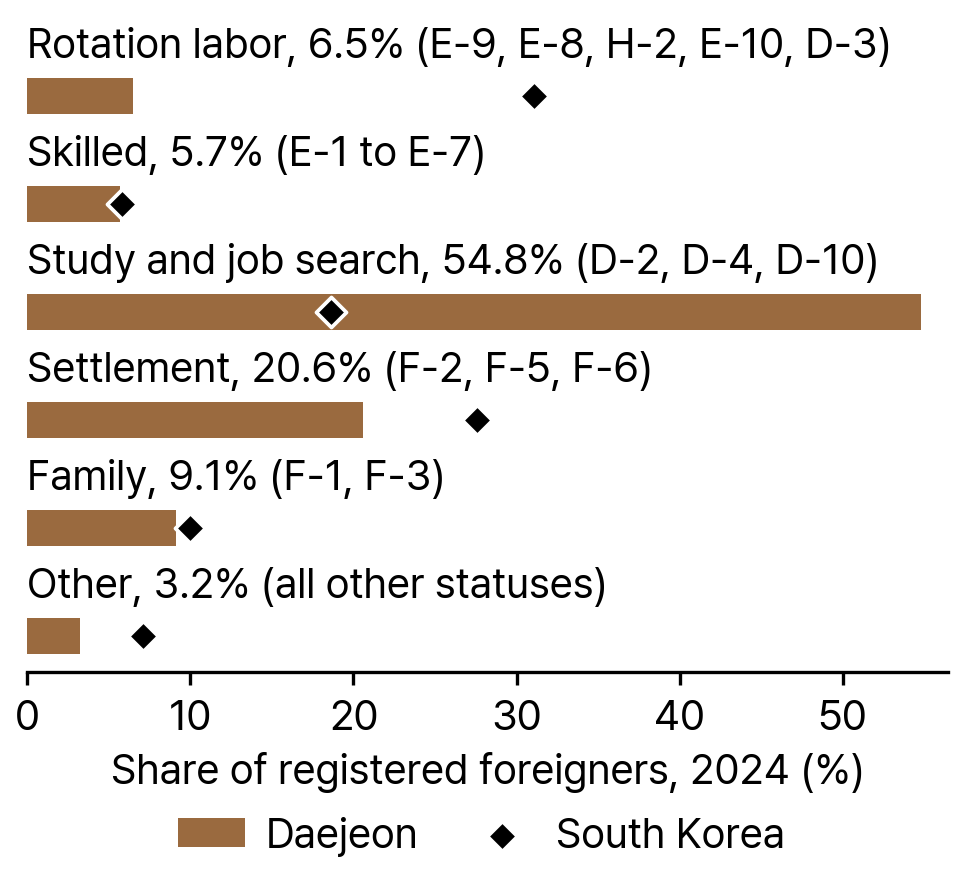
In 2024, D-2 students, D-4 general trainees and D-10 job seekers made up 54.8 percent of Daejeon's registered foreigners, against 18.6 percent nationally, and rotation labor statuses such as E-9 covered 6.5 percent, against 31.1 percent nationally. Higher-education institutions with main campuses in Daejeon enrolled 11,950 international students as of 1 April 2024 KEDI, 2024. Vietnamese nationals were the largest group of registered foreigners, at 37.3 percent. The KIRD census of migrant-serving organizations counts 64 in Daejeon, 24.4 per 10,000 registered foreigners in 2024, about twice the national rate of 11.6. None of the city's five districts is a population-decline area, and three are among the 18 areas of interest designated in 2021.
Size of the Foreign-Resident Population
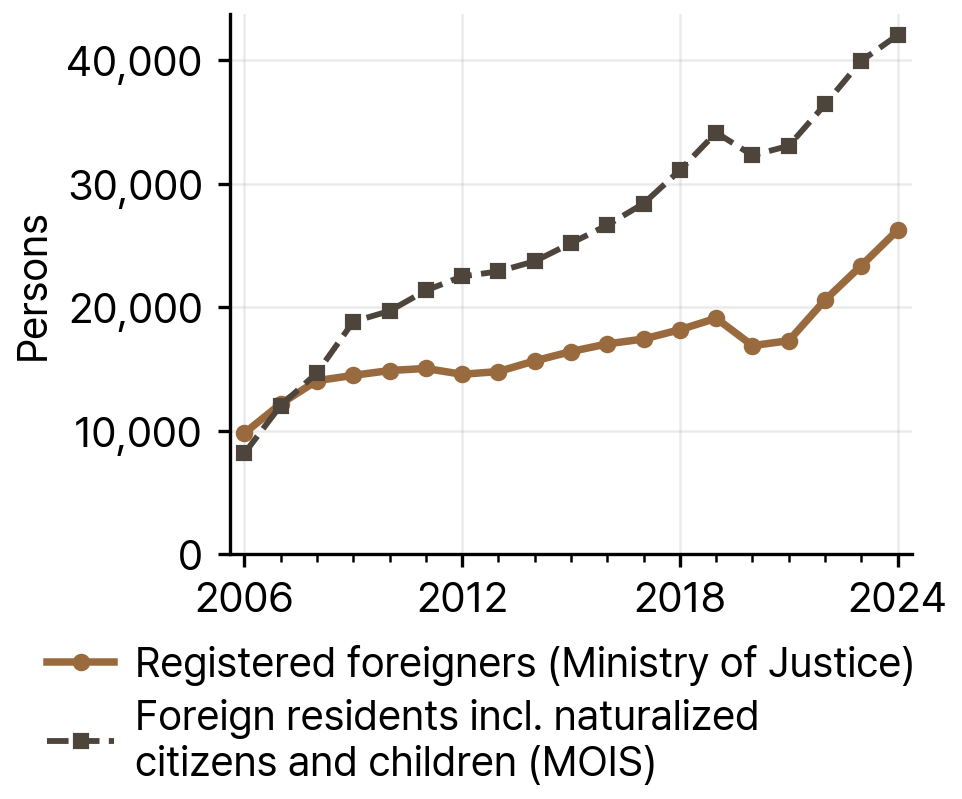
The Ministry of Justice counted 26,249 registered foreigners in Daejeon on 31 December 2024, up from 9,804 in 2006, 15,658 in 2014 and 19,109 in 2019 (Figure 1). The count fell 11.6 percent between 2019 and 2020, to 16,895, and rose in each year after 2020. The increase from 2021 (17,292) to 2024 was 8,957 people, or 51.8 percent.
The MOIS count of foreign residents, which adds naturalized citizens and the children of foreign residents, grew from 14,682 in 2008 to 23,729 in 2014, 34,148 in 2019 and 42,043 in 2024. It was larger than the registered count in every year from 2008 to 2024, and in 2024 it was 1.6 times the registered count (42,043 against 26,249).
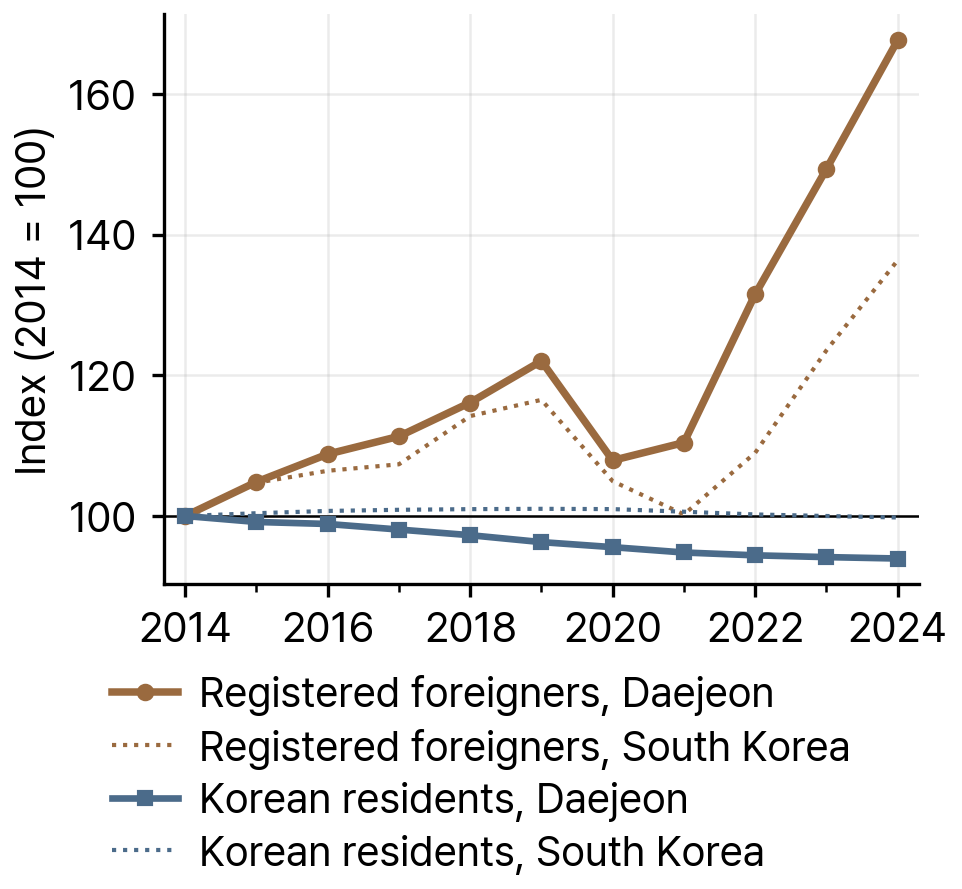
The number of Korean residents of Daejeon peaked at 1,532,811 in 2013 and declined in every year from 2014 to 2024, to 1,439,157 (Figure 2). Between 2014 and 2024 it fell 6.0 percent (92,652 people), while registered foreigners grew 67.6 percent (10,591 people). Between 2019 and 2024, registered foreigners grew 37.4 percent, the third-fastest growth among the 17 provinces, and Korean residents fell 2.4 percent. The gain of 7,140 registered foreigners equaled 20.0 percent of the loss of 35,713 Korean residents.
Daejeon had 0.7 registered foreigners per 100 Korean residents in 2006, 1.0 in 2014, 1.3 in 2019 and 1.8 in 2024 (Table 1). In 2024 it ranked 15th among the 17 provinces by the number of registered foreigners and 13th by registered foreigners per Korean resident. The national figure in 2024 was 2.9 per 100 Korean residents, and Daejeon's share of South Korea's 1,488,353 registered foreigners was 1.8 percent.
Source: KIRD dataset, from Ministry of Justice immigration yearbooks and Ministry of the Interior and Safety statistics, 2006-2024.
Source: KIRD dataset, from Ministry of Justice immigration yearbooks and Ministry of the Interior and Safety resident registration statistics, 2014-2024.
Table 1Registered Foreigners, MOIS Foreign Residents and Korean Residents in Daejeon, Selected Years, 2006-24
| Year | Registered foreigners | MOIS foreign residents | Korean residents | Registered foreigners per 100 Korean residents |
|---|---|---|---|---|
| 2006 | 9,804 | n/a | 1,466,158 | 0.7 |
| 2014 | 15,658 | 23,729 | 1,531,809 | 1.0 |
| 2019 | 19,109 | 34,148 | 1,474,870 | 1.3 |
| 2024 | 26,249 | 42,043 | 1,439,157 | 1.8 |
Note: n/a = not shown. MOIS counts appear in the table from 2008. The MOIS counts for 2006 (8,167) and 2007 (12,044), plotted in Figure 1, were below the registered counts for those years (9,804 and 12,177) although the MOIS definition is broader. For South Korea as a whole in 2024, there were 1,488,353 registered foreigners, 51,217,221 Korean residents and 2.9 registered foreigners per 100 Korean residents.
Source: KIRD dataset, from Ministry of Justice immigration yearbooks and Ministry of the Interior and Safety statistics, 2006-2024.
Nationalities
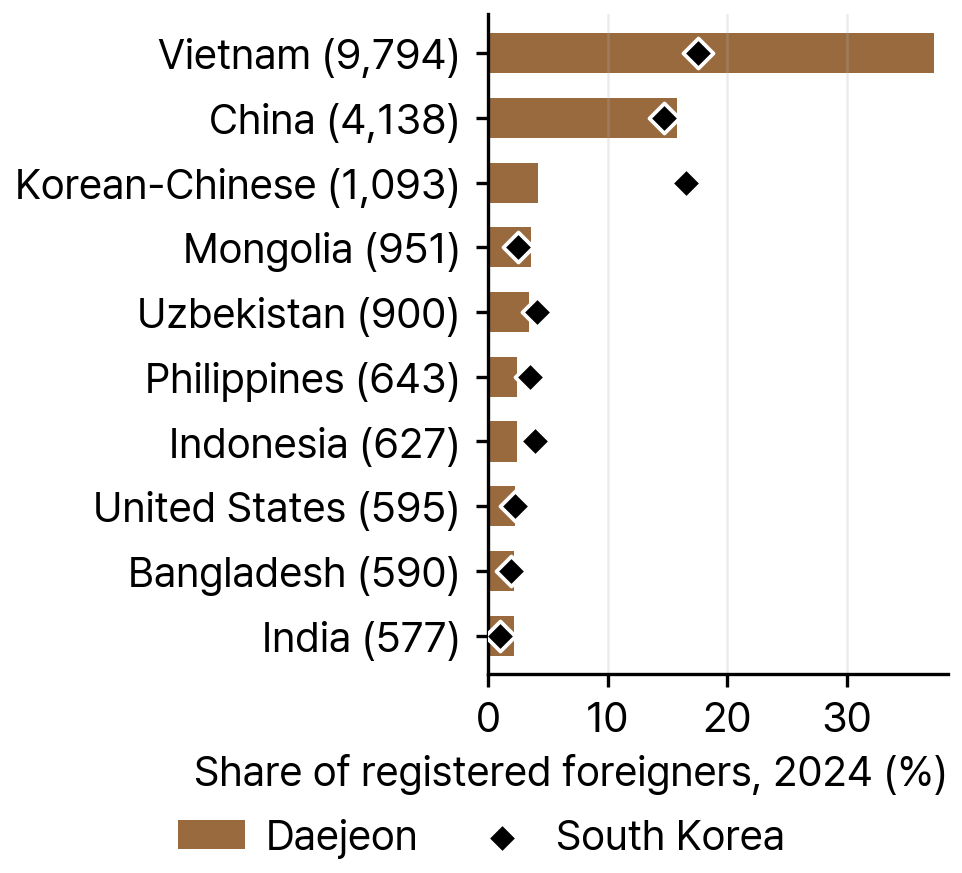
Vietnam was the largest nationality among Daejeon's registered foreigners in 2024, with 9,794 people (37.3 percent), followed by China (4,138; 15.8 percent), Korean-Chinese (1,093; 4.2 percent), Mongolia (951; 3.6 percent) and Uzbekistan (900; 3.4 percent) (Figure 3 and Table 2). The ten largest nationalities made up 75.8 percent of the total (19,908 people). The Vietnamese share was about twice the national share of 17.6 percent in 2024, and the Korean-Chinese share was about a quarter of the national share of 16.6 percent.
Between 2019 and 2024 the number of Vietnamese nationals rose from 4,182 to 9,794. The increase of 5,612 equaled 78.6 percent of the city's net gain of 7,140 registered foreigners. In 2019 China had more registered foreigners in Daejeon than Vietnam (5,446 against 4,182), and by 2024 the Chinese count had fallen by 1,308, to 4,138. The Korean-Chinese count fell from 1,382 to 1,093 over the same years and the United States count from 714 to 595. Mongolia (469 to 951), Bangladesh (242 to 590) and Indonesia (348 to 627) grew faster than the city total.
Daejeon had 1.8 percent of South Korea's registered foreigners in 2024 and larger shares of several national groups: 7.5 percent of Ethiopians (108 of 1,445), 5.1 percent of Ghanaians (63 of 1,224), 4.4 percent of South Africans (202 of 4,641), 3.9 percent of Indians (577 of 14,762) and 3.7 percent of Vietnamese (9,794 of 261,581).
The KIRD data record 141 nationalities among Daejeon's registered foreigners in 2024. The Shannon diversity index was 2.2 in both 2014 and 2024 at one decimal place, and in 2024 it was 15th of the 17 provinces, counting from the most diverse.
Overseas Koreans on F-4 status report their residence instead of registering, so they are not among the registered foreigners counted above. In 2024, 3,380 of them reported a residence in Daejeon, 0.6 percent of the 553,664 nationwide. Korean-Chinese made up 1,791 of the 3,380, followed by nationals of the United States (899), Canada (309) and Australia (107), and by Korean-Russians (63).
Source: KIRD dataset, from Ministry of Justice immigration yearbooks, 2024.
Table 2Ten Largest Nationalities among Registered Foreigners in Daejeon, 2019 and 2024
| Nationality | 2019 | 2024 | Share of Daejeon's registered foreigners, 2024 (%) | Daejeon's share of this nationality in South Korea, 2024 (%) |
|---|---|---|---|---|
| Vietnam | 4,182 | 9,794 | 37.3 | 3.7 |
| China | 5,446 | 4,138 | 15.8 | 1.9 |
| Korean-Chinese | 1,382 | 1,093 | 4.2 | 0.4 |
| Mongolia | 469 | 951 | 3.6 | 2.5 |
| Uzbekistan | 793 | 900 | 3.4 | 1.5 |
| Philippines | 661 | 643 | 2.4 | 1.2 |
| Indonesia | 348 | 627 | 2.4 | 1.1 |
| United States | 714 | 595 | 2.3 | 1.7 |
| Bangladesh | 242 | 590 | 2.2 | 2.1 |
| India | 404 | 577 | 2.2 | 3.9 |
Note: Korean-Chinese (Chinese nationals of Korean ethnicity) are counted separately from other Chinese nationals. Shares of Daejeon's registered foreigners use the 2024 total of 26,249. Daejeon's share of all registered foreigners in South Korea was 1.8 percent in 2024.
Source: KIRD dataset, from Ministry of Justice immigration yearbooks, 2019 and 2024.
Residence Statuses
Study and job-search statuses (D-2, D-4 and D-10) covered 14,378 of Daejeon's registered foreigners in 2024, 54.8 percent of the total, against 18.6 percent in South Korea as a whole (Figure 4). Settlement statuses (F-2, F-5 and F-6) covered 20.6 percent (27.6 percent nationally), family statuses (F-1 and F-3) 9.1 percent (10.0 percent), rotation labor 6.5 percent (31.1 percent), skilled statuses (E-1 to E-7) 5.7 percent (5.8 percent) and all other statuses 3.2 percent (7.1 percent).
D-2 student status was the most common in 2024, with 9,302 holders (35.4 percent of registered foreigners), followed by D-4 general trainees (4,501; 17.1 percent) and F-6 marriage migrants (2,985; 11.4 percent) (Table 3). In 2024 Daejeon had 5.2 percent of all D-2 holders and 5.6 percent of all D-4 holders in South Korea, about three times its 1.8 percent share of registered foreigners, and 3.2 percent of D-10 job seekers. Its 1,260 E-9 workers were 0.4 percent of the national total, and its 1,633 permanent residents (F-5) were 0.8 percent.
In the MOIS count for 2024, Daejeon's 42,043 foreign residents consisted of 31,322 foreign nationals, 3,911 naturalized citizens and 6,810 children of foreign residents. The foreign nationals comprised 12,605 students, 3,593 marriage migrants, 2,895 workers, 2,098 ethnic Koreans of foreign nationality and 10,131 other foreign nationals. Students made up 30.0 percent of the MOIS total and workers 6.9 percent.
Source: KIRD dataset, from Ministry of Justice immigration yearbooks, 2024.
Table 3Ten Most Common Residence Statuses among Registered Foreigners in Daejeon, 2024
| Status | Meaning | Registered foreigners | Share of Daejeon's registered foreigners (%) | Daejeon's share of all holders in South Korea (%) |
|---|---|---|---|---|
| D-2 | Student | 9,302 | 35.4 | 5.2 |
| D-4 | General trainee | 4,501 | 17.1 | 5.6 |
| F-6 | Marriage migration | 2,985 | 11.4 | 2.0 |
| F-5 | Permanent residence | 1,633 | 6.2 | 0.8 |
| F-1 | Visiting cohabitation | 1,382 | 5.3 | 1.4 |
| E-9 | Non-professional employment | 1,260 | 4.8 | 0.4 |
| F-3 | Dependent family | 1,014 | 3.9 | 2.0 |
| F-2 | Residential | 794 | 3.0 | 1.3 |
| G-1 | Other (miscellaneous) | 624 | 2.4 | 1.1 |
| D-10 | Job seeker | 575 | 2.2 | 3.2 |
Note: Shares of Daejeon's registered foreigners use the 2024 total of 26,249. Daejeon's share of all registered foreigners in South Korea was 1.8 percent in 2024. F-4 overseas Koreans report their residence and are not included.
Source: KIRD dataset, from Ministry of Justice immigration yearbooks, 2024.
Districts and Population-Decline Areas
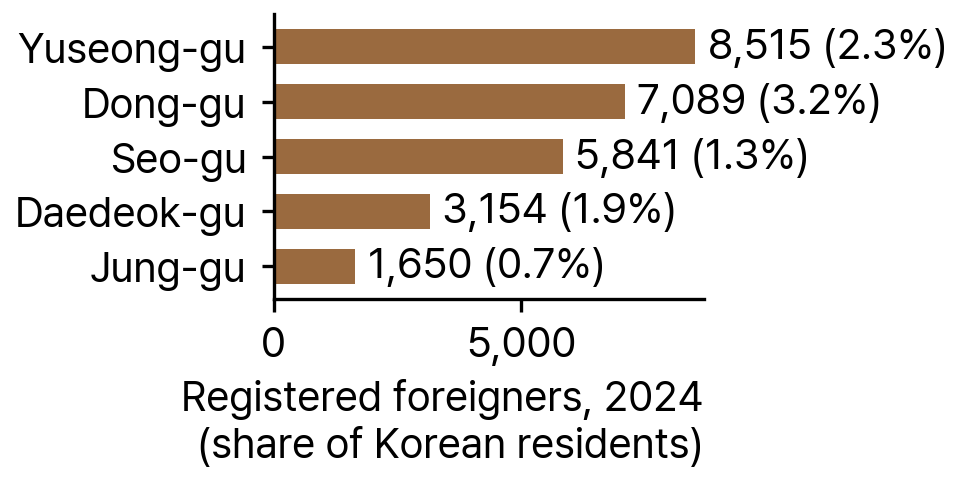
Daejeon has five districts (gu). In 2024 Yuseong-gu had the most registered foreigners (8,515, or 32.4 percent of the city total), followed by Dong-gu (7,089; 27.0 percent), Seo-gu (5,841), Daedeok-gu (3,154) and Jung-gu (1,650) (Figure 5 and Table 4). Relative to the Korean population, Dong-gu had the most registered foreigners in 2024, 3.2 per 100 Korean residents, and Jung-gu the fewest, 0.7.
Between 2019 and 2024 the number of registered foreigners rose in all five districts, most in Yuseong-gu (by 2,372) and Seo-gu (by 2,037). In Seo-gu the count grew 53.5 percent, from 3,804 to 5,841. Yuseong-gu was the only district where the number of Korean residents grew over those years, by 20,095, and Seo-gu lost the most Korean residents (23,271).
None of Daejeon's districts is among the 89 population-decline areas designated by the Ministry of the Interior and Safety in October 2021. Dong-gu, Jung-gu and Daedeok-gu are among the 18 areas of interest designated at the same time. Between 2019 and 2024 these districts together lost 32,537 Korean residents (8,258 in Dong-gu, 15,465 in Jung-gu and 8,814 in Daedeok-gu) and gained 2,731 registered foreigners (1,848, 117 and 766). The foreign gain equaled 8.4 percent of the Korean loss, against 20.0 percent for the city as a whole (7,140 of 35,713). The ratio was 22.4 percent in Dong-gu, 8.7 percent in Daedeok-gu and 0.8 percent in Jung-gu.
By the definition used in this Spotlight, Dong-gu was a Vietnamese enclave in 2024. Its 2,566 Vietnamese residents made up 36.2 percent of the district's registered foreigners, with a location quotient of 2.3. No other district in Daejeon met the definition in 2024.
Source: KIRD dataset, from Ministry of Justice immigration yearbooks and Ministry of the Interior and Safety resident registration statistics, 2024.
Table 4Registered Foreigners and Korean Residents by District in Daejeon, 2019-24
| District | Registered foreigners, 2024 | Per 100 Korean residents, 2024 | Change in Korean residents, 2019-24 | Change in registered foreigners, 2019-24 | Population-decline area | Area of interest |
|---|---|---|---|---|---|---|
| Yuseong-gu | 8,515 | 2.3 | +20,095 | +2,372 | No | No |
| Dong-gu | 7,089 | 3.2 | -8,258 | +1,848 | No | Yes |
| Seo-gu | 5,841 | 1.3 | -23,271 | +2,037 | No | No |
| Daedeok-gu | 3,154 | 1.9 | -8,814 | +766 | No | Yes |
| Jung-gu | 1,650 | 0.7 | -15,465 | +117 | No | Yes |
| Daejeon | 26,249 | 1.8 | -35,713 | +7,140 |
Note: Population-decline areas and areas of interest are the Ministry of the Interior and Safety designations of October 2021.
Source: KIRD dataset, from Ministry of Justice immigration yearbooks and Ministry of the Interior and Safety statistics, 2019-2024.
Population Trends
The number of Korean residents of Daejeon fell 1.8 percent between 2006 and 2024 (27,001 people), 6.0 percent between 2014 and 2024 (92,652 people) and 2.4 percent between 2019 and 2024 (35,713 people). Over the same three periods the number of registered foreigners grew by 16,445, 10,591 and 7,140.
Daejeon's population rose to 1,440,729 at the end of 2025, 1,572 more than the 1,439,157 at the end of 2024, ending a decline that had continued since 2013 Chungcheong Times, 2026. The report's figure for the end of 2024 matches the count of Korean residents used in this Spotlight.
In 2025, 80,173 people moved to Daejeon from other regions of Korea and 77,339 moved out, a net inflow of 2,834. People in their 20s and 30s made up about 60 percent of those who moved in, and the most common reasons for the move were work or business (36.9 percent), marriage or a change of household (24.8 percent), education (16 percent) and housing (12.5 percent) Chungcheong Times, 2026.
Daejeon's total fertility rate rose from 0.81 births per woman in 2021 to 0.84 in 2022, when it was the only region of South Korea where the rate increased, and fell to 0.79 in 2023 Daejeon Ilbo, 2024.
At the end of 2022, 232,663 residents were aged 65 or older, 16.1 percent of the city's 1,446,072 residents, up from 14.4 percent in 2020 and 15.2 percent in 2021 Chungnam Ilbo, 2023.
Industry and Foreign Workers
In 2022, 9,201 foreign residents of Daejeon were in employment, 16th of the 17 provinces by that number Chungnam Ilbo, 2024. The same 2024 report put the average annual total income of employed foreign residents in Daejeon at 31,982,362 won, the highest among the 17 provinces after Seoul.
Rotation labor statuses covered 1,708 of Daejeon's registered foreigners in 2024 (6.5 percent, against 31.1 percent nationally). Holders of the E-9 non-professional employment status, issued under the Employment Permit System, numbered 806 in 2014, 937 in 2019, 725 in 2021 and 1,260 in 2024. In 2024 they made up 73.8 percent of the rotation labor group in Daejeon and 0.4 percent of all E-9 holders in South Korea.
The Ministry of Justice counts E-8 seasonal workers on 31 December, and most seasonal contracts end before winter, so the year-end count misses most seasonal workers. Daejeon had 4 E-8 holders at the end of 2023 and 9 at the end of 2024.
Skilled statuses (E-1 to E-7) covered 1,503 registered foreigners in Daejeon in 2024, 5.7 percent of the total, close to the national 5.8 percent. In a 2026 recruitment round for foreign skilled workers on E-7-3 status in automobile body repair and painting, Daejeon was allocated 9 of the 330 places distributed nationwide Early Adopter News, 2026.
International Students and Universities
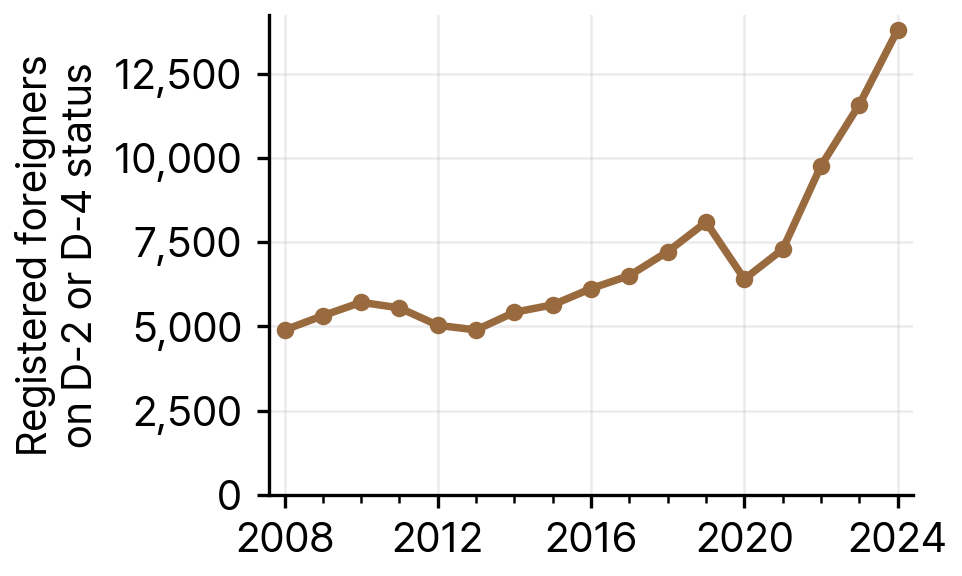
Registered foreigners on D-2 student or D-4 general trainee status in Daejeon numbered 4,894 in 2008, 5,422 in 2014 and 8,098 in 2019 (Figure 6). The count fell to 6,408 in 2020, then rose each year to 13,803 in 2024, 70.4 percent above the 2019 level. In 2024 Daejeon had 5.4 percent of all D-2 and D-4 holders in South Korea, three times its 1.8 percent share of all registered foreigners. D-2 students numbered 9,302 and D-4 general trainees 4,501 in 2024, and 575 registered foreigners were D-10 job seekers.
Source: KIRD dataset, from Ministry of Justice immigration yearbooks, 2008-2024.
The Korea Educational Development Institute (KEDI) counts international students by institution and places each institution in the province of its main campus. As of 1 April 2024, higher-education institutions with main campuses in Daejeon enrolled 11,950 international students KEDI, 2024. Woosong University had the most, 2,891, followed by Mokwon University (1,648), Hannam University (1,317), KAIST (1,236) and Chungnam National University (989), all as of 1 April 2024. Together they enrolled 8,081 of the 11,950 (67.6 percent).
The KEDI count differs from the government residence counts in reference date and coverage. The Ministry of Justice counted 13,803 D-2 and D-4 holders living in Daejeon on 31 December 2024, and the MOIS count for 2024 listed 12,605 students among the city's foreign residents.
Provincial Policy
Daejeon's ordinance on support for foreign residents (대전광역시 외국인주민 지원 조례) was fully revised in 2019 (Ordinance No. 5391 of 27 December 2019) and most recently amended in 2024 (Ordinance No. 6356 of 27 December 2024) U-LEX, 2024.
The city opened its Foreign Resident Integrated Support Center (외국인주민 통합지원센터) on 18 February 2021. The city's International Affairs Division oversees the center, and the Daejeon Social Service Agency (대전광역시사회서비스원) operates it under a contract from 1 January 2025 to 31 December 2027 Daejeon Metropolitan City, 2025.
In the Ministry of Justice's 2025 pilot of metropolitan-type visas (광역형 비자), Daejeon was one of six regional governments, with Daegu, Ulsan, Gyeonggi, Gyeongbuk and Gyeongnam, that submitted plans for the E-7 visa for skilled workers in specially designated activities. Ten others (Seoul, Busan, Incheon, Gwangju, Gangwon, Chungbuk, Chungnam, Jeonbuk, Jeonnam and Jeju) submitted plans for the D-2 student visa Migration Research and Training Centre, 2025.
The Ministry of Justice opened a Global Talent Visa Center (글로벌 인재 비자 센터) inside KAIST in Daedeok Innopolis (대덕연구개발특구), with an opening ceremony on 23 December 2021. The ministry described its aims as resolving immigration complaints of foreign residents of the Daedeok research zone and recruiting more skilled foreign talent Ministry of Justice, 2021.
Dong-gu, Jung-gu and Daedeok-gu are among the 18 population-decline areas of interest (인구감소 관심지역). Of the regional visas, a list of the designated areas published by Jobploy, a job portal for foreign workers, ties only the E-7-4R regionally specialized skilled-worker visa to the areas of interest Jobploy, 2025.
Languages
The KIRD dataset estimates the first languages of registered foreigners by splitting each nationality's count across the first languages of its country, using Ethnologue first-language shares. Korean is excluded, so the 1,093 Korean-Chinese registered foreigners in Daejeon in 2024 add no speakers to the estimates.
By this estimate, 8,369 registered foreigners in Daejeon in 2024 spoke Vietnamese as a first language and 4,367 spoke Chinese (Table 5). These were the only two languages with 1,000 or more estimated speakers in 2024. Mongolian (831), English (774), Uzbek (700), Russian (634), Tagalog/Filipino (569), Bengali (529), Khmer (518) and Japanese (467) followed. The Vietnamese estimate equals 85.5 percent of the 9,794 Vietnamese nationals, because the method assigns part of each national group to the other first languages of its country.
Table 5Estimated First-Language Speakers among Registered Foreigners in Daejeon, Ten Largest Languages, 2024
| Language | Estimated speakers |
|---|---|
| Vietnamese | 8,369 |
| Chinese | 4,367 |
| Mongolian | 831 |
| English | 774 |
| Uzbek | 700 |
| Russian | 634 |
| Tagalog/Filipino | 569 |
| Bengali | 529 |
| Khmer | 518 |
| Japanese | 467 |
Note: Estimates split each nationality's count by Ethnologue first-language shares for its country and exclude Korean.
Source: KIRD dataset, language estimates from Ministry of Justice nationality counts and Ethnologue first-language shares, 2024.
Service Organizations and Community Places
The KIRD census of 1,720 migrant-serving organizations in South Korea counts 64 in Daejeon, 3.7 percent of the national total. That equals 24.4 organizations per 10,000 registered foreigners in 2024, about twice the national rate of 11.6. Of the 64, 62 provide direct services to migrants.
The most common types in Daejeon were foreign resident support centers (15), providers of the Social Integration Program and early adaptation programs (14) and medical support institutions (13). The census also lists 4 family centers, 4 civic and faith-based support organizations, 3 migrant community organizations, 2 migrant places of worship and 2 research and policy institutes, along with 7 organizations of other types, among them a migrant worker support center, an international student support center and a shelter.
An organization can name more than one group it serves. In Daejeon, 21 organizations name migrant workers, 14 families, 13 all foreign residents, 8 undocumented migrants, 7 women, 6 children, 5 refugees and 4 students.
The city government lists a multicultural family support center in each of its five districts, Dong-gu, Jung-gu, Seo-gu, Yuseong-gu and Daedeok-gu Daejeon Metropolitan City, 2026. The KIRD census includes 4 family centers in Daejeon.
Daejeon's mosque, the Islamic Center of Daejeon, is in Gung-dong, Yuseong-gu (Daejeon Mosque, n.d.).
Daejeon has hosted an annual soccer tournament for Vietnamese international students since 2009. The 12th tournament, in 2023, resumed after a four-year break during the COVID-19 pandemic and drew about 1,000 Vietnamese students from Seoul, Busan, Gwangju, Ulsan and other parts of the country TJB, 2023.
Sources
KIRD dataset (Korea Immigration Regional Dashboard). Spatiotemporal administrative dataset of nationality, residential diversity, and language demand among immigrants in South Korea, 2006-2024. openICPSR. https://doi.org/10.3886/E249944V1
U-LEX. 2024. Daejeon Metropolitan City Ordinance on Support for Foreign Residents, as amended by Ordinance No. 6356 (in Korean). https://www.ulex.co.kr/%EB%B2%95%EB%A5%A0/1837631-2050837-%EB%8C%80%EC%A0%84%EA%B4%91%EC%97%AD%EC%8B%9C%EC%99%B8%EA%B5%AD%EC%9D%B8%EC%A3%BC
Daejeon Metropolitan City. 2025. Foreign Resident Integrated Support Center (in Korean). https://www.daejeon.go.kr/drh/DrhContentsHtmlView.do?menuSeq=5277
Daejeon Metropolitan City. 2026. Multicultural family support (in Korean). https://www.daejeon.go.kr/drh/DrhContentsHtmlView.do?menuSeq=2269
Migration Research and Training Centre. 2025. Demand-driven metropolitan-type visa pilot program for national competitiveness and regional economies, reproducing Ministry of Justice materials (in Korean). https://www.mrtc.re.kr/community/05.php?admin_mode=read&no=27807&make=title&search=&type=&apply_no=&table_name=trend03_1
Jobploy. 2025. Population decline areas: 89 regions (F-2-R, E-7-4R, F-4-R). https://www.jobploy.kr/en/content/population-decline-areas-89-regions
Ministry of Justice. 2021. Ministry of Justice opens Global Talent Visa Center in Daedeok Innopolis, Daejeon (in Korean). https://www.moj.go.kr/bbs/immigration/48/554871/artclView.do
Early Adopter News. 2026. Daejeon Daedeok-gu recruits employers wishing to hire foreign skilled workers in automobile body repair and painting (in Korean). https://eanews.kr/news/955023
Chungnam Ilbo. 2024. Foreign residents of Daejeon on the rise, with a high share of international students (in Korean). https://www.chungnamilbo.co.kr/news/articleView.html?idxno=813354
Chungcheong Times. 2026. Daejeon population rises for the first time in 12 years, up 1,572 in 2025 (in Korean). https://www.cctimes.kr/news/articleView.html?idxno=884969
Daejeon Ilbo. 2024. Daejeon's total fertility rate turns to decline (in Korean). https://www.daejonilbo.com/news/articleView.html?idxno=2120549
Chungnam Ilbo. 2023. Daejeon's population aged 65 and over grows every year (in Korean). https://www.chungnamilbo.co.kr/news/articleView.html?idxno=724502
Korea Educational Development Institute (KEDI). 2024. International students in Korean higher education institutions, 2024, by institution (in Korean). https://clik.nanet.go.kr/clikr-collection/policyinfo/202/1013/2024/CLIKC4856094490052227_attach_1.xlsx
TJB. 2023. Vietnamese students from across the country gather in Daejeon (in Korean). https://www.tjb.co.kr/news05/bodo/view/id/63774/version/1
Daejeon Mosque (Islamic Center of Daejeon). n.d. Home page. http://daejeon-mosque.blogspot.com/
Suggested citation: Korea Immigration Regional Dashboard (KIRD). 2026. “Foreign Residents in Daejeon.” Foreign Residents in South Korea series, September 2026. Data: Korea Immigration Regional Dashboard (KIRD) dataset, https://doi.org/10.3886/E249944V1. Interactive maps and tables: https://immigrantsinkorea.today.