 Korea Immigration Regional Dashboard
SpotlightSeptember 2026Province profilesDownload PDF
Foreign Residents in Gangwon State
Highlights
- At the end of 2024, 26,074 registered foreigners lived in Gangwon State, 80.5 percent more than in 2014, while the province's Korean resident population fell 1.7 percent (26,676 people) over the same ten years.
- Study and job-search statuses (D-2, D-4 and D-10) covered 29.4 percent of the province's registered foreigners in 2024, against 18.6 percent nationally, and the number of students and general trainees on D-2 and D-4 status rose from 2,146 in 2014 to 7,336 in 2024.
- The 12 population-decline areas among the province's 18 cities and counties lost 31,915 Korean residents between 2019 and 2024 and gained 2,460 registered foreigners, a foreign gain equal to 7.7 percent of the Korean loss.
Gangwon State had 26,074 registered foreigners on 31 December 2024, 1.8 percent of the 1,488,353 registered foreigners in South Korea. Among the 17 provinces and metropolitan cities, it ranked 16th by the number of registered foreigners, ahead of only Sejong, and 14th by registered foreigners per Korean resident, with 1.7 per 100 Korean residents against 2.9 nationally. The Ministry of the Interior and Safety (MOIS), whose count adds naturalized citizens and the children of foreign residents, recorded 50,652 foreign residents in the province on 1 November 2024. Gangwon Province became Gangwon Special Self-Governing Province (Gangwon State) on 11 June 2023, and the series in this Spotlight are continuous across the change.
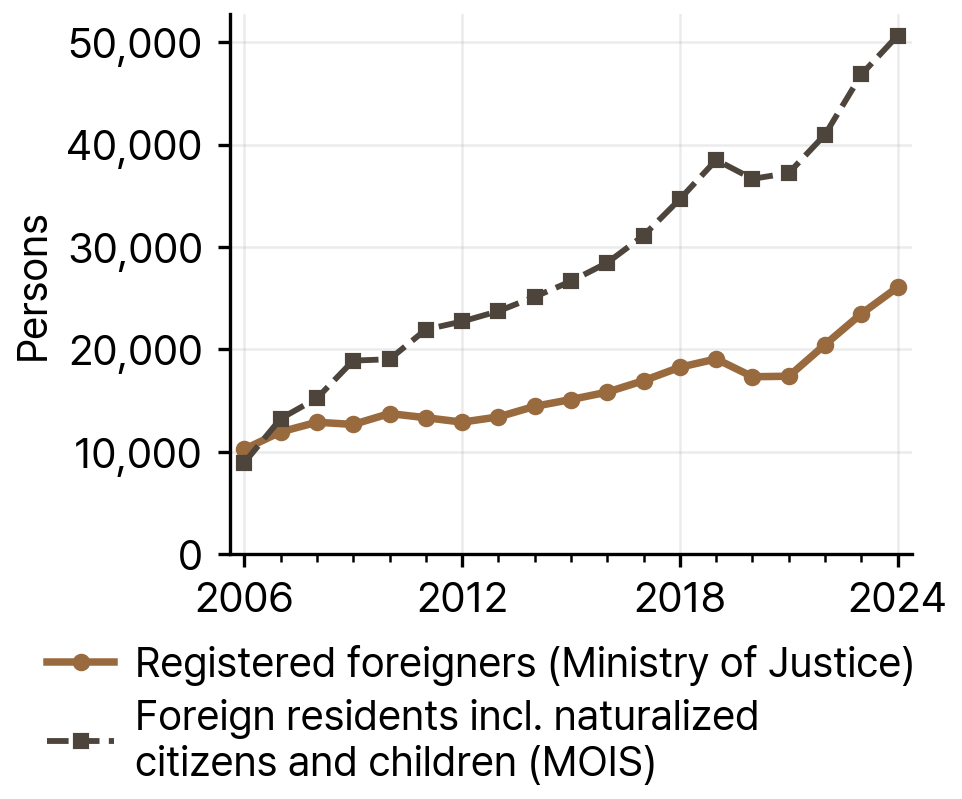
The number of registered foreigners rose from 10,252 in 2006 to 19,069 in 2019, fell to 17,332 in 2020, and then rose each year to 26,074 in 2024. The number of Korean residents peaked at 1,550,806 in 2016 and declined to 1,517,766 in 2024. Between 2019 and 2024 the province gained 7,005 registered foreigners (36.7 percent, the fifth-fastest growth among the 17 provinces and metropolitan cities) and lost 23,736 Korean residents (1.5 percent), so the foreign gain equaled 29.5 percent of the Korean loss.
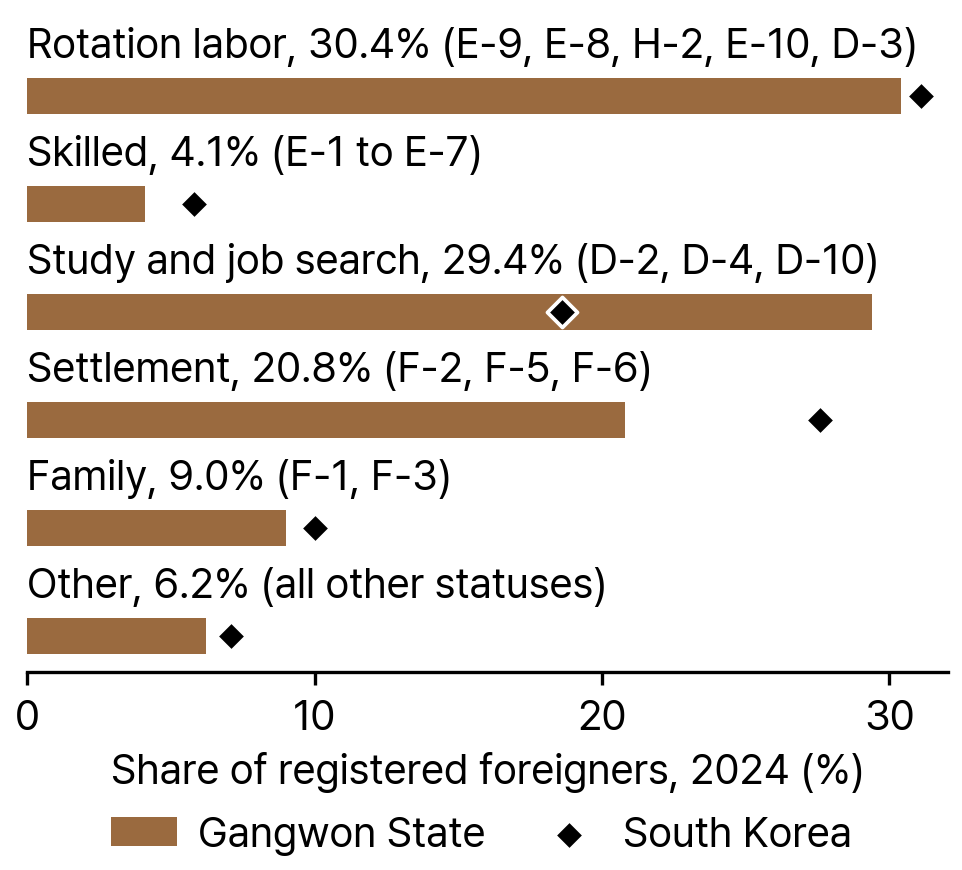
In 2024, students and trainees made up a larger share of registered foreigners in Gangwon State than in South Korea as a whole. Study and job-search statuses covered 29.4 percent of the province's registered foreigners, against 18.6 percent nationally, while settlement statuses covered 20.8 percent, against 27.6 percent. The province was home to 4.3 percent of the country's registered Russian nationals, 3.8 percent of Nepali nationals and 3.1 percent of Thai nationals, compared with its 1.8 percent share of all registered foreigners. In Goseong-gun, registered foreigners equaled 7.1 per 100 Korean residents in 2024, the highest ratio in the province, and Nepali nationals made up 44.0 percent of them. Twelve of the province's 18 cities and counties were designated population-decline areas in October 2021, and four more were designated areas of interest.
Size of the Foreign-Resident Population
The number of registered foreigners in Gangwon State rose from 10,252 in 2006 to 14,443 in 2014 and 19,069 in 2019 (see Figure 1). It fell 9.1 percent to 17,332 in 2020 (1,737 fewer people) and was 17,384 in 2021. The count then rose to 20,472 in 2022, 23,484 in 2023 and 26,074 in 2024, 50.0 percent above the 2021 level. The 2024 count was about 2.5 times the 2006 count (15,822 more people, an increase of 154.3 percent).
Source: KIRD dataset, from Ministry of Justice immigration yearbooks and Ministry of the Interior and Safety statistics, 2006-2024.
The MOIS count of foreign residents rose from 15,236 in 2008 to 38,504 in 2019 and 50,652 in 2024, when it was 1.9 times the registered-foreigner count. Of the 50,652 people in 2024, 36,580 were foreign nationals, 5,253 were naturalized Korean citizens and 8,819 were children of foreign residents (see Residence Statuses).
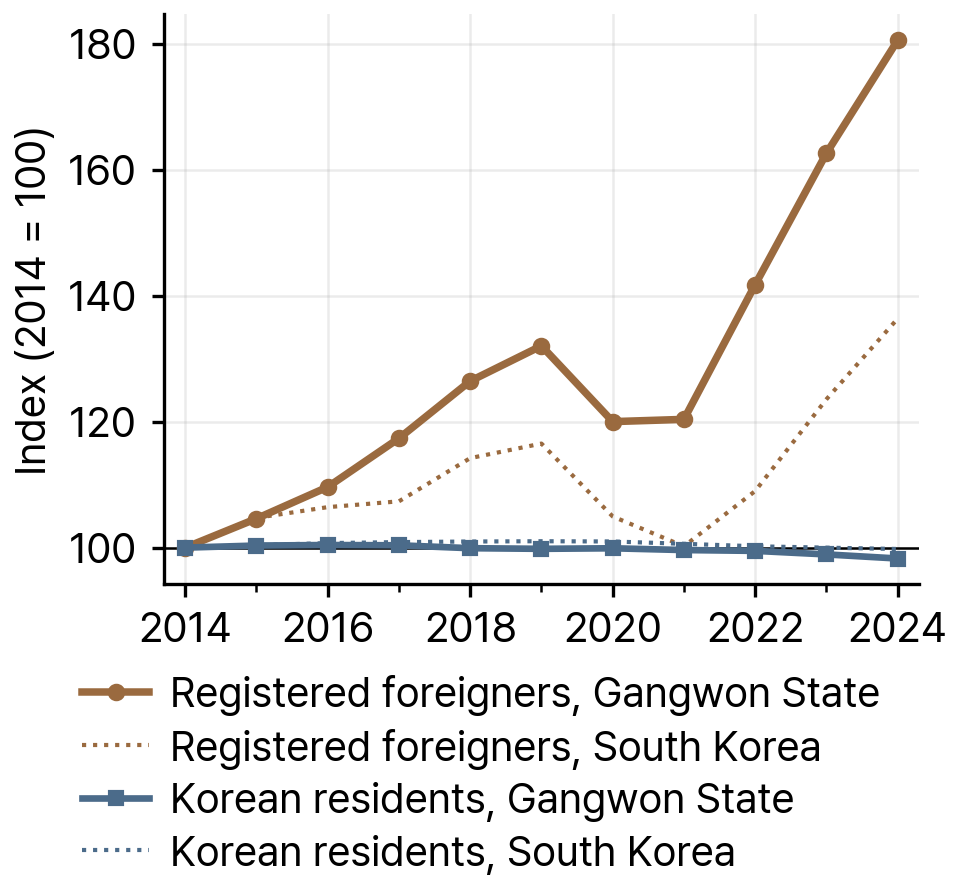
Between 2014 and 2024 the number of registered foreigners in Gangwon State grew 80.5 percent (11,631 people), faster than in South Korea as a whole, while the number of Korean residents fell 1.7 percent (26,676 people), a larger decline than the national one (see Figure 2). Registered foreigners per 100 Korean residents rose from 0.7 in 2006 and 0.9 in 2014 to 1.2 in 2019 and 1.7 in 2024 (see Table 1).
Source: KIRD dataset, from Ministry of Justice immigration yearbooks and Ministry of the Interior and Safety resident registration statistics, 2014-2024.
In 2024 Gangwon State ranked 16th among the 17 provinces and metropolitan cities by the number of registered foreigners and 14th by registered foreigners per Korean resident (1.7 per 100 Korean residents, against 2.9 nationally). Its growth of 36.7 percent between 2019 and 2024, from 19,069 to 26,074, was the fifth-fastest among the 17.
Table 1Registered Foreigners, Foreign Residents and Korean Residents in Gangwon State, Selected Years, 2006-24
| Year | Registered foreigners | MOIS foreign residents | Korean residents | Registered foreigners per 100 Korean residents |
|---|---|---|---|---|
| 2006 | 10,252 | – | 1,505,420 | 0.7 |
| 2014 | 14,443 | 25,141 | 1,544,442 | 0.9 |
| 2019 | 19,069 | 38,504 | 1,541,502 | 1.2 |
| 2024 | 26,074 | 50,652 | 1,517,766 | 1.7 |
Note: Registered foreigners are counted on 31 December and MOIS foreign residents on 1 November. The table shows MOIS counts from 2008, when the province had 15,236 MOIS foreign residents; Figure 1 also plots the MOIS counts for 2006 and 2007. South Korea had 2.9 registered foreigners per 100 Korean residents in 2024.
Source: KIRD dataset, from Ministry of Justice immigration yearbooks and Ministry of the Interior and Safety statistics, 2006-2024.
Nationalities
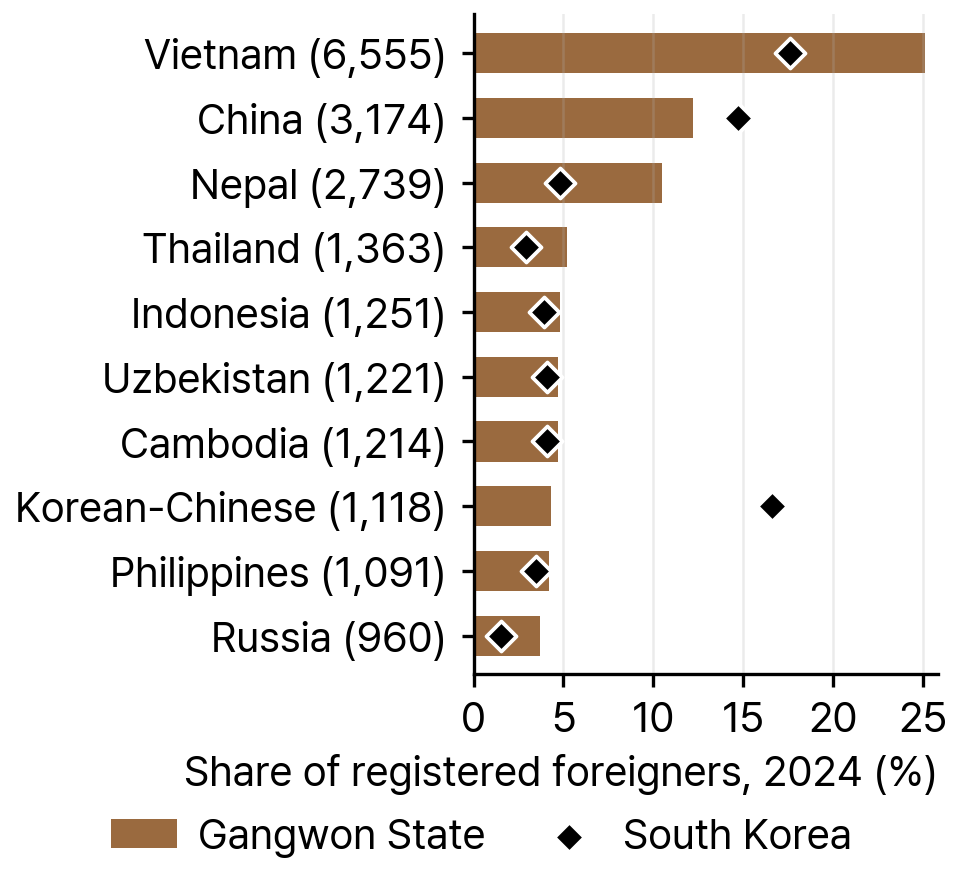
The KIRD data record 114 nationalities among registered foreigners in Gangwon State in 2024. Vietnamese nationals were the largest group (6,555, or 25.1 percent), followed by Chinese nationals (3,174, or 12.2 percent) and Nepali nationals (2,739, or 10.5 percent) (see Figure 3 and Table 2). The ten largest nationalities accounted for 79.3 percent of registered foreigners (20,686 of 26,074).
Vietnamese, Nepali, Thai and Russian nationals made up larger shares of registered foreigners in the province than in South Korea as a whole in 2024 (25.1, 10.5, 5.2 and 3.7 percent, against 17.6, 4.8, 2.9 and 1.5 percent). Korean-Chinese made up 4.3 percent, against 16.6 percent nationally, and other Chinese nationals 12.2 percent, against 14.7 percent.
Source: KIRD dataset, from Ministry of Justice immigration yearbooks, 2024.
Between 2019 and 2024 the number of Russian nationals in the province rose from 371 to 960 (2.6 times), the number of Nepali nationals doubled from 1,361 to 2,739, and the number of Thai nationals nearly doubled from 694 to 1,363. Korean-Chinese were the only group among the ten largest to decline, from 1,337 to 1,118.
Table 2Ten Largest Nationalities among Registered Foreigners in Gangwon State, 2019 and 2024
| Nationality | 2019 | 2024 | Share of the province's registered foreigners, 2024 (%) | Share of all registered foreigners of this nationality in South Korea, 2024 (%) |
|---|---|---|---|---|
| Vietnam | 4,947 | 6,555 | 25.1 | 2.5 |
| China | 2,768 | 3,174 | 12.2 | 1.5 |
| Nepal | 1,361 | 2,739 | 10.5 | 3.8 |
| Thailand | 694 | 1,363 | 5.2 | 3.1 |
| Indonesia | 753 | 1,251 | 4.8 | 2.1 |
| Uzbekistan | 744 | 1,221 | 4.7 | 2.0 |
| Cambodia | 961 | 1,214 | 4.7 | 2.0 |
| Korean-Chinese | 1,337 | 1,118 | 4.3 | 0.5 |
| Philippines | 818 | 1,091 | 4.2 | 2.1 |
| Russia | 371 | 960 | 3.7 | 4.3 |
Note: Korean-Chinese are Chinese nationals of Korean descent and are reported separately from other Chinese nationals.
Source: KIRD dataset, from Ministry of Justice immigration yearbooks, 2019 and 2024.
Gangwon State was home to 1.8 percent of all registered foreigners in South Korea in 2024 and to larger shares of several national groups: 4.3 percent of Russian nationals (960 of 22,450), 3.9 percent of South African nationals (181 of 4,641), 3.8 percent of Nepali nationals (2,739 of 72,151), 3.1 percent of Thai nationals (1,363 of 43,459) and 2.8 percent of Tajik nationals (44 of 1,567).
The Shannon diversity index of registered foreigners' nationalities rises with the number of nationalities and with the evenness of their shares. In Gangwon State it was 2.5 in 2014 and 2.6 in 2024, the sixth-highest among the 17 provinces and metropolitan cities in 2024.
Overseas Koreans on F-4 status report their residence instead of registering and are not counted among registered foreigners. In 2024, 4,144 of them reported a residence in Gangwon State, 0.7 percent of the 553,664 nationwide. The largest groups were Korean-Chinese (1,990), nationals of the United States (1,244) and Canada (313), Korean-Russians (168) and nationals of Australia (121).
Residence Statuses
Rotation labor statuses covered 30.4 percent of registered foreigners in Gangwon State in 2024 (7,936 people), close to the national share of 31.1 percent (see Figure 4). Study and job-search statuses covered 29.4 percent (7,668 people), against 18.6 percent nationally. Settlement statuses covered 20.8 percent (5,424), against 27.6 percent; family statuses 9.0 percent (2,357), against 10.0 percent; skilled statuses 4.1 percent (1,067), against 5.8 percent; and all other statuses 6.2 percent (1,622), against 7.1 percent.
Source: KIRD dataset, from Ministry of Justice immigration yearbooks, 2024.
E-9 non-professional employment was the most common status in 2024, with 5,717 holders (21.9 percent of registered foreigners), followed by D-2 student status (5,178, or 19.9 percent) and F-6 marriage migration status (3,339, or 12.8 percent) (see Table 3). Among the ten most common statuses, the province's share of all holders in South Korea was highest for E-10 crew employment (4.8 percent, 1,038 holders) and E-8 seasonal work (3.8 percent, 746 holders on 31 December), followed by D-2 (2.9 percent) and D-4 general trainee status (2.7 percent). For F-5 permanent residence it was 0.8 percent (1,694 holders), less than half the province's 1.8 percent share of all registered foreigners.
Table 3Ten Most Common Residence Statuses among Registered Foreigners in Gangwon State, 2024
| Status | Meaning | Registered foreigners | Share of the province's registered foreigners (%) | Share of all holders of this status in South Korea (%) |
|---|---|---|---|---|
| E-9 | Non-professional employment | 5,717 | 21.9 | 1.7 |
| D-2 | Student | 5,178 | 19.9 | 2.9 |
| F-6 | Marriage migration | 3,339 | 12.8 | 2.3 |
| D-4 | General trainee | 2,158 | 8.3 | 2.7 |
| F-1 | Visiting cohabitation | 1,788 | 6.9 | 1.8 |
| F-5 | Permanent residence | 1,694 | 6.5 | 0.8 |
| G-1 | Other (miscellaneous) | 1,385 | 5.3 | 2.5 |
| E-10 | Crew employment | 1,038 | 4.0 | 4.8 |
| E-8 | Seasonal worker | 746 | 2.9 | 3.8 |
| F-3 | Dependent family | 569 | 2.2 | 1.1 |
Note: Shares of the province's registered foreigners use the 2024 total of 26,074. E-8 holders are counted on 31 December, after most seasonal contracts have ended (see Industry and Foreign Workers).
Source: KIRD dataset, from Ministry of Justice immigration yearbooks, 2024.
The MOIS count for 1 November 2024 uses different categories. Of the 50,652 foreign residents it recorded in Gangwon State, 36,580 (72.2 percent) were foreign nationals: 7,989 foreign workers, 4,118 marriage migrants, 6,786 international students, 2,519 ethnic Koreans of foreign nationality and 15,168 other foreign nationals. The remaining 14,072 (27.8 percent) were 5,253 naturalized Korean citizens and 8,819 children of foreign residents.
Districts and Population-Decline Areas
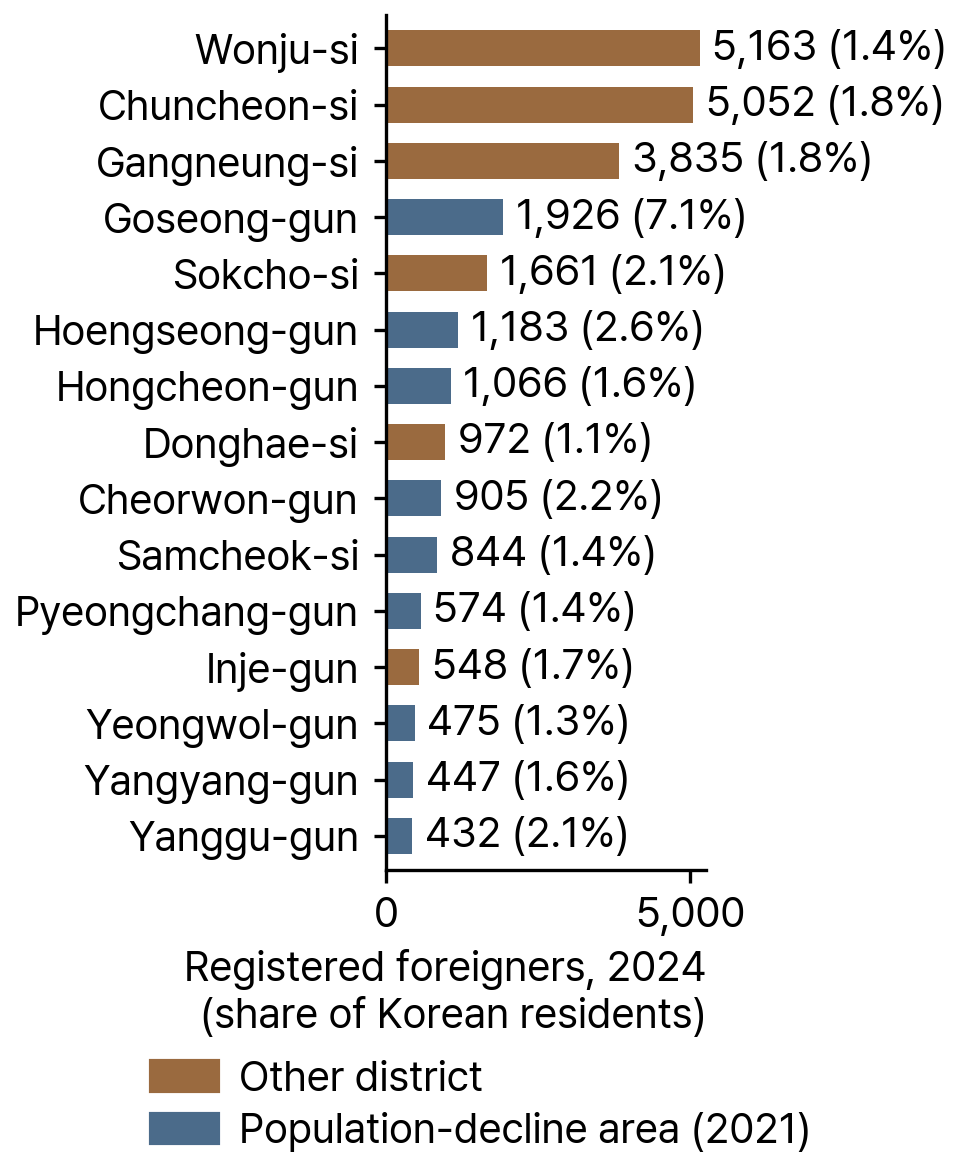
Gangwon State has seven cities (si) and 11 counties (gun). In 2024 Wonju-si (5,163 registered foreigners) and Chuncheon-si (5,052) had the most registered foreigners, followed by Gangneung-si (3,835); together they accounted for 53.9 percent of the province's registered foreigners (14,050 of 26,074) (see Figure 5 and Table 4). The number of registered foreigners per 100 Korean residents was highest in Goseong-gun (7.1), followed by Hoengseong-gun (2.6) and Cheorwon-gun (2.2). Goseong-gun is the location of Kyungdong University's Global Campus, which reported 984 international students as of 1 April 2024 (Academy Info, 2026a; see International Students and Universities).
Source: KIRD dataset, from Ministry of Justice immigration yearbooks and Ministry of the Interior and Safety statistics, 2024; population-decline areas as designated by the Ministry of the Interior and Safety in 2021.
Between 2019 and 2024 the number of registered foreigners rose in all 18 cities and counties, and the number of Korean residents fell in 16 of them. Only Wonju-si and Chuncheon-si gained Korean residents (12,949 and 4,778) as well as registered foreigners (1,518 and 758).
The Ministry of the Interior and Safety designated 12 of the 18 cities and counties as population-decline areas in October 2021: Goseong-gun, Hoengseong-gun, Cheorwon-gun, Yanggu-gun, Yangyang-gun, Hongcheon-gun, Pyeongchang-gun, Samcheok-si, Hwacheon-gun, Yeongwol-gun, Jeongseon-gun and Taebaek-si. Between 2019 and 2024 these 12 areas lost 31,915 Korean residents and gained 2,460 registered foreigners, so the foreign gain equaled 7.7 percent of the Korean loss. The largest Korean losses were in Taebaek-si (5,930), Samcheok-si (5,493) and Cheorwon-gun (5,087), and the largest foreign gains were in Goseong-gun (794) and Hoengseong-gun (501).
Table 4Ten Cities and Counties with the Most Registered Foreigners in Gangwon State, 2024
| City or county | Registered foreigners, 2024 | Per 100 Korean residents, 2024 | Change in Korean residents, 2019-24 | Change in registered foreigners, 2019-24 | Population-decline area |
|---|---|---|---|---|---|
| Wonju-si | 5,163 | 1.4 | +12,949 | +1,518 | No |
| Chuncheon-si | 5,052 | 1.8 | +4,778 | +758 | No |
| Gangneung-si | 3,835 | 1.8 | -5,711 | +1,366 | No (area of interest) |
| Goseong-gun | 1,926 | 7.1 | -261 | +794 | Yes |
| Sokcho-si | 1,661 | 2.1 | -853 | +623 | No (area of interest) |
| Hoengseong-gun | 1,183 | 2.6 | -464 | +501 | Yes |
| Hongcheon-gun | 1,066 | 1.6 | -2,433 | +151 | Yes |
| Donghae-si | 972 | 1.1 | -2,847 | +41 | No (area of interest) |
| Cheorwon-gun | 905 | 2.2 | -5,087 | +194 | Yes |
| Samcheok-si | 844 | 1.4 | -5,493 | +71 | Yes |
Note: Population-decline areas and areas of interest as designated by the Ministry of the Interior and Safety on 19 October 2021. Registered foreigners per 100 Korean residents use the Korean residents of the same city or county in 2024.
Source: KIRD dataset, from Ministry of Justice immigration yearbooks and Ministry of the Interior and Safety statistics, 2019 and 2024.
Four other cities and counties were designated areas of interest: Gangneung-si, Sokcho-si, Donghae-si and Inje-gun. Between 2019 and 2024 they lost 9,548 Korean residents (5,711, 853, 2,847 and 137, respectively) and gained 2,269 registered foreigners (1,366, 623, 41 and 239), a foreign gain equal to 23.8 percent of the Korean loss.
Two counties met the definition of an ethnic enclave in 2024, both for Nepali nationals. In Goseong-gun, a population-decline area, 848 Nepali nationals made up 44.0 percent of registered foreigners, with a location quotient of 22.3. In Inje-gun, an area of interest, 226 Nepali nationals made up 41.2 percent, with a location quotient of 5.1.
Population Trends
The Korean resident population of Gangwon State grew from 1,505,420 in 2006 to a peak of 1,550,806 in 2016 and then declined to 1,517,766 in 2024. The 2024 count was 0.8 percent above the 2006 level, 1.7 percent below the 2014 level and 1.5 percent (23,736 people) below the 2019 level. The two largest annual declines in the series were in 2023 (8,691 people) and 2024 (10,041).
The province's total fertility rate was 0.89 in 2024, the fourth-highest among the 17 provinces and metropolitan cities and above the national rate of 0.75, while the number of births fell 1.4 percent from the year before to 6,600. Hwacheon-gun (1.50) and Inje-gun (1.27) ranked third and ninth nationally (Kangwon Domin Ilbo, 2025). In 2024, 384,585 residents of the province were aged 65 or older, 25.3 percent of a population of about 1.52 million (Kangwon Ilbo, 2024a).
Gangwon State lost population to other regions of South Korea through domestic migration in each year from 2023 to 2025, with net out-migration of 1,397 people in 2023, 2,527 in 2024 and 1,387 in 2025. Over 2023-2025, people in their twenties made up the largest net outflow to the capital region of any age group, 11,916 people (Wonju Sinmun, 2026).
Statistics Korea's 2022-2052 provincial population projections put the province's total population at 1.53 million in 2022, 1.50 million in 2045 and 1.44 million in 2052 under the baseline scenario, and at 1.41 million in 2052 under the low-fertility scenario (Kangwon Ilbo, 2024b).
Industry and Foreign Workers
The number of registered foreigners on E-9 non-professional employment status, the status issued under the Employment Permit System (EPS), was 3,301 in 2014, 4,161 in 2019, 3,193 in 2021 and 5,717 in 2024, an increase of 79.0 percent from 2021 to 2024. Gangwon State's share of E-9 holders in South Korea was 1.7 percent in 2024, slightly below its 1.8 percent share of all registered foreigners.
According to the Kangwon Domin Ilbo, 5,246 E-9 workers were employed at 1,517 workplaces in Gangwon State at the end of July 2026. Of these workers, 1,421 (27.1 percent) worked in agriculture and livestock, at 633 workplaces, the largest number of workplaces of any sector. In second-quarter counts reported in the same article, E-9 workers in agriculture and livestock increased from 1,037 in 2022 to 1,364 in 2023, 1,475 in 2024, 1,600 in 2025 and 1,713 in 2026, about 65 percent over four years (Kangwon Domin Ilbo, 2026).
In 2023 the vacancy rate for foreign workers in manufacturing in Gangwon State was 25.1 percent, above the national average of 16.2 percent and the fourth-highest among the 17 provinces and metropolitan cities (Kangwon Ilbo, 2024c). In the third quarter of 2023, 3,743 foreign workers were employed in the province under the EPS, 1.6 percent of the national total. A Kangwon Ilbo report that year described an ice-cream manufacturer in Gangneung, a pollock-processing plant in Sokcho and a restaurant in Pyeongchang struggling to find workers, and stated that the province had no long-term overall plan for foreign labor. In the same report, the chair of the Korea Association for Migration Studies, a professor at Kangwon National University, said that no policy existed to make foreign workers choose Gangwon as a place to work or live (Kangwon Ilbo, 2023).
E-8 seasonal workers counted on 31 December numbered 190 in 2021, 630 in 2022, 760 in 2023 and 746 in 2024. The 31 December count misses most seasonal workers, because their contracts end before winter. For 2024, the province had projected demand for 7,428 seasonal workers, 9.2 percent more than for the year before (Kangwon Ilbo, 2023), and for 2026 it was allocated 11,168 (see Provincial Policy).
In 2024 the province had 1,038 registered foreigners on E-10 crew employment status, 4.8 percent of all E-10 holders in South Korea. In January 2026 Samcheok-si became the first city or county in Gangwon State to subsidize rent for foreign fishing-boat crew, covering 50 percent of the actual rent up to 70 percent of the two-person minimum housing standard under the Housing Benefit Act; the head of the city's marine and fisheries division described foreign crew as core personnel sustaining the local fishing industry (Newspim, 2026). The Sokcho Marine Industrial Park (속초해양산업단지), with about 120 companies in three estates and about 1,300 Korean and foreign workers, had about 350 foreign workers in 2025, about 30 percent of its workforce (Gangwon Sinmun, 2025).
International Students and Universities
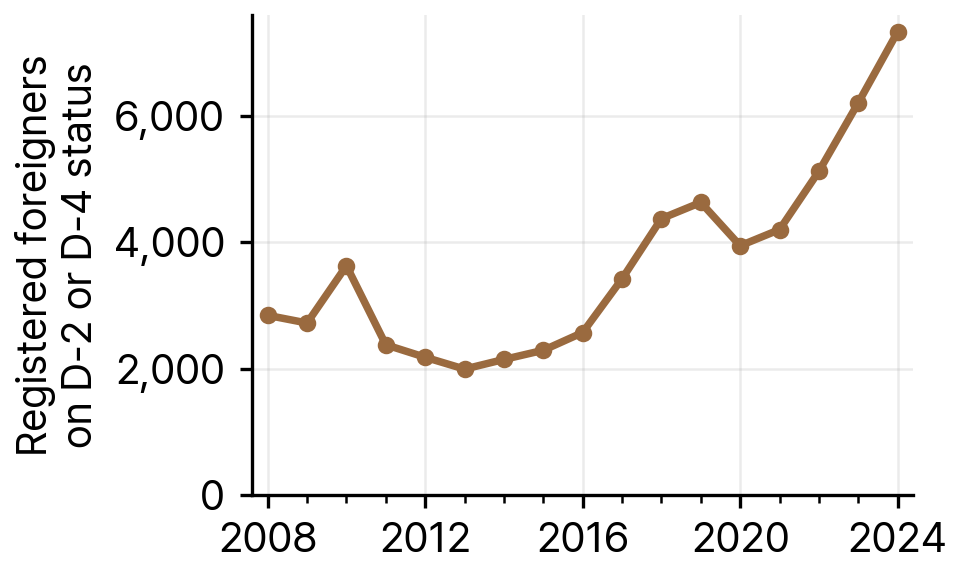
Registered foreigners on D-2 student and D-4 general trainee status in Gangwon State numbered 2,844 in 2008 and 3,630 in 2010, declined to 1,993 in 2013, and rose to 4,633 in 2019 (see Figure 6). After a drop to 3,947 in 2020, the count rose each year to 7,336 in 2024 (5,178 on D-2 and 2,158 on D-4), 58.3 percent more than in 2019. Students and trainees made up 28.1 percent of the province's registered foreigners in 2024, up from 14.9 percent in 2014, and the province's share of all D-2 and D-4 holders in South Korea was 2.8 percent, against its 1.8 percent share of all registered foreigners.
Source: KIRD dataset, from Ministry of Justice immigration yearbooks, 2008-2024.
At the end of 2025, 7,565 international students were enrolled at 17 higher-education institutions in the province: 4,723 undergraduates, 1,517 graduate students and 1,325 non-degree trainees (Kangwon Ilbo, 2026).
Academy Info (대학알리미), the government's university disclosure system, reports international students as of 1 April of each year (see Table 5). Kyungdong University's Global Campus in Goseong reported 984 international students in 2024, 1,169 in 2025 and 1,572 in 2026, of whom 1,436 were in degree programs (Academy Info, 2026a). Kangwon National University's main campus in Chuncheon reported 483 in 2024, 1,015 in 2025 and 1,400 in 2026, of whom 1,123 were in degree programs (Academy Info, 2026b). In 2026 Gangneung-Wonju National University reported 296, Sangji University in Wonju 245 (up from 75 in 2025) and Catholic Kwandong University in Gangneung 206. The regional visa pilot for international students at 12 universities in the province is described under Provincial Policy.
Table 5International Students at Five Universities in Gangwon State, 2024-26
| University | 2024 | 2025 | 2026 | In degree programs, 2026 | Source |
|---|---|---|---|---|---|
| Kyungdong University, Global Campus (Goseong) | 984 | 1,169 | 1,572 | 1,436 | Academy Info, 2026a |
| Kangwon National University, main campus (Chuncheon) | 483 | 1,015 | 1,400 | 1,123 | Academy Info, 2026b |
| Gangneung-Wonju National University | 243 | 299 | 296 | 141 | Academy Info, 2026c |
| Sangji University (Wonju) | 92 | 75 | 245 | 245 | Academy Info, 2026d |
| Catholic Kwandong University (Gangneung) | 204 | 157 | 206 | 67 | Academy Info, 2026e |
Note: Counts are as of 1 April of each year and include degree and non-degree programs. Kangwon National University figures cover its main campus only, and Kyungdong University figures cover its Global Campus in Goseong.
Source: Academy Info (대학알리미) disclosures of each university, as linked in each row.
Provincial Policy
Gangwon State enacted an ordinance on support for foreign residents (강원특별자치도 외국인주민 지원 조례) on 27 February 2026. Under it the province formed a Foreign Resident Support Council chaired by the vice governor, with 10 appointed members (experts and foreign residents) whose terms end on 31 August 2028 (Shinailbo, 2026). The council met for the first time on 10 September 2026. A working-level foreign policy task force of officials from agencies in four sectors (education, the economy, daily life and safety) shares the status of support projects for foreign residents and develops cooperation measures (Gukje News, 2026).
For 2025-2026 the province plans to operate its regional specialized visa programs (F-2-R, F-4-R and E-7-4R) for a combined 229 people, as part of an effort, coordinated by the province's population-decline response policy officer, to recruit foreign workers and support their settlement in the region (Herald Corp, 2025).
In 2025 the Ministry of Justice selected Gangwon State as one of 14 provincial-level governments for its regional visa pilot (광역형 비자). Under the pilot the province can issue up to 770 visas through 2026 to international students in semiconductor, biohealth, future mobility, future energy, food technology, ICT and tourism-related programs at 12 participating universities, with eased D-2 student visa requirements and semester-long internships (Korea JoongAng Daily, 2025).
In 2026 the provincial assembly advanced an amendment to the province's ordinance on supporting and recruiting international students (강원특별자치도 외국인 유학생 등의 지원 및 유치에 관한 조례) to create a legal basis for a dedicated International Student Support Center (Weekly Today, 2026).
The province was allocated 11,168 foreign seasonal workers (E-8) for 2026 under memoranda of understanding with eight countries, including the Philippines, Vietnam, Laos, Cambodia and Thailand, 1,921 more (20.7 percent) than in 2025. Of these, 10,409 were allocated under direct contracts with farms and 759 under a public model mediated by cooperatives (Asiae, 2026).
Languages
The KIRD dataset estimates the first languages of registered foreigners by applying each nationality's first-language shares from Ethnologue to the number of registered foreigners of that nationality. By this estimate, six languages had 1,000 or more first-language speakers among registered foreigners in Gangwon State in 2024: Vietnamese (5,607), Chinese (3,465), Nepali (1,421), Khmer (1,256), Thai (1,219) and Russian (1,090) (see Table 6).
Table 6Estimated First-Language Speakers among Registered Foreigners in Gangwon State, Ten Most Common Languages, 2024
| Language | Estimated speakers | Share of the province's registered foreigners (%) |
|---|---|---|
| Vietnamese | 5,607 | 21.5 |
| Chinese | 3,465 | 13.3 |
| Nepali | 1,421 | 5.4 |
| Khmer | 1,256 | 4.8 |
| Thai | 1,219 | 4.7 |
| Russian | 1,090 | 4.2 |
| Tagalog/Filipino | 953 | 3.7 |
| Uzbek | 909 | 3.5 |
| Indonesian | 880 | 3.4 |
| Japanese | 564 | 2.2 |
Note: Estimates apply Ethnologue first-language shares for each nationality to the number of registered foreigners of that nationality on 31 December 2024. Shares use the province total of 26,074 registered foreigners.
Source: KIRD dataset, from Ministry of Justice immigration yearbooks, 2024, with first-language shares from Ethnologue.
Because the estimate divides each nationality among its first languages, the count for a language can differ from the count of the corresponding nationality. The estimate for Nepali (1,421) is about half the number of Nepali nationals in 2024 (2,739). The estimate for Russian (1,090) exceeds the number of Russian nationals (960), because the shares also assign Russian as a first language to some registered foreigners of other nationalities.
Service Organizations and Community Places
The KIRD census of 1,720 migrant-serving organizations in South Korea lists 49 in Gangwon State, or 18.8 per 10,000 registered foreigners in 2024, against 11.6 per 10,000 nationally. Of the 49, 48 provide direct services. They include 18 family centers (가족센터), one in each of the province's 18 cities and counties. Seven hospitals in the census are designated to provide medical support to foreign workers and undocumented residents, and five of them are regional public medical centers, in Wonju, Gangneung, Sokcho, Yeongwol and Samcheok. The census also lists the Chuncheon Immigration Office and its branch offices in Goseong, Donghae and Sokcho.
By the populations they list, 24 of the 49 organizations serve families, 12 serve all foreign residents, 11 serve workers, 7 serve undocumented residents and 5 serve refugees. Other organizations in the census include the Gangwon Migrant Women Counseling Center (강원이주여성상담소) in Chuncheon, operated by the Catholic Diocese of Chuncheon; foreign worker support centers in Wonju and Gangneung; Haemil School (해밀학교) in Hongcheon, an alternative school for teenagers from multicultural families; and the Gangwon office of the National Human Rights Commission of Korea in Wonju.
The Gangneung City Foreign Worker Support Center (강릉시 외국인근로자 지원센터), at 26 Okga-ro 19beon-gil in Gangneung, is designated by the Ministry of Justice as an operating institution of the Social Integration Program (KIIP) and offers Korean-language classes, counseling and cultural programs for foreign workers (Gangneung City Foreign Worker Support Center, 2025).
In 2025 the Sokcho Marine Industrial Park, where foreign workers made up about 30 percent of the workforce, launched a Sokcho Tour that took foreign workers to the municipal museum, the mountain museum and Cheongcho Lake, to support their early settlement in the city (Gangwon Sinmun, 2025).
In Wonju's Miro Art Market (미로예술시장), a multicultural cafe operated jointly by an immigrant from the Philippines, an immigrant from Japan and the Korean head of the Rainbow cultural-tourism cooperative (원주문화관광협동조합무지개) serves Japanese-style desserts such as souffle cake and mitarashi dango. The cooperative's local-market tour ends at the cafe (Erounnet, 2024).
To our knowledge, no published source describes a place of worship or a residential neighborhood associated with a particular immigrant group in the province.
Sources
Korea Immigration Regional Dashboard (KIRD) dataset. Spatiotemporal administrative dataset of nationality, residential diversity, and language demand among immigrants in South Korea, 2006-2024. openICPSR. https://doi.org/10.3886/E249944V1
Shinailbo. 2026. Gangwon Holds the First Meeting of Its Foreign Resident Support Council (in Korean). https://www.shinailbo.co.kr/news/articleView.html?idxno=5060733
Gukje News. 2026. Gangwon State Launches Foreign Resident Support Council to Strengthen Social Integration Policy (in Korean). https://www.gukjenews.com/news/articleView.html?idxno=3691412
Herald Corp. 2025. Gangwon State Promotes Conversion to Regional Specialized and Skilled Worker Visas (in Korean). https://biz.heraldcorp.com/article/10437332
Korea JoongAng Daily. 2025. Regional Visas to Allow International Students Longer Internship Opportunities. https://www.koreajoongangdaily.com/korea/regional-visas-to-allow-international-students-longer-internship-opportunities/12049476
Asiae. 2026. Gangwon Enters the Era of 11,000 Foreign Seasonal Workers, Easing Rural Labor Shortages (in Korean). https://view.asiae.co.kr/article/2026031009501900979
Weekly Today. 2026. Gangwon Provincial Assembly Member Jeong Jae-woong Strengthens Support for International Students (in Korean). https://www.weeklytoday.com/news/articleView.html?idxno=767637
Kangwon Domin Ilbo. 2026. Gangwon Agriculture Grows More Dependent on Foreign Labor, with Employment Up 65 Percent in Four Years (in Korean). https://www.kado.net/news/articleView.html?idxno=2071151
Kangwon Ilbo. 2024c. Foreign Workers Avoid Hard Work: Gangwon Manufacturers Search for Foreign Workers (in Korean). https://www.kwnews.co.kr/article/202407240122464
Kangwon Ilbo. 2023. Farms, Factories and Restaurants Scramble for Foreign Workers as Gangwon Lacks an Overall Plan (in Korean). https://www.kwnews.co.kr/page/view/2023112917565266477
Newspim. 2026. Samcheok Supports Housing for Foreign Fishing-Boat Crew, a First in the Province (in Korean). https://www.newspim.com/news/view/20260118000044
Kangwon Domin Ilbo. 2025. Gangwon's Total Fertility Rate Ranks Fourth Nationally (in Korean). https://www.kado.net/news/articleView.html?idxno=2001990
Kangwon Ilbo. 2024a. South Korea Becomes a Super-Aged Society, with Gangwon's Ageing Rate at 25.3 Percent (in Korean). https://www.kwnews.co.kr/page/view/2024122516240228060
Wonju Sinmun. 2026. Gangwon Records Net Out-Migration for a Third Straight Year: Young Adults Leave for the Capital Region, Students for Chungcheong and the South (in Korean). http://www.iwjnews.com/news/articleView.html?idxno=70423
Kangwon Ilbo. 2024b. Gangwon's Population Could Fall to 1.41 Million in 28 Years in the Worst Case (in Korean). https://www.kwnews.co.kr/page/view/2024052812051514530
Academy Info (대학알리미), Korean Council for University Education. 2026a. Foreign Students by Year: Kyungdong University (in Korean). https://www.academyinfo.go.kr/pubinfo/pubinfo0020/list.do?schlId=0000060
Academy Info (대학알리미), Korean Council for University Education. 2026b. Foreign Students by Year: Kangwon National University (in Korean). https://www.academyinfo.go.kr/pubinfo/pubinfo0020/list.do?schlId=0000003
Academy Info (대학알리미), Korean Council for University Education. 2026c. Foreign Students by Year: Gangneung-Wonju National University (in Korean). https://www.academyinfo.go.kr/pubinfo/pubinfo0020/list.do?schlId=0000001
Academy Info (대학알리미), Korean Council for University Education. 2026d. Foreign Students by Year: Sangji University (in Korean). https://www.academyinfo.go.kr/pubinfo/pubinfo0020/list.do?schlId=0000119
Academy Info (대학알리미), Korean Council for University Education. 2026e. Foreign Students by Year: Catholic Kwandong University (in Korean). https://www.academyinfo.go.kr/pubinfo/pubinfo0020/list.do?schlId=0000072
Kangwon Ilbo. 2026. A university campus with more international students than Korean students (in Korean). 31 March 2026, via Daum. https://v.daum.net/v/20260331182903931
Erounnet. 2024. Local Market Tours and Multicultural Desserts: Wonju Rainbow Cultural Tourism Cooperative (in Korean). https://www.eroun.net/news/articleView.html?idxno=46548
Gangneung City Foreign Worker Support Center. 2025. About the Center (in Korean). https://www.gnscfw.org/1006
Gangwon Sinmun. 2025. Sokcho Marine Industrial Park Runs the 2025 Sokcho Tour for Foreign Workers (in Korean). https://www.gwnews.org/news/articleView.html?idxno=258200
Suggested citation: Korea Immigration Regional Dashboard (KIRD). 2026. “Foreign Residents in Gangwon State.” Foreign Residents in South Korea series, September 2026. Data: Korea Immigration Regional Dashboard (KIRD) dataset, https://doi.org/10.3886/E249944V1. Interactive maps and tables: https://immigrantsinkorea.today.