 Korea Immigration Regional Dashboard
SpotlightSeptember 2026Nationality profilesDownload PDF
Vietnamese Immigrants in South Korea
Highlights
- At the end of 2024, 261,581 Vietnamese nationals were registered foreigners in South Korea, making Vietnam the largest nationality among registered foreigners (17.6 percent) and the third-largest among all resident foreigners (305,936 people, 11.5 percent), up from 54,698 resident foreigners in 2006.
- Study and training visas covered 32.0 percent of Vietnamese residents in 2024, compared with 10.2 percent of all resident foreigners, and Vietnamese nationals held 63.7 percent of all D-4 general trainee visas in the country.
- The Ministry of Justice counted 77,730 unauthorized Vietnamese residents in 2024, equal to 25.4 percent of Vietnamese resident foreigners and the second-largest group of unauthorized residents by nationality.
At the end of 2024, 261,581 Vietnamese nationals were registered foreigners in South Korea, residing for more than 90 days. Vietnam was the largest nationality among registered foreigners (17.6 percent of the total, up from third in 2019) and the third-largest among all resident foreigners, a count that also includes short-term visitors (305,936 people and 11.5 percent of the total, up from fourth in 2014). Registered foreigners made up 85.5 percent of Vietnamese resident foreigners in 2024. The resident count was about 5.6 times its 2006 size of 54,698 and grew 36.3 percent between 2019 and 2024, the sixth-fastest growth among the 20 largest nationalities.
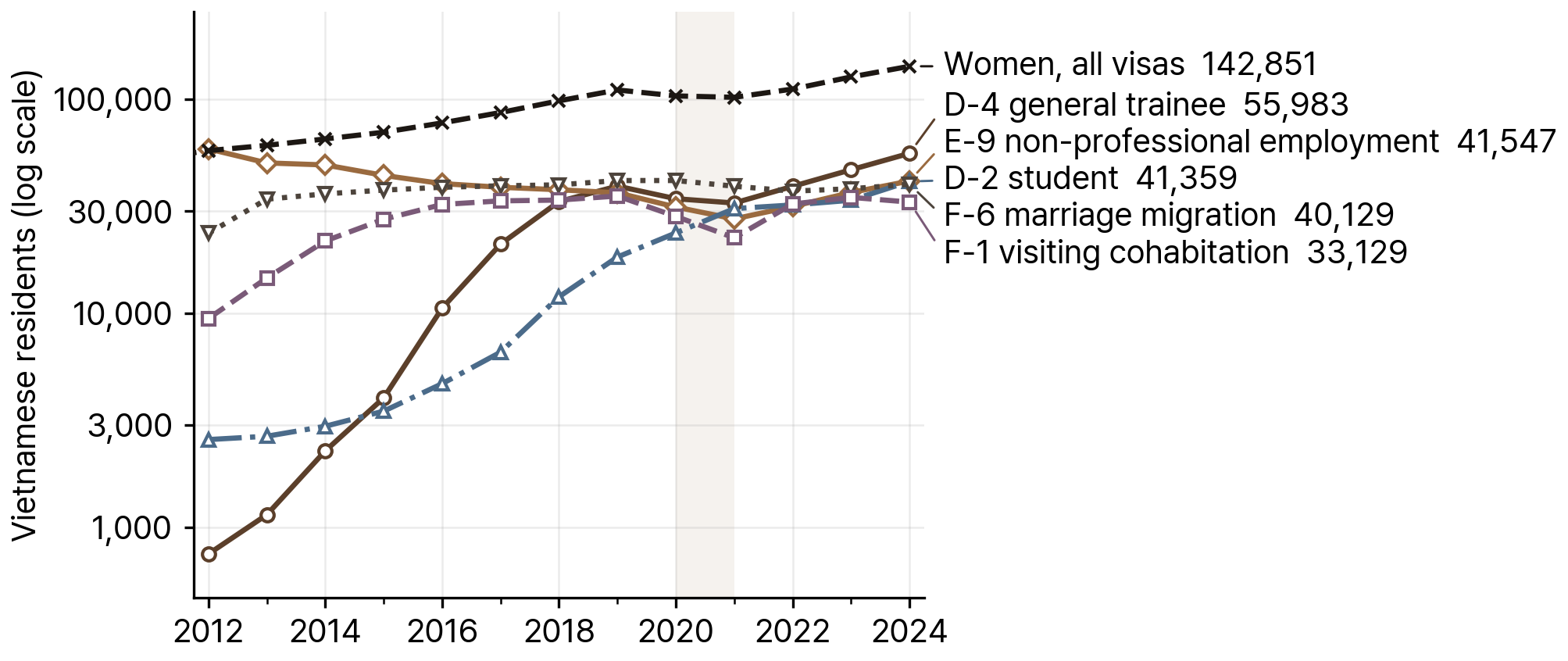
Vietnamese migration to Korea grew through three channels. Korea and Vietnam signed an Employment Permit System (EPS) agreement in 2004, and by 2023 Vietnam had sent about 137,000 E-9 workers, more than any of the 16 EPS sending countries (EToday, 2023). Vietnam has also been the largest source of foreign brides marrying Korean nationals since 2015 (World Bank/KNOMAD, 2023). Since 2019 the fastest growth has come through student and trainee visas: D-2 student visa holders rose from 18,337 in 2019 to 41,359 in 2024, and D-4 general trainees from 39,336 to 55,983.
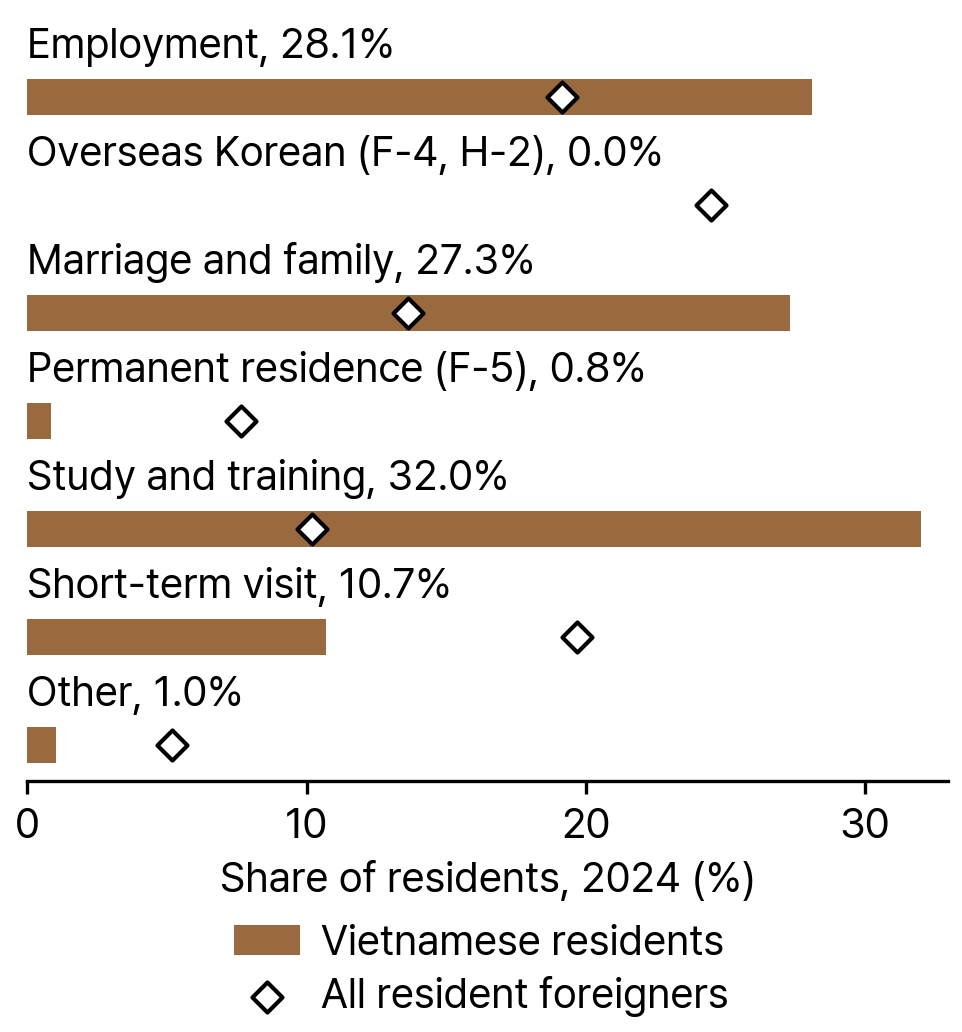
Compared with all resident foreigners, Vietnamese residents in 2024 were younger (68.5 percent aged 20 to 39, against 49.7 percent), less concentrated in Seoul, Incheon, and Gyeonggi (33.6 percent, against 55.2 percent), and more likely to hold study, training, or marriage and family visas. Almost none held the overseas Korean visas (F-4 and H-2) that covered 24.5 percent of all resident foreigners.
Size of the Population over Time
The number of Vietnamese resident foreigners rose from 54,698 in 2006 to 103,306 in 2010, 129,973 in 2014, and 224,518 in 2019. The count fell to 211,243 in 2020 and 208,740 in 2021, the years of COVID-19 border restrictions, then rose each year to a peak of 305,936 in 2024.
With 2019 set to 100, the Vietnamese population had an index of 136.3 in 2024, the sixth-highest growth among the 20 largest nationalities. The registered share was 85.5 percent in 2024 (261,581 of 305,936), so most Vietnamese residents were long-term stayers.
Vietnam ranked third among registered foreigners in 2006, 2014, and 2019 and first in 2024, when Vietnamese nationals made up 17.6 percent of all registered foreigners, up from 8.3 percent in 2006 and 14.7 percent in 2019. Among all resident foreigners, the group ranked fourth in 2006 and 2014 and third in 2019 and 2024, and its share rose from 6.0 percent in 2006 to 11.5 percent in 2024.
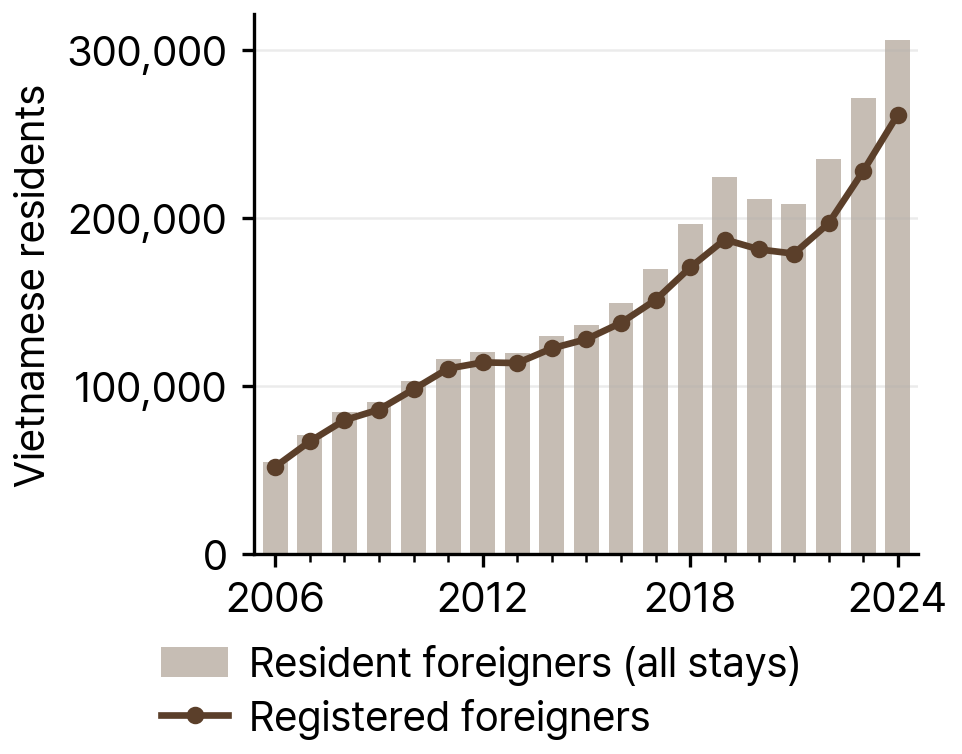
Source: KIRD dataset, from Ministry of Justice immigration yearbooks, 2006-2024.
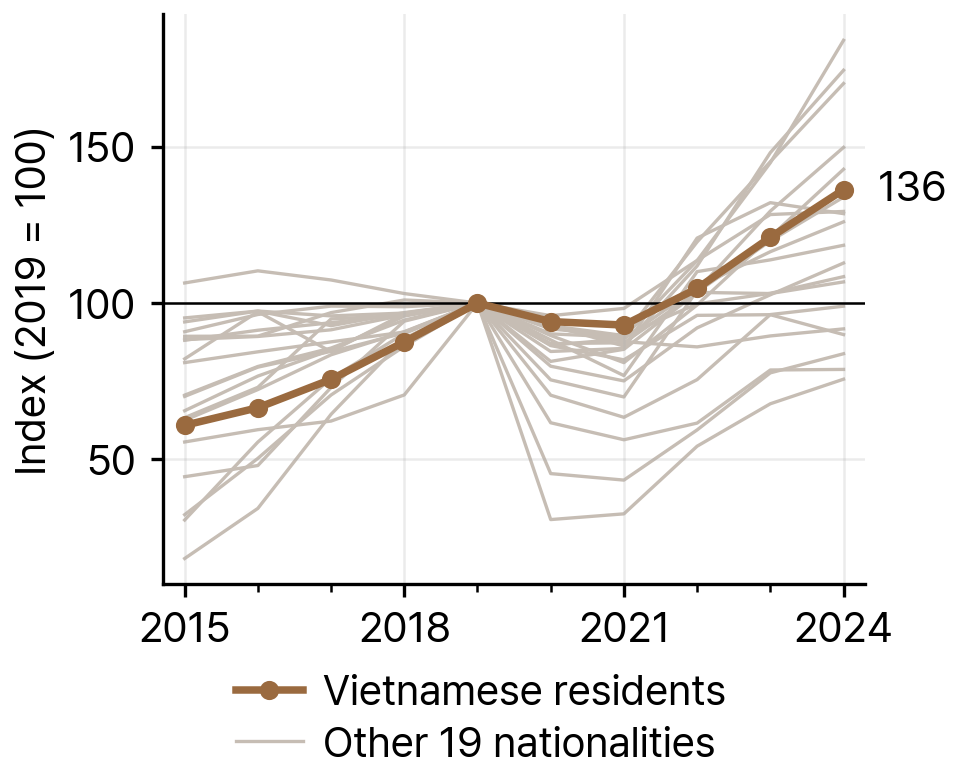
Source: KIRD dataset, from Ministry of Justice immigration yearbooks, 2006-2024.
Table 1Vietnamese Resident and Registered Foreigners in South Korea, Selected Years
| Year | Resident foreigners | Registered foreigners | Rank among registered foreigners | Rank among all resident foreigners | Share of all registered foreigners (%) | Share of all resident foreigners (%) |
|---|---|---|---|---|---|---|
| 2006 | 54,698 | 52,157 | 3 | 4 | 8.3 | 6.0 |
| 2014 | 129,973 | 122,571 | 3 | 4 | 11.2 | 7.2 |
| 2019 | 224,518 | 187,334 | 3 | 3 | 14.7 | 8.9 |
| 2024 | 305,936 | 261,581 | 1 | 3 | 17.6 | 11.5 |
Note: Resident foreigners include short-term visitors and overseas Koreans with F-4 visas who report their residence. Registered foreigners are long-term residents who registered with immigration authorities.
Source: KIRD dataset, from Ministry of Justice immigration yearbooks, 2006-2024.
Distribution by Province and District
Vietnamese residents were spread more widely across the country than foreign residents as a whole. In 2024, the Yeongnam region (Busan, Daegu, Ulsan, and the two Gyeongsang provinces) was home to 82,265 registered Vietnamese (31.4 percent), followed by Incheon and Gyeonggi with 60,901 (23.3 percent), Chungcheong with 40,957 (15.7 percent), Honam with 39,252 (15.0 percent), Seoul with 27,032 (10.3 percent), and Gangwon and Jeju with 11,174 (4.3 percent). Seoul, Incheon, and Gyeonggi together accounted for 33.6 percent of Vietnamese residents, compared with 55.2 percent of all resident foreigners.
Rural counties (gun) were home to 13.9 percent of registered Vietnamese residents in 2024, compared with 10.6 percent of all foreign residents. In Honam the rural share was 32.0 percent. At least 100 Vietnamese residents lived in each of 240 districts, and the ten largest districts accounted for 18.3 percent of the group.
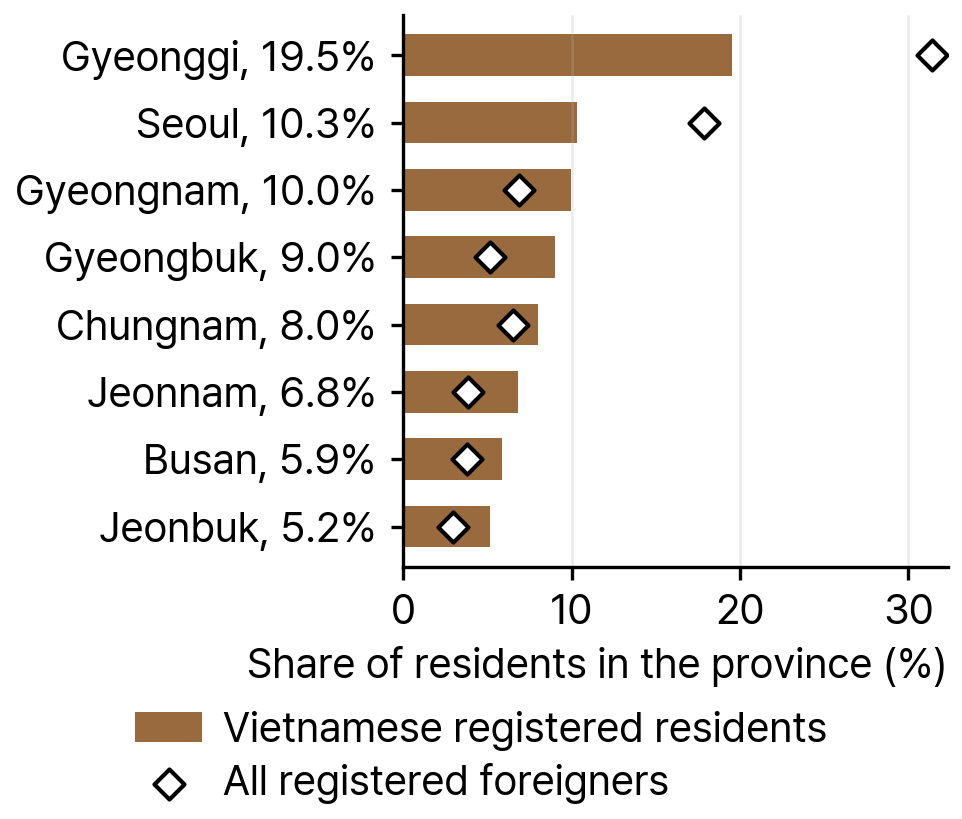
Source: KIRD dataset, from Ministry of Justice immigration yearbooks, 2006-2024.
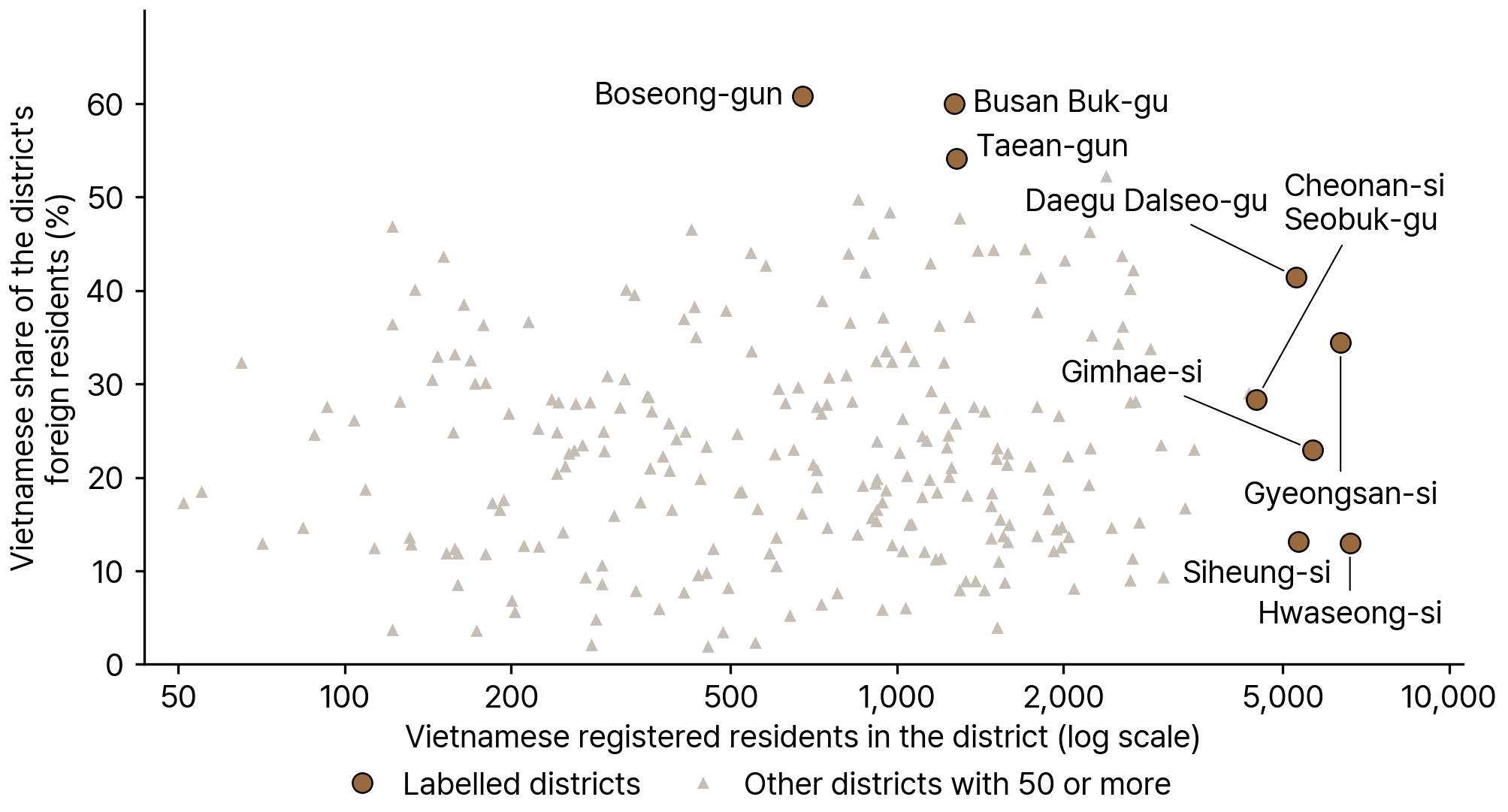
Source: KIRD dataset, from Ministry of Justice immigration yearbooks, 2006-2024.
Table 2Ten Districts with the Most Registered Vietnamese Residents, 2024
| District | Province | Vietnamese residents | Share of district's registered foreigners (%) |
|---|---|---|---|
| Hwaseong-si | Gyeonggi-do | 6,615 | 13.0 |
| Gyeongsan-si | Gyeongsangbuk-do | 6,362 | 34.4 |
| Gimhae-si | Gyeongsangnam-do | 5,668 | 22.9 |
| Siheung-si | Gyeonggi-do | 5,332 | 13.2 |
| Daegu Dalseo-gu | Daegu | 5,290 | 41.5 |
| Cheonan-si Seobuk-gu | Chungcheongnam-do | 4,474 | 28.3 |
| Gwangju Gwangsan-gu | Gwangju | 4,341 | 29.0 |
| Geoje-si | Gyeongsangnam-do | 3,450 | 23.0 |
| Seoul Dongdaemun-gu | Seoul | 3,325 | 16.7 |
| Pyeongtaek-si | Gyeonggi-do | 3,036 | 9.3 |
Note: Counts are registered foreigners in the 2024 district-level data (261,581 Vietnamese in total).
Source: KIRD dataset, from Ministry of Justice immigration yearbooks, 2006-2024.
The dissimilarity index between Vietnamese and other registered foreigners fell from 0.324 in 2014 to 0.298 in 2024, so the group's spread across districts moved slightly closer to that of other foreign residents.
By the definition used here, 21 districts were Vietnamese enclaves in 2024. Most were rural counties or small cities outside the capital region, including Jindo-gun (810 residents, location quotient 5.6), Boryeong-si (2,234; 4.7), Taean-gun (1,283; 4.2), and Boseong-gun (675; 3.6). The larger urban enclaves were Gyeongsan-si (6,362; 4.7), Busan Sasang-gu (2,644; 2.6), Daejeon Dong-gu (2,566; 2.3), and Naju-si (1,791; 3.0). In Boseong-gun and Busan Buk-gu, Vietnamese nationals made up about 60 percent of registered foreigners (60.8 and 60.0 percent).
Age and Sex
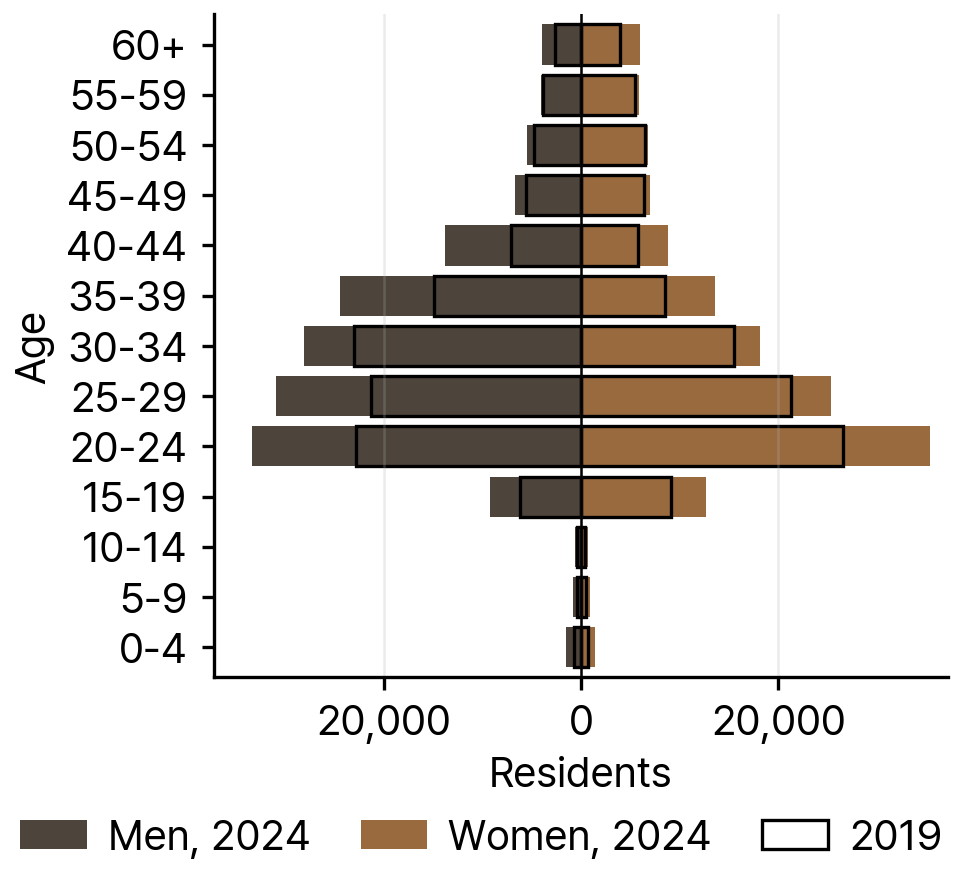
Women made up 46.7 percent of Vietnamese residents in 2024 (142,851 of 305,936), down from 49.3 percent in 2019 (110,707 of 224,518). The 2024 share was slightly above that of all resident foreigners (45.1 percent).
Most Vietnamese residents were young adults. In 2024, 209,452 (68.5 percent) were aged 20 to 39, compared with 49.7 percent of all resident foreigners. The largest five-year age group was 20 to 24, and the median fell in the 30 to 34 group. Children under 15 made up 2.0 percent (6,023) and people aged 60 and older 3.3 percent, against 5.7 percent and 12.9 percent among all resident foreigners. The number of children under 15 nearly doubled between 2019 and 2024, from 3,188 to 6,023.
Source: KIRD dataset, from Ministry of Justice immigration yearbooks, 2006-2024.
Visa Status
In 2024, study and training visas covered 32.0 percent of Vietnamese residents, employment visas 28.1 percent, marriage and family visas 27.3 percent, and short-term visits 10.7 percent. Among all resident foreigners, the corresponding shares were 10.2, 19.2, 13.6, and 19.7 percent. Only 0.8 percent of Vietnamese residents held permanent residence (F-5), compared with 7.7 percent of all resident foreigners.
The D-4 general trainee visa was the most common visa among Vietnamese residents in 2024 (55,983 holders), up from 2,277 in 2014 and 39,336 in 2019. Vietnamese nationals held 63.7 percent of all D-4 visas in Korea, the largest share of any nationality. They also held 55.2 percent of E-8 seasonal worker visas (13,541), a category with no Vietnamese holders in 2019. E-9 non-professional employment visas rose from 36,621 in 2019 to 41,547 in 2024 but remained below the 2014 level of 49,404.
Source: KIRD dataset, from Ministry of Justice immigration yearbooks, 2006-2024.
Source: KIRD dataset, from Ministry of Justice immigration yearbooks, 2006-2024.
Table 3Main Visa Types Held by Vietnamese Residents in South Korea, 2019 and 2024
| Visa | Meaning | 2019 | 2024 | Share of Vietnamese residents, 2024 (%) | Share of all holders of this visa in Korea, 2024 (%) |
|---|---|---|---|---|---|
| D-4 | General trainee | 39,336 | 55,983 | 18.3 | 63.7 |
| E-9 | Non-professional employment | 36,621 | 41,547 | 13.6 | 12.3 |
| D-2 | Student | 18,337 | 41,359 | 13.5 | 23.2 |
| F-6 | Marriage migration | 41,772 | 40,129 | 13.1 | 27.0 |
| F-1 | Visiting cohabitation | 35,364 | 33,129 | 10.8 | 33.4 |
| C-3 | Short-term visit | 31,531 | 31,278 | 10.2 | 19.2 |
| E-8 | Seasonal worker | 0 | 13,541 | 4.4 | 55.2 |
Note: Shares of Vietnamese residents use the 2024 total of 305,936 resident foreigners.
Source: KIRD dataset, from Ministry of Justice immigration yearbooks, 2006-2024.
Migration Channels and Policy
Labor migration from Vietnam takes place mainly through the Employment Permit System. Korea and Vietnam first signed an EPS memorandum in 2004 and renewed it for the ninth time in June 2023, by which point Vietnam had sent about 137,000 E-9 workers in total, the most among the 16 sending countries (EToday, 2023).
Marriage migration is a second channel. Vietnam has been the largest source of foreign brides marrying Korean nationals since 2015, and in 2018 it accounted for 38 percent of them (6,338 of 16,608) (World Bank/KNOMAD, 2023). In the KIRD data, 40,129 Vietnamese held the F-6 marriage migrant visa in 2024, 27.0 percent of all F-6 holders.
Education is the most recent channel. In the count of students at Korean universities as of April 2026, Vietnam passed China for the first time as the largest source of international students, with 96,834 students (31.5 percent) (Korea JoongAng Daily, 2026). Ministry of Justice data had already shown Vietnam ahead in August 2025, with 107,807 Vietnamese students against 86,179 Chinese students, out of 305,329 foreign students in total (Korea Times, 2025).
Korea has suspended EPS recruitment from parts of Vietnam over visa overstays. After a suspension in 2012, Korea in March 2017 barred recruitment from 11 localities, Hanoi and areas of Bac Ninh, Hai Duong, Hung Yen, Nam Dinh, Phu Tho, Thai Binh, Thanh Hoa, Nghe An, Ha Tinh, and Quang Binh provinces, where more than 30 percent of workers sent had overstayed (VnExpress International, 2017). Suspensions ordered from the Vietnamese side are described in the section on migration from Vietnam to South Korea.
Naturalization
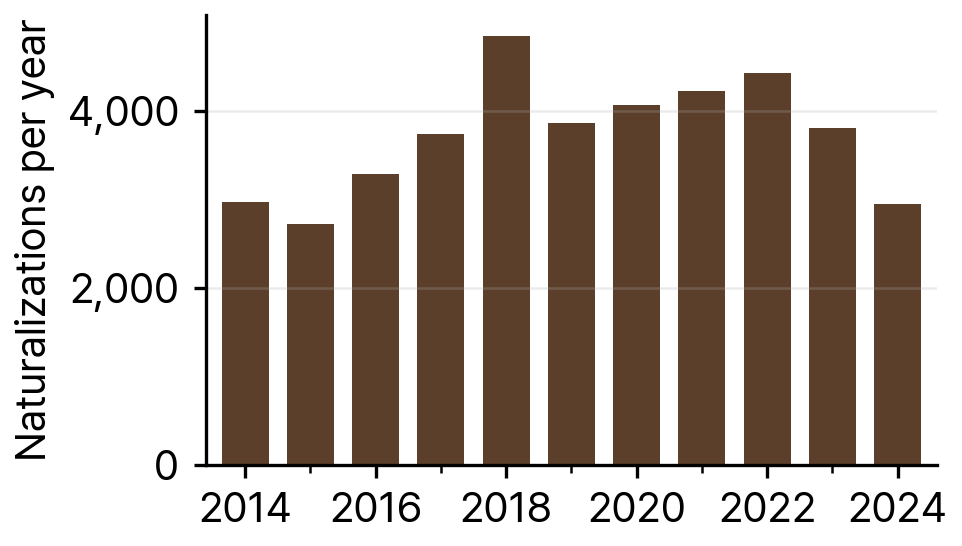
Between 2014 and 2024, 40,936 Vietnamese nationals acquired Korean citizenship through naturalization. Annual numbers rose from 2,977 in 2014 to a high of 4,849 in 2018, ranged from 3,807 to 4,431 from 2019 to 2023, and fell to 2,951 in 2024. The Ministry of Justice also recorded 722 restorations of Korean nationality among Vietnamese nationals over 2011-2024, 20 of them in 2024.
Source: KIRD dataset, from Ministry of Justice immigration yearbooks, 2006-2024.
Unauthorized Residents
Vietnam is among the ten nationalities that the Ministry of Justice yearbook (table 6-4) reports separately for unauthorized residents. The count was 58,686 in 2019, 70,411 in 2021, 79,882 in 2023, and 77,730 in 2024. The 2024 figure equals 25.4 percent of Vietnamese resident foreigners that year (77,730 of 305,936) and 19.6 percent of all 397,522 unauthorized foreign residents (77,730 of 397,522), the second-largest count by nationality.
Overstays have led to suspensions of EPS recruitment from Vietnamese districts with high non-return rates in 2012, 2016, 2017, and 2023. The two migration sections of this profile describe them.
Health and Well-being
A 2014 study of 216 Vietnamese immigrant women in South Korea found that acculturative stress and depression directly affected the mental health component of their health-related quality of life, while social support acted indirectly through stress and depression (Chae et al., 2014).
Occupational safety has drawn public attention. On March 10, 2026, Nguyen Van Tuan, a 23-year-old Vietnamese worker, died after being trapped beneath an operating conveyor belt at a gravel-processing plant in Icheon, Gyeonggi Province; the company had not followed the two-person team rule for the task (Kyunghyang Shinmun, 2026). On April 17, 2026, the employer agreed to compensate his family using Korean wage levels through age 65, the basis applied to Korean workers. Compensation for migrant workers had usually switched to home-country wages after the end of their visa period (Business & Human Rights Resource Centre, 2026).
Migration from Vietnam to South Korea
Vietnam sent more than 158,500 workers abroad for employment in 2024, including more than 52,800 women, and Japan, South Korea, and Taiwan were the traditional markets receiving the most Vietnamese workers (Vietnam News, 2024). Of the 158,588 workers counted in 2024, 13,649 (8.6 percent) went to South Korea (Vietnam.vn, 2024). In 2025, more than 11,600 of over 144,000 Vietnamese workers sent abroad went to South Korea, about 8 percent (Vietnam.vn, 2025a). Vietnamese sources counted nearly 130,000 worker placements to Korea over the first 20 years of the EPS (Vietnam.vn, 2023).
In 2023, Vietnam registered 23,412 workers for the EPS, nearly double its target of about 12,000 workers (Vietnam News, 2023). In the round covered by a December 2023 bilateral agreement, about 29,000 Vietnamese workers registered for the Korean-language test, more than half met the conditions, and just over 10,200 received visas (Vietnam.vn, 2023). In 2024, nearly 46,000 Vietnamese candidates applied to take the EPS-TOPIK Korean-language test, the most in ten years (Vietnam.vn, 2024).
Vietnam received an estimated USD 14 billion in remittances in 2023, among the ten largest amounts received by any country (VietnamPlus, 2023). Personal remittances equaled 3.36 percent of Vietnam's GDP in 2024 (Trading Economics, 2024, citing World Bank data). The World Bank's bilateral remittance estimates, last produced for 2021, put remittances sent from South Korea to Vietnam at about US$918.9 million that year (World Bank, 2021).
Information on where Korea-bound workers come from is available for Nghe An province and from lists of districts under recruitment suspension. About 16,500 people from Nghe An province were working in South Korea on fixed-term contracts in the mid-2020s, out of an estimated 85,000 Nghe An natives working abroad (Vietnam.vn, 2025b). In 2016, Korea's labor ministry blocked new EPS placements from 44 districts and towns in Nghe An, Thanh Hoa, Ha Tinh, Hanoi, Hai Duong, Thai Binh, Nam Dinh, Bac Ninh, Quang Binh, and Hung Yen. In 2012, more than 70 percent of workers from Nghe An and more than 90 percent from Quang Binh had remained in Korea after their contracts expired (VietNamNet, 2016).
Vietnam's labor ministry has also suspended recruitment from its own side. In April 2017, the Ministry of Labour, Invalids and Social Affairs halted the enrollment of fishery workers from 58 districts in coastal provinces that each had more than 60 workers living unlawfully in Korea, among them Nghi Xuan, Cam Xuyen, Loc Ha, Thach Ha, and Ky Anh in Ha Tinh and Bo Trach, Ba Don, and Dong Hoi in Quang Binh (VietNamNet, 2017). On March 10, 2023, Vietnam's Ministry of Labour suspended recruitment for eight districts, towns, and cities, which were Nghi Xuan and Cam Xuyen in Ha Tinh, Chi Linh in Hai Duong, Cua Lo, Nghi Loc, and Hung Nguyen in Nghe An, and Dong Son and Hoang Hoa in Thanh Hoa. Each had more than 70 workers residing unlawfully in Korea and a non-return rate above 27 percent (Vietnam News, 2023).
Research on Vietnamese migration to Korea has concentrated on marriage migration and on Korean policy. The growth of the Vietnam-Korea marriage market has been attributed to a marriage squeeze on rural Korean men, a preference for marrying up in both countries, economic motives on the Vietnamese side, commercial marriage brokers, and growing migrant networks (Lee et al., 2016). A Q-methodology study of 26 Vietnamese marriage migrants in rural Korea found four patterns of adaptation, ranging from positive adaptation with strong family support to passive adaptation with regret about the marriage and language barriers, which together explained 55.4 percent of the variance (Jeon et al., 2019). A policy analysis found that Korea's policy toward Vietnamese migrants alternated between coalitions favoring expansion and restriction, with tighter rules in 2012 and wider admissions after 2020, and concluded that expanding temporary recruitment without paths to permanent residence does not address Korea's demographic decline (Kim et al., 2026). A qualitative study of Vietnamese workers in Taiwan and their families found that commercial brokers working within restrictive migration systems raise migration costs and add to families' financial strain (Hoang, 2020). To our knowledge, no comparable study examines debt among Vietnamese EPS workers bound for Korea.
Table 4Migration indicators, Vietnam and South Korea
| Indicator | Value | Source |
|---|---|---|
| Workers sent abroad, 2024 | More than 158,500 | Vietnam News, 2024 |
| Workers sent to South Korea, 2024 | 13,649 (8.6% of 158,588) | Vietnam.vn, 2024 |
| Workers sent to South Korea, 2025 | More than 11,600 of over 144,000 | Vietnam.vn, 2025a |
| EPS worker placements to Korea, first 20 years | Nearly 130,000 | Vietnam.vn, 2023 |
| EPS registrations against target, 2023 | 23,412 against about 12,000 | Vietnam News, 2023 |
| EPS-TOPIK applicants, 2024 | Nearly 46,000 | Vietnam.vn, 2024 |
| Remittances received, 2023 | About USD 14 billion | VietnamPlus, 2023 |
| Remittances as share of GDP, 2024 | 3.36% | Trading Economics, 2024 |
| Remittances sent from South Korea, 2021 (World Bank estimate) | About USD 918.9 million | World Bank, 2021 |
| Nghe An natives working in South Korea, mid-2020s | About 16,500 | Vietnam.vn, 2025b |
Source: Vietnamese government and press reports, World Bank data via Trading Economics.
Community Organizations
The Association of Vietnamese Community in Korea (AVCK) opened a chapter in Asan, South Chungcheong Province, on July 26, 2026. At the launch, Vietnam's embassy cited more than 370,000 Vietnamese nationals in Korea, including nearly 100,000 women in multicultural families and more than 100,000 students (VietnamPlus, 2026). That embassy figure is for 2026 and differs from the Ministry of Justice count of 305,936 for 2024. In Wongok-dong, Ansan, a designated multicultural special zone with the country's largest concentration of foreign residents, Vietnamese residents are the second-largest group after Chinese residents (Korea Times, 2024).
Of the 1,720 migrant-serving organizations in the KIRD census, 7 name the Vietnamese community in their name or target group. They include the community group Xin Chào in Jeungpyeong-gun (North Chungcheong), the Vietnamese Community Association of Jeonnam and Gwangju in Gwangju Seo-gu, Wonosa, a Vietnamese Buddhist temple in Cheonan Dongnam-gu (South Chungcheong), the Seoul office of the Vietnamese overseas labor center that manages EPS workers, in Seoul Jung-gu, and the Okcheon County Council of Marriage Migrant Women in Okcheon-gun (North Chungcheong). Most general-purpose organizations in the census, such as multicultural family support centers and migrant worker centers, also serve Vietnamese residents.
Sources
KIRD dataset (Korea Immigration Regional Dashboard), compiled from Ministry of Justice immigration yearbooks, 2006-2024. https://doi.org/10.3886/E249944V1
EToday. 2023. Korea-Vietnam EPS MOU renewed for the ninth time (in Korean). https://www.etoday.co.kr/news/view/2259772
Lee, Taehoon. 2023. Migration Data and Marriage Migrants in the Republic of Korea. KNOMAD Paper 56. World Bank/KNOMAD. https://documents1.worldbank.org/curated/en/099754108232424887/txt/IDU124a61ea01f8c414ac919c8a195748e549a0d.txt
Korea JoongAng Daily. 2026. Vietnam overtakes China as No. 1 source of international students in Korea. https://www.koreajoongangdaily.com/korea/vietnam-overtakes-china-as-no-1-source-of-international-students-in-korea/12845246
VnExpress International. 2017. S Korea closes labor door to Hanoi, Vietnam provinces as many overstay. https://e.vnexpress.net/news/business/s-korea-closes-labor-door-to-hanoi-vietnam-provinces-as-many-overstay-3563552.html
Vietnam News. 2023. Number of Vietnamese labourers in South Korea grows as workers overstay contracts. https://vietnamnews.vn/society/1532916/number-of-vietnamese-labourers-in-south-korea-grows-as-workers-overstay-contracts.html
Chae, Sun-Mi, Jee Won Park, and Hee Sun Kang. 2014. Relationships of Acculturative Stress, Depression, and Social Support to Health-Related Quality of Life in Vietnamese Immigrant Women in South Korea. Journal of Transcultural Nursing 25 (2): 137-144. https://doi.org/10.1177/1043659613515714
Kyunghyang Shinmun. 2026. 'The last journey in a foreign land': A 23-year-old Vietnamese worker who died in an industrial accident finally returns to his homeland. https://www.khan.co.kr/en/article/202603221652067/
Business & Human Rights Resource Centre. 2026. Vietnamese family wins equal compensation in fatal industrial accident case. https://www.business-humanrights.org/en/latest-news/vietnamese-family-wins-equal-compensation-in-fatal-industrial-accident-case/
VietnamPlus. 2023. Vietnam among top 10 recipients of overseas remittances in 2023. https://en.vietnamplus.vn/vietnam-among-top-10-recipients-of-overseas-remittances-in-2023-post276990.vnp
VietnamPlus. 2026. Vietnamese association launched in RoK's Asan to strengthen community ties. https://en.vietnamplus.vn/vietnamese-association-launched-in-roks-asan-to-strengthen-community-ties-post348981.vnp
The Korea Times. 2024. Wongok explores ethnic diversity. https://www.koreatimes.co.kr/www/nation/2024/09/113_75381.html
Vietnam News. 2024. Over 158,500 Vietnamese workers going abroad in 2024. https://vietnamnews.vn/society/1690985/over-158-500-vietnamese-workers-going-abroad-in-2024.html
Vietnam.vn. 2024. Labor export is booming, but still faces weaknesses in foreign language skills and discipline. https://www.vietnam.vn/en/xuat-khau-lao-dong-but-pha-nhung-van-con-diem-yeu-ve-ngoai-ngu-ky-luat
Vietnam.vn. 2025a. 2026: Recruit 4,200 workers to work in South Korea under the EPS program. https://www.vietnam.vn/en/nam-2026-tuyen-chon-4-200-lao-dong-di-lam-viec-tai-han-quoc-theo-chuong-trinh-eps
Vietnam.vn. 2023. New agreement on services to send Vietnamese workers to South Korea. https://www.vietnam.vn/en/thoa-thuan-moi-ve-dich-vu-dua-lao-dong-viet-nam-di-han-quoc/
Vietnam.vn. 2025b. Sending Vietnamese workers abroad safely and at low cost thanks to a non-profit model. https://www.vietnam.vn/en/dua-lao-dong-viet-nam-ra-nuoc-ngoai-an-toan-chi-phi-thap-nho-mo-hinh-phi-loi-nhuan
Trading Economics. 2024. Vietnam: Workers' remittances and compensation of employees received (% of GDP), World Bank data. https://tradingeconomics.com/vietnam/workers-remittances-and-compensation-of-employees-received-percent-of-gdp-wb-data.html
VietNamNet. 2016. South Korea blocks workers from 10 provinces in Vietnam. https://vietnamnet.vn/en/south-korea-blocks-workers-from-10-provinces-in-vietnam-E161376.html
VietNamNet. 2017. Workers from 58 districts banned from work in South Korea. https://vietnamnet.vn/en/workers-from-58-districts-banned-from-work-in-south-korea-E175758.html
The Korea Times. 2025. Vietnam replaces China as largest source of int'l students at Korean universities. https://www.koreatimes.co.kr/southkorea/society/20251224/vietnam-replaces-china-as-largest-source-of-intl-students-at-korean-universities
Hoang, L. A. (2020). Debt and (un)freedoms: The case of transnational labour migration from Vietnam. Geoforum, 116, 33-41. https://doi.org/10.1016/j.geoforum.2020.08.001
Jeon, M., Ahn, O., & An, M. (2019). Immigrant Vietnamese women's adaptation to culture and society in rural areas of Korea. PLoS ONE, 14(2), e0212265. https://doi.org/10.1371/journal.pone.0212265
Kim, H., Park, J., & Lee, J. (2026). Instrumentalizing migration in an era of demographic crisis: Policy beliefs and punctuated equilibria in South Korea's Vietnamese migration policy. Social Sciences, 15(9), 619. https://doi.org/10.3390/socsci15090619
Lee, H., Williams, L., & Arguillas, F. (2016). Adapting to marriage markets: International marriage migration from Vietnam to South Korea. Journal of Comparative Family Studies, 47(2), 267-288. https://doi.org/10.3138/jcfs.47.2.267
World Bank. 2021. Bilateral Remittance Estimates (WB_KNOMAD_BRE), Data360. https://data360api.worldbank.org/data360/data?DATABASE_ID=WB_KNOMAD&INDICATOR=WB_KNOMAD_BRE&REF_AREA=KOR
Suggested citation: Korea Immigration Regional Dashboard (KIRD). 2026. “Vietnamese Immigrants in South Korea.” Foreign Residents in South Korea series, September 2026. Data: Korea Immigration Regional Dashboard (KIRD) dataset, https://doi.org/10.3886/E249944V1. Interactive maps and tables: https://immigrantsinkorea.today.