 Korea Immigration Regional Dashboard
SpotlightSeptember 2026Nationality profilesDownload PDF
Thai Immigrants in South Korea
Highlights
- At the end of 2024, Thailand was the 10th-largest nationality among registered foreigners in South Korea (43,459 people, 2.9 percent) and the fourth-largest among all resident foreigners (188,770 people, 7.1 percent).
- The Thai resident population peaked at 209,909 in 2019 and stood 10.1 percent below that level in 2024, 17th of the 20 largest nationalities by growth over 2019-24.
- In 2024, 75.6 percent of Thai residents held B-1 visa-exemption status, and Thai nationals made up 69.1 percent of all B-1 holders in Korea.
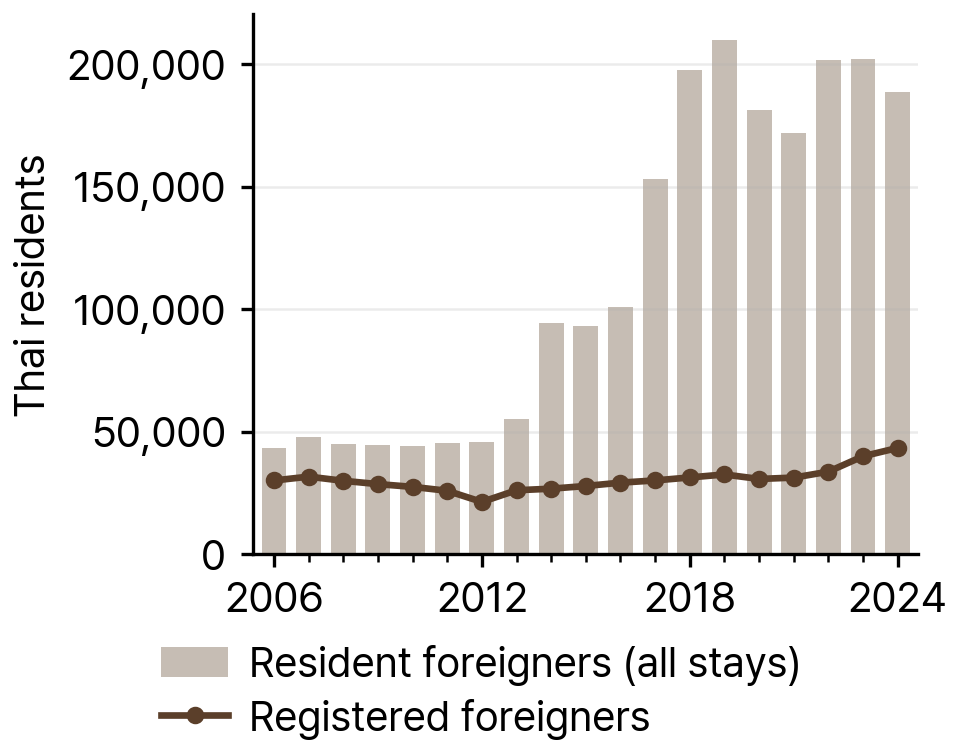
At the end of 2024, 43,459 Thai nationals were registered foreigners in South Korea, 2.9 percent of all registered foreigners and the 10th-largest nationality on that basis; counting short-term visitors, South Korea had 188,770 Thai resident foreigners, 7.1 percent of the total and the fourth-largest nationality. Among registered foreigners Thailand moved from fifth place in 2006 to 10th in 2024, while among all resident foreigners it moved from sixth in 2006 to fourth in 2019 and 2024. The resident count grew from 43,307 in 2006 to a peak of 209,909 in 2019, then fell to 188,770 in 2024.
Organized labor migration from Thailand began with a 2004 memorandum of understanding under Korea's Employment Permit System (EPS), and Thailand and Korea have since signed seven such agreements covering nearly 95,000 Thai workers (Pattaya Mail, 2024). Thai women also arrive through marriage, and Thailand was the third-largest nationality of foreign wives in 2024 (Korea Multicultural Internet Newspaper, 2024). Since 2024 a seasonal-worker scheme (E-8) has added short farm and fishery placements (The Nation, 2026a).
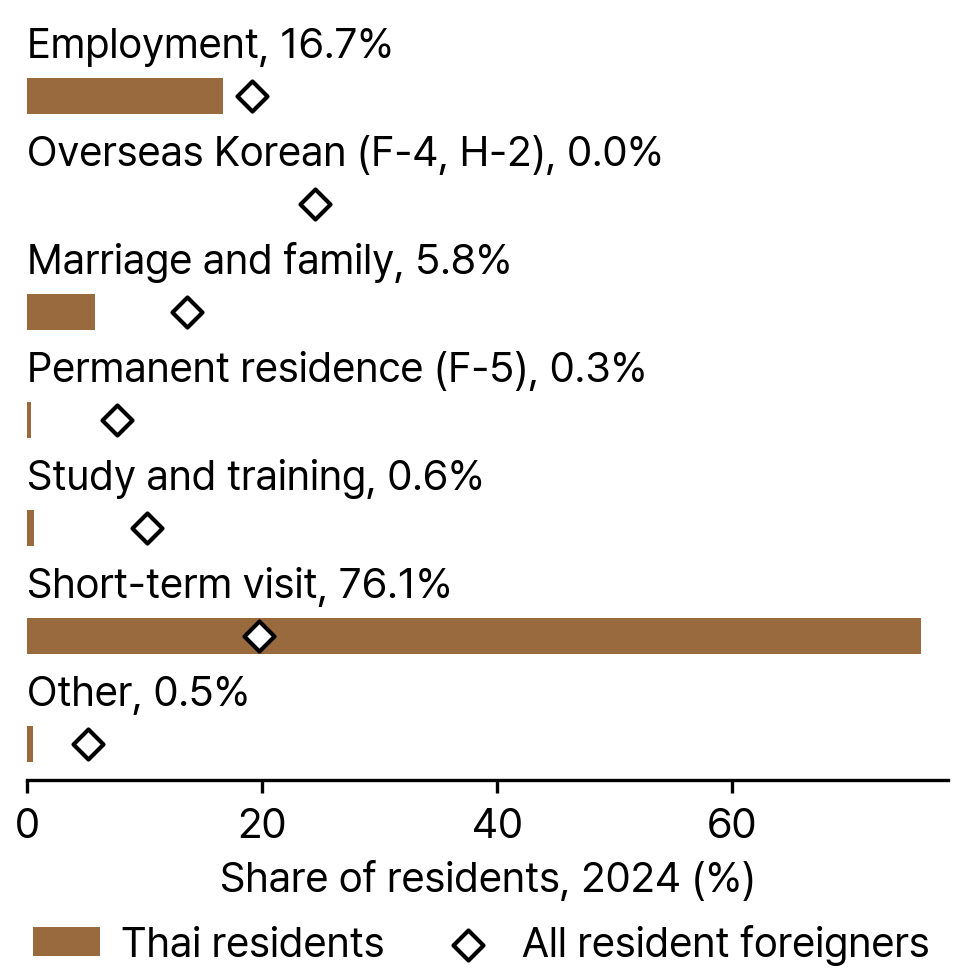
The Thai population differs from resident foreigners overall in its legal status. In 2024, 76.1 percent of Thai residents were on short-term visit statuses, compared with 19.7 percent of all resident foreigners, and only 23.0 percent were registered foreigners. Thai residents are also younger and more often women: 62.6 percent were aged 20 to 39 and 53.4 percent were women, against 49.7 percent and 45.1 percent of all resident foreigners.
Size of the Population over Time
The number of Thai resident foreigners rose from 43,307 in 2006 to 209,909 in 2019, a more than fourfold increase. Growth was uneven. The count edged up to 44,250 in 2010, more than doubled to 94,314 by 2014, and more than doubled again by 2019. Thailand's rank among all resident foreigners rose from sixth in 2006 to fifth in 2014 and fourth in 2019, and its share of resident foreigners went from 4.8 percent in 2006 to 8.3 percent in 2019.
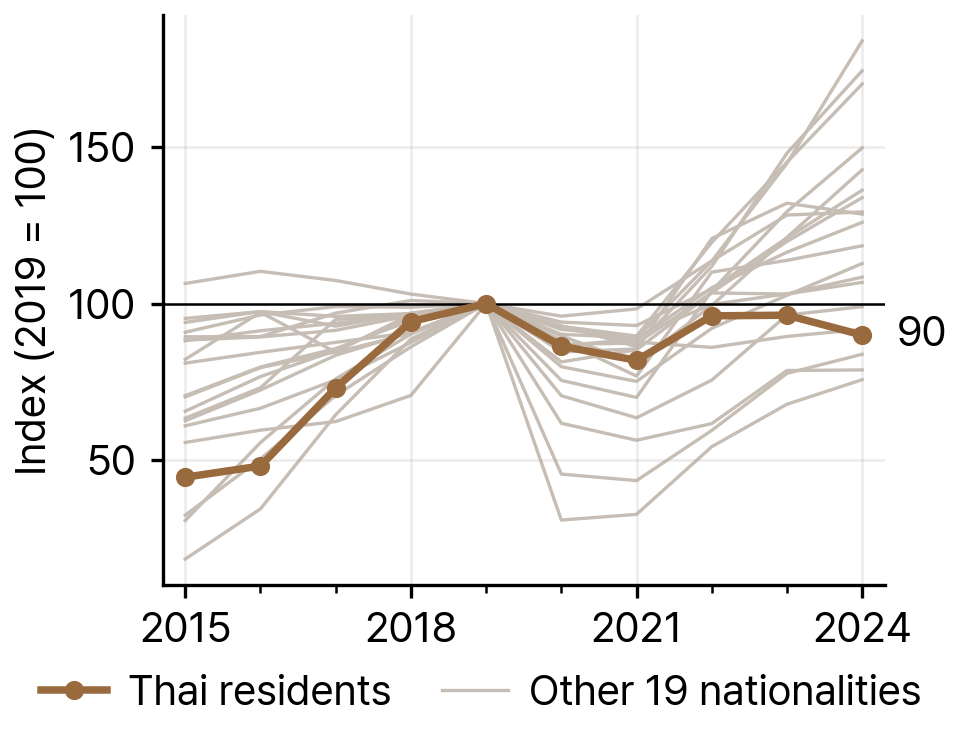
After 2019 the population declined to 181,386 in 2020 and 171,800 in 2021, recovered to 201,681 in 2022 and 202,121 in 2023, and fell to 188,770 in 2024, when Thailand still ranked fourth among resident foreigners with 7.1 percent of the total. The 2024 figure was 89.9 percent of the 2019 level (index 2019 = 100), which placed Thailand 17th of the 20 largest nationalities by change over 2019-24.
Registered foreigners are a small share of the Thai total. In 2006, 30,170 of 43,307 Thai residents (69.7 percent) were registered; by 2019 the figure was 32,633 of 209,909 (15.5 percent). In 2024, 43,459 Thai residents were registered, 23.0 percent of the total. Among registered foreigners, Thailand ranked fifth in 2006 (4.8 percent of all registered foreigners), eighth in 2014 (2.5 percent), ninth in 2019 (2.6 percent), and 10th in 2024 (2.9 percent).
Source: KIRD dataset, from Ministry of Justice immigration yearbooks, 2006-2024.
Source: KIRD dataset, from Ministry of Justice immigration yearbooks, 2019-2024.
Table 1Thai Residents in South Korea, Selected Years, 2006-24
| Year | Resident foreigners | Registered foreigners | Registered as % of resident | Rank among registered foreigners | Rank among all resident foreigners | Share of all registered foreigners (%) | Share of all resident foreigners (%) |
|---|---|---|---|---|---|---|---|
| 2006 | 43,307 | 30,170 | 69.7 | 5 | 6 | 4.8 | 4.8 |
| 2014 | 94,314 | 26,827 | 28.4 | 8 | 5 | 2.5 | 5.2 |
| 2019 | 209,909 | 32,633 | 15.5 | 9 | 4 | 2.6 | 8.3 |
| 2024 | 188,770 | 43,459 | 23.0 | 10 | 4 | 2.9 | 7.1 |
Note: Registered as % of resident is computed as registered foreigners divided by resident foreigners. Resident foreigners include short-term visitors and F-4 residence reporters; registered foreigners are long-term residents who registered with immigration authorities.
Source: KIRD dataset, from Ministry of Justice immigration yearbooks, 2006-2024.
Distribution by Province and District
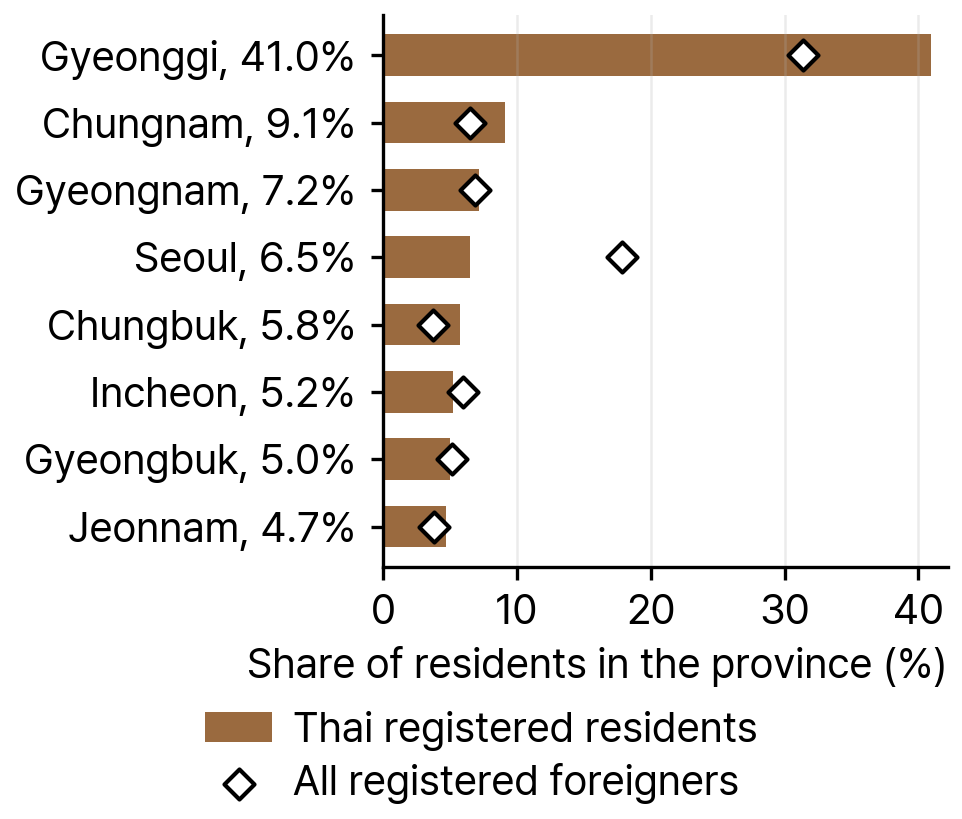
Of the 43,459 Thai registered foreigners in 2024, 46.2 percent (20,060) lived in Incheon and Gyeonggi and 6.5 percent (2,840) in Seoul, so 52.7 percent lived in the capital region, against 55.2 percent of all foreigners. Yeongnam was home to 18.0 percent (7,815), Chungcheong 16.7 percent (7,251), Honam 9.0 percent (3,903), and Gangwon and Jeju 3.7 percent (1,590).
Thai residents live in rural counties (gun) more often than other foreigners: 15.8 percent did in 2024, compared with 10.6 percent of all foreigners. The rural share was highest in Gangwon and Jeju (44.5 percent) and Honam (43.0 percent).
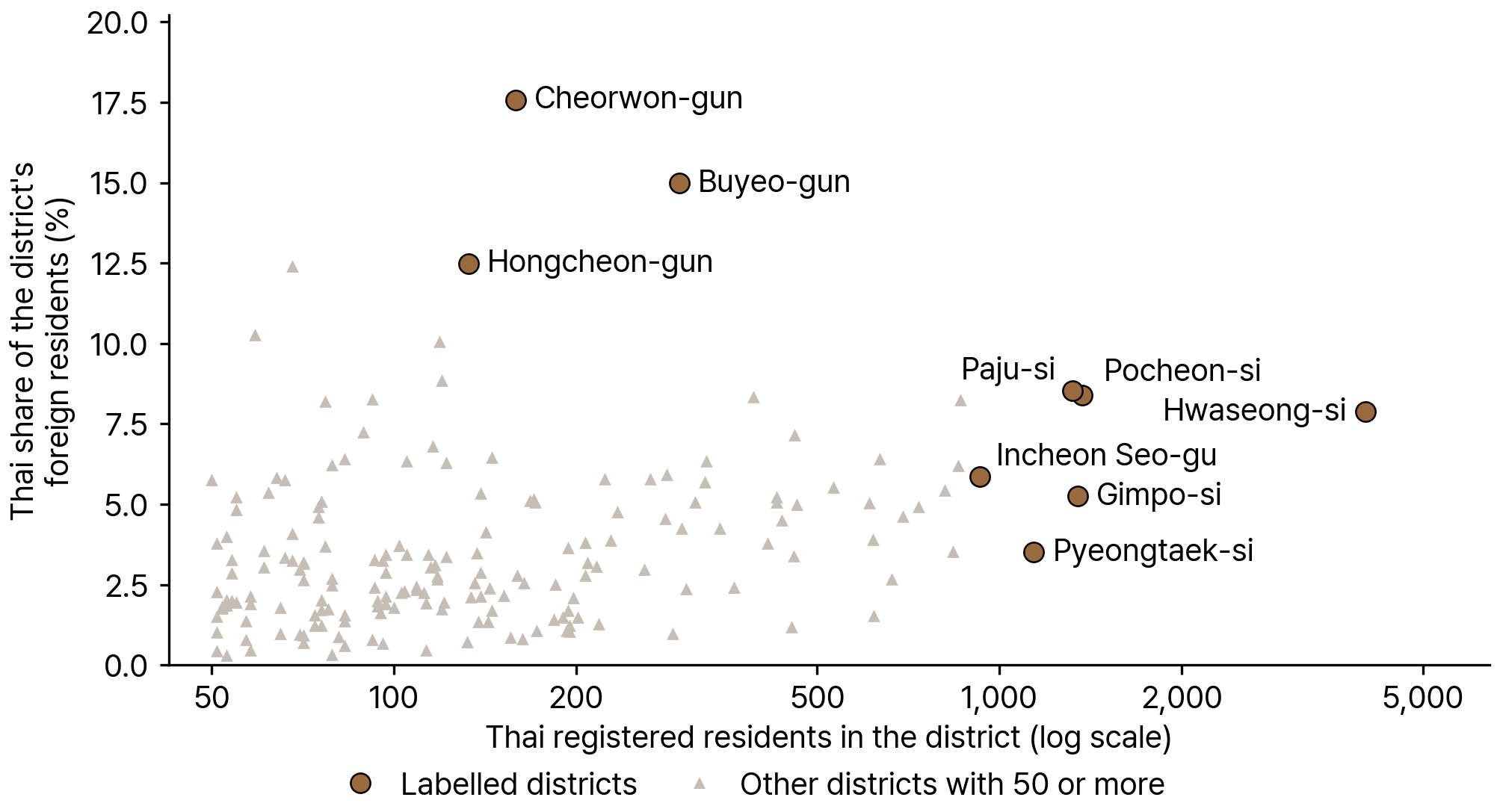
Hwaseong-si in Gyeonggi-do had the largest Thai population, 4,028 in 2024, or 7.9 percent of the district's foreign residents. The ten largest districts together accounted for 31.1 percent of Thai registered foreigners, and 105 districts had 100 or more Thai residents. Thai residents made up the largest shares of the foreign population in small rural counties, led by Cheorwon-gun (159 people, 17.6 percent of its foreign residents), Buyeo-gun (296, 15.0 percent), and Hongcheon-gun (133, 12.5 percent).
The index of dissimilarity (D) between Thai and all other registered foreigners across districts fell from 0.525 in 2014 to 0.418 in 2024, so Thai residents became more evenly distributed across districts relative to other registered foreigners. No district met the definition of an ethnic enclave in 2024 (a location quotient of at least 2 with Thai nationals forming at least 30 percent of the district's foreign residents).
Source: KIRD dataset, from Ministry of Justice immigration yearbooks, 2024.
Source: KIRD dataset, from Ministry of Justice immigration yearbooks, 2024.
Table 2Ten Districts with the Largest Thai Populations, 2024
| District | Province | Thai residents | Share of district's foreign residents (%) |
|---|---|---|---|
| Hwaseong-si | Gyeonggi-do | 4,028 | 7.9 |
| Pocheon-si | Gyeonggi-do | 1,370 | 8.4 |
| Gimpo-si | Gyeonggi-do | 1,346 | 5.3 |
| Paju-si | Gyeonggi-do | 1,320 | 8.5 |
| Pyeongtaek-si | Gyeonggi-do | 1,140 | 3.5 |
| Seo-gu | Incheon | 928 | 5.9 |
| Icheon-si | Gyeonggi-do | 862 | 8.3 |
| Eumseong-gun | Chungcheongbuk-do | 856 | 6.2 |
| Asan-si | Chungcheongnam-do | 837 | 3.6 |
| Anseong-si | Gyeonggi-do | 813 | 5.5 |
Note: Counts are registered foreigners. The ten districts accounted for 31.1 percent of Thai registered foreigners in 2024.
Source: KIRD dataset, from Ministry of Justice immigration yearbooks, 2024.
Age and Sex
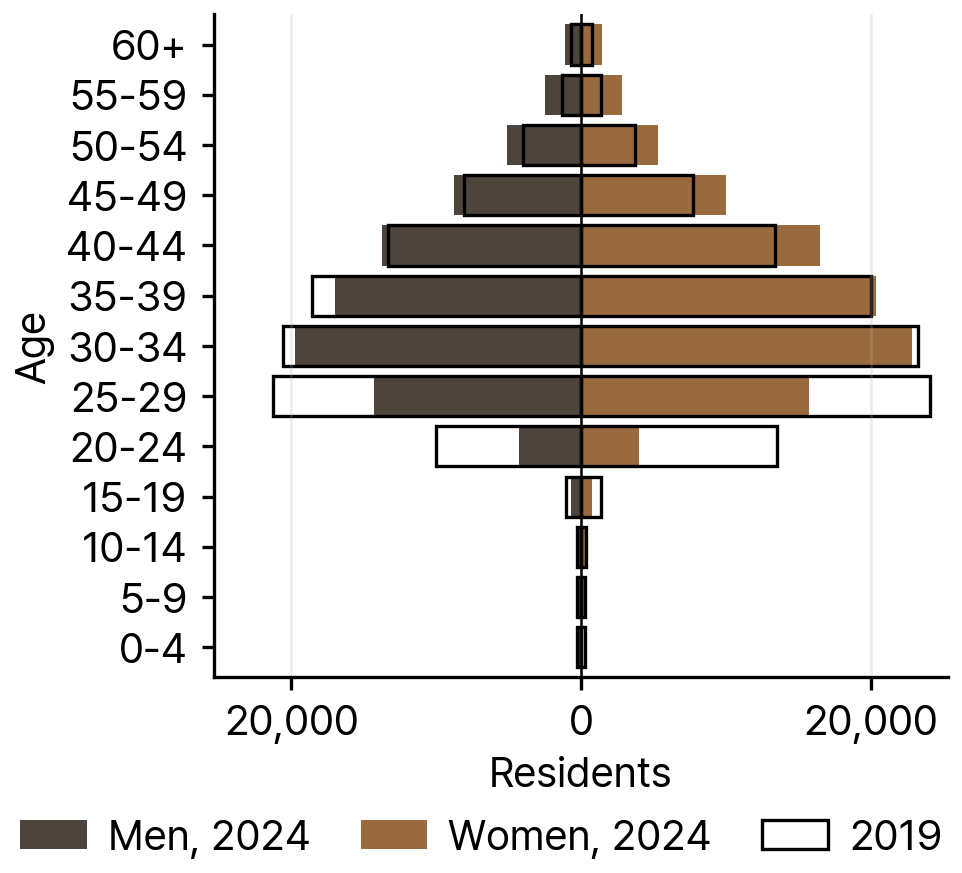
Women made up 53.4 percent (100,765) of Thai residents in 2024, up from 52.5 percent in 2019. Among all resident foreigners, 45.1 percent were women.
The Thai population is concentrated in young working ages. In 2024, 62.6 percent (118,237) were aged 20 to 39, compared with 49.7 percent of all resident foreigners. The largest five-year group was 30 to 34, and the median fell in the 35 to 39 group. Children aged 0 to 14 were 0.9 percent (1,657) of Thai residents, against 5.7 percent of all resident foreigners, and people aged 60 or older were 1.4 percent, against 12.9 percent.
The number aged 50 or older rose from 11,910 in 2019 to 18,350 in 2024, while the number aged 20 to 39 fell from 151,346 to 118,237.
Source: KIRD dataset, from Ministry of Justice immigration yearbooks, 2024.
Visa Status
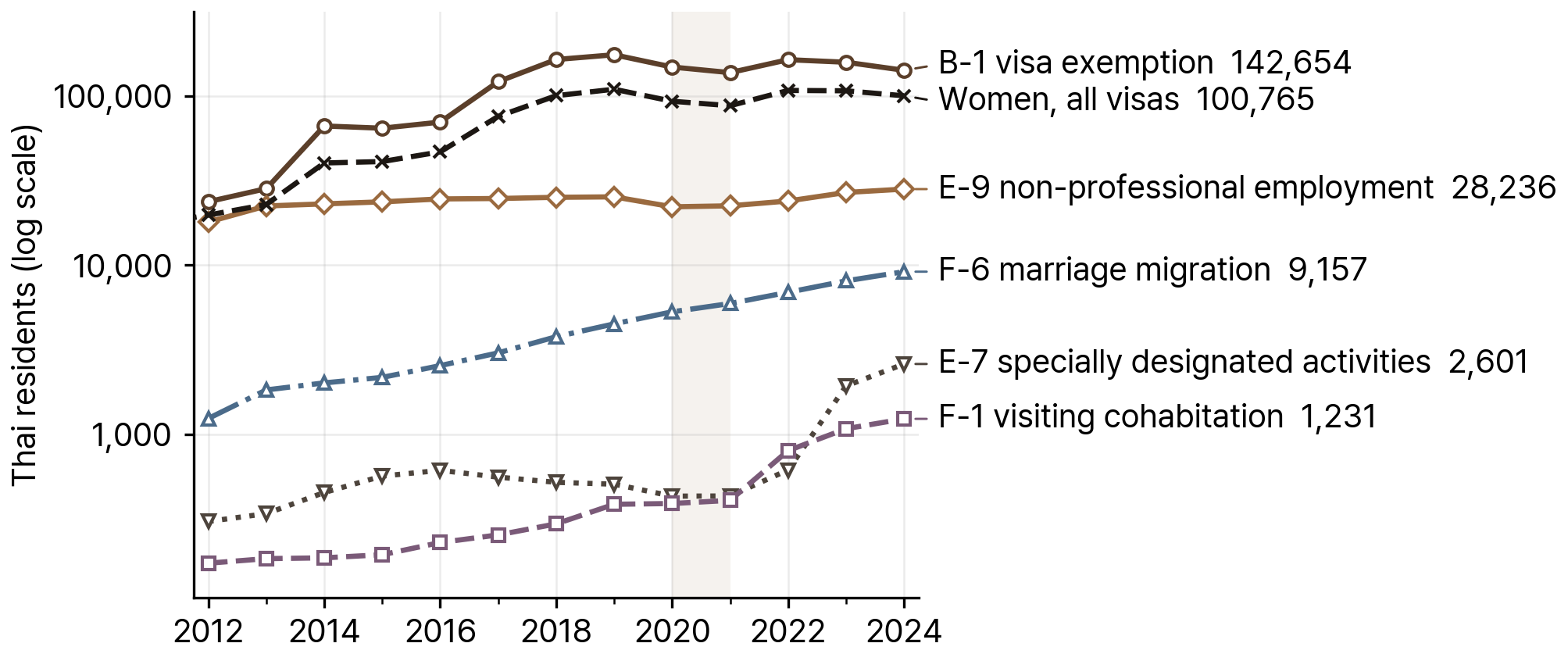
Most Thai residents are in Korea on visa exemption (B-1). In 2024, 142,654 Thai nationals held B-1 status, 75.6 percent of the group, and they accounted for 69.1 percent of all B-1 holders in Korea, the largest share of any nationality. Grouped by purpose, short-term visit statuses covered 76.1 percent of Thai residents, against 19.7 percent of all resident foreigners.
Employment statuses covered 16.7 percent of Thai residents (19.2 percent of all resident foreigners). The largest was non-professional employment (E-9), held by 28,236 Thai nationals in 2024, up from 25,402 in 2019; Thai workers were 8.4 percent of all E-9 holders. Specially designated activities (E-7) grew from 505 to 2,601 over the same period.
Marriage migration (F-6) roughly doubled, from 4,495 in 2019 to 9,157 in 2024. Marriage and family statuses together covered 5.8 percent of Thai residents, compared with 13.6 percent of all resident foreigners. Permanent residents (F-5) numbered 625 in 2024, 0.3 percent of the group, against 7.7 percent of all resident foreigners.
Source: KIRD dataset, from Ministry of Justice immigration yearbooks, 2024.
Source: KIRD dataset, from Ministry of Justice immigration yearbooks, 2006-2024.
Table 3Main Visa Types Held by Thai Residents, 2019 and 2024
| Visa | Meaning | 2019 | 2024 | Share of Thai residents, 2024 (%) | Thai share of all holders of the visa, 2024 (%) |
|---|---|---|---|---|---|
| B-1 | Visa exemption | 176,322 | 142,654 | 75.6 | 69.1 |
| E-9 | Non-professional employment | 25,402 | 28,236 | 15.0 | 8.4 |
| F-6 | Marriage migration | 4,495 | 9,157 | 4.9 | 6.2 |
| E-7 | Specially designated activities | 505 | 2,601 | 1.4 | 4.1 |
| F-1 | Visiting cohabitation | 384 | 1,231 | 0.7 | 1.2 |
| C-3 | Short-term visit | 23 | 962 | 0.5 | 0.6 |
| F-5 | Permanent residence | 637 | 625 | 0.3 | 0.3 |
Note: Shares are of 188,770 Thai resident foreigners in 2024.
Source: KIRD dataset, from Ministry of Justice immigration yearbooks, 2019 and 2024.
Migration Channels and Policy
Thailand has sent workers under Korea's Employment Permit System since the first bilateral memorandum of understanding in 2004. The two countries have signed seven such agreements, and nearly 95,000 Thai workers had been employed in Korea under the program by 2024 (Pattaya Mail, 2024). In March 2024 Korea agreed to offer Thai workers 5,500 more EPS jobs that year, a 15 percent increase over the previous year's quota, according to Thailand's Labour Minister (The Nation, 2024).
A seasonal-worker program (E-8) began in 2024 as a cooperation scheme between Thailand's Department of Employment and Korean local authorities, placing workers from selected Thai provinces in agricultural and fishery jobs (The Nation, 2026a). Korea suspended intake from four of those provinces (Udon Thani, Khon Kaen, Chaiyaphum, and Maha Sarakham) from January 1 to December 31, 2026, after some workers sent under the seasonal-labour agreement left their employers (The Nation, 2026b).
Marriage is a second channel. Thai women were 10.0 percent of foreign wives in marriages recorded in 2024, the third-largest nationality after Vietnam (26.8 percent) and China (15.9 percent), according to Statistics Korea's 2024 multicultural population statistics as reported by the Korea Multicultural Internet Newspaper, 2024.
Visa-free entry is a third route. Thai nationals' share of Korea's visa-free overstayers rose from 27.9 percent in 2005 to 76.3 percent in 2023, the largest share of any nationality; researchers linked the trend to cheaper flights, Korean Wave tourism, and broker-arranged illegal employment. Researchers recommended adding suspension and withdrawal provisions to visa-exemption agreements such as the one with Thailand, while officials cautioned that such changes could affect diplomatic relations and would require mutual consultation (Seoul Economic Daily, 2026).
Naturalization
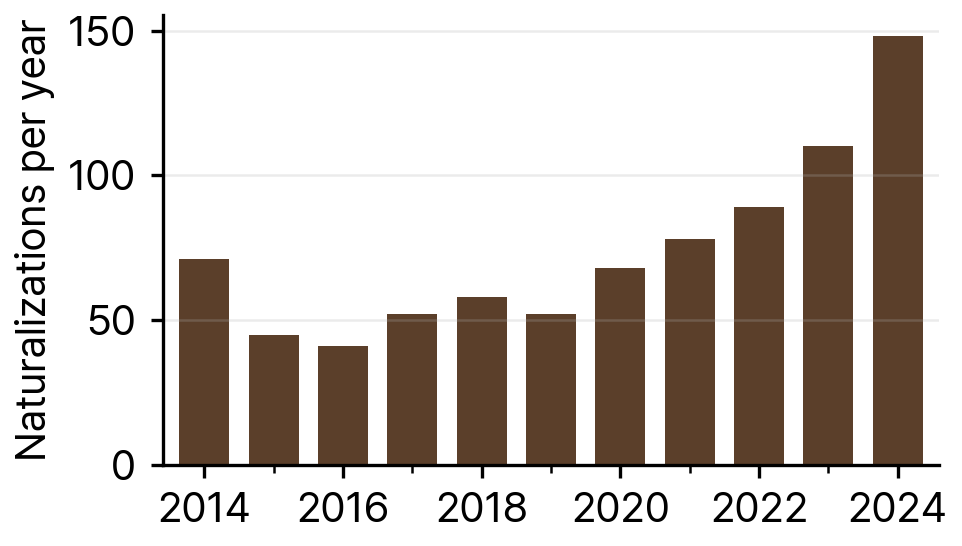
Between 2014 and 2024, 812 Thai nationals acquired Korean citizenship through naturalization. Annual numbers ranged from 41 to 58 between 2015 and 2019 and then rose each year, to 68 in 2020, 89 in 2022, 110 in 2023, and 148 in 2024, the highest in the period.
Source: KIRD dataset, from Ministry of Justice immigration yearbooks, 2014-2024.
Unauthorized Residents
Thailand does not appear among the ten nationalities that the Ministry of Justice yearbook (table 6-4) reports separately for unauthorized residents, so no official count for Thai nationals is published there; Korea had 397,522 unauthorized residents of all nationalities in 2024.
Other reporting points to a large Thai share among visa-free overstayers: Thai nationals accounted for 76.3 percent of them in 2023 (Seoul Economic Daily, 2026).
Health and Well-being
To our knowledge, no peer-reviewed study reports health outcomes for Thai residents separately. Available figures concern deaths. Of 320 migrant workers who died in industrial accidents in Korea from 2022 through June 2025, 15 were Thai nationals, the fifth-largest group after ethnic Korean Chinese (145), Chinese (36), Vietnamese (25), and Uzbek (20) workers (Kyunghyang Shinmun, 2025).
Thai embassy records obtained by Reuters through a freedom-of-information request showed that at least 522 Thai nationals had died in South Korea since 2015, as reported in December 2020, and that 84 percent of those who died were undocumented. Forty percent of the recorded deaths were attributed to unknown causes; the other 60 percent were reported as health-related incidents, accidents, and suicides (The Thaiger, 2020).
Migration from Thailand to South Korea
Korea is the second most common destination of Thai emigrants. UN DESA estimated that 199,861 Thailand-born people lived in South Korea in mid-2024, about 17 percent of the 1,178,757 Thai emigrants worldwide, behind the United States (307,741) and ahead of every other Asian destination, including Taiwan (80,032), Malaysia (70,718), and Japan (61,263) (UN DESA 2024). The Thailand Migration Report 2024, using the earlier 2020 revision of the same UN DESA series, put Korea second as well, with 159,264 of 1.086 million Thai nationals abroad in mid-2020 (IOM 2024).
Formal deployment of Thai workers to all destinations fell from 149,455 in 2019 to 118,080 in 2023. In December 2023, Korea was the second-largest destination for Thai workers deployed that month, with 1,013 workers against 2,568 for Taiwan. The Thai government arranged about 96 percent of Korea's 638 new placements that month (612 workers) under the EPS, and recruitment agencies arranged 19; for Taiwan, agencies arranged 1,721 of 1,752 new placements (IOM 2024). For fiscal year 2024, Thailand's Ministry of Labour set a target of 7,500 workers for Korea out of 100,000 workers sent abroad, the third-largest country target after Taiwan (20,300) and Israel (7,700) (Mekong Migration Network 2024). In 2024, 31,759 Thais took the EPS-TOPIK and 7,786 passed (HRD Korea 2025), and Korea admitted 6,963 Thai workers on E-9 visas (Ministry of Employment and Labor 2026).
Remittances received by Thailand through formal channels rose from USD 8.1 billion in 2019 to USD 8.9 billion in 2022, or from 1.5 percent to 1.8 percent of gross domestic product (IOM 2024). World Bank data put personal remittances at 1.82 percent of GDP in 2024 (Trading Economics 2024). The World Bank's bilateral remittance estimates, last produced for 2021, put remittances sent from South Korea to Thailand at about US$1.28 billion that year, second only to China (about US$3.76 billion) and ahead of Vietnam, the Philippines, and Mongolia (World Bank 2021).
Published sources indicate that Korea-bound workers come mainly from the northeastern (Isan) region. Field research on Thai EPS and undocumented migrants to Korea was carried out in Udon Thani province in 2022 (IPSR 2023). When 16 of 80 Thai seasonal workers left their Korean employers in 2024, most came from Udon Thani, Chaiyaphum, Khon Kaen, and Maha Sarakham (Thai PBS World 2024), the four provinces later covered by Korea's 2026 suspension of E-8 intake.
The Thai state manages most labor migration to Korea. Under a memorandum of understanding signed on June 26, 2023, for seasonal work in Korean agriculture and fisheries, Thailand's Department of Employment is the sole recruiter (IOM 2024). In 2019 Korea's justice ministry and Thailand's labour ministry signed a memorandum to share data on suspected undocumented Thai workers, after Korean immigration data for July 2019 showed Thai nationals made up 40 percent of 37,889 undocumented foreign residents (Korea Times 2019). A 2023 seminar at Mahidol University reported 147,440 undocumented Thai nationals in Korea as of January 31, 2023 (IPSR 2023). In August 2026 Thai officials described tighter pre-departure safeguards, including certificates of good conduct, briefings on roles and employment conditions, and monitoring systems, along with a state DSD Online Training platform offering more than 300 courses in Korean language, vocational, and digital skills; Korean officials had begun calling this group workers who are registered or using the wrong type of visa, dropping the term illegal foreign workers (ASEAN NOW 2026).
Research on Thai migration to Korea is limited. Chan (2023), drawing on interviews with undocumented Thai workers in Daegu and fieldwork in Bangkok, finds that the Thai government's tolerance of undocumented emigration encourages loosely planned attempts to work in Korea outside the EPS, and that informal brokers, though excluded from the EPS, continue to recruit by presenting undocumented migration as easy. Tadee et al. (2025), using 86 interviews with Thai migrant workers and stakeholders in Thailand and Korea, find that information and communication technology connects Thai workers to co-ethnic networks and labor markets in Korea while maintaining their ties to their places of origin. An earlier master's thesis (Wongprommoon 2011) reports that Thai workers favored the 2009 amendment to Korea's foreign worker act, which allowed five years of continuous employment, because it saved the cost and time of re-entry and visa renewal.
Table 4Migration indicators, Thailand and South Korea
| Indicator | Value | Source |
|---|---|---|
| Thailand-born population in South Korea, mid-2024 | 199,861 | UN DESA 2024 |
| South Korea's share of Thai emigrants and rank among destinations, 2024 | About 17 percent (199,861 of 1,178,757); second after the United States | UN DESA 2024 |
| Thai workers formally working abroad, all destinations | 149,455 (2019); 118,080 (2023) | IOM 2024 |
| Thai workers deployed to South Korea, December 2023 | 1,013; second after Taiwan (2,568) | IOM 2024 |
| New placements to South Korea arranged by the Thai government, December 2023 | 612 of 638 (about 96 percent) | IOM 2024 |
| Deployment target for South Korea, fiscal year 2024 | 7,500 of 100,000; third after Taiwan and Israel | Mekong Migration Network 2024 |
| EPS-TOPIK test takers in Thailand, 2024 | 31,759 (7,786 passed) | HRD Korea 2025 |
| E-9 workers admitted from Thailand, 2024 | 6,963 | Ministry of Employment and Labor 2026 |
| Remittances received by Thailand, formal channels | USD 8.1 billion (2019); USD 8.9 billion (2022) | IOM 2024 |
| Remittances as share of GDP | 1.5 percent (2019); 1.8 percent (2022); 1.82 percent (2024) | IOM 2024; Trading Economics 2024 |
| Remittances sent from South Korea, 2021 (World Bank estimate) | USD 1.28 billion | World Bank 2021 |
| Undocumented Thai nationals in South Korea, January 31, 2023 | 147,440 | IPSR 2023 |
Community Organizations
The KIRD census of 1,720 migrant-serving organizations lists six whose name or target group names the Thai community, all of them religious sites. They include Wat Buddharangsi Seoul temple and Hmong Blessing Church in Hwaseong-si, Buddharama Temple (formerly Dhammacetiyaram) in Danwon-gu, Ansan, the Incheon Thai Church support center in Yeonsu-gu, Incheon, Beopsinsa (a Thai Dhammakaya meditation center) in Uijeongbu-si, and Love Ground in Yeoju-si. Most general-purpose organizations in the census, such as multicultural family and migrant worker support centers, also serve Thai residents.
The Royal Thai Embassy and the Royal Thai Cultural Center in Korea co-hosted a Songkran (Thai New Year) festival with the Thailand Studies and Thai Interpretation departments of Hankuk University of Foreign Studies on April 3, 2026, which drew about 200 students and staff (Asia Economy, 2026).
Sources
Korea Immigration Regional Dashboard (KIRD) dataset, compiled from Ministry of Justice Statistical Yearbooks of Immigration and Foreign Policy, 2006-2024. https://doi.org/10.3886/E249944V1
Pattaya Mail. 2024. Thailand updates 'Employment Permit System (EPS)' with South Korea. https://www.pattayamail.com/thailandnews/thailand-updates-employment-permit-system-eps-with-south-korea-466711
The Nation (Thailand). 2024. 5500 more Thai workers to be offered jobs in South Korea. https://www.nationthailand.com/thailand/general/40036392
The Nation (Thailand). 2026a. 20% absconding rate prompts South Korea to pause intake as both sides seek fixes. https://www.nationthailand.com/business/economy/40066541
The Nation (Thailand). 2026b. South Korea halts seasonal worker intake from four Thai provinces. https://www.nationthailand.com/news/general/40066121
Korea Multicultural Internet Newspaper (한국다문화인터넷신문). 2024. Analysis of multicultural marriage by nationality, part 3: Thai marriage migrant women. https://www.xn--3e0bx5e0sbx9qba378ifzhyiursi7oc.com/bbs/board.php?bo_table=news&wr_id=4923&me_id=&me_code=&type=web
Seoul Economic Daily. 2026. Visa-Free Overstayers Exceed 170,000 as Abuse of Entry System Surges. https://en.sedaily.com/society/2026/01/29/visa-free-overstayers-exceed-170000-as-abuse-of-entry
Trading Economics (World Bank data). 2024. Thailand: Workers' remittances and compensation of employees, received (% of GDP). https://tradingeconomics.com/thailand/workers-remittances-and-compensation-of-employees-received-percent-of-gdp-wb-data.html
Kyunghyang Shinmun (경향신문). 2025. Migrant worker fatal accidents by nationality, 2022 to June 2025. https://www.khan.co.kr/article/202509281643001
The Thaiger. 2020. High number of Thai migrant worker deaths in South Korea. https://thethaiger.com/news/national/379491
Asia Economy (아시아경제). 2026. Hankuk University of Foreign Studies holds Thai Songkran festival on campus. https://view.asiae.co.kr/article/2026040907150217336
UN DESA Population Division. 2024. International Migrant Stock 2024: Destination and origin. https://www.un.org/development/desa/pd/sites/www.un.org.development.desa.pd/files/undesa_pd_2024_ims_stock_by_sex_destination_and_origin.xlsx
International Organization for Migration (IOM). 2024. Thailand Migration Report 2024. https://thailand.iom.int/sites/g/files/tmzbdl1371/files/documents/2024-12/thailand-migration-report-2024.pdf
Mekong Migration Network. 2024. Thai Ministry to send 100,000 workers abroad in fiscal year 2024. https://mekongmigration.org/?p=22694
Institute for Population and Social Research (IPSR), Mahidol University. 2023. Labour migrants from Thailand to South Korea: EPS and its challenges (IPSR Seminar No. 1209). https://ipsr.mahidol.ac.th/en/post_training/in-house-1209/
Thai PBS World. 2024. South Korea blacklists Thai workers from four northeastern provinces. https://www.thaipbsworld.com/news/south-korea-blacklists-thai-workers-from-four-northeastern-provinces
The Korea Times. 2019. Korea, Thailand sign MOU to curb flow of illegal migrant workers. https://www.koreatimes.co.kr/pages/article.asp?newsIdx=279376
ASEAN NOW. 2026. Thailand seeks South Korea E-8 visa solution. https://aseannow.com/thailand-news/thailand-seeks-south-korea-e-8-visa-solution-r3510
Chan, S. K.-L. (2023). Migration, brokerage and recruitment: Examining the socio-cultural factors surrounding Thai phi-noy undocumented migrant workers in South Korea. *PORTAL Journal of Multidisciplinary International Studies, 19*(1-2). https://doi.org/10.5130/pjmis.v19i1-2.7680
Tadee, R., Sakdapolrak, P., Sterly, H., & Pagogna, R. (2025). The roles of information communication technology in translocal embedding and anchoring among Thai migrant workers in South Korea. *Tijdschrift voor Economische en Sociale Geografie, 116*(4), 439-456. https://doi.org/10.1111/tesg.70008
Wongprommoon, N. (2011). Impacts of the Republic of Korea's amendment of foreign workers employment act (2009) on Thai labor [Unpublished master's thesis]. Chulalongkorn University. https://oalib-perpustakaan.upi.edu/Record/repochula_33595/Details
World Bank. 2021. Bilateral Remittance Estimates (WB_KNOMAD_BRE), Data360. https://data360api.worldbank.org/data360/data?DATABASE_ID=WB_KNOMAD&INDICATOR=WB_KNOMAD_BRE&REF_AREA=KOR
Human Resources Development Service of Korea (HRD Korea). 2025. 국가별 한국어시험 시행 정보 [EPS-TOPIK test takers and passes by country, 2024]. Archived April 21, 2025. https://web.archive.org/web/20250421163507/https://epstopik.hrdkorea.or.kr/epstopik/pass/candidate/selectChart.do?lang=ko
Ministry of Employment and Labor. 2026. 국가별 일반고용허가제 외국인근로자(E-9) 도입현황 [E-9 workers admitted under the Employment Permit System, by country], 2004-2025. KOSIS. https://kosis.kr/statHtml/statHtml.do?orgId=118&tblId=DT_11827_N001&conn_path=I2
Suggested citation: Korea Immigration Regional Dashboard (KIRD). 2026. “Thai Immigrants in South Korea.” Foreign Residents in South Korea series, September 2026. Data: Korea Immigration Regional Dashboard (KIRD) dataset, https://doi.org/10.3886/E249944V1. Interactive maps and tables: https://immigrantsinkorea.today.