 Korea Immigration Regional Dashboard
SpotlightSeptember 2026Nationality profilesDownload PDF
Uzbek Immigrants in South Korea
Highlights
- There were 94,893 Uzbek nationals in South Korea at the end of 2024, 61,733 of them registered foreigners. Uzbekistan was the fifth-largest nationality among registered foreigners (4.1 percent) and the sixth-largest among all resident foreigners (3.6 percent), up from seventh and ninth in 2014.
- Holders of the F-4 overseas Korean visa rose from 11,873 in 2019 to 28,895 in 2024 to become the largest visa group (30.5 percent of Uzbek residents), while H-2 working visit holders fell from 20,281 to 7,666.
- Children under age 15 made up 10.6 percent of Uzbek residents in 2024, compared with 5.7 percent of all resident foreigners, and their number grew from 5,505 in 2019 to 10,101 in 2024.
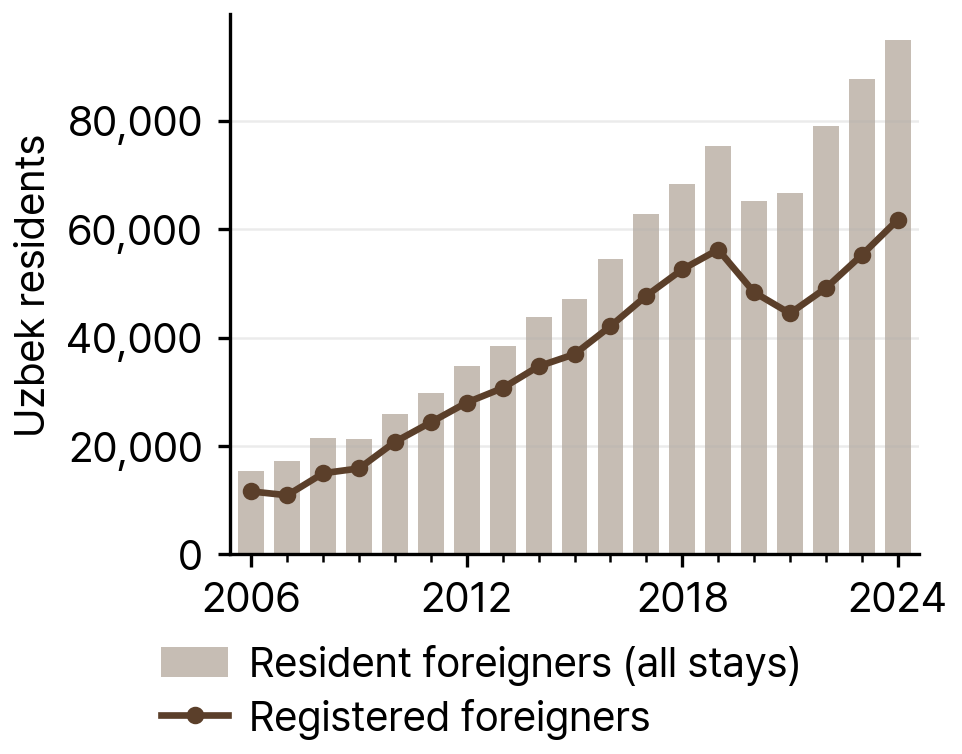
South Korea had 94,893 resident foreigners of Uzbek nationality on December 31, 2024, according to Ministry of Justice yearbook figures compiled in the KIRD dataset. Of these, 61,733 were registered foreigners, which made Uzbekistan the fifth-largest nationality among registered foreigners (4.1 percent) and the sixth-largest among all resident foreigners (3.6 percent). The population stood at 15,380 in 2006, and 2024 was its highest recorded count.
Large-scale labor migration from Uzbekistan followed a memorandum of understanding, signed on March 29, 2006, that made Uzbekistan a sending country under the Employment Permit System (KDI Economic Information and Education Center, 2006). Two other channels have since grown. Ethnic Koreans from Uzbekistan (Koryoin) enter on the H-2 working visit and F-4 overseas Korean visas, and between 2019 and 2024 the F-4 count more than doubled as the H-2 count fell. Student numbers also rose, from 632 D-2 visa holders in 2014 to 13,054 in 2024.
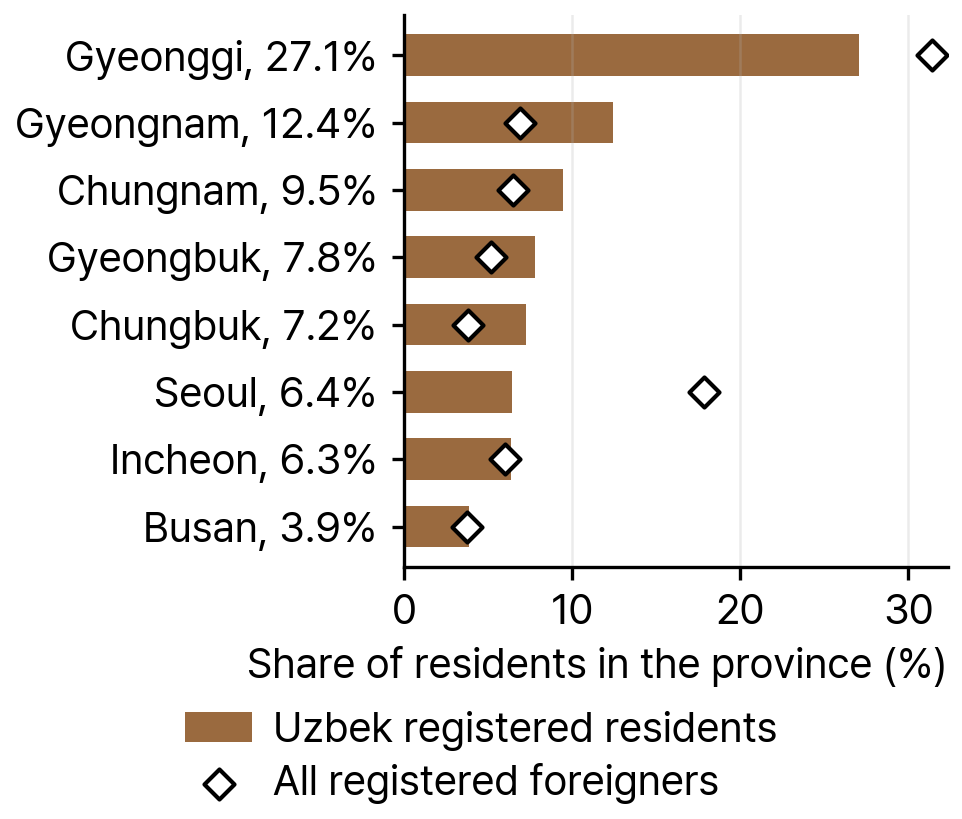
Compared with all resident foreigners in 2024, Uzbek residents were more often men (65.8 percent, against 54.9 percent; computed as 100 minus the shares of women, 34.2 and 45.1 percent), more often children, and less often short-term visitors (2.8 percent, against 19.7 percent). They were also less concentrated in the Seoul capital region (Seoul, Incheon, and Gyeonggi), where 39.8 percent of registered Uzbek residents lived, compared with 55.2 percent of all registered foreigners.
Size of the Population over Time
The number of Uzbek resident foreigners grew from 15,380 in 2006 to 25,895 in 2010, 43,852 in 2014, and 75,320 in 2019. The count fell to 65,205 in 2020 (down 10,115, or 13.4 percent, from 2019) and to 66,677 in 2021, then rose each year to 94,893 in 2024. The 2024 figure is 6.2 times the 2006 figure (94,893 / 15,380).
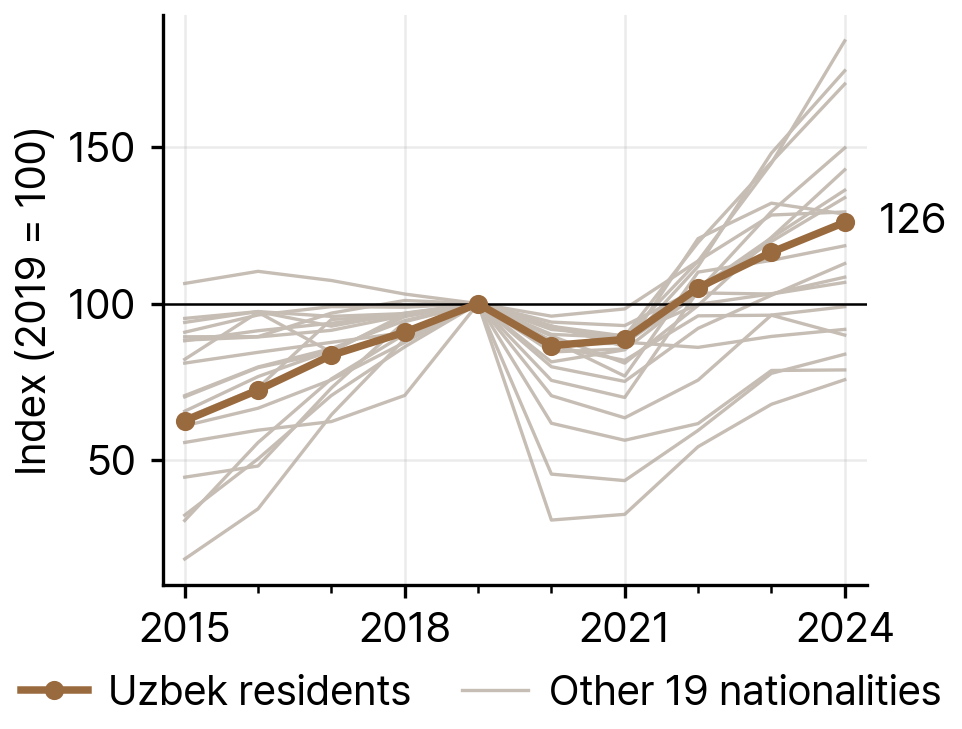
Among registered foreigners, Uzbekistan ranked eleventh in 2006, seventh in 2014, fourth in 2019, and fifth in 2024, and its share of all registered foreigners rose from 1.8 percent in 2006 to 4.4 percent in 2019 before easing to 4.1 percent in 2024. Among all resident foreigners it ranked eleventh in 2006, ninth in 2014, seventh in 2019, and sixth in 2024, with a share that rose from 1.7 percent to 3.6 percent. With 2019 set at 100, the population index was 126 in 2024, tenth for growth among the 20 largest nationalities.
Source: KIRD dataset, from Ministry of Justice immigration yearbooks, 2006-2024.
Registered foreigners numbered 61,733 in 2024, or 65.1 percent of Uzbek resident foreigners. The difference between the two counts (94,893 minus 61,733, or 33,160 people) includes F-4 visa holders, who report residence instead of registering, and short-term visitors.
Source: KIRD dataset, from Ministry of Justice immigration yearbooks, 2006-2024.
Table 1Uzbek Residents in South Korea, Selected Years, 2006-24
| Year | Resident foreigners | Registered foreigners | Rank among registered foreigners | Rank among all resident foreigners | Share of all registered foreigners (%) | Share of all resident foreigners (%) |
|---|---|---|---|---|---|---|
| 2006 | 15,380 | 11,617 | 11 | 11 | 1.8 | 1.7 |
| 2014 | 43,852 | 34,710 | 7 | 9 | 3.2 | 2.4 |
| 2019 | 75,320 | 56,237 | 4 | 7 | 4.4 | 3.0 |
| 2024 | 94,893 | 61,733 | 5 | 6 | 4.1 | 3.6 |
Note: Counts as of December 31. Registered foreigners are long-term residents who registered with immigration authorities; resident foreigners also include short-term visitors and F-4 visa holders who report residence instead of registering.
Source: KIRD dataset, from Ministry of Justice immigration yearbooks, 2006-2024.
Distribution by Province and District
In 2024, 33.4 percent of registered Uzbek residents lived in Incheon and Gyeonggi, 28.8 percent in the southeastern Yeongnam region, 18.5 percent in the Chungcheong provinces, 10.7 percent in the southwestern Honam region, 6.4 percent in Seoul, and 2.2 percent in Gangwon and Jeju. By province, 27.1 percent lived in Gyeonggi and 12.4 percent in South Gyeongsang. Seoul, Incheon, and Gyeonggi combined accounted for 39.8 percent of registered Uzbek residents, against 55.2 percent of all registered foreigners.
About 11.9 percent of registered Uzbek residents lived in rural counties (gun), compared with 10.6 percent of all registered foreigners. The rural share was higher in Honam (31.1 percent of the region's Uzbek residents), Chungcheong (23.2 percent), and Gangwon and Jeju (22.5 percent).
Source: KIRD dataset, from Ministry of Justice registered foreigner statistics by district, 2024.
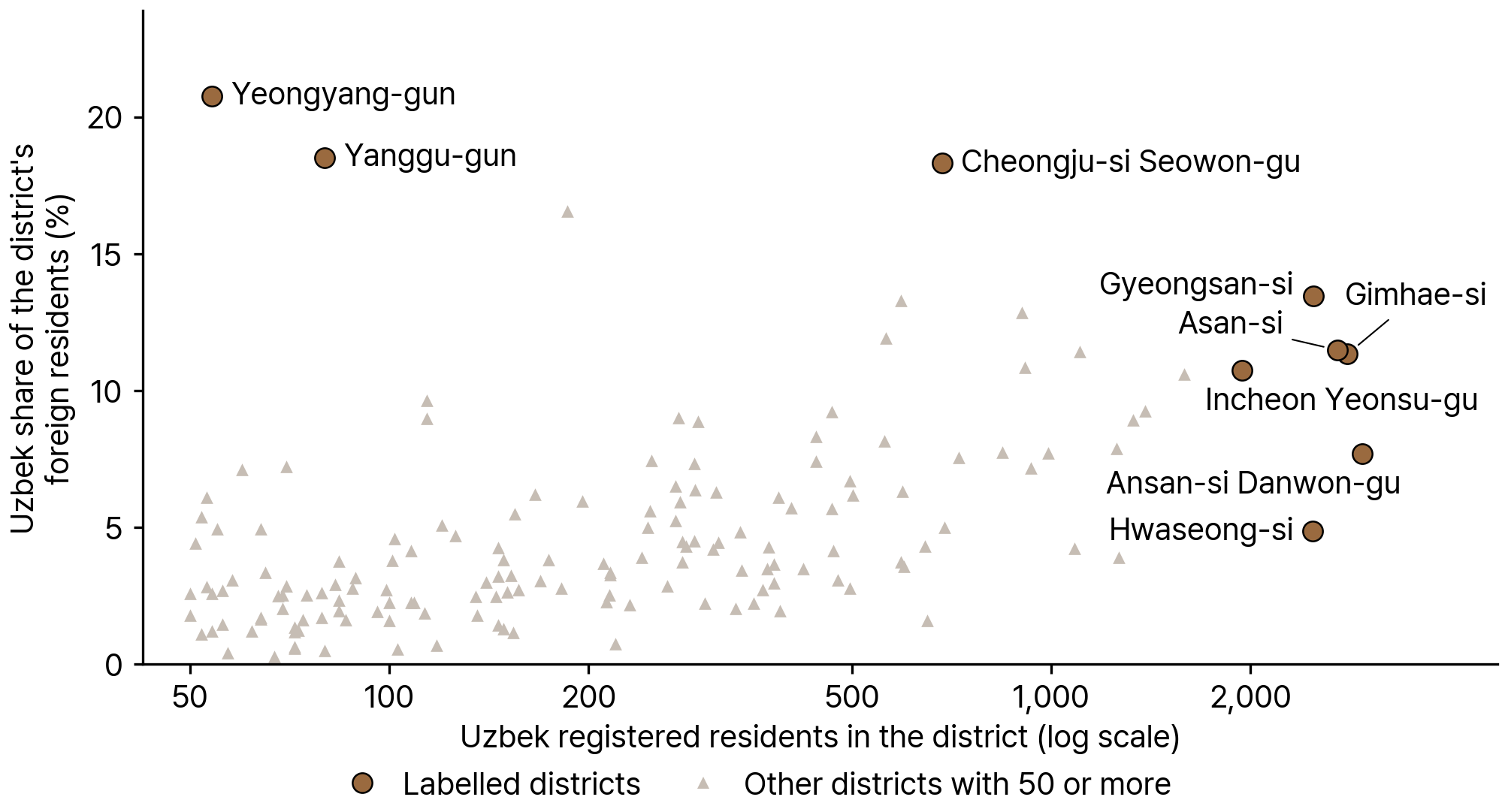
The largest district populations in 2024 were in Ansan's Danwon-gu (2,952), Gimhae (2,805), Asan (2,708), Gyeongsan (2,489), and Hwaseong (2,483). The ten largest districts accounted for 33.9 percent of registered Uzbek residents, and 112 districts had at least 100. Uzbek nationals made up the largest share of a district's registered foreigners in Cheongju's Seowon-gu (18.3 percent, 685 residents), Yeongdong-gun (16.6 percent, 186), Gyeongsan (13.5 percent, 2,489), Wanju-gun (13.3 percent, 593), and Cheongju's Heungdeok-gu (12.9 percent, 904).
Source: KIRD dataset, from Ministry of Justice registered foreigner statistics by district, 2024.
Table 2Ten Districts with the Most Registered Uzbek Residents, 2024
| District | Province | Uzbek residents | Share of district's registered foreigners (%) |
|---|---|---|---|
| Ansan-si Danwon-gu | Gyeonggi-do | 2,952 | 7.7 |
| Gimhae-si | Gyeongsangnam-do | 2,805 | 11.3 |
| Asan-si | Chungcheongnam-do | 2,708 | 11.5 |
| Gyeongsan-si | Gyeongsangbuk-do | 2,489 | 13.5 |
| Hwaseong-si | Gyeonggi-do | 2,483 | 4.9 |
| Incheon Yeonsu-gu | Incheon | 1,943 | 10.7 |
| Geoje-si | Gyeongsangnam-do | 1,590 | 10.6 |
| Gwangju Gwangsan-gu | Gwangju | 1,386 | 9.3 |
| Anseong-si | Gyeonggi-do | 1,331 | 8.9 |
| Pyeongtaek-si | Gyeonggi-do | 1,267 | 3.9 |
Note: Registered foreigners only; F-4 visa holders who report residence are not included.
Source: KIRD dataset, from Ministry of Justice registered foreigner statistics by district, 2024.
The index of dissimilarity (D), which measures how unevenly Uzbek residents are spread across districts compared with all other registered foreigners, fell from 0.546 in 2014 to 0.462 in 2024. The index runs from 0 (identical distribution) to 1 (complete separation); the 2024 value means that 46.2 percent of Uzbek residents would have had to change district to match the distribution of other foreigners. No district met the KIRD definition of an ethnic enclave (a location quotient of at least 2 with Uzbek nationals making up at least 30 percent of the district's registered foreigners).
Age and Sex
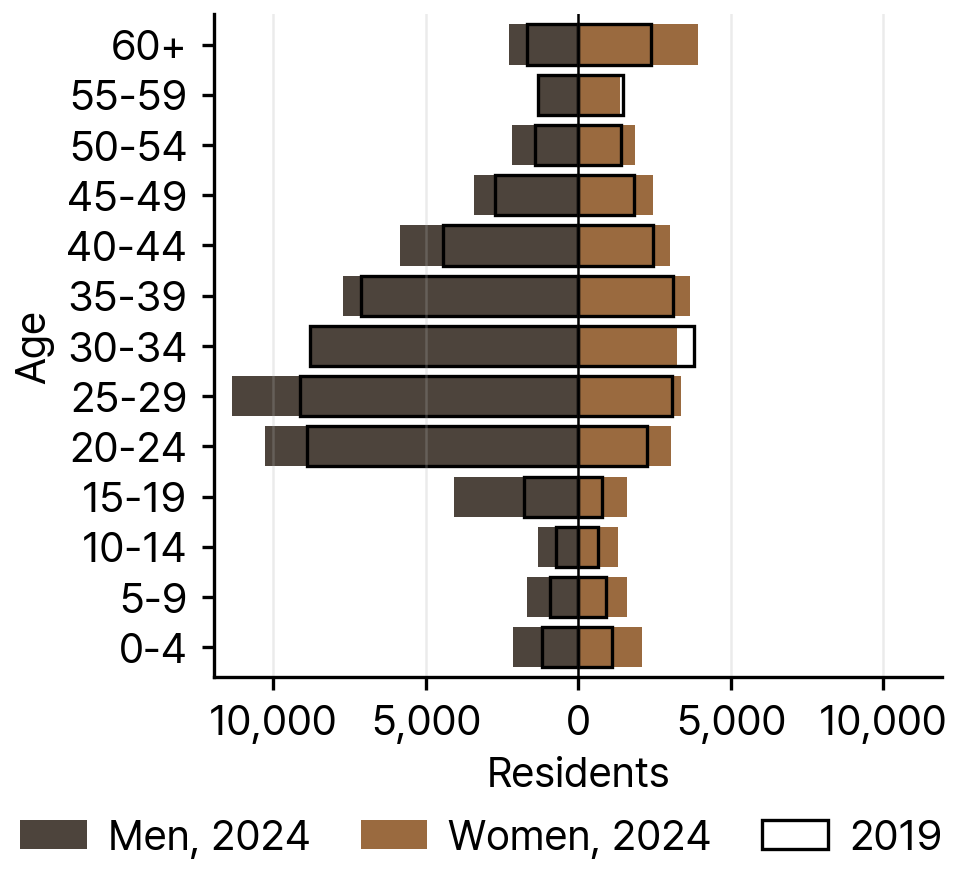
Women were 34.2 percent of Uzbek residents in 2024 (32,464 people), compared with 45.1 percent of all resident foreigners. The share of women was 33.4 percent in 2019.
The largest five-year age group in 2024 was 25 to 29, and the median resident fell in the 30 to 34 group. Adults aged 20 to 39 made up 54.3 percent of Uzbek residents, against 49.7 percent of all resident foreigners, and those aged 60 and older made up 6.6 percent, against 12.9 percent.
Children under age 15 accounted for 10.6 percent of Uzbek residents, nearly twice the share among all resident foreigners (5.7 percent). Their number rose from 5,505 in 2019 to 10,101 in 2024, and the number under age 5 rose from 2,307 to 4,223. Over the same years, holders of the F-3 dependent family visa increased from 826 to 4,874.
Source: KIRD dataset, from Ministry of Justice immigration yearbooks, 2006-2024.
Visa Status
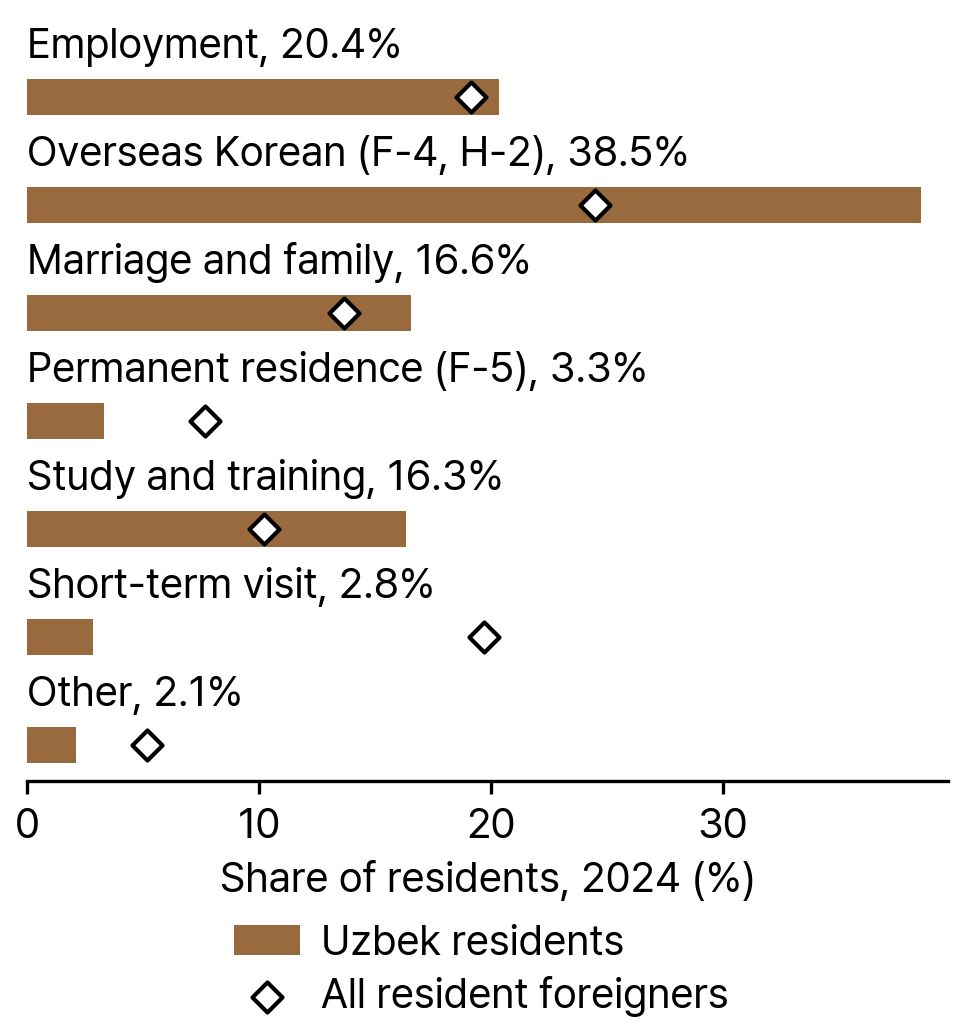
The F-4 overseas Korean visa was the most common status among Uzbek residents in 2024, held by 28,895 people (30.5 percent). Uzbekistan ranked fourth among nationalities in the number of F-4 holders, and Uzbek nationals were 5.2 percent of all F-4 holders in Korea. The two ethnic Korean visas (F-4 and H-2) together covered 38.5 percent of Uzbek residents, compared with 24.5 percent of all resident foreigners.
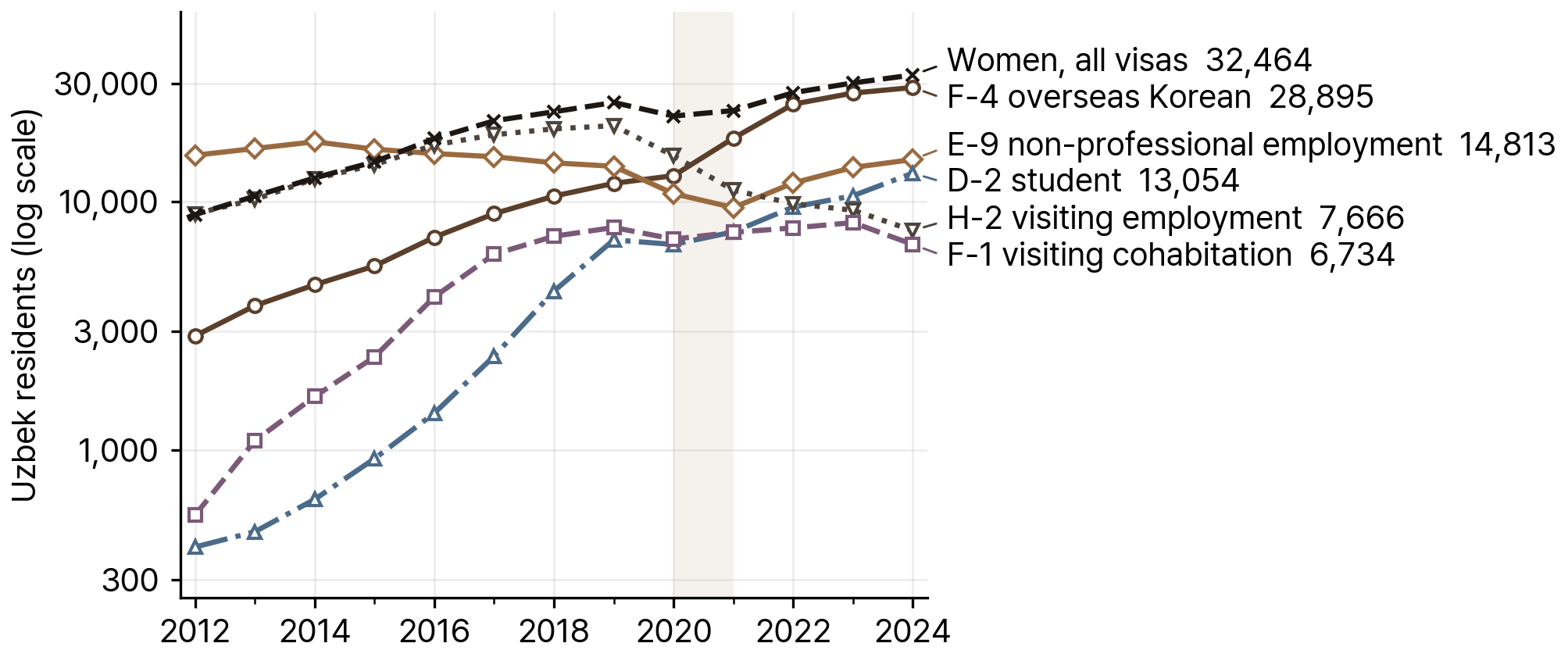
Within that group the balance changed between 2019 and 2024. F-4 holders increased from 11,873 to 28,895, and H-2 working visit holders fell from 20,281 to 7,666. At a 2024 forum on Koryoin settlement, a presenter noted that most Koryoin from Russia hold F-4 visas, while Koryoin from Uzbekistan still hold H-2 status at a high rate (SNU Asia Center, 2024).
E-9 non-professional employment visa holders, the workers admitted under the Employment Permit System, numbered 14,813 in 2024 (15.6 percent), compared with 17,466 in 2014 and 13,909 in 2019. Student (D-2) visa holders rose from 632 in 2014 to 7,026 in 2019 and 13,054 in 2024; Uzbek nationals held 7.3 percent of all D-2 visas in Korea in 2024. Study and training statuses covered 16.3 percent of Uzbek residents, against 10.2 percent of all resident foreigners.
Permanent residents (F-5) numbered 3,139 in 2024, up from 1,282 in 2019. They made up 3.3 percent of Uzbek residents, compared with 7.7 percent of all resident foreigners.
Source: KIRD dataset, from Ministry of Justice immigration yearbooks, 2006-2024.
Source: KIRD dataset, from Ministry of Justice immigration yearbooks, 2006-2024.
Table 3Main Visa Types Held by Uzbek Residents, 2019 and 2024
| Visa | Meaning | 2019 | 2024 | Share of Uzbek residents, 2024 (%) | Uzbek share of all holders of the visa in Korea, 2024 (%) |
|---|---|---|---|---|---|
| F-4 | Overseas Korean | 11,873 | 28,895 | 30.5 | 5.2 |
| E-9 | Non-professional Employment | 13,909 | 14,813 | 15.6 | 4.4 |
| D-2 | Student | 7,026 | 13,054 | 13.8 | 7.3 |
| H-2 | Visiting Employment | 20,281 | 7,666 | 8.1 | 8.2 |
| F-1 | Visiting Cohabitation | 7,882 | 6,734 | 7.1 | 6.8 |
| F-3 | Dependent Family | 826 | 4,874 | 5.1 | 9.3 |
| F-5 | Permanent Residence | 1,282 | 3,139 | 3.3 | 1.5 |
Note: Shares of Uzbek residents use the 2024 total of 94,893 resident foreigners.
Source: KIRD dataset, from Ministry of Justice immigration yearbooks, 2006-2024.
Migration Channels and Policy
Labor migration under the Employment Permit System dates from a memorandum of understanding signed during the Korea-Uzbekistan summit on March 29, 2006 (KDI Economic Information and Education Center, 2006). By December 2022, about 69,000 Uzbek workers had worked in Korea through the system, the largest number from any Central Asian sending country, and about 8,000 were then employed in manufacturing and service jobs (Ministry of Employment and Labor, 2022).
In a meeting reported on December 1, 2022, the two countries' labor ministers renewed the memorandum and discussed the smooth entry of new workers, residency support for Uzbek workers already in Korea, and their safe return within their permitted period of residence (Ministry of Employment and Labor, 2022).
Uzbek citizens also participate in the E-8 seasonal worker program. Access was suspended after many earlier participants broke their labor contracts and did not return home on schedule, and it was restored on May 13, 2024. Uzbekistan's government reported that up to 100,000 citizens could compete for the 2024 places, with more than 37,000 at the first stage (Gazeta.uz, 2024).
Students form a third channel. About 20,000 international students in Korea held Uzbek nationality in 2025, the third-largest group after Vietnam (116,000) and China (79,000) (Edaily, 2026). Ethnic Korean migrants from Uzbekistan enter on the H-2 and F-4 visas described in the previous section (SNU Asia Center, 2024).
Naturalization
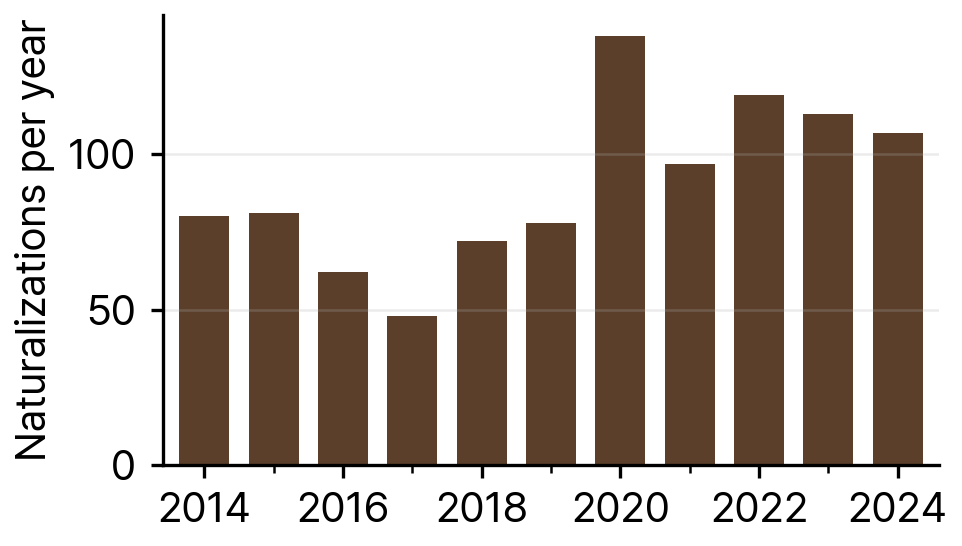
From 2014 to 2024, 995 Uzbek nationals naturalized as Korean citizens. Annual numbers ranged from 48 in 2017 to 138 in 2020, and 107 people naturalized in 2024.
A further 214 Uzbek nationals had their Korean nationality restored from 2011 to 2024, including 8 in 2024. Restoration applies to people who previously held Korean nationality.
Source: KIRD dataset, from Ministry of Justice immigration yearbooks, 2006-2024.
Unauthorized Residents
The Ministry of Justice yearbook (table 6-4) reports unauthorized residents separately for the ten largest nationalities only. Uzbekistan appeared in that table in 2019 (7,137 unauthorized residents, 9.5 percent of Uzbek resident foreigners), 2021 (9,167; 13.7 percent), 2023 (8,812; 10.0 percent), and 2024 (8,103; 8.5 percent). In 2024 Uzbekistan ranked tenth, and its 8,103 unauthorized residents were 2.0 percent of the 397,522 unauthorized residents in Korea (8,103 / 397,522). A missing year means Uzbekistan was not among the ten nationalities listed that year; it does not mean the count was zero.
Table 4Unauthorized Uzbek Residents, Selected Years, 2019-24
| Year | Unauthorized residents | Uzbek resident foreigners | Unauthorized share (%) |
|---|---|---|---|
| 2019 | 7,137 | 75,320 | 9.5 |
| 2021 | 9,167 | 66,677 | 13.7 |
| 2023 | 8,812 | 87,698 | 10.0 |
| 2024 | 8,103 | 94,893 | 8.5 |
Note: Share computed as unauthorized residents divided by Uzbek resident foreigners in the same year. Years not shown were not reported for Uzbekistan in table 6-4.
Source: KIRD dataset, from Ministry of Justice immigration yearbooks (table 6-4), 2019-2024.
Health and Well-being
Among 2,498 Uzbek migrant workers who filed occupational injury claims in Korea between January 2007 and September 2018, 36 injuries were fatal, a fatality rate of 1.4 percent. All 36 deaths were among the 2,259 male claimants (1.6 percent); none of the 239 female claimants died (Lee, Lee, and Cho, 2023).
On July 18, 2026, an Uzbek worker in his twenties died at HD Hyundai Heavy Industries' Ulsan shipyard after being caught between a gondola lift and an upper scaffold inside the cargo hold of an LNG carrier (Ulsan Journal, 2026). To our knowledge, no published study reports mental health measures for Uzbek residents separately.
Migration from Uzbekistan to South Korea
About 2.1 million Uzbek nationals lived abroad in 2024, according to a UN DESA estimate cited by the International Organization for Migration (IOM 2025). The 94,893 Uzbek nationals in Korea in December 2024 were about 4.5 percent of that total (94,893 / 2.1 million). Russia remained the main destination, although the number of Uzbek migrants living there fell from 1.2 million at the start of 2024 to 698,000 at the end of the year (IOM 2025).
Uzbekistan's Migration Agency recruited 168,100 citizens for jobs abroad through its official channels in 2024. Of these, 123,681 went to Russia, 10,695 to Kazakhstan, and 10,120 (6.0 percent) to South Korea, which ranked third among named destinations, ahead of the United Kingdom (4,886) (IOM 2025). A narrower count covers E-9 workers under the Employment Permit System: 4,878 Uzbek citizens were employed in Korea on E-9 visas in 2023 and 3,080 in 2024, a fall of 37 percent. Migration Agency officials attributed the decline to workers leaving their assigned jobs and to some employers going bankrupt (Kun.uz 2025). In 2024, 33,397 people took the EPS Korean-language test (EPS-TOPIK) in Uzbekistan and 13,317 passed (HRD Korea 2025). The head of the EPS Center in Tashkent said that passing does not guarantee a job, because the job-seeker roster lists three times as many workers as employers need, so some wait a long time or are never placed (Yonhap News 2026).
Remittance inflows to Uzbekistan totaled 14.8 billion USD in 2024, about 13 percent of GDP, up roughly 30 percent from 11.4 billion USD in 2023, according to the Central Bank of Uzbekistan. Russia sent 11.5 billion USD (77 percent), followed by Kazakhstan (795 million USD), the United States (577 million USD), and South Korea (534 million USD), about 3.6 percent of the total (IOM 2025).
Ethnic Koreans (Koryoin) make up a large part of the Uzbek population in Korea. In December 2024, 42,543 of the 94,893 Uzbek nationals in Korea (44.8 percent) were ethnic Koreans, according to Korea Immigration Service data cited by IOM (IOM 2025). A 2022 review found that most Uzbek labor migrants in Korea come from rural areas of Uzbekistan (Shin and Kim 2022). The Fergana region hosts a training center set up with the help of Hyundai Heavy Industries and the city of Ulsan, where 668 people had completed language, cultural, and vocational training by 2025 (UzDaily.uz 2025). About 280 workers were to be trained in Uzbekistan for shipbuilding jobs, with the first group expected in Korea in July 2025 (Korea Times 2025).
On October 17, 2024, a presidential decree turned the Agency for External Labour Migration into the Migration Agency under the Cabinet of Ministers. The agency licenses private employment agencies, oversees the organized dispatch of workers abroad, and offers vocational and foreign-language courses matched to foreign employers' requirements (IOM 2025). In 2025, Uzbek authorities reported a fraud scheme linked to labor migration to Korea with estimated damages of 90 million USD. Brokers, including former employees of the migration agency, charged migrants between 7,000 and 12,000 USD each, and one scheme collected 5.6 million USD from about 1,000 migrants. The former head of the agency's office in South Korea was dismissed in March 2025 and placed on Interpol's wanted list (AnewZ 2025).
Research on this migration covers work, study, and family life. Interviews with 30 Uzbek workers and students in Korea and 66 migrants in Japan in 2019 and 2020 found that labor and educational migration to Korea and Japan stems from the same lack of jobs at home as migration to Russia (Dadabaev and Soipov 2020). Shin and Kim found that remittances from Korea pay for household consumption, schooling, health care, marriages, and housing in Uzbekistan (Shin and Kim 2022). In interviews with ten Koryoin women from Uzbekistan married to Korean men, Jo found that their skills were devalued in the Korean labor market because they lacked Korean language fluency even though they appear Korean (Jo 2018). A study of Koryoin in Gwangju described transnational families whose members separate and reunite repeatedly between Uzbekistan and Korea (Kim 2015).
Table 5Migration indicators, Uzbekistan and South Korea
| Indicator | Value | Source |
|---|---|---|
| Uzbek nationals living abroad, 2024 | About 2.1 million | IOM 2025, citing UN DESA |
| Uzbek nationals in South Korea, December 2024 | 94,893 (about 4.5% of those abroad) | IOM 2025, citing Korea Immigration Service |
| Ethnic Koreans among Uzbek nationals in South Korea, December 2024 | 42,543 (44.8%) | IOM 2025, citing Korea Immigration Service |
| Workers recruited abroad through official channels, 2024 | 168,100; 10,120 to South Korea (6.0%, third) | IOM 2025, citing Migration Agency |
| Uzbek workers employed in South Korea on E-9 visas | 4,878 (2023); 3,080 (2024) | Kun.uz 2025 |
| EPS-TOPIK test takers in Uzbekistan, 2024 | 33,397 (13,317 passed) | HRD Korea 2025 |
| Remittance inflows, 2024 | 14.8 billion USD (about 13% of GDP) | IOM 2025, citing Central Bank of Uzbekistan |
| Remittances from South Korea, 2024 | 534 million USD (fourth-largest source, 3.6% of inflows) | IOM 2025, citing Central Bank of Uzbekistan |
Note: The Migration Agency recruitment count and the E-9 employment count use different definitions and should not be compared directly. Shares of Uzbek nationals abroad and of ethnic Koreans are computed from the figures shown.
Source: IOM 2025; Kun.uz 2025.
Community Organizations
The Gwanghui-dong area near Dongdaemun, which Seoul's Jung-gu district designates as Central Asia Street, began forming in the early 1990s after Korea and Russia established diplomatic relations, as people from Russia and Central Asia moved to the neighborhood. About 150 trading firms, restaurants, and grocery stores operate in the area (Seoul Jung-gu District Office, 2026). The Uzbek restaurant Samarkand operated four branches there in 2018 (Asia Economy, 2018).
More than 80 percent of Uzbekistan's population is Muslim, and a 2023 report described a Korean construction site that provided prayer space and a pork-free menu for its Muslim workers, including Uzbek workers (Industry Journal, 2023).
Of the 1,720 migrant-serving organizations in the KIRD census, 2 name Uzbek nationals in their name or target group. One is Cheonan Moise, a privately funded NGO in Dongnam-gu, Cheonan (South Chungcheong); the other is the Seoul Central Mosque in Yongsan-gu, Seoul. Most general-purpose organizations in the census, such as foreign worker and multicultural family support centers, also serve Uzbek residents.
Sources
KIRD: Korea Immigration Regional Dashboard dataset. openICPSR. https://doi.org/10.3886/E249944V1
KDI Economic Information and Education Center. 2006. Korea-Uzbekistan labor-sending MOU under the Employment Permit System. https://eiec.kdi.re.kr/policy/materialView.do?num=79726
Ministry of Employment and Labor. 2022. Press release on the renewal of the Korea-Uzbekistan Employment Permit System MOU. https://www.moel.go.kr/news/enews/report/enewsView.do?news_seq=14311
Gazeta.uz. 2024. Uzbekistan citizens granted renewed access to seasonal work in South Korea. https://www.gazeta.uz/en/2024/05/13/seasonal-work-korea/
Edaily. 2026. International students by nationality, 2025. https://edaily.co.kr/News/Read?mediaCodeNo=257&newsId=05074166645484672
SNU Asia Center, Central Asia Center. 2024. Forum on Koryoin settlements in Ansan, Gwangju, and Jecheon. https://snuac.snu.ac.kr/?u_event=%ED%95%9C%EA%B5%AD-%EB%82%B4-%EA%B3%A0%EB%A0%A4%EC%9D%B8-%EB%B0%80%EC%A7%91%EA%B1%B0%EC%A3%BC%EC%A7%80%EC%9D%98-%ED%98%95%EC%84%B1-%EC%95%88%EC%82%B0-%EA%B4%91%EC%A3%BC-%EC%A0%9C%EC%B2%9C
Lee JY, Lee W, Cho SI. 2023. Characteristics of fatal occupational injuries in migrant workers in South Korea: A machine learning study. Heliyon. https://pmc.ncbi.nlm.nih.gov/articles/PMC10559917/
Ulsan Journal. 2026. Fatal accident involving an Uzbek worker at HD Hyundai Heavy Industries' Ulsan shipyard. https://www.usjournal.kr/news/newsview.php?ncode=1065594273973398
Seoul Jung-gu District Office. 2026. Gwanghui-dong Central Asia Street. https://www.junggu.seoul.kr/tour/content.do?cmsid=15027&contentId=3512
Asia Economy. 2018. Gwanghui-dong Central Asia Street. https://www.asiae.co.kr/article/2018062910004437134
Industry Journal. 2023. Prayer space and Muslim menus at construction sites. https://industryjournal.co.kr/news/231074
International Organization for Migration. 2025. Uzbekistan: Migration Situation Report, October-December 2024. https://uzbekistan.iom.int/sites/g/files/tmzbdl2566/files/documents/2025-03/uzbekistan-migration-situation-report-oct-dec-2024.pdf
Kun.uz. 2025. South Korea reduces Uzbek migrant intake amid job abandonment concerns. https://kun.uz/en/news/2025/01/18/south-korea-reduces-uzbek-migrant-intake-amid-job-abandonment-concerns
UzDaily.uz. 2025. South Korea plans to recruit builders from Uzbekistan. https://www.uzdaily.uz/en/south-korea-plans-to-recruit-builders-from-uzbekistan/
The Korea Times. 2025. Korea to train Uzbek workers for shipbuilding industry jobs. https://www.koreatimes.co.kr/southkorea/globalcommunity/20250313/korea-to-train-uzbek-workers-for-shipbuilding-industry-jobs
AnewZ. 2025. Uzbekistan uncovers alleged $90 million South Korea labour migration fraud. https://anewz.tv/region/central-asia/20128/uzbekistan-uncovers-90m-south-korea-labour-scam/news
Dadabaev, T., & Soipov, J. (2020). Craving jobs? Revisiting labor and educational migration from Uzbekistan to Japan and South Korea. Acta Via Serica, 5(2), 111-140. https://doi.org/10.22679/avs.2020.5.2.005
Jo, M.-J. (2018). The intersectionality of gender and ethnicity in (social) mobility: Migration of Koryo saram women from Uzbekistan to South Korea. S/N Korean Humanities, 4(1), 49-72. https://doi.org/10.17783/ihu.2018.4.1.49
Shin, M.-K., & Kim, H. (2022). Uzbek migrant workers in Korea: The impact of remittances on Uzbekistan trade and economic growth. Journal of Global Business and Trade, 18(2), 17-32. https://doi.org/10.20294/jgbt.2022.18.2.17
Kim, K.-H. (2015). International migration of Uzbek Koryein to Korea and characteristics of their family types, with particular reference to Koryeins in Gwangju Metropolitan City [in Korean]. Journal of Diaspora Studies, 9(2), 37-67. https://www.kci.go.kr/kciportal/ci/sereArticleSearch/ciSereArtiView.kci?sereArticleSearchBean.artiId=ART002055810
Yonhap News. 2026. [한·중앙아를 잇다]⑧ 우즈베크 '숙련인력'vs키르기스 '신흥송출'…新 코리안드림 [Connecting Korea and Central Asia 8: Uzbekistan's skilled workers and Kyrgyzstan's new sending]. Reported by Park Hyun-soo, September 3, 2026; republished by Supple. https://supple.kr/news/cmtktqcoa008vvh0uuyzfaqgf
Human Resources Development Service of Korea (HRD Korea). 2025. 국가별 한국어시험 시행 정보 [EPS-TOPIK test takers and passes by country, 2024]. Archived April 21, 2025. https://web.archive.org/web/20250421163507/https://epstopik.hrdkorea.or.kr/epstopik/pass/candidate/selectChart.do?lang=ko
Suggested citation: Korea Immigration Regional Dashboard (KIRD). 2026. “Uzbek Immigrants in South Korea.” Foreign Residents in South Korea series, September 2026. Data: Korea Immigration Regional Dashboard (KIRD) dataset, https://doi.org/10.3886/E249944V1. Interactive maps and tables: https://immigrantsinkorea.today.