 Korea Immigration Regional Dashboard
SpotlightSeptember 2026Nationality profilesDownload PDF
Russian Immigrants in South Korea
Highlights
- South Korea had 33,268 Russian nationals in 2024. Russia was the 16th-largest nationality among registered foreigners and the 18th-largest among all resident foreigners, up from 21st and 22nd in 2014, when 8,973 Russians were resident.
- In 2024, 31.3 percent of Russian residents were short-term visitors and 30.4 percent held other statuses, most of them the miscellaneous G-1 status, compared with 19.7 percent and 5.2 percent of all resident foreigners.
- Russian nationals held 9,260 G-1 statuses in 2024, 16.4 percent of all G-1 holders in Korea, up from 3,937 in 2019 and 106 in 2014.
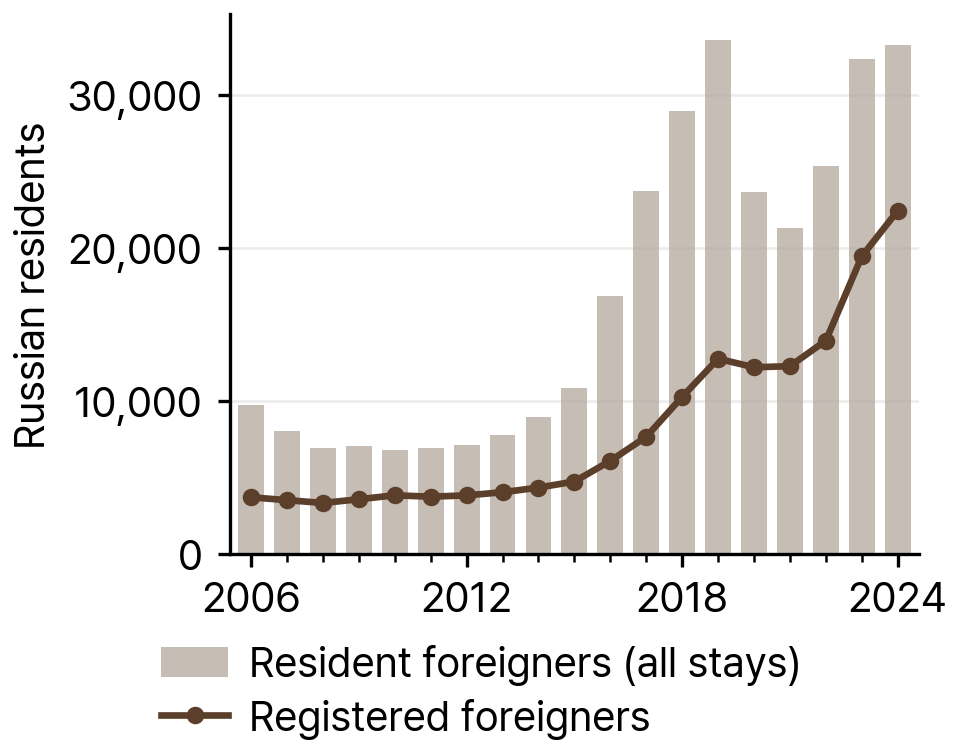
In 2024, 33,268 Russian nationals were resident in South Korea on 31 December, of whom 22,450 (67.5 percent) were registered foreigners. Russia was the 16th-largest nationality among registered foreigners (1.5 percent of the total) and the 18th-largest among all resident foreigners (1.3 percent). The population numbered 9,735 in 2006, 6,794 in 2010, and 8,973 in 2014, when Russia ranked 21st among registered foreigners and 22nd among all resident foreigners. It rose to 33,600 in 2019, the highest count in the series, fell to 23,702 in 2020 and 21,326 in 2021, and returned to 33,268 by 2024.
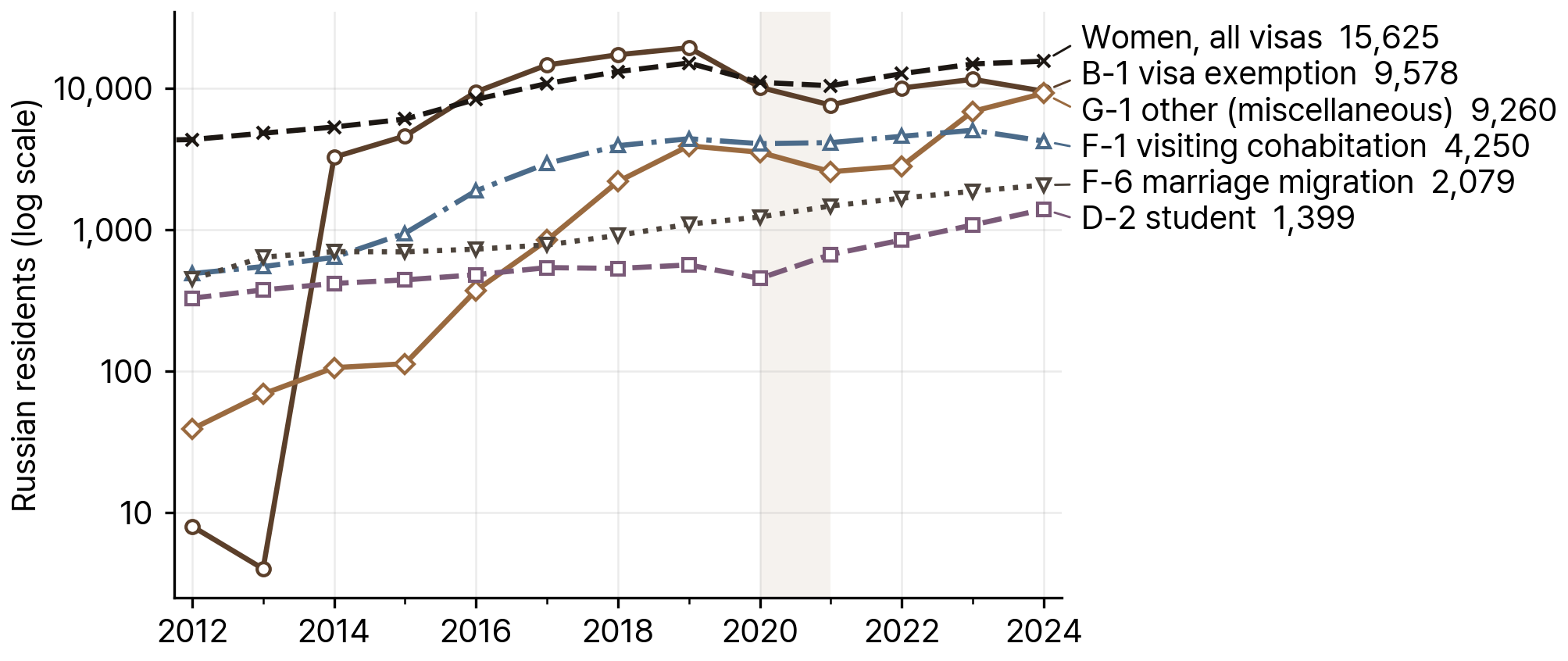
Russians began arriving in number after Mikhail Gorbachev visited Jeju in 1990 and the two countries normalized relations; about 100,000 Russians, mostly sailors and shuttle traders, visited Busan in 1993 (Sisa Journal, 1994). Russia is not a sending country under the Employment Permit System (Employment Permit System, 2026). Between 2019 and 2024 the number of visa-exempt visitors (B-1) fell by about half, from 19,460 to 9,578, while holders of the miscellaneous G-1 status more than doubled, from 3,937 to 9,260.
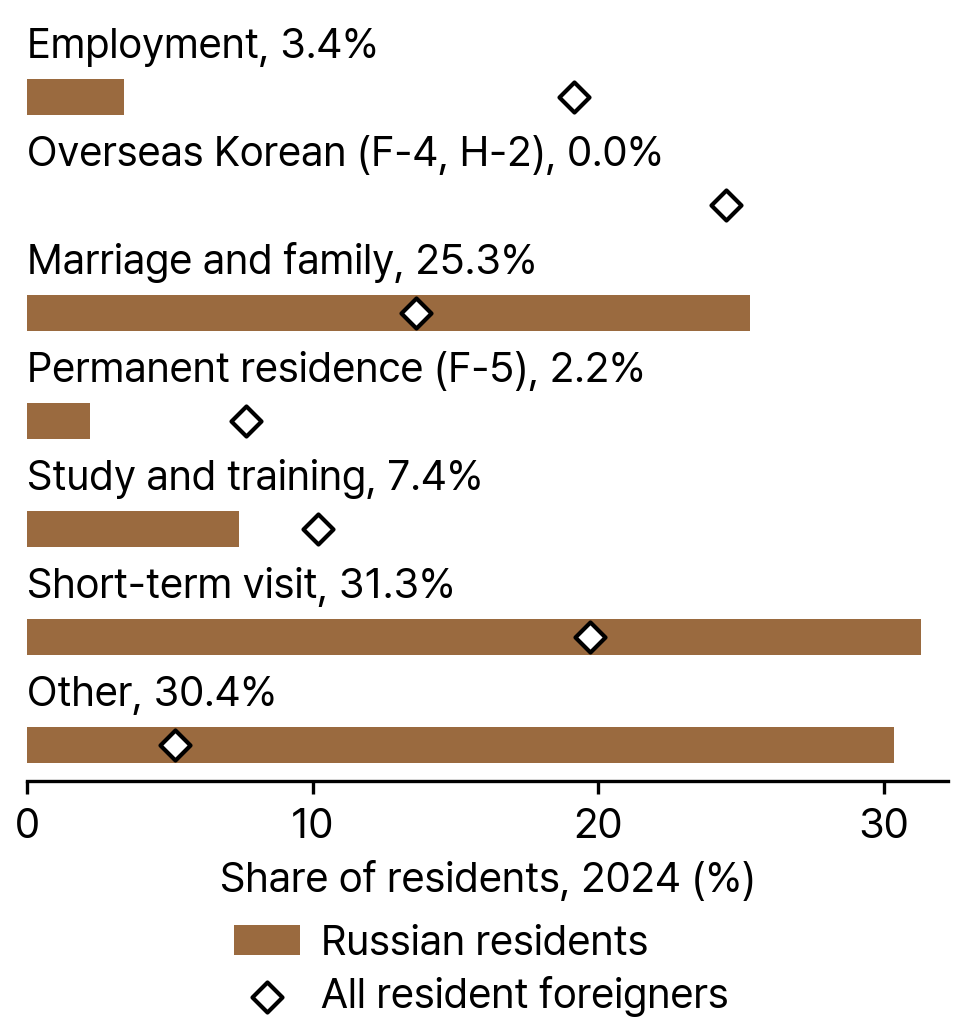
Compared with all resident foreigners in 2024, Russian residents were more likely to be children (11.5 percent aged 0-14, against 5.7 percent), to be aged 20-39 (57.2 percent, against 49.7 percent), and to hold short-term, family, or other statuses. Few held employment visas (3.4 percent, against 19.2 percent), and none in this category held the overseas Korean statuses F-4 or H-2, because the Ministry of Justice counts ethnic Koreans of Russian nationality separately. This Spotlight describes the size, location, age and sex, visa status, and naturalization of Russian nationals in South Korea, drawing on the KIRD dataset (KIRD, 2026) and published sources.
Size of the Population over Time
The number of Russian resident foreigners remained below 10,000 between 2006 and 2014 (9,735 in 2006, 6,794 in 2010, and 8,973 in 2014). By 2019 it had risen to 33,600, about 3.7 times the 2014 figure. The count fell by 9,898 (29.5 percent) to 23,702 in 2020 and to 21,326 in 2021, then rose to 25,374 in 2022, 32,366 in 2023, and 33,268 in 2024.
The registered share of the population has risen. In 2006, 3,731 of 9,735 Russian residents (38.3 percent) were registered, and in 2019, 12,786 of 33,600 (38.1 percent). By 2024 the figure was 22,450 of 33,268 (67.5 percent). Those outside the registered count are mainly short-term visitors.
Source: KIRD dataset, from Ministry of Justice immigration yearbooks, 2006-2024.
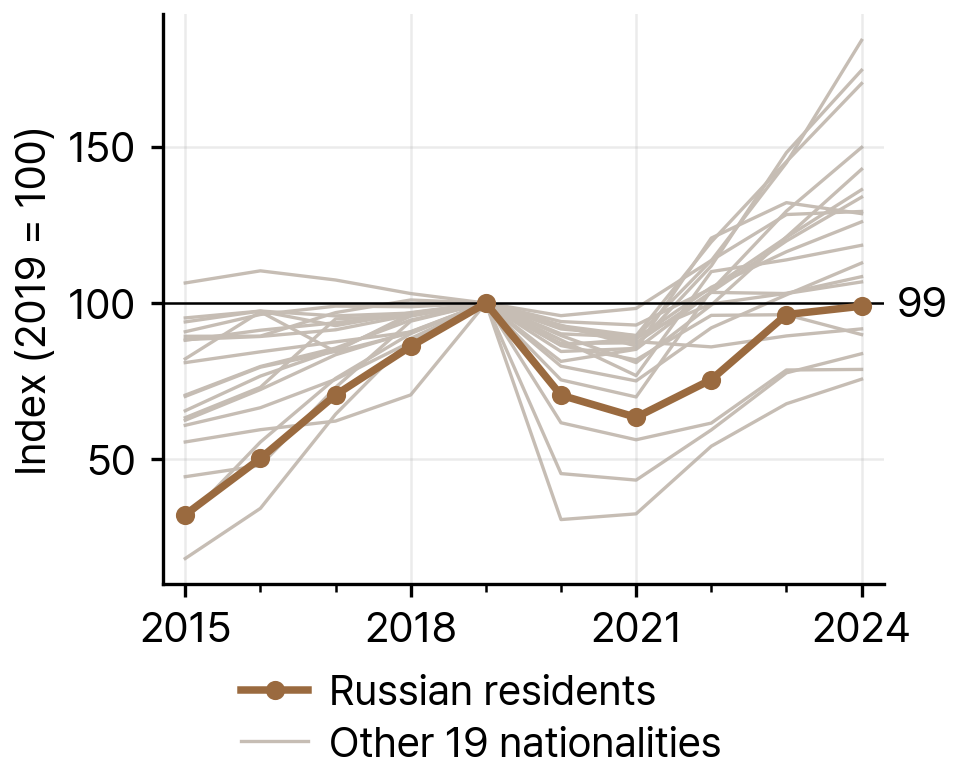
Measured against 2019, the Russian population stood at an index of 99.0 in 2024, about 1 percent below its 2019 level. Russia ranked 15th in growth among the 20 largest nationalities over 2019-24.
Source: KIRD dataset, from Ministry of Justice immigration yearbooks, 2006-2024.
Table 1Russian Residents in South Korea, Selected Years, 2006-24
| Year | Resident foreigners | Registered foreigners | Rank among registered foreigners | Rank among all resident foreigners | Share of registered foreigners | Share of all resident foreigners |
|---|---|---|---|---|---|---|
| 2006 | 9,735 | 3,731 | 18 | 16 | 0.6% | 1.1% |
| 2014 | 8,973 | 4,365 | 21 | 22 | 0.4% | 0.5% |
| 2019 | 33,600 | 12,786 | 18 | 15 | 1.0% | 1.3% |
| 2024 | 33,268 | 22,450 | 16 | 18 | 1.5% | 1.3% |
Note: Ranks and shares are computed among all nationalities in each count. Resident foreigners include short-term visitors and F-4 overseas Koreans who report their residence; registered foreigners are long-term residents who registered with immigration authorities. Korean-Russians are counted separately and are excluded.
Source: KIRD dataset, from Ministry of Justice immigration yearbooks, 2006-2024.
Distribution by Province and District
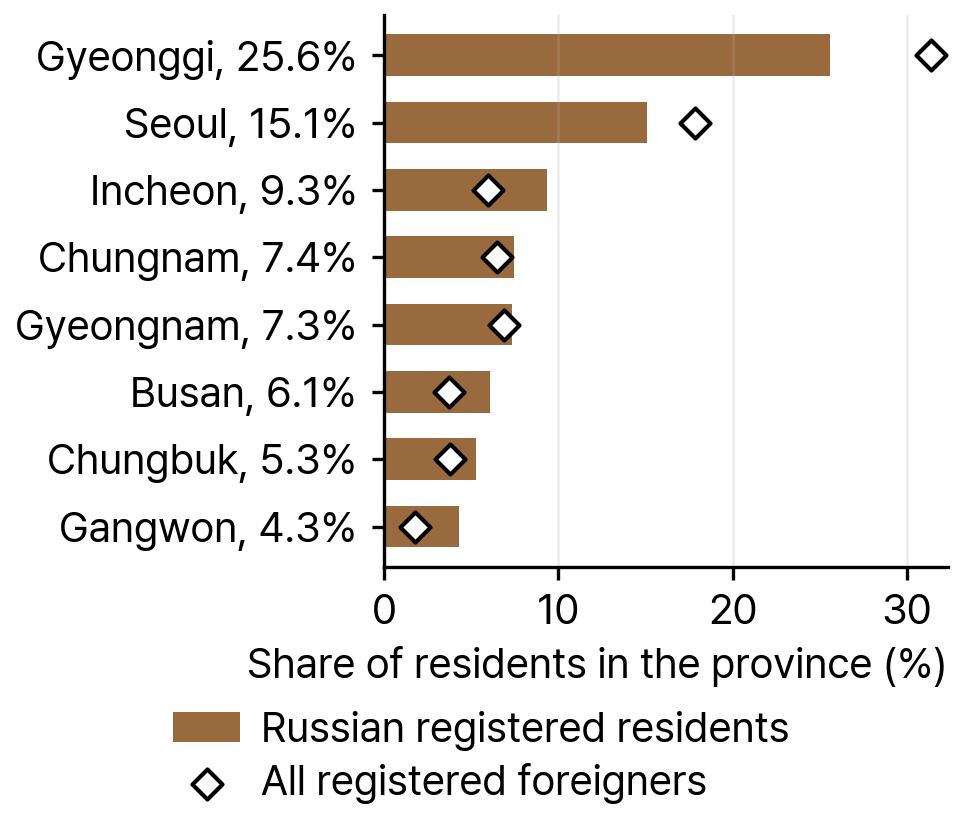
District-level data cover the 22,450 Russian registered foreigners in 2024. The Incheon and Gyeonggi area accounted for 34.9 percent of them and Seoul for 15.1 percent, so 50.0 percent lived in the capital region, compared with 55.2 percent of all foreign residents. The Yeongnam region accounted for 22.2 percent, the Chungcheong provinces 15.0 percent, Honam 8.2 percent, and Gangwon and Jeju 4.7 percent. Some 7.1 percent lived in rural counties (gun), compared with 10.6 percent of all foreign residents.
Source: KIRD dataset, from Ministry of Justice district statistics on registered foreigners, 2024.
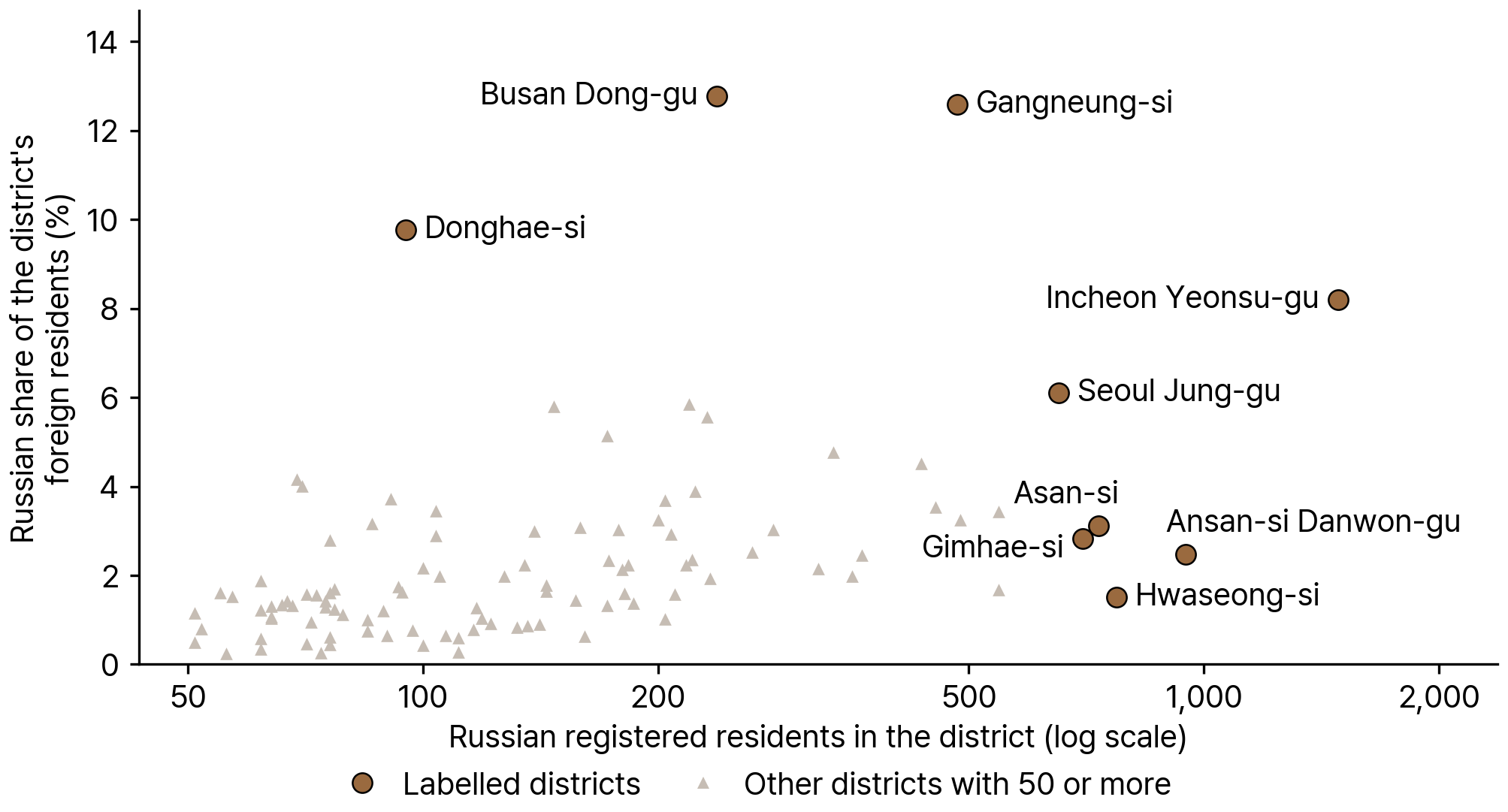
The population is spread across many districts. The ten largest districts accounted for 32.7 percent of Russian registered foreigners in 2024, and 62 districts had at least 100. Incheon Yeonsu-gu had the most (1,484), followed by Ansan-si Danwon-gu (948), Hwaseong-si (772), Asan-si (733), and Gimhae-si (700). In Seoul, Jung-gu had 652 and Gwanak-gu 354.
Russian nationals made up the largest shares of registered foreigners in Busan Dong-gu (12.8 percent, 238 people), Gangneung-si (12.6 percent, 483), Incheon Yeonsu-gu (8.2 percent), and Seoul Jung-gu (6.1 percent). Busan Dong-gu contains the Choryang-dong area near Busan Station, which became a Russian-oriented commercial district in the early 1990s (Sisa Journal, 1994).
Source: KIRD dataset, from Ministry of Justice district statistics on registered foreigners, 2024.
The index of dissimilarity (D) between Russian registered foreigners and all other registered foreigners across districts was 0.419 in 2014 and 0.44 in 2024, a slight increase in residential separation. No district met the definition of an ethnic enclave used in this series (a location quotient of at least 2 and the group making up at least 30 percent of the district's foreign residents).
Table 2Ten Districts with the Most Russian Registered Foreigners, 2024
| District | Province | Russian residents | Share of district's foreign residents (%) |
|---|---|---|---|
| Incheon Yeonsu-gu | Incheon | 1,484 | 8.2 |
| Ansan-si Danwon-gu | Gyeonggi-do | 948 | 2.5 |
| Hwaseong-si | Gyeonggi-do | 772 | 1.5 |
| Asan-si | Chungcheongnam-do | 733 | 3.1 |
| Gimhae-si | Gyeongsangnam-do | 700 | 2.8 |
| Seoul Jung-gu | Seoul | 652 | 6.1 |
| Ansan-si Sangnok-gu | Gyeonggi-do | 546 | 3.4 |
| Pyeongtaek-si | Gyeonggi-do | 546 | 1.7 |
| Gwangju Gwangsan-gu | Gwangju | 487 | 3.3 |
| Gangneung-si | Gangwon-do | 483 | 12.6 |
Note: Registered foreigners only. Share is the Russian count divided by all registered foreigners in the district.
Source: KIRD dataset, from Ministry of Justice district statistics on registered foreigners, 2024.
Age and Sex
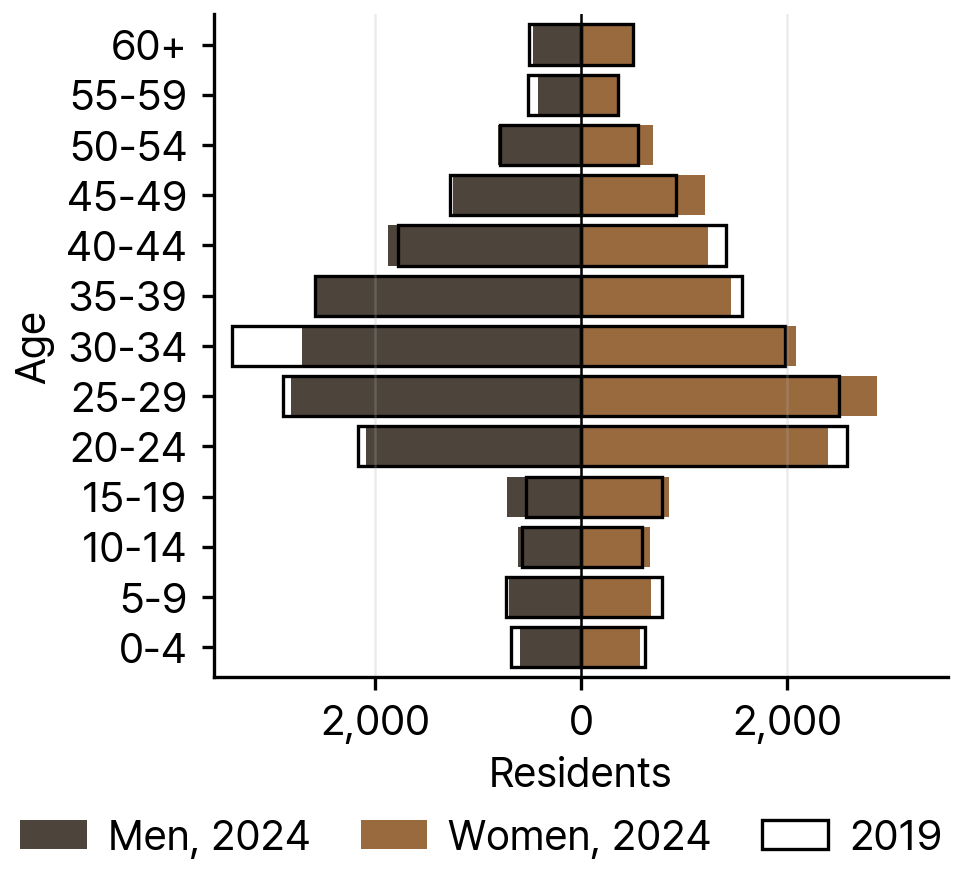
Women made up 47.0 percent of Russian residents in 2024 (15,625 of 33,268), up from 45.2 percent in 2019 and slightly above the 45.1 percent among all resident foreigners. The largest five-year age group in 2024 was 25-29, and the median fell in the 30-34 group.
In 2024, 3,837 Russian residents (11.5 percent) were aged 0-14, twice the 5.7 percent share among all resident foreigners; in 2019 the figure was 3,972. Children under 5 numbered 1,161 in 2024, down from 1,295 in 2019. Adults aged 20-39 made up 57.2 percent of Russian residents (49.7 percent of all resident foreigners), and people aged 60 and older 2.9 percent (12.9 percent of all resident foreigners). Those aged 50 and older numbered 3,260.
Source: KIRD dataset, from Ministry of Justice immigration yearbooks, 2006-2024.
Visa Status
In 2024, 31.3 percent of Russian residents were short-term visitors, compared with 19.7 percent of all resident foreigners. Another 30.4 percent held other statuses (5.2 percent overall) and 25.3 percent held marriage or family statuses (13.6 percent overall). Only 3.4 percent held employment visas, against 19.2 percent of all resident foreigners; 7.4 percent were in study and training (10.2 percent overall), and 2.2 percent held permanent residence (F-5), against 7.7 percent. None held an overseas Korean status (F-4 or H-2), compared with 24.5 percent of all resident foreigners.
Source: KIRD dataset, from Ministry of Justice immigration yearbooks, 2006-2024.
Visa exemption (B-1) was the most common single status in 2024, held by 9,578 Russian nationals (28.8 percent). The number was 3,270 in 2014 and 19,460 in 2019. Russia had the third-largest number of B-1 holders of any nationality in 2024. The miscellaneous G-1 status grew from 106 holders in 2014 to 3,937 in 2019 and 9,260 in 2024; Russians made up 16.4 percent of all G-1 holders in Korea in 2024.
Visiting cohabitation (F-1) holders numbered 4,250 in 2024, close to the 4,418 of 2019. Between 2019 and 2024, marriage migrants (F-6) rose from 1,098 to 2,079, students (D-2) from 565 to 1,399, dependent family members (F-3) from 485 to 1,291, and general trainees (D-4) from 433 to 1,058.
Source: KIRD dataset, from Ministry of Justice immigration yearbooks, 2006-2024.
Table 3Most Common Visa Types among Russian Residents in South Korea, 2019 and 2024
| Visa | Meaning | 2019 | 2024 | Share of Russian residents, 2024 (%) | Share of all holders of this visa in Korea, 2024 (%) |
|---|---|---|---|---|---|
| B-1 | Visa exemption | 19,460 | 9,578 | 28.8 | 4.6 |
| G-1 | Other (miscellaneous) | 3,937 | 9,260 | 27.8 | 16.4 |
| F-1 | Visiting cohabitation | 4,418 | 4,250 | 12.8 | 4.3 |
| F-6 | Marriage migration | 1,098 | 2,079 | 6.2 | 1.4 |
| D-2 | Student | 565 | 1,399 | 4.2 | 0.8 |
| F-3 | Dependent family | 485 | 1,291 | 3.9 | 2.5 |
| D-4 | General trainee | 433 | 1,058 | 3.2 | 1.2 |
Note: Share of Russian residents is out of 33,268 Russian resident foreigners in 2024.
Source: KIRD dataset, from Ministry of Justice immigration yearbooks, 2006-2024.
Migration Channels and Policy
Russian arrivals in South Korea grew after diplomatic normalization in the early 1990s. Russians began coming to Busan right after Mikhail Gorbachev's 1990 visit to Jeju, and in 1993 about 100,000 Russians visited Busan, the second-largest group of visitors after Japanese. Most were sailors and shuttle traders, and the Texas Street area of Choryang-dong near Busan Station became a Russian-oriented commercial district (Sisa Journal, 1994).
Russia is not among the sending countries listed in the Employment Permit System program guide, so the E-9 low-skilled work visa is not a route for Russian nationals (Employment Permit System, 2026). Few Russian residents held employment visas in 2024 (3.4 percent).
Ethnic Koreans who hold Russian nationality have a separate route. The F-4 overseas Korean status is available to people who held Korean nationality and to their direct descendants who can document the relationship (Ministry of Government Legislation, 2026). The Ministry of Justice counts these Korean-Russians in their own category, so they are not part of the figures in this Spotlight. Korea also operates a permanent return and resettlement program for elderly Sakhalin Koreans, ethnic Koreans who were moved to Sakhalin under Japanese colonial rule. The government selected 270 people in 2023, down from 350 in 2021, and about 3,900 Sakhalin Koreans and family members were estimated to be waiting (Incheon Ilbo, 2026).
In February 2026, Korea merged the H-2 (visiting employment) status into F-4, ending the practice of giving overseas Koreans different visa routes depending on country or region of origin. Within about six months, more than 54 percent of H-2 holders had converted to F-4 (Dongpo World News, 2026). Because the Russian category in the KIRD data contains no F-4 or H-2 holders, this change mainly concerns Korean-Russians and other overseas Koreans. The KIRD data end in 2024 and so predate it.
Naturalization
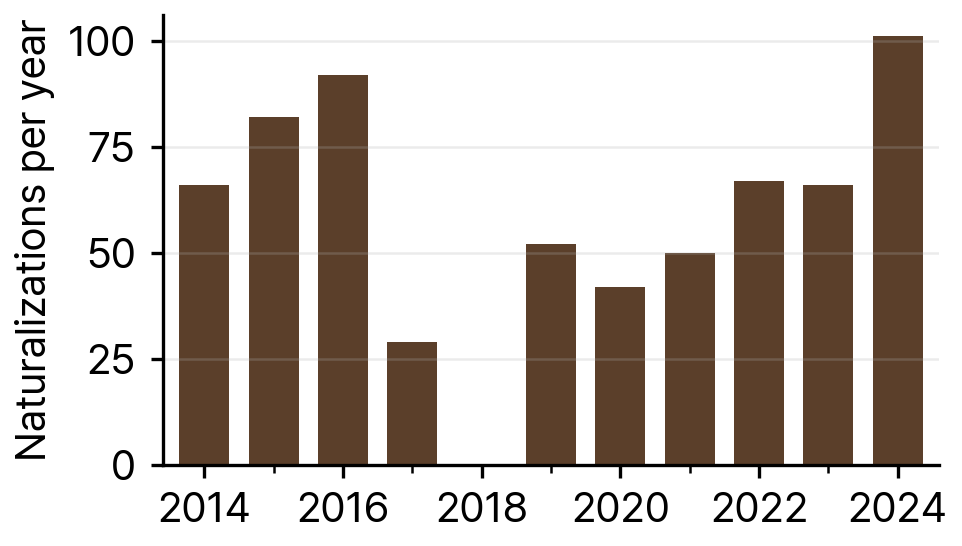
The KIRD dataset records 647 naturalizations of Russian nationals from 2014 to 2024, drawn from the yearbook's by-country tables for 2014-2017 and 2019-2024; the 2018 yearbook reports China and Korean-Chinese together and is excluded. Annual counts ranged from 29 in 2017 to 101 in 2024, the highest year in the period.
The yearbooks also record 89 restorations of Korean nationality by Russian nationals from 2011 to 2024 (also excluding 2018), a procedure open to people who previously held Korean nationality. Only 26 restorations were recorded in 2024. Against a resident population of 33,268 in 2024, these totals are small, and 2.2 percent of Russian residents held permanent residence that year.
Source: KIRD dataset, from Ministry of Justice immigration yearbooks, 2006-2024.
Unauthorized Residents
Russia is not among the ten nationalities listed separately in table 6-4 of the Ministry of Justice yearbook for 2024, so the yearbook gives no count of unauthorized Russian residents for that year. The yearbook counted 397,522 unauthorized residents of all nationalities in 2024. Global Voices reported in 2024 that 9,108 Russian nationals were overstaying their visas in 2022, the tenth-largest number of any nationality (Global Voices, 2024). The report does not say whether this count includes Korean-Russians.
Health and Well-being
To our knowledge, no published study reports health outcomes for Russian nationals in South Korea separately.
News reports describe occupational deaths and injuries among Russian sailors on ships docked in Busan, who may not be counted as resident foreigners. On 29 August 2025, a Russian sailor in his 40s died of heat-related cardiac arrest in the engine room of a Russian-flagged refrigerated cargo ship at Gamcheon Port in Saha District (Nocut News, 2025). On 15 September 2026, a Freon gas leak during maintenance of the freezer compartment of a 769-ton Russian fishing vessel in Saha District injured 5 of the 15 Russian sailors aboard, 2 of whom were found in cardiac arrest (Hankook Ilbo, 2026).
Migration from Russia to South Korea
We know of no published source that reports what share of Russian emigrants live in South Korea or Korea's rank among their destinations. On the Korean side, Ministry of Justice statistics for March 2025 counted 71,464 residents linked to Russia, comprising 35,952 Koryo-saram (Korean-Russians) and 35,512 other Russian nationals (Ministry of Justice, 2025). The ethnic Korean population of Russia, the group from which Korean-Russian migration draws, fell from 153,156 in the 2010 census (Rosstat, 2011) to 87,819 in the 2021 census (Federal State Statistics Service of Russia, 2022).
Russia has no government labor-sending agreement with South Korea. The e-나라지표 government indicator portal lists 17 Employment Permit System sending countries in 2026, and Russia is not among them (e-나라지표, 2026). No EPS Korean-language test (EPS-TOPIK) is held for Russian nationals, so no count of applicants against quota places exists for this corridor.
Russians have come to Korea by other routes. Through the 1990s and early 2000s, the E-6 entertainer visa brought Russian women to work as dancers in clubs. In February 2003, after more than 20 Russian women on this visa petitioned that they had been made to serve customers in bars and in some cases forced into sexual liaisons, the Ministry of Justice ceased issuing E-6 visas for dancers at cabarets and night spots (Korea Herald via YaleGlobal, 2003). In 2024, Global Voices reported that many Russians enter on short-term permits and look for jobs in Telegram and KakaoTalk chat groups (Global Voices, 2024).
Russia has been the largest source of asylum applications in South Korea since 2023. Applications from Russian nationals rose from 1,038 in 2022 to 5,750 in 2023 (Korea Herald, 2024), then numbered 4,546 in 2024 and 2,026 in 2025, 13.8 percent of the 14,626 applications that year. Officials linked the applications to the war in Ukraine and to military conscription, and no Russian applicant was granted refugee status in 2025 (Anadolu Agency, 2026).
Remittances are a very small part of Russia's economy. Personal remittances received equaled 0.083 percent of GDP in 2024, down from 0.128 percent in 2023, 0.142 percent in 2022, 0.527 percent in 2021, and 0.664 percent in 2020 (World Bank, 2025). The World Bank's bilateral remittance estimates, last produced for 2021, put remittances sent from South Korea to Russia at about US$5.0 million that year (World Bank, 2021). In a case reported in 2026, Korea Customs Service investigators alleged that an underground broker used the Tether (USDT) stablecoin to move about US$42 million between South Korea and Russia in more than 6,000 transactions between January 2023 and July 2024 (Bitget News, 2026).
Russian migrants to Korea have come mainly from Buryatia, Zabaykalsky Krai (Transbaikalia), Primorsky Krai, Khabarovsk Krai, and Amur Oblast, the eastern regions of Russia closest to Korea. Global Voices reported in 2024 that people now come from all parts of Russia (Global Voices, 2024).
The main policy governing travel between the two countries is a visa waiver agreement signed on 13 November 2013 and in force since 1 January 2014. Holders of ordinary passports of either country may remain up to 60 days without a visa, provided the visit is not for employment, residence, or study (Ministry of Foreign Affairs, 2013). The agreement does not permit employment.
Table 4Migration Indicators, Russia and South Korea
| Indicator | Value | Source |
|---|---|---|
| Share of Russian emigrants living in South Korea | n.a. | No published source known to us |
| Russian nationals among resident foreigners in South Korea, March 2025 | 71,464 total; 35,952 Korean-Russians and 35,512 other Russian nationals | Ministry of Justice, 2025 |
| Employment Permit System sending country, 2026 | No (not among 17 countries) | e-나라지표, 2026 |
| Asylum applications by Russian nationals, 2022 | 1,038 | Korea Herald, 2024 |
| Asylum applications by Russian nationals, 2023 | 5,750 | Korea Herald, 2024 |
| Asylum applications by Russian nationals, 2024 | 4,546 | Anadolu Agency, 2026 |
| Asylum applications by Russian nationals, 2025 | 2,026 (13.8% of 14,626) | Anadolu Agency, 2026 |
| Russian nationals overstaying visas, 2022 | 9,108 (10th) | Global Voices, 2024 |
| Remittances as a share of Russia's GDP, 2024 | 0.083% | World Bank, 2025 |
| Remittances from South Korea to Russia, 2021 (World Bank estimate) | US$5.0 million | World Bank, 2021 |
| Alleged USDT transfers between South Korea and Russia, January 2023 to July 2024 | About US$42 million | Bitget News, 2026 |
Note: Figures from news and reference sources are as reported there. n.a. = not available.
Source: Sources as listed in each row.
Research on Russian nationals in South Korea, apart from Korean-Russians, is limited and centers on commerce and travel. Kim and Yang (2017) dated the origins of the Central Asia Street in Gwanghui-dong, Seoul, to Russian merchants who came in the 1990s, after the 1990 normalization of relations, to buy Dongdaemun clothing for resale in the former Soviet Union; when most of these traders moved their business to China in the 2000s, Mongolian and Central Asian merchants took over the cargo companies, restaurants, and Cyrillic signage they left. Park (2014) used bilateral panel data for 1995-2010 to estimate that visa waiver agreements raise inbound visitors from partner countries by about 60 percent and outbound travel by about 14 percent, and applied these estimates to the 2014 Korea-Russia waiver. Fedorova and Nam (2023) photographed more than 800 public signs in four Seoul districts between 2018 and 2020 and found that new migrant communities, including the Russian-speaking cluster near Dongdaemun, create "multilingual islands" in the streetscape. Harmon-Donovan (2015) asked why Russian speakers chose South Korea, Cambodia, and the Netherlands over North America and Western Europe between 1989 and 2015. We are not aware of any study of brokers, debt, work, marriage, or return migration among Russian nationals in Korea.
Community Organizations
Two of the 1,720 migrant-serving organizations in the KIRD census name Russians or Russian speakers in their name or target group. The Svoboda Russian-Speaking Support Center (Seubaboda Reosiaeogwon Jiwon Senteo) is a community organization in Yeonsu-gu, Incheon, the district with the most Russian registered foreigners. Cheonan Moise is a nongovernmental organization in Dongnam-gu, Cheonan. Both are self-operated and privately funded. Most general-purpose organizations, such as multicultural family support centers and foreign worker support centers, also serve Russian residents.
In Busan's Choryang-dong, the Choryang TCK House, a nongovernmental organization, supports Russian-speaking migrant families. In 2023, about 100 Russian-speaking students attended Choryang Elementary School, and volunteer teachers at the center provided after-school instruction in Korean and Russian, along with music and other activities (The AsiaN, 2023). The source describes these families as Russian-speaking and does not break them down by nationality.
Sources
KIRD dataset. Nationality-level data from Ministry of Justice immigration yearbooks and district statistics, 2006-2024. https://doi.org/10.3886/E249944V1
Sisa Journal. 1994. Busan's new source of money: Russia town (부산의 새 돈줄 러시아 타운). 11 August 1994. https://www.sisajournal.com/news/articleView.html?idxno=110913
Employment Permit System (Ministry of Employment and Labor). 2026. EPS program guide (고용허가제 안내). Accessed 2026. https://www.eps.go.kr/eo/EmployPerSystemInfoM.eo?pageGb=02
Ministry of Government Legislation. 2026. Overseas Korean (F-4) residence status (재외동포(F-4) 체류자격). Accessed 2026. https://easylaw.go.kr/CSP/CnpClsMain.laf?popMenu=ov&csmSeq=1136&ccfNo=3&cciNo=2&cnpClsNo=2
Incheon Ilbo. 2026. Return of Sakhalin Koreans widened, but government support falls back (사할린동포 귀국 문 넓혔지만…정부 지원 뒷걸음). 6 August 2026. https://www.incheonilbo.com/news/articleView.html?idxno=1329043
Dongpo World News. 2026. Integration of H-2 overseas Koreans into F-4 under way (방문취업 동포(H-2)도 '재외동포'(F-4)로 통합 본격화). 12 August 2026. https://www.dongponews.net/news/articleView.html?idxno=59820
Nocut News. 2025. Russian sailor dies in hot engine room of ship moored at Busan port (부산항 계류 선박서 고온 기관실에 있던 러시아 선원 숨져). https://www.nocutnews.co.kr/news/6392565
Hankook Ilbo. 2026. Gas leak on Russian fishing vessel moored in Saha-gu, Busan (부산 사하구 정박 러시아 어선서 가스 누출로 2명 심정지). 15 September 2026. https://www.hankookilbo.com/news/article/A2026091511100003311
World Bank. 2025. Personal remittances, received (% of GDP), Russian Federation. World Development Indicators, series BX.TRF.PWKR.DT.GD.ZS. https://api.worldbank.org/v2/country/RUS/indicator/BX.TRF.PWKR.DT.GD.ZS?format=json&date=2015:2024
Rosstat (Federal State Statistics Service of Russia). 2011. All-Russian population census 2010: National composition of the population of the Russian Federation (Всероссийская перепись населения 2010 г. Национальный состав населения Российской Федерации). Reproduced by Demoscope Weekly, Institute of Demography, National Research University Higher School of Economics. https://www.demoscope.ru/weekly/ssp/rus_nac_10.php
Federal State Statistics Service of Russia (Rosstat). 2022. All-Russian Population Census 2020: Volume 5, Table 1, National composition of the population (Национальный состав населения). https://rosstat.gov.ru/storage/mediabank/Tom5_tab1_VPN-2020.xlsx
The AsiaN. 2023. Busan Koryoin Village (1): Choryang TCK House ([부산 고려인마을①] 초량 TCK 하우스 가면, 고려인 삶이 온전히 보인다). 14 June 2023. https://kor.theasian.asia/archives/339239
Ministry of Justice, Republic of Korea (Korea Immigration Service). 2025. Immigration and Foreign Policy Statistics Monthly Report, March 2025 (출입국·외국인정책 통계월보, 2025년 3월). https://www.immigration.go.kr/bbs/immigration/227/594384/artclView.do
e-나라지표 (Republic of Korea government indicator portal). 2026. Employment Permit System employment trends (고용허가제 고용동향). Accessed 2026. https://www.index.go.kr/unify/idx-info.do?idxCd=1501
Kim, K. 2003. No more E-6 visas for foreign dancers. Korea Herald, 27 February 2003. Republished by YaleGlobal Online. https://archive-yaleglobal.yale.edu/node/52371
Global Voices. 2024. How immigrants from Russia manage to live in South Korea for years without proper registration. 16 July 2024. https://globalvoices.org/2024/07/16/how-illegal-immigrants-from-russia-manage-to-live-in-south-korea-for-years/
Korea Herald. 2024. Coverage of asylum applications by Russian nationals in South Korea, 2022-2023. February 2024. https://www.koreaherald.com/article/3324431
Anadolu Agency. 2026. Russian asylum seekers top South Korea's list for 3rd straight year. February 2026. https://www.aa.com.tr/en/asia-pacific/russian-asylum-seekers-top-south-korea-s-list-for-3rd-straight-year/3833217
Bitget News. 2026. Record South Korea suspicious crypto reports may point to Tether (USDT) use in illegal remittances. https://www.bitget.com/news/detail/12560604980121
Ministry of Foreign Affairs, Republic of Korea. 2013. ROK-Russia Agreement on the Mutual Abolition of Visa Requirements to take effect on January 1, 2014. https://www.mofa.go.kr/eng/brd/m_5676/view.do?seq=313139
Fedorova, K., & Nam, H. H. (2023). "Multilingual islands in the monolingual sea": Foreign languages in the South Korean linguistic landscape. Open Linguistics, 9(1), Article opli-2022-0238. https://doi.org/10.1515/opli-2022-0238
Kim, S.-J., & Yang, S.-W. (2017). 서울시 중구 중앙아시아거리 형성 과정 연구 [A study on the formation process of the Central Asia Street in Jung-gu, Seoul]. Seoul Studies, (68), 35-70. https://doi.org/10.17647/jss.2017.08.68.35
Park, S. (2014). 한-러 비자면제 협정이 방문객 이동에 미치는 파급효과 추정 [Estimating the spillover effect of the Korea-Russia visa waiver agreement on visitor movement]. Northeast Asian Economic Review, 26(3), 157-174. https://www.kci.go.kr/kciportal/ci/sereArticleSearch/ciSereArtiView.kci?sereArticleSearchBean.artiId=ART001918666
Harmon-Donovan, D. J. (2015). A history of the Soviet diaspora in the post-Cold War era (1989-2015): Case studies of Russian-speakers in South Korea, Cambodia, and the Netherlands [Master's thesis, Texas State University]. https://digital.library.txst.edu/items/b21ad2e9-f701-431a-8d83-2fbdedf7dc7c/full
World Bank. 2021. Bilateral Remittance Estimates (WB_KNOMAD_BRE), Data360. https://data360api.worldbank.org/data360/data?DATABASE_ID=WB_KNOMAD&INDICATOR=WB_KNOMAD_BRE&REF_AREA=KOR
Suggested citation: Korea Immigration Regional Dashboard (KIRD). 2026. “Russian Immigrants in South Korea.” Foreign Residents in South Korea series, September 2026. Data: Korea Immigration Regional Dashboard (KIRD) dataset, https://doi.org/10.3886/E249944V1. Interactive maps and tables: https://immigrantsinkorea.today.