 Korea Immigration Regional Dashboard
SpotlightSeptember 2026Nationality profilesDownload PDF
Bangladeshi Immigrants in South Korea
Highlights
- At the end of 2024, 31,220 Bangladeshi nationals lived in South Korea, 27,875 of them registered foreigners; Bangladesh was the 15th-largest nationality among registered foreigners (1.9 percent) and the 19th-largest among all resident foreigners (1.2 percent).
- The Bangladeshi population grew 70.2 percent between 2019 and 2024 (from 18,340 to 31,220), the third-fastest growth among the 20 largest nationalities.
- In 2024, 43.7 percent of Bangladeshi residents held an E-9 non-professional employment visa, and women made up 14.4 percent of the group, compared with 45.1 percent of all resident foreigners.
South Korea had 31,220 resident foreigners of Bangladeshi nationality on 31 December 2024. Of these, 27,875 (89.3 percent) were registered foreigners, the category for foreign nationals in Korea for more than 90 days. Bangladesh was the 15th-largest nationality among registered foreigners (1.9 percent of the total) and the 19th-largest among all resident foreigners (1.2 percent). The count was 14,649 in 2006, when Bangladesh ranked 14th among registered foreigners and 13th among all resident foreigners, and 14,644 in 2014, when it ranked 16th and 17th.
Most Bangladeshi workers came through the Employment Permit System (EPS). Korea designated Bangladesh as an EPS partner country in 2007 and invited more than 1,500 Bangladeshi workers under the program in 2008 (Embassy of the Republic of Korea in Bangladesh, 2007-2008). The population was flat for more than a decade, then rose from 16,426 in 2021 to 31,220 in 2024. Over 2019-2024, the number holding specially designated activities (E-7) visas grew from 321 to 3,749, and the number holding dependent family (F-3) visas grew from 616 to 3,430.
Compared with all resident foreigners in 2024, Bangladeshi residents were far more likely to hold employment visas (56.9 percent against 19.2 percent), much more likely to be men, and more concentrated in ages 20 to 39 (70.8 percent against 49.7 percent). A slightly larger share lived in the Seoul capital area (59.4 percent against 55.2 percent). This Spotlight describes the size of the population, where Bangladeshi residents live, their age, sex, and visa status, the channels and policies behind their migration, naturalization, health and well-being, ties to Bangladesh, and community organizations.
Size of the Population over Time
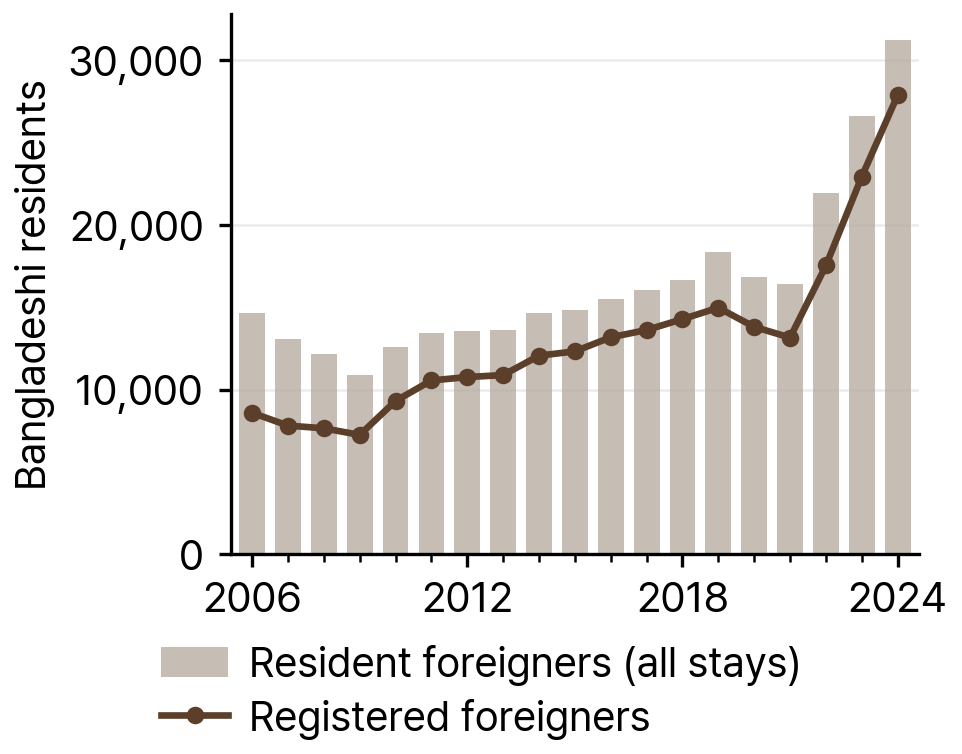
The number of Bangladeshi resident foreigners fell from 14,649 in 2006 to 12,605 in 2010, a decline of 14.0 percent (2,044 fewer people). It then rose to 14,644 in 2014 and 18,340 in 2019 (see Figure 1). The count dipped to 16,823 in 2020 and 16,426 in 2021, 10.4 percent below 2019 (1,914 fewer people), then climbed to 21,928 in 2022, 26,636 in 2023, and 31,220 in 2024, the highest count on record. The 2024 total was about 2.1 times the 2006 total (31,220 against 14,649).
The registered share of the group grew over time. Registered foreigners made up 8,596 of 14,649 Bangladeshi residents in 2006 (58.7 percent), 12,065 of 14,644 in 2014 (82.4 percent), and 27,875 of 31,220 in 2024 (89.3 percent). Among registered foreigners, Bangladesh ranked 14th in 2006, 16th in 2014, 17th in 2019, and 15th in 2024. Among all resident foreigners, it ranked 13th, 17th, 21st, and 19th in the same years (see Table 1).
Source: KIRD dataset, from Ministry of Justice immigration yearbooks, 2006-2024.
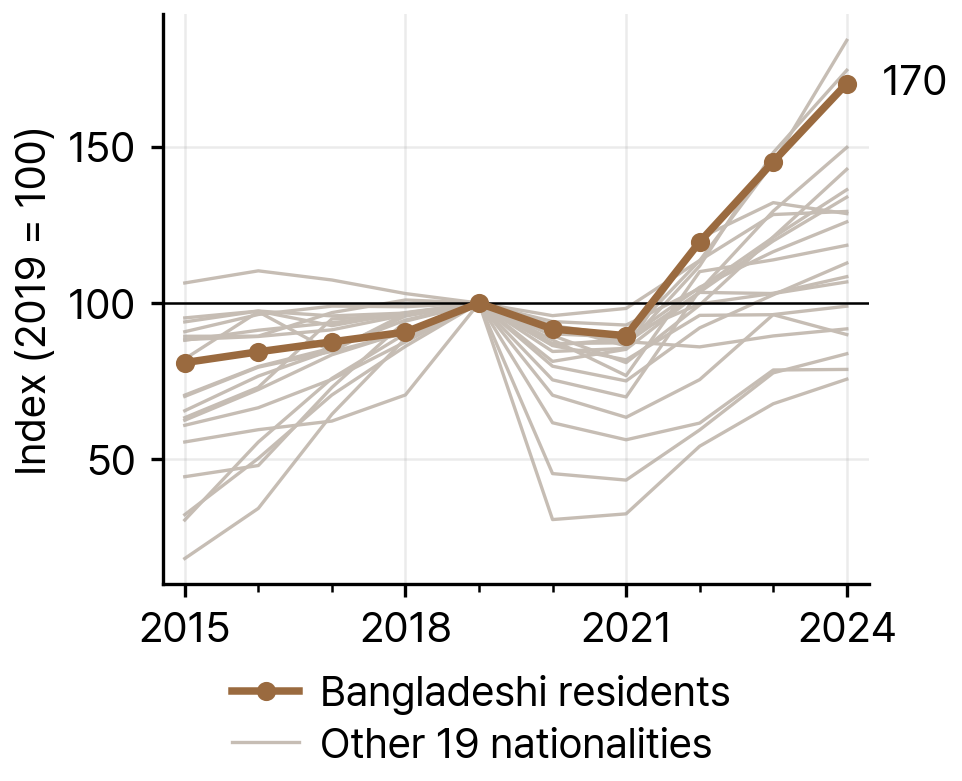
Indexed to 2019 = 100, the Bangladeshi population stood at 170.2 in 2024, a growth of 70.2 percent over five years. That was the third-fastest growth among the 20 largest nationalities in South Korea (see Figure 2).
Source: KIRD dataset, from Ministry of Justice immigration yearbooks, 2006-2024.
Table 1Bangladeshi Residents in South Korea, Selected Years, 2006-24
| Year | Resident foreigners | Registered foreigners | Rank among registered foreigners | Rank among all resident foreigners | Share of all registered foreigners | Share of all resident foreigners |
|---|---|---|---|---|---|---|
| 2006 | 14,649 | 8,596 | 14 | 13 | 1.4% | 1.6% |
| 2014 | 14,644 | 12,065 | 16 | 17 | 1.1% | 0.8% |
| 2019 | 18,340 | 14,975 | 17 | 21 | 1.2% | 0.7% |
| 2024 | 31,220 | 27,875 | 15 | 19 | 1.9% | 1.2% |
Note: Ranks are among all nationalities. Resident foreigners include short-term visitors and overseas Koreans with F-4 visas who report their residence; registered foreigners are long-term residents who register with immigration authorities.
Source: KIRD dataset, from Ministry of Justice immigration yearbooks, 2006-2024.
Distribution by Province and District
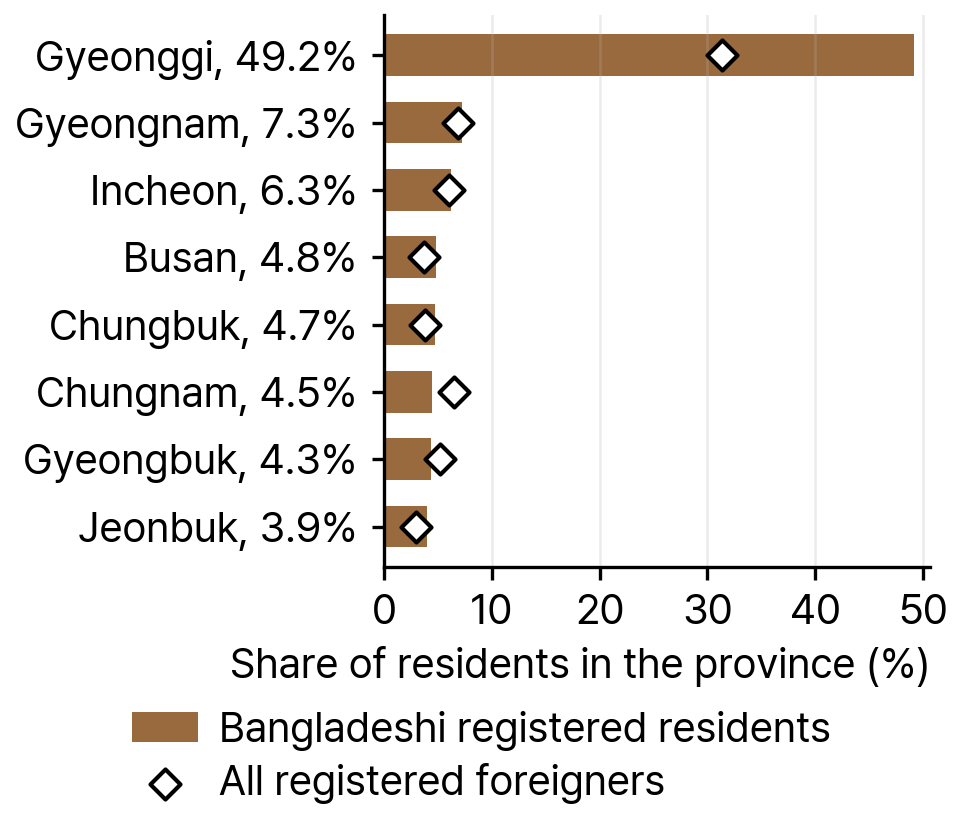
In 2024, 55.5 percent of Bangladeshi registered residents lived in Incheon and Gyeonggi province, 20.2 percent in the Yeongnam region (Busan, Daegu, Ulsan, and the Gyeongsang provinces), 11.6 percent in the Chungcheong region, 6.9 percent in the Honam region, 3.9 percent in Seoul, and 1.9 percent in Gangwon and Jeju (see Figure 3). The Seoul capital area (Seoul, Incheon, and Gyeonggi) was home to 59.4 percent of the group, compared with 55.2 percent of all resident foreigners.
Overall, 11.1 percent of Bangladeshi residents lived in rural counties (gun) in 2024, close to the 10.6 percent of all resident foreigners. The rural share was higher outside the capital area: 50.6 percent in Gangwon and Jeju, 35.1 percent in Honam, and 32.2 percent in Chungcheong.
Source: KIRD dataset, from Ministry of Justice registered-foreigner statistics by district, 2024.
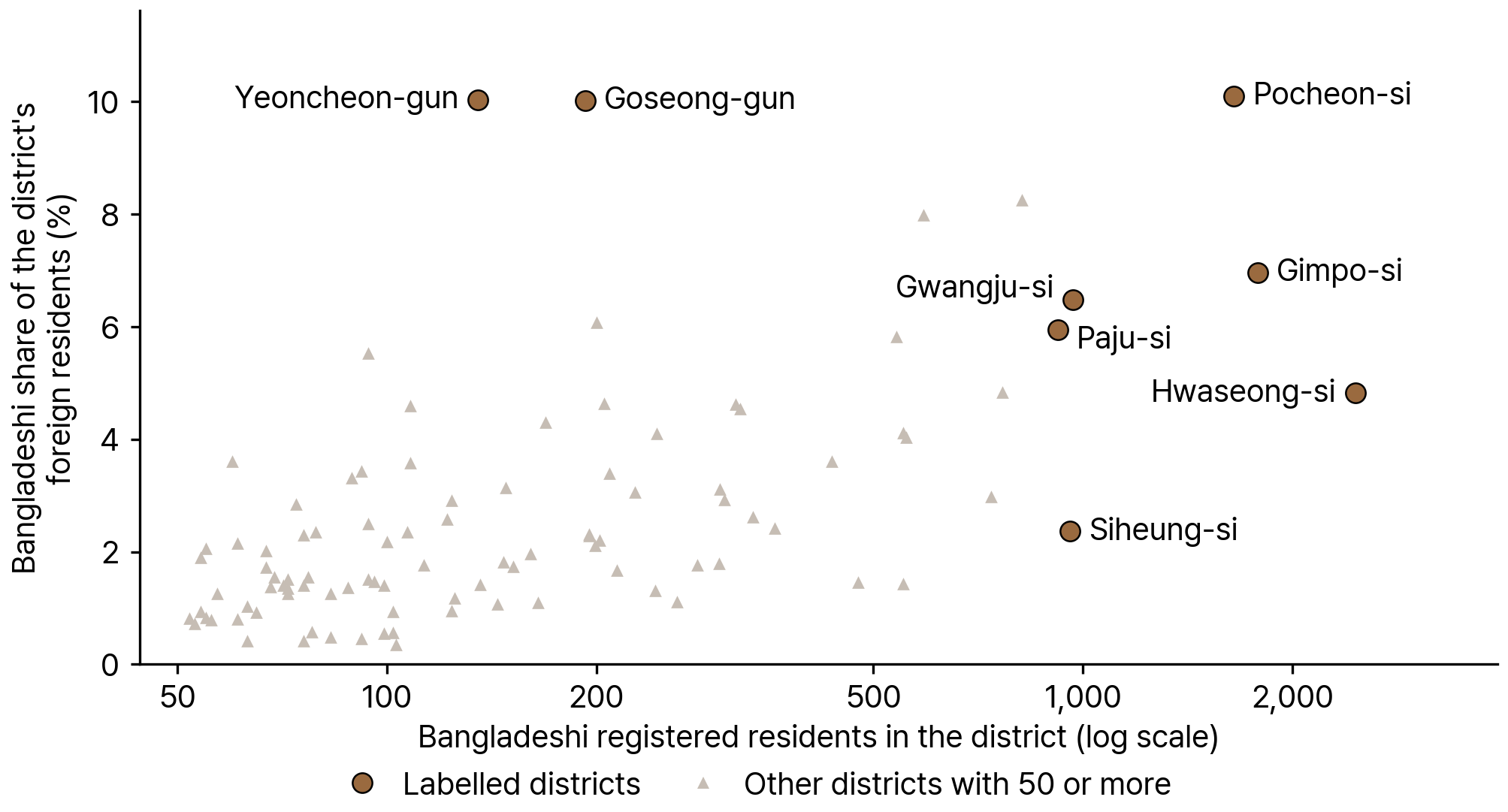
The largest Bangladeshi populations were in Hwaseong-si (2,461), Gimpo-si (1,784), and Pocheon-si (1,648), all in Gyeonggi province (see Figure 4 and Table 2). Seven of the ten largest districts were in Gyeonggi. The ten largest districts together accounted for 41.8 percent of Bangladeshi registered residents, and 58 districts had at least 100. In Seoul, the largest counts were in Gwangjin-gu (300) and Yongsan-gu (144).
Source: KIRD dataset, from Ministry of Justice registered-foreigner statistics by district, 2024.
Table 2Ten Districts with the Most Bangladeshi Registered Residents, 2024
| District | Province | Bangladeshi residents | Share of district's foreign residents |
|---|---|---|---|
| Hwaseong-si | Gyeonggi-do | 2,461 | 4.8% |
| Gimpo-si | Gyeonggi-do | 1,784 | 7.0% |
| Pocheon-si | Gyeonggi-do | 1,648 | 10.1% |
| Gwangju-si | Gyeonggi-do | 967 | 6.5% |
| Siheung-si | Gyeonggi-do | 957 | 2.4% |
| Paju-si | Gyeonggi-do | 920 | 5.9% |
| Yangju-si | Gyeonggi-do | 816 | 8.3% |
| Incheon Seo-gu | Incheon | 765 | 4.8% |
| Gimhae-si | Gyeongsangnam-do | 738 | 3.0% |
| Busan Nam-gu | Busan | 590 | 8.0% |
Note: Share of district's foreign residents is Bangladeshi registered residents divided by all registered foreigners in the district.
Source: KIRD dataset, from Ministry of Justice registered-foreigner statistics by district, 2024.
Bangladeshi residents made up at most about one in ten foreign residents of any district. The highest shares in 2024 were in Pocheon-si (10.1 percent), Yeoncheon-gun (10.0 percent), and Goseong-gun in Gangwon (10.0 percent). No district met the KIRD definition of an ethnic enclave (a location quotient of at least 2 with the group making up at least 30 percent of the district's foreign residents).
The index of dissimilarity (D) between Bangladeshi residents and all other registered foreigners across districts was 0.545 in 2014 and 0.524 in 2024. At 0.524, about half of Bangladeshi residents would have to move to another district for the group to be distributed like other foreigners.
Age and Sex
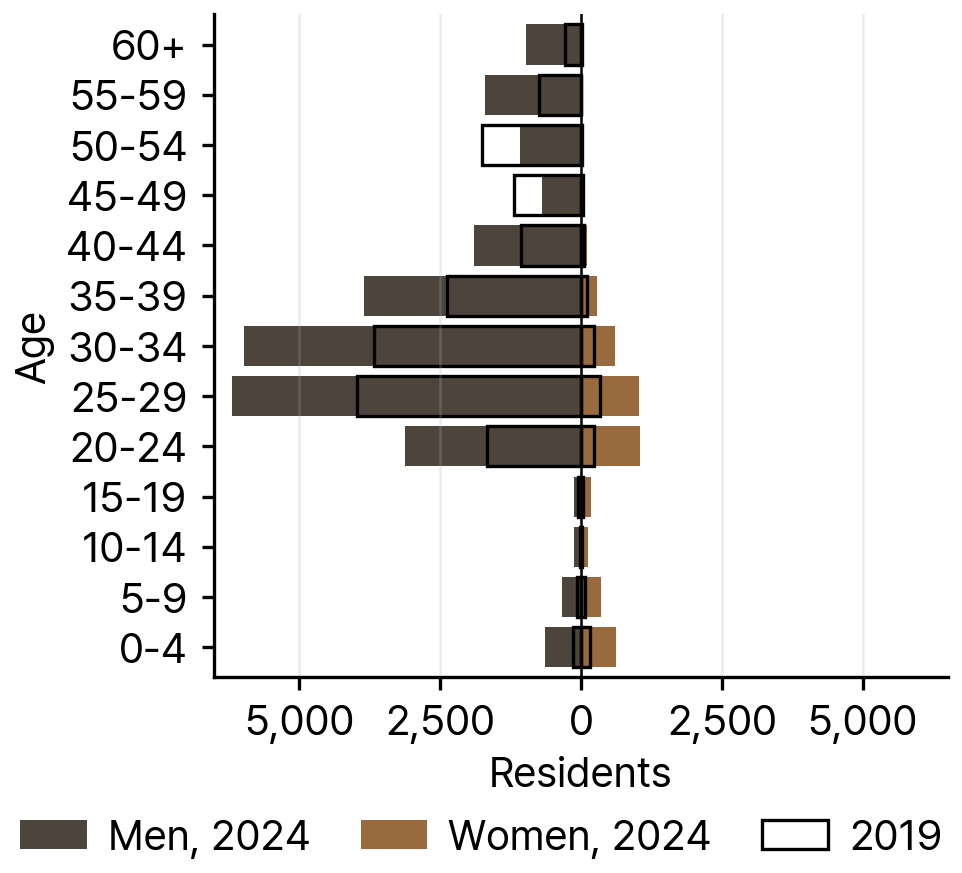
Bangladeshi residents were mostly men. Women numbered 4,481 in 2024, or 14.4 percent of the group, up from 1,301 (7.1 percent) in 2019. Among all resident foreigners, 45.1 percent were women in 2024.
The group was concentrated in young working ages. In 2024, 70.8 percent of Bangladeshi residents were ages 20 to 39 (22,093 people), compared with 49.7 percent of all resident foreigners. The largest five-year age group was 25-29, and the median fell in the 30-34 group. Only 3.3 percent were age 60 or older, against 12.9 percent of all resident foreigners (see Figure 5).
The number of children grew quickly. Bangladeshi children ages 0 to 14 rose from 503 in 2019 to 2,202 in 2024, about 4.4 times the 2019 count, and made up 7.1 percent of the group in 2024 (5.7 percent among all resident foreigners). Children under age 5 rose from 305 to 1,245 over the same years.
Source: KIRD dataset, from Ministry of Justice immigration yearbooks, 2024.
Visa Status
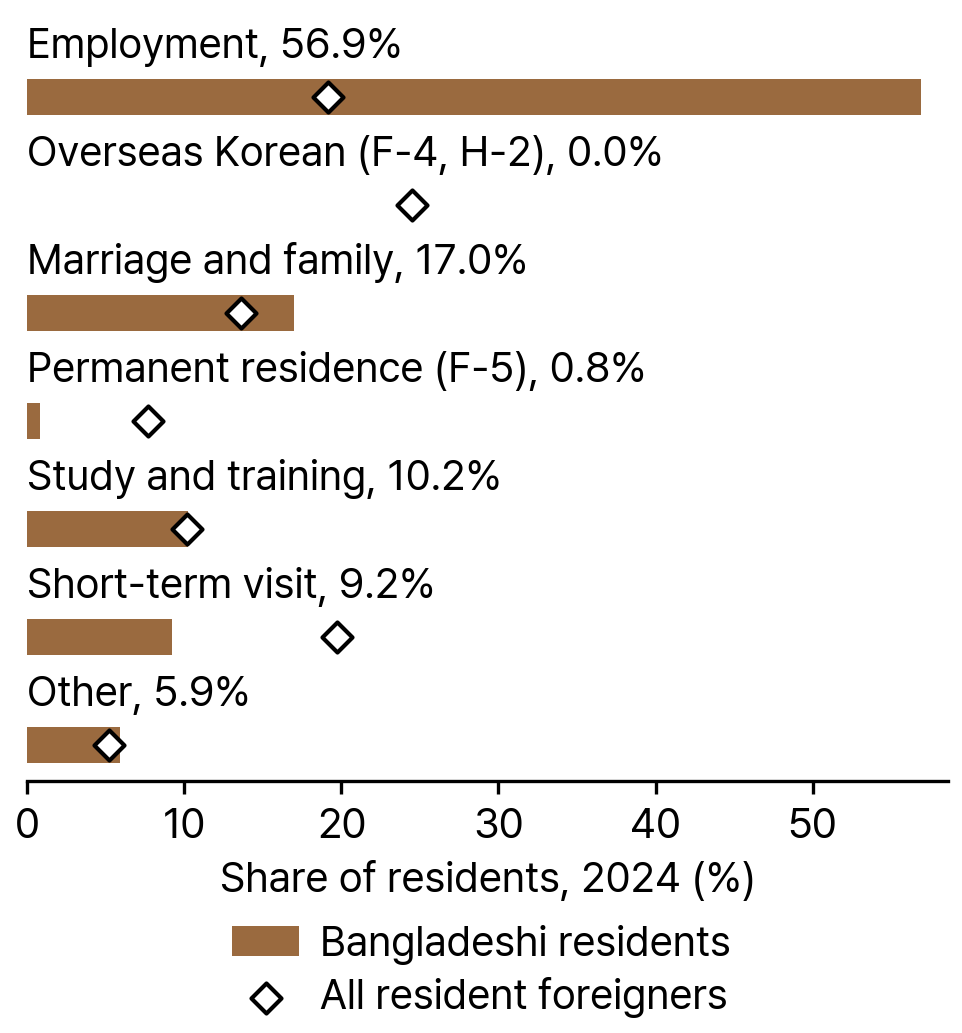
In 2024, 56.9 percent of Bangladeshi residents held an employment visa, about three times the share among all resident foreigners (19.2 percent). Marriage and family visas accounted for 17.0 percent (13.6 percent of all resident foreigners), study and training visas for 10.2 percent (the same share as all resident foreigners), and short-term visits for 9.2 percent (19.7 percent of all). Only 0.8 percent held permanent residence (F-5), against 7.7 percent of all resident foreigners (see Figure 6).
Source: KIRD dataset, from Ministry of Justice immigration yearbooks, 2024.
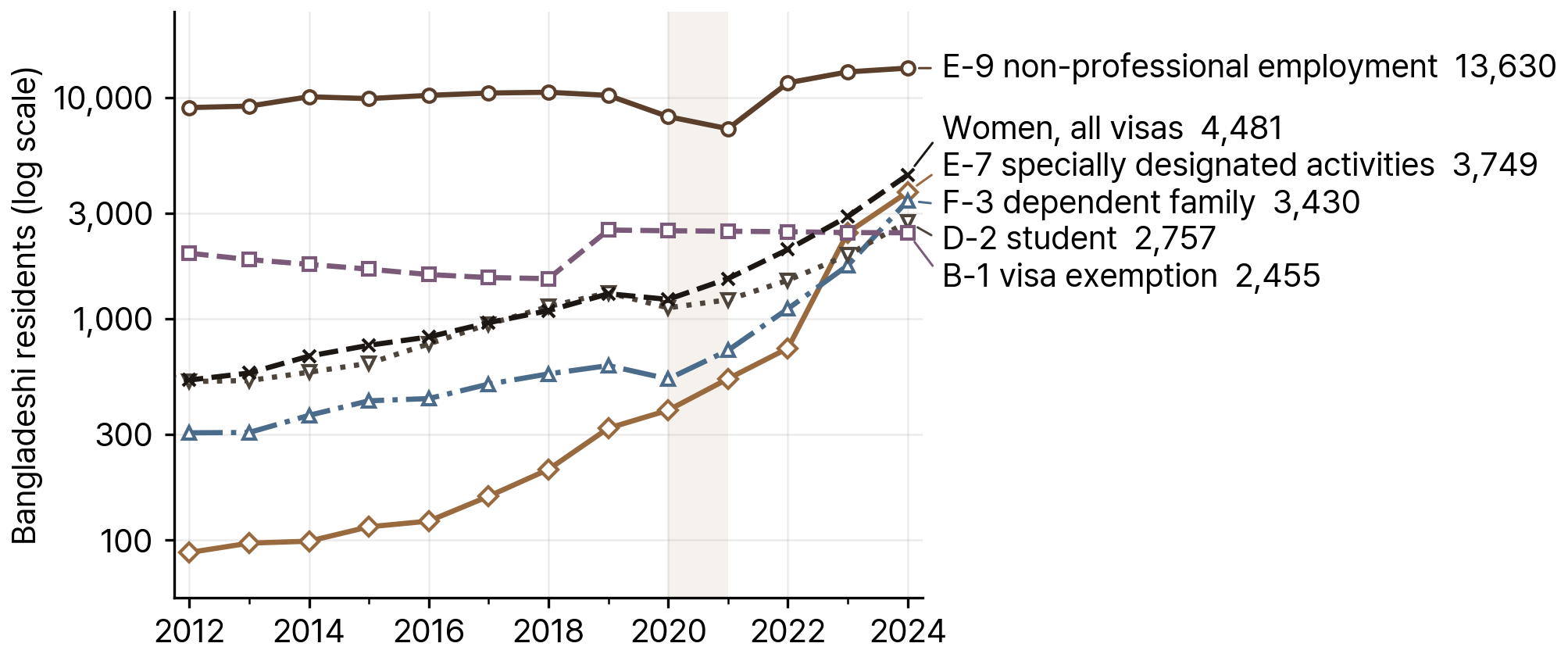
The E-9 non-professional employment visa was the most common single status: 13,630 Bangladeshi residents held it in 2024 (43.7 percent of the group), up from 10,117 in 2014 and 10,260 in 2019. Bangladeshi nationals were 4.0 percent of all E-9 holders in Korea, the tenth-largest group of E-9 holders by nationality.
Several other statuses grew faster than E-9 between 2019 and 2024 (see Figure 7 and Table 3). E-7 specially designated activities visas rose from 321 to 3,749, and Bangladeshi nationals held 5.9 percent of all E-7 visas in Korea in 2024. F-3 dependent family visas rose from 616 to 3,430 (6.5 percent of all F-3 holders), and D-2 student visas from 1,316 to 2,757. The number of visa-exempt (B-1) residents changed little, from 2,526 to 2,455.
Source: KIRD dataset, from Ministry of Justice immigration yearbooks, 2012-2024.
Table 3Most Common Visas Held by Bangladeshi Residents in South Korea, 2019 and 2024
| Visa | Meaning | 2019 | 2024 | Share of Bangladeshi residents, 2024 | Share of all holders of this visa in Korea, 2024 |
|---|---|---|---|---|---|
| E-9 | Non-professional employment | 10,260 | 13,630 | 43.7% | 4.0% |
| E-7 | Specially designated activities | 321 | 3,749 | 12.0% | 5.9% |
| F-3 | Dependent family | 616 | 3,430 | 11.0% | 6.5% |
| D-2 | Student | 1,316 | 2,757 | 8.8% | 1.5% |
| B-1 | Visa exemption | 2,526 | 2,455 | 7.9% | 1.2% |
| F-2 | Residential | 596 | 1,096 | 3.5% | 1.8% |
| G-1 | Other (miscellaneous) | 829 | 846 | 2.7% | 1.5% |
Note: Shares of Bangladeshi residents use the 2024 total of 31,220 resident foreigners.
Source: KIRD dataset, from Ministry of Justice immigration yearbooks, 2019 and 2024.
Migration Channels and Policy
Korea designated Bangladesh as a partner country for the Employment Permit System in 2007, and in 2008 it invited more than 1,500 Bangladeshi workers under the program (Embassy of the Republic of Korea in Bangladesh, 2007-2008). As of 2025, Bangladesh was one of 17 countries with an agreement with the Korean government to send workers under the EPS (HRD Korea, 2025).
Korea has raised its hiring targets for Bangladeshi workers. In 2022, the Korean government decided to hire 6,000 Bangladeshi workers in 2023, doubling the earlier quota (KIEP, 2022). In February 2024, the Korean ambassador announced that the fisheries and construction sectors would open to Bangladeshi job seekers for the first time, with 2024 targets of 7,500 workers in manufacturing, 1,877 in fisheries, 1,095 in construction, and 304 in shipbuilding (The Business Standard, 2024).
Naturalization
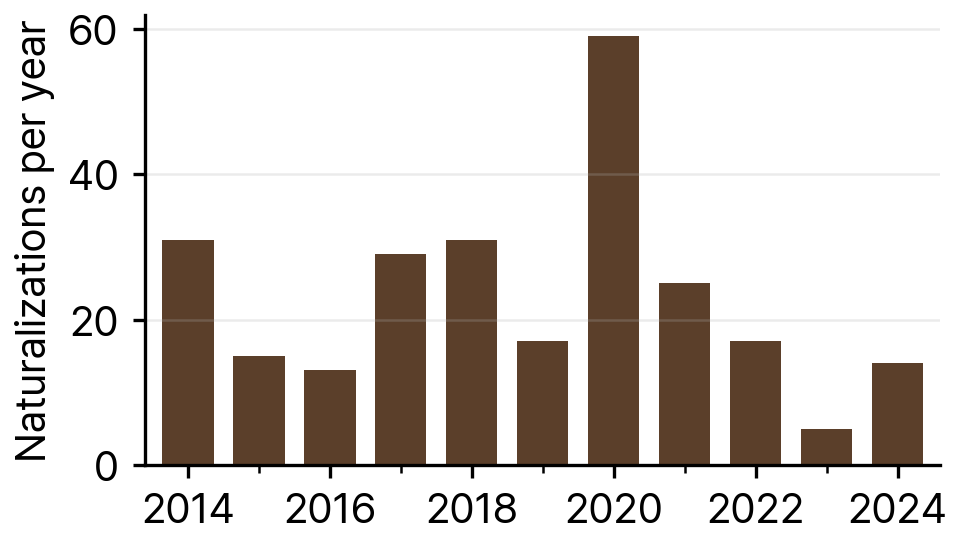
A total of 256 Bangladeshi nationals acquired Korean citizenship through naturalization from 2014 to 2024. Annual counts ranged from 5 in 2023 to 59 in 2020, and 14 Bangladeshi nationals naturalized in 2024 (see Figure 8).
Source: KIRD dataset, from Ministry of Justice immigration yearbooks, 2014-2024.
Unauthorized Residents
Bangladesh is not among the ten nationalities that the Ministry of Justice immigration yearbook (table 6-4) reports separately for unauthorized residents, so no count of unauthorized Bangladeshi residents is published. The yearbook reported 397,522 unauthorized residents of all nationalities in 2024.
Health and Well-being
To our knowledge, no source reports population-level health statistics for Bangladeshi residents. Published reporting consists of individual cases of workplace injury and illness among Bangladeshi EPS workers.
In March 2025, Rayhan, a Bangladeshi worker in his twenties, fractured a bone in his hand at a plastics factory in Pocheon, Gyeonggi province. His employer refused to support an industrial-accident claim; he filed it on his own, and his E-9 visa was later not renewed (Newstapa, 2025). Roy Ajit, a 41-year-old Bangladeshi worker, developed interstitial lung disease and lost 40 percent of his lung function after he began polishing metal parts at an agricultural-machinery factory in Gyeonggi in February 2021. The Korea Workers' Compensation and Welfare Service rejected his industrial-accident claim, and as of April 2026 he was pursuing an administrative lawsuit challenging the denial (Kyunghyang Weekly, 2026).
Migration from Bangladesh to South Korea
Bangladesh ranked fifth worldwide in the number of its nationals living abroad before the COVID-19 pandemic, with an estimated 7.8 million Bangladeshis working abroad in 2018 (World Bank, 2023). The same World Bank background paper describes the EPS as a channel of modest demand next to the Gulf states, with a total of about 30,000 workers needed from all sending countries combined. We know of no published source that reports South Korea's rank among the destinations of Bangladeshi emigrants.
Bangladesh sent 28,697 workers to South Korea through the EPS from 2008 to 2022, including a record 5,891 in 2022 (The Business Standard, 2022a). The World Bank paper counts 16,721 migrants sent to Korea from 2008 to 2017 (World Bank, 2023).
Departures have fallen short of Korea's allocations. According to data from BOESL, Bangladesh's state recruiting agency, reported by Bonikbarta, Korea allocated 11,700 places to Bangladesh in 2024 and 2,779 workers (24 percent) were sent. Over the five years covered by the report, Korea allocated 39,255 places, BOESL received job orders for 17,247 workers, and 14,829 workers (37 percent of the allocation) were sent. In 2024, more than 7,400 Bangladeshis passed the EPS Korean-language test and were placed on the EPS roster of job seekers. A rostered worker who does not go to Korea within two years must retake the language, skills, and medical tests to apply again (Bonikbarta, 2025).
Bangladesh received US$96.27 million in recorded remittances from South Korea in fiscal year 2018, 15.61 percent more than in fiscal year 2017, up from US$64.71 million in fiscal year 2016. At the time, Bangladesh Bank was seeking to raise remittance flows from Japan and South Korea (The Financial Express, 2018). The World Bank's bilateral remittance estimates, modeled from migrant numbers and incomes and last produced for 2021, put remittances sent from South Korea to Bangladesh at about US$39.1 million that year, below the recorded figure for fiscal year 2018 (World Bank, 2021). Personal remittances received by Bangladesh from all countries equaled 4.67 percent of GDP in 2022, 5.05 percent in 2023, and 6.11 percent in 2024 (World Bank, 2024), and 7.42 percent in 2025 (TheGlobalEconomy.com, 2025).
No published source that we know of reports the home districts or ethnic groups of Korea-bound migrants. For overseas labor migration to all destinations, 10 districts in the Dhaka and Chattogram divisions accounted for about 49 percent of the 9.19 million Bangladeshis who went abroad for work from 2005 to 2020. Cumilla (964,000), Chattogram (726,000), Brahmanbaria (493,000), Tangail (443,000), and Dhaka (404,000) sent the most workers (The Business Standard, 2021).
Bangladesh sends workers to South Korea through the government-run EPS, which the Human Resources Development Service of Korea (HRD Korea) manages on the Korean side. A World Bank background paper found that migrants paid about US$900 to go to Korea under the EPS, compared with more than US$4,000 through privately intermediated programs to the same destination. EPS candidates must be ages 18 to 39 and pass a basic Korean-language exam (World Bank, 2023).
Bengali (Bangla) is the sole official language of Bangladesh under Article 3 of its constitution, and the first language of 98 percent of the population (The Business Standard, 2022b).
Table 4Migration Indicators, Bangladesh and South Korea
| Indicator | Value | Source |
|---|---|---|
| Bangladeshis working abroad, 2018 | 7.8 million (fifth worldwide) | World Bank, 2023 |
| Cumulative EPS departures to South Korea, 2008-2022 | 28,697 | The Business Standard, 2022a |
| EPS departures to South Korea, 2022 | 5,891 | The Business Standard, 2022a |
| EPS places allocated and workers sent, 2024 | 11,700 places; 2,779 sent (24%) | Bonikbarta, 2025 |
| EPS places allocated and workers sent, five years reported in 2025 | 39,255 places; 14,829 sent (37%) | Bonikbarta, 2025 |
| Candidates who passed the EPS language test and were rostered, 2024 | More than 7,400 | Bonikbarta, 2025 |
| Migration cost, EPS and private intermediaries | About US$900; more than US$4,000 | World Bank, 2023 |
| Remittances from South Korea to Bangladesh, fiscal year 2018 | US$96.27 million | The Financial Express, 2018 |
| Remittances as a share of Bangladesh's GDP, 2024 | 6.11% | World Bank, 2024 |
| Remittances as a share of Bangladesh's GDP, 2025 | 7.42% | TheGlobalEconomy.com, 2025 |
Note: Remittance shares of GDP cover inflows from all countries.
Source: Sources as listed in each row.
Studies of Bangladeshi migrants in South Korea have examined migration motives, settlement, business ownership, and discrimination. In an ethnographic study, Kim and Rabbani (2017) found that Bangladeshi workers were drawn by high employment and wages, good workplace conditions, political and economic stability, and secularism, and that those who sought permanent residence did so by marrying Korean nationals, investing in small businesses, changing their visa status, or applying for refugee status. Fee and Rahman (2014) found that opportunity structures and market conditions explained the move of Bangladeshi workers into business ownership, and that these entrepreneurs served both ethnic and local Korean markets. Kim and Rabbani (2020) reported that during the COVID-19 pandemic in 2020, Bangladeshi workers faced restrictions on their movement at workplaces, limited access to public masks and emergency text alerts, and exclusion from emergency relief grants. We are not aware of any study of recruitment costs, brokers, or debt in this corridor.
Community Organizations
The Bangladeshi Students' Association in Korea (BSAK) is a student community organization with members from more than 19 Korean universities. It organizes events for national and religious holidays of Bangladesh and Korea, along with career activities (Bangladesh Circle, n.d.). Ansan's Wongok-dong, a district designated a multicultural village special zone in May 2009, was home to about 21,000 foreign residents from 57 countries in January 2019, and its roughly 200 ethnic restaurants included one Bangladeshi restaurant (Gyeonggi Cultural Foundation, 2019).
A survey of 310 Bangladeshi migrants in Korea, conducted from March to August 2016 and published in 2018, found that they maintained strong bonding networks based on close family ties and weak bridging networks with the wider host society (Hafiz and Shin, 2018).
The KIRD census of 1,720 migrant-serving organizations includes 8 whose name or listed target group names Bangladeshi residents. Most are religious sites, among them the Seoul Central Mosque and the Sri Radha Shyamasundar Mandir (ISKCON Seoul temple), both in Yongsan-gu, Seoul, and the Daejeon Islamic Center in Yuseong-gu, Daejeon. Others are the Jumma People's Network Korea (JPNK) in Gimpo-si, the Universal Cultural Center in Dong-gu, Gwangju, and the GFC International Student Center at Pusan National University in Geumjeong-gu, Busan. Most general-purpose organizations in the census, such as migrant worker centers and multicultural family support centers, also serve Bangladeshi residents.
Sources
KIRD dataset (Korea Immigration Regional Dashboard), openICPSR. https://doi.org/10.3886/E249944V1
Embassy of the Republic of Korea in the People's Republic of Bangladesh. Receiving Bangladesh Workers to Korea (EPS). https://overseas.mofa.go.kr/bd-en/brd/m_2128/view.do?seq=617249
HRD Korea. 2025. 외국인근로자 권익 보장을 위한 제도 고용허가제 A to Z (The Employment Permit System A to Z). Webzine. https://webzine.hrdkorea.or.kr/section/webzine/view?id=13189
Bonikbarta. 2025. Only 37% of South Korea Quota for Bangladeshi Workers Filled over Five Years. https://en.bonikbarta.com/bangladesh/pkKgcbRkEm2eZOVa
Korea Institute for International Economic Policy (KIEP). 2022. [방글라데시] 노동자 송출 쿼터 2배 확대 (Bangladesh: Worker Quota Doubled). News brief, 6 September 2022. https://www.kiep.go.kr/aif/newsBriefDetail.es?brdctsNo=335538&mid=a30100000000&systemcode=02
The Business Standard. 2024. Korea Opens Construction, Fisheries Sectors for Bangladeshi Job Seekers. 20 February 2024. https://www.tbsnews.net/bangladesh/korea-opens-construction-fisheries-sectors-bangladeshi-job-seekers-796134
Newstapa. 2025. [허가된 착취①] 다치고, 버려지고, 죽는다...고용허가제에 갇힌 이주노동자 (Permitted Exploitation, Part 1). 13 October 2025. https://newstapa.org/article/3wltG
Kyunghyang Weekly (주간경향). 2026. '부디 나에게 이러지 말아요'... 방글라데시 출신 이주노동자 기자회견. 1 April 2026. https://weekly.khan.co.kr/article/202604011438011/
World Bank. Personal Remittances, Received (% of GDP), Bangladesh. World Development Indicators, series BX.TRF.PWKR.DT.GD.ZS. https://data.worldbank.org/indicator/BX.TRF.PWKR.DT.GD.ZS?locations=BD
World Bank. 2023. Low-Skilled Temporary Migration Policies: The Case of Bangladesh. Background paper to the World Development Report 2023: Migrants, Refugees, and Societies. https://thedocs.worldbank.org/en/doc/3ab0cffdc2e4621f8b5a70a0410213d5-0050062023/original/Bangladesh-case-study-FORMATTED.pdf
The Business Standard. 2022a. Record 5,891 Bangladeshi Workers Went to South Korea in 2022. https://www.tbsnews.net/bangladesh/migration/record-5891-bangladeshi-workers-went-south-korea-2022-562082
The Financial Express (Bangladesh). 2018. Bangladesh Bank Moves to Raise Remittance Flow from Japan, S Korea. https://thefinancialexpress.com.bd/economy/bangladesh/bangladesh-bank-moves-to-raise-remittance-flow-from-japan-s-korea-1535946468
TheGlobalEconomy.com. 2025. Bangladesh: Remittances, Percent of GDP (based on World Bank data). https://www.theglobaleconomy.com/Bangladesh/remittances_percent_GDP/
The Business Standard. 2021. 10 Districts Grab 50% of Foreign Jobs. https://www.tbsnews.net/bangladesh/migration/10-districts-grab-50-foreign-jobs-387790
Fee, L. K., & Rahman, M. M. (2014). From workers to entrepreneurs: Development of Bangladeshi migrant businesses in the Republic of Korea. International Migration, 52(2), 122-139. https://doi.org/10.1111/j.1468-2435.2010.00680.x
Kim, K.-H., & Rabbani, G. (2017). 방글라데시 이주노동자의 한국 이주와 영구정착 과정 [Processes of migration and permanent settlement with particular reference to Bangladeshi migrant workers in Korea]. Journal of Cultural and Historical Geography, 29(3), 129-144. https://www.kci.go.kr/kciportal/ci/sereArticleSearch/ciSereArtiView.kci?sereArticleSearchBean.artiId=ART002261388
Kim, K.-H., & Rabbani, M. G. (2020). 한국 내 방글라데시 이주노동자의 코로나-19에 대한 경험: 차별과 배제 및 사회, 경제적 영향을 중심으로 [Bangladeshi migrant workers' experience of COVID-19 in Korea: Discrimination, exclusion, and socioeconomic impact]. Journal of Diaspora Studies, 14(2), 7-46. https://www.kci.go.kr/kciportal/ci/sereArticleSearch/ciSereArtiView.kci?sereArticleSearchBean.artiId=ART002658931
Bangladesh Circle. Bangladeshi Students' Association in Korea. Directory entry. https://www.bangladeshcircle.com/bangladesh-business-directory/6496/bangladeshi-students-association-korea/
Gyeonggi Cultural Foundation (지지씨). 2019. 대한민국 속의 작은 외국, 안산 원곡동 다문화거리 (Ansan Wongok-dong Multicultural Street). https://ggc.ggcf.kr/p/5f5fb7038b3b1b26c6f7f643
Hafiz, Md Golam, and Julia Jiwon Shin. 2018. 한국 내 방글라데시 이주민의 사회적 네트워크에 관한 연구 (A Study on the Social Networks of Bangladeshi Migrants in Korea). 디아스포라연구 (Journal of Diaspora Studies) 12 (1): 213-249. https://www.kci.go.kr/kciportal/ci/sereArticleSearch/ciSereArtiView.kci?sereArticleSearchBean.artiId=ART002353990
World Bank. 2021. Bilateral Remittance Estimates (WB_KNOMAD_BRE), Data360. https://data360api.worldbank.org/data360/data?DATABASE_ID=WB_KNOMAD&INDICATOR=WB_KNOMAD_BRE&REF_AREA=KOR
The Business Standard. 2022b. Languages of Bangladesh. https://www.tbsnews.net/supplement/languages-bangladesh-373636
Suggested citation: Korea Immigration Regional Dashboard (KIRD). 2026. “Bangladeshi Immigrants in South Korea.” Foreign Residents in South Korea series, September 2026. Data: Korea Immigration Regional Dashboard (KIRD) dataset, https://doi.org/10.3886/E249944V1. Interactive maps and tables: https://immigrantsinkorea.today.