 Korea Immigration Regional Dashboard
SpotlightSeptember 2026Nationality profilesDownload PDF
Canadian Immigrants in South Korea
Highlights
- At the end of 2024, 28,604 Canadian nationals were resident in South Korea, up from 14,879 in 2006. Canada was the 27th-largest nationality among registered foreigners (0.3 percent) and the 20th-largest among all resident foreigners (1.1 percent), down from 19th and 15th in 2014.
- In 2024, 62.1 percent of Canadians (17,757 people) held the F-4 Overseas Korean visa, compared with 24.5 percent of all resident foreigners who held an Overseas Korean visa (F-4 or H-2).
- Between 2011 and 2024, 4,542 people whose previous nationality was Canadian restored their Korean nationality, compared with 28 Canadians who naturalized between 2014 and 2024.
The Ministry of Justice counted 14,879 Canadian resident foreigners in South Korea at the end of 2006 and 28,604 at the end of 2024, an increase of 13,725 people (92.2 percent). In 2024, Canada was the 27th-largest nationality among registered foreigners (0.3 percent of the total) and the 20th-largest among all resident foreigners (1.1 percent). In 2014 it ranked 19th among registered foreigners and 15th among all resident foreigners.
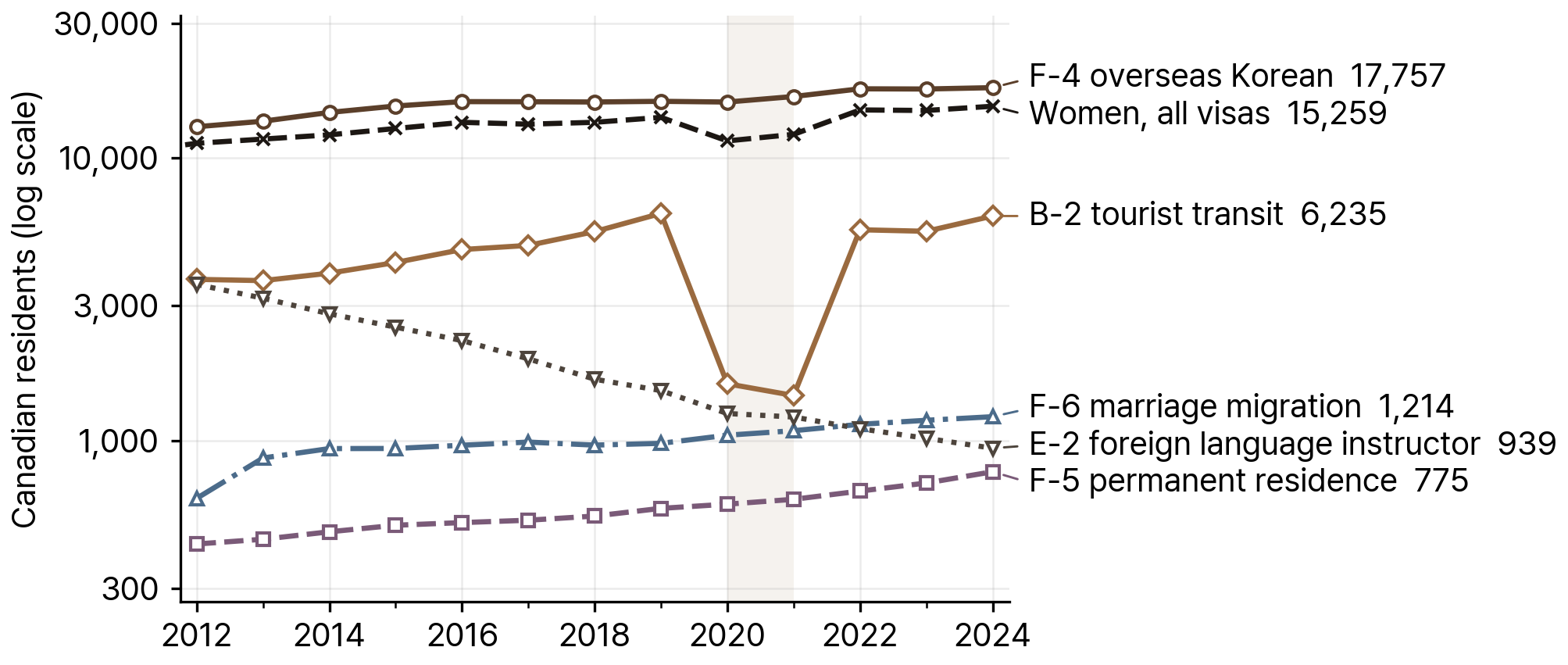
Most Canadians in Korea hold statuses tied to Korean ancestry or to short visits. The F-4 Overseas Korean visa was the most common status in 2024 (17,757 holders), followed by B-2 tourist and transit status (6,235). The number of E-2 foreign language instructor visa holders fell from 2,809 in 2014 to 939 in 2024, while F-4 holders rose from 14,509 to 17,757 over the same years.
Compared with all resident foreigners in 2024, Canadians were more often women (53.3 percent versus 45.1 percent) and more often aged 60 and older (25.7 percent versus 12.9 percent). Registered Canadians were more concentrated in Seoul, Incheon, and Gyeonggi (67.3 percent versus 55.2 percent), and 5.6 percent of Canadians held an employment visa, against 19.2 percent of all resident foreigners. This Spotlight describes the number of Canadian residents over time, where they live, their age and sex, visa status, migration channels, naturalization, health and well-being, migration from Canada to South Korea, and community organizations.
Size of the Population over Time
The number of Canadian resident foreigners grew from 14,879 in 2006 to 20,435 in 2010, 24,353 in 2014, and 26,789 in 2019. It fell to 21,794 in 2020, a drop of 4,995 people (18.6 percent), then rose to 22,830 in 2021 and 27,705 in 2022, eased to 27,607 in 2023, and rose again to 28,604 in 2024, the highest count in the series (KIRD dataset).
Registered foreigners are a much smaller group, and their number has declined. In 2024, 4,452 Canadians were registered, 15.6 percent of all Canadian resident foreigners, compared with 6,843 registered in 2006, 5,747 in 2014, and 4,358 in 2019.
Canada ranked lower among registered foreigners than among all resident foreigners in each year shown in Table 1, since F-4 holders (62.1 percent of Canadians in 2024) and short-term visitors (22.0 percent) are not counted among registered foreigners. Among registered foreigners, Canada ranked 15th in 2006, 19th in 2014, 23rd in 2019, and 27th in 2024. Among all resident foreigners, it ranked 12th, 15th, 18th, and 20th in the same years. Canadians' share of registered foreigners fell from 1.1 percent in 2006 to 0.3 percent in 2024, and their share of all resident foreigners fell from 1.6 percent to 1.1 percent.
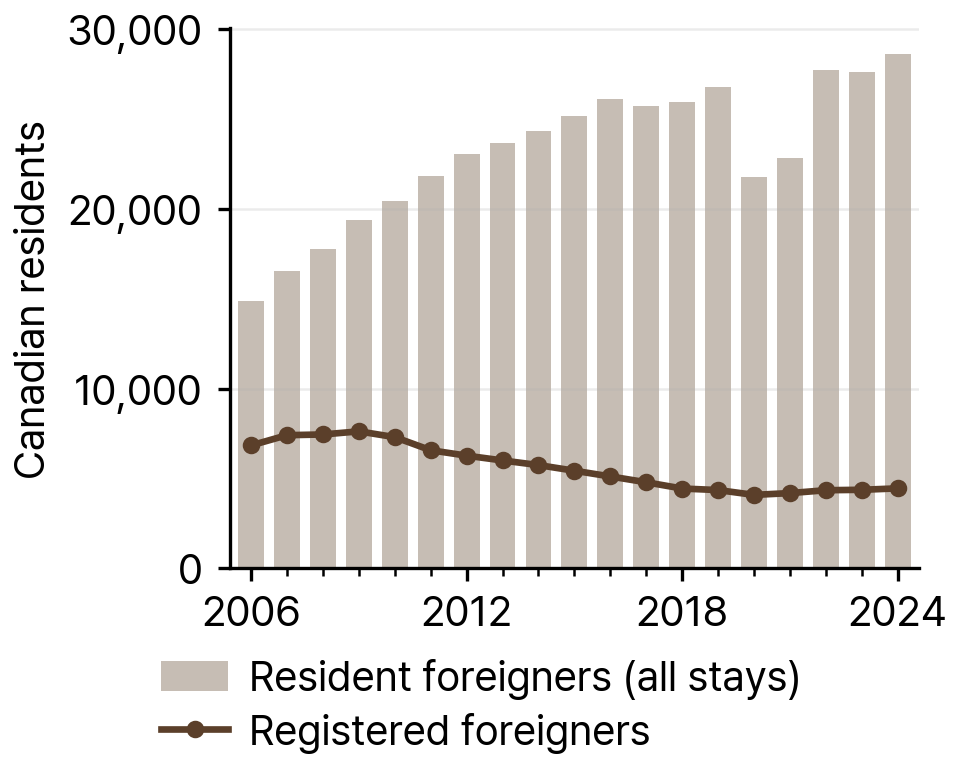
Source: KIRD dataset, from Ministry of Justice immigration yearbooks, 2006-2024.
Measured against 2019, the Canadian population stood at an index of 106.8 in 2024 (28,604 divided by 26,789). This ranked 14th in growth among the 20 largest nationalities.
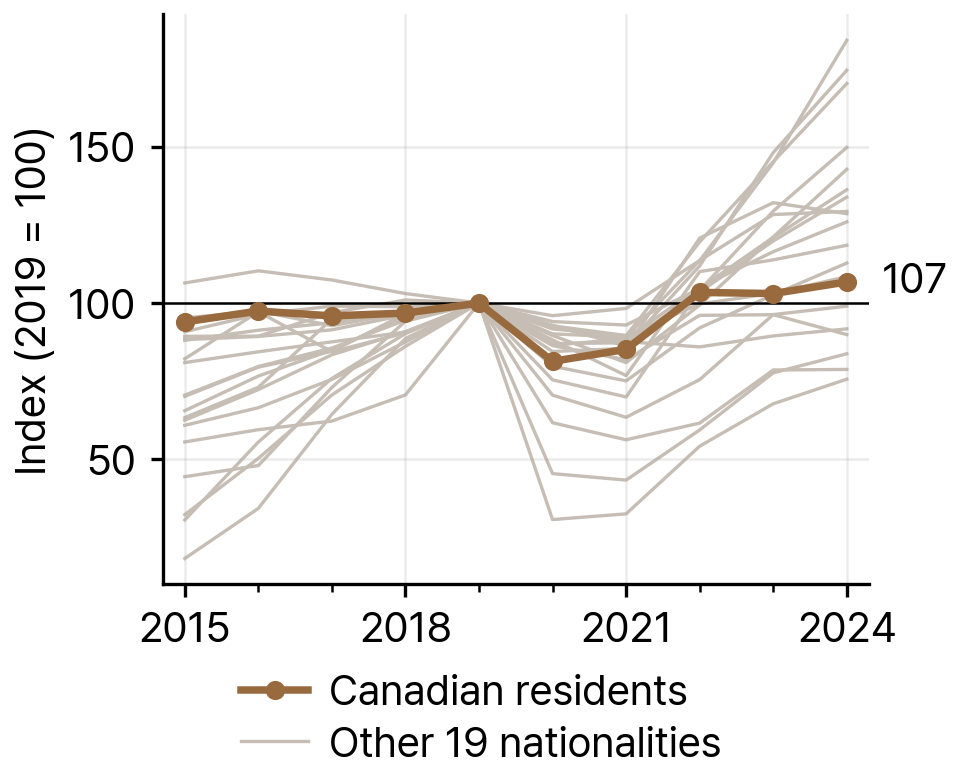
Source: KIRD dataset, from Ministry of Justice immigration yearbooks, 2006-2024.
Table 1Canadian Resident Foreigners and Registered Foreigners in South Korea, Selected Years
| Year | Resident foreigners | Registered foreigners | Rank among registered foreigners | Rank among all resident foreigners | Share of all registered foreigners (%) | Share of all resident foreigners (%) |
|---|---|---|---|---|---|---|
| 2006 | 14,879 | 6,843 | 15 | 12 | 1.1 | 1.6 |
| 2014 | 24,353 | 5,747 | 19 | 15 | 0.5 | 1.4 |
| 2019 | 26,789 | 4,358 | 23 | 18 | 0.3 | 1.1 |
| 2024 | 28,604 | 4,452 | 27 | 20 | 0.3 | 1.1 |
Note: Counts on 31 December. Ranks and shares are computed among all nationalities in each count. Resident foreigners include short-term visitors and F-4 overseas Koreans who report their residence; registered foreigners are those in Korea for more than 90 days who completed alien registration.
Source: KIRD dataset, from Ministry of Justice immigration yearbooks, 2006-2024.
Distribution by Province and District
District data cover the 4,452 Canadians who were registered foreigners in 2024. Of these, 38.5 percent (1,712) lived in Seoul, 28.8 percent (1,282) in Incheon and Gyeonggi, 16.0 percent (714) in the Yeongnam region, 7.3 percent (324) in Chungcheong, 5.4 percent (242) in Gangwon and Jeju, and 4.0 percent (178) in Honam. Together, Seoul, Incheon, and Gyeonggi accounted for 67.3 percent of registered Canadians, compared with 55.2 percent of all registered foreigners.
Few Canadians live in rural counties (gun). In 2024, 3.1 percent of registered Canadians lived in a county, compared with 10.6 percent of all registered foreigners. Outside the capital area, the largest local populations were in Seogwipo-si (111) and Jeju-si (67) on Jeju, Busan's Haeundae-gu (81), and Daejeon's Yuseong-gu (57).
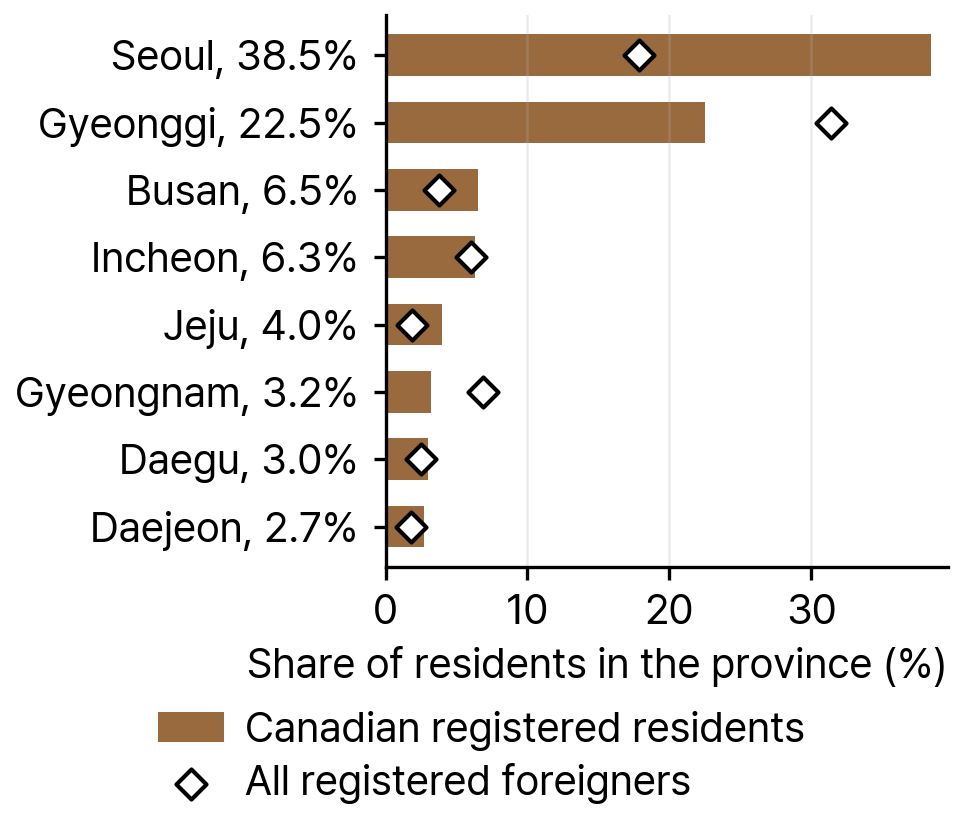
Source: KIRD dataset, from Ministry of Justice registered-foreigner statistics by district, 2024.
Seoul's Yongsan-gu had the largest number of registered Canadians in 2024 (196), followed by Gangnam-gu (187) and Incheon's Yeonsu-gu (131). The ten largest districts accounted for 28.8 percent of registered Canadians, and eight districts had at least 100.
Canadians are a small part of the foreign population in every district where they live in numbers. Among the ten largest districts, their share of registered foreigners was highest in Seoul's Gangnam-gu and Bundang-gu, Seongnam-si (3.2 percent each), followed by Seocho-gu (2.7 percent).
The index of dissimilarity (D), which measures how differently Canadians and all other registered foreigners are spread across districts on a scale from 0 to 1, rose from 0.303 in 2014 to 0.342 in 2024. No district met the KIRD definition of an ethnic enclave for Canadians in 2024 (a location quotient of at least 2 and Canadians making up at least 30 percent of the district's registered foreigners).
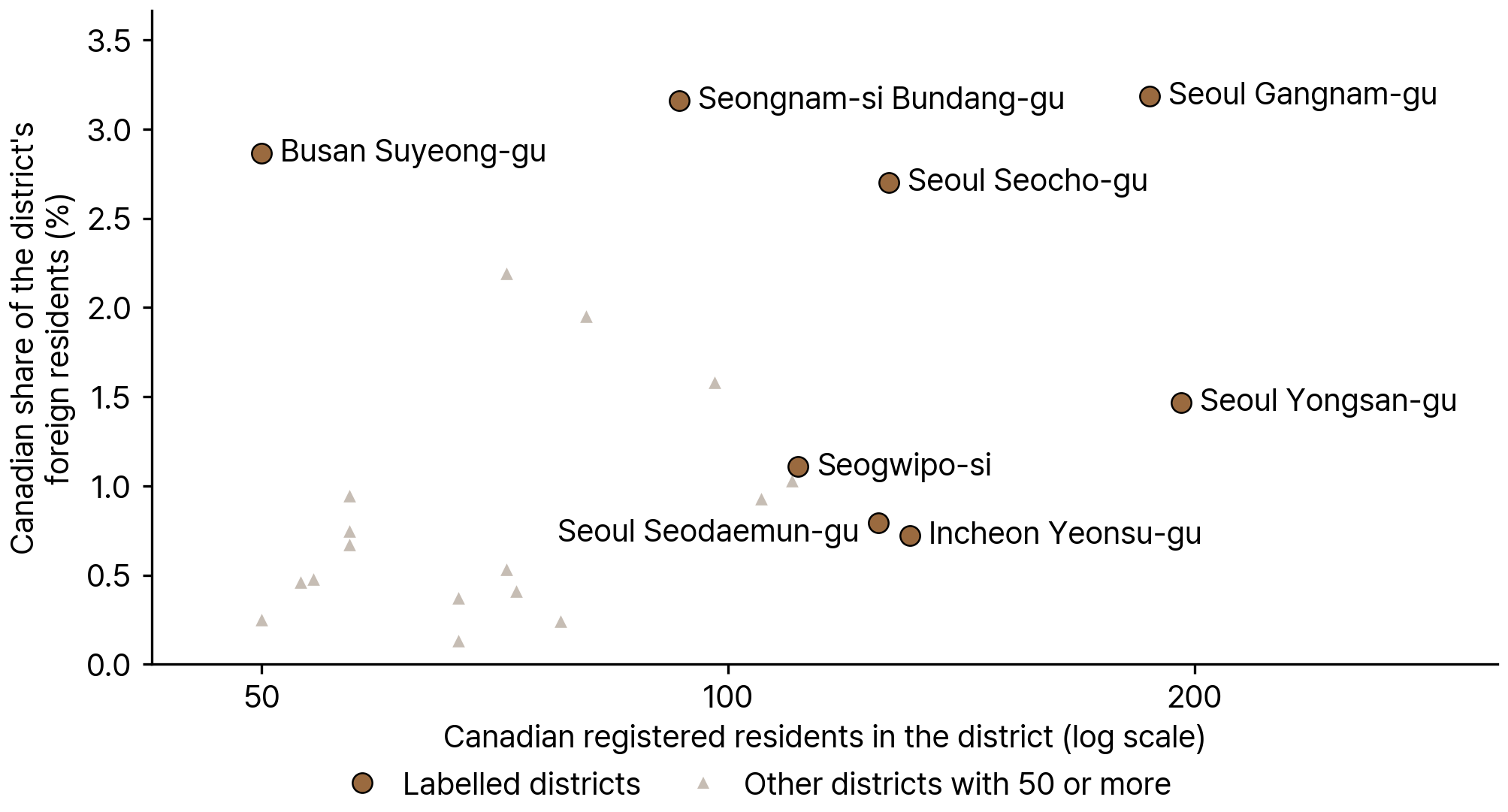
Source: KIRD dataset, from Ministry of Justice registered-foreigner statistics by district, 2024.
Table 2Ten Districts with the Most Registered Canadian Foreigners, 2024
| District | Province | Registered Canadians | Share of district's registered foreigners (%) |
|---|---|---|---|
| Seoul Yongsan-gu | Seoul | 196 | 1.5 |
| Seoul Gangnam-gu | Seoul | 187 | 3.2 |
| Incheon Yeonsu-gu | Incheon | 131 | 0.7 |
| Seoul Seocho-gu | Seoul | 127 | 2.7 |
| Seoul Seodaemun-gu | Seoul | 125 | 0.8 |
| Seogwipo-si | Jeju-do | 111 | 1.1 |
| Seoul Jung-gu | Seoul | 110 | 1.0 |
| Seoul Mapo-gu | Seoul | 105 | 0.9 |
| Seoul Songpa-gu | Seoul | 98 | 1.6 |
| Seongnam-si Bundang-gu | Gyeonggi-do | 93 | 3.2 |
Note: Registered foreigners only; F-4 holders, who report residence instead of registering, are not included.
Source: KIRD dataset, from Ministry of Justice registered-foreigner statistics by district, 2024.
Age and Sex
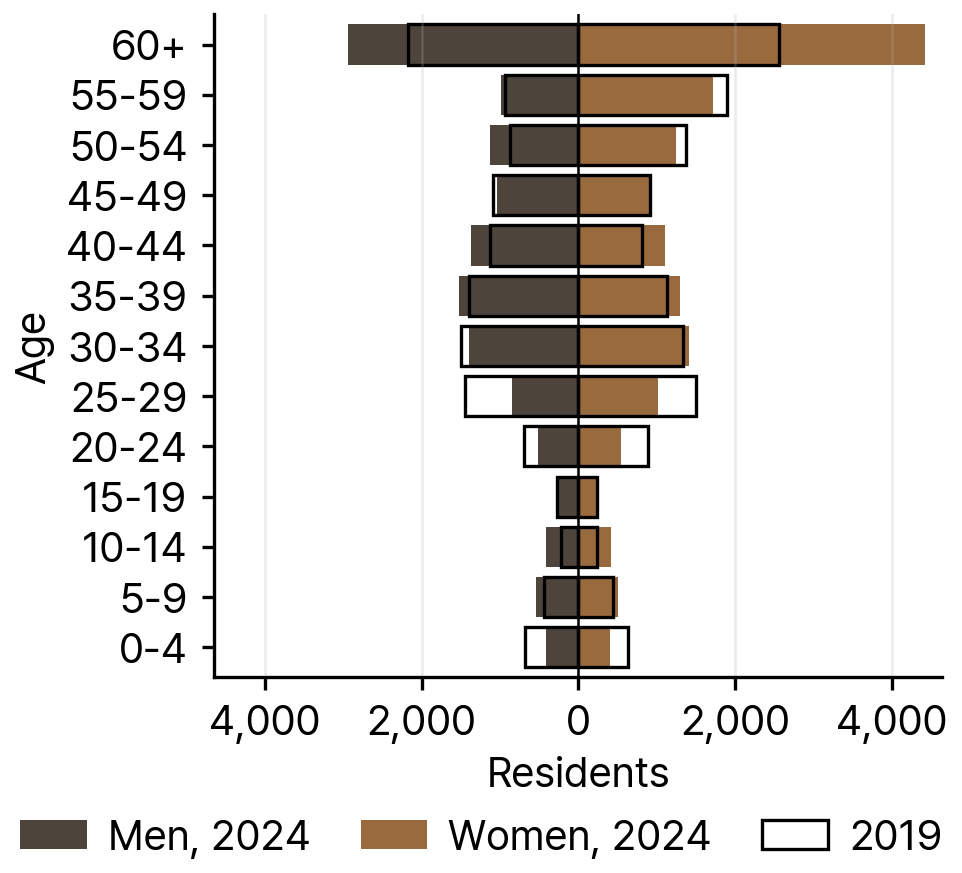
Women made up 53.3 percent of Canadian resident foreigners in 2024 (15,259 of 28,604), up from 52.0 percent in 2019 (13,936 of 26,789) and above the 45.1 percent among all resident foreigners.
The Canadian population is older than the foreign population overall. In 2024, 25.7 percent of Canadians were aged 60 and older, against 12.9 percent of all resident foreigners, and 9.4 percent were under age 15, against 5.7 percent. Adults aged 20 to 39 made up 29.9 percent of Canadians and 49.7 percent of all resident foreigners. The largest age group among Canadians was 60 and older, and the median fell in the 45 to 49 age group.
Between 2019 and 2024, the number of Canadians aged 50 and older rose from 9,811 to 12,430, and the number aged 20 to 39 fell from 9,870 to 8,544. Children under 5 fell from 1,323 to 819, while the number of children under 15 changed little (2,655 in 2019 and 2,686 in 2024).
Source: KIRD dataset, from Ministry of Justice immigration yearbooks, 2006-2024.
Visa Status
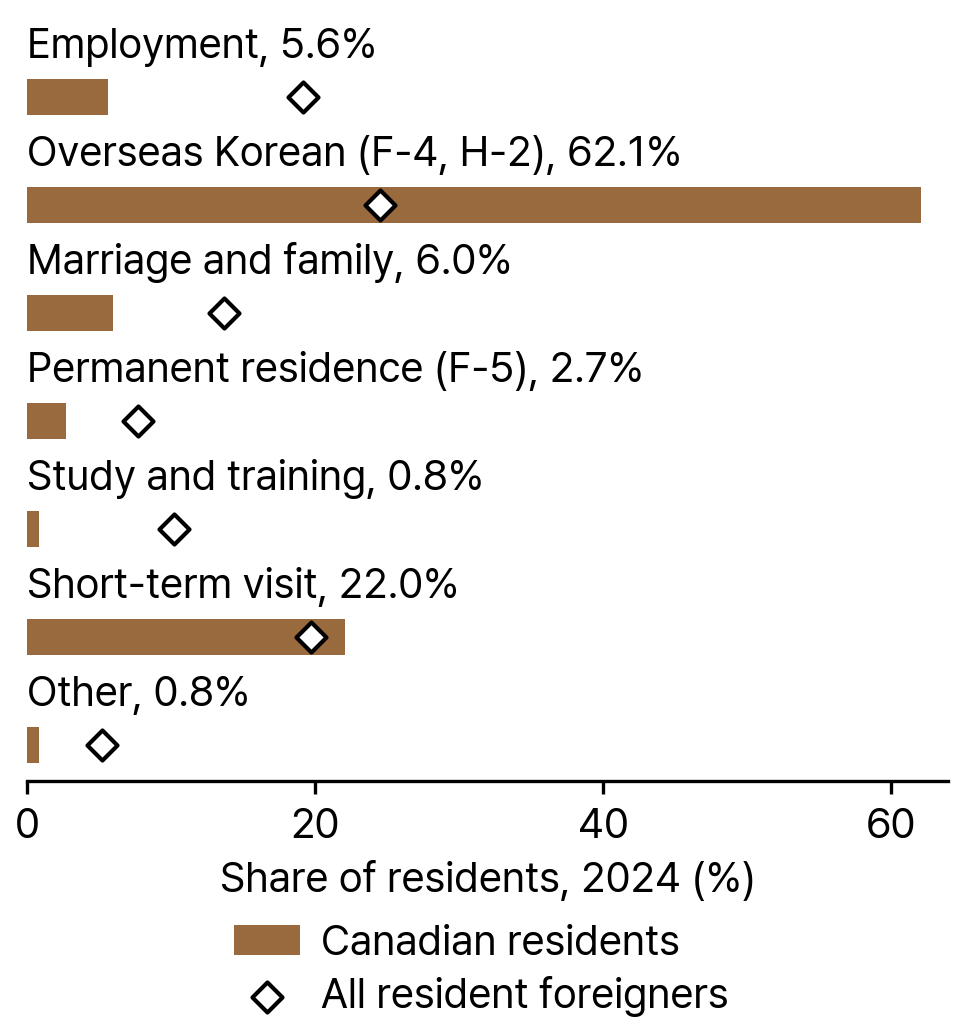
In 2024, 62.1 percent of Canadians held the F-4 Overseas Korean visa (17,757 people), and Canadians were the fifth-largest nationality among F-4 holders. Another 21.8 percent (6,235) held B-2 tourist and transit status, up from 3,913 in 2014.
Canadians held 939 E-2 foreign language instructor visas in 2024, 7.0 percent of all E-2 holders in the country, down from 1,502 in 2019 and 2,809 in 2014. Marriage migrant (F-6) holders rose from 977 in 2019 to 1,214 in 2024, and permanent residents (F-5) from 575 to 775.
Grouped by purpose, 5.6 percent of Canadians held employment visas in 2024 (19.2 percent of all resident foreigners), 6.0 percent held marriage or family visas (13.6 percent), 2.7 percent held permanent residence (7.7 percent), and 0.8 percent held study or training visas (10.2 percent). Short-term visit statuses made up 22.0 percent of Canadians and 19.7 percent of all resident foreigners.
Source: KIRD dataset, from Ministry of Justice immigration yearbooks, 2024.
Source: KIRD dataset, from Ministry of Justice immigration yearbooks, 2006-2024.
Table 3Most Common Visas Held by Canadian Resident Foreigners, 2019 and 2024
| Visa | Meaning | 2019 | 2024 | Share of Canadians, 2024 (%) | Canadians' share of all holders of the visa, 2024 (%) |
|---|---|---|---|---|---|
| F-4 | Overseas Korean | 15,884 | 17,757 | 62.1 | 3.2 |
| B-2 | Tourist Transit | 6,369 | 6,235 | 21.8 | 4.1 |
| F-6 | Marriage Migration | 977 | 1,214 | 4.2 | 0.8 |
| E-2 | Foreign Language Instructor | 1,502 | 939 | 3.3 | 7.0 |
| F-5 | Permanent Residence | 575 | 775 | 2.7 | 0.4 |
| E-7 | Specially Designated Activities | 299 | 289 | 1.0 | 0.5 |
| F-3 | Dependent Family | 176 | 214 | 0.7 | 0.4 |
Note: Resident foreigners on 31 December. Shares of Canadians use the 2024 total of 28,604.
Source: KIRD dataset, from Ministry of Justice immigration yearbooks, 2006-2024.
Migration Channels and Policy
Canada is not one of the 16 sending countries of Korea's Employment Permit System, so Canadians do not use the E-9 route for lower-skilled workers (Employment Permit System, 2026).
Teaching is an older channel. Most of Korea's roughly 16,000 native-speaking foreign language teachers come from the United States, Canada, the United Kingdom, Ireland, South Africa, Australia, and New Zealand (Keralis, 2017).
Young Canadians can also come through the Working Holiday (H-1) program. Korea set it up with Canada in January 1996, after its first agreement with Australia in July 1995, and applicants must be 18 to 35 at the time of issuance (Embassy of the Republic of Korea to Canada, 2026). Canada's side of the arrangement is described under Migration from Canada to South Korea.
Rules for E-2 teachers have changed. Effective July 3, 2017, the Ministry of Justice dropped the mandatory HIV test for issuing or renewing E-2 visas, ending a requirement in place since 2007 that citizen groups had pushed for partly over news that Christopher Paul Neil had taught in Korea (Korea Herald, 2017).
Enforcement of E-2 conditions has affected Canadian teachers directly. In May 2017, immigration authorities deported 14 Canadian teachers from Canada British Columbia International School in Seoul over allegations that the school had used E-2 visas, which cover language-academy teaching, for full international-school instruction (Globe and Mail, 2017).
Naturalization
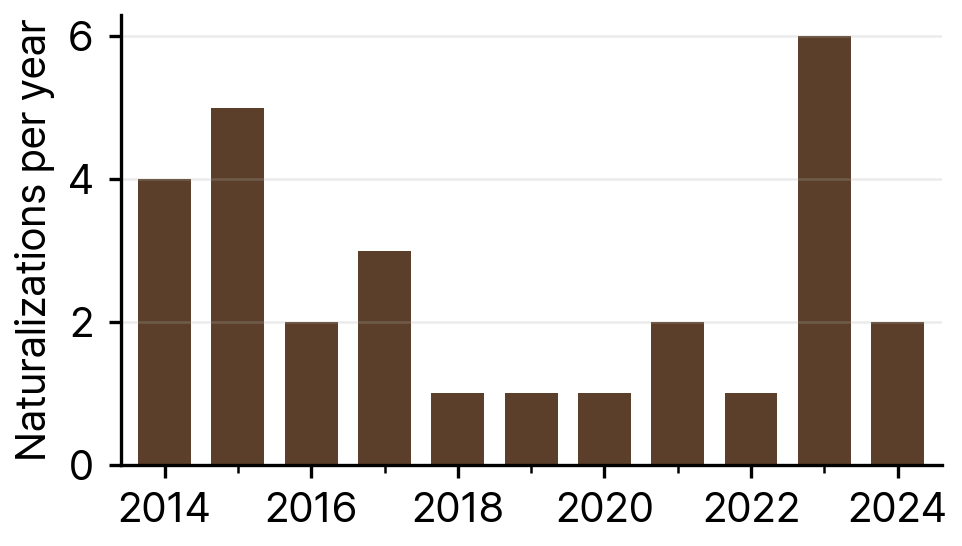
Few Canadians naturalize in Korea. Between 2014 and 2024, 28 Canadians acquired Korean nationality through naturalization; annual numbers ranged from 1 to 6 (2023), with 2 in 2024. The Ministry of Justice's by-country table reports this combined naturalization total from 2014; the 2009 and 2010 yearbook editions instead publish cumulative totals since 1991, so this Spotlight does not use them.
Restoration of nationality is far more common. Former Korean nationals who had taken Canadian citizenship can apply to restore Korean nationality, and 4,542 people whose previous nationality was Canadian did so between 2011 and 2024, including 610 in 2024. This restoration total is about 162 times the 28 naturalizations recorded between 2014 and 2024 (4,542 divided by 28).
Source: KIRD dataset, from Ministry of Justice immigration yearbooks, 2014-2024.
Unauthorized Residents
Canadians are not among the ten nationalities that the Ministry of Justice immigration yearbook (table 6-4) reports separately, so no count of unauthorized Canadian residents is published. The yearbook counted 397,522 unauthorized residents of all nationalities in 2024.
Health and Well-being
To our knowledge, no published study in OpenAlex, PubMed, or the wider web reports the health or well-being of Canadian residents in Korea separately from other nationalities.
Health policy toward foreign teachers has a Canadian connection. According to a 2017 article, Korea's mandatory HIV testing of E-2 teachers followed public outrage over the Interpol arrest of Christopher Paul Neil, a Canadian national who had taught English in Korea, for sex crimes committed in Thailand; there was no evidence that he had committed crimes in Korea or that he was HIV positive (Keralis, 2017).
Global Affairs Canada confirmed that a Canadian was injured in the crowd crush in Seoul's Itaewon district on October 29, 2022, which killed more than 150 people (Yahoo News, 2022).
Migration from Canada to South Korea
The United Nations estimated South Korea's international migrant stock at 1,811,507 people in 2024. Canada is not listed as a separate origin country in that table; Canadian-born migrants fall within the residual "Others" category of 192,536 people (UN DESA, 2024). We know of no published source that reports what share of Canadian emigrants live in South Korea or South Korea's rank among their destinations.
Canada has no labor-deployment arrangement with South Korea. It is not one of the 16 sending countries of the Employment Permit System, so no EPS deployment or EPS-TOPIK applicant figures exist for Canada (Employment Permit System, 2025). The E-2 foreign language instructor visa is open to citizens of the United States, Canada, the United Kingdom, Ireland, Australia, New Zealand, and South Africa, seven countries in all (Korvia Consulting, 2026).
Canada administers youth mobility with South Korea through International Experience Canada (IEC). A May 2023 arrangement replaced the memorandum of understanding signed in 1995, raised the eligible age range from 18 to 30 to 18 to 35, added International Co-op (Internship) and Young Professionals streams to the Working Holiday stream, and allowed participants to participate twice, for up to 24 months each time, with implementation expected in 2024 (Immigration, Refugees and Citizenship Canada, 2023).
For the 2025 season, IEC set quotas for South Korean youth going to Canada of 10,000 Working Holiday places, 1,500 Young Professionals places, and 500 International Co-op places, 12,000 in total. The Working Holiday quota was 1,625 places lower than in 2024, and the other two streams gained the same number (Immigration News Canada, 2025). We are not aware of any published annual count of Canadians who go to South Korea under the arrangement.
The World Bank's bilateral remittance estimates, last produced for 2021, put remittances sent from South Korea to Canada at about US$11.8 million that year and remittances sent from Canada to South Korea at about US$458.5 million (World Bank, 2021). Canada received about US$851 million in personal remittances from all countries in 2024, equal to 0.04 percent of its GDP (World Bank, 2024).
No government source reports the Canadian province of origin of Canadians who move to South Korea. Canadian F-4 holders are Korean Canadians, and the 2021 Census recorded 218,140 people of Korean ethnic or cultural origin in Canada, including 100,025 in Ontario and 72,025 in British Columbia (Statistics Canada, 2022).
Table 4Migration Indicators, Canada and South Korea
| Indicator | Value | Source |
|---|---|---|
| International migrant stock in South Korea, 2024 | 1,811,507 (Canada not listed separately) | UN DESA, 2024 |
| EPS deployments and EPS-TOPIK applicants from Canada | n.a. (Canada is not an EPS sending country) | Employment Permit System, 2025 |
| Countries whose citizens are eligible for the E-2 visa | 7, including Canada | Korvia Consulting, 2026 |
| IEC places for South Korean youth in Canada, 2025 season | 12,000 | Immigration News Canada, 2025 |
| Remittances from South Korea to Canada, 2021 | US$11.8 million | World Bank, 2021 |
| Remittances from Canada to South Korea, 2021 | US$458.5 million | World Bank, 2021 |
| Personal remittances received by Canada, 2024 | US$851 million | World Bank, 2024 |
| Remittances as a share of Canada's GDP, 2024 | 0.04% | World Bank, 2024 |
| Korean ethnic or cultural origin in Canada, 2021 Census | 218,140 | Statistics Canada, 2022 |
Note: Remittance figures are World Bank model estimates in current US dollars. n.a. = not available.
Source: Sources as listed in each row.
Research on migration from Canada to South Korea is limited. According to Kim (2024)familiar%20Homes%20A%20Korean%20Canadian%E2%80%99s%20Affective%20Return%20to%20South%20Korea.pdf), a doctoral dissertation by Sheen (2021) at Inha University was the only empirical study of return migrants from North America to South Korea as of June 2023. Sheen interviewed 11 returnees, 3 of them Korean Canadians, and found that their self-identity changed with the time they had spent in each country and the place where they lived. In a 2017 book on English language teaching in Korea, Jenks (2017) argues that Korean hiring practice, which recognizes a small group of countries including Canada as English-speaking, treats whiteness as a qualification for good language teaching. As far as we know, no study examines recruitment brokers, debt, or marriage migration between Canada and South Korea.
Community Organizations
The Canadian Chamber of Commerce in Korea (CanCham Korea), based in Seoul, has worked for more than three decades to promote trade and investment between Canada and Korea (CanCham Korea, 2026). Branksome Hall Asia, an International Baccalaureate school on Jeju Island, was founded in 2012 as the sister school of Branksome Hall in Toronto (Branksome Hall Asia, 2026).
Canada's consulate in Busan is closed until further notice, and consular services for the region are provided at the Embassy of Canada in Seoul (Global Affairs Canada, 2026).
None of the 1,720 migrant-serving organizations in the KIRD census names Canadians in its name or target group (KIRD dataset). Canadians can use the general-purpose organizations in the census, which serve residents of all nationalities.
Sources
Korea Immigration Regional Dashboard (KIRD) dataset. openICPSR. https://doi.org/10.3886/E249944V1
Korea Employment Permit System (Ministry of Employment and Labor). 2026 (accessed). EPS sending countries. https://www.eps.go.kr/eo/langMain.eo?langCD=en
Keralis, Jessica M. 2017. At the Nexus: How HIV-Related Immigration Policies Affect Foreign Nationals and Citizens in South Korea. Health and Human Rights 19 (2): 123-132. https://www.hhrjournal.org/2017/12/04/at-the-nexus-how-hiv-related-immigration-policies-affect-foreign-nationals-and-citizens-in-south-korea/
Embassy of the Republic of Korea to Canada (Ministry of Foreign Affairs). 2026 (accessed). [H-1] Working Holiday Visa. https://overseas.mofa.go.kr/ca-en/brd/m_5238/view.do?seq=659005
Immigration, Refugees and Citizenship Canada. 2023. New Arrangement Expands Work Opportunities for Canadian and South Korean Youth. https://www.canada.ca/en/immigration-refugees-citizenship/news/2023/05/new-arrangement-expands-work-opportunities-for-canadian-and-south-korean-youth.html
The Korea Herald. 2017. Korea Scraps Mandatory HIV Tests for English Teachers. https://koreaherald.com/view.php?ud=20170707000771
The Globe and Mail. 2017. B.C.-Certified Schools in South Korea Face Visa Crackdown. https://www.theglobeandmail.com/news/british-columbia/bc-certified-schools-in-south-korea-face-visa-crackdown/article35406700/
Yahoo News. 2022. Canadian among Those Injured in Halloween Stampede in Seoul, South Korea. https://www.yahoo.com/news/seoul-stampede-halloween-canada-victim-222058268-222058092.html
Canadian Chamber of Commerce in Korea. 2026 (accessed). About CanCham Korea. https://canchamkorea.org/about/
Branksome Hall Asia. 2026 (accessed). About Branksome Hall Asia. https://www.branksome.asia/about
Global Affairs Canada. 2026 (accessed). Consulate of Canada to the Republic of Korea, in Busan. https://www.international.gc.ca/country-pays/republic_korea-republique_coree/busan.aspx?lang=eng
United Nations Department of Economic and Social Affairs, Population Division. 2024. International Migrant Stock 2024: Destination and Origin. https://www.un.org/development/desa/pd/sites/www.un.org.development.desa.pd/files/undesa_pd_2024_ims_stock_by_sex_destination_and_origin.xlsx
Korea Employment Permit System (Ministry of Employment and Labor). 2025. EPS official portal, sending countries. https://www.eps.go.kr/eo/main.eo
Korvia Consulting. 2026 (accessed). E-2 Visa Guide. https://www.korvia.com/e2-visa-korvia-guide
Immigration News Canada. 2025. International Experience Canada: IEC 2025 Season Is Now Open. https://immigrationnewscanada.ca/international-experience-canada-iec-2025/
World Bank. 2021. Bilateral Remittance Estimates (WB_KNOMAD_BRE), Data360. https://data360api.worldbank.org/data360/data?DATABASE_ID=WB_KNOMAD&INDICATOR=WB_KNOMAD_BRE&REF_AREA=KOR
World Bank. 2024. Personal Remittances, Received (% of GDP): Canada. World Development Indicators. https://api.worldbank.org/v2/country/CA/indicator/BX.TRF.PWKR.DT.GD.ZS?format=json&date=2024
Statistics Canada. 2022. Census Profile, 2021 Census of Population. https://www12.statcan.gc.ca/census-recensement/2021/dp-pd/prof/index.cfm?Lang=E
Kim, Y. (2024). In-between (un)familiar homes: A Korean Canadian's affective return to South Korea [Paper]. David Lam Centre, Simon Fraser University. https://www.sfu.ca/content/sfu/davidlamcentre/news-events/news-archives/2024/2023-PTYN/_jcr_content/main_content/download/file.res/In-between%20(Un)familiar%20Homes%20A%20Korean%20Canadian%E2%80%99s%20Affective%20Return%20to%20South%20Korea.pdf
Sheen, H. J. (2021). A study on the social adjustment of return migrants: A narrative inquiry based on the Korean returnees from North America [Doctoral dissertation, Inha University].
Jenks, C. J. (2017). Race and ethnicity in English language teaching: Korea in focus. Multilingual Matters. https://caes.hku.hk/ajal/index.php/ajal/article/download/533/535/2044
Kim, C. (2018). [Review of the book Race and ethnicity in English language teaching: Korea in focus, by C. J. Jenks]. The Asian Journal of Applied Linguistics. https://caes.hku.hk/ajal/index.php/ajal/article/download/533/535/2044
Suggested citation: Korea Immigration Regional Dashboard (KIRD). 2026. “Canadian Immigrants in South Korea.” Foreign Residents in South Korea series, September 2026. Data: Korea Immigration Regional Dashboard (KIRD) dataset, https://doi.org/10.3886/E249944V1. Interactive maps and tables: https://immigrantsinkorea.today.