 Korea Immigration Regional Dashboard
SpotlightSeptember 2026Nationality profilesDownload PDF
Filipino Immigrants in South Korea
Highlights
- At the end of 2024, 51,991 Filipinos were registered foreigners in South Korea, the ninth-largest nationality among registered foreigners (3.5 percent), and 70,392 were resident foreigners, also the ninth-largest among all resident foreigners (2.7 percent) and the highest count recorded since 2006.
- Employment visas covered 48.9 percent of Filipino residents in 2024, compared with 19.2 percent of all resident foreigners, and the number holding the E-8 seasonal worker visa rose from none in 2019 to 4,454 in 2024.
- The Ministry of Justice counted 13,937 Filipino nationals without authorized status at the end of 2024, equal to 19.8 percent of Filipino resident foreigners and the fifth-largest count among nationalities.
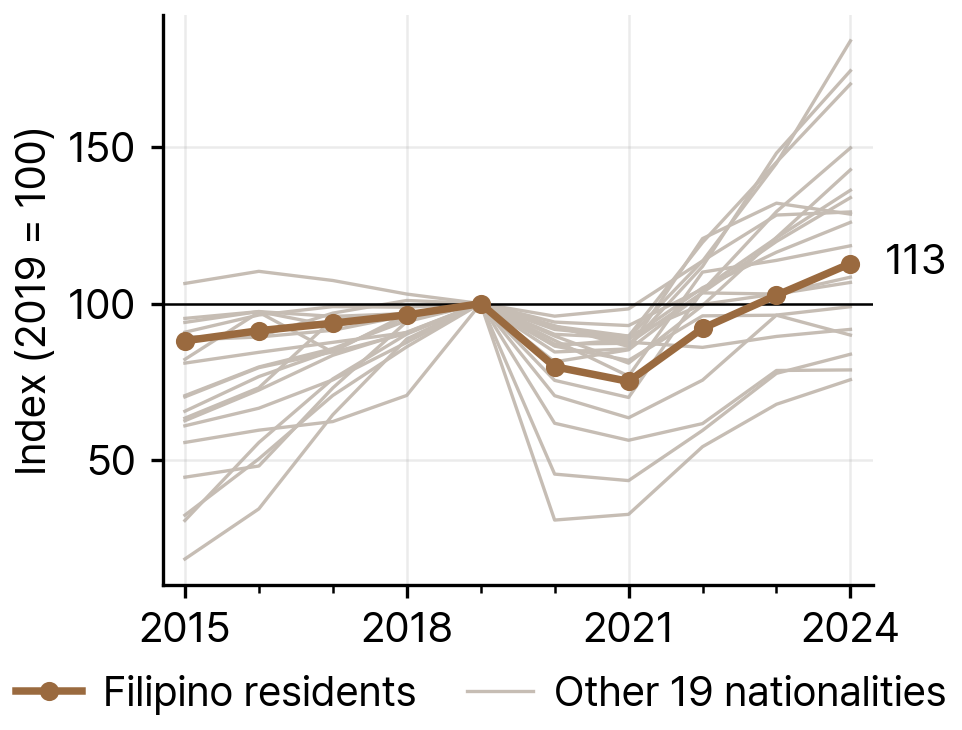
At the end of 2024, 70,392 nationals of the Philippines lived in South Korea, and 51,991 of them were registered foreigners. Filipinos were the ninth-largest nationality among registered foreigners (3.5 percent) and the ninth-largest among all resident foreigners (2.7 percent). In 2014 they ranked fourth among registered foreigners and sixth among all resident foreigners. Their number fell from 62,398 in 2019 to 46,871 in 2021 and then rose each year to 70,392 in 2024, 12.8 percent above the 2019 level. Of the 20 largest nationalities, Filipinos ranked 12th for growth between 2019 and 2024.
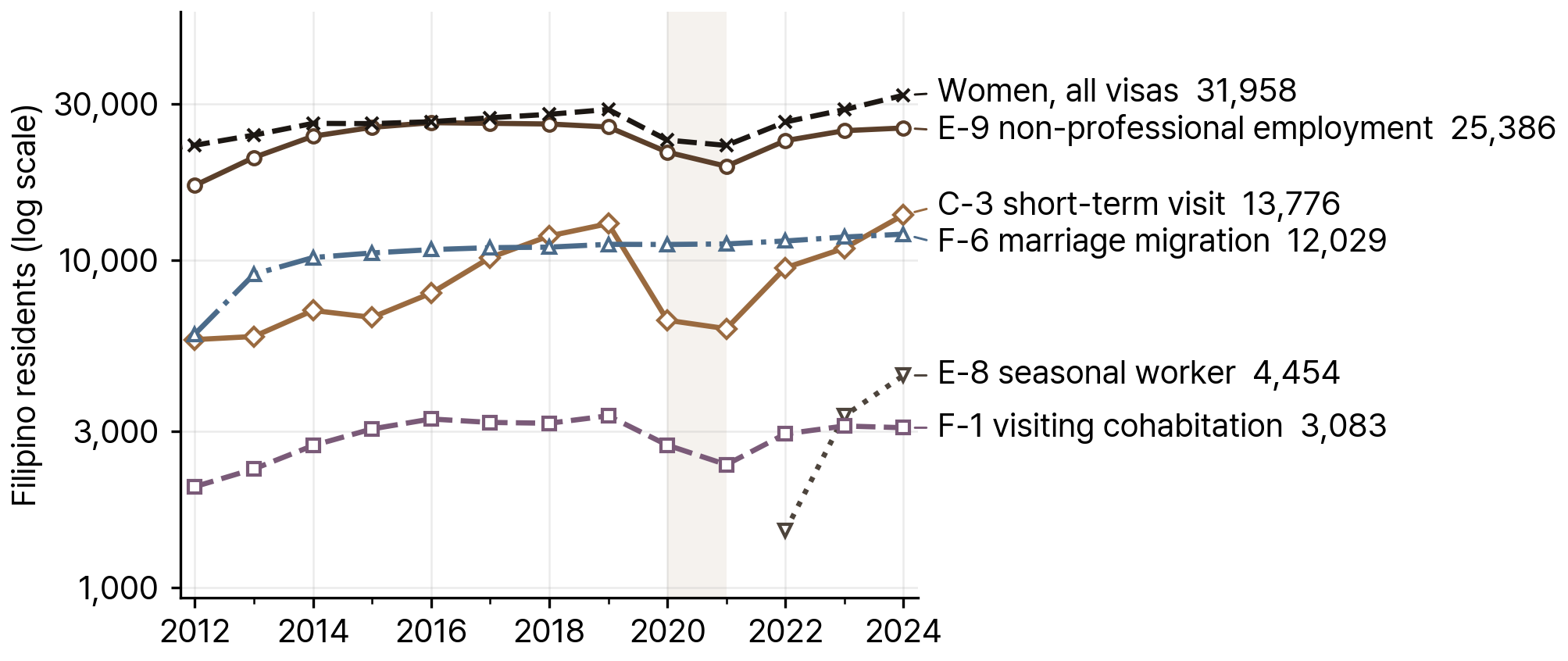
Most Filipinos in Korea came as workers or as spouses. In 2024, 36.1 percent held the E-9 non-professional employment visa issued under the Employment Permit System (EPS), and 17.1 percent held the F-6 marriage migrant visa. The E-8 seasonal worker visa, which no Filipino held in 2019, had 4,454 Filipino holders in 2024, and the number on the E-7 visa for specially designated occupations grew from 437 to 2,229 over the same years. In 2024 a Seoul pilot also brought 100 Filipino household service workers to Korean homes (Ajunews, 2024).
Compared with all resident foreigners, Filipinos are more concentrated in working ages (59.5 percent aged 20 to 39, against 49.7 percent), more likely to hold employment visas, and almost absent from the overseas Korean (F-4, H-2) and permanent residence (F-5) categories. They are less concentrated in Seoul and the surrounding capital region (48.0 percent of registered Filipinos, against 55.2 percent of all foreign residents) and more likely to live in rural counties.
Size of the Population over Time
The Filipino population in Korea changed little between 2006 and 2014, when resident foreigners numbered 48,164 and 53,538. It grew to 62,398 by 2019, fell during the COVID-19 border closures to 49,800 in 2020 and 46,871 in 2021, and then rose to 57,452 in 2022, 64,055 in 2023, and 70,392 in 2024. The 2024 figure is 22,234 (46.2 percent) higher than in 2006.
Registered foreigners made up most of the group. In 2024, 51,991 Filipinos were registered, or 73.9 percent of Filipino resident foreigners. Short-term visitors accounted for much of the remainder: 13,776 Filipinos held the C-3 short-term visit visa in 2024.
The group's rank fell over the period on both bases. Among registered foreigners, Filipinos ranked fourth in 2006 and 2014, fifth in 2019, and ninth in 2024, and their share of all registered foreigners fell from 6.4 percent in 2006 to 3.5 percent in 2024. Among all resident foreigners they ranked fifth in 2006, sixth in 2014, eighth in 2019, and ninth in 2024, with a share that fell from 5.3 percent to 2.7 percent.
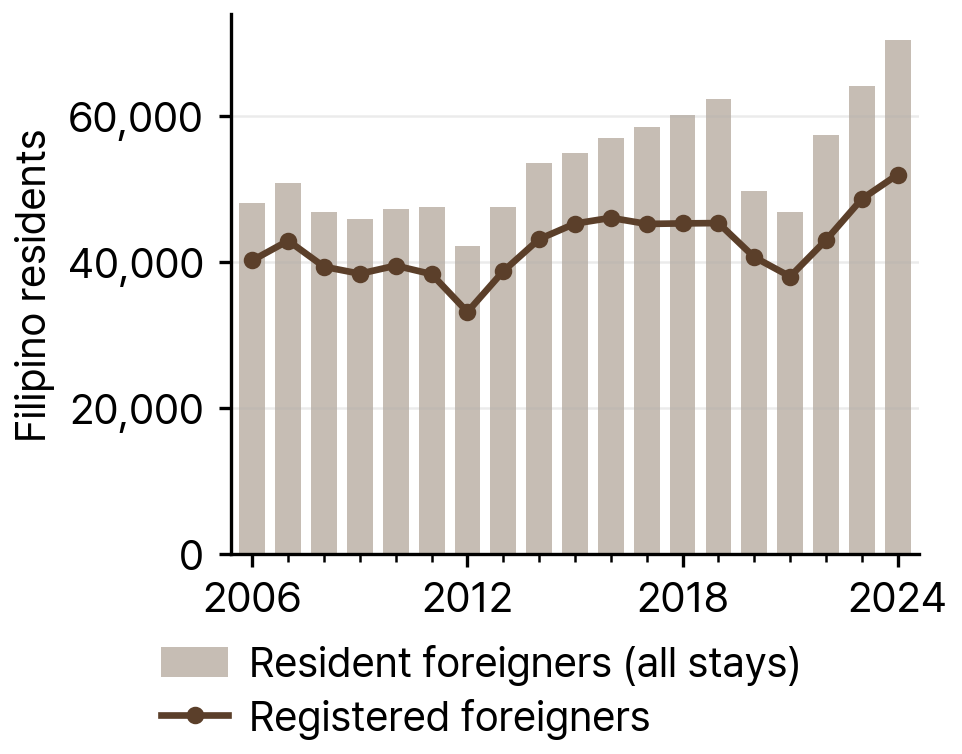
Source: KIRD dataset, from Ministry of Justice immigration yearbooks, 2006-2024.
Indexed to 2019, the Filipino population stood at 112.8 in 2024. Among the 20 largest nationalities this ranked 12th, so the group grew more slowly than most other large nationalities between 2019 and 2024.
Source: KIRD dataset, from Ministry of Justice immigration yearbooks, 2006-2024.
Table 1Filipino Residents in South Korea, Selected Years
| Year | Resident foreigners | Registered foreigners | Rank among registered foreigners | Rank among all resident foreigners | Share of all registered foreigners (%) | Share of all resident foreigners (%) |
|---|---|---|---|---|---|---|
| 2006 | 48,164 | 40,246 | 4 | 5 | 6.4 | 5.3 |
| 2014 | 53,538 | 43,155 | 4 | 6 | 4.0 | 3.0 |
| 2019 | 62,398 | 45,354 | 5 | 8 | 3.6 | 2.5 |
| 2024 | 70,392 | 51,991 | 9 | 9 | 3.5 | 2.7 |
Note: Ranks are among all nationalities. Resident foreigners include short-term visitors and F-4 residence reporters; registered foreigners are long-term residents registered with immigration authorities.
Source: KIRD dataset, from Ministry of Justice immigration yearbooks, 2006-2024.
Distribution by Province and District
In 2024, 41.0 percent of registered Filipinos lived in Incheon and Gyeonggi Province and 7.0 percent in Seoul, for a capital-region share of 48.0 percent, below the 55.2 percent for all foreign residents. The southeastern Yeongnam region had 24.4 percent, Honam 12.1 percent, Chungcheong 12.0 percent, and Gangwon and Jeju 3.5 percent.
Filipinos are more likely than other foreign residents to live in rural counties (gun): 16.9 percent did so in 2024, compared with 10.6 percent of all foreign residents. The rural share was highest in Honam (49.5 percent of the region's Filipino residents) and Chungcheong (35.2 percent).
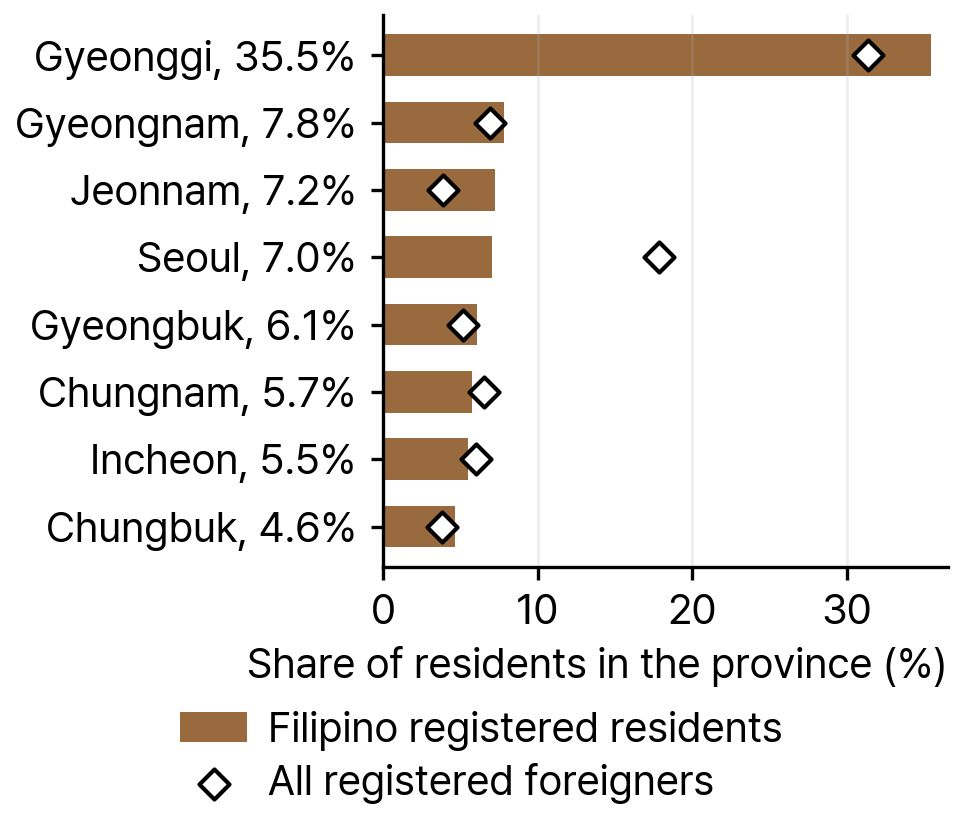
Source: KIRD dataset, from Ministry of Justice registered-foreigner statistics by district, 2024.
The population is spread across many places. In 2024, 140 cities, counties, and districts had at least 100 registered Filipino residents, and the ten largest accounted for 25.3 percent of the total. Hwaseong-si in Gyeonggi Province had the largest number (2,607). In Seoul, the largest community was in Yongsan-gu (591).
Filipinos made up the largest share of foreign residents in Wando-gun, a county in South Jeolla Province, where 1,139 Filipinos were 22.3 percent of all registered foreigners in 2024. Other districts with high shares were Dongducheon-si (14.3 percent), Busan Dong-gu (13.4 percent), Geochang-gun (12.8 percent), and Busan Yeongdo-gu (11.8 percent).
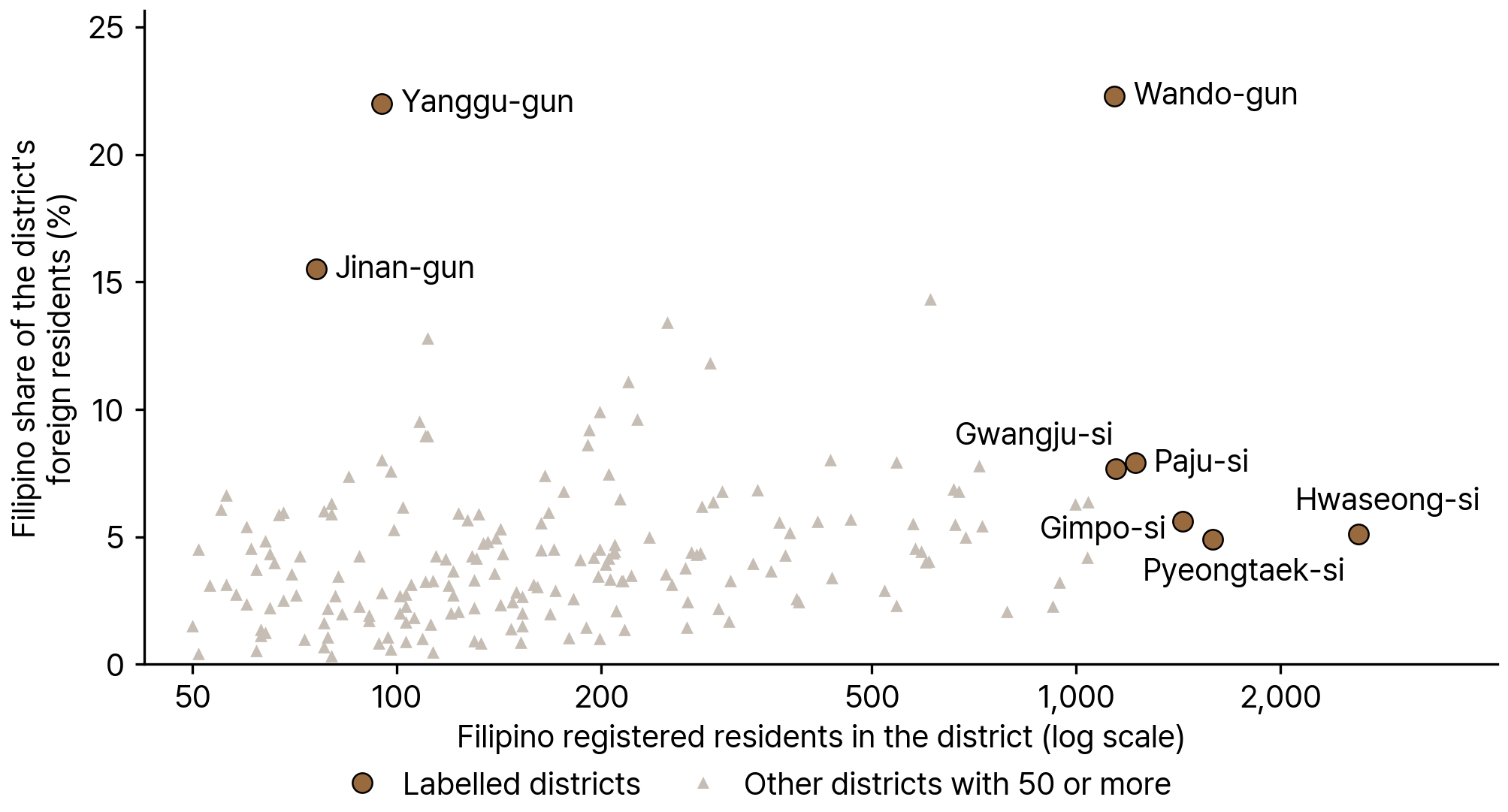
Source: KIRD dataset, from Ministry of Justice registered-foreigner statistics by district, 2024.
Table 2Ten Largest Filipino Communities by City, County, and District, 2024
| District | Province | Registered Filipino residents | Share of district's registered foreigners (%) |
|---|---|---|---|
| Hwaseong-si | Gyeonggi-do | 2,607 | 5.1 |
| Pyeongtaek-si | Gyeonggi-do | 1,591 | 4.9 |
| Gimpo-si | Gyeonggi-do | 1,435 | 5.6 |
| Paju-si | Gyeonggi-do | 1,222 | 7.9 |
| Gwangju-si | Gyeonggi-do | 1,143 | 7.7 |
| Wando-gun | Jeollanam-do | 1,139 | 22.3 |
| Pocheon-si | Gyeonggi-do | 1,042 | 6.4 |
| Gimhae-si | Gyeongsangnam-do | 1,039 | 4.2 |
| Seo-gu | Incheon | 996 | 6.3 |
| Bucheon-si | Gyeonggi-do | 945 | 3.2 |
Note: The ten districts together held 25.3 percent of registered Filipino residents.
Source: KIRD dataset, from Ministry of Justice registered-foreigner statistics by district, 2024.
The index of dissimilarity (D), which measures on a scale from 0 to 1 how differently Filipinos and other foreign residents are spread across districts, was 0.366 in 2014 and 0.365 in 2024. No district met the KIRD definition of an ethnic enclave in 2024 (a location quotient of at least 2, with Filipinos making up at least 30 percent of the district's foreign residents).
Age and Sex
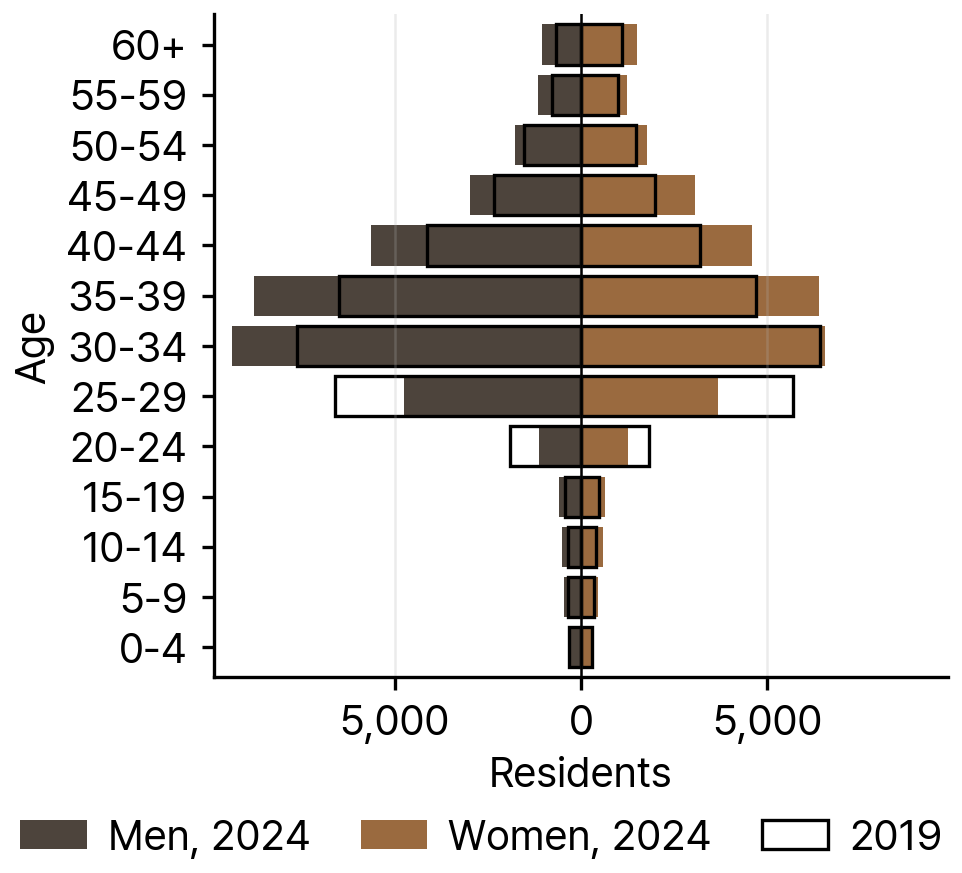
Women made up 45.4 percent of Filipino resident foreigners in 2024, close to the 45.1 percent among all resident foreigners, and down from 46.3 percent in 2019. The largest five-year age group was 30 to 34, and the median fell in the 35 to 39 group.
The group is concentrated in working ages. In 2024, 59.5 percent were aged 20 to 39, compared with 49.7 percent of all resident foreigners. Children under 15 made up 3.6 percent (5.7 percent among all resident foreigners), and people aged 60 and older 3.6 percent (12.9 percent among all). The number aged 50 and older rose from 6,550 in 2019 to 8,467 in 2024.
Source: KIRD dataset, from Ministry of Justice immigration yearbooks, 2006-2024.
Visa Status
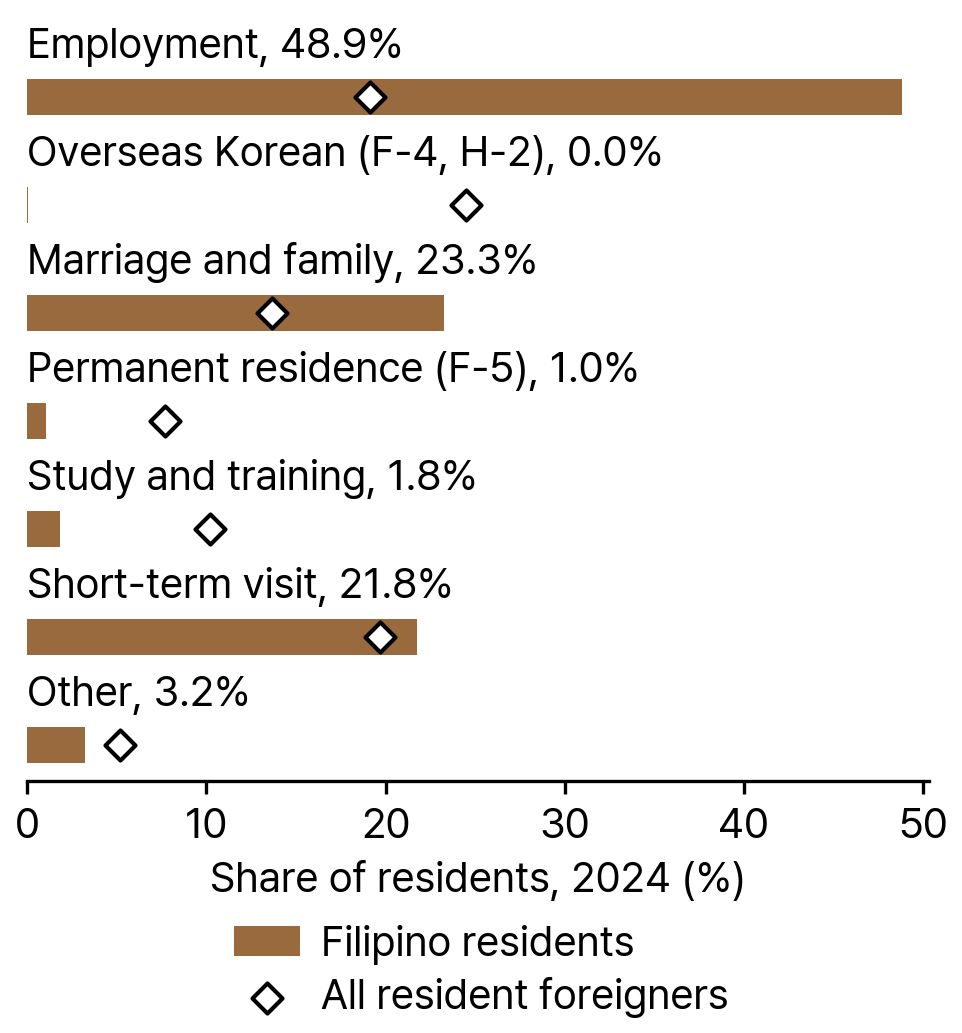
In 2024, 48.9 percent of Filipino residents held employment visas, compared with 19.2 percent of all resident foreigners. Marriage and family visas covered 23.3 percent (13.6 percent among all) and short-term visits 21.8 percent (19.7 percent among all). Filipinos were almost absent from the overseas Korean category (0.0 percent, against 24.5 percent of all resident foreigners) and rarely held permanent residence (1.0 percent, against 7.7 percent).
Source: KIRD dataset, from Ministry of Justice immigration yearbooks, 2006-2024.
The E-9 visa was the most common, held by 25,386 Filipinos in 2024, about the same as in 2019 (25,566). Filipinos ranked seventh among nationalities in E-9 holders. The E-8 seasonal worker visa grew from none in 2019 to 4,454 in 2024, when Filipinos held 18.2 percent of all E-8 visas in Korea. E-7 holders grew about fivefold, from 437 to 2,229. Filipinos also held 42.3 percent of all E-6 arts and entertainment visas in 2024 (1,862 people), although their number on this visa fell from 3,639 in 2014.
Source: KIRD dataset, from Ministry of Justice immigration yearbooks, 2006-2024.
Table 3Main Visa Types Held by Filipino Resident Foreigners, 2019 and 2024
| Visa | Meaning | 2019 | 2024 | Share of Filipino residents, 2024 (%) | Filipino share of all holders of this visa, 2024 (%) |
|---|---|---|---|---|---|
| E-9 | Non-professional employment | 25,566 | 25,386 | 36.1 | 7.5 |
| C-3 | Short-term visit | 12,948 | 13,776 | 19.6 | 8.5 |
| F-6 | Marriage migration | 11,198 | 12,029 | 17.1 | 8.1 |
| E-8 | Seasonal worker | 0 | 4,454 | 6.3 | 18.2 |
| F-1 | Visiting and joining family | 3,353 | 3,083 | 4.4 | 3.1 |
| E-7 | Specially designated activities | 437 | 2,229 | 3.2 | 3.5 |
| E-6 | Arts and entertainment | 1,958 | 1,862 | 2.6 | 42.3 |
Note: Shares of Filipino residents use the 2024 total of 70,392 resident foreigners.
Source: KIRD dataset, from Ministry of Justice immigration yearbooks, 2006-2024.
Migration Channels and Policy
The Philippines is one of the sending countries in Korea's Employment Permit System, the government program behind the E-9 visa, and the EPS portal maintains a Philippine-language page (EPS, 2026). Entry to the program requires a Korean-language test held in the Philippines. The test scheduled for January 2026 was postponed over implementation issues, and registration for the rescheduled test reopened in April 2026 in Cebu, Metro Manila, Davao, Pampanga, and Baguio (Embassy of the Philippines in Seoul, 2026).
Seasonal work is the second labor channel. Between 2018 and 2022, the Philippines sent 4,973 seasonal workers to Korea, the most of the 11 sending countries, and Filipinos made up more than 20 percent of all seasonal workers in Korea (Korea Herald, 2024). In the KIRD data, Filipinos held 18.2 percent of all E-8 visas in 2024.
The Seoul Metropolitan Government's plan to bring in 100 Filipina domestic workers was delayed in early 2024, when the Philippine government suspended the deployment of its workers to Korea (Korea Herald, 2024). The pilot went ahead later that year, with 100 Filipino household service workers placed with Seoul households and full service beginning in early September 2024 (Ajunews, 2024).
Marriage is the main family channel. In 2024, 605 Filipino women married Korean men, 3.9 percent of all marriages between Korean men and foreign women that year, placing the Philippines sixth among countries of origin of foreign wives (Dongpo News, 2025, citing Statistics Korea). In the KIRD data, 12,029 Filipinos held the F-6 marriage migrant visa in 2024.
Naturalization
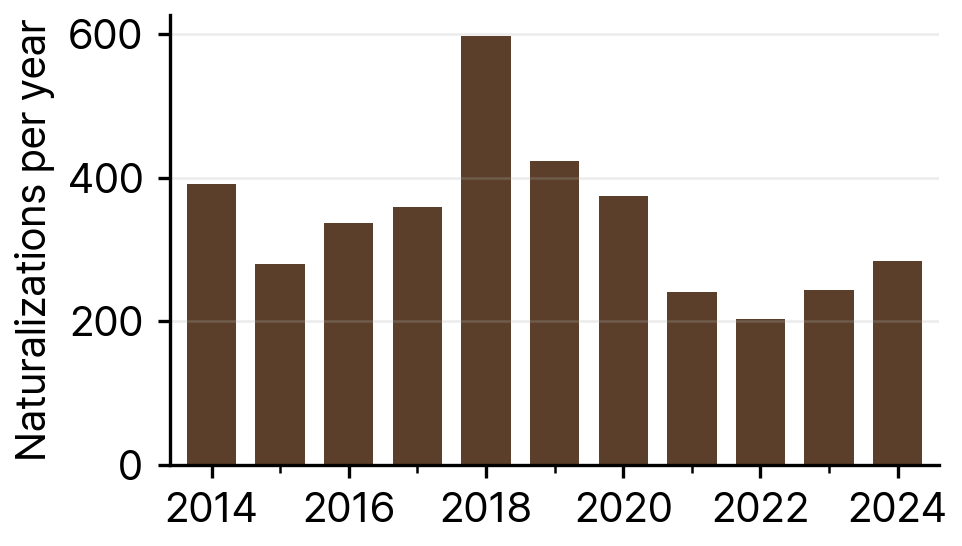
From 2014 to 2024, 3,734 Philippine nationals became Korean citizens through naturalization, ranging from 203 in 2022 to 597 in 2018, and 284 naturalized in 2024. The Ministry of Justice yearbook's all-routes naturalization total for the Philippines begins in 2014; the 2009 and 2010 editions of the yearbook print cumulative totals since 1991. People who naturalize leave the resident foreigner count, so the population figures in this Spotlight exclude them.
Source: KIRD dataset, from Ministry of Justice immigration yearbooks, 2006-2024.
Unauthorized Residents
The Ministry of Justice yearbook (table 6-4) reports unauthorized residents separately for the ten largest nationalities, and the Philippines is among them. The count was 13,095 in 2019, 13,613 in 2021, 13,951 in 2023, and 13,937 in 2024. In 2024, unauthorized residents equaled 19.8 percent of Filipino resident foreigners, and the Philippines had the fifth-largest count. Of the 397,522 unauthorized residents of all nationalities in 2024, Filipinos accounted for 3.5 percent (13,937 divided by 397,522).
Health and Well-being
A survey of 116 Filipino migrant workers in Daegu and Gyeongsan, carried out between May 2015 and August 2018, found that 44.83 percent had musculoskeletal disorders, most often in the arm or elbow, followed by the shoulder and lower back. After adjusting for migration status, undocumented workers were more likely than legally employed workers to report inadequate social support at work (odds ratio 5.37, 95% CI 2.41 to 11.95), and the authors concluded that undocumented workers were more vulnerable to workplace stressors (Amit et al., 2020).
Fatal workplace accidents involving Filipino workers appear in news reports. On August 28, 2026, a fire after an explosion at a paint ingredient factory in Cheonan killed three people, two of them Philippine nationals (Korea Times, 2026).
Migration from the Philippines to South Korea
The UN Department of Economic and Social Affairs (UN DESA) counted 6,988,383 people born in the Philippines living abroad in 2024, of whom 37,555 lived in South Korea, or 0.54 percent. Korea ranked 18th among the 93 countries hosting Philippine-born migrants. The count for Korea stood at 49,570 in 2015 and 45,708 in 2020 (UN DESA 2024). The UN figure counts people by country of birth and differs from the Ministry of Justice count of Philippine nationals used elsewhere in this Spotlight.
Korea receives a small share of new Philippine labor deployments. In the first quarter of 2024, the Philippine Department of Migrant Workers (DMW) recorded 429,056 deployed Overseas Filipino Workers (OFWs), land-based and seafarers, down from 635,748 in the first quarter of 2023. Of the roughly 319,000 land-based workers, about 6,000 (1.8 percent) went to Korea, the same share as Malaysia. Among Asian destinations, Saudi Arabia, the United Arab Emirates, Singapore, Hong Kong (9.0 percent), Qatar, Taiwan (4.9 percent), Kuwait, and Japan (3.2 percent) each received more (DMW 2024). In December 2024, the Philippine News Agency reported that about 36,186 Filipinos were working in Korea, 25,895 of them under the Employment Permit System (EPS) (PNA 2024).
We know of no published EPS quota for the Philippines. For the 10th round of worker selection in the Philippines, the first under a pilot point-based system, the DMW capped online registration at 2,500 registrants. Registration opened on August 25, 2025, the computer-based test was held from September 22 to 30, 2025, and skills-test results were issued in November 2025 (DMW 2025).
Bangko Sentral ng Pilipinas (BSP) recorded US$853.7 million in cash remittances from South Korea through banks in 2024, up from US$834.7 million in 2023. The 2024 amount was about 2.5 percent of the US$34.49 billion in cash remittances the Philippines received from all countries that year (BSP 2024). Personal remittances from all sources equaled 8.7 percent of Philippine GDP in 2024, down from 9.7 percent in 2018 (World Bank 2024).
No published source reports the home regions of Filipinos who go to Korea. For land-based OFWs to all destinations in the first quarter of 2024, CALABARZON (Region IV-A) supplied 22.6 percent, Central Luzon 16.8 percent, the National Capital Region 10.2 percent, the Ilocos Region 8.1 percent, and Western Visayas 7.1 percent, and seven in ten came from Luzon (DMW 2024).
The EPS operates through bilateral agreements between Korea and each sending country. In 2017, 15 such agreements were in place, including one with the Philippines, and a policy brief found that Filipino workers paid the lowest total placement fees of the 15 countries to reach Korea (US$551.80 in 2013), while Pakistani workers paid the highest (Migrant Forum in Asia 2017). In early 2024, the Philippine government suspended the deployment of its workers to Korea, citing a growing number of human rights violations against Filipino workers, including unsafe conditions, underpayment of wages, overwork, and worker deaths (Korea Herald, 2024).
In May 2024, the DMW opened registration for a pilot to recruit 100 caregivers for Korean households under the EPS, open to applicants aged 24 to 38 who held the national caregiving certificate (NC II) from the Technical Education and Skills Development Authority (Philstar 2024). In August 2025, Korea's Ministry of Employment and Labor and the DMW announced a point-based selection system for EPS workers, piloted first in the Philippines. Candidates are screened by Korean-language test score to 1.1 times the recruitment quota and then take a skills test and job capacity assessment, which asks for proof of education equivalent to a junior college diploma, before final selection (DMW 2025).
Research on Filipinos in Korea has concentrated on marriage and community life. Yea (2004) studied Filipina entertainers recruited, in some cases trafficked, to work in clubs near US military bases, some of whom left the clubs to marry or live with American soldiers. Moon (2012) described a Filipina marriage migrant organization in Changwon that worked with the GABRIELA women's network in the Philippines and found that ties between women's organizations in both countries helped marriage migrants act as rights advocates in Korea and at home. Montalvo Granados and Camposano (2024) found that marriage migrants can obtain permanent residence and citizenship through family ties while E-9 workers under the EPS cannot, and described Korean multicultural policy as managed assimilation. In a mixed-methods study of Filipina marriage migrants, Miranda et al. (2026) found that 94.5 percent participated in religious or Filipino community organizations, yet 54.8 percent reported language barriers, and longer residence did not remove these barriers.
Table 4Migration indicators, the Philippines and South Korea
| Indicator | Value | Source |
|---|---|---|
| Philippine-born people living in South Korea, 2024 | 37,555 | UN DESA 2024 |
| Korea's share of Philippine-born people living abroad, 2024 | 0.54% | UN DESA 2024 |
| Korea's rank among destination countries of Philippine-born migrants, 2024 | 18th of 93 | UN DESA 2024 |
| Land-based OFWs deployed to Korea, first quarter of 2024 | About 6,000 (1.8% of land-based deployments) | DMW 2024 |
| Filipinos working in Korea, December 2024 | 36,186 (25,895 under the EPS) | PNA 2024 |
| Registration cap, 10th EPS selection round in the Philippines, 2025 | 2,500 registrants | DMW 2025 |
| Cash remittances from South Korea, 2024 | US$853.7 million (about 2.5% of the total) | BSP 2024 |
| Personal remittances as a share of GDP, 2024 | 8.7% | World Bank 2024 |
Note: UN DESA counts people by country of birth. DMW deployment figures cover newly hired and rehired workers.
Source: UN DESA International Migrant Stock 2024; Philippine Department of Migrant Workers; Philippine News Agency; Bangko Sentral ng Pilipinas; World Bank World Development Indicators.
Community Organizations
Catholic congregations are among the oldest Filipino organizations in Korea. The Hyehwa-dong Filipino Catholic Community in Seoul, the largest Filipino community organization in the country, dates from 1989, when Sr. Mary Anne of the Good Shepherd Sisters founded Sampagita, the first Filipino migrant congregation in Korea (Jang, 2017).
In the KIRD census of 1,720 migrant-serving organizations, four name the Filipino community in their name or target group: the Filipino Community KASAMAKO in Seoul; KASAMMAKO, the Solidarity Council of Filipino Workers' Communities in Korea (location not recorded); Cheonan Moise in Cheonan-si Dongnam-gu, South Chungcheong Province; and an association of Filipino marriage migrants in Seogwipo-si, Jeju. All four are self-run and privately funded. Most general-purpose organizations in the census, such as multicultural family support centers and migrant worker centers, also serve Filipino residents.
Sources
KIRD dataset (Korea Immigration Regional Dashboard), openICPSR. https://doi.org/10.3886/E249944V1
Ajunews. 2024. Filipino housemaids to be deployed from September; Seoul begins recruiting host households on the 17th (in Korean). https://www.ajunews.com/view/20240716123126429
Amit, L. M., V. U. Ultra Jr., and Y. W. Song. 2020. Link Between Migration Status and Occupational Health and Safety of Filipino Migrant Workers in South Korea. Philippine Journal of Science 149 (2): 451-462. https://philjournalsci.dost.gov.ph/link-between-migration-status-and-occupational-health-and-safety-of-filipino-migrant-workers-in-south-korea/
Bangko Sentral ng Pilipinas. 2024. Overseas Filipino Cash Remittances by Country, Table 11. https://www.bsp.gov.ph/statistics/external/ofw2.aspx
Dongpo News. 2025. Last year's international-marriage couples numbered 21,000, up 5.3 percent (in Korean), citing Statistics Korea, 2024 Marriage and Divorce Statistics. https://www.dongponews.net/news/articleView.html?idxno=52054
Embassy of the Republic of the Philippines in Seoul. 2026. Philippines Resumes Registration for EPS Language Test. https://www.philembassy-seoul.com/news/philippines-resumes-registration-for-eps-language-test
Employment Permit System (Ministry of Employment and Labor and HRD Korea). 2026. EPS portal, Philippine-language page. https://www.eps.go.kr/eo/langMain.eo?langCD=ph
Jang, Hyung Chull. 2017. Practicing Filipino Catholicism in Korea: Characteristics of Hyehwa-dong Filipino Catholic Community (HFCC) in Seoul. Korea Journal 57 (4): 72-97. https://accesson.kr/kj/v.57/4/72/8435
Korea Herald. 2024. Foreign nanny plan put on hold as Philippines suspends worker deployment. https://www.koreaherald.com/article/3320434
Korea Times. 2026. 3 killed, 2 injured in paint ingredient factory fire in Cheonan. https://www.koreatimes.co.kr/southkorea/20260828/3-killed-2-injured-in-paint-ingredient-factory-fire-in-cheonan
Migrant Forum in Asia. 2017. South Korea's Employment Permit System: A Successful Government-to-Government Model? Policy Brief No. 2. http://mfasia.org/migrantforumasia/wp-content/uploads/2017/01/2-Policy-Brief-South-Koreas-EPS-A-Successful-G2G-Model.pdf
Miranda, A. T., Jr., Miranda, J. L. F., & Kim, E. (2026). Bonding without bridging: Social capital, integration, and well-being among Filipina marriage migrants in South Korea. International Journal of Environmental Research and Public Health, 23(3), 305. https://doi.org/10.3390/ijerph23030305
Montalvo Granados, D., & Camposano, S. (2024). South Korea's journey towards a multicultural society: A Filipino case study. Oasis, (41), 69-88. https://doi.org/10.18601/16577558.n41.05
Moon, K.-H. (2012). International women's NGOs and empowerment of marriage migrant women in Korea: Focusing on the GABRIELA Network from the Philippines. OMNES: The Journal of Multicultural Society, 3(2), 82. https://doi.org/10.15685/omnes.2012.12.3.2.82
Philippine Department of Migrant Workers. 2024. Special Release: First Quarter 2024 Overseas Deployment Data (Preliminary). https://dmw.gov.ph/archives/v1/resources/dsms/DMW/Externals/2024/Statistics/special-release/Special-Release-1st-Quarter-2024.pdf
Philippine Department of Migrant Workers. 2025. EPS-TOPIK Advisory No. 9, Series of 2025: EPS-TOPIK Online Registration (Pilot Implementation of Ubiquitous-Based Test), with the Notice on the Implementation of the Point-Based Selection System for Foreign Workers. https://dmw.gov.ph/archives/v1/resources/dsms/DMW/Externals/2025/EPS-ADVISORY-09-2025.pdf
Philippine News Agency. 2024. Work situation in S. Korea normal; deployment of OFWs steady. https://www.pna.gov.ph/articles/1239396
Philstar.com. 2024. DMW to recruit 100 caregivers for South Korea. https://www.philstar.com/nation/2024/05/06/2352842/dmw-recruit-100-caregivers-south-korea
United Nations Department of Economic and Social Affairs, Population Division. 2024. International Migrant Stock 2024: Destination and Origin. https://www.un.org/development/desa/pd/sites/www.un.org.development.desa.pd/files/undesa_pd_2024_ims_stock_by_sex_destination_and_origin.xlsx
World Bank. 2024. World Development Indicators: Personal remittances, received (% of GDP), Philippines. https://api.worldbank.org/v2/country/PH/indicator/BX.TRF.PWKR.DT.GD.ZS?format=json&date=2018:2024
Yea, S. (2004). Runaway brides: Anxieties of identity among trafficked Filipina entertainers in South Korea. Singapore Journal of Tropical Geography, 25(2), 180-197. https://doi.org/10.1111/j.0129-7619.2004.00181.x
Suggested citation: Korea Immigration Regional Dashboard (KIRD). 2026. “Filipino Immigrants in South Korea.” Foreign Residents in South Korea series, September 2026. Data: Korea Immigration Regional Dashboard (KIRD) dataset, https://doi.org/10.3886/E249944V1. Interactive maps and tables: https://immigrantsinkorea.today.