 Korea Immigration Regional Dashboard
SpotlightSeptember 2026Nationality profilesDownload PDF
Indonesian Immigrants in South Korea
Highlights
- At the end of 2024, 58,248 Indonesian nationals were registered foreigners in South Korea, making Indonesia the seventh-largest nationality among registered foreigners (3.9 percent), and with 73,180 residents in all it was the eighth-largest among all resident foreigners (2.8 percent).
- The Indonesian population grew by about 50 percent between 2019 and 2024 (from 48,854 to 73,180), the fourth-fastest growth among the 20 largest nationalities.
- Three in four Indonesian residents (75.0 percent) held an employment visa in 2024, compared with 19.2 percent of all resident foreigners, and 17.1 percent were women.
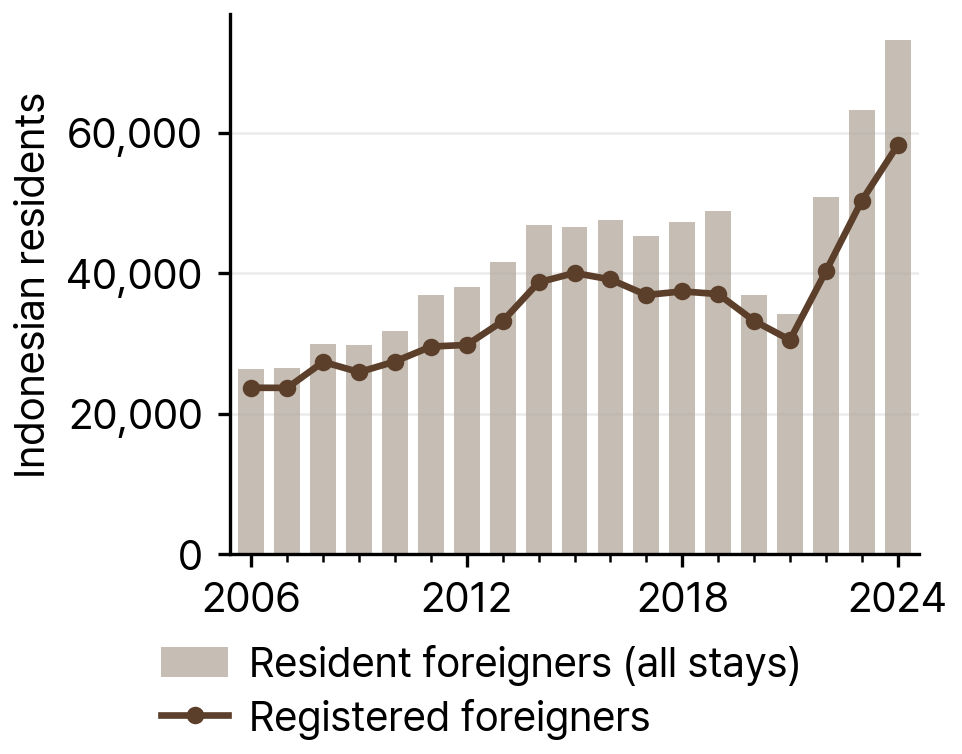
South Korea counted 73,180 Indonesian resident foreigners on December 31, 2024, the largest number on record. Of these, 58,248 (79.6 percent) were registered foreigners remaining longer than 90 days. In 2024 Indonesians were the seventh-largest nationality among registered foreigners (3.9 percent of the total) and the eighth-largest among all resident foreigners (2.8 percent). Among registered foreigners they ranked seventh in 2006, fifth in 2014, and eighth in 2019; among all resident foreigners they ranked ninth in 2006, eighth in 2014, and ninth in 2019. The population stood at 26,378 in 2006 and 48,854 in 2019, fell to 34,188 in 2021, and then rose each year to 2024.
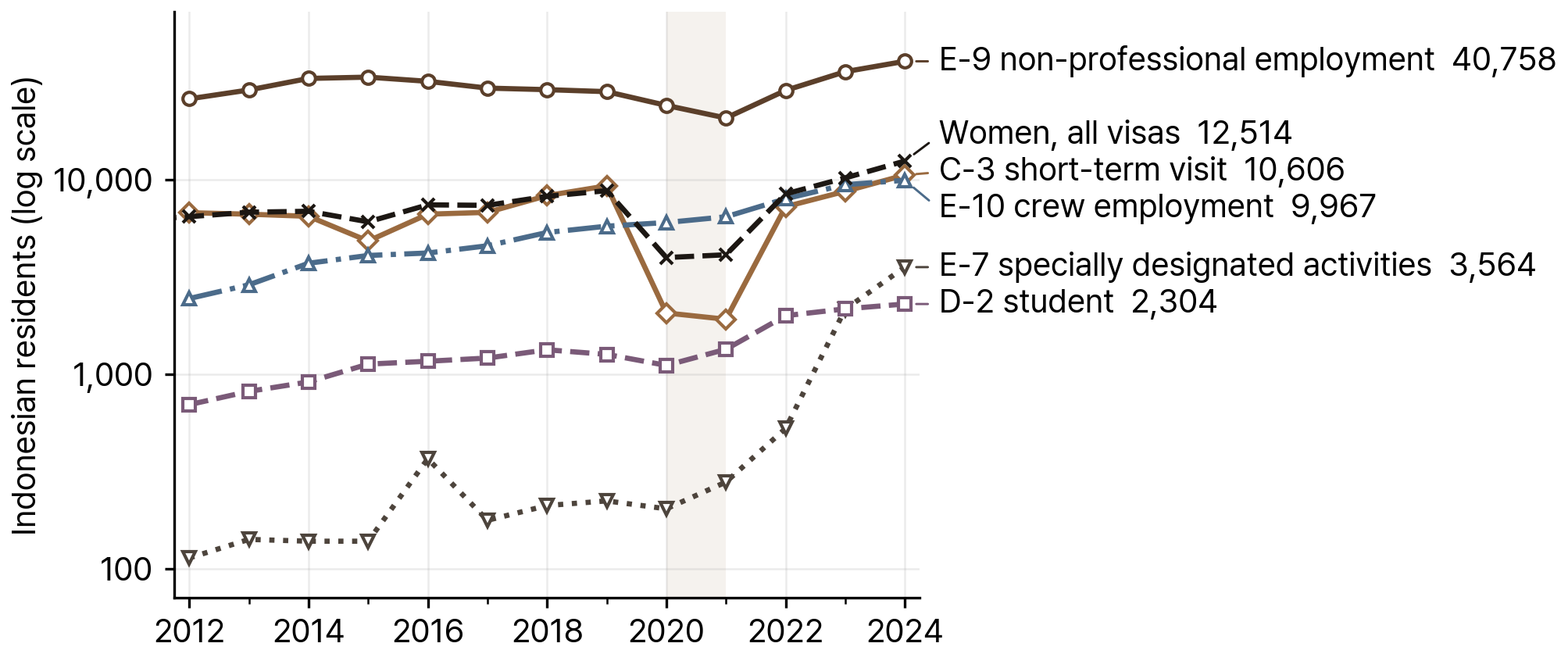
Most Indonesians came to Korea as temporary workers under the Employment Permit System (EPS), for which the two governments signed a memorandum of understanding in 2004 (Recruitment Advisor, 2004). Non-professional employment (E-9) visas accounted for 40,758 Indonesians in 2024, 55.7 percent of the group. Between 2019 and 2024 the number holding crew employment (E-10) visas rose from 5,787 to 9,967, and the number holding specially designated activity (E-7) visas rose from 224 to 3,564.
Compared with all resident foreigners, Indonesians in 2024 were far more likely to be men (82.9 percent, against 54.9 percent of all resident foreigners), to be aged 20 to 39 (79.6 percent, against 49.7 percent), and to live outside the Seoul capital area (74.1 percent of registered Indonesians, against 44.8 percent of all foreign residents). Almost none held overseas Korean or permanent residence visas (0.4 percent each).
Size of the Population over Time
The number of Indonesian resident foreigners nearly tripled between 2006 and 2024, from 26,378 to 73,180 (a ratio of 2.8). Growth was uneven. The population rose to 46,945 in 2014 and 48,854 in 2019, then dropped to 36,858 in 2020 and 34,188 in 2021 before climbing to 50,841 in 2022, 63,226 in 2023, and 73,180 in 2024 (see Figure 1).
Source: KIRD dataset, from Ministry of Justice immigration yearbooks, 2006-2024.
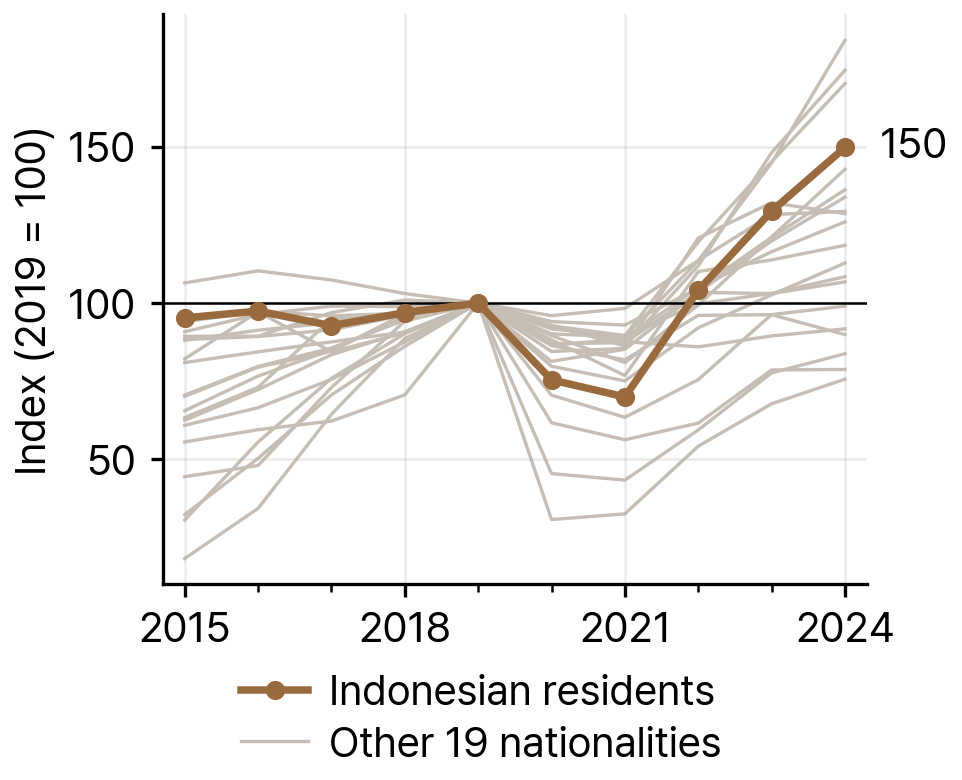
Measured against 2019, the Indonesian population had an index value of 149.8 in 2024, an increase of 24,326 people (73,180 minus 48,854). This was the fourth-fastest growth among the 20 largest nationalities over 2019-24 (see Figure 2). The number of registered Indonesians rose from 37,043 in 2019 to 58,248 in 2024, and registered foreigners made up 79.6 percent of the total in 2024.
Source: KIRD dataset, from Ministry of Justice immigration yearbooks, 2006-2024.
Table 1Indonesian Residents in South Korea, Selected Years, 2006-24
| Year | Resident foreigners | Registered foreigners | Rank among registered foreigners | Rank among all resident foreigners | Share of all registered foreigners (%) | Share of all resident foreigners (%) |
|---|---|---|---|---|---|---|
| 2006 | 26,378 | 23,715 | 7 | 9 | 3.8 | 2.9 |
| 2014 | 46,945 | 38,718 | 5 | 8 | 3.5 | 2.6 |
| 2019 | 48,854 | 37,043 | 8 | 9 | 2.9 | 1.9 |
| 2024 | 73,180 | 58,248 | 7 | 8 | 3.9 | 2.8 |
Note: Ranks and shares are computed separately among registered foreigners (long-term residents) and among all resident foreigners (including short-term visitors and F-4 residence reporters).
Source: KIRD dataset, from Ministry of Justice immigration yearbooks, 2006-2024.
Distribution by Province and District
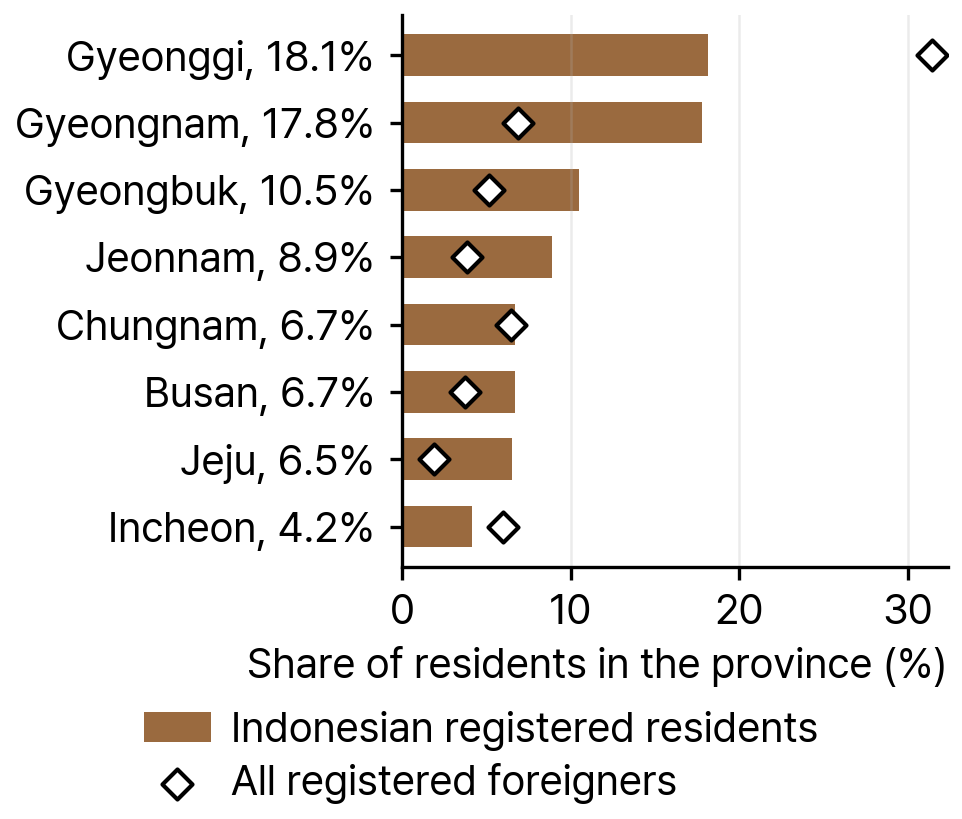
Registered Indonesians lived mainly in the southeast. In 2024 the Yeongnam region (Busan, Daegu, Ulsan, and North and South Gyeongsang) was home to 23,976 registered Indonesians, 41.2 percent of the group. Incheon and Gyeonggi had 12,984 (22.3 percent), Honam 7,526 (12.9 percent), Chungcheong 6,599 (11.3 percent), Gangwon and Jeju 5,054 (8.7 percent), and Seoul 2,109 (3.6 percent). The Seoul capital area therefore accounted for 25.9 percent of registered Indonesians, compared with 55.2 percent of all foreign residents (see Figure 3).
Source: KIRD dataset, from Ministry of Justice immigration yearbooks, 2006-2024.
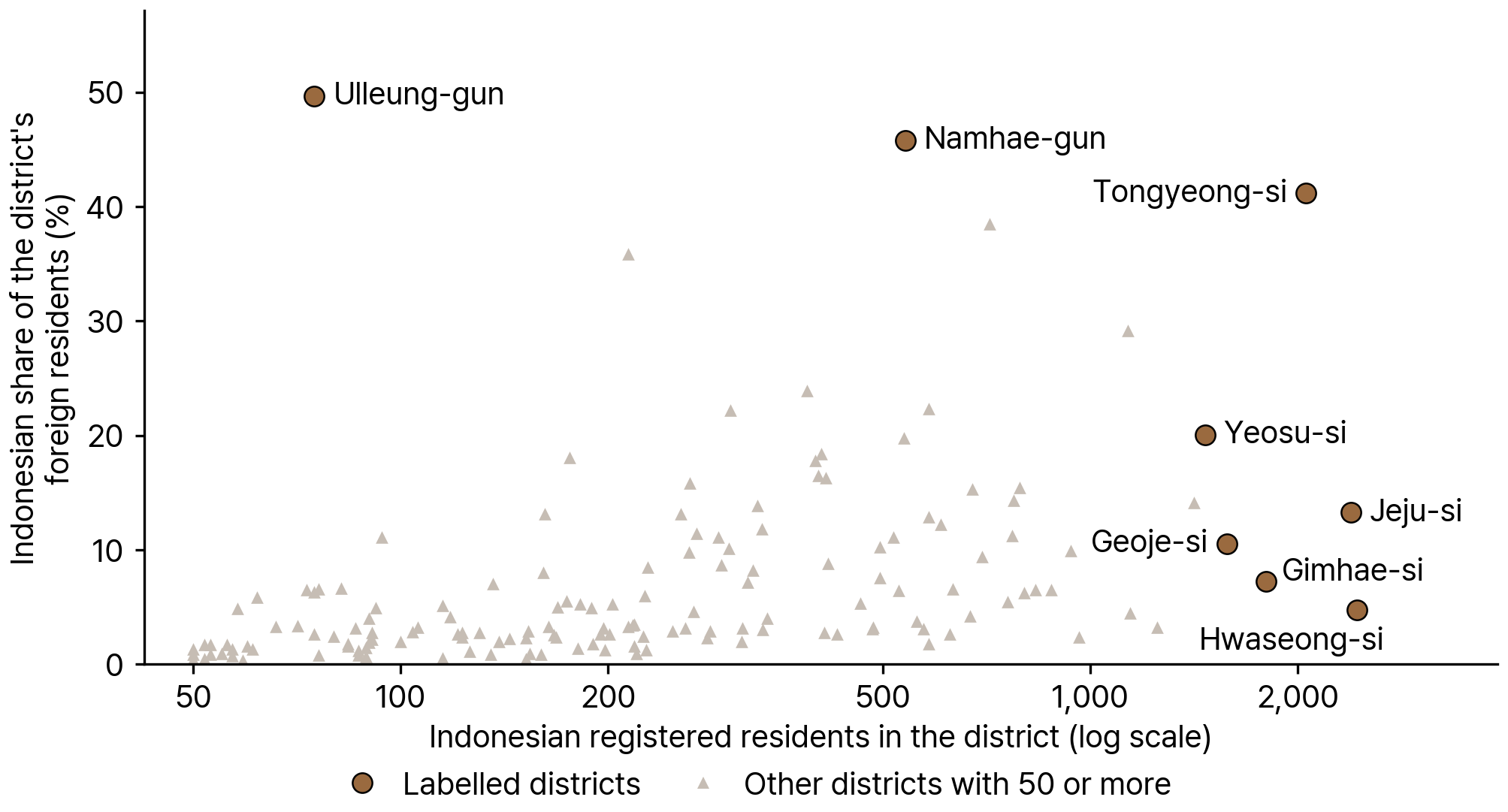
About 21.1 percent of registered Indonesians lived in rural counties (gun) in 2024, about twice the rate for all foreign residents (10.6 percent). The rural share was 43.2 percent in Honam and 39.6 percent in Chungcheong. Indonesians numbered 100 or more in 116 districts, and the ten largest districts accounted for 28.6 percent of the group. Hwaseong-si in Gyeonggi had the most Indonesian residents (2,434), followed by Jeju-si (2,389) and Tongyeong-si (2,056) (see Figure 4 and Table 2).
Source: KIRD dataset, from Ministry of Justice immigration yearbooks, 2006-2024.
Table 2Ten Districts with the Most Registered Indonesian Residents, 2024
| District | Province | Indonesian residents | Share of district's foreign residents (%) |
|---|---|---|---|
| Hwaseong-si | Gyeonggi-do | 2,434 | 4.8 |
| Jeju-si | Jeju-do | 2,389 | 13.3 |
| Tongyeong-si | Gyeongsangnam-do | 2,056 | 41.2 |
| Gimhae-si | Gyeongsangnam-do | 1,798 | 7.3 |
| Geoje-si | Gyeongsangnam-do | 1,579 | 10.5 |
| Yeosu-si | Jeollanam-do | 1,467 | 20.0 |
| Seogwipo-si | Jeju-do | 1,414 | 14.1 |
| Ansan-si Danwon-gu | Gyeonggi-do | 1,249 | 3.3 |
| Gimpo-si | Gyeonggi-do | 1,142 | 4.5 |
| Sacheon-si | Gyeongsangnam-do | 1,134 | 29.2 |
Note: Registered foreigners only. Together these ten districts accounted for 28.6 percent of registered Indonesians.
Source: KIRD dataset, from Ministry of Justice immigration yearbooks, 2006-2024.
The index of dissimilarity (D) between registered Indonesians and all other registered foreigners across districts was 0.527 in 2014 and 0.504 in 2024. A value of 0.504 means that about half of Indonesians would have to move to another district for the group to be distributed like other foreign residents.
Four districts met the KIRD definition of an ethnic enclave in 2024 (a location quotient of at least 2 and the group making up at least 30 percent of the district's foreign residents). They were Tongyeong-si (2,056 Indonesians, 41.2 percent of the district's foreign residents, location quotient 15.3), Uljin-gun (714, 38.5 percent, 13.6), Namhae-gun (540, 45.8 percent, 11.9), and Ongjin-gun in Incheon (214, 35.8 percent, 9.4). In Sacheon-si, Indonesians made up 29.2 percent of foreign residents, just below the threshold.
Age and Sex
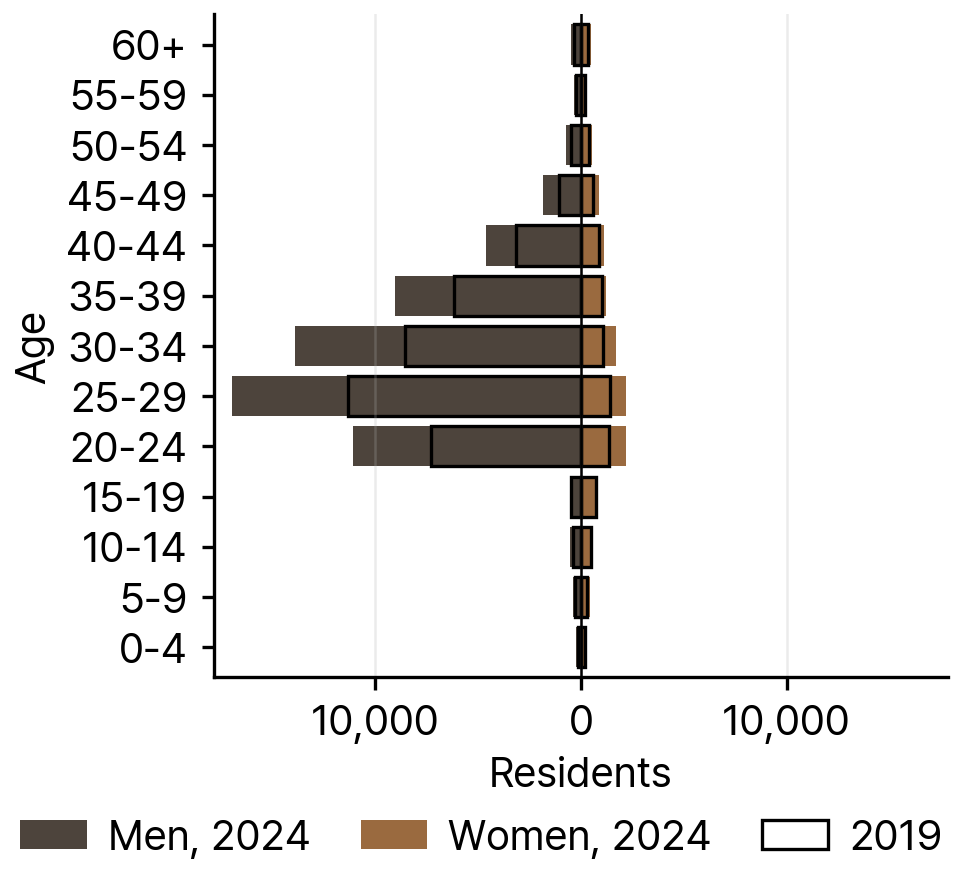
Indonesian residents were young and mostly men. In 2024, 12,514 of 73,180 (17.1 percent) were women, down from 18.0 percent in 2019; among all resident foreigners the share of women was 45.1 percent. The largest five-year age group was 25-29, and the median fell in the 30-34 group (see Figure 5).
Source: KIRD dataset, from Ministry of Justice immigration yearbooks, 2006-2024.
People aged 20 to 39 made up 79.6 percent of Indonesian residents in 2024 (58,252 people), compared with 49.7 percent of all resident foreigners. Children under 15 were 3.2 percent of the group (2,347), against 5.7 percent of all resident foreigners, and 467 were under age 5. Only 1.3 percent were aged 60 or older, compared with 12.9 percent of all resident foreigners; 2,870 Indonesians (3.9 percent) were aged 50 or older.
Visa Status
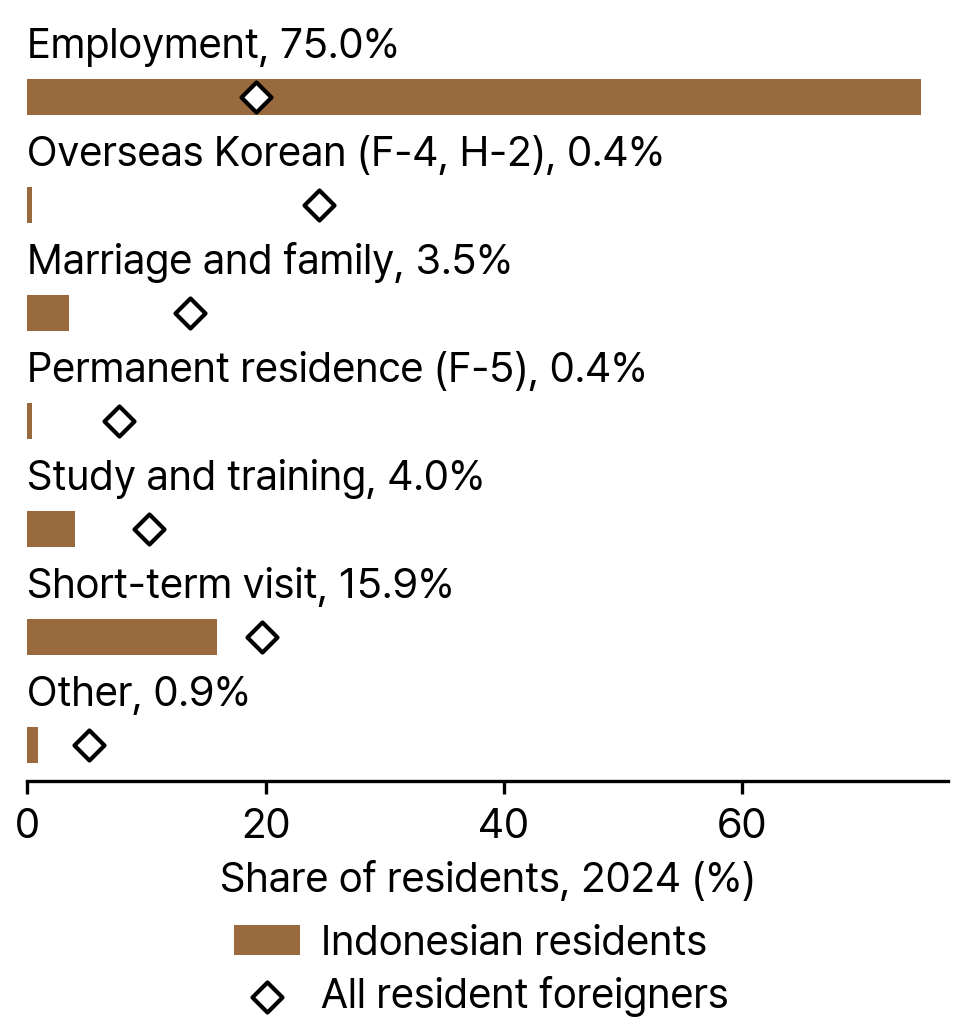
Employment visas accounted for 75.0 percent of Indonesian residents in 2024, compared with 19.2 percent of all resident foreigners. Short-term visits made up 15.9 percent (19.7 percent of all resident foreigners), study and training 4.0 percent (10.2 percent), and marriage and family 3.5 percent (13.6 percent). Overseas Korean visas (F-4, H-2) accounted for 0.4 percent of Indonesians and 24.5 percent of all resident foreigners, and permanent residence (F-5) for 0.4 percent and 7.7 percent (see Figure 6).
Source: KIRD dataset, from Ministry of Justice immigration yearbooks, 2006-2024.
The E-9 non-professional employment visa was the largest single status, held by 40,758 Indonesians in 2024 (55.7 percent of the group), up from 28,463 in 2019. Indonesia ranked fourth among nationalities in E-9 holders. Indonesians held 9,967 E-10 crew employment visas in 2024, 45.5 percent of all E-10 holders in Korea. The E-7 count grew from 224 in 2019 to 3,564 in 2024, and D-2 student visas from 1,269 to 2,304 (see Figure 7 and Table 3).
Source: KIRD dataset, from Ministry of Justice immigration yearbooks, 2006-2024.
Table 3Most Common Visa Types among Indonesian Residents, 2019 and 2024
| Visa | Meaning | 2019 | 2024 | Share of Indonesian residents, 2024 (%) | Share of all holders of this visa in Korea, 2024 (%) |
|---|---|---|---|---|---|
| E-9 | Non-professional employment | 28,463 | 40,758 | 55.7 | 12.1 |
| C-3 | Short-term visit | 9,331 | 10,606 | 14.5 | 6.5 |
| E-10 | Crew employment | 5,787 | 9,967 | 13.6 | 45.5 |
| E-7 | Specially designated activities | 224 | 3,564 | 4.9 | 5.6 |
| D-2 | Student | 1,269 | 2,304 | 3.1 | 1.3 |
| F-6 | Marriage migration | 730 | 1,281 | 1.8 | 0.9 |
| B-2 | Tourist transit | 964 | 1,020 | 1.4 | 0.7 |
Note: Resident foreigners on December 31 of each year.
Source: KIRD dataset, from Ministry of Justice immigration yearbooks, 2006-2024.
Migration Channels and Policy
South Korea and Indonesia signed a memorandum of understanding on sending Indonesian workers under the Employment Permit System in 2004. E-9 workers are recruited through a government-to-government scheme managed jointly by Indonesia's National Board for the Protection of Indonesian Migrant Workers (BP2MI) and Korea's Human Resources Development Service (Recruitment Advisor, 2004).
For 2025, Indonesia's EPS placement quota for Korea was 8,200 workers, and 5,410 had been placed by September 23, 2025, including 3,603 in manufacturing and 1,785 in fisheries (Migrant Times, 2026).
For the 2024 EPS-TOPIK testing cycle, the sectors open to Indonesian applicants were expanded from manufacturing and fisheries to include shipbuilding, waste-processing services ("Service 1"), and hotel and restaurant work ("Service 2") (Antara News, 2024).
Study is a smaller channel. As of February 28, 2023, 2,546 Indonesians were enrolled in Korea on study and language-training visas (2,284 degree students on D-2 visas and 262 Korean-language trainees on D-4-1 visas), making Indonesia the eighth-largest source of international students, according to Ministry of Justice data reported by Haninpost, 2023.
Naturalization
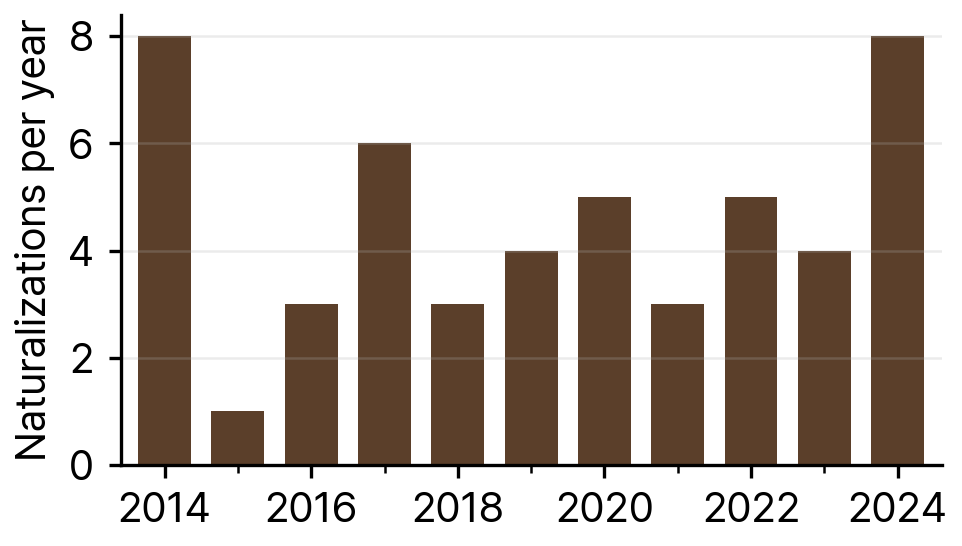
Few Indonesians acquire Korean nationality. The immigration yearbooks record 50 naturalizations of Indonesian nationals from 2014 to 2024, with annual counts between 1 and 8 each year and 8 in 2024 (see Figure 8). The 2024 count equals about 0.01 percent of the 73,180 Indonesian residents that year.
Source: KIRD dataset, from Ministry of Justice immigration yearbooks, 2006-2024.
The yearbooks also record 111 restorations of nationality (국적회복, a procedure for people who previously held Korean nationality) from Indonesian nationality from 2011 to 2024, including 12 in 2024.
Unauthorized Residents
Indonesia is among the ten nationalities for which the Ministry of Justice yearbook (table 6-4) reports unauthorized residents separately. The count was 8,460 in 2019, 9,142 in 2021, 11,806 in 2023, and 13,001 in 2024. The 2024 figure equals 17.8 percent of Indonesian resident foreigners and 3.3 percent of the 397,522 unauthorized residents in Korea that year (13,001 / 397,522), placing Indonesia sixth among nationalities. As shares of Indonesian resident foreigners, the counts were 17.3 percent in 2019 (8,460 / 48,854), 26.7 percent in 2021 (9,142 / 34,188), and 18.7 percent in 2023 (11,806 / 63,226).
Health and Well-being
A survey of 91 Indonesian migrant workers in Korea conducted in September 2018 found that higher acculturative stress was associated with more depressive symptoms and lower quality of life (Dineva R and Choi, 2019).
A study of 248 Indonesian migrant workers surveyed between November 2018 and January 2019 examined income-based inequality in self-rated oral health. Perceived discrimination had the largest explanatory power (69.57 percent), and discrimination and health insurance coverage both contributed to the inequality (Novrinda and Han, 2022).
On June 25, 2025, an Indonesian worker from Cilacap, Central Java, died in Cheongwon after his arm was pulled into a conveyor machine he was cleaning. Indonesia's government pressed for a legal investigation, and Rp213 million (about US$13,000) in compensation was paid to his family through the state insurer BPJS (Antara News, 2025).
Migration from Indonesia to South Korea
The UN Population Division estimated that 27,807 people born in Indonesia lived in South Korea in mid-2024, about 0.7 percent of Indonesia's 3,745,148 emigrants worldwide and 1.5 percent of Korea's 1,811,507 foreign-born residents (UN DESA 2024). Ranked by the country estimates in the same table, Korea was the 14th-largest destination of Indonesian emigrants in 2024, after Malaysia, the United Arab Emirates, Taiwan, Bangladesh, Singapore, Saudi Arabia, Japan, Hong Kong, Kuwait, Australia, the Netherlands, Qatar, and Bahrain. The UN estimate counts people by country of birth and is lower than the Ministry of Justice count of 73,180 Indonesian nationals at the end of 2024.
Indonesia placed 11,570 workers in South Korea through the government-to-government EPS scheme in 2023, about 4.2 percent of the 274,965 Indonesian migrant workers placed abroad that year (ANTARA 2024a; ANTARA 2024b). Placements to Korea fell to 10,111 in 2024, a decline officials attributed to lower demand from Korean employers (ANTARA 2024b).
Applicants for the Korea scheme outnumber the places. In 2019, 24,952 prospective workers registered online for the manufacturing stream alone, the same year Indonesia's EPS quota rose by 8,800 places (4,900 in manufacturing and 3,900 in fisheries), an increase of 25.71 percent (Merdeka 2019). For the 2023 intake, 35,000 Indonesians registered for Korea against a placement figure of 18,000 (Kompas 2023). In the 2024 testing round, more than 62,000 people registered for the EPS-TOPIK Korean-language test (ANTARA 2024c), while 10,111 workers were placed in Korea that year.
The World Bank and KNOMAD estimated remittances from South Korea to Indonesia at US$115 million in 2021, 1.2 percent of Indonesia's US$9,402 million in remittance inflows that year (World Bank and KNOMAD 2022). Bank Indonesia recorded US$202 million sent from South Korea in the first quarter of 2026, out of US$4.536 billion sent home by Indonesian migrant workers in that quarter. Malaysia, Saudi Arabia, Taiwan, Hong Kong, and Japan each sent more than Korea, and Singapore sent less (Migrant Times 2026). Personal remittances from all countries equaled 1.15 percent of Indonesia's GDP in 2024, up from 0.99 percent in 2022 and 1.06 percent in 2023 (World Bank 2024).
Central Java supplies the largest number of Korea-bound applicants. Of the 35,000 Indonesians who registered for the Korea scheme in 2023, about 17,000 (48.6 percent) came from that province (Espos 2023).
Placement under the government-to-government program began in 2004 with 360 workers. Indonesia's Ministry of Manpower and Transmigration managed placements from 2004 to 2006, and the National Agency for the Placement and Protection of Indonesian Workers (BNP2TKI, later BP2MI) took over in 2007. Departing workers complete a mandatory 10-day pre-departure course covering medical examinations, passports, visas, and insurance (Pusat Sumber Daya Buruh Migran 2014).
Research on the Indonesia-Korea corridor is limited. Yazid 2017 argues that the number of Indonesians working in Korea is small compared with the numbers in Malaysia, Singapore, Hong Kong, and Taiwan because Korea's language and skill requirements are demanding and Indonesian institutions have struggled to prepare candidates to meet them. Comparing Indonesian workers under Korea's EPS and Japan's Technical Intern Training Program (TITP), On and Iskandar 2025 find that government-to-government recruitment under EPS lowers hiring costs, while TITP workers take on recruitment debt to supervising organizations. Bureaucratic barriers and the need for employer consent still limit job changes under EPS, and workers in both systems coped mainly through what the authors call compliant silence. In a survey of 248 Indonesian E-9 workers, Novrinda and Han 2022 found that those with lower incomes had 2.97 times the odds of poor self-rated oral health.
Table 4Migration indicators, Indonesia and South Korea
| Indicator | Value | Source |
|---|---|---|
| Indonesia-born population in South Korea, 2024 | 27,807 | UN DESA 2024 |
| Share of Indonesia's emigrants living in South Korea, 2024 | 0.7% of 3,745,148 | UN DESA 2024 |
| South Korea's rank among destinations of Indonesian emigrants, 2024 | 14th | UN DESA 2024 |
| Workers placed in South Korea (G2G), 2023 | 11,570 (4.2% of 274,965 placed abroad) | ANTARA 2024 |
| Workers placed in South Korea (G2G), 2024 | 10,111 | ANTARA 2024 |
| Registrants for the Korea scheme, 2023 | 35,000 (17,000 from Central Java) | Kompas 2023; Espos 2023 |
| Registrants for EPS-TOPIK, 2024 | More than 62,000 | ANTARA 2024 |
| Remittances from South Korea, 2021 | US$115 million (1.2% of inflows) | World Bank and KNOMAD 2022 |
| Remittances from South Korea, first quarter of 2026 | US$202 million (of US$4.536 billion) | Migrant Times 2026 |
| Personal remittances, share of GDP, 2024 | 1.15% | World Bank 2024 |
Note: The UN rank is computed from the country rows of the UN DESA bilateral table. Placement figures cover the government-to-government EPS scheme.
Source: Sources as listed in each row; full references under Sources.
Community Organizations
Religious networks are the most documented form of Indonesian community organization in Korea. The Indonesian Muslim Community (KMI) is the umbrella organization for about 57 Indonesian mushalla (prayer rooms) across the country. The same study describes the Korean branch of Nahdlatul Ulama and the Muslim women's group Rumah Muslimah Indonesia di Korea Selatan (Rumaisa) (Putri, 2025). The imam of the Ansan Islamic Center Mosque in Gyeonggi is from Indonesia, and the mosque is used as a meeting place for Muslims living nearby (Dompet Dhuafa, 2026).
The KIRD census of 1,720 migrant-serving organizations includes 6 whose name or target group names the Indonesian community. Four are religious sites and two are community associations: the Korea branch of Nahdlatul Ulama (PCINU Korea, Dong-gu, Daejeon), the Korea branch of Muhammadiyah (PCIM Korea, Seoul), the Indonesian Muslim Community's Sayyidina Bilal mosque headquarters (KMI, Seongsan-gu, Changwon), the Daejeon Islamic Center (Yuseong-gu, Daejeon), Seoul Central Mosque (Yongsan-gu, Seoul), and Shelter Church (Pyeongtaek, Gyeonggi). All six are operated by the communities or religious bodies themselves. Most general-purpose migrant support centers also serve Indonesian residents.
Sources
Korea Immigration Regional Dashboard (KIRD) dataset, from Ministry of Justice immigration yearbooks, 2006-2024. https://doi.org/10.3886/E249944V1
Recruitment Advisor. Existing government to government agreement on protection of migrant workers (Indonesia-Korea EPS MOU, 2004). https://www.recruitmentadvisor.org/law/id/existing-government-government-agreement-protection-migrant-workers
Antara News. 2024c. BP2MI targetkan peningkatan penempatan PMI ke Korsel pada 2024. https://www.antaranews.com/berita/4090911/bp2mi-targetkan-peningkatan-penempatan-pmi-ke-korsel-pada-2024
Antara News. 2024. BP2MI: Sektor penempatan PMI ke Korsel bertambah, ini bidangnya. https://www.antaranews.com/berita/3973266/bp2mi-sektor-penempatan-pmi-ke-korsel-bertambah-ini-bidangnya
Migrant Times. 2026. Indonesia Opens Korea EPS Test Window for Returning Migrant Workers. https://migrantimes.com/education-talent-mobility/19-05-2026/indonesia-opens-korea-eps-test-window-for-returning-migrant-workers
Haninpost. 2023. 한국유학 외국인 유학생 20만명 돌파... 인도네시아 2,500명으로 8위. https://haninpost.com/archives/69390
Dineva R, Farah, and Heeseung Choi. 2019. Associations of Acculturative Stress, Depression, and Quality of Life among Indonesian Migrant Workers in South Korea. Journal of Korean Academy of Psychiatric and Mental Health Nursing 28 (2): 172-180. https://jkpmhn.org/journal/view.php?doi=10.12934%2Fjkpmhn.2019.28.2.172
Novrinda, H., & Han, D.-H. (2022). Oral health inequality among Indonesian workers in South Korea: Role of health insurance and discrimination factors. BMC Oral Health, 22. https://doi.org/10.1186/s12903-022-02050-3
Antara News. 2025. Indonesia demands South Korea investigate migrant worker's death. https://en.antaranews.com/news/362833/indonesia-demands-south-korea-investigate-migrant-workers-death
Putri, Ardila. 2025. Indonesian Muslim Migrants in South Korea: Digital Religion, Community Care, and Transnational Belonging. OMNES: Journal of Multicultural Society 15 (2): 51-69. https://omnesjournal.kr/DOIx.php?id=10.64446%2Fomnes.2025.07.15.2.51
Dompet Dhuafa. South Korea's Taste of the Archipelago: Dai Ambassador Explores Cross-Cultural Friendship with Ansan Mosque Imam. Accessed 2026. https://www.dompetdhuafa.org/en/south-koreas-taste-of-the-archipelago-dai-ambassador-explores-cross-cultural-friendship-with-ansan-mosque-imam/
United Nations Department of Economic and Social Affairs, Population Division. 2024. International Migrant Stock 2024: Destination and origin (Table 1). https://www.un.org/development/desa/pd/sites/www.un.org.development.desa.pd/files/undesa_pd_2024_ims_stock_by_sex_destination_and_origin.xlsx
ANTARA News. 2024b. KP2MI kembali memberangkatkan 400 PMI skema G-to-G ke Korsel. https://www.antaranews.com/berita/4531294/kp2mi-kembali-memberangkatkan-400-pmi-skema-g-to-g-ke-korsel
ANTARA News. 2024a. BP2MI targetkan penempatan pekerja migran 2024 lampaui 274 ribu orang. https://www.antaranews.com/berita/4198194/bp2mi-targetkan-penempatan-pekerja-migran-2024-lampaui-274-ribu-orang
Kompas.com. 2023. 18.000 Pekerja Migran Indonesia Bakal Diberangkatkan ke Korea Selatan Tahun Ini. https://regional.kompas.com/read/2023/01/27/224419078/18000-pekerja-migran-indonesia-bakal-diberangkatkan-ke-korea-selatan-tahun
Merdeka.com. 2019. 24.952 CPMI Daftar Program G to G ke Korea. https://www.merdeka.com/uang/24952-cpmi-daftar-program-g-to-g-ke-korea.html
Migrant Times. 2026. Indonesia Migrant Remittances Hit US$4.54B in Q1 (reporting Bank Indonesia data). https://migrantimes.com/remittance-finance/20-06-2026/indonesia-migrant-remittances-hit-us454b-in-q1
World Bank and KNOMAD. 2022. KNOMAD/World Bank Bilateral Remittance Matrix 2021. https://thedocs.worldbank.org/en/doc/cf8eee7ff5029398f75e897b342e7320-0050122023/related/WB-KNOMAD.xlsx
World Bank. 2024. World Development Indicators: Personal remittances, received (% of GDP), Indonesia (BX.TRF.PWKR.DT.GD.ZS). https://api.worldbank.org/v2/country/IDN/indicator/BX.TRF.PWKR.DT.GD.ZS?format=json
Espos.id. 2023. Terbanyak! 17.000 Warga Jateng Daftar Jadi Pekerja Migran ke Korea Selatan. https://regional.espos.id/terbanyak-17000-warga-jateng-daftar-jadi-pekerja-migran-ke-korea-selatan-1530602
Pusat Sumber Daya Buruh Migran. 2014. Seluk Beluk Program Penempatan TKI G to G ke Korea Selatan. https://buruhmigran.or.id/en/2014/08/08/seluk-beluk-program-penempatan-tki-g-to-g-ke-korea-selatan/
Yazid, S. (2017). Labour migration from Indonesia to South Korea: Challenges in maximizing potentials. Jurnal Hubungan Internasional, 6(1). https://doi.org/10.18196/HI.61106
On, T., & Iskandar, K. (2025). Comparative experiences of Indonesian migrant workers under Korea's EPS and Japan's TITP. In Proceedings of the International Conference on Social, Governance and Sustainability (ICSGS 2025). Atlantis Press. https://doi.org/10.2991/978-94-6463-918-6_15
Suggested citation: Korea Immigration Regional Dashboard (KIRD). 2026. “Indonesian Immigrants in South Korea.” Foreign Residents in South Korea series, September 2026. Data: Korea Immigration Regional Dashboard (KIRD) dataset, https://doi.org/10.3886/E249944V1. Interactive maps and tables: https://immigrantsinkorea.today.