 Korea Immigration Regional Dashboard
SpotlightSeptember 2026Province profilesDownload PDF
Foreign Residents in Gyeonggi Province
Highlights
- Gyeonggi Province had 467,398 registered foreigners at the end of 2024, the largest number among South Korea's 17 provinces and 31.4 percent of the national total, with 3.4 registered foreigners per 100 Korean residents against 2.9 nationally.
- The number of registered foreigners in the province grew 32.7 percent between 2014 and 2024 (from 352,166 to 467,398), about three times the 10.8 percent growth of its Korean population.
- In 2024 the province was home to 48.3 percent of all Korean-Chinese registered foreigners in South Korea (119,240 of 246,988), 47.1 percent of H-2 visiting employment holders and 36.7 percent of E-9 non-professional employment holders.
Gyeonggi Province, which borders Seoul, had 467,398 registered foreigners on 31 December 2024, the largest number among South Korea's 17 provinces and metropolitan cities and 31.4 percent of the national total of 1,488,353. It had 3.4 registered foreigners per 100 Korean residents, against 2.9 nationally, the fourth-highest ratio among the 17. The Ministry of the Interior and Safety, whose count adds naturalized citizens and the children of foreign residents, recorded 845,074 foreign residents in the province in 2024.
Between 2006 and 2024 the number of registered foreigners in Gyeonggi grew 134.2 percent, from 199,538 to 467,398, while the Korean population grew 25.6 percent, from 10,906,033 to 13,694,685. Registered foreigners fell from 414,318 in 2019 to 360,412 in 2021, the years of COVID-19 border restrictions, and then rose each year to the highest count on record in 2024. Their growth of 12.8 percent between 2019 and 2024 was the 13th-fastest among the 17 provinces, and the Korean population grew 3.4 percent over the same period.
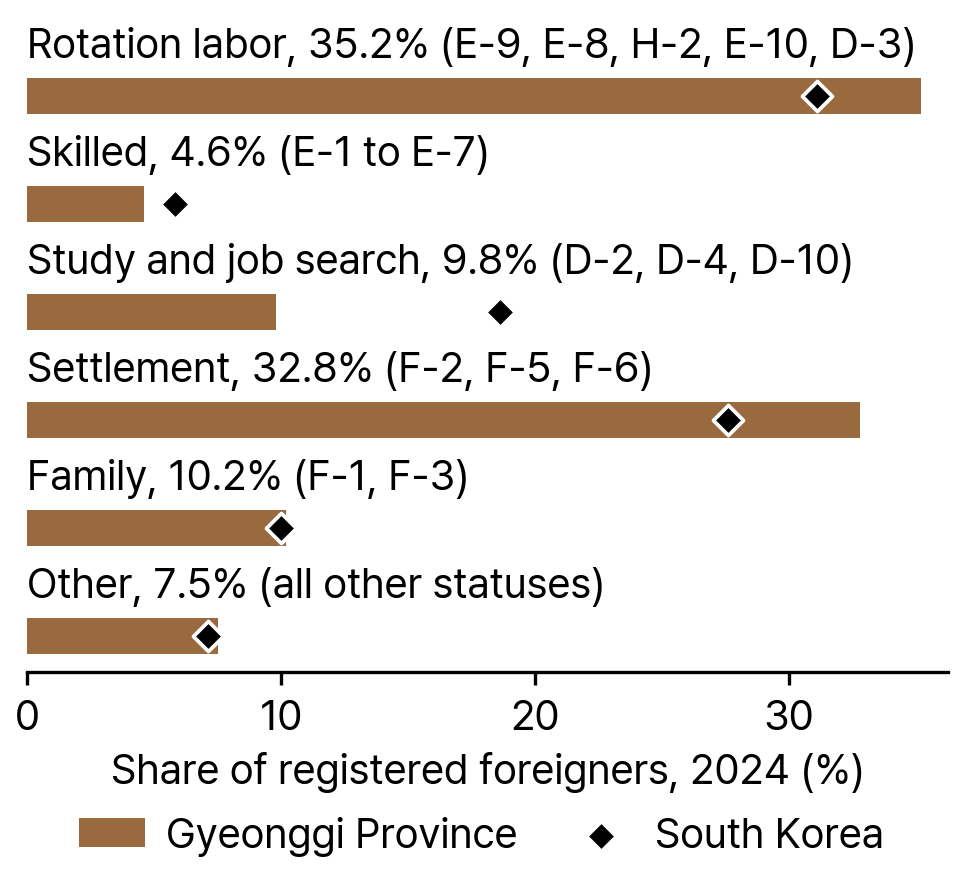
Rotation labor statuses, led by E-9 non-professional employment, covered 35.2 percent of the province's registered foreigners in 2024, and settlement statuses such as permanent residence 32.8 percent, both above the national shares of 31.1 and 27.6 percent. Study and job search statuses covered 9.8 percent, about half the national share of 18.6 percent. Korean-Chinese residents made up a quarter of the province's registered foreigners, and all ten ethnic enclaves in the province were Korean-Chinese. Two districts, Yeoncheon-gun and Gapyeong-gun, were designated population-decline areas in 2021. In July 2024 Gyeonggi created an Immigration and Social Affairs Bureau, the first of its kind among Korea's provincial-level governments (Gyeonggi Provincial Government, 2025).
Size of the Foreign-Resident Population
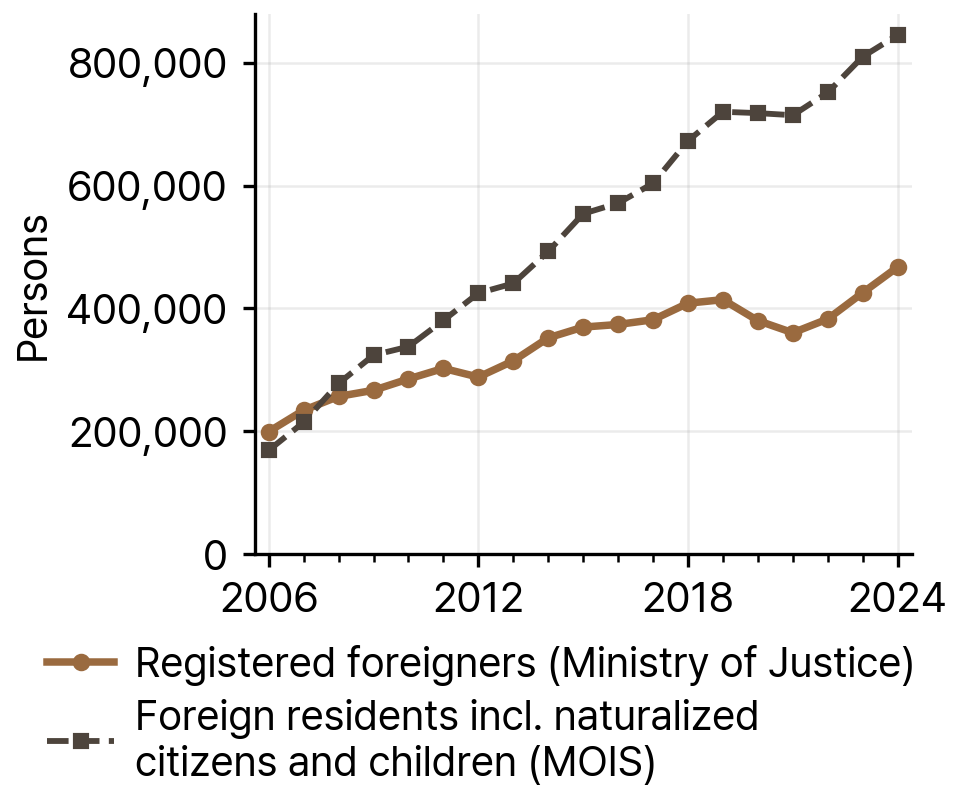
The number of registered foreigners in Gyeonggi rose each year from 199,538 in 2006 to 302,447 in 2011, dipped to 288,251 in 2012, and rose each year again to 414,318 in 2019. It fell to 380,144 in 2020 and 360,412 in 2021, 13.0 percent below the 2019 level (53,906 fewer people), then grew to 382,865 in 2022, 425,629 in 2023 and 467,398 in 2024, the highest count on record.
The MOIS count of foreign residents, which adds naturalized citizens and the children of foreign residents, rose from 277,991 in 2008 to 720,090 in 2019. It changed little in 2020 and 2021 (717,900 and 714,497), while the registered count fell, and rose to 845,074 in 2024, 1.8 times the number of registered foreigners that year (467,398).
Source: KIRD dataset, from Ministry of Justice immigration yearbooks and Ministry of the Interior and Safety statistics, 2006-2024.
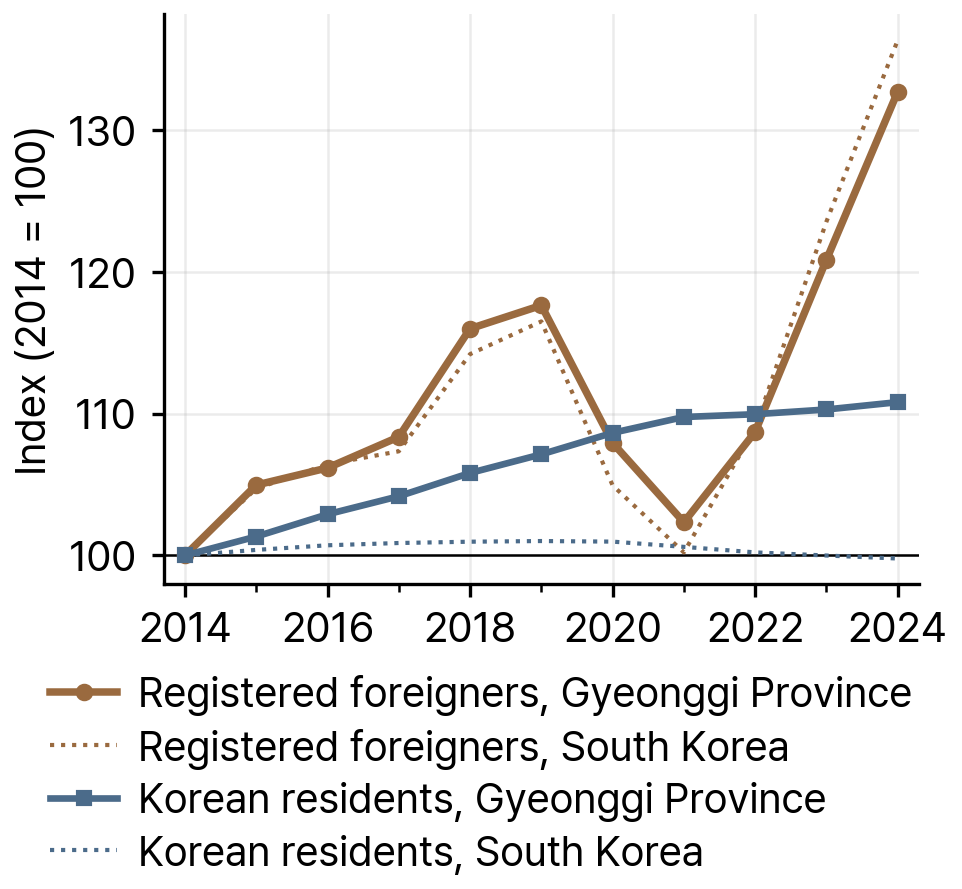
With 2014 set to 100, the registered foreign population of Gyeonggi stood at 132.7 in 2024 and its Korean population at 110.8. The number of registered foreigners per 100 Korean residents rose from 1.8 in 2006 to 2.8 in 2014, 3.1 in 2019 and 3.4 in 2024, when the national ratio was 2.9.
Source: KIRD dataset, from Ministry of Justice immigration yearbooks and Ministry of the Interior and Safety resident registration statistics, 2014-2024.
In 2024 Gyeonggi ranked first among the 17 provinces by the number of registered foreigners and fourth by registered foreigners per Korean resident. Its registered foreign population grew by 53,080 people (12.8 percent) between 2019 and 2024, the 13th-fastest growth of the 17.
Table 1Registered Foreigners, MOIS Foreign Residents and Korean Residents in Gyeonggi Province, Selected Years
| Year | Registered foreigners | MOIS foreign residents | Korean residents | Registered foreigners per 100 Korean residents |
|---|---|---|---|---|
| 2006 | 199,538 | n/a | 10,906,033 | 1.8 |
| 2014 | 352,166 | 492,790 | 12,357,830 | 2.8 |
| 2019 | 414,318 | 720,090 | 13,239,666 | 3.1 |
| 2024 | 467,398 | 845,074 | 13,694,685 | 3.4 |
Note: Registered foreigners are counted on 31 December and MOIS foreign residents on 1 November. MOIS foreign residents are shown from 2008. The MOIS counts for 2006 (169,081) and 2007 (214,727) were lower than the registered counts for those years (199,538 and 234,292). In 2024 South Korea had 1,488,353 registered foreigners, 2.9 per 100 Korean residents.
Source: KIRD dataset, from Ministry of Justice immigration yearbooks and Ministry of the Interior and Safety statistics, 2006-2024.
Nationalities
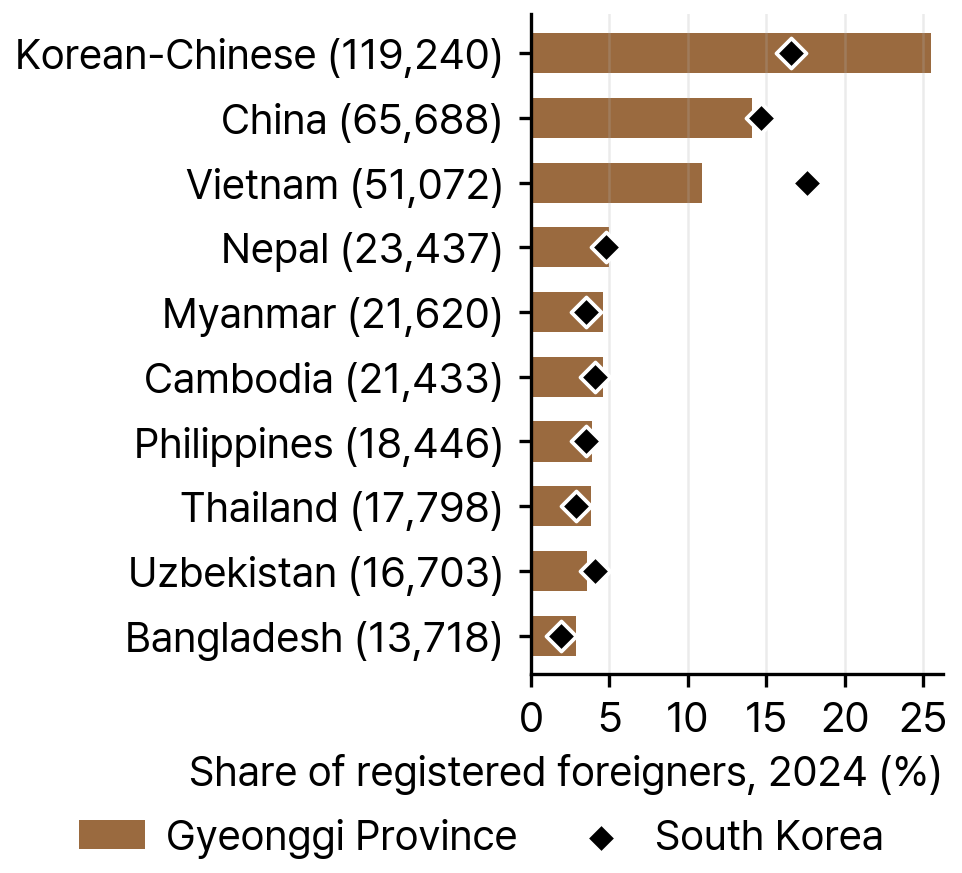
Korean-Chinese residents were the largest group of registered foreigners in Gyeonggi in 2024 (119,240, or 25.5 percent), followed by nationals of China other than Korean-Chinese (65,688, or 14.1 percent) and of Vietnam (51,072, or 10.9 percent). Nepal, Myanmar, Cambodia, the Philippines, Thailand, Uzbekistan and Bangladesh each accounted for between 2.9 and 5.0 percent. Korean-Chinese made up a larger share of registered foreigners in the province than in South Korea as a whole (16.6 percent), and Vietnamese a smaller share (17.6 percent nationally).
Source: KIRD dataset, from Ministry of Justice immigration yearbooks, 2024.
Between 2019 and 2024 the number of Korean-Chinese registered foreigners in the province fell by 30,620 (20.4 percent, from 149,860 to 119,240), and their share of the province's registered foreigners dropped from 36.2 percent (149,860 of 414,318) to 25.5 percent. Uzbek nationals also declined, by 1,476 (8.1 percent). The other eight of the ten largest groups grew, most quickly Myanmar nationals (up 76.0 percent, from 12,283 to 21,620), Bangladeshis (up 71.8 percent, from 7,983 to 13,718) and Nepalis (up 59.1 percent, from 14,727 to 23,437).
Gyeonggi was home to about half of all registered foreigners from Bangladesh in South Korea (49.2 percent, 13,718 of 27,875) and from Nigeria (49.1 percent, 1,259 of 2,566) in 2024, and to 48.3 percent of Korean-Chinese registered foreigners (119,240 of 246,988). Its shares of the country's Ghanaian (43.3 percent, 530 of 1,224) and Myanmar nationals (41.5 percent, 21,620 of 52,034) were also above 40 percent.
The KIRD data record 177 nationalities among the province's registered foreigners in 2024. The Shannon diversity index for the province rose from 2.2 in 2014 to 2.5 in 2024, the ninth-highest value among the 17 provinces.
Overseas Koreans with F-4 status report their place of residence instead of registering, so they are not among the registered foreigners counted above. In 2024, 239,460 F-4 holders reported a residence in Gyeonggi, 43.3 percent of the 553,664 in South Korea. Most were Korean-Chinese (182,659), followed by ethnic Koreans of US (15,768), Russian (13,057), Uzbek (11,697) and Canadian (5,787) nationality. The two registers together counted 301,899 Korean-Chinese in the province in 2024 (119,240 registered foreigners and 182,659 F-4 holders).
Table 2Ten Largest Nationalities among Registered Foreigners in Gyeonggi Province, 2019 and 2024
| Nationality | 2019 | 2024 | Share of the province's registered foreigners, 2024 (%) | Province's share of all registered foreigners of this nationality in South Korea, 2024 (%) |
|---|---|---|---|---|
| Korean-Chinese | 149,860 | 119,240 | 25.5 | 48.3 |
| China | 54,133 | 65,688 | 14.1 | 30.0 |
| Vietnam | 38,204 | 51,072 | 10.9 | 19.5 |
| Nepal | 14,727 | 23,437 | 5.0 | 32.5 |
| Myanmar | 12,283 | 21,620 | 4.6 | 41.5 |
| Cambodia | 16,861 | 21,433 | 4.6 | 35.1 |
| Philippines | 17,248 | 18,446 | 3.9 | 35.5 |
| Thailand | 15,893 | 17,798 | 3.8 | 41.0 |
| Uzbekistan | 18,179 | 16,703 | 3.6 | 27.1 |
| Bangladesh | 7,983 | 13,718 | 2.9 | 49.2 |
Note: China excludes Korean-Chinese, who are counted separately. The last column divides the province's count by all registered foreigners of that nationality in South Korea.
Source: KIRD dataset, from Ministry of Justice immigration yearbooks, 2019 and 2024.
Residence Statuses
Rotation labor statuses covered 164,548 registered foreigners in Gyeonggi in 2024 (35.2 percent), against 31.1 percent nationally, and settlement statuses 153,105 (32.8 percent), against 27.6 percent. Family statuses (47,459, or 10.2 percent) and other statuses (35,004, or 7.5 percent) were close to the national shares of 10.0 and 7.1 percent. Study and job search statuses covered 45,661 people (9.8 percent), about half the national share of 18.6 percent, and skilled statuses 21,621 (4.6 percent), against 5.8 percent nationally.
Source: KIRD dataset, from Ministry of Justice immigration yearbooks, 2024.
E-9 non-professional employment was the most common single status in 2024, with 120,561 holders (25.8 percent of the province's registered foreigners), followed by F-5 permanent residence (86,777, or 18.6 percent) and F-6 marriage migration (45,019, or 9.6 percent). The province accounted for 47.1 percent of all H-2 visiting employment holders in South Korea, 42.8 percent of F-5 holders and 36.7 percent of E-9 holders, and for 16.0 percent of D-2 student holders.
Table 3Ten Most Common Residence Statuses among Registered Foreigners in Gyeonggi Province, 2024
| Status | Meaning | Registered foreigners | Share of the province's registered foreigners (%) | Province's share of all holders in South Korea (%) |
|---|---|---|---|---|
| E-9 | Non-professional employment | 120,561 | 25.8 | 36.7 |
| F-5 | Permanent residence | 86,777 | 18.6 | 42.8 |
| F-6 | Marriage migration | 45,019 | 9.6 | 30.7 |
| H-2 | Visiting employment | 43,263 | 9.3 | 47.1 |
| F-1 | Visiting cohabitation | 31,677 | 6.8 | 32.7 |
| D-2 | Student | 28,564 | 6.1 | 16.0 |
| F-2 | Residential | 21,309 | 4.6 | 34.9 |
| G-1 | Other (miscellaneous) | 19,676 | 4.2 | 34.8 |
| E-7 | Specially designated activities | 16,353 | 3.5 | 26.0 |
| F-3 | Dependent family | 15,782 | 3.4 | 30.8 |
Note: Shares of the province's registered foreigners use the 2024 total of 467,398. The last column divides the province's count by all registered holders of that status in South Korea.
Source: KIRD dataset, from Ministry of Justice immigration yearbooks, 2024.
The MOIS count of 845,074 foreign residents in Gyeonggi in 2024 comprised 681,201 foreign nationals, 83,971 naturalized Korean citizens and 79,902 children of foreign residents. Naturalized citizens and children together made up 19.4 percent of the MOIS count (163,873 of 845,074). The foreign nationals included 184,365 ethnic Koreans of foreign nationality, 177,122 foreign workers, 62,496 marriage migrants, 38,501 international students and 218,717 other foreign nationals.
Districts and Population-Decline Areas
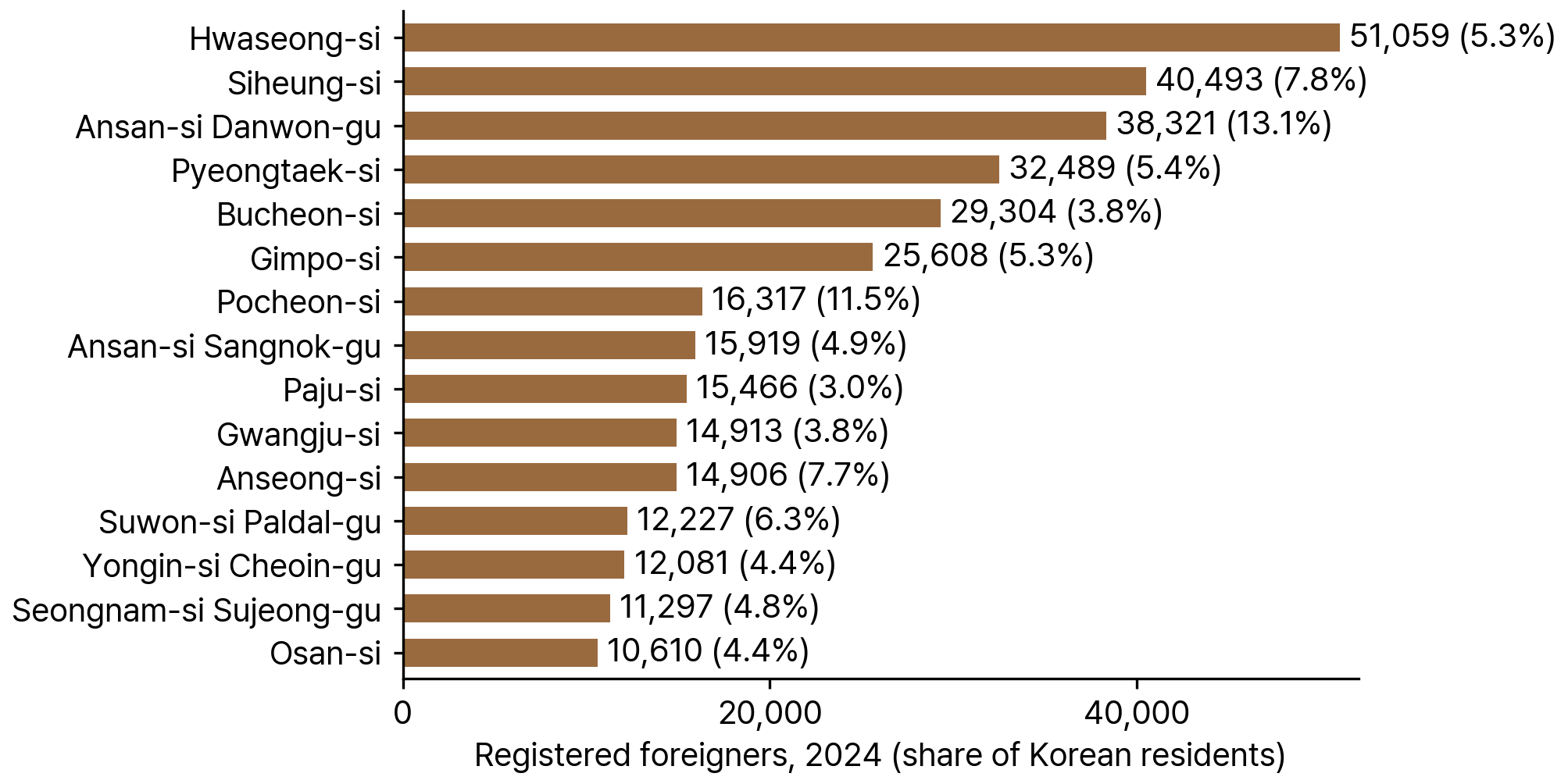
Of the province's 42 districts, Hwaseong-si had the most registered foreigners in 2024 (51,059), followed by Siheung-si (40,493), Ansan-si Danwon-gu (38,321), Pyeongtaek-si (32,489) and Bucheon-si (29,304). Together they had 41.0 percent of the province's registered foreigners (191,666 of 467,398), and the ten largest districts had 59.9 percent (279,889). Relative to the Korean population, the largest foreign populations in 2024 were in Ansan-si Danwon-gu (13.1 registered foreigners per 100 Korean residents), Pocheon-si (11.5), Siheung-si (7.8), Anseong-si (7.7) and Suwon-si Paldal-gu (6.3).
Source: KIRD dataset, from Ministry of Justice immigration yearbooks and Ministry of the Interior and Safety resident registration statistics, 2024.
Between 2019 and 2024 the Korean population grew most in Hwaseong-si (by 153,425), Pyeongtaek-si (85,529) and Yangju-si (66,691), and registered foreigners increased most in Hwaseong-si (10,506), Pyeongtaek-si (8,381) and Siheung-si (5,796). The Korean population fell in 19 of the 42 districts, and in 10 of those 19 the number of registered foreigners rose. Among them, Bucheon-si had the largest Korean decline (60,078), while its registered foreigners increased by 3,615. In Ansan-si Danwon-gu both fell, Korean residents by 12,917 and registered foreigners by 5,367, the largest foreign decline of any district in the province.
Table 4Ten Districts with the Most Registered Foreigners in Gyeonggi Province, 2024
| District | Registered foreigners, 2024 | Per 100 Korean residents, 2024 | Change in Korean residents, 2019-24 | Change in registered foreigners, 2019-24 | Population-decline area |
|---|---|---|---|---|---|
| Hwaseong-si | 51,059 | 5.3 | +153,425 | +10,506 | No |
| Siheung-si | 40,493 | 7.8 | +44,450 | +5,796 | No |
| Ansan-si Danwon-gu | 38,321 | 13.1 | -12,917 | -5,367 | No |
| Pyeongtaek-si | 32,489 | 5.4 | +85,529 | +8,381 | No |
| Bucheon-si | 29,304 | 3.8 | -60,078 | +3,615 | No |
| Gimpo-si | 25,608 | 5.3 | +49,632 | +5,273 | No |
| Pocheon-si | 16,317 | 11.5 | -6,916 | +3,053 | No (area of interest) |
| Ansan-si Sangnok-gu | 15,919 | 4.9 | -17,422 | +3,140 | No |
| Paju-si | 15,466 | 3.0 | +57,268 | +3,894 | No |
| Gwangju-si | 14,913 | 3.8 | +24,951 | +1,927 | No |
Note: Changes are 2024 counts minus 2019 counts. Pocheon-si is one of the 18 areas of interest designated with the population-decline areas in October 2021. Gwangju-si is a city in Gyeonggi Province, separate from the metropolitan city of Gwangju.
Source: KIRD dataset, from Ministry of Justice immigration yearbooks and Ministry of the Interior and Safety statistics, 2019-2024; designations from the Ministry of the Interior and Safety, October 2021.
Two districts in Gyeonggi, Yeoncheon-gun and Gapyeong-gun, were among the 89 population-decline areas designated by the Ministry of the Interior and Safety in October 2021, and two others, Pocheon-si and Dongducheon-si, were among the 18 areas of interest. Between 2019 and 2024 the two decline areas together lost 2,846 Korean residents and gained 569 registered foreigners, a foreign gain equal to 20.0 percent of the Korean loss. The whole Korean loss was in Yeoncheon-gun (2,958), since the Korean population of Gapyeong-gun grew by 112. In 2024 Yeoncheon-gun had 1,345 registered foreigners (3.3 per 100 Korean residents) and Gapyeong-gun 1,286 (2.1).
In the two areas of interest the Korean population fell by 6,916 in Pocheon-si and by 7,930 in Dongducheon-si between 2019 and 2024, while registered foreigners rose by 3,053 and 781, equal to 44.1 and 9.8 percent of the Korean losses. Pocheon-si had 16,317 registered foreigners in 2024, 11.5 per 100 Korean residents, the second-highest ratio of any district in the province.
Table 5Population-Decline Areas and Areas of Interest in Gyeonggi Province, 2019-24
| District | Designation, October 2021 | Registered foreigners, 2024 | Per 100 Korean residents, 2024 | Change in Korean residents, 2019-24 | Change in registered foreigners, 2019-24 | Foreign gain as a share of the Korean loss (%) |
|---|---|---|---|---|---|---|
| Yeoncheon-gun | Population-decline area | 1,345 | 3.3 | -2,958 | +330 | 11.2 |
| Gapyeong-gun | Population-decline area | 1,286 | 2.1 | +112 | +239 | n/a |
| Both population-decline areas | 2,631 | 2.5 | -2,846 | +569 | 20.0 | |
| Pocheon-si | Area of interest | 16,317 | 11.5 | -6,916 | +3,053 | 44.1 |
| Dongducheon-si | Area of interest | 4,258 | 4.9 | -7,930 | +781 | 9.8 |
Note: The foreign gain as a share of the Korean loss divides the increase in registered foreigners by the decrease in Korean residents. It is not computed for Gapyeong-gun, where the Korean population grew. The combined ratio for the two decline areas divides 2,631 registered foreigners by 103,393 Korean residents (40,866 in Yeoncheon-gun and 62,527 in Gapyeong-gun).
Source: KIRD dataset, from Ministry of Justice immigration yearbooks and Ministry of the Interior and Safety statistics, 2019-2024; designations from the Ministry of the Interior and Safety, October 2021.
By the definition used in this Spotlight, ten districts in Gyeonggi were Korean-Chinese enclaves in 2024, and no other nationality formed an enclave in the province. The largest were Siheung-si (17,727 Korean-Chinese, 43.8 percent of the district's registered foreigners, location quotient 7.1), Ansan-si Danwon-gu (15,146; 39.5 percent; 10.7) and Bucheon-si (14,979; 51.1 percent; 4.0). The others were Suwon-si Paldal-gu, where Korean-Chinese made up 60.8 percent of registered foreigners (7,431 of 12,227), Suwon-si Gwonseon-gu, Osan-si, Ansan-si Sangnok-gu, Seongnam-si Sujeong-gu, Gunpo-si and Anyang-si Manan-gu. The ten enclaves together had 80,508 Korean-Chinese registered foreigners, 67.5 percent of the group in the province.
Population Trends
Gyeonggi had 13,694,685 Korean residents in 2024, 26.7 percent of the national total of 51,217,221 and 2,788,652 more than in 2006 (up 25.6 percent). Growth slowed from 7.1 percent between 2014 and 2019 (881,836 people) to 3.4 percent between 2019 and 2024 (455,019 people).
In 2024 the province had a net inflow of 64,318 residents, the largest of the 17 provinces, and three second-phase new towns (Dongtan 2 in Hwaseong, Okjeong in Yangju and Unjeong in Paju) accounted for 91.8 percent of it, according to the Ministry of the Interior and Safety's resident registration statistics (Kihoilbo, 2025). Statistics Korea reported that the net inflows to Incheon, Gyeonggi and Sejong in 2024 were mainly for housing and family reasons (Korea.kr, 2025). In the KIRD data, the Korean population grew between 2019 and 2024 by 153,425 in Hwaseong-si, 66,691 in Yangju-si and 57,268 in Paju-si.
Gyeonggi's total fertility rate was 0.79 in 2024, against 0.75 nationally. The province recorded 71,300 births that year, 29.9 percent of the national total of 238,300 and the largest share of any province (Seoul Economic TV, 2025).
The share of the province's population aged 65 and over rose from 9.8 percent in 2013 to 14.2 percent in 2022. It is projected to rise to 20.1 percent in 2028, the level of a super-aged society, and to 21.8 percent in 2030, 26.3 percent in 2035 and 31.9 percent in 2042. The total dependency ratio, the number of children and older residents per 100 working-age residents, is projected to increase from 36.8 in 2022 to 68.8 in 2042 (KPI News, 2025).
Statistics Korea's provincial population projections of May 2022 place Gyeonggi among four provinces, with Sejong, Jeju and South Chungcheong, whose population is projected to grow between 2020 and 2050. The province's working-age population is projected to shrink by 22.2 percent over that period, the smallest decline of any province, and the share aged 65 and over to rise to 36.4 percent in 2050, against 49.5 percent in South Jeolla, the highest of any province (Statistics Korea, 2022).
Industry and Foreign Workers
At the end of 2024 Gyeonggi had 120,561 registered foreigners on E-9 non-professional employment status, the status issued under the Employment Permit System (EPS). They made up 25.8 percent of the province's registered foreigners and 36.7 percent of all E-9 holders in South Korea. The count was 100,925 in 2014 and 106,617 in 2019, fell to 84,804 in 2021, and then rose by 35,757 (42.2 percent) by 2024.
Ministry of Employment and Labor statistics on E-9 workers employed under the EPS cover later dates. At the end of December 2025 Gyeonggi had 103,972 E-9 workers, more than any other province (e-Nara Index, 2025). In the second quarter of 2026 it had 104,474, or 36.5 percent of the national total of 285,880. Of these, 92,497 (88.5 percent) worked in manufacturing, 9,004 in agriculture and livestock, 2,169 in construction, 477 in services and 324 in fishing (KOSIS, 2026).
For 2025 the province estimated its agricultural labor demand at about 1.2 million workers and planned to supply 270,000 of them from public sources, including 8,000 through the EPS (Nongmin Ilbo, 2025).
The count of E-8 seasonal workers on 31 December misses most of them, because their contracts end before winter. The KIRD data record 50 E-8 holders in Gyeonggi on 31 December 2022, 205 on 31 December 2023 and 500 on 31 December 2024. The province's allocation of seasonal workers (계절근로자) was 1,263 in 2022, 1,497 in 2023 and 2,877 in 2024, and it rose to 5,258 in 2025 and 7,130 in 2026 (Joongboo Ilbo, 2026).
International Students and Universities
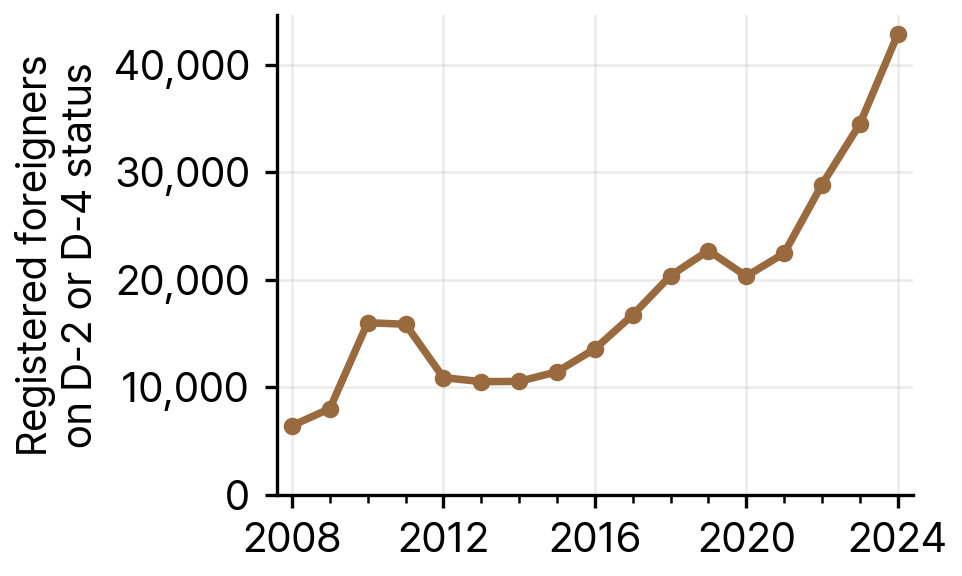
At the end of 2024, 42,808 registered foreigners in Gyeonggi were on D-2 student or D-4 general training status, 16.6 percent of all D-2 and D-4 holders in South Korea. D-2 students numbered 28,564 and D-4 trainees 14,244 (42,808 minus 28,564). The province's share of these statuses was lower than its 31.4 percent share of all registered foreigners, and study and job search statuses covered 9.8 percent of its registered foreigners, against 18.6 percent nationally.
The number of D-2 and D-4 holders in the province rose from 6,433 in 2008 to 16,013 in 2010, was between 10,533 and 11,448 from 2012 to 2015, and grew to 22,721 in 2019. After a dip to 20,334 in 2020 it rose to 28,848 in 2022, 34,478 in 2023 and 42,808 in 2024, 88.4 percent above the 2019 level.
Source: KIRD dataset, from Ministry of Justice immigration yearbooks, 2008-2024.
In the university disclosure data of the Korean Educational Development Institute (KEDI) for 1 April 2024, Gachon University had 5,149 international students, the most of any university in Gyeonggi, followed by the Natural Science Campus of Myongji University in Yongin with 2,451 and Ajou University with 2,231. The 75 higher-education institutions located in the province, including junior colleges, graduate schools, and technical and cyber colleges, had 31,895 international students on that date (KEDI, 2024).
Table 6Universities with the Most International Students in Gyeonggi Province, 1 April 2024
| University | International students |
|---|---|
| Gachon University | 5,149 |
| Myongji University, Natural Science Campus (Yongin) | 2,451 |
| Ajou University | 2,231 |
| Calvin University | 1,742 |
| Dankook University | 1,672 |
| The Catholic University of Korea | 1,603 |
Note: Four-year universities located in Gyeonggi Province, ranked by the number of international students on 1 April 2024. All 75 higher-education institutions in the province had 31,895 international students on that date. These counts differ in date and source from the Ministry of Justice count of D-2 and D-4 holders on 31 December 2024.
Source: KEDI, 2024, university disclosure data distributed by the National Assembly Library.
Provincial Policy
The province's ordinance on foreign residents is the Gyeonggi-do Foreign Resident Support Ordinance (경기도 외국인주민 지원 조례), Provincial Ordinance No. 8942, whose latest amended form took effect on 14 July 2026 (National Law Information Center, 2026).
In July 2024 Gyeonggi became the first of Korea's provincial-level governments to create an Immigration and Social Affairs Bureau (이민사회국), which it set up in response to its rapidly growing immigrant population. The province's Immigrant Society Master Plan for 2025-2027 (경기도 이민사회 종합계획) sets 33 tasks in four areas (social integration, human rights protection, immigration policy and governance). They include an integrated support platform for immigrants, better housing and working conditions for migrant workers, attracting and developing skilled talent, and support for the basic rights of children with migration backgrounds (Gyeonggi Provincial Government, 2025).
By 2025 the Gyeonggi Immigration and Social Integration Support Center in Uijeongbu had expanded its office more than 14-fold, from 53.24 to 766.96 square meters. It offers consultations in 10 languages, and it supported more than 10,000 people with education and living consultations in 2024 (Gyeonggi Provincial Government, 2025).
Under the Ministry of Justice's metropolitan-type visa pilot, Gyeonggi secured 630 of the 1,210 places in the nationwide E-7 quota (52 percent). In April 2025 it began operating its own Gyeonggi-type metropolitan visa, planned to continue through 2026, to recruit skilled foreign workers in 12 occupations (Asia Economy, 2025).
Both of the province's population-decline areas participated in the Ministry of Justice's regional specialized visa pilot. Yeoncheon-gun conducted the fourth round of the pilot from 4 October 2022 to 3 October 2023, with 38 places for holders of the F-2-R regional talent visa and F-1-R visas for accompanying family members. Holders were required to remain employed in the county for up to five years after their first visa was issued (Yeoncheon County, 2022). Gapyeong-gun announced on 10 December 2022 that it had been added to the pilot, ahead of the program's nationwide start on 1 January 2023 under the special act supporting population-decline areas (Seoul Shinmun, 2022).
Languages
The KIRD dataset estimates first-language speakers among registered foreigners from nationality counts and the first-language shares that Ethnologue reports for each country. By this estimate, Chinese was the most common first language among registered foreigners in Gyeonggi in 2024 (65,609 speakers), followed by Vietnamese (43,789), Khmer (21,231), Tagalog/Filipino (16,123) and Thai (15,681). Thirty-two languages had 1,000 or more estimated speakers in the province in 2024.
Table 7Estimated First-Language Speakers among Registered Foreigners in Gyeonggi Province, 2024
| Language | Estimated speakers |
|---|---|
| Chinese | 65,609 |
| Vietnamese | 43,789 |
| Khmer | 21,231 |
| Tagalog/Filipino | 16,123 |
| Thai | 15,681 |
| Burmese | 13,866 |
| Uzbek | 12,544 |
| Nepali | 12,275 |
| English | 12,264 |
| Bengali | 11,614 |
Note: Estimates multiply the number of registered foreigners of each nationality by Ethnologue's first-language shares for that country and add the results across nationalities. Korean-Chinese registered foreigners are not included.
Source: KIRD dataset, from Ministry of Justice immigration yearbooks, 2024, and Ethnologue first-language shares.
The estimates do not cover the 119,240 Korean-Chinese registered foreigners in the province, for whom the dataset assigns no first-language shares. An estimate can also differ from the matching nationality count, because Ethnologue records other first languages for part of a country's population. In 2024 the province had 23,437 Nepali nationals and 12,275 estimated first-language speakers of Nepali, equal to 52.4 percent of the number of Nepali nationals. The provincial support center in Uijeongbu offers consultations in 10 languages (see Provincial Policy).
Service Organizations and Community Places
The KIRD census of 1,720 migrant-serving organizations in South Korea lists 347 in Gyeonggi, 20.2 percent of the total, against the province's 31.4 percent share of registered foreigners in 2024. The province had 7.4 organizations per 10,000 registered foreigners, against 11.6 for the country as a whole. Of the 347 organizations, 337 provide direct services to migrants.
The most common types were social integration program providers (120), civic and faith-based organizations (61), medical support institutions (38), migrant worker support centers (28) and migrant community organizations (25), and the census also lists 12 migrant places of worship in the province. Twenty-nine of the organizations have "family center" (가족센터) in their names. Organizations can name more than one population. Of the 347, 139 name migrant workers, 84 all migrants, 79 families, 47 refugees and 28 youth of migrant background. Smaller numbers name overseas Koreans (23), children (22), undocumented migrants (22), migrant women (9) and international students (5).
In 2011 Wongok-dong in Ansan, known as a "borderless village" (국경없는 마을), had about 170 restaurants and shops operated by immigrants, representing 50 countries of origin (Kyeonggi Ilbo, 2011). In early 2010, 16,214 of the neighborhood's 45,564 residents, about one in three, were foreign nationals (Korea.kr, 2010). Ansan City opened a foreign resident center and a migrant interpretation support center in Wongok-dong in March 2008 (Kim, n.d.). In 2010 the center was staffed and operated directly by city officials, while most foreign-resident support centers in Korea were set up by national or local governments and then contracted out to private organizations or NGOs (Korea.kr, 2010). Ansan-si Danwon-gu, the district that includes Wongok-dong, had 13.1 registered foreigners per 100 Korean residents in 2024, the highest ratio in the province.
In neighboring Siheung, about 70 percent of the city's 27,700 foreign residents lived in the Jeongwang-dong area in August 2012, and the Kyeongin Ilbo called Jeongwang-dong a "second international village" after Wongok-dong. The foreign-resident population of Siheung grew 23.3 percent (5,244 people) that year (Kyeongin Ilbo, 2012). In 2024 Siheung-si had 40,493 registered foreigners, the second-largest number of any district in the province, and 17,727 Korean-Chinese registered foreigners, the largest Korean-Chinese enclave in Gyeonggi.
Sources
Korea Immigration Regional Dashboard (KIRD) dataset. Spatiotemporal administrative dataset of nationality, residential diversity, and language demand among immigrants in South Korea, 2006-2024. openICPSR. https://doi.org/10.3886/E249944V1
Ministry of Government Legislation, National Law Information Center. 2026. Gyeonggi-do Foreign Resident Support Ordinance, Provincial Ordinance No. 8942 (in Korean). https://www.law.go.kr/LSW//ordinInfoP.do?ordinSeq=2151165&chrClsCd=010202&gubun=ELIS
Gyeonggi Provincial Government, Gyeonggi News Portal. 2025. First anniversary of the Immigration and Social Affairs Bureau: policies for an inclusive society (in Korean). https://gnews.gg.go.kr/briefing/brief_gongbo_view.do?BS_CODE=s017&number=66864
Asia Economy. 2025. Gyeonggi launches metropolitan visa pilot to attract 630 foreign workers (in Korean). https://www.asiae.co.kr/article/2025040317020463655
Seoul Shinmun. 2022. Gapyeong County additionally selected for the regional specialized visa pilot (in Korean). https://go.seoul.co.kr/news/newsView.php?id=20221210500050
Yeoncheon County Government. 2022. Recruitment notice for the regional specialized visa program, fourth pilot round (in Korean). https://www.yeoncheon.go.kr/www/selectBbsNttView.do?key=3386&id=&bbsNo=8&nttNo=79033&searchCtgry=&searchCnd=all&searchKrwd=&pageIndex=1&integrDeptCode=&searchDeptCode=
Joongboo Ilbo. 2026. Seasonal workers number 7,000, but the management system is unchanged (in Korean). https://www.joongboo.com/news/articleView.html?idxno=363734499
Seoul Economic TV (SEN). 2025. Statistics Korea's 2024 population trends survey: Gyeonggi first in births (in Korean). https://www.sentv.co.kr/article/view/sentv202502280141
KPI News. 2025. Ageing deepens in Gyeonggi, with one in three residents aged 65 and over by 2042 (in Korean). https://www.kpinews.kr/newsView/1065595388098911
Statistics Korea. 2022. Provincial population projections, 2020-2050 (in Korean). https://mods.go.kr/board.es?act=view&bid=207&list_no=418448&mid=a10301020600
Kihoilbo. 2025. Gyeonggi had the country's largest net population inflow last year (in Korean). https://www.kihoilbo.co.kr/news/articleView.html?idxno=1127845
Korea.kr (Korea Policy Briefing), Statistics Korea. 2025. Domestic migration statistics, 2024 (in Korean). https://www.korea.kr/briefing/policyBriefingView.do?newsId=156672078
KOSIS (Korean Statistical Information Service), Ministry of Employment and Labor. 2026. General Employment Permit System (E-9) foreign workers by province and industry (in Korean). https://kosis.kr/statHtml/statHtml.do?orgId=118&tblId=DT_11827_A003&conn_path=I2
e-Nara Index (National Indicator System), Ministry of Employment and Labor. 2025. Employment Permit System employment trends (in Korean). https://www.index.go.kr/unity/potal/main/EachDtlPageDetail.do?idx_cd=1501
Nongmin Ilbo. 2025. Gyeonggi to supply 270,000 workers to ease farm labor shortages in the busy season (in Korean). https://www.nongmin.com/article/20250507500538
Korean Educational Development Institute (KEDI). 2024. International students by higher-education institution, 2024, from university disclosure data, distributed by the National Assembly Library (in Korean). https://clik.nanet.go.kr/clikr-collection/policyinfo/202/1013/2024/CLIKC4856094490052227_attach_1.xlsx
Kyeonggi Ilbo. 2011. Ansan's Wongok-dong, a borderless village (in Korean). https://www.kyeonggi.com/article/201105300407869
Kim, Jong-nyeon (김종년). n.d. Ansan foreign resident center (안산시 외국인 주민 센터). In Digital Ansan Culture Encyclopedia (디지털안산문화대전). Academy of Korean Studies. https://ansan.grandculture.net/ansan/toc/GC02530045
Korea.kr (Korea Policy Briefing). 2010. Where the Korean dream ripens: Wongok-dong, Ansan (in Korean). https://www.korea.kr/news/policyNewsView.do?newsId=148689021
Kyeongin Ilbo. 2012. Field report: Siheung's Jeongwang-dong, a second international village (in Korean). https://www.kyeongin.com/article/674004
Suggested citation: Korea Immigration Regional Dashboard (KIRD). 2026. “Foreign Residents in Gyeonggi Province.” Foreign Residents in South Korea series, September 2026. Data: Korea Immigration Regional Dashboard (KIRD) dataset, https://doi.org/10.3886/E249944V1. Interactive maps and tables: https://immigrantsinkorea.today.